 Скачать презентацию FREEDOM OF OPINION AND EXPRESSION FREELY EXPRESSED BY
f5003d8fb1ba1ac7b2b4c6ca724d7575.ppt
- Количество слайдов: 65



FREEDOM OF OPINION AND EXPRESSION FREELY EXPRESSED BY Charles Maina Kariuki Giorgio Heinrich Neidhardt Kanika Mehrotra Luca Di Ruggiero Prutus Morlai Sackie MAHRCM, Scuola Superiore Sant’Anna, Pisa, Italy International Human Rights Law, A. Y. 2009
BACKGROUND British Magna Carta (1215) Article 11 of the French Declaration of the Rights of Man and Citizen, The French Revolution, 1789 : Freedom of Expression is one of the most precious rights of man. Every individual has freedom to form his or her own opinions free from external indoctrination and to defend them in the “free market of ideas” without fear of repression. Freedom of expression is an essential component of the individual’s privacy, requiring absolute protection against external interference The Human Rights Committee, 1950: freedom of opinion and freedom of expression were two different rights, making two separate provisions appropriate 2 Freedom of Opinion and Expression
Freedom of opinion-a purely private matter, belonging to the realm of the mind. Freedom to form an opinion. Its absolute. Not restricted by law. The private freedom to have and form opinions thus overlaps with freedom of thought guaranteed by Art. 18. Freedom of thought therefore contributes to freedom of opinion in that opinions usually represent the result of a thought process. Based on John Stuart Mill's arguments, the freedom today is understood as a multi-faceted right that includes not only the right to express, or disseminate, information and ideas, but three further distinct aspects: The right to seek information and ideas; the right to receive information and ideas; the right to impart information and ideas. International, regional and national standards also recognize the freedom as including any medium, be it orally, in written, in print, through the Internet or through art forms. Thus the right includes not only the content, but also the means of expression 3 Freedom of Opinion and Expression
Embraces publication—writing, broadcasting, distributing recordings—as well as oral delivery of ideas. The Forms of Communication are quite wide. Article 19(2) mentions oral, written and printed communication and also works of art and “any other media of his choice”. Verbal communications include speech, writing, telecommunications and the press. Non-Verbal includes assemblies and demonstrations; all acoustic, visual, electronic media in particular radio and television, electronic media, film, photography, music, graphic and other arts, etc. 4 Freedom of Opinion and Expression
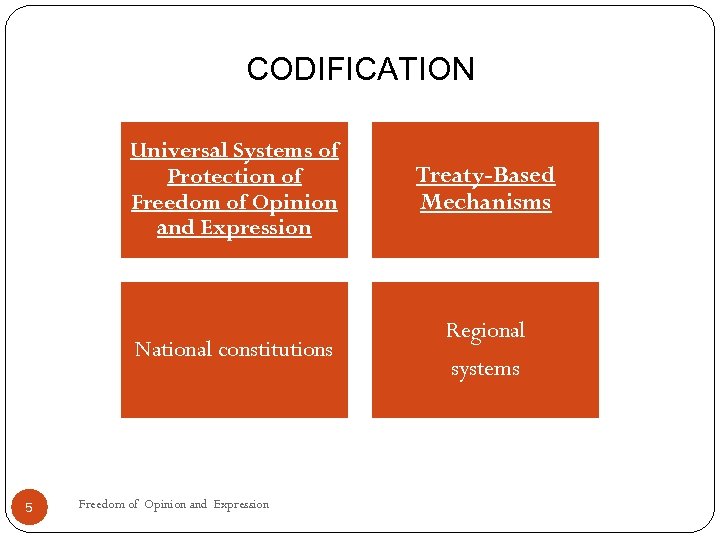
CODIFICATION Universal Systems of Protection of Freedom of Opinion and Expression National constitutions 5 Treaty-Based Mechanisms Regional systems Freedom of Opinion and Expression
UNIVERSAL MECHANISMS OF PROTECTION OF FREEDOM OF EXPRESSION AND OPINION UNITED NATIONS SYSTEMS Universal Declaration of Human Rights 1948 Article 19 Everyone has the right to freedom of opinion and expression; this right includes freedom to hold opinions without interference and to seek, receive and impart information and ideas through any media and regardless of frontiers. Resolutions and General Comments UN General Assembly Resolution 59(I), 1946: “Freedom of information is a fundamental human right and. . . the touchstone of all the freedoms to which the United Nations is consecrated. ” 6 Freedom of Opinion and Expression
UN General Assembly 50/197. 11 March 1996 Situation of human rights in Sudan 14. Invites the Special Rapporteurs of the Commission on Human Rights on the questions of religious intolerance and freedom of expression to consult with the Special Rapporteur on the situation of human rights in the Sudan and to consider and report on the situation in the Sudan, and calls upon the Government of the Sudan to extend to them its full cooperation, including inviting them to visit the Sudan; 15. Recommends the continued monitoring of the serious human rights situation in the Sudan and of the regional efforts to end the hostilities and human suffering in the south, and invites the Commission on Human Rights, at its fifty-second session, to give urgent attention to the situation of human rights in the Sudan; 7 Freedom of Opinion and Expression
UN General Assembly Resolution 53/162 11 March 1996 Situation of human rights in Myanmar 10. Further strongly urges the Government of Myanmar to ensure full respect for human rights and fundamental freedoms, including freedom of expression, association, movement and assembly, the right to a fair trial and the protection of the rights of persons belonging to ethnic and religious minorities, to put an end to violations of the right to life and integrity of the human being, to the practices of torture, abuse of women, forced labour and forced relocations and to enforced disappearances and summary executions, and to fulfil its obligations to end the impunity of perpetrators of human rights violations, including members of the military, and to investigate and prosecute alleged violations committed by government agents in all circumstances; Freedom of Opinion and Expression 8 Freedom of Opinion and Expression
Human Rights Committee, General Comment 10, Article 19 , 1983 1. Paragraph 1 requires protection of the "right to hold opinions without interference". This is a right to which the Covenant permits no exception or restriction. 2. Paragraph 2 requires protection of the right to freedom of expression, which includes not only freedom to "impart information and ideas of all kinds", but also freedom to "seek" and "receive" them "regardless of frontiers" and in whatever medium, "either orally, in writing or in print, in the form of art, or through any other media of his choice". Commission on Human Rights resolution 1993/45 7. Appeals to all States to ensure respect and support for the rights of all persons who exercise the right to freedom of opinion and expression, the rights to freedom of thought, conscience 9 Freedom of Opinion and Expression
Other Resolutions of the Human Rights Commission included: Commission on Human Rights resolution 2002/48. Commission on Human Rights Resolution: 2004/42. Commission on Human Rights Resolution 2005/38. Sub-Commission on Human Rights Resolution 1999/1 Situation of human rights in DRC Concerned also about the allegations of deportations in the Democratic Republic of Congo (DRC), arbitrary detentions and non-observance of the freedom of expression, 1. Calls upon the Government of DRC : (b) To ratify the Convention against Torture and Other Cruel, Inhuman or Degrading Treatment or Punishment, the Rome Statute of the International Criminal Court, and the draft optional protocol to the African Charter on Human and Peoples' Rights establishing the African Court on Human and Peoples' Rights; Ag/Res. 2149 (xxxv-o/05) Right to Freedom of Thought and Expression and the Importance of the media (Adopted at the fourth plenary session, held on June 7, 2005) 10 Freedom of Opinion and Expression
STATE OBLIGATIONS To ensure, respect and support the rights of all persons who exercise the right to freedom of opinion and expression. To promote, including by ensuring that relevant national legislation complies with their international human rights obligations and is effectively implemented; To ensure that persons seeking to exercise these rights and freedoms are not discriminated against, particularly in such areas as employment, housing and social services, and in this context to pay particular attention to the situation of women; To create and permit an enabling environment in which training and professional development of the media can be organized in order to promote and protect the right to freedom of opinion and expression and can be carried out without threat of legal, criminal or administrative sanction by the State, To cooperate fully with and assist the Special Rapporteur in the performance of his tasks and to provide all information necessary in order to permit him fully to carry out his mandate. 11 Freedom of Opinion and Expression
TREATY BASED MECHANISMS International Convention on Civil and Political Rights, 1966 Article 19 1. Everyone shall have the right to hold opinions without interference. 2. Everyone shall have the right to freedom of expression; this right shall include freedom to seek, receive and impart information and ideas of all kinds, regardless of frontiers, either orally, in writing or in print, in the form of art, or through any other media of his choice. United Nations Declaration on the Rights of Indigenous Peoples, 13 September 2007 Article 16 2. States shall take effective measures to ensure that State-owned media duly reflect indigenous cultural diversity. States, without prejudice to ensuring full freedom of expression, should encourage privately owned media to adequately reflect indigenous cultural diversity. 12 Freedom of Opinion and Expression
Convention on the Rights of the Child, November, 1989 Article 1 The child shall have the right to freedom of expression; this right shall include freedom to seek, receive and impart information and ideas of all kinds, regardless of frontiers, either orally, in writing or in print, in the form of art, or through any other media of the child's choice. Convention on the Elimination of Discrimination Against Women, 1979 Article 3 Equal access to and representation of women in the media are crucial to ensuring proper coverage of issues of concern to women and to enable their full participation in public decision making. Effective measures need to be taken to combat discrimination against women and to promote their access to the media. 13 Freedom of Opinion and Expression
Convention on the Rights of Persons with Disabilities, 2006. Article 21 States Parties shall take all appropriate measures to ensure that persons with disabilities can exercise the right to freedom of expression and opinion, including the freedom to seek, receive and impart information and ideas on an equal basis with others and through all forms of communication of their choice, as defined in article 2 of the present Convention, including by: …………… International Convention on the Elimination of All Forms of Racial Discrimination, 1965 Article 5 Racial and ethnic minorities equally should not be discriminated against and have equal access to airing their views and sharing information of concern to them. Broadcasters also have a responsibility to promote a culture of tolerance and ensure that their broadcasts do not become a vehicle for spreading hatred and contempt of minority groups. 14 Freedom of Opinion and Expression
International Convention on the Protection of the Rights of All Migrant Workers and Members of Their Families, 1990 Article 13: 1. Migrant workers and members of their families shall have the right to hold opinions without interference. 2. 15 Migrant workers and members of their families shall have the right to freedom of expression; this right shall include freedom to seek, receive and impart information and ideas of all kinds, regardless of frontiers, either orally, in writing or in print, in the form of art or through any other media of their choice. Freedom of Opinion and Expression
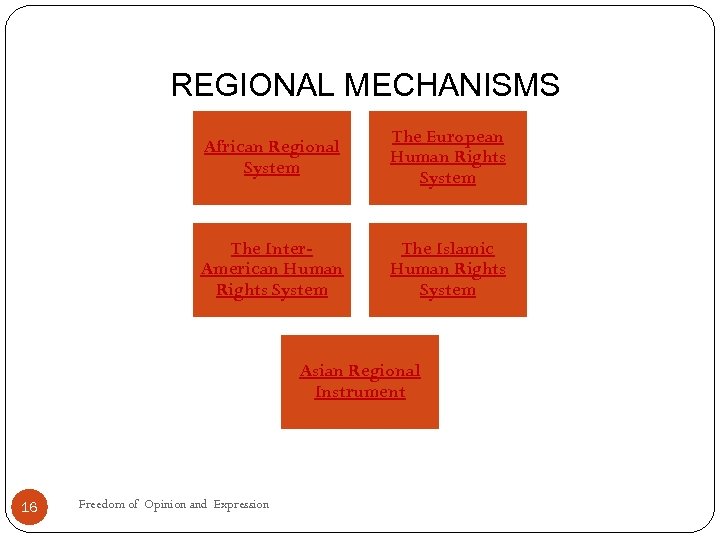
REGIONAL MECHANISMS African Regional System The European Human Rights System The Inter. American Human Rights System The Islamic Human Rights System Asian Regional Instrument 16 Freedom of Opinion and Expression
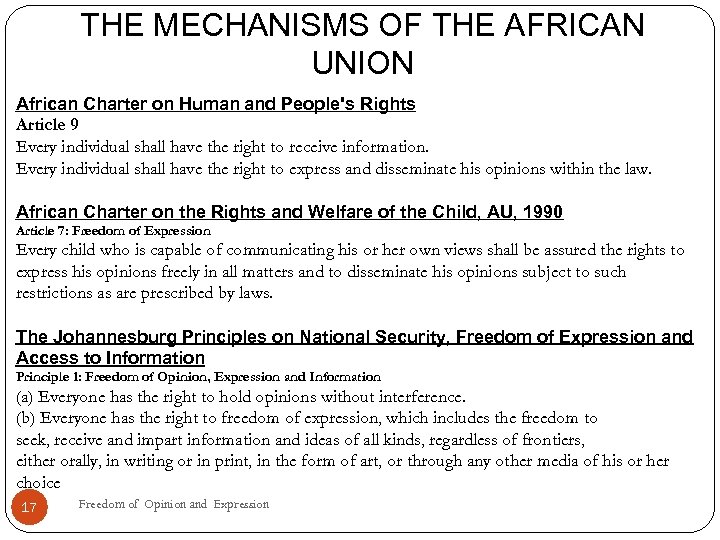
THE MECHANISMS OF THE AFRICAN UNION African Charter on Human and People's Rights Article 9 Every individual shall have the right to receive information. Every individual shall have the right to express and disseminate his opinions within the law. African Charter on the Rights and Welfare of the Child, AU, 1990 Article 7: Freedom of Expression Every child who is capable of communicating his or her own views shall be assured the rights to express his opinions freely in all matters and to disseminate his opinions subject to such restrictions as are prescribed by laws. The Johannesburg Principles on National Security, Freedom of Expression and Access to Information Principle 1: Freedom of Opinion, Expression and Information (a) Everyone has the right to hold opinions without interference. (b) Everyone has the right to freedom of expression, which includes the freedom to seek, receive and impart information and ideas of all kinds, regardless of frontiers, either orally, in writing or in print, in the form of art, or through any other media of his or her choice 17 Freedom of Opinion and Expression
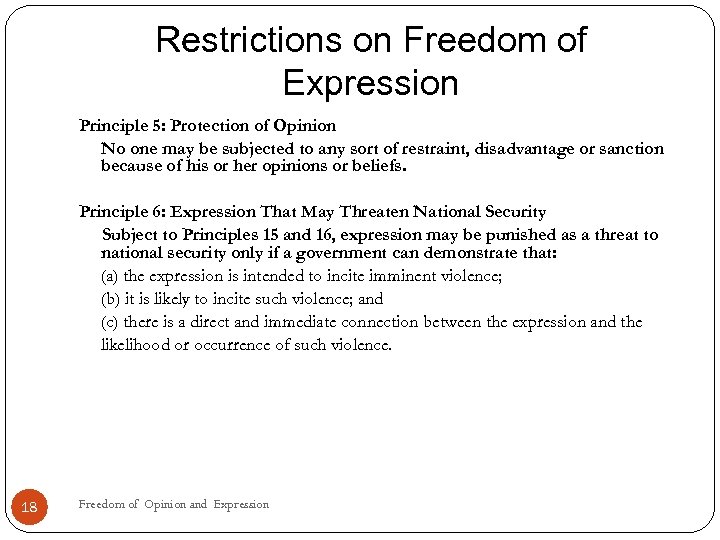
Restrictions on Freedom of Expression Principle 5: Protection of Opinion No one may be subjected to any sort of restraint, disadvantage or sanction because of his or her opinions or beliefs. Principle 6: Expression That May Threaten National Security Subject to Principles 15 and 16, expression may be punished as a threat to national security only if a government can demonstrate that: (a) the expression is intended to incite imminent violence; (b) it is likely to incite such violence; and (c) there is a direct and immediate connection between the expression and the likelihood or occurrence of such violence. 18 Freedom of Opinion and Expression
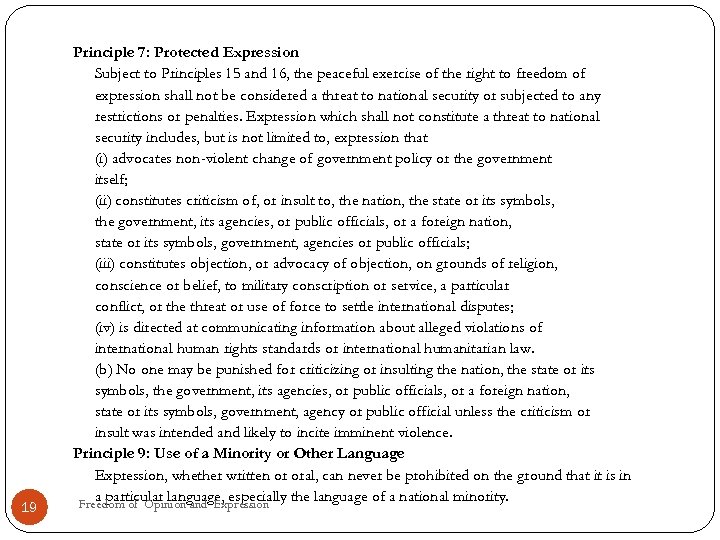
19 Principle 7: Protected Expression Subject to Principles 15 and 16, the peaceful exercise of the right to freedom of expression shall not be considered a threat to national security or subjected to any restrictions or penalties. Expression which shall not constitute a threat to national security includes, but is not limited to, expression that (i) advocates non-violent change of government policy or the government itself; (ii) constitutes criticism of, or insult to, the nation, the state or its symbols, the government, its agencies, or public officials, or a foreign nation, state or its symbols, government, agencies or public officials; (iii) constitutes objection, or advocacy of objection, on grounds of religion, conscience or belief, to military conscription or service, a particular conflict, or the threat or use of force to settle international disputes; (iv) is directed at communicating information about alleged violations of international human rights standards or international humanitarian law. (b) No one may be punished for criticizing or insulting the nation, the state or its symbols, the government, its agencies, or public officials, or a foreign nation, state or its symbols, government, agency or public official unless the criticism or insult was intended and likely to incite imminent violence. Principle 9: Use of a Minority or Other Language Expression, whether written or oral, can never be prohibited on the ground that it is in a particular language, especially the language of a national minority. Freedom of Opinion and Expression
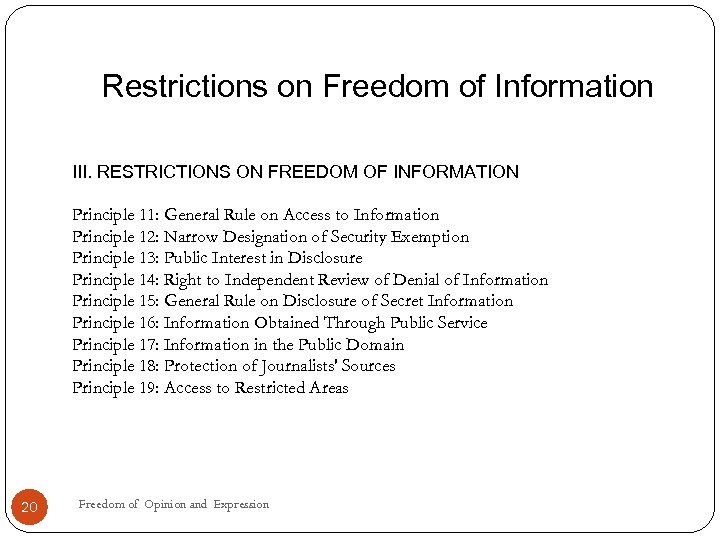
Restrictions on Freedom of Information III. RESTRICTIONS ON FREEDOM OF INFORMATION Principle 11: General Rule on Access to Information Principle 12: Narrow Designation of Security Exemption Principle 13: Public Interest in Disclosure Principle 14: Right to Independent Review of Denial of Information Principle 15: General Rule on Disclosure of Secret Information Principle 16: Information Obtained Through Public Service Principle 17: Information in the Public Domain Principle 18: Protection of Journalists' Sources Principle 19: Access to Restricted Areas 20 Freedom of Opinion and Expression
ACHPR /Res. 62(XXXII)02: Resolution on the Adoption of the Declaration of Principles on Freedom of Expression in Africa (2002) The Guarantee of Freedom of Expression, Interference with Freedom of Expression Diversity Freedom of Information Private Broadcasting Public Broadcasting Regulatory Bodies for Broadcast and Telecommunications Print Media Promoting Professionalism Attacks on Media Practitioners Protecting Reputations Economic Measures Protection of Sources and other journalistic material Implementation: States Parties to the African Charter on Human and Peoples’ Rights should make every effort to give practical effect to these principles. 21 Freedom of Opinion and Expression
Obligations of Member States of the African Union Calls upon Member States of the African Union to take all necessary measures to ensure the protection of the right to freedom of expression and to include information on measures taken to ensure the enjoyment of the right to freedom of expression in their periodic reports to the African Commission; Urges Member States of the African Union to co-operate with and assist the Special Rapporteur in the performance of his tasks and to provide all necessary information for the fulfillment of his mandate; Invites its Members to incorporate the issue of freedom of expression in their promotional activities to Member States; (76. ACHPR /Res. 71(XXXVI)04) 22 Freedom of Opinion and Expression
Case Study: African Commission on Human and Peoples’ Right, Communication No. 228/99: The Law Office of Ghazi Suleiman v. Sudan The African Commission found that the Government of Sudan committed an Article 9 violation in prohibiting Mr Suleiman from delivering a public lecture. 23 Freedom of Opinion and Expression
European Human Rights Mechanisms Convention for the Protection of Human Rights and Fundamental Freedoms, as amended by Protocol No. 11, COE, 1950 Article 10 - Freedom of expression 1. Everyone has the right to freedom of expression. This right shall include freedom to hold opinions and to receive and impart information and ideas without interference by public authority and regardless of frontiers. This article shall not prevent States from requiring the licensing of broadcasting, television or cinema enterprises. 2. The exercise of these freedoms, since it carries with it duties and responsibilities, may be subject to such formalities, conditions, restrictions or penalties as are prescribed by law and are necessary in a democratic society, in the interests of national security, territorial integrity or public safety, for the prevention of disorder or crime, for the protection of health or morals, for the protection of the reputation or rights of others, for preventing the disclosure of information received in confidence, or for maintaining the authority and impartiality of the judiciary. 24 Freedom of Opinion and Expression
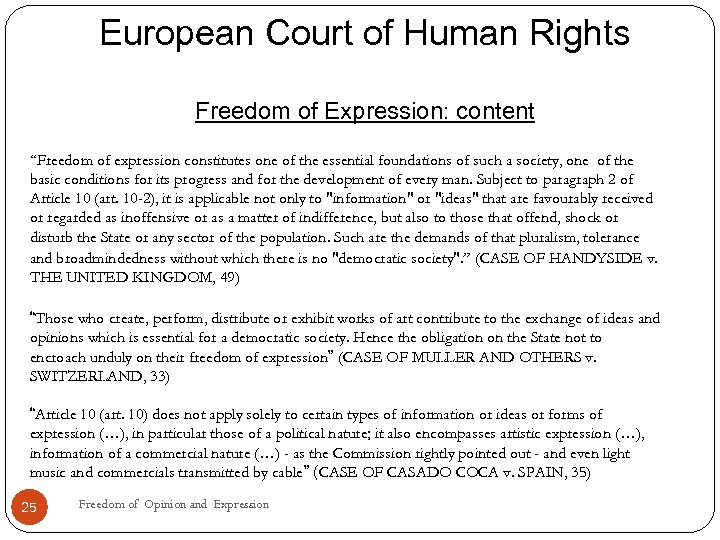
European Court of Human Rights Freedom of Expression: content “Freedom of expression constitutes one of the essential foundations of such a society, one of the basic conditions for its progress and for the development of every man. Subject to paragraph 2 of Article 10 (art. 10 -2), it is applicable not only to "information" or "ideas" that are favourably received or regarded as inoffensive or as a matter of indifference, but also to those that offend, shock or disturb the State or any sector of the population. Such are the demands of that pluralism, tolerance and broadmindedness without which there is no "democratic society". ” (CASE OF HANDYSIDE v. THE UNITED KINGDOM, 49) “Those who create, perform, distribute or exhibit works of art contribute to the exchange of ideas and opinions which is essential for a democratic society. Hence the obligation on the State not to encroach unduly on their freedom of expression” (CASE OF MULLER AND OTHERS v. SWITZERLAND, 33) “Article 10 (art. 10) does not apply solely to certain types of information or ideas or forms of expression (…), in particular those of a political nature; it also encompasses artistic expression (…), information of a commercial nature (…) - as the Commission rightly pointed out - and even light music and commercials transmitted by cable” (CASE OF CASADO COCA v. SPAIN, 35) 25 Freedom of Opinion and Expression
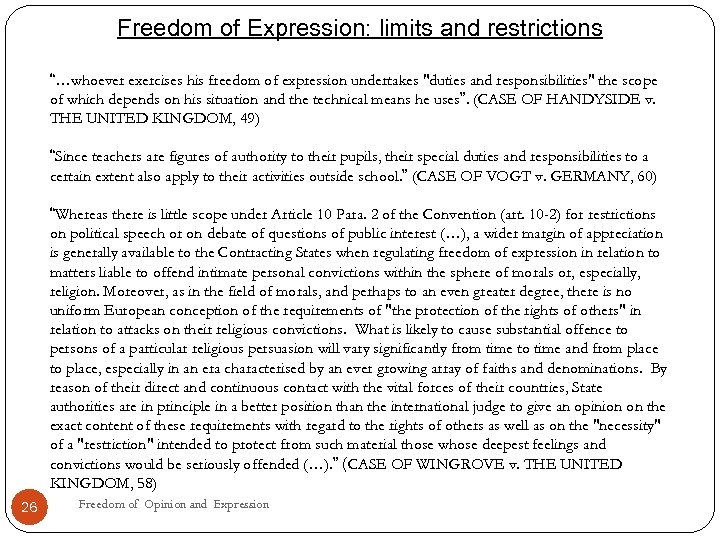
Freedom of Expression: limits and restrictions “…whoever exercises his freedom of expression undertakes "duties and responsibilities" the scope of which depends on his situation and the technical means he uses”. (CASE OF HANDYSIDE v. THE UNITED KINGDOM, 49) “Since teachers are figures of authority to their pupils, their special duties and responsibilities to a certain extent also apply to their activities outside school. ” (CASE OF VOGT v. GERMANY, 60) “Whereas there is little scope under Article 10 Para. 2 of the Convention (art. 10 -2) for restrictions on political speech or on debate of questions of public interest (…), a wider margin of appreciation is generally available to the Contracting States when regulating freedom of expression in relation to matters liable to offend intimate personal convictions within the sphere of morals or, especially, religion. Moreover, as in the field of morals, and perhaps to an even greater degree, there is no uniform European conception of the requirements of "the protection of the rights of others" in relation to attacks on their religious convictions. What is likely to cause substantial offence to persons of a particular religious persuasion will vary significantly from time to time and from place to place, especially in an era characterised by an ever growing array of faiths and denominations. By reason of their direct and continuous contact with the vital forces of their countries, State authorities are in principle in a better position than the international judge to give an opinion on the exact content of these requirements with regard to the rights of others as well as on the "necessity" of a "restriction" intended to protect from such material those whose deepest feelings and convictions would be seriously offended (…). ” (CASE OF WINGROVE v. THE UNITED KINGDOM, 58) 26 Freedom of Opinion and Expression
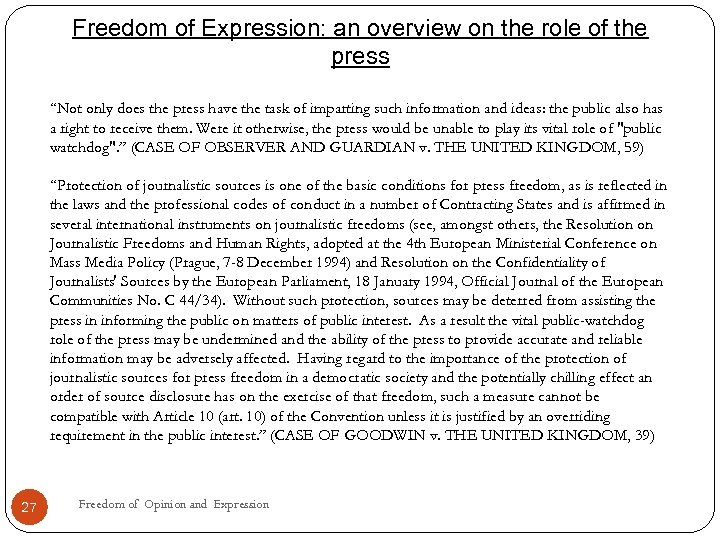
Freedom of Expression: an overview on the role of the press “Not only does the press have the task of imparting such information and ideas: the public also has a right to receive them. Were it otherwise, the press would be unable to play its vital role of "public watchdog". ” (CASE OF OBSERVER AND GUARDIAN v. THE UNITED KINGDOM, 59) “Protection of journalistic sources is one of the basic conditions for press freedom, as is reflected in the laws and the professional codes of conduct in a number of Contracting States and is affirmed in several international instruments on journalistic freedoms (see, amongst others, the Resolution on Journalistic Freedoms and Human Rights, adopted at the 4 th European Ministerial Conference on Mass Media Policy (Prague, 7 -8 December 1994) and Resolution on the Confidentiality of Journalists' Sources by the European Parliament, 18 January 1994, Official Journal of the European Communities No. C 44/34). Without such protection, sources may be deterred from assisting the press in informing the public on matters of public interest. As a result the vital public-watchdog role of the press may be undermined and the ability of the press to provide accurate and reliable information may be adversely affected. Having regard to the importance of the protection of journalistic sources for press freedom in a democratic society and the potentially chilling effect an order of source disclosure has on the exercise of that freedom, such a measure cannot be compatible with Article 10 (art. 10) of the Convention unless it is justified by an overriding requirement in the public interest. ” (CASE OF GOODWIN v. THE UNITED KINGDOM, 39) 27 Freedom of Opinion and Expression
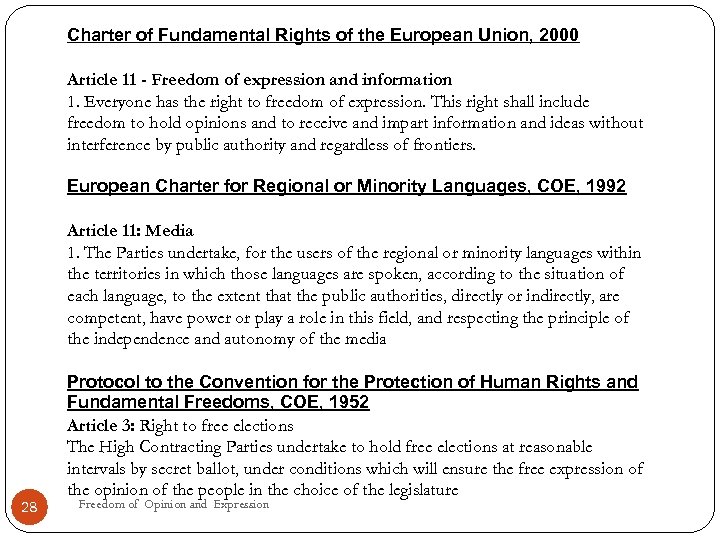
Charter of Fundamental Rights of the European Union, 2000 Article 11 - Freedom of expression and information 1. Everyone has the right to freedom of expression. This right shall include freedom to hold opinions and to receive and impart information and ideas without interference by public authority and regardless of frontiers. European Charter for Regional or Minority Languages, COE, 1992 Article 11: Media 1. The Parties undertake, for the users of the regional or minority languages within the territories in which those languages are spoken, according to the situation of each language, to the extent that the public authorities, directly or indirectly, are competent, have power or play a role in this field, and respecting the principle of the independence and autonomy of the media 28 Protocol to the Convention for the Protection of Human Rights and Fundamental Freedoms, COE, 1952 Article 3: Right to free elections The High Contracting Parties undertake to hold free elections at reasonable intervals by secret ballot, under conditions which will ensure the free expression of the opinion of the people in the choice of the legislature Freedom of Opinion and Expression
Convention on the Participation of Foreigners in Public Life at Local Level, COE, 1992 Article 3: Each Party undertakes, subject to the provisions of Article 9, to guarantee to foreign residents, on the same terms as to its own nationals: 1. the right to freedom of expression; this right shall include freedom to hold opinions and to receive and impart information and ideas without interference by public authority and regardless of frontiers. This article shall not prevent States from requiring the licensing of broadcasting, television or cinema enterprises; European Convention on Transfrontier Television, COE, 1989 Article 4: Freedom of reception and retransmission The Parties shall ensure freedom of expression and information in accordance with Article 10 of the Convention for the Protection of Human Rights and Fundamental Freedoms and they shall guarantee freedom of reception and shall not restrict the retransmission on their territories of programme services which comply with the terms of this Convention. 29 Freedom of Opinion and Expression
Convention on Contact concerning Children, COE, 2003 Article 6: The right of a child to be informed, consulted and to express his or her views 1. A child considered by internal law as having sufficient understanding shall have the right, unless this would be manifestly contrary to his or her best interests: - to receive all relevant information; - to be consulted; - to express his or her views. 2. Due weight shall be given to those views and to the ascertainable wishes and feelings of the child. Framework Convention for the Protection of National Minorities, COE, 1995 Article 9 : 1. The Parties undertake to recognise that the right to freedom of expression of every person belonging to a national minority includes freedom to hold opinions and to receive and impart information and ideas in the minority language, without interference by public authorities and regardless of frontiers. The Parties shall ensure, within the framework of their legal systems, that persons belonging to a national minority are not discriminated against in their access to the media. 30 Freedom of Opinion and Expression
The Organization of American States (OAS) American Convention on Human Rights (Pact of San Jose, Costa Rica), OAS, 1969, 24 state parties Article 13. Freedom of Thought and Expression 1. Everyone has the right to freedom of thought and expression. This right includes freedom to seek, receive, and impart information and ideas of all kinds, regardless of frontiers, either orally, in writing, in print, in the form of art, or through any other medium of one's choice. 2. The exercise of the right provided for in the foregoing paragraph shall not be subject to prior censorship but shall be subject to subsequent imposition of liability, which shall be expressly established by law to the extent necessary to ensure: a. respect for the rights of reputations of others; or b. the protection of national security, public order, or public health or morals. 31 Freedom of Opinion and Expression
3. The right of expression may not be restricted by indirect methods or means, such as the abuse of government or private controls over newsprint, radio broadcasting frequencies, or equipment used in the dissemination of information, or by any other means tending to impede the communication and circulation of ideas and opinions. 4. Notwithstanding the provisions of paragraph ~ above, public entertainments may be subject by law to prior censorship for the sole purpose of regulating access to them for the moral protection of childhood and adolescence. 5. Any propaganda for war and any advocacy of national, racial, or religious hatred that constitute incitements to lawless violence or to any other similar illegal action against any person or group of persons on any grounds including those of race, color, religion, language, or national origin shall be considered as offenses punishable by law. 32
Convention on Territorial Asylum, OAS, 1954, 34 state parties Article 7: Freedom of expression of thought, recognized by domestic law for all inhabitants of a State, may not be ground of complaint by a third State on the basis of opinions expressed publicly against it or its government by asylees or refugees, except when these concepts constitute systematic propaganda through which they incite to the use of force or violence against the government of the complaining State. Inter-American Democratic Charter, OAS, 2001, 34 state parties Article 4: Transparency in government activities, probity, responsible public administration on the part of governments, respect for social rights, and freedom of expression and of the press are essential components of the exercise of democracy. 33 Freedom of Opinion and Expression
Access to Governmental Information: Marcel Claude Reyes and Others v. Chile The case, Marcel Claude Reyes and Others v. Chile, marks the Inter-American Court’s first opportunity in its 27 -year history to rule on the right of access to governmentheld information. The Justice Initiative, ARTICLE 19; Libertad de Información Mexico, Asociación Civil (LIMAC); Instituto Prensa y Sociedad (IPYS) of Peru; and Access Info Europe—filed the “friend of the court” brief in support of Claude Reyes and his two co-applicants. The case surveys access to information laws and jurisprudence and argues that a fundamental right of people to access information held by their governments has been established internationally and is contained in the American Convention on Human Rights. 34 Freedom of Opinion and Expression
The Organization of Islamic Conference (OIC) The Charter of the Organization of Islamic Conference, 57 state parties, established in Morocco in September 1969 Although Freedom of Expression is not explicitely mentioned in the Charter, among the objectives of the Charter, is (Chapter 1) Article 1, paragraph 12: To protect and defend the true image of Islam, to combat defamation of Islam and encourage dialogue among civilisations and religions; The Standing Committee for Information and Cultural Affairs of the OIC: established pursuant to resolution 13/3 – P (IS) adopted by the Third Islamic Summit Conference, held in Saudi Arabia in January 1981. 35 Freedom of Opinion and Expression
The Cairo Declaration on Human Rights in Islam, signed in August 1990, 54 states parties Article 22: a) Everyone shall have the right to express his opinion freely in such manner as would not be contrary to the principles of the Shari’ah. b) Everyone shall have the right to advocate what is right, and propagate what is good, and warn against what is wrong and evil according to the norms of Islamic Shari’ah. 36 Freedom of Opinion and Expression
The League of Arab States Arab Charter on Human Rights, 2004, entered into force March 15, 2008, 7 state parties Article 32: 1. The present Charter guarantees the right to information and to freedom of opinion and expression, as well as the right to seek, receive and impart information and ideas through any medium, regardless of geographical boundaries. 2. Such rights and freedoms shall be exercised in conformity with the fundamental values of society and shall be subject only to such limitations as are required to ensure respect for the rights or reputation of others or the protection of national security, public order and public health or morals. 37 Freedom of Opinion and Expression
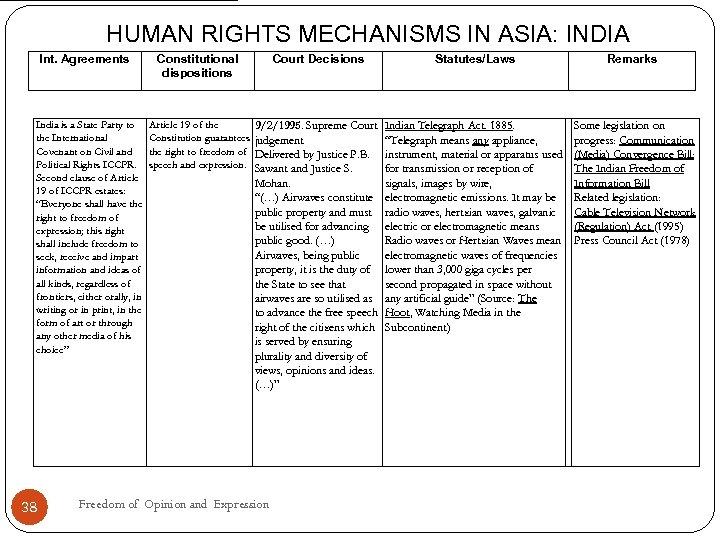
HUMAN RIGHTS MECHANISMS IN ASIA: INDIA Int. Agreements India is a State Party to the International Covenant on Civil and Political Rights ICCPR. Second clause of Article 19 of ICCPR estates: “Everyone shall have the right to freedom of expression; this right shall include freedom to seek, receive and impart information and ideas of all kinds, regardless of frontiers, either orally, in writing or in print, in the form of art or through any other media of his choice” 38 Constitutional dispositions Court Decisions Statutes/Laws Remarks Article 19 of the Constitution guarantees the right to freedom of speech and expression. 9/2/1995. Supreme Court judgement Delivered by Justice P. B. Sawant and Justice S. Mohan. “(…) Airwaves constitute public property and must be utilised for advancing public good. (…) Airwaves, being public property, it is the duty of the State to see that airwaves are so utilised as to advance the free speech right of the citizens which is served by ensuring plurality and diversity of views, opinions and ideas. (…)” Indian Telegraph Act. 1885. “Telegraph means any appliance, instrument, material or apparatus used for transmission or reception of signals, images by wire, electromagnetic emissions. It may be radio waves, hertzian waves, galvanic electric or electromagnetic means Radio waves or Hertzian Waves mean electromagnetic waves of frequencies lower than 3, 000 giga cycles per second propagated in space without any artificial guide” (Source: The Hoot, Watching Media in the Subcontinent) Some legislation on progress: Communication (Media) Convergence Bill; The Indian Freedom of Information Bill Related legislation: Cable Television Network (Regulation) Act (1995) Press Council Act (1978) Freedom of Opinion and Expression
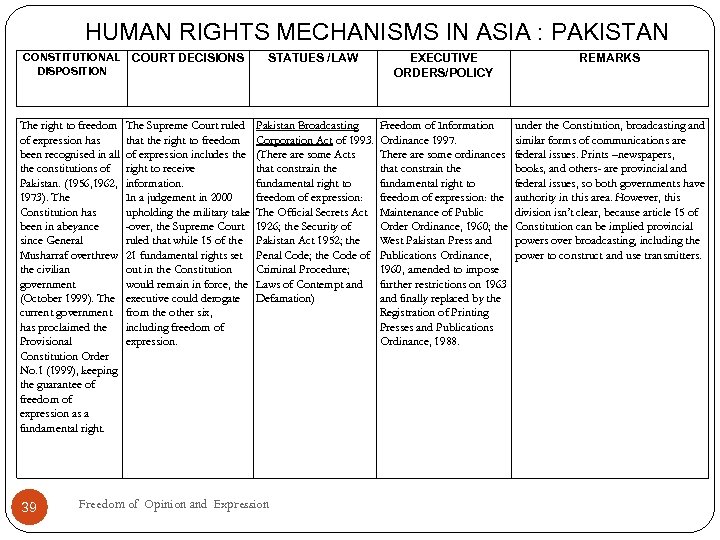
HUMAN RIGHTS MECHANISMS IN ASIA : PAKISTAN CONSTITUTIONAL DISPOSITION COURT DECISIONS STATUES /LAW EXECUTIVE ORDERS/POLICY REMARKS The right to freedom of expression has been recognised in all the constitutions of Pakistan. (1956, 1962, 1973). The Constitution has been in abeyance since General Musharraf overthrew the civilian government (October 1999). The current government has proclaimed the Provisional Constitution Order No. 1 (1999), keeping the guarantee of freedom of expression as a fundamental right. The Supreme Court ruled that the right to freedom of expression includes the right to receive information. In a judgement in 2000 upholding the military take -over, the Supreme Court ruled that while 15 of the 21 fundamental rights set out in the Constitution would remain in force, the executive could derogate from the other six, including freedom of expression. Pakistan Broadcasting Corporation Act of 1993. (There are some Acts that constrain the fundamental right to freedom of expression: The Official Secrets Act 1926; the Security of Pakistan Act 1952; the Penal Code; the Code of Criminal Procedure; Laws of Contempt and Defamation) Freedom of Information Ordinance 1997. There are some ordinances that constrain the fundamental right to freedom of expression: the Maintenance of Public Order Ordinance, 1960; the West Pakistan Press and Publications Ordinance, 1960, amended to impose further restrictions on 1963 and finally replaced by the Registration of Printing Presses and Publications Ordinance, 1988. under the Constitution, broadcasting and similar forms of communications are federal issues. Prints –newspapers, books, and others- are provincial and federal issues, so both governments have authority in this area. However, this division isn’t clear, because article 15 of Constitution can be implied provincial powers over broadcasting, including the power to construct and use transmitters. 39 Freedom of Opinion and Expression
NATIONAL FRAMEWORKS CONSTITUTION OF THE REPUBLIC OF CUBA, 1992 ARTICLE 53. Citizens have freedom of speech and of the press in keeping with the objectives of socialist society. Material conditions for the exercise of that right are provided by the fact that the press, radio, television, cinema, and other mass media are state or social property and can never be private property. This assures their use at exclusive service of the working people and in the interests of society. ARTICLE 39: …) there is freedom of artistic creation as long as its content is not contrary to the Revolution. There is freedom of artistic expression; CONSTITUTION OF SWEDEN – The Fundamental law on freedom of expression, 1991 Art. 1. Every Swedish citizen is guaranteed the right under this Fundamental Law, vis-a-vis the public institutions, publicly to express his thoughts, opinions and sentiments, and in general to communicate information on any subject whatsoever on sound radio, television and certain like transmissions, films, video recordings, sound recordings and other technical recordings. The purpose of freedom of expression under this Fundamental Law is to secure the free exchange of opinion, free and comprehensive information, and freedom of artistic creation. No restrictionof Opinionfreedom shall be permitted other than such as follows from this Freedom of this and Expression 40 Fundamental Law.
CONSTITUTION OF THE FEDERAL DEMOCRATIC REPUBLIC OF ETHIOPIA, 1994 Article 29 Right to Hold Opinions, Thoughts and Free Expressions 1. Everyone shall have the right to hold opinions without any interference. 2. Everyone shall have the right to freedom of expression without interference. This right shall include freedom to seek, receive and impart information and ideas of all kinds, regardless of frontiers, either orally, in writing or in print, in the form of art, or through other media of his choice. … 4. The press shall be granted institutional independence and legal protection to enable it to accommodate different opinions and ensure the free flow of information, ideas and opinions that are necessary in a democratic society. 5. Any media financed or controlled by the government shall be organized in a manner suitable for the accommodation of differences of opinion. CONSTITUTION OF THE ARAB REPUBLIC OF SYRIA, 1973 Article 38 [Expression] Every citizen has the right to freely and openly express his views in words, in writing, and through all other means of expression. He also has the right to participate in supervision and constructive criticism in a manner that safeguards the soundness of the domestic and nationalist structure and strengthens the socialist system. The state guarantees the freedom of the press, of printing, and Expression Freedom of Opinion and publication in accordance with the law. 41
SPECIAL RAPPORTEURS UN Special Rapporteur on Freedom of Opinion and Expression OAS Special Rapporteur on Freedom of Expression Special Rapporteur or Independent Expert in Africa Standing Committee for Information and Cultural Affairs of the OIC 42 Freedom of Opinion and Expression
SPECIAL RAPPORTEURS The United Nations Commission on Human Rights, in its resolution 1993/45 of 5 March 1993, appointed a Special Rapporteur on the promotion and protection of the right to freedom of opinion and expression. 43 Freedom of Opinion and Expression
MANDATE OF THE SPECIAL RAPPORTEUR a) to gather all relevant information, wherever it might occur, of discrimination against, threats or use of violence and harassment, including persecution and intimidation, directed at persons seeking to exercise or to promote the exercise of the right to freedom of opinion and expression as affirmed in the Universal Declaration of Human Rights and, where applicable, the International Covenant on Civil and Political Rights, taking into account the work being conducted by other mechanisms of the Commission and Sub-Commission which touched on that right, with a view to avoiding duplication of work; b) as a matter of high priority, to gather all relevant information, wherever it might occur, of discrimination against, threats or use of violence and harassment, including persecution and intimidation, against professionals in the field of information seeking to exercise or to promote the exercise of the right to freedom of opinion and expression; 44 Freedom of Expression Opinion and
c) to seek and receive credible and reliable information from governments and nongovernmental organizations and any other parties who have knowledge of these cases; and to submit annually to the Commission a report covering the activities relating to his or her mandate, containing recommendations to the Commission and providing suggestions on ways and means to better promote and protect the right to freedom of opinion and expression in all its manifestations. In the discharge of his mandate the Special Rapporteur: a) Transmits urgent appeals and communications to States with regard to individuals or professionals in the field of information who have been reported to be discriminated against, threatened with the use of violence, persecuted, intimidated or harassed for seeking to exercise or to promote the exercise of the right to freedom of opinion and expression. See Individual complaints; b) Undertakes fact-finding country visits. See Country visits; c) Submits annual reports on activities, identification of trends and methods of work, and addressing specific thematic issues to the Commission. 45 Freedom of Opinion and Expression
CHANGE IN THE MANDATE OF THE SPECIAL RAPPORTEUR The resolution requires the UN Special Rapporteur on Freedom of Expression to report on abuses of the right to freedom of expression when they constitute an act of racial or religious discrimination. The resolution, proposed by Pakistan on behalf of the Organization of the Islamic Conference (OIC), was passed by 32 council members with 15 abstentions. 46 Freedom of Opinion and Expression
UN Special Rapporteurs Mr. Frank William La Rue (Guatemala), since August 2008 Mr. Ambeyi Ligabo (Kenya), from August 2002 to July 2008 Mr. Abid Hussain (India), from 1993 to July 2002 47 Freedom of Opinion and Expression
Issues of concern for Special Rapporteurs ØThe right to seek and receive information ØThe media in countries of transition and in elections ØThe impact of new information technologies ØNational security ØWomen and freedom of expression 48 Freedom of Opinion and Expression
JOINT DECLARATIONS OF THE SRs The Special Rapporteur on freedom of opinion and expression, Mr. Frank La Rue, the OSCE Representativeon freedom of the media, Mr. Miklos Haraszti, the OAS Special Rapporteur on freedom of expression, Ms. Catalina Botero, and the ACHPR Special Rapporteur on freedom of expression and access to information, Ms. Faith Pansy Tlakula, adopted on 10 December 2008 A joint declaration on defamation of religions, and anti-terrorism and anti-extremism Legislation “defamation of religions” does not accord with international standards regarding defamation, which refers to the protection of the reputation of individuals, and provides that restrictions on freedom of expression should be limited in scope and should never be used to protect particular institutions, including concepts, notions or beliefs. It further encourages international organizations to desist from adopting statements supporting the idea of “defamation of religions”. 49 Freedom of Opinion and Expression
JOINT DECLARATION OF THE SRs Regarding anti-terrorism legislation, the Declaration provides that criminalization of speech relating to terrorism should be restricted to instances of intentional incitement to terrorism. Vague notions of glorification or promotion of terrorism or extremism should not be criminalized, says the Declaration. Moreover, it states that the role of the media as a key vehicle for realizing freedom of expression should be respected and that normal rules on the protection of confidentiality of journalists’ sources of information should apply in the context of anti-terrorist actions as at other times. 50 Freedom of Opinion and Expression
Special Rapporteur on Freedom of Expression of the Organization of American States (OAS) was established by the Inter-American Commission on Human Rights (IACHR) in 1997 to monitor OAS member states' compliance with the American Convention on Human Rights in the area of freedom of expression. 51 Freedom of Expression Opinion and
Special Rapporteur and Independent experts - Africa ACHPR /Res. 71 (XXXVI) 04: Resolution on the Mandate and Appointment of a Special Rapporteur on Freedom of Expression in Africa Decides to appoint a Special Rapporteur on Freedom of Expression in Africa with the following mandate: analyse national media legislation, policies and practice within Member States, monitor their compliance with freedom of expression standards in general and the Declaration of Principles on Freedom of Expression in particular, and advise Member States accordingly; undertake investigative missions to Member States where reports of massive violations of the right to freedom of expression are made and make appropriate recommendations to the African Commission; undertake country Missions and any other promotional activity that would strengthen the full enjoyment of the right to freedom of expression in Africa; 52 Freedom of Opinion and Expression
make public interventions where violations of the right to freedom of expression have been brought to his/her attention. This could be in the form of issuing public statements, press releases, urgent appeals; keep a proper record of violations of the right to freedom of expression and publish this in his/her reports submitted to the African Commission; and submit reports at each Ordinary Session of the African Commission on the status of the enjoyment of the right to freedom of expression in Africa. (2) Further decides to appoint Commissioner Andrew Ranganayi Chigovera as Special Rapporteur on the Right to Freedom of Expression in Africa for the remainder of his mandate 53 Freedom of Opinion and Expression
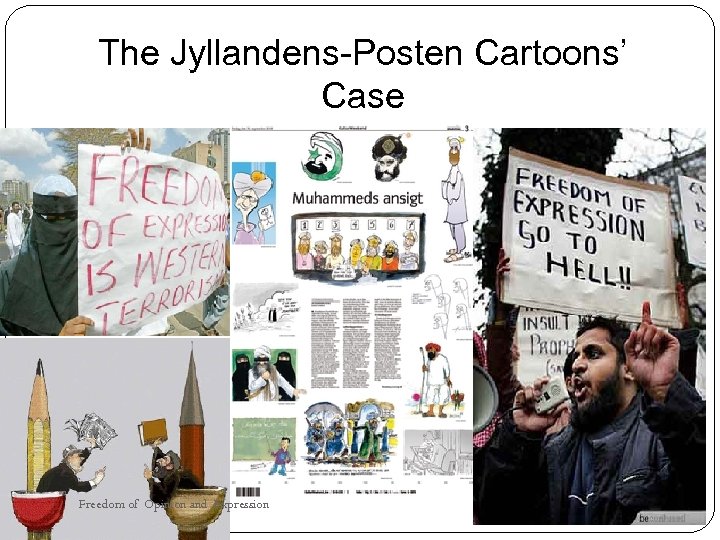
The Jyllandens-Posten Cartoons’ Case 54 Freedom of Opinion and Expression
HISTORY OF THE CASE 30 September 2005 The cartoons are printed in the Danish daily newspaper, Jyllands-Posten. 27 October 2005 A number of Muslim organizations filed a complaint with the Danish police claiming that Jyllands-Posten had committed an offence under section 140 and 266 b of the Danish Criminal Code. Section 140 of the Criminal Code, known as the blasphemy law, prohibits disturbing public order by publicly ridiculing or insulting the dogmas of worship of any lawfully existing religious community in Denmark. Only one case has ever resulted in a sentence, a 1938 case involving an anti-Semitic group. The most recent case was in 1971 when a program director of Danmarks Radio was charged, but found not guilty. Section 266 b criminalises insult, threat or degradation of natural persons, by publicly and with malice attacking their race, color of skin, national or ethnical roots, faith or sexual orientation. 55 Freedom of Opinion and Expression
DETAILS ABOUT THE CASE On 6 January 2006, the Regional Public Prosecutor in Viborg discontinued the investigation as he found no basis for concluding that the cartoons constituted a criminal offence. His reason is based on his finding that the article concerns a subject of public interest and, further, on Danish case law which extends editorial freedom to journalists when it comes to a subject of public interest. He stated that, in assessing what constitutes an offence, the right to freedom of speech must be taken into consideration. He stated that the right to freedom of speech must be exercised with the necessary respect for other human rights, including the right to protection against discrimination, insult and degradation, but no apparent violation of the law had occurred. In a new hearing, the Director of Public Prosecutors in Denmark agreed. 56 Freedom of Opinion and Expression
JUDGEMENTS IN THE DENMARK JUDICIAL SYSTEM ON THE CASE “Even if the text accompanying the pictures could be read as being derogatory and mocking, the cartoons are not offensive“ Of course it cannot be excluded that the drawings offended some Muslims, " the ruling said. "But there is no sufficient reason to assume that the cartoons are or were intended to be insulting. . . or put forward ideas that could hurt the standing of Muslims in society. " ” Arahus court The judicial commission, which decides if cases can be heard by the Supreme Court, rejected the claims about the case without giving reasons. It was the third attempt by the group to take the case to the Supreme Court. 57 Freedom of Opinion and Expression
FREEDOM OF EXPRESSION IN DENMARK Freedom of speech was guaranteed in law by the Danish Constitution in 1849, as it is today by The Constitutional Act of Denmark, of 5 June 1953. It is defended vigorously. It was suspended during the German occupation of Denmark in World War II. In Denmark the freedom of speech and freedom of the press are ensured by ARTICLE 77 of the constitution: "Anyone is entitled to in print, writing and speech to publish his or hers thoughts, yet under responsibility to the courts. Censorship and other preventive measures can never again be introduced. " The phrase under responsibility to the courts provides the main concept of the freedom: the constitution grants you the freedom to say whatever you please, but does not protect you from being punished for doing so. Tradition by the court is that the boundaries for what is deemed inappropriate are wider for the press or in a political debate than for civil citizens. The major punishable acts are libel, blasphemy and racism, which are restricted by the Danish penal code. Like most other countries, Denmark also forbids publishing copyright-protected material without permission and revealing trade secrets in the civil law. 58 Freedom of Opinion and Expression
INTERNATIONAL REACTIONS TO THE CASE THE UNITED NATIONS The United Nations Special Rapporteur on freedom of religion or belief and Special Rapporteur on contemporary forms of racism, racial discrimination, xenophobia and related intolerance request the Permanent Danish Mission to the UN to deliver their observations of the case Labour strikes begin in Pakistan in response to the cartoons. Louise Arbour, the UN High Commissioner for Human Rights has expressed concern over the cartoons and said that United Nations is investigating racism of the Danish cartoonists. 59 Freedom of Opinion and Expression
THE EUROPEAN UNION The European Union backs Denmark, saying that any retaliatory boycott of Danish goods would violate world trade rules. Armed gunmen from al-Aqsa Martyrs' Brigades storm the European Union's office in Gaza and threaten to kidnap the workers unless they receive an official apology for the cartoons from the EU. 60 Freedom of Opinion and Expression
FRANCE A French court refused to order the confiscation of a magazine on Tuesday which local Muslim organisations tried to prevent from publishing controversial cartoons of the Prophet Muhammad. The satirical weekly Charlie-Hebdo was due to publish on Wednesday 12 cartoons originally printed by the Danish paper Jyllens-Posten which have caused outrage in the Muslim world. The judges rejected demands by French Muslim organisations, including the French Council of Muslim Faith (CFCM) and the Grand Mosques of Paris and Lyon, which had argued the paper was undermining the principle of the respect of faiths. The court did not rule on the contents of the claim, but rejected it on a technicality, saying the plaintiffs had failed to follow several points of procedure in filing their suit. 61 Freedom of Opinion and Expression
SOUTH AFRICA Johannesburg High Court: Judge Mohammed Jajbhay pre-emptively banned the publication of the cartoons in South Africa following a request for an urgent interdict by the Muslim Jamiat-ul Ulama Transvaal organization. This move is widely criticized by opposition political parties and journalist organizations. Judge Mohammed Jajbhay in his judgement said that ‘These expressions advocate hatred and stereotyping of Muslims on the basis of immutable characteristics that is particularly harmful to the achievement of our core values as a nation, and reinforces and perpetuates patterns of discrimination and inequality’ 62 Freedom of Opinion and Expression
NGOs, Books, Internet Sites • Conte A. Davidson S. Burchill R. “Defining Civil and Political Rights” Ashgate Publishing Company, USA, 2004. • de Salvia M. “La Convenzione. Europea dei Diritti dell’Uomo” Editoriale Scientifica, Napoli, 2001. • IFLA - International Federation of Library Associations. • IFLA, representing the world forum for library organizations and national libraries, launched FAIFE. - Committee on Freedom of Expression and Access to Information in 1997. • FAIFE, defending and enhancing freedom of expression and free access to information, also monitoring and reporting on the world status of intellectual freedom. • IFEX, International Freedom of Expression e. Xchange currently counting 54 members on all continents, established in 1992, represent the main global network of freedom of expression organizations, daily monitoring and reporting on freedom of expression abuses world wide. www. ifex. org • The Library of Alexandria - www. bibalex. org • Egyptian Human Rights Organization, www. eohr. org • Cairo Institute for Human Rights Studies, www. cihrs. org • UNESCO's Division of Human Rights, Democracy, Peace & Tolerance will represent an invaluable supporter of this project, expected to play a more active role after the Norwegian database has been presented to the new library of Alexandria, and the project continues as a joint international venture. www. unesco. org • Committee to Protect Journalists, www. cpj. org • International PEN, www. internatpen. org • Writers in Prison Committee at www. internatpen. org • Article 19, www. article 19. org • World Press Freedom Committee, www. wpfc. org • World Association of Newspapers, www. wan-press. org • International Press Institute, www. freemedia. at • UN - Freedom of Opinion and Expression, www. un. org • ALA Office for Intellectual Freedom, www. ala. org • Centre for Media Freedom in the Middle East and North Africa, www. cmfmena. org • Reporters sans frontiers, www. rsf. fr • World View Rights, www. worldviewrights. org • Human Rights Watch, www. hrw. org • Amnesty International, www. amnesty. org 63 Freedom of Opinion and Expression
• Asian Centre for Human Rights, New Delhi, India, www. achrweb. org • The Asia Pacific Human Rights Network (APHRN), http: //www. aphrn. org/ • ’Demos', Center for the Development of Democracy and Human Rights • American Civil Liberties Union (ACLU) • Amnesty International-Turkey • Arab Association of Cyber Law • Arab Women Media Center • Article 19 • Association for Freedom of Thought and Expression (AFTE) • Bahrain Center for Human Rights • Bulgarian Helsinki Committee • Center for Defending Freedom of Journalists (CDFJ) • Center for Media Freedom & Responsibility • Cairo Institute for Human Rights Studies • Committee for the Defense of Human Rights in the Arabian Peninsula (CDHRAP) • Committee to Protect Journalists • Commonwealth Press Union • Council of Europe • Croatian Helsinki Committee §Cyber Rights and Cyber Liberties §Egyptian Organization for Human rights (EOHR) §Finnish Helsinki Committee §Forum for Development and Human Rights Dialogue (FDHRD) §Freedom House §Global Internet Liberty Campaign (GILC) §Global Justice §Greek Helsinki Monitor §Helsinki Association §Helsinki Committee for Human Rights in Bosnia and Herzegovina §Human Rights Agenda Association §Human Rights Center of Azerbaijan (AIHMM – HRCA) 64 Freedom of Opinion and Expression
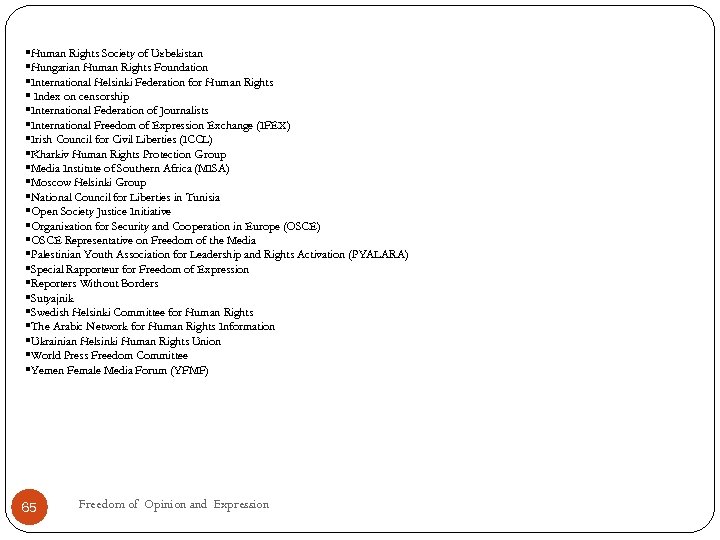
§Human Rights Society of Uzbekistan §Hungarian Human Rights Foundation §International Helsinki Federation for Human Rights § Index on censorship §International Federation of Journalists §International Freedom of Expression Exchange (IFEX) §Irish Council for Civil Liberties (ICCL) §Kharkiv Human Rights Protection Group §Media Institute of Southern Africa (MISA) §Moscow Helsinki Group §National Council for Liberties in Tunisia §Open Society Justice Initiative §Organization for Security and Cooperation in Europe (OSCE) §OSCE Representative on Freedom of the Media §Palestinian Youth Association for Leadership and Rights Activation (PYALARA) §Special Rapporteur for Freedom of Expression §Reporters Without Borders §Sutyajnik §Swedish Helsinki Committee for Human Rights §The Arabic Network for Human Rights Information §Ukrainian Helsinki Human Rights Union §World Press Freedom Committee §Yemen Female Media Forum (YFMF) 65 Freedom of Opinion and Expression
Скачать презентацию FREEDOM OF OPINION AND EXPRESSION FREELY EXPRESSED BY
f5003d8fb1ba1ac7b2b4c6ca724d7575.ppt