


 Скачать презентацию Freedom of Expression ETHR 103 Assist Prof R
a88b010323b1a879a9506888af4fa8ca.ppt
- Количество слайдов: 67
 Freedom of Expression ETHR 103 Assist. Prof. R. Murat ÖNOK
 UDHR Art. 19 • Everyone has the right to freedom of opinion and expression; this right includes freedom to hold opinions without interference and to seek, receive and impart information and ideas through any media and regardless of frontiers.
 ICCPR Art. 19 • 1. Everyone shall have the right to hold opinions without interference. • 2. Everyone shall have the right to freedom of expression; this right shall include freedom to seek, receive and impart information and ideas of all kinds, regardless of frontiers, either orally, in writing or in print, in the form of art, or through any other media of his choice. • 3. The exercise of the rights provided for in paragraph 2 of this article carries with it special duties and responsibilities. It may therefore be subject to certain restrictions, but these shall only be such as are provided by law and are necessary: • (a) For respect of the rights or reputations of others; • (b) For the protection of national security or of public order (ordre public), or of public health or morals.
 ECHR Art. 10
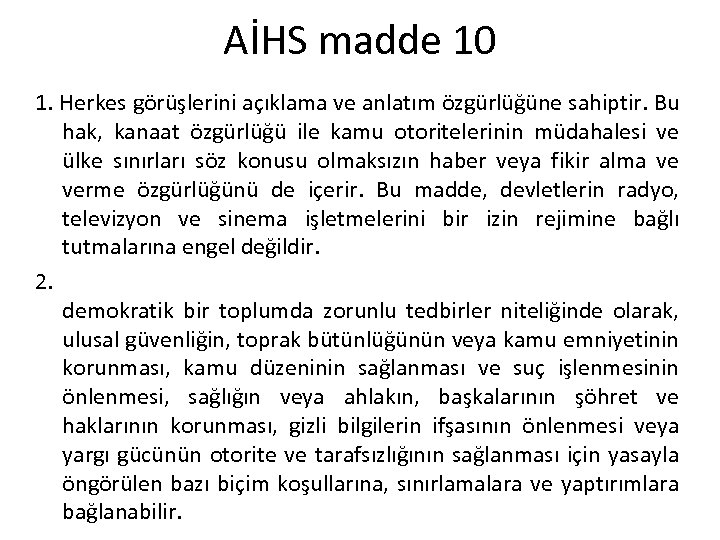 AİHS madde 10 1. Herkes görüşlerini açıklama ve anlatım özgürlüğüne sahiptir. Bu hak, kanaat özgürlüğü ile kamu otoritelerinin müdahalesi ve ülke sınırları söz konusu olmaksızın haber veya fikir alma ve verme özgürlüğünü de içerir. Bu madde, devletlerin radyo, televizyon ve sinema işletmelerini bir izin rejimine bağlı tutmalarına engel değildir. 2. demokratik bir toplumda zorunlu tedbirler niteliğinde olarak, ulusal güvenliğin, toprak bütünlüğünün veya kamu emniyetinin korunması, kamu düzeninin sağlanması ve suç işlenmesinin önlenmesi, sağlığın veya ahlakın, başkalarının şöhret ve haklarının korunması, gizli bilgilerin ifşasının önlenmesi veya yargı gücünün otorite ve tarafsızlığının sağlanması için yasayla öngörülen bazı biçim koşullarına, sınırlamalara ve yaptırımlara bağlanabilir.
 Özlü sözler • Bastille Cezaevinde bulunan XVI. Louis’nin, Voltaire ve Rousseau’yu kast ederek, Fransa’yı bu ikilinin yıktığını söylemesi üzerine; Napolyon şöyle der: “Bourbon’lar, kağıt ve mürekkebi denetim altında tutsalardı, iktidarlarını sürdürebilirlerdi”. • “Hoşlarına gitmeyen düşüncelerin yayılmasını engellemek için ifade özgürlüğünü baskı altında tutan hükümetler, görünmemek için gözlerini kapayan çocuklar gibidir” - Ludwig Borne • "Düşüncenin üstesinden gelemeyen, düşünenin üstesinden gelir" - P. Valery.
 The function of ‘free speech’ • Overall, it serves to enhance individual and social interests, and development. 1) Freedom of expression is based on human dignity, and the right to protect and develop his material and spiritual entity. Gerçekten de, düşünce özgürlüğü sayesinde, insanın kendisini entelektüel ve iletişimsel açıdan geliştirmesi mümkün olacaktır. 2) Freedom of expression allows the individual to take part in the shaping of the society in a democratic way. - It is thanks to the dissemination of different and new thoughts that it is possible to determine and correct the shortcomings of the political system. As stated by a writer (S. Reisoğlu), the line of development achieved today by the modern world is owed to the discussion of different views which emerged in time.
 - The function of free speech is realizing democracy is very clear. Democracy is based on the principle that individuals take collective decisions on societal matters, especially through voting. In order for the individuals to be able to make the correct choices, they should be able to have access to all relevant information, and to be free in making their own decisions (is this so in Turkey? ! Are people informed? Are their political decisions based on their own free will? Remember the discussions in class (ağanın-cemaatin-kocanın iradesine göre oy verme) (cehalet konusunda: http: //www. hurriyet. com. tr/yazarlar/17756921. asp In order for democracy to function properly, all statements expressed by free people concerning the process of determinining their common future must be protected.
 - As underlined by the ECt. HR, in a pluralistic democracy, with regard to political issues in particular, the fact that certain groups represent marginal or extreme thoughts should be regarded to a degree as normal and met with tolerance + If non-conformist views are oppressed and inhibited, the public will be prevented from thinking on important political and social matters. + If the expression of thoughts is prohibited, hostility will radicalize, the political opposition will be forced to go underground, and eventually, problems will be tried to be resolved by using force instead of reason. - If the expression of every type of thought is allowed for, the public who has the chance to learn about and reflect on these different opinions and perspectives will be more sensitive and will have a broader perspective. These attributes will contribute to the creation of a more tolerant society.
 3)Freedom of expression provides for individual autonomy as it makes it possible for individuals to express themselves through their actions, and, thus, to realize their personal aims.
 Basics • This right is closely linked with democracy’s political process, and it is an indispensable vehicle for minorities, political opponents and civil society to nurture and foster public debates (DJ Harris et al. at 443). • It is vital to protect the right to free speech because of its power to promote democracy, uncover abuses, and advance political, artistic, scientific and commercial development. • However, it is also important to recognize that free speech can be used to incite violence, spread hatred, and impinge on individual privacy and safety. • The important thing is to strike a fair balance between these competing interests.
 ‘Expression’ • The right to freedom of expression is extremely broad and it encompasses all forms of expression of any content, including: - Hate speech; - Pornography; - Blasphemy; - Defamation. • The right covers ideas expressed through any medium, such as: - Books, cartoons - Paintings - Films, video-recordings - Statements in radio interviews - Distributing information pamphlets - Public demonstrations (e. g. , a sit-in)
 ‘Expression’ • As stated in Handyside/UK (judgment of 07/12/1976, § 49): ‘Freedom of expression constitutes one of the essential foundations of such a [democratic] society, one of the basic conditions for its progress and for the development of every man. Subject to paragraph 2 of Article, it is applicable not only to "information" or "ideas" that are favourably received or regarded as inoffensive or as a matter of indifference, but also to those that offend, shock or disturb the State or any sector of the population. Such are the demands of that pluralism, tolerance and broadmindedness without which there is no "democratic society"’.
 Turkish (partial) translation & resumé • AİHS organlarının bu konudaki yerleşmiş içtihadına göre, toplumun ilerlemesi ve her bireyin gelişmesini sağlaması bakımından, demokratik toplumun temel dayanaklarından birini oluşturan ifade özgürlüğü, sadece olağan karşılanan, zararsız ya da önemsiz görülen bilgilerin ve düşüncelerin açıklanması bakımından değil; ayrıca devlete ve toplumun belirli bir bölümüne aykırı gelen, onları rahatsız eden, endişe verici ve hatta şoke edici görüşler bakımından da geçerlidir. • Değerlendirme: Demek ki, ifade özgürlüğünü geniş şekilde yorumlamak, “aşırı” olarak nitelendirilebilecek bazı siyasi görüşlerin bir dereceye kadar normal sayılarak, bunlara hoşgörü ile yaklaşmak, demokratik toplumun vazgeçemeyeceği çoğulculuk, hoşgörü ve geniş fikirliliğin bir gereğidir.
 What constitutes an ‘interference’ with free expression? • • • Executive orders preventing publication Confiscation of published material Refusal to authorize the performance of a play Prohibition on wearing a certain political symbol Penalties imposed due to the expression of ideas: Criminal sanctions Damages in a civil action Reprimands in disciplinary proceedings Dismissal from public employment Attempts to uncover journalistic sources • It is not possible to rely on ECHR Art. 10 with a view to claiming the right to speak in native language or in a given language during official proceedings (m. 10’a dayanarak, resmi işlemlerde ana dilini ya da istenilen bir dili kullanma hakkına sahip olunduğu iddia edilemez (Habitants de Leeuw St. Pierre/Belçika, European Commission on Human Rights, 15. 7. 1965, p. 339)).
 Limitations on freedom of expression • Certain restrictions are expressly allowed by Art. 10 (2) of the ECHR. • The Court will determine the legitimacy of an intervention by applying the following approach: - First, it will determine whether the interference is ‘in accordance with’ or ‘prescribed by’ law. In other words, the Court determines if there is a legal basis under national law for the interference. - Then, the Court will assess whether the intervention fits into one of the permitted limitations listed in the second paragraph. - Finally, the Court will analyse whether the limitation was necessary in a democratic society. This is the most important step where the Court adopts a rigorous approach.
 Limitations on freedom of expression • Under Art. 10, the Court seeks the existence of ‘a pressing social need’ which justifies any limitation. • When faced with an interference, the Court will pay particular attention to anaysing the proportionality of the interference made by state authorities. • A restriction should strike a fair balance between the means chosen to satisfy it and the individual’s freedom of expression. • The Court’s general understanding is that when determining the method of the interference, the state authorities should choose the least injurious means for free speech rights. • The restriction must not entail a ‘chilling effect’ on free speech rights. • Although states possess a certain margin of appreciation, national authorities must adduce ‘relevant and sufficient’ reasons to justify measures of interference.
 The ECHR and Freedom of Expression • Certain values have been considered egregiously (açık bir şekilde) offensive and contrary to the overall values of the Convention. Trying to take advantage of Art. 10 to disseminate such thoughts is considered an abuse of the Convention, and it is not protected. • Typical examples of such values are Nazism (and neo-Nazism), fascism, racism, anti-Semitism, and communism. The recent case -law also addresses Islamic fundamentalism (incompatibility of sharia with democracy – Refah Partisi/Turkey), and Kurdish nationalism involving discussions of hatred an incitement to violence. • When incitement to violence and hate speech is concerned, the expression of such thoughts will not be protected.
 Scope of protection • The scope of the protection to be afforded depends on a variety of factors, including, inter alia, the category (type/nature) of expression in question, the means used to express it, the status of the person exercising free speech, and the aim behind the restriction. 1. The nature of the expression is very important in determining the protection to be afforded. Certain types of expressions are given a higher level of protection. An example are publications and speech which contribute towards social and political debate, criticism and information. a. POLITICAL EXPRESSION: Freedom of political debate and free elections form ‘the bedrock of any democratic system’. In democratic systems governments are exposed to close scrutiny not only by the legislative and judicial authorities, but also by the general public and mass media. By virtue of its dominant power, government (including national and local authorities) must tolerate the greatest extent of criticism against it. It must ensure that any restrictive measures adopted do not have a chilling effect upon political expression.
 Scope of protection b. CIVIL EXPRESSION: Expression that claims to be in the public interest enjoys a higher degree of protection. • Public interest encompasses social, economic, cultural or even commercial and religious aspects. • For example, allegations that Mc. Donald’s was responsible for abusive farming, deforestation, cancer and exploitation of children were found to be of public concern and worthy of a higher degree of protection. c. ARTISTIC EXPRESSION (novels, paintings, sculptures) is also protected, although not as strongly as political or civil expression. Even so, the liberal democratic values underpinning the Convention system means that artists should be encouraged to manifest their artistic conviction to challenge the orthodoxy as avant-gardes, and to create new and critical thinking. The mission of the artists to defy the establishment by radical work should be encouraged (oysa bizde RTÜK var!) • Whereas some older judgments easily sacrificed artistic expression in favour of other aims, some recent judgments of the Court are strongly favourable to artistic expression (e. g. , Vereinigung Bildener Künstler v Austria, 2007).
 Scope of protection 2. The means of the expression is also important in determining the protection to be afforded. • The press has been accorded the broadest scope of protection in the case law. As the watchdog of democracy, the press has a very privileged role, especially in terms of expressions concerning matters of public interest. • See bullet 4 concerning ‘the status of the person exercising free speech’.
 Scope of protection 3. The aim pursued with the restriction and the extent of the restriction is also important. • States are afforded a certain margin of appreciation when the protection of national security is in issue. • When confronted with real or potential danger of terrorism, states are fully entitled to take appropriate measures under Art. 10 (2), for the prevention of disorder and crime. • However, even where national security is at stake, freedom of political speech is given priority by the court. • With regard to limitations imposed for the protection of morals, the contracting States enjoy a wide margin of apprecation due to the variable nature of morals, the lack of a common European understanding, and the fact that national authorities are in a better position to assess the requirements of moral due to their direct contact with national societies.
 Scope of protection 4. The status of the person exercising free speech is another factor to be taken into account. • Political parties have a crucial role in promoting pluralism and ensuring the healthy function of democracy. However, parties that pursue policies that incite to violence, or that are not democratic (e. g. , anti-secular parties), or which aim at destroying democratic systems (e. g. , the Court found promotion of sharia to be incompatible with democracy) and infringing rights safeguarded in the democracy cannot rely on Art. 10 against penalties imposed on these grounds (Refah Partisi/Turkey).
 SPECIFIC CATEGORIES OF EXPRESSION
 INCITEMENT TO VIOLENCE AND HATE SPEECH
 Incitement to violence and hate speech • States may sanction or even prevent statements that ‘spread, incite, promote or justify hatred based on intolerance’. • When confronted with remarks liable to incite violence against an individual, a public official, or a sector of the population, the State authorities enjoy a wider margin of appreciation when examining the need for an interference with freedom of expression. • In determining whether or not a statement constitutes such an incitement, the context is very important: - A statement is less likely to be interpreted as an incitement to violence if it is reported to a well-informed audience as part of a pluralistic debate. - If racist remarks are presented in an objective manner as part of news reporting and analysis, the freedom of expression should prevail (see Jersild/Denmark, 24/09/1994). If such views are presented in a tendentious manner abetting the incitement of racial hatred, they will fall outside the scope of protection of Art. 10.
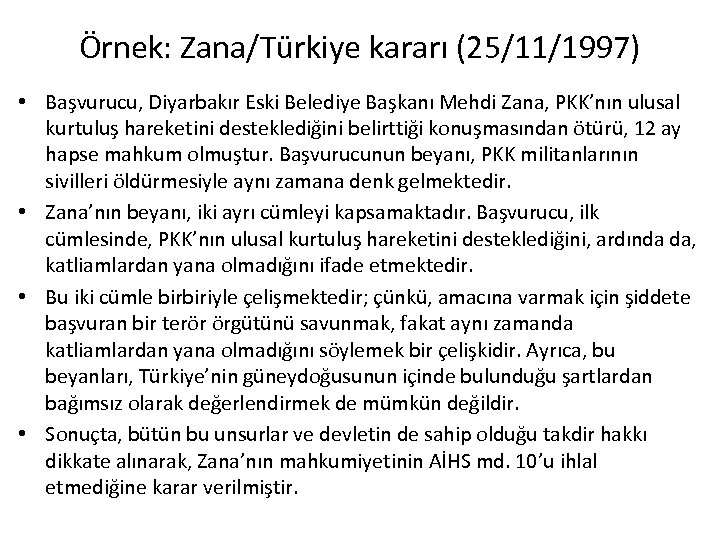 Örnek: Zana/Türkiye kararı (25/11/1997) • Başvurucu, Diyarbakır Eski Belediye Başkanı Mehdi Zana, PKK’nın ulusal kurtuluş hareketini desteklediğini belirttiği konuşmasından ötürü, 12 ay hapse mahkum olmuştur. Başvurucunun beyanı, PKK militanlarının sivilleri öldürmesiyle aynı zamana denk gelmektedir. • Zana’nın beyanı, iki ayrı cümleyi kapsamaktadır. Başvurucu, ilk cümlesinde, PKK’nın ulusal kurtuluş hareketini desteklediğini, ardında da, katliamlardan yana olmadığını ifade etmektedir. • Bu iki cümle birbiriyle çelişmektedir; çünkü, amacına varmak için şiddete başvuran bir terör örgütünü savunmak, fakat aynı zamanda katliamlardan yana olmadığını söylemek bir çelişkidir. Ayrıca, bu beyanları, Türkiye’nin güneydoğusunun içinde bulunduğu şartlardan bağımsız olarak değerlendirmek de mümkün değildir. • Sonuçta, bütün bu unsurlar ve devletin de sahip olduğu takdir hakkı dikkate alınarak, Zana’nın mahkumiyetinin AİHS md. 10’u ihlal etmediğine karar verilmiştir.
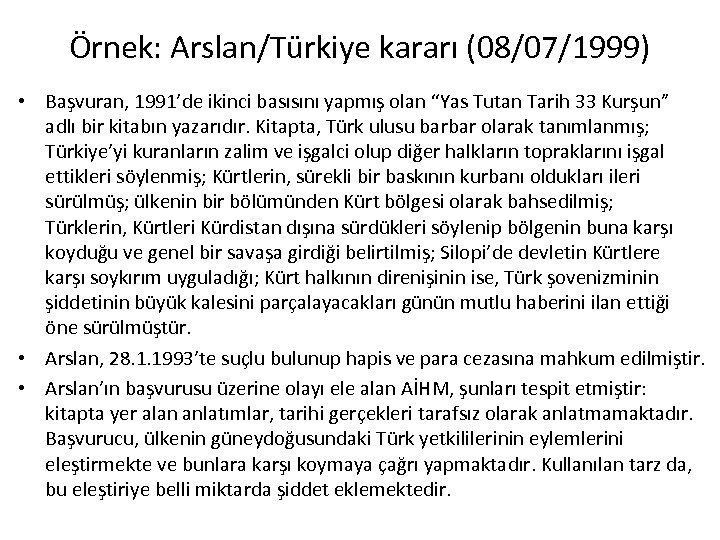 Örnek: Arslan/Türkiye kararı (08/07/1999) • Başvuran, 1991’de ikinci basısını yapmış olan “Yas Tutan Tarih 33 Kurşun” adlı bir kitabın yazarıdır. Kitapta, Türk ulusu barbar olarak tanımlanmış; Türkiye’yi kuranların zalim ve işgalci olup diğer halkların topraklarını işgal ettikleri söylenmiş; Kürtlerin, sürekli bir baskının kurbanı oldukları ileri sürülmüş; ülkenin bir bölümünden Kürt bölgesi olarak bahsedilmiş; Türklerin, Kürtleri Kürdistan dışına sürdükleri söylenip bölgenin buna karşı koyduğu ve genel bir savaşa girdiği belirtilmiş; Silopi’de devletin Kürtlere karşı soykırım uyguladığı; Kürt halkının direnişinin ise, Türk şovenizminin şiddetinin büyük kalesini parçalayacakları günün mutlu haberini ilan ettiği öne sürülmüştür. • Arslan, 28. 1. 1993’te suçlu bulunup hapis ve para cezasına mahkum edilmiştir. • Arslan’ın başvurusu üzerine olayı ele alan AİHM, şunları tespit etmiştir: kitapta yer alan anlatımlar, tarihi gerçekleri tarafsız olarak anlatmamaktadır. Başvurucu, ülkenin güneydoğusundaki Türk yetkililerinin eylemlerini eleştirmekte ve bunlara karşı koymaya çağrı yapmaktadır. Kullanılan tarz da, bu eleştiriye belli miktarda şiddet eklemektedir.
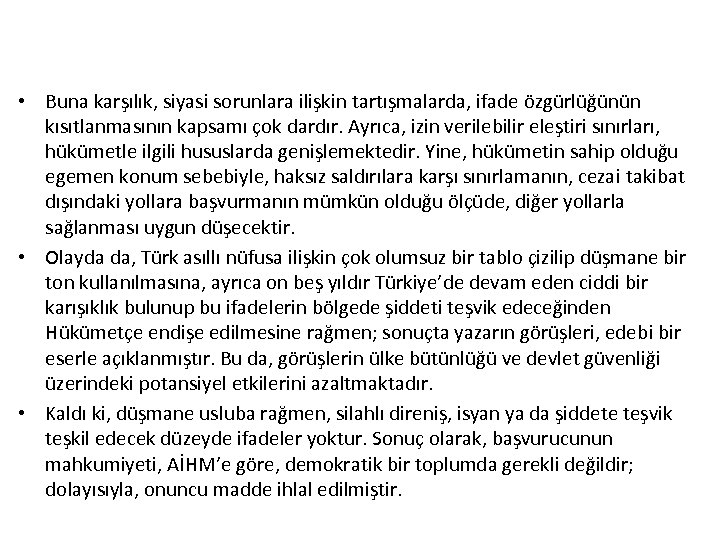 • Buna karşılık, siyasi sorunlara ilişkin tartışmalarda, ifade özgürlüğünün kısıtlanmasının kapsamı çok dardır. Ayrıca, izin verilebilir eleştiri sınırları, hükümetle ilgili hususlarda genişlemektedir. Yine, hükümetin sahip olduğu egemen konum sebebiyle, haksız saldırılara karşı sınırlamanın, cezai takibat dışındaki yollara başvurmanın mümkün olduğu ölçüde, diğer yollarla sağlanması uygun düşecektir. • Olayda da, Türk asıllı nüfusa ilişkin çok olumsuz bir tablo çizilip düşmane bir ton kullanılmasına, ayrıca on beş yıldır Türkiye’de devam eden ciddi bir karışıklık bulunup bu ifadelerin bölgede şiddeti teşvik edeceğinden Hükümetçe endişe edilmesine rağmen; sonuçta yazarın görüşleri, edebi bir eserle açıklanmıştır. Bu da, görüşlerin ülke bütünlüğü ve devlet güvenliği üzerindeki potansiyel etkilerini azaltmaktadır. • Kaldı ki, düşmane usluba rağmen, silahlı direniş, isyan ya da şiddete teşvik teşkil edecek düzeyde ifadeler yoktur. Sonuç olarak, başvurucunun mahkumiyeti, AİHM’e göre, demokratik bir toplumda gerekli değildir; dolayısıyla, onuncu madde ihlal edilmiştir.
 REVISIONIST SPEECH
 Revisionist speech • Some ‘clearly established historical facts’ are so sensitive that attempts to deny or revise them are considered hate speech. • So far, the Court has only applied this approach to the Holocaust. • Garaudy/France, admissibility decision of 24/06/2003: ‘There can be no doubt that denying the reality of clearly established historical facts, such as the Holocaust, as the applicant does in his book, does not constitute historical research akin to a quest for the truth. The aim and the result of that approach are completely different, the real purpose being to rehabilitate the National-Socialist regime and, as a consequence, accuse the victims themselves of falsifying history. Denying crimes against humanity is therefore one of the most serious forms of racial defamation of Jews and of incitement to hatred of them. The denial or rewriting of this type of historical fact undermines the values on which the fight against racism and anti-Semitism are based and constitutes a serious threat to public order. Such acts are incompatible with democracy and human rights because they infringe the rights of others’.
 Revisionist speech • Not only denying the existence of specific atrocities that form part of ‘clearly established historical facts’, but also minimizing their degree and seriousness will fall outside the protection of Art. 10. • A question is, to what extent, apart from the Holocaust, the negation or downplaying of such facts can be excluded from the protection of Art. 10 (e. g. , the alleged Armenian genocide). • A second problem is that, even if the existence of a certain atrocity is well established in its historical context, its death toll and legal characterization may be in dispute. Furthermore, the causes of such an atrocity may also be in dispute. • It is argued (DJ Harris et al. at 452) that it would be preferable to carry out a specific contextual analysis in each case, rather than adopt an approach banning the free speech as such. • I submit that since there is no consensus between historians and lawyers on the legal characterization of the Armenian deportation of 1915 (and with regard to its actual magnitude), and no court judgment establishing the judicial truth, expressions debating these issues should be protected by Art. 10.
 DEFAMATION AND INSULT
 Defamation and insult • The majority of cases concerning Article 10 are brought by persons who have received a penalty for defaming or insulting (hakaretsövme) other people. • Obviously, states may sanction defamatory statements through their civil or even criminal law in order to protect ‘the rights of others’. • When considering whether such a penalty constitutes a violation of Art. 10, in addition to the above-mentioned general criteria, the Court will take into account the following factors: a. The function fulfilled by the author; b. The function of the subject in the society; c. Whether the impugned expression consists of a statement of fact or a value judgment; d. The severity of the penalty.
 a. The function fulfilled by the author • The press is extensively protected as a ‘public watchdog’ in a democratic society. It has been accorded the broadest scope of protection in the case law. • Although they are not immune from restrictions, press members have a right and a duty to impart information and ideas on all matters of public interest. The public also has a right to receive such information. • As a result, the national margin of appreciation is limited when the author of the expression in question is a journalist fulfilling his duty to impart information on matters of public concern. • In fact, journalists are also free to use a degree of exaggeration and provocation (Prager and Oberschlick v Austria, 26/04/1995, § 38). • Any penalty imposed on journalists should not have a disproportionate ‘chilling effect’ on their ability to contribute to the public debate. • Therefore, the imposition of a prison sentence for a press offence will only be compatible with Art. 10 under exceptional circumstances, notably where other fundamental rights have been seriously impaired, as in the case of hate speech or incitement to violence.
 b. The function of the subject in society • The limits of permissible criticism are wider with regard to the government than in relation to a private citizen, or even a politician. As stated in Castells v Spain, 23/04/1992: ‘In a democratic system the actions or omissions of the Government must be subject to the close scrutiny not only of the legislative and judicial authorities but also of the press and public opinion. Furthermore, the dominant position which the Government occupies makes it necessary for it to display restraint in resorting to criminal proceedings, particularly where other means are available for replying to the unjustified attacks and criticisms of its adversaries or the media. Nevertheless it remains open to the competent State authorities to adopt, in their capacity as guarantors of public order, measures, even of a criminal law nature, intended to react appropriately and without excess to defamatory accusations devoid of foundation or formulated in bad faith. ’ • The limits of acceptable criticism are wider in regard to all politicians, because they knowingly lay themselves open to the scrutiny of the press and public (Dichand others v Austria, 26/02/2002). Politicians must display greater tolerance to criticism.
 • The Court displays a more careful scrutiny when the press is accused of defamation against a politician. In this case, the limits of permissible criticims widens. • In fact, the limits of permissible criticism are wider for all other persons who have voluntarily entered the public arena (prominent businessmen who are actively involved in the affairs of large public companies, or persons and associations that participate in a public debate). This may be referred to as the ‘public figure doctrine’. • Even so, public figures are also entitled to some privacy. If there is no public benefit to be derived from exposing certain aspects of a public figure’s private life, the right to respect for private life should prevail over the freedom of press (von Hannover v Germany, 24/06/2004). • When it comes private persons, the permissible bounds of criticism are much narrower.
 c. statement of fact v value judgment • • • The Court draws a distinction between value judgments (soyut değer yargıları eg. , ‘Mr. RT is incompetent to run a State’) and statements of facts/factual assertions (somut bir hususun karşı tarafa yüklenmesi- eg. , ‘Mr. RM has provided financial support to the PKK’). Value judgments will require a ‘sufficient factual basis’. A defendant can not express any opinion, no matter how damaging, without any evidence to support it. Even value judgments will require some factual grounds. However, value judgments can not be proved. Therefore, a defendant can not be asked to prove the truth of a value judgment. (yani: değer yargısının kendisinin (incompetent olduğunun) ispatlanması istenemez, ama bu soyut yargıyı destekleyen somut bir dayanak olmalıdır (neden bu yargıya vardın? ). Factual statements can be proved. As a result, A defendant may be required to prove the truth of factual statements in order to avoid punishment; In this case, the defendant should actually be given the chance to do so. (AİHM uygulamasında, değer yargısının az çok bir dayanağı varsa, bu görüşün ifade edilmesi hakaret sayılmıyor).
 d. Severity of the penalty • In case of punishing a person for his statements, the severity of the penalty is important in determining whethere is a violation of Art. 10. • Large awards of damages in civil proceedings (yüksek miktarda tazminata hükmetmek) can, in themselves, be enough to violate Art. 10, particularly if they are out of proportion to the income of the applicant and there is no evidence of any financial damage to the person defamed. • Sentences of imprisonment will require a stronger justification. The seriousness of the offence will be an important criterion. • As explained before, the imposition of a prison sentence for a press offence will only be compatible with Art. 10 under exceptional circumstances. In this sense, what matters most is not the gravity of the penalty inflicted on the journalist, but the very fact that they are convicted (Dammann v Switzerland, 25/04/2006, para. 57). This may have a ‘chilling effect’ on other journalists (onları konuşmaktan caydırıcı etkiye sahip olabilir, bu da kabul edilemez).
 Obscenity (müstehcenlik) and blasphemy (dini değerleri tahkir)
 Obscenity (müstehcenlik) and blasphemy (dini değerleri tahkir) • Since there is no uniform European concept of ‘morality’, States enjoy a wide margin of appreciation on this issue. • Müller and others v Switzerland (24/05/1988): no violation found in the confiscation of paintings depicting homosexuality and bestiality in crude form (the audience was not warned of the content, the exhibition was free of charge and open to everyone, including children). Criticism: less onerous alternatives available? • Compare with Wingrove v UK (25/11/1996): it concerned a video of sexual content made by the applicant portraying a woman, dressed as a nun and described in the credits as ‘Saint Teresa’ (of Avila), having an erotic fantasy involving the crucified figure of Christ. The video was refused a certificate for distribution on the grounds that it appeared to contravene British blasphemy law, as the British Board of Film Classification thought its public distribution would outrage and insult the feelings of believing Christians. No violation. Criticism: If distribution was permitted but limited to sex shops, the viewer would have been able to avoid the content.
 • İ. A. v Turkey (13/09/2005): Proprietor and managing director of a publishing house punished for publishing a novel containing the following passage: ‘God’s messenger broke his fast through sexual intercourse, after dinner and before prayer. Muhammed did not forbid sexual intercourse with a dead person or a live animal’. The ECt. HR found no violation in punishing İ. A. (two year sentence commuted to a modest fine). • This judgment is important in that it demonstrates the tension which can exist between free speech rights, and the rights of others under Art. 9 (freedom of religion). Religious beliefs and convictions of persons may be offended by a blasphemous expression in regard to objects of veneration. In this sense, those exercising free speech rights are under a ‘duty to avoid expressions that are gratuitously offensive to others and profane’ (para. 24 of the judgment), and that ‘do not contribute to any form of public debate capable of furthering progress in human affairs’ (Gündüz v Turkey, 2003). • Therefore, state authorities can take measures to punish improper attacks on objectives of religious veneration.
 EXAMPLE • Vereinigung Bildender Künstler v Austria, 25/01/2007: An exhibition includeded a collage of public figures in sexual positions. Among the figures was the former general secretary of the Austrian Freedom Party (ÖFP) who was shown naked, gripping the ejaculating penis of the former head of the Party, and ejaculating on Mother Teresa. The general secretary was granted an injunction preventing the further exhibition of the painting. The Court found the depiction ‘somewhat outrageous’ and accepted that the injunction had the legitimate aim of protecting the rights of others. However, the measure was found disproportionate (the nature of the exhibit is satirical, satire is inherently exaggerated and distorts reality, aiming to provoke and agitate; the gen. sec. was only one of over 30 public figures in the collage, thus diminishing the attention drawn to him; the offensive painting of his body was completely covered by red paint (the result of damage caused by a visitor), so that it was uncertain if the gen. sec. was recognizable; the injunction was too broad, extending to all future exhibitions anywhere. • In sum, the Ect HR found a violation of Art. 10! (ki sanatçı cezalandırılmamıştır, serginin yasaklanması bile yeterli görülmüştür).
 Protection of Private Life v Freedom of Press
 • The public has the right to be informed even of aspects of private lives of public figures. However, private aspects of public figures must be sufficiently related to their public function to justify disclosure. • The test is whether it is in the public interest to publish such information (or images), and whether its publication contributes to a debate of general interest. Therefore, in case of persons who do not fulfil a public function, even if famous, the right to respect for private life shall prevail, since the publication of their intimate photos (or other details concerning their private sphere) can not contribute to a debate of public interest. • Von Hannover v Germany (24. 6. 2004): The applicant, Princess Caroline von Hannover, has been campaigning to prevent photographs about her private life being published in the sensationalist press. The German Constitutional Court considered that the applicant, who was undeniably a contemporary “public figure”, had to tolerate the publication of photographs of herself in a public place, even if they showed her in scenes from her daily life rather than engaged in her official duties. The Constitutional Court referred in that connection to the freedom of the press and to the public’s legitimate interest in knowing how such a person generally behaved in public.
 • ECt. HR: Although freedom of expression also extended to the publication of photographs, this was an area in which the protection of the rights and reputation of others took on particular importance, as it did not concern the dissemination of “ideas”, but of images containing very personal or even intimate “information” about an individual. Furthermore, photos appearing in the tabloid press were often taken in a climate of continual harassment which induced in the person concerned a very strong sense of intrusion into their private life or even of persecution. • The Court considered that the decisive factor in balancing the protection of private life against freedom of expression should lie in the contribution that the published photographs and articles made to a debate of general interest. In the case before it, the photographs showed Caroline von Hannover in scenes from her daily life, and thus engaged in activities of a purely private nature. It was clear that they made no contribution to a debate of public interest, since the applicant exercised no official function and the photographs and articles related exclusively to details of her private life. The Court considered that the general public did not have a legitimate interest in knowing Caroline von Hannover’s whereabouts or how she behaved generally in her private life even if she appeared in places that could not always be described as secluded and was well known to the public. • Result: Suchphotos should not be published!
 • • • Turkish resumé: Basın özgürlüğü ve kişilik hakları Eleştiri ve haber verme hakkı, Anayasal teminat altında bulunan ‘basın özgürlüğü’nün bir parçasıdır. Ancak bazı hallerde, haber verme ya da eleştiri hakkı ile kişilik hakkı arasında çatışma olabilir. Bu durumda, bu farklı haklar arasında bir denge kurulması ve her iki hakkın da kullanılabilmesinin gözetilmesi gerekir. Bir olayın kamuya aktarılmasında, haber verme hakkından yararlanılabilmesi ve bu hakkın ön plana çıkarılarak, kişilik haklarını ilgilendiren bir yayının hukuka uygun sayılabilmesi, yayın konusu hususun “haber” niteliğini taşımasına bağlıdır. Gazetecinin, bilinmesinde kamu yararı bulunan ve kamunun ilgisini çeken güncel olayları, gerçekleri araştırdıktan sonra kamuya aktarma hakkı vardır. Bu bakımdan: a) olayın gerçek olması; b) güncel bulunması; c) açıklanmasında kamu yararının bulunması; d) bilinmesinin kamunun ilgisini çekmesi; e) haber ile kullanılan ifadeler arasında fikri bir bağın varlığı; diğer bir deyişle, haberin içerdiği düşünce ile bağlantısı olmayan küçültücü ifadelerin, değer yargılarının yazıya eklenmemiş olması gerekir. Prenses Caroline olayı Türk basını açısından çok önemli dersler ortaya koymaktadır. Olayın doğru ve hatta güncel olması yetmemektedir. Bu olayın yayımlanmasında kamu yararı da bulunmalıdır. Kamu yararı veya kamu ilgisinden maksat, haberin, paparazzi haberlerinde olduğu gibi, okuyucunun soyut merakını (Yargıtay deyişiyle “marazi merak duygularını”) tatmine yönelik olması değildir. Burada, haberin verilmesindeki yarar, üstün ahlaki ve hukuki değerleri korumaya yönelik olmalıdır. Buradaki “kamu ilgisi”, aslında “kamu yararı”na bağlı bir kıstastır. Bu nedenle, basının demokratik toplumdaki görevi açısından hiç bir katkısı olmayan “paparazzi” haberlerinin, salt “rating” yapıyor ve halkın ilgisini çekiyor diye yayımlanması hukuka uygun olmayacaktır.
 EXAMPLES DISCUSSED IN CLASS
 Political statements • ‘Parasız eğitim’ pankartı 19 ay sonra özgür • ''Roman Buluşması''nda pankart açtıkları için 19 aydır cezaevinde bulunan Ferhat Tüzer ile Berna Yılmaz isimli öğrenciler serbest bırakıldı. • Başbakan Recep Tayyip Erdoğan’ın “Roman açılımı” toplantısında “Parasız eğitim istiyoruz. Alacağız” yazılı pankart açan Ferhat Tüzer ile Berna Yılmaz isimli öğrenciler bir kez daha hakim karşısına çıktı. • http: //www. ntvmsnbc. com/id/25286166/
 Political statements • Arınç'a öğrencilerden protesto: 16 gözaltı • Bursa Uludağ Üniversitesi'nin yeni akademik yılın açılışına katılan Başbakan Yardımcısı Bülent Arınç'ı protesto etmek isteyen 16 öğrenci gözaltına alındı. • http: //www. ntvmsnbc. com/id/25283866/
 Political statements • Kılıçdaroğlu’na ‘omurgasız’ tazminatı • Başbakan Erdoğan, ''kişilik haklarına saldırıda bulunduğu'' iddiasıyla CHP lideri Kılıçdaroğlu aleyhinde açtığı davada, 7 bin lira manevi tazminat kazandı. • Başbakan Recep Tayyip Erdoğan’ın, TBMM'de partisinin grup toplantısında yaptığı konuşmada, ''. . . İnsanda biraz utanma olur, insanda biraz ahlak olur, insanda biraz insana saygı olur, insanda biraz onur olur. . . Kim samimi, kim dürüst, kim omurgalı? Eğer verdiğin sözün arkasında durmuyorsan sayın başbakan sana omurgasız derler, kusura bakma. . . '' şeklinde ifadeler kullanan CHP Genel Başkanı Kemal Kılıçdaroğlu’na karşı açtığı davanın karar duruşması Ankara 5. Asliye Hukuk Mahkemesi'nde görüldü. • http: //www. ntvmsnbc. com/id/25211684/
 Political statements • Trompet sanatçısı Onurcan Çağatay, Başbakan’ı protesto eylemi yapacağı gerekçesiyle konserinden önce gözaltına alındı • Emniyet, trompet sanatçısı Onurcan Çağatay’ı göz altına alırken sınıf arkadaşının kendisini ihbar etmesini gerekçe olarak söyledi. • Ancak Emniyet Müdürlüğü bir ayrıntıyı unuttu. Onurcan Çağatay öğrenci değildi. • Trompet Sanatçısı Onurcan Çağatay elinde trompeti ve konser kıyafeti smokini ile Ankara Emniyet Müdürlüğü Terörle Mücadele Birimi’nde beş saat tutuldu. • http: //demokrathabertr. wordpress. com/2011/02/04/trompetsanatcisi-onurcan-cagatay-basbakani-protesto-eylemi-yapacagigerekcesiyle-konserinden-once-gozaltina-alindi/
 Political statements • Başbakan’ı protesto eden 18 İTÜ’lüye hapis • İstanbul Teknik Üniversitesinde iki yıl önce Başbakan Erdoğan'ı protesto eden 18 öğrenci 1 yıl 3'er ay hapis cezasına çarptırıldı. • http: //www. ntvmsnbc. com/id/25152761 • See photos 1 -2 on desktop
 Political statements • Türkiye Gençlik Birliği üyesi Özgür Senger, Dokuz Eylül Üniversitesi Hukuk Fakültesi’ne birinci girmesi nedeniyle davet edildiği açılış töreninde Başbakan Erdoğan’a “cumhuriyet yıkıcısı” dediği için yargılandı, 354 gün hapis cezası aldı. Cezası 7 Bin 80 TL para cezasına çevrildi. • http: //www. odatv. com/n. php? n=erdogan-icin-1 -tl-verecek 7080 -kisi-araniyor-0911101200 • See picture 3
 Political statements • Sayın Başbakan özgürlük’ dedi, 24 gün sonra özgür • Başbakan Tayyip Erdoğan’ın 25 Temmuz’daki Malatya gezisinde otobüsüne doğru koşarak, “Sayın Başbakan özgürlük” diye bağırdığı için tutuklanan ve hakkında “Devlet büyüğüne hakaret” suçundan dava açılan Jeofizik Mühendisi Kemal Duran (37), perşembe günü ilk kez hâkim karşısına çıktı. • http: //www. hurriyet. com. tr/gundem/15608877. asp
 Political criticism • Belly-dancer caricature of Kemal Kılıçdaroğlu: • http: //www. youtube. com/watch? v=t. Ol. O 9 r 8 b. PLs
 Political criticism (satire – cartoons) • Başbakan Recep Tayyip Erdoğan, "Salih Memecan'ın çizdiği dansöz kıyafetli Kemal Kılıçdaroğlu karikatürünü nasıl buldunuz? " sorusuna, "Onu ben değerlendirmeyeceğim, karikatüristlere sorun. Tayyip Erdoğan'ı kediye, köpeğe benzettikleri zaman bir şey söylemediniz. Hepsini sevimli hayvan yaptınız" yanıtını verdi. Erdoğan, kendisini ipe dolanan kedi tasviriyle çizen Cumhuriyet gazetesi çizeri Musa Kart'a dava açmıştı. Dava üzerine haftalık mizah dergisi Penguen de Erdoğan’ı değişik hayvan tasvirleriyle çizdiği bir kapak yapmış ve bu kapak da davalık olmuştu. • http: //fotogaleri. ntvmsnbc. com/erdoganin-davalikkarikaturleri. html? position=0
 Political criticism • Seyrantepe (stad açılış) protestosu • http: //www. hurriyet. com. tr/yazarlar/1681516 4. asp
 Freedom of the press • Sınır Tanımayan Gazeteciler Örgütü: 'Kitaptan bomba olmaz' • Başbakan Erdoğan'ın 'Bazı kitaplar vardır ki bombadan daha tehlikelidir' şeklindeki sözlerine Sınır Tanımayan Gazeteciler Örgütü'nden yanıt geldi. Örgütün ''Türkiye'de Medya ve Yargı: Güvensizlik ve Güvenlik Refleksi arasında'' adını taşıyan raporu, ''Kitaptan bomba olmaz'' başlığıyla kamuoyuna açıklandı. Erdoğan, Avrupa Konseyi Parlamenterler Meclisi'nde yaptığı konuşmada gazetecilerin tutuklanmasıyla ilgili 'bomba yapmak suçsa, onun parçalarını üretmek de suçtur' demişti. • http: //www. euractiv. com. tr/yazici-sayfasi/article/sinir-tanimayangazeteciler-orgutu-kitaptan-bomba-olmaz-019077
 Insult/defamation cases • R. T. Erdoğan: “Sayın Öcalan düşüncelerinin değil, şu anda, almış olduğu kellelerin hesabını veriyor. Bense düşüncemden dolayı 4 ay hapis yattım, aramızdaki fark çok büyük”. • http: //www. milliyet. com. tr/2007/03/16/sonsiy 05. asp • Ankara Cumhuriyet Başsavcılığı, Başbakan’ın terör örgütünün lideri ABDULLLAH ÖCALAN’ a sayın diye hitap etmesi nedeniyle yapılan suç duyuruları hakkında takipsizlik kararı verdi. Üst mahkeme sıfatıyla itirazı inceleyen Sincan 1. Ağır Ceza Mahkemesi Başkanı OSMAN KAÇMAZ , Başbakan hakkındaki takipsizlik kararını kaldırdı. • Başbakan, şehitlere 'Kelle' dediği için tazminata mahkum oldu http: //www. milliyet. com. tr/2007/12/13/sonsiy 28. asp (Yargıtay da onadı)
 Insult/defamation cases • Tansu Çiller (Dönemin başbakanı Mesut Yılmaz'a yönelik) Samsun mitinginde yaptığı konuşmada kullandığı ‘Onbaşı olma şerefsizliği’ sözünden dolayı, bir kez daha tazminat ödemeye mahkûm edildi. Ankara 26. Asliye Hukuk Mahkemesi, askerliğini İstanbul Askeri Dikimevi'nde yapmakta olan Onbaşı Fatih Gürsu'nun açtığı dava üzerine, Çiller'i 101 milyon lira tazminat cezasına çarptırdı. Ankara 26. Asliye Hukuk Mahkemesi, Gürsu'nun, ‘‘Şimdiye kadar seçilmiş bir genel başkan, onbaşı olma şerefsizliğini göstermedi’’ sözlerinden dolayı Çiller aleyhine açtığı manevi tazminat davasını sonuçlandırdı. Davaya ilişkin kararını dün açıklayan mahkeme, Çiller'i mahkûm etti.
 Insult/defamation cases • OKTAY EKŞİ (Hürriyet Gazetesi Başyazarı iken) yazısı: • Biliyorsunuz devletin her kurumunun varlığı, onunla ilgili yasa hükmüne dayanır. Açın Çevre ve Orman Bakanlığı'nın kuruluş yasasını okuyun. Burada Çevre ve Orman Bakanlığı'nın, “baraj” yapmasına izin veren tek kelimelik bir hüküm yok. • Tam tersine yasa, Çevre Bakanı'na, bu sıfatıyla ilgili tam 13 adet görev vermiş. Onlardan biri olarak da “Çevreye olumsuz etkileri olan her türlü faaliyeti ülke bütününde izlemesini ve denetlemesini” emretmiş. • Ama anlaşılan bir kararla Devlet Su İşleri'ni Çevre Bakanı'na bağlamışlar yani “kümesi tilkiye teslim edip” meseleyi çözmüşler. Biliyorsunuz “ileri demokrasi” ve yeni “hukuk devleti” anlayışıyla yönetiliyoruz ya. . .
 • Bu anlayış, Anadolu'daki 2000'den fazla akarsuyu, o yörenin tabiatına ne zarar vereceğini hesaba katmadan tuttu “Baraj yapıp elektrik üreteceğim, bunu da devlete satacağım” diyen şirketlere 49 yıl için peşkeş çekti. Şimdi, her şeyi satan işte o zihniyetin marifetlerini görüyoruz. " • Hürriyet'in internet sitesinde "Şimdi, her şeyi satan işte o zihniyetin marifetlerini görüyoruz. " cümlesiyle biten yazının taşra baskısında "Bu zihniyet analarını da satar" ifadelerinin yer aldığı, bu ifadelerin daha sonra şehir baskısından çıkartıldığı öğrenildi. • http: //www. habervitrini. com/analarini_da_satarlar_diyen_ek siye_erdogandan_sert_yanit-493405. html
 Controversial recent statements • 'Dekolte giyene tecavüz ederler' • İlahiyat Profesörü Orhan Çeker, “dekolte giyerek tacizciyi tahrik eden kadının da suçlu olduğunu” savundu ve “tahrik edici kıyafet”i belirleyecek bir komisyonun kurulmasını de önerdi. YÖK Başkanı da bu sözler üzerine Çeker için inceleme başlatılmasını istedi. • http: //www. ntvmsnbc. com/id/25182961/
 Controversial recent statements • Hakkı Devrim ‘kabile reisi’, ‘Muhammed’in sözü’ lafları (web’de bu kelimelerle arama yapın, doğrudan bir dolu hakaret çıkacak hakkında) • Caricature concerning religion (currently on trial): http: //www. radikal. com. tr/Radikal. aspx? a. Typ e=Radikal. Detay. V 3&Article. ID=1064690&Date= 28. 09. 2011&Category. ID=77&fb_source=mess age
 Art. 301 Turkish Penal Code • Orhan Pamuk'un bir İsviçre gazetesine yaptığı açıklamadaki, "Türkiye'de bir milyon Ermeni, otuz bin Kürt öldürüldü” ifadesi. • Hrant Dink: "Türk"ten boşalacak o zehirli kanın yerini dolduracak temiz kan, Ermeni'nin Ermenistan'la kuracağı asil damarında mevcuttur. ”
 Art. 301 Turkish Penal Code • ELİF ŞAFAK: -'Baba ve Piç' isimli kitabında 'Türklüğü aşağıladığı' öne sürülen yazar Elif Şafak hakkında Türk Ceza Kanunu'nun 301. maddesine göre üç yıla kadar hapis cezası istemiyle dava açıldı. Müslüman-Türk Kazancı ailesi ile Ermeni asıllı Amerikalı Çakmakçıyan'ların anlatıldığı kitapta yer alan ". . . bütün akrabalarını 1915'te kasap Türklerin ellerinde kaybetmiş bir sülalenin torunuyum, köklerime ihanet etmeyi öğrendim, soykırımı inkâr etmek üzere yetiştirildim. . . ", '. . Sen kalk gel Orta Asya'dan, dal dosdoğru Anadolu'nun bağrına, sonra bir bakmışsın her yerdeler. Orada yerleşik milyonlarca Ermeni'ye ne oldu peki? Asimile edildiler, eridiler, yetim bırakıldılar, sürüldüler, mal mülklerinden oldular' şeklindeki ifadelerle 'Türklüğü aşağılama' suçunun işlendiğini öne süren avukat Kemal Kerinçsiz suç duyurusunda bulunmuştu. • Beraat etti.