


 Скачать презентацию Freddy poirier Dispersion Matched Steering and Alignment Model
5b7f99e8e0d835eda4864e86cc1b3bee.ppt
- Количество слайдов: 14
 Freddy poirier Dispersion Matched Steering and Alignment Model in Main Linac EUROTe. V meeting 26/08/08 Freddy Poirier 1
 Freddy poirier Simulation of Dispersion Matched Steering (DMS) • Present Simulations are using Merlin (a C++ based library for particle tracking) • The Merlin based ILCDFS package – Is performing the tracking throught the curved main linac (positron side) – It has implementation of the Beam Based Alignment: Dispersion Matched Steering correction# • Dispersion Matched Steering (DMS) – DMS attempts to locally correct dispersion which arises from magnets and other accelerators components alignment errors. – Steerers (here correctors) are set to minimize dispersion and thus preserve the emittance along the Main Linac (ML) – This technique uses: • A nominal beam (15 Ge. V at beg. of ML to 250 Ge. V at exit) • One (or more) test-beam with off-energy beam (different energy from nominal) 2 #Due to non-zero design dispersion (curved linac) which must be match, the more general algorithm applied is here DMS rather than DFS (Free)
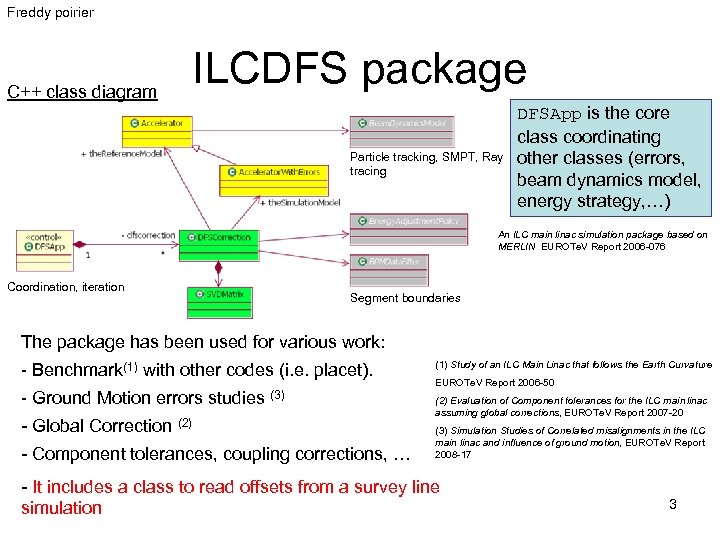 Freddy poirier C++ class diagram ILCDFS package Particle tracking, SMPT, Ray tracing DFSApp is the core class coordinating other classes (errors, beam dynamics model, energy strategy, …) An ILC main linac simulation package based on MERLIN EUROTe. V Report 2006 -076 Coordination, iteration Segment boundaries The package has been used for various work: - Benchmark(1) with other codes (i. e. placet). - Ground Motion errors studies (3) - Global Correction (2) - Component tolerances, coupling corrections, … (1) Study of an ILC Main Linac that follows the Earth Curvature EUROTe. V Report 2006 -50 (2) Evaluation of Component tolerances for the ILC main linac assuming global corrections, EUROTe. V Report 2007 -20 (3) Simulation Studies of Correlated misalignments in the ILC main linac and influence of ground motion, EUROTe. V Report 2008 -17 - It includes a class to read offsets from a survey line simulation 3
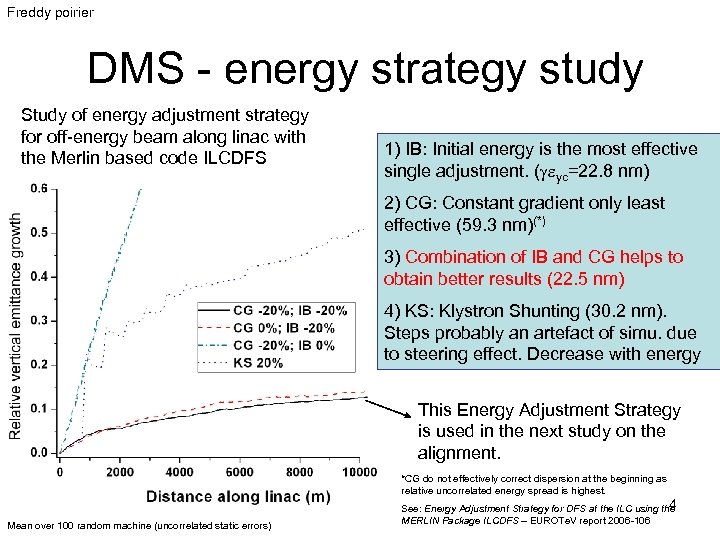 Freddy poirier DMS - energy strategy study Study of energy adjustment strategy for off-energy beam along linac with the Merlin based code ILCDFS 1) IB: Initial energy is the most effective single adjustment. (geyc=22. 8 nm) 2) CG: Constant gradient only least effective (59. 3 nm)(*) 3) Combination of IB and CG helps to obtain better results (22. 5 nm) 4) KS: Klystron Shunting (30. 2 nm). Steps probably an artefact of simu. due to steering effect. Decrease with energy This Energy Adjustment Strategy is used in the next study on the alignment. *CG do not effectively correct dispersion at the beginning as relative uncorrelated energy spread is highest. Mean over 100 random machine (uncorrelated static errors) 4 See: Energy Adjustment Strategy for DFS at the ILC using the MERLIN Package ILCDFS – EUROTe. V report 2006 -106
 Freddy poirier Purpose of Alignment Simulation (courtesy of A. Reichold – Oxford Uni. ) • Solve two long standing problems: – LET simulation studies have to date used models of alignment that were not fully comparable to any potential survey and alignment process that may once be used in the ILC we may have missed some problems that alignments may cause for LET – The parameters describing these models could not be translated into requirements for survey processes we have not determined which survey and alignment processes do or don’t satisfy the ILC-LET requirements We don’t have a real world alignment model for ILC! 5
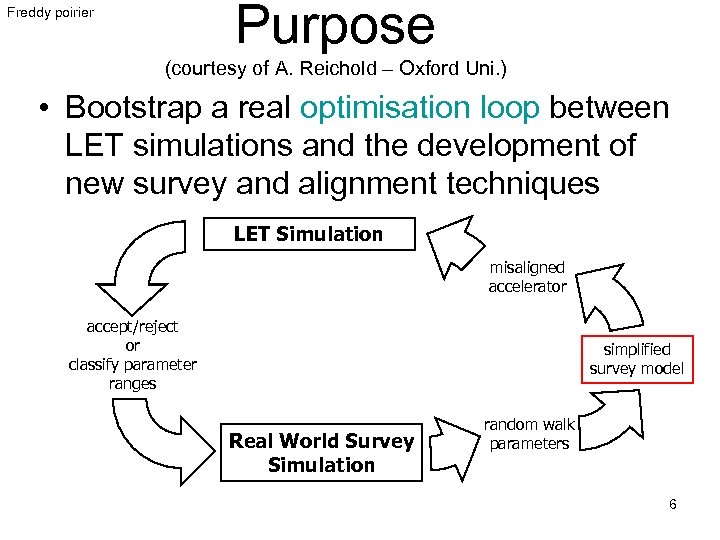 Purpose Freddy poirier (courtesy of A. Reichold – Oxford Uni. ) • Bootstrap a real optimisation loop between LET simulations and the development of new survey and alignment techniques LET Simulation misaligned accelerator accept/reject or classify parameter ranges simplified survey model Real World Survey Simulation random walk parameters 6
 Freddy poirier Real Survey & Alignment Processes • Survey and alignment for the ILC will consist of many techniques using many different measurements • We don’t know the entire chain yet – we know candidates for the linear tunnel reference survey (i. e. Li. CAS) – we know candidates for the site wide reference network O(km) differential GPS 7
 Freddy poirier Survey Model • A simplified alignment model has been proposed – For the tunnel reference survey based on a pseudorandom walk – Using the wide reference network (primary points) to correct the reference survey. • Components of the linac are then positioned according to the adjusted offsets of the survey line 8
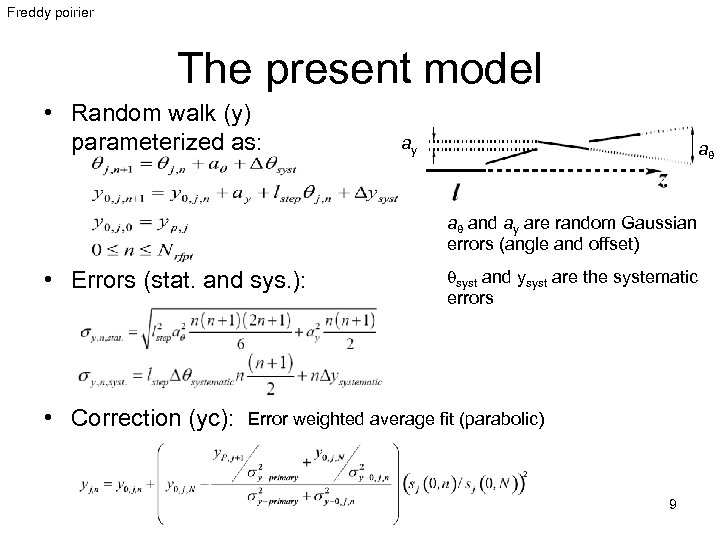 Freddy poirier The present model • Random walk (y) parameterized as: ay aq aq and ay are random Gaussian errors (angle and offset) • Errors (stat. and sys. ): • Correction (yc): qsyst and ysyst are the systematic errors Error weighted average fit (parabolic) 9
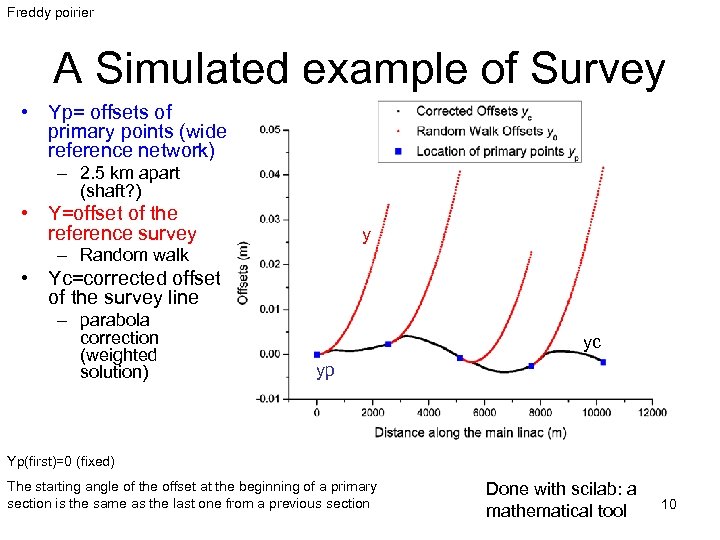 Freddy poirier A Simulated example of Survey • Yp= offsets of primary points (wide reference network) – 2. 5 km apart (shaft? ) • Y=offset of the reference survey y – Random walk • Yc=corrected offset of the survey line – parabola correction (weighted solution) yc yp Yp(first)=0 (fixed) The starting angle of the offset at the beginning of a primary section is the same as the last one from a previous section Done with scilab: a mathematical tool 10
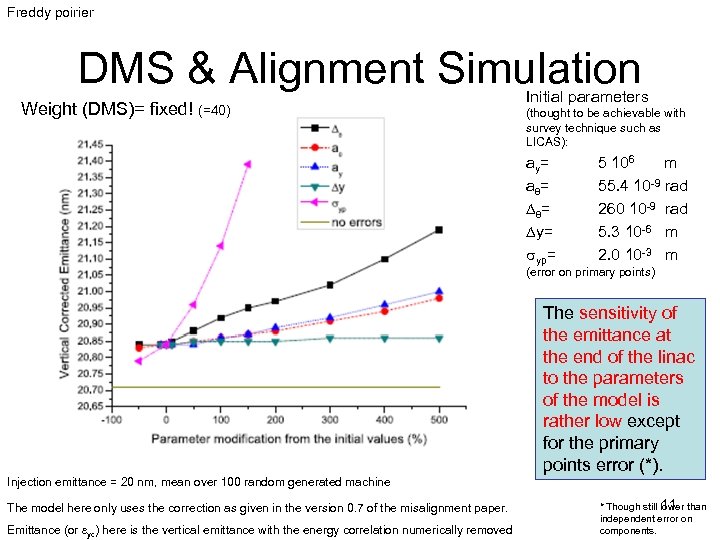 Freddy poirier DMS & Alignment Simulation Weight (DMS)= fixed! (=40) Initial parameters (thought to be achievable with survey technique such as LICAS): ay= aq = D q= Dy= syp= 5 106 m 55. 4 10 -9 rad 260 10 -9 rad 5. 3 10 -6 m 2. 0 10 -3 m (error on primary points) The sensitivity of the emittance at the end of the linac to the parameters of the model is rather low except for the primary points error (*). Injection emittance = 20 nm, mean over 100 random generated machine The model here only uses the correction as given in the version 0. 7 of the misalignment paper. Emittance (or eyc) here is the vertical emittance with the energy correlation numerically removed 11 * Though still lower than independent error on components.
 Freddy poirier Conclusion – Emittance growth with standard uncorrelated errors = ~2. 4 nm – Emittance growth (alignment model + std errors)=~2. 4 nm • Impact on the emittance growth of the alignment model with (initial) parameters thought to be achievable with survey techniques: – Negligible 12
 Freddy poirier Note • Traditionally (2007 ILC-GDE meeting) the alignment errors used are 200 mm/ 600 m of linac length. • With the initial parameters used here, the errors obtained from the monte-carlo alignment model are of ~100 mm/ 600 m (This includes the correction scheme) 13
 Freddy poirier Outlook • A first loop has been done here to use a simplified model characteristic of an alignment process. • This study is part of an on-going discussion between beam dynamics group and ILC metrology group. I would like to thank E. Elsen, K. Kubo, A. Reichold for discussions 14