


 Скачать презентацию Frankenstein Did I request thee Maker from my
6c7287a8556c2c0a2ee53dc247c0f6dd.ppt
- Количество слайдов: 23
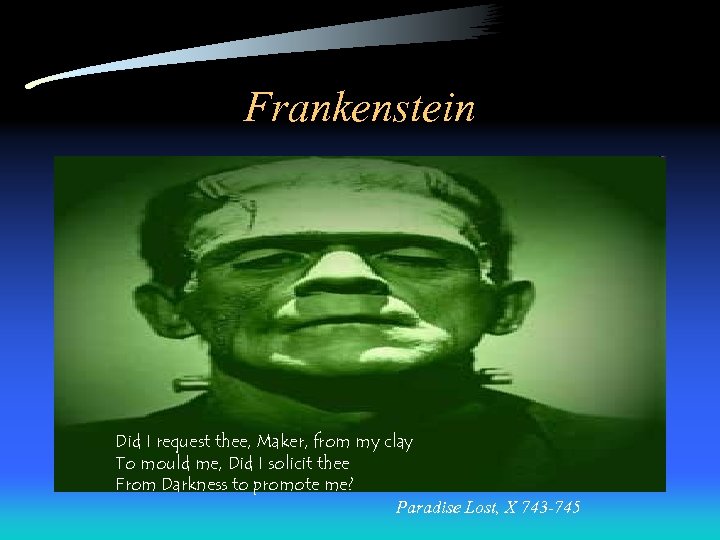 Frankenstein Did I request thee, Maker, from my clay To mould me, Did I solicit thee From Darkness to promote me? Paradise Lost, X 743 -745
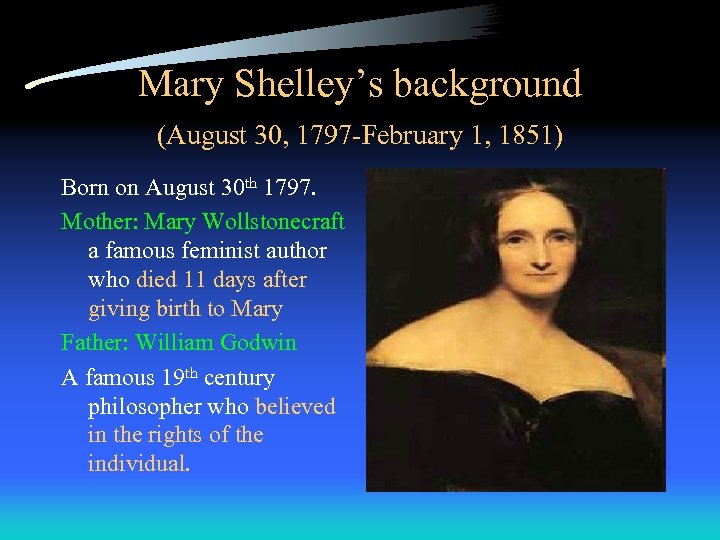 Mary Shelley’s background (August 30, 1797 -February 1, 1851) Born on August 30 th 1797. Mother: Mary Wollstonecraft a famous feminist author who died 11 days after giving birth to Mary Father: William Godwin A famous 19 th century philosopher who believed in the rights of the individual.
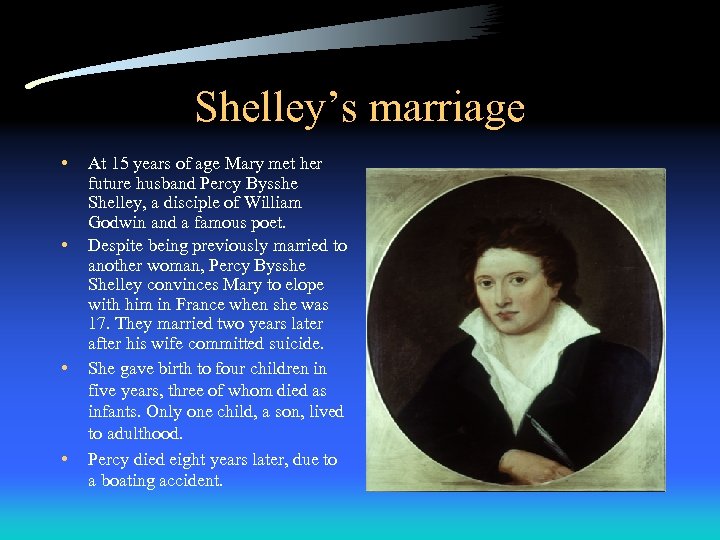 Shelley’s marriage • • At 15 years of age Mary met her future husband Percy Bysshe Shelley, a disciple of William Godwin and a famous poet. Despite being previously married to another woman, Percy Bysshe Shelley convinces Mary to elope with him in France when she was 17. They married two years later after his wife committed suicide. She gave birth to four children in five years, three of whom died as infants. Only one child, a son, lived to adulthood. Percy died eight years later, due to a boating accident.
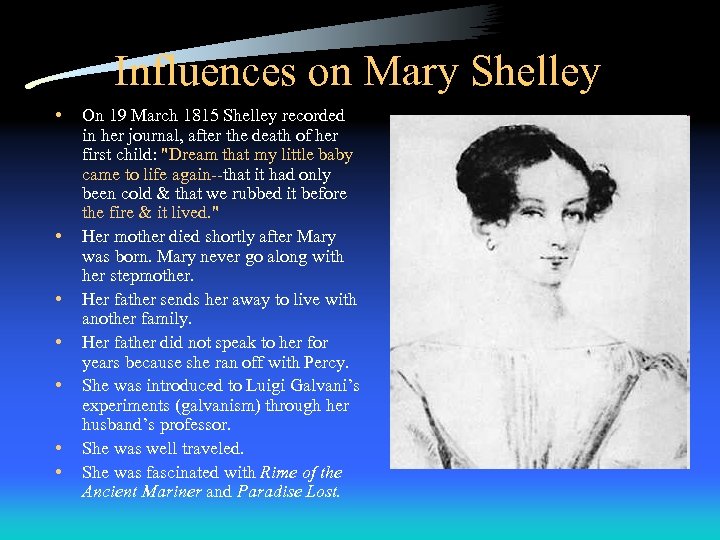 Influences on Mary Shelley • • On 19 March 1815 Shelley recorded in her journal, after the death of her first child: "Dream that my little baby came to life again--that it had only been cold & that we rubbed it before the fire & it lived. " Her mother died shortly after Mary was born. Mary never go along with her stepmother. Her father sends her away to live with another family. Her father did not speak to her for years because she ran off with Percy. She was introduced to Luigi Galvani’s experiments (galvanism) through her husband’s professor. She was well traveled. She was fascinated with Rime of the Ancient Mariner and Paradise Lost.
 Byron’s Challenge • In the summer of 1816, Percy and Mary visit Lord Byron’s estate in France. • The summer of 1816 had fall like weather because a massive volcano in Indonesia spewed ash around the world. • Because of the gloomy weather, Byron issued a challenge to his guests to create the best horror story. • For days Shelley could not think of an idea. Then, while she was listening to Lord Byron and Percy discussing the probability of using electricity to create life artificially, according to a theory called galvanism, an idea began to grow in her mind: Perhaps a corpse would be re-animated; galvanism had given token of such things: perhaps the component parts of a creature might be manufactured, brought together, and [endued] with vital warmth.
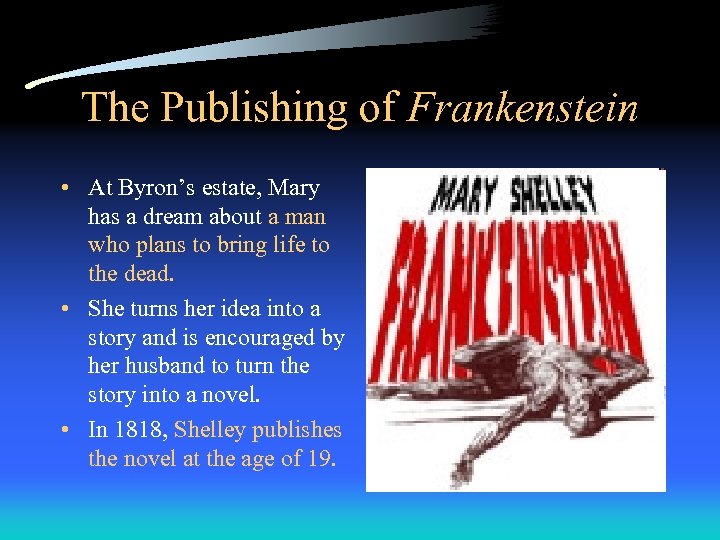 The Publishing of Frankenstein • At Byron’s estate, Mary has a dream about a man who plans to bring life to the dead. • She turns her idea into a story and is encouraged by her husband to turn the story into a novel. • In 1818, Shelley publishes the novel at the age of 19.
 The Publishing of Frankenstein • The novel was first printed • The second edition was anonymously with a published in 1822 and preface written by credited Shelley as an Shelley’s husband. author. • The novel was first • In 1831, the first popular published using the triple edition in one volume was decker format. Only 500 published. This version copies were published. was heavily revised to be more conservative.
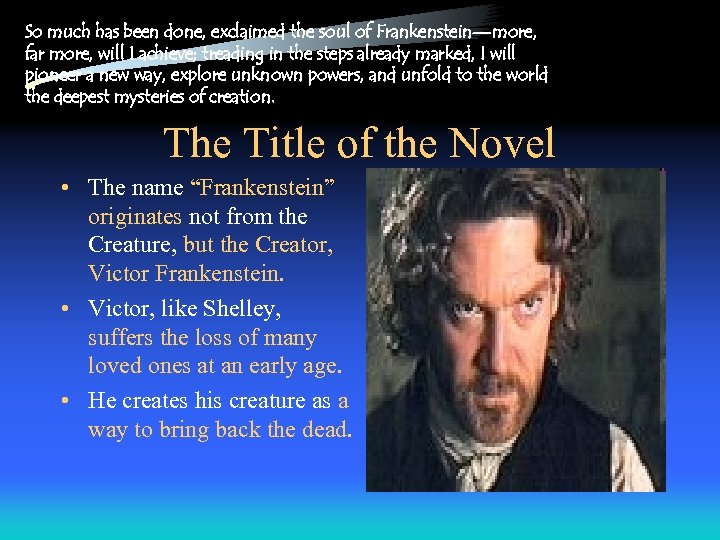 So much has been done, exclaimed the soul of Frankenstein—more, far more, will I achieve; treading in the steps already marked, I will pioneer a new way, explore unknown powers, and unfold to the world the deepest mysteries of creation. The Title of the Novel • The name “Frankenstein” originates not from the Creature, but the Creator, Victor Frankenstein. • Victor, like Shelley, suffers the loss of many loved ones at an early age. • He creates his creature as a way to bring back the dead.
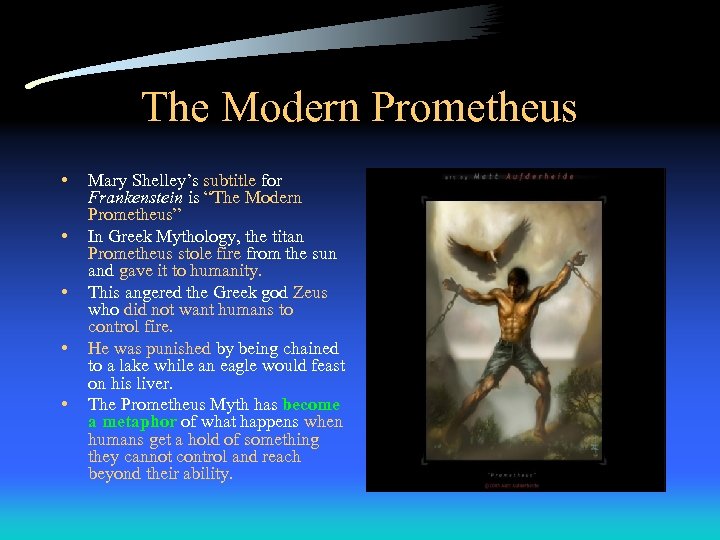 The Modern Prometheus • • • Mary Shelley’s subtitle for Frankenstein is “The Modern Prometheus” In Greek Mythology, the titan Prometheus stole fire from the sun and gave it to humanity. This angered the Greek god Zeus who did not want humans to control fire. He was punished by being chained to a lake while an eagle would feast on his liver. The Prometheus Myth has become a metaphor of what happens when humans get a hold of something they cannot control and reach beyond their ability.
 Science Fiction Era With Frankenstein, the sci-fi era began. The novel contains the 3 elements essential for all science fiction work: (1)“it’s based on valid scientific research; (2)gives a persuasive prediction of what science might achieve in the future; (3) and it offers a humanistic critique of the benefits and dangers of either the achievement or scientific thought. ” (p. xx)
 Romantic Novel Romantic Movement: (1770 -1870) This movement is not about “romance or love” but about disillusioned liberals who were tired of the common people being oppressed by tyrant rulers. This time period happens simultaneously with revolutions around the world: the American R. 1776, the French R. 1789, the French Reign of Terror 1793, Napoleon is crowned Emperor--1804. Nature imagery is a key element in Romantic literature because human tyranny could not control nature. For the Romantics, nature represented peace and they believed that all emotional healing came from nature. [Nature imagery is abundant in Frankenstein. ]
 Gothic Literature In addition, Gothic literature is “a style of fiction, especially in the late 18 th century and early 19 th century, with historical and picturesque settings, an atmosphere of mystery, gloom and terror, supernatural or psychological plot elements, with violent, gruesome deaths. ” (Webster) The setting is usually in medieval castles built in the Gothic style of architecture—with secret passageways, dungeons, and towers.
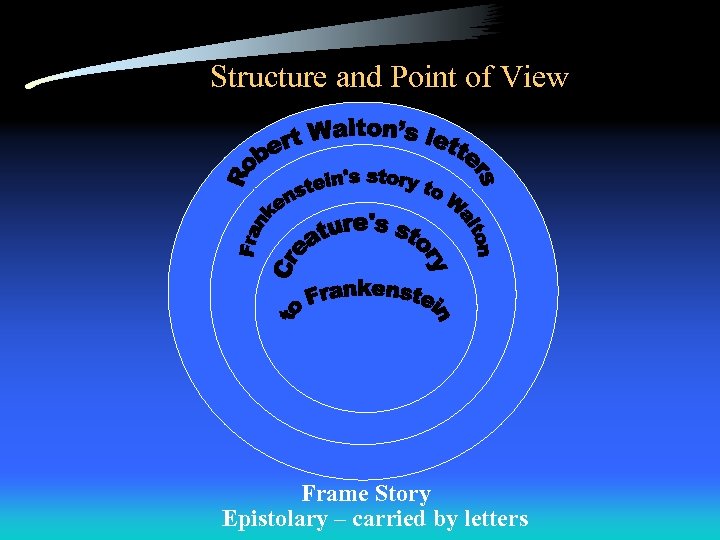 Structure and Point of View Frame Story Epistolary – carried by letters
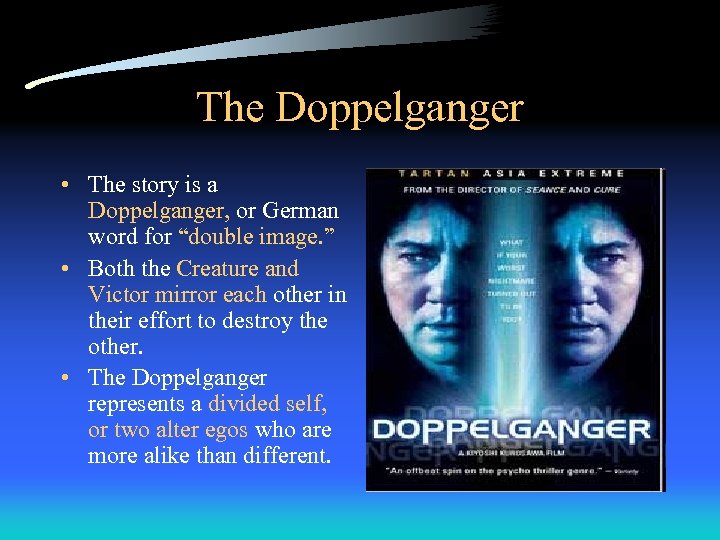 The Doppelganger • The story is a Doppelganger, or German word for “double image. ” • Both the Creature and Victor mirror each other in their effort to destroy the other. • The Doppelganger represents a divided self, or two alter egos who are more alike than different.
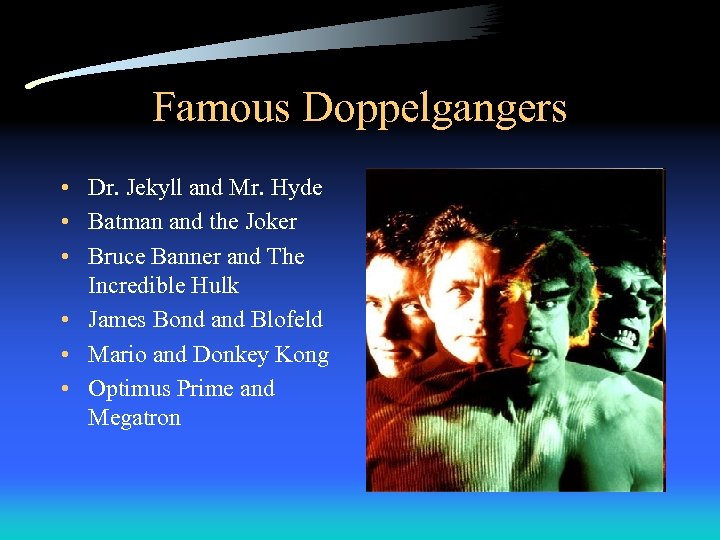 Famous Doppelgangers • Dr. Jekyll and Mr. Hyde • Batman and the Joker • Bruce Banner and The Incredible Hulk • James Bond and Blofeld • Mario and Donkey Kong • Optimus Prime and Megatron
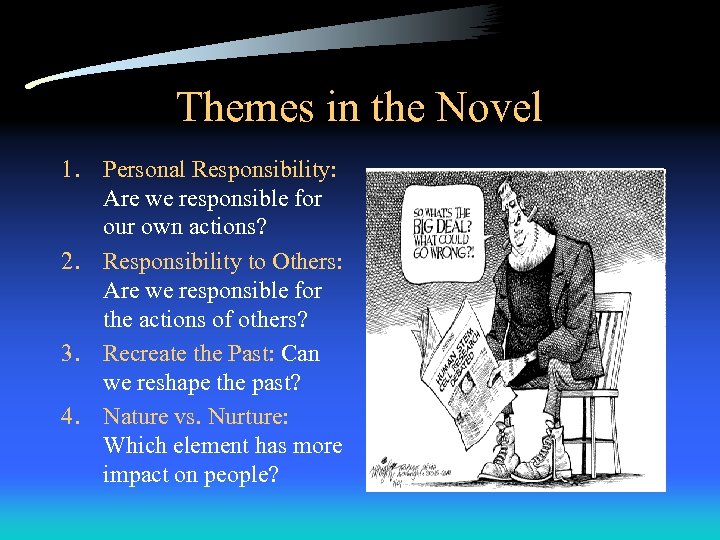 Themes in the Novel 1. Personal Responsibility: Are we responsible for our own actions? 2. Responsibility to Others: Are we responsible for the actions of others? 3. Recreate the Past: Can we reshape the past? 4. Nature vs. Nurture: Which element has more impact on people?
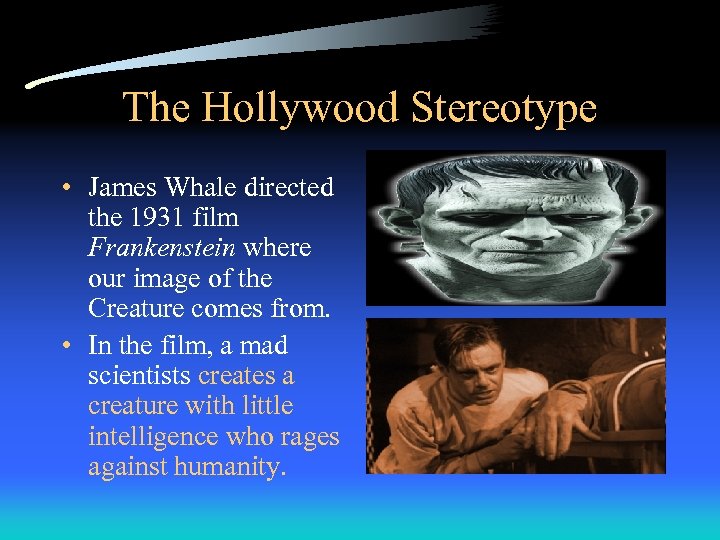 The Hollywood Stereotype • James Whale directed the 1931 film Frankenstein where our image of the Creature comes from. • In the film, a mad scientists creates a creature with little intelligence who rages against humanity.
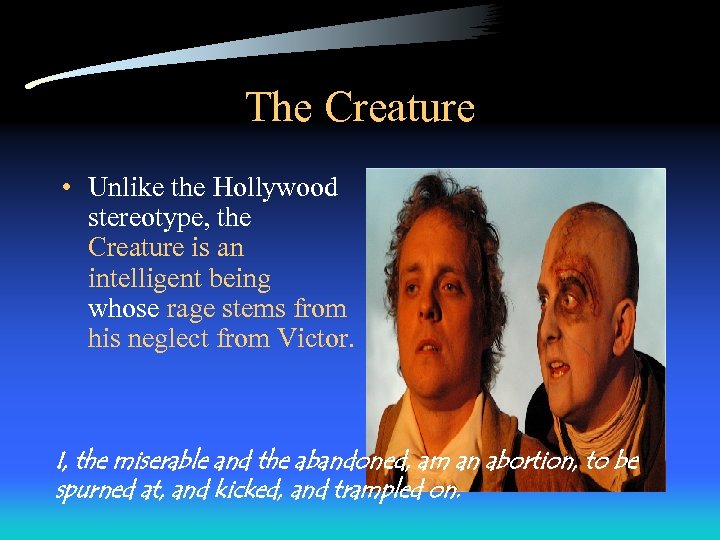 The Creature • Unlike the Hollywood stereotype, the Creature is an intelligent being whose rage stems from his neglect from Victor. I, the miserable and the abandoned, am an abortion, to be spurned at, and kicked, and trampled on.
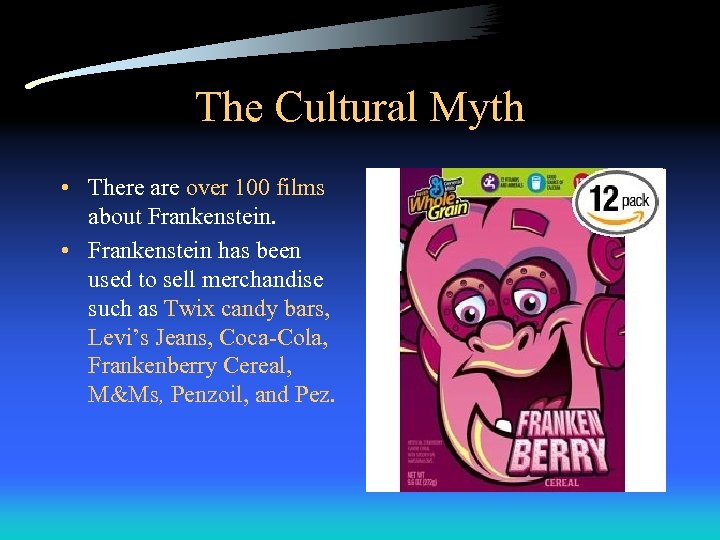 The Cultural Myth • There are over 100 films about Frankenstein. • Frankenstein has been used to sell merchandise such as Twix candy bars, Levi’s Jeans, Coca-Cola, Frankenberry Cereal, M&Ms, Penzoil, and Pez.
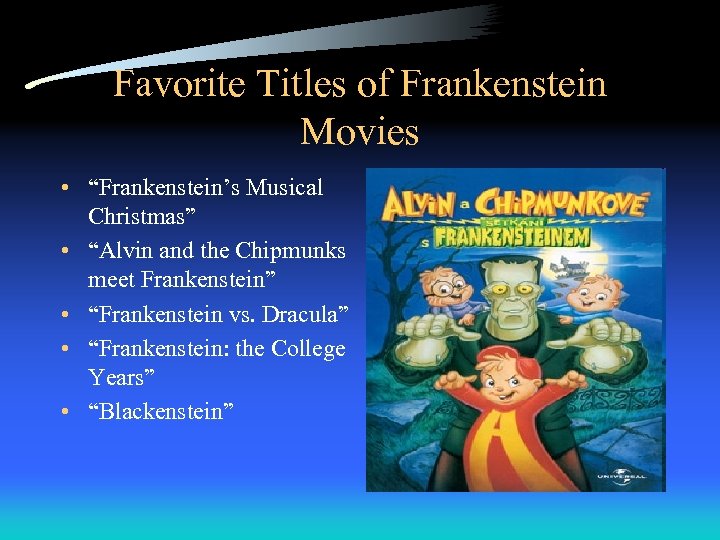 Favorite Titles of Frankenstein Movies • “Frankenstein’s Musical Christmas” • “Alvin and the Chipmunks meet Frankenstein” • “Frankenstein vs. Dracula” • “Frankenstein: the College Years” • “Blackenstein”
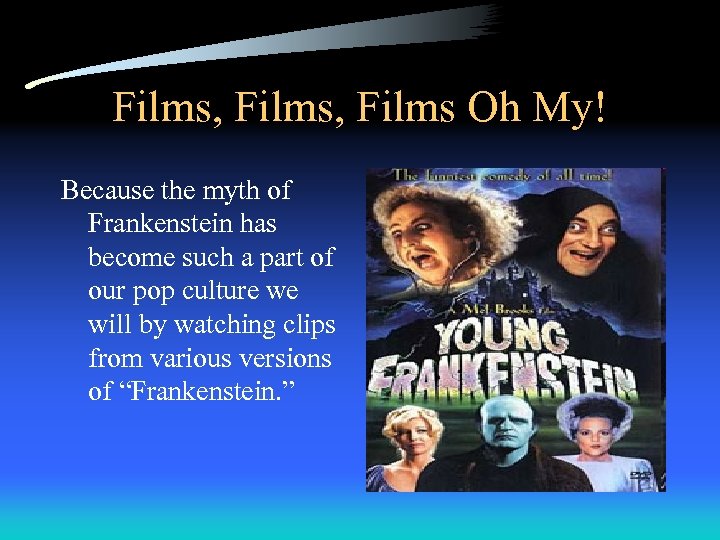 Films, Films Oh My! Because the myth of Frankenstein has become such a part of our pop culture we will by watching clips from various versions of “Frankenstein. ”
 Letters 1 -4 • Allusion to “Rime of the Ancient Mariner” • Structure of the book arranged (epistolary =“letters”) • “Stranger” = general narrator • Walton = substitute for audience • THEME: Quest for Knowledge can lead to selfdestruction – Walton suffers from “hubris” ; believes he is invincible – Walton’s values are questionable; does not honor his father’s dying request
 Works Cited • Art. com. 1995. Online October 5, 2003. http: //www. art. com • “Frankenstein. ” U. S. National Library of Medicine. 13 February 2002. Online.