


 Скачать презентацию France France officially the French
France. Никитин Н. А. 9С-32.pptx
- Количество слайдов: 19
 France
 • France officially the French Republic. • Type of Government Unitary semi-presidential constitutional republic
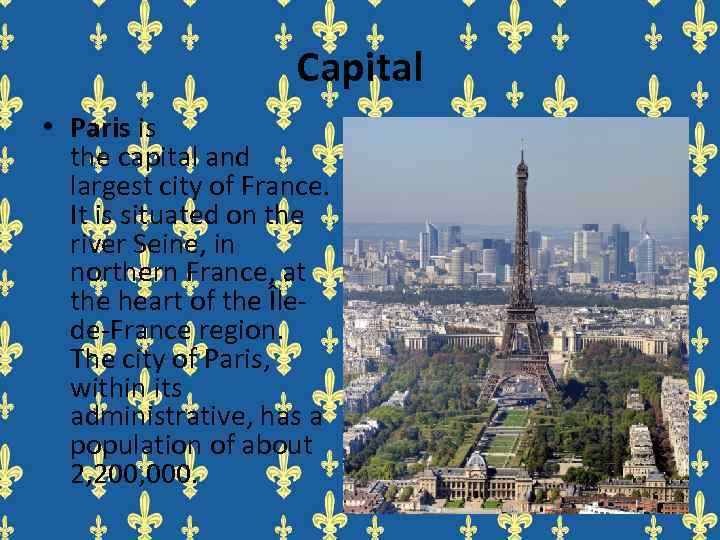 Capital • Paris is the capital and largest city of France. It is situated on the river Seine, in northern France, at the heart of the Îlede-France region. The city of Paris, within its administrative, has a population of about 2, 200, 000.
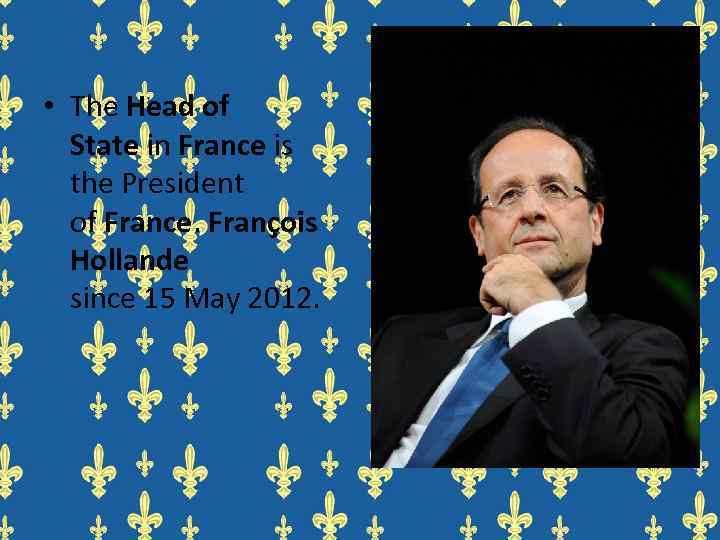 • The Head of State in France is the President of France. François Hollande since 15 May 2012.
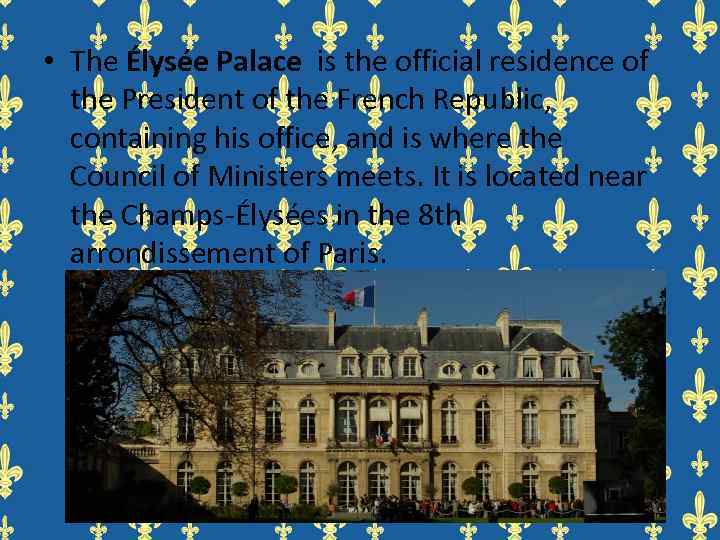 • The Élysée Palace is the official residence of the President of the French Republic, containing his office, and is where the Council of Ministers meets. It is located near the Champs-Élysées in the 8 th arrondissement of Paris.
 • The population of France has about 65 million people. The continental France is home 60876136 people. In terms of population France is ranked 20 th among 192 countries - members of the United Nations.
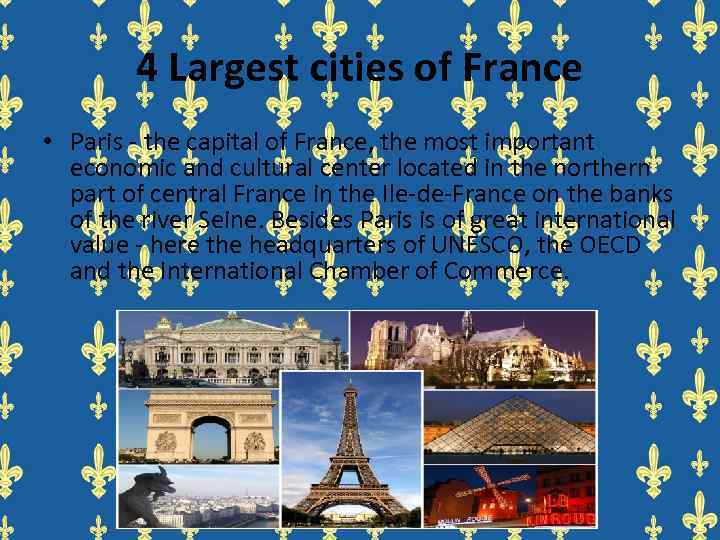 4 Largest cities of France • Paris - the capital of France, the most important economic and cultural center located in the northern part of central France in the Ile-de-France on the banks of the river Seine. Besides Paris is of great international value - here the headquarters of UNESCO, the OECD and the International Chamber of Commerce.
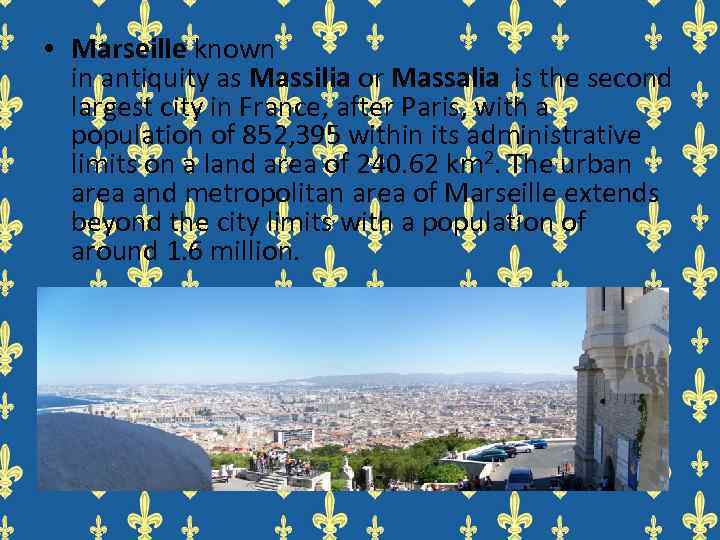 • Marseille known in antiquity as Massilia or Massalia is the second largest city in France, after Paris, with a population of 852, 395 within its administrative limits on a land area of 240. 62 km 2. The urban area and metropolitan area of Marseille extends beyond the city limits with a population of around 1. 6 million.
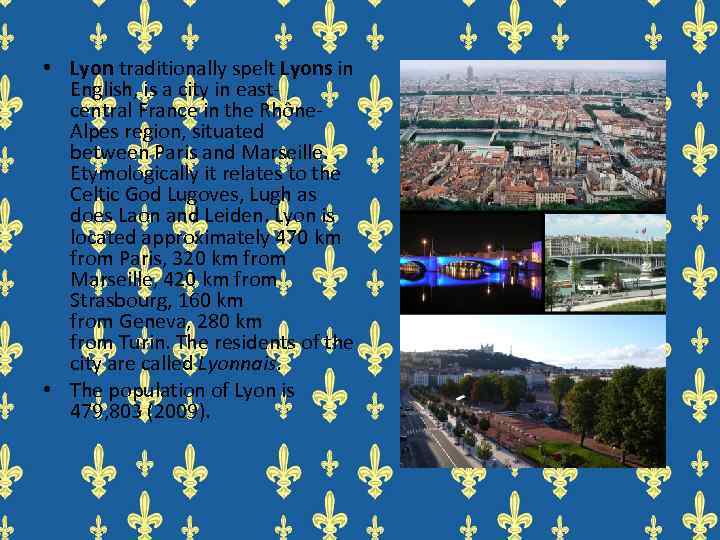 • Lyon traditionally spelt Lyons in English, is a city in eastcentral France in the Rhône. Alpes region, situated between Paris and Marseille. Etymologically it relates to the Celtic God Lugoves, Lugh as does Laon and Leiden. Lyon is located approximately 470 km from Paris, 320 km from Marseille, 420 km from Strasbourg, 160 km from Geneva, 280 km from Turin. The residents of the city are called Lyonnais. • The population of Lyon is 479, 803 (2009).
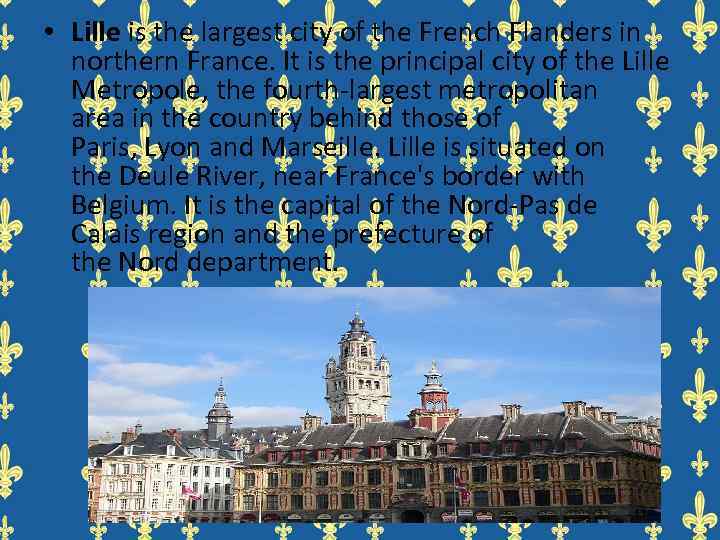 • Lille is the largest city of the French Flanders in northern France. It is the principal city of the Lille Metropole, the fourth-largest metropolitan area in the country behind those of Paris, Lyon and Marseille. Lille is situated on the Deule River, near France's border with Belgium. It is the capital of the Nord-Pas de Calais region and the prefecture of the Nord department.
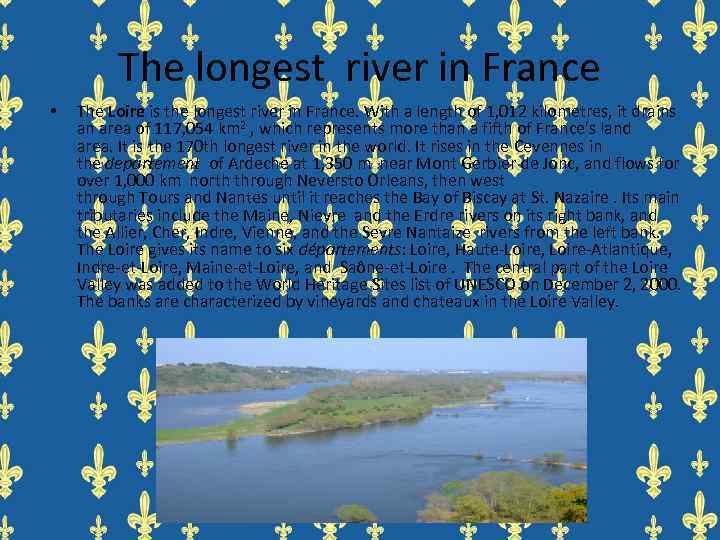 The longest river in France • The Loire is the longest river in France. With a length of 1, 012 kilometres, it drains an area of 117, 054 km 2 , which represents more than a fifth of France's land area. It is the 170 th longest river in the world. It rises in the Cevennes in the departement of Ardeche at 1, 350 m near Mont Gerbier de Jonc, and flows for over 1, 000 km north through Neversto Orleans, then west through Tours and Nantes until it reaches the Bay of Biscay at St. Nazaire. Its main tributaries include the Maine, Nievre and the Erdre rivers on its right bank, and the Allier, Cher, Indre, Vienne, and the Sevre Nantaize rivers from the left bank. The Loire gives its name to six départements: Loire, Haute-Loire, Loire-Atlantique, Indre-et-Loire, Maine-et-Loire, and Saône-et-Loire. The central part of the Loire Valley was added to the World Heritage Sites list of UNESCO on December 2, 2000. The banks are characterized by vineyards and chateaux in the Loire Valley.
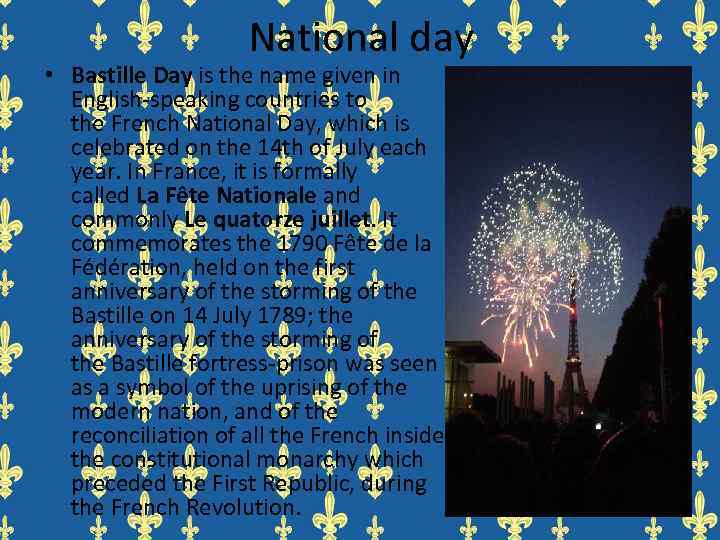 National day • Bastille Day is the name given in English-speaking countries to the French National Day, which is celebrated on the 14 th of July each year. In France, it is formally called La Fête Nationale and commonly Le quatorze juillet. It commemorates the 1790 Fête de la Fédération, held on the first anniversary of the storming of the Bastille on 14 July 1789; the anniversary of the storming of the Bastille fortress-prison was seen as a symbol of the uprising of the modern nation, and of the reconciliation of all the French inside the constitutional monarchy which preceded the First Republic, during the French Revolution.
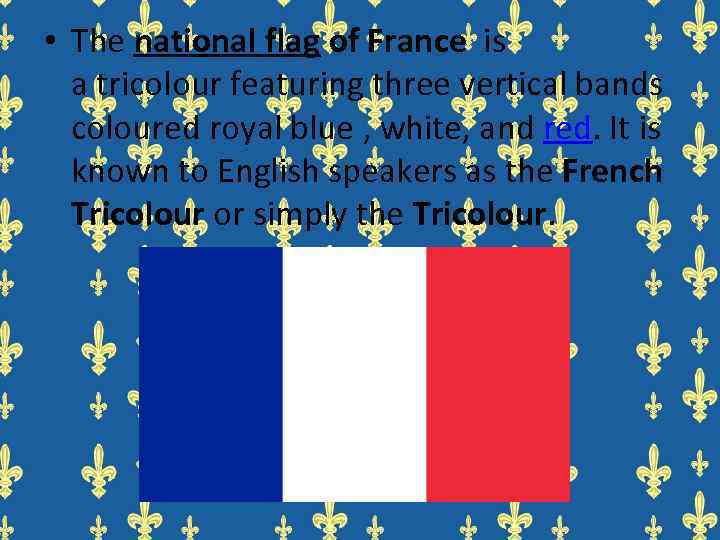 • The national flag of France is a tricolour featuring three vertical bands coloured royal blue , white, and red. It is known to English speakers as the French Tricolour or simply the Tricolour.
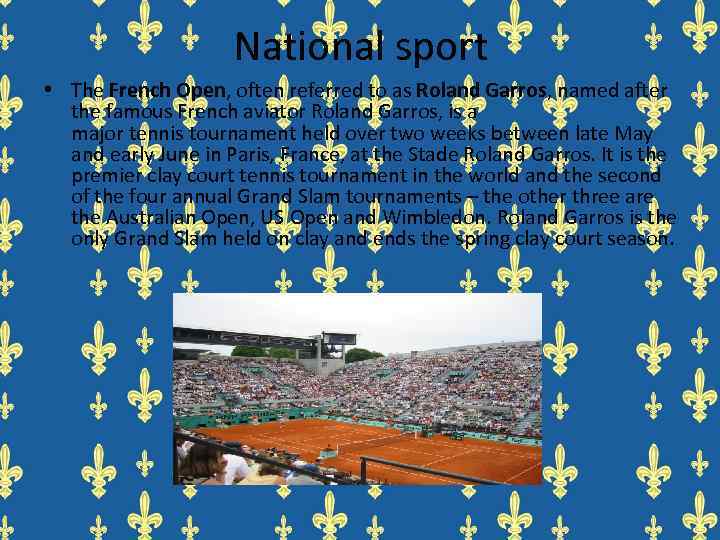 National sport • The French Open, often referred to as Roland Garros, named after the famous French aviator Roland Garros, is a major tennis tournament held over two weeks between late May and early June in Paris, France, at the Stade Roland Garros. It is the premier clay court tennis tournament in the world and the second of the four annual Grand Slam tournaments – the other three are the Australian Open, US Open and Wimbledon. Roland Garros is the only Grand Slam held on clay and ends the spring clay court season.
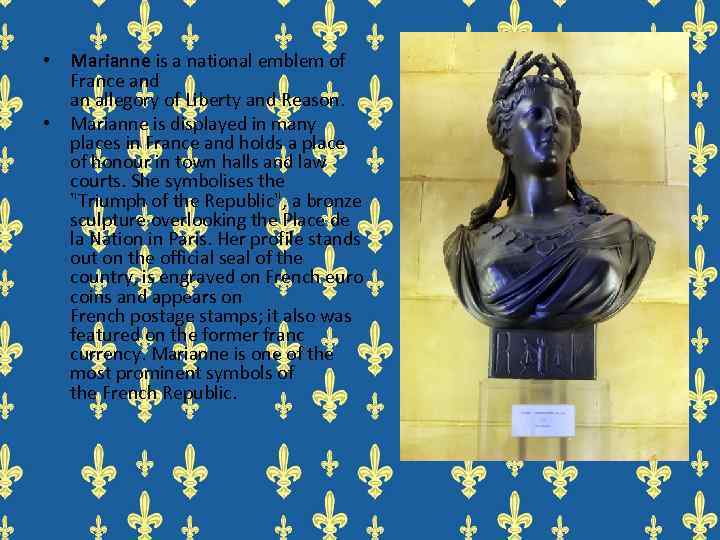 • Marianne is a national emblem of France and an allegory of Liberty and Reason. • Marianne is displayed in many places in France and holds a place of honour in town halls and law courts. She symbolises the "Triumph of the Republic", a bronze sculpture overlooking the Place de la Nation in Paris. Her profile stands out on the official seal of the country, is engraved on French euro coins and appears on French postage stamps; it also was featured on the former franc currency. Marianne is one of the most prominent symbols of the French Republic.
 Regions of France • Aquitaine, archaic Guyenne/Guienne , is one of the 27 regions of France, in the south-western part of metropolitan France, along the Atlantic Ocean and the Pyrenees mountain range on the border with Spain. It is composed of the 5 departments of Dordogne, Lot et Garonne, Pyrénées. Atlantiques, Landes and Gironde. In the Middle Ages Aquitaine was a kingdom and a duchy, whose boundaries fluctuated considerably.
 • Brittany is one of the 27 regions of France. It occupies a large peninsula in the northwest of the country, lying between the English Channel to the north and the Bay of Biscay to the south. Its capital is Rennes.
 • Burgundy is one of the. The name comes from the Burgundians, an ancient Germanic people originating in Bornholm who settled in the area during the early Middle Ages. The Old Norse name for Bornholm was Burgundaholmr. An example of an equivalent name in presentday Scandinavia is Borgund in Norway. 27 regions of France.
 • Upper Normandy is one of the 27 regions of France. It was created in 1984 from two départements: Seine. Maritime and Eure, when Normandy was divided into Lower Normandy and Upper Normandy. This division continues to provoke controversy, and many people continue to call for reuniting the two regions.