


 Скачать презентацию Frameworks Product Lines The frame for reuse
d6addce94b6731c883930eec30ce8dd4.ppt
- Количество слайдов: 51
 Frameworks / Product Lines The frame for reuse Henrik Bærbak Christensen 1
 Motivation I have presented some design principles – 3 -1 -2 process: encapsulate variation, program to an interface and compose behaviour using delegation – Compositional design • it is better to reuse code by delegation than inheritance • let someone else do the dirty job – Iterative and Incremental search for variability • supported by TDD • supported by refactoring . . . and on the way we discovered some patterns Henrik Bærbak Christensen 2
 Abstracting What I have actually done is to show you the pieces that together form the puzzle called frameworks: Framework: – A framework is a set of cooperating classes that make up a reusable design for a specific class of software. [Go. F] Exercise: – Is the pay station a framework given this definition? – Argue why Mini. Draw is a framework. Henrik Bærbak Christensen 3
 Framework Characteristics A framework is characterized by – reuse of both design as well as executable code – reuse within a well defined domain • Swing is for GUI’s, not for banking… – high reuse percentage (70 -90%) – must be customized for customer’s particular need Example: – – HP printer software Eclipse IDE plug-in architecture Celcius. Tech C&C for ships Java Swing Henrik Bærbak Christensen 4
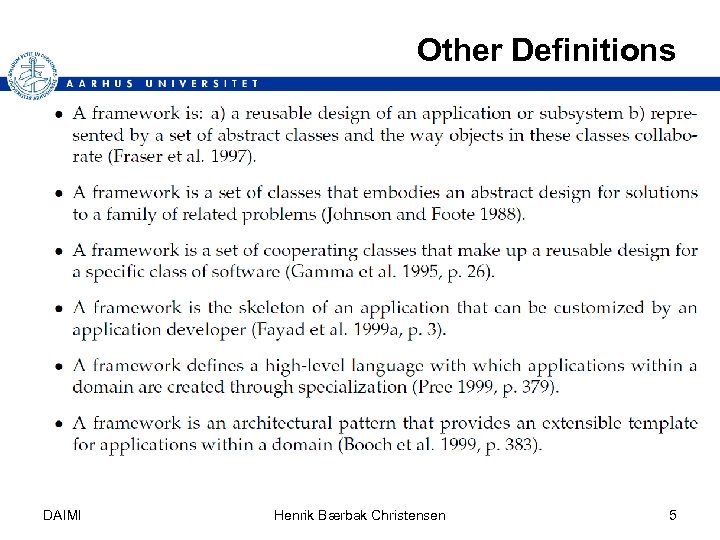 Other Definitions DAIMI Henrik Bærbak Christensen 5
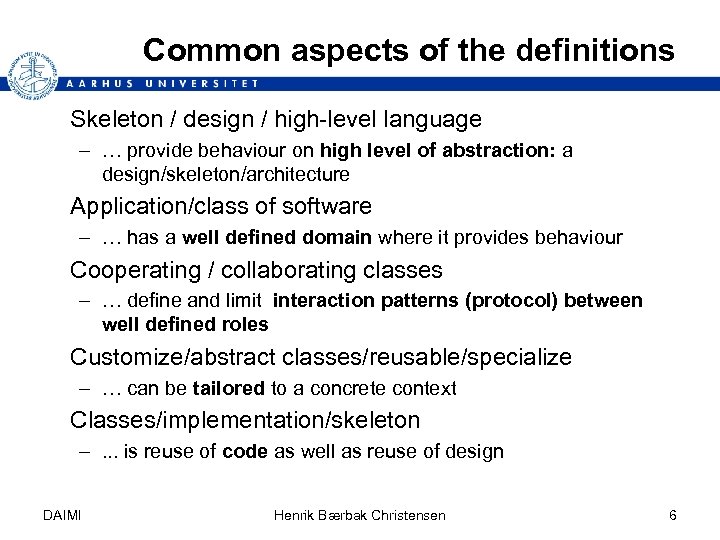 Common aspects of the definitions Skeleton / design / high-level language – … provide behaviour on high level of abstraction: a design/skeleton/architecture Application/class of software – … has a well defined domain where it provides behaviour Cooperating / collaborating classes – … define and limit interaction patterns (protocol) between well defined roles Customize/abstract classes/reusable/specialize – … can be tailored to a concrete context Classes/implementation/skeleton –. . . is reuse of code as well as reuse of design DAIMI Henrik Bærbak Christensen 6
 Variability points = Hotspots Henrik Bærbak Christensen
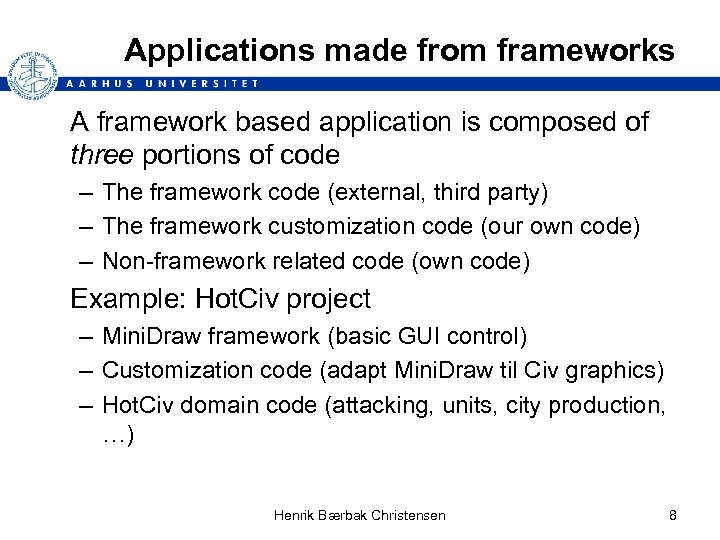 Applications made from frameworks A framework based application is composed of three portions of code – The framework code (external, third party) – The framework customization code (our own code) – Non-framework related code (own code) Example: Hot. Civ project – Mini. Draw framework (basic GUI control) – Customization code (adapt Mini. Draw til Civ graphics) – Hot. Civ domain code (attacking, units, city production, …) Henrik Bærbak Christensen 8
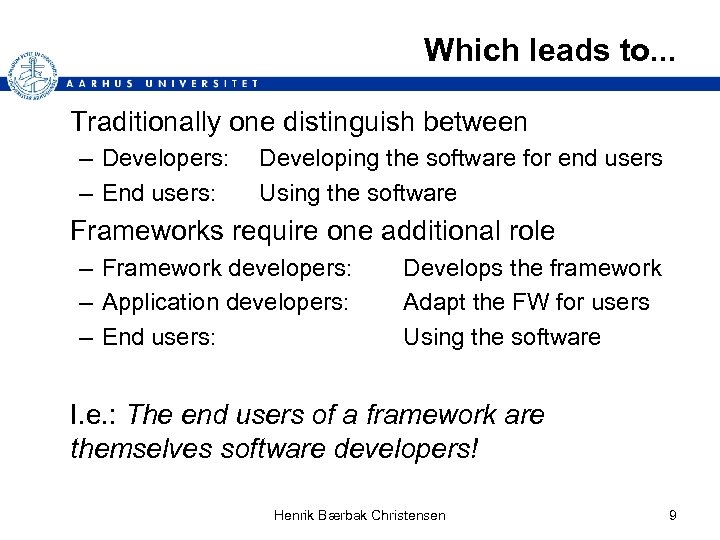 Which leads to. . . Traditionally one distinguish between – Developers: – End users: Developing the software for end users Using the software Frameworks require one additional role – Framework developers: – Application developers: – End users: Develops the framework Adapt the FW for users Using the software I. e. : The end users of a framework are themselves software developers! Henrik Bærbak Christensen 9
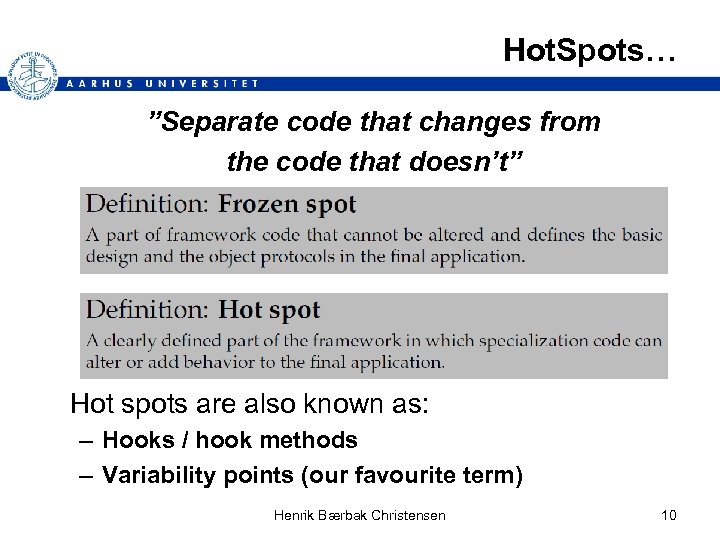 Hot. Spots… ”Separate code that changes from the code that doesn’t” Hot spots are also known as: – Hooks / hook methods – Variability points (our favourite term) Henrik Bærbak Christensen 10
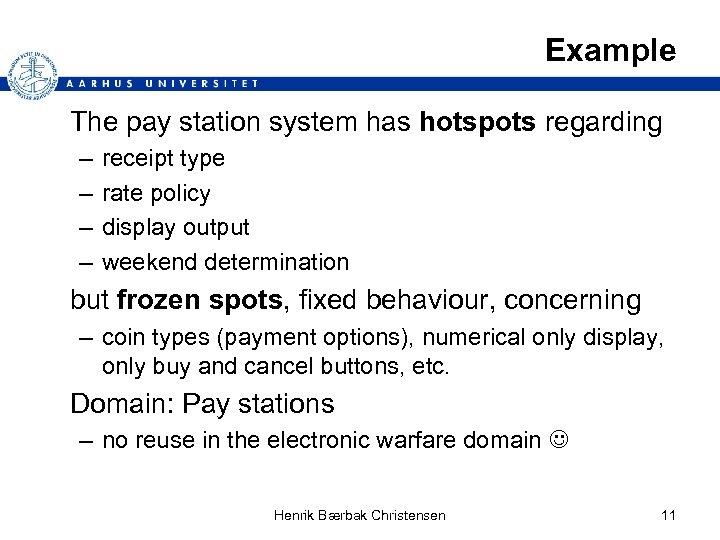 Example The pay station system has hotspots regarding – – receipt type rate policy display output weekend determination but frozen spots, fixed behaviour, concerning – coin types (payment options), numerical only display, only buy and cancel buttons, etc. Domain: Pay stations – no reuse in the electronic warfare domain Henrik Bærbak Christensen 11
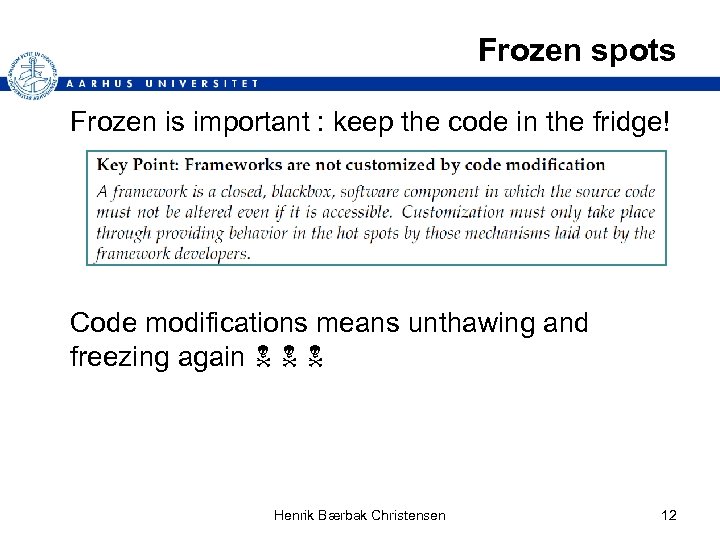 Frozen spots Frozen is important : keep the code in the fridge! Code modifications means unthawing and freezing again Henrik Bærbak Christensen 12
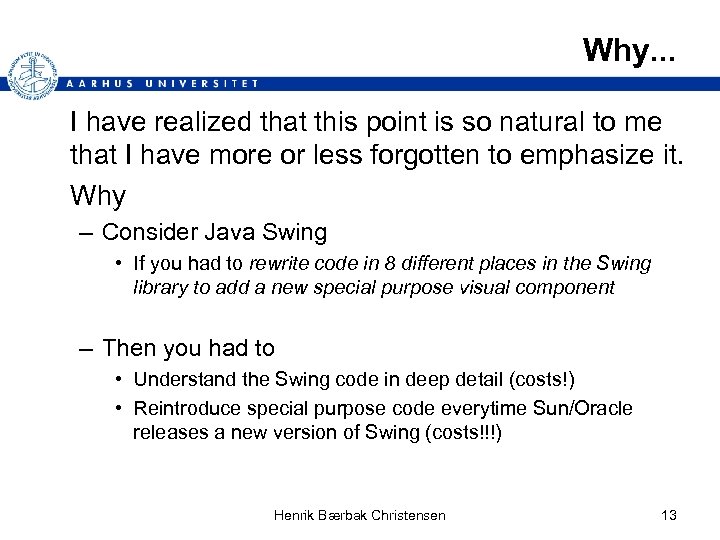 Why. . . I have realized that this point is so natural to me that I have more or less forgotten to emphasize it. Why – Consider Java Swing • If you had to rewrite code in 8 different places in the Swing library to add a new special purpose visual component – Then you had to • Understand the Swing code in deep detail (costs!) • Reintroduce special purpose code everytime Sun/Oracle releases a new version of Swing (costs!!!) Henrik Bærbak Christensen 13
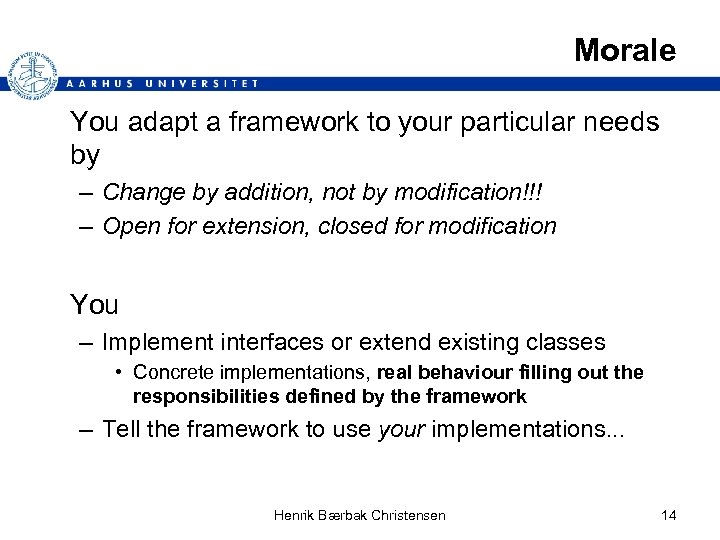 Morale You adapt a framework to your particular needs by – Change by addition, not by modification!!! – Open for extension, closed for modification You – Implement interfaces or extend existing classes • Concrete implementations, real behaviour filling out the responsibilities defined by the framework – Tell the framework to use your implementations. . . Henrik Bærbak Christensen 14
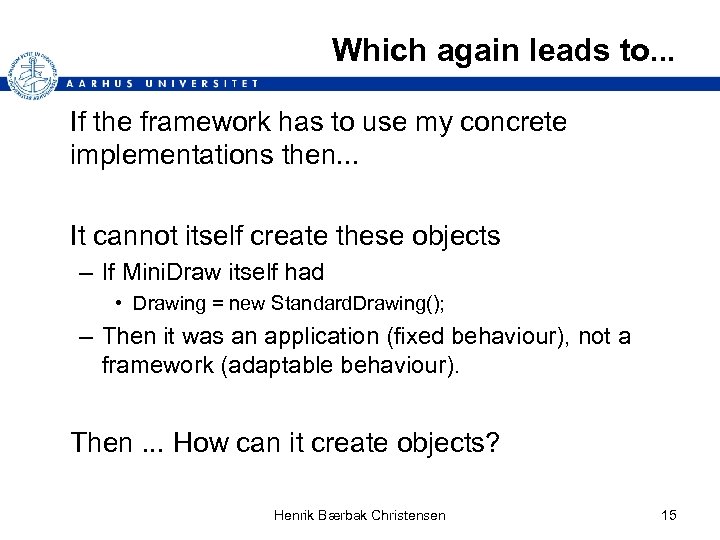 Which again leads to. . . If the framework has to use my concrete implementations then. . . It cannot itself create these objects – If Mini. Draw itself had • Drawing = new Standard. Drawing(); – Then it was an application (fixed behaviour), not a framework (adaptable behaviour). Then. . . How can it create objects? Henrik Bærbak Christensen 15
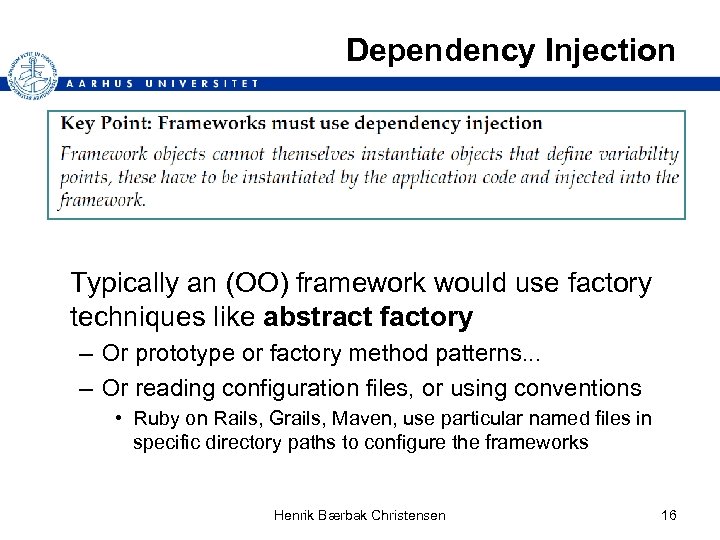 Dependency Injection Typically an (OO) framework would use factory techniques like abstract factory – Or prototype or factory method patterns. . . – Or reading configuration files, or using conventions • Ruby on Rails, Grails, Maven, use particular named files in specific directory paths to configure the frameworks Henrik Bærbak Christensen 16
 Customization Techniques Henrik Bærbak Christensen
 Techniques to define hotspots We have object oriented composition to define hotspots. We have also looked at other techniques – Parameterization, overriding superclass methods Henrik Bærbak Christensen 18
 Hot. Spots Exercise: List techniques to make the hotspots – Hint: Consider techniques used in • • • Mini. Draw Swing Java RMI Collection classes Eclipse C library sorting algorithms Intel 486 interrupt vector handling Functional languages Amiga libraries Does a Framework require object-orientation? Henrik Bærbak Christensen 19
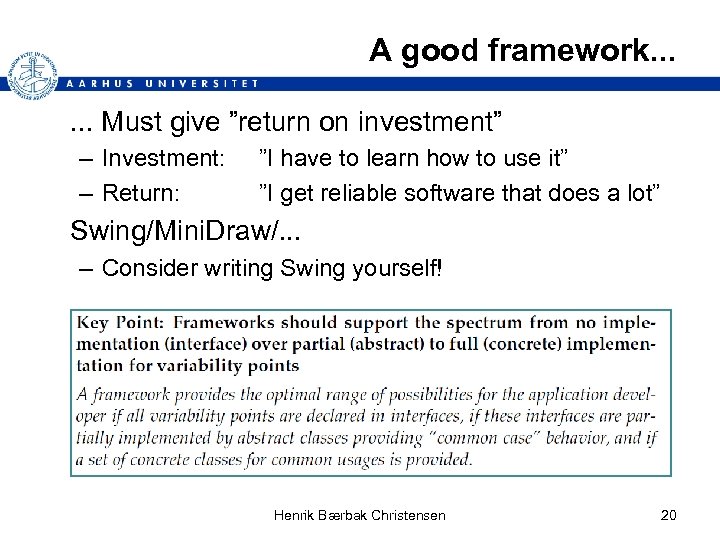 A good framework. . . . Must give ”return on investment” – Investment: – Return: ”I have to learn how to use it” ”I get reliable software that does a lot” Swing/Mini. Draw/. . . – Consider writing Swing yourself! Henrik Bærbak Christensen 20
 In the old times. . . Henrik Bærbak Christensen 21
 Henrik Bærbak Christensen 22
 Framework Protocol
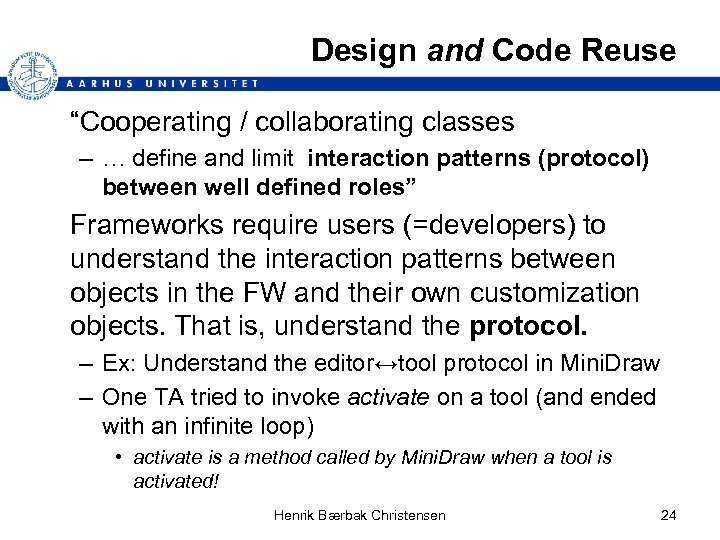 Design and Code Reuse “Cooperating / collaborating classes – … define and limit interaction patterns (protocol) between well defined roles” Frameworks require users (=developers) to understand the interaction patterns between objects in the FW and their own customization objects. That is, understand the protocol. – Ex: Understand the editor↔tool protocol in Mini. Draw – One TA tried to invoke activate on a tool (and ended with an infinite loop) • activate is a method called by Mini. Draw when a tool is activated! Henrik Bærbak Christensen 24
 Where is the protocol? So: The framework dictates the protocol! The question is: How? Henrik Bærbak Christensen 25
 Protocol The protocol arise because objects in the framework invokes methods on objects that are defined by you. These methods/functions/procedures that are predefined by the framework to be ‘overridable’ or customizable are the hotspots. A framework contains frozen code with embedded hotspots where your (unfrozen) code may be called. Henrik Bærbak Christensen 26
 Inversion of Control This property of frameworks is called Inversion of Control (”Hollywood principle: do not call us, we will call you. ) The framework dictates the prototocol – the customization code just has to obey it! Henrik Bærbak Christensen 27
 Compare ‘traditional’ reuse Another type of reuse of code (more than design) is libraries I have never written my own cosine function – have you? There are lot of libraries of usable behavior out there that does not invert control. Henrik Bærbak Christensen 28
 Inversion of Control Note: inversion of control is not a ’required’ characteristics of a framework in some author’s view – RMI is an example. The control inversion is difficult to spot. . . – (but why is it not just a library then? ? ? ) Henrik Bærbak Christensen 29
 Template Method The central OO pattern to separate frozen and hot code The core of the inverted control Henrik Bærbak Christensen 30
 Template Method Intent (Original Go. F statement) – Define the skeleton of an algorithm in an operation, deferring some steps to subclasses. Template Method lets subclasses redefine certain steps of an algorithm without changing the algorithm's structure. Restatement – Some steps in the algorithm are fixed but some steps I would like to keep open for future modifications to the behaviour Henrik Bærbak Christensen 31
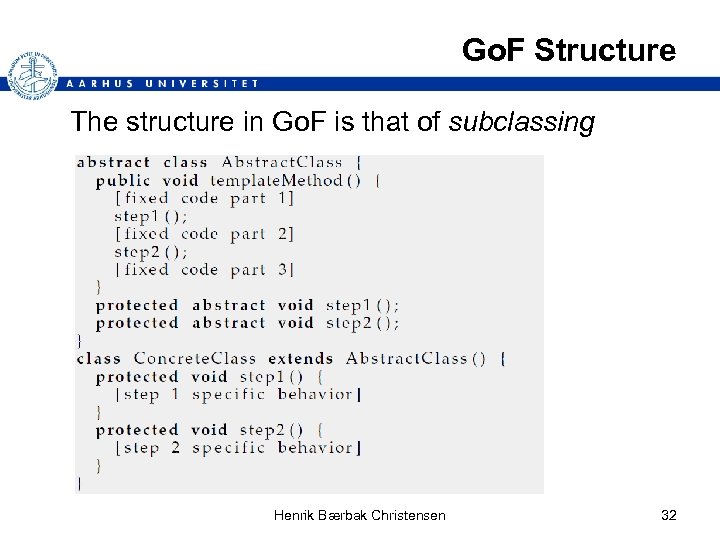 Go. F Structure The structure in Go. F is that of subclassing Henrik Bærbak Christensen 32
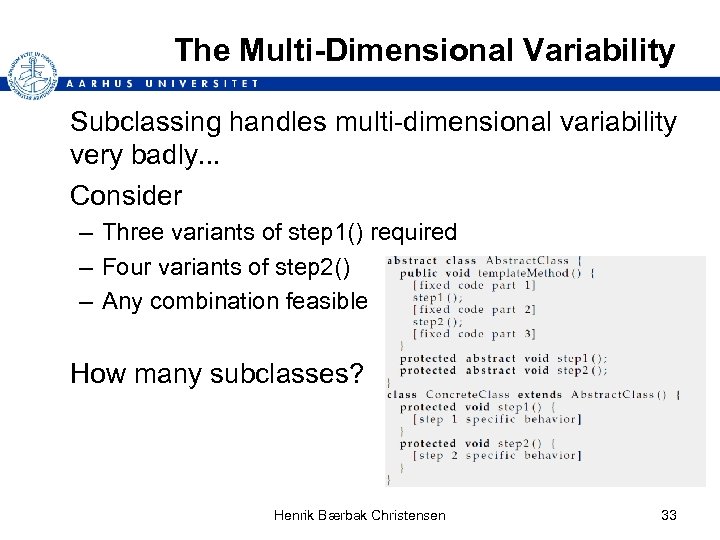 The Multi-Dimensional Variability Subclassing handles multi-dimensional variability very badly. . . Consider – Three variants of step 1() required – Four variants of step 2() – Any combination feasible How many subclasses? Henrik Bærbak Christensen 33
 Conclusion Conclusion: Favour object composition over class inheritance Henrik Bærbak Christensen 34
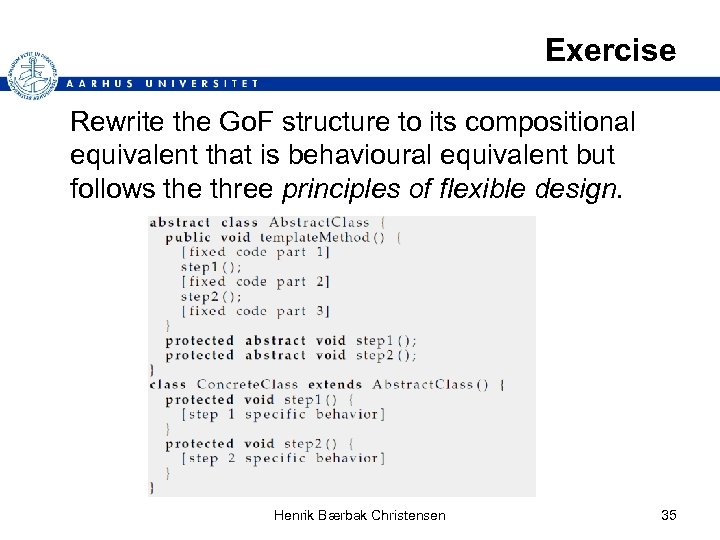 Exercise Rewrite the Go. F structure to its compositional equivalent that is behavioural equivalent but follows the three principles of flexible design. Henrik Bærbak Christensen 35
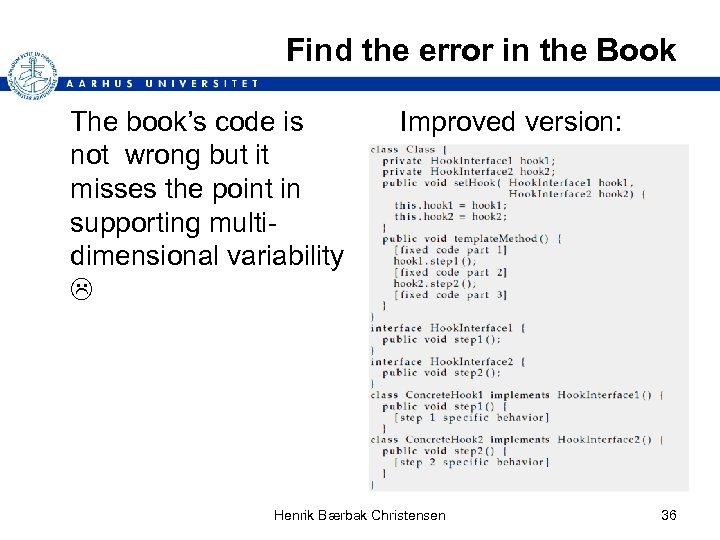 Find the error in the Book The book’s code is Improved version: not wrong but it misses the point in supporting multidimensional variability Henrik Bærbak Christensen 36
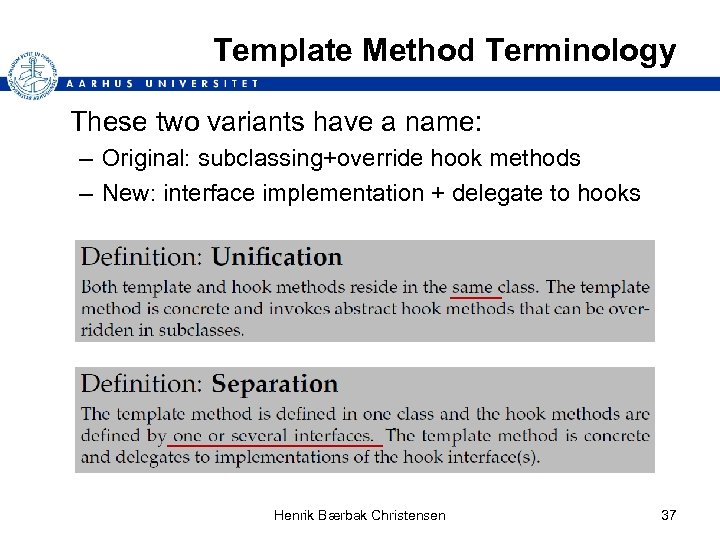 Template Method Terminology These two variants have a name: – Original: subclassing+override hook methods – New: interface implementation + delegate to hooks Henrik Bærbak Christensen 37
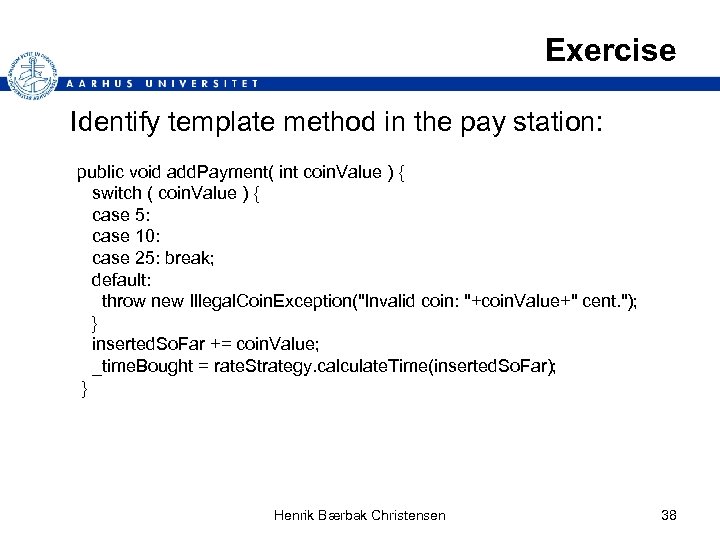 Exercise Identify template method in the pay station: public void add. Payment( int coin. Value ) { switch ( coin. Value ) { case 5: case 10: case 25: break; default: throw new Illegal. Coin. Exception("Invalid coin: "+coin. Value+" cent. "); } inserted. So. Far += coin. Value; _time. Bought = rate. Strategy. calculate. Time(inserted. So. Far); } Henrik Bærbak Christensen 38
 Exercise How does template method relate to the inversion of control property of frameworks? Henrik Bærbak Christensen 39
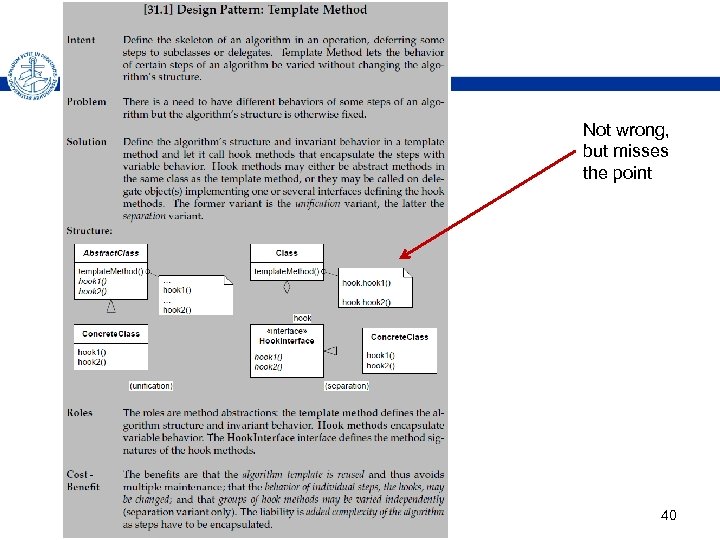 Not wrong, but misses the point Henrik Bærbak Christensen 40
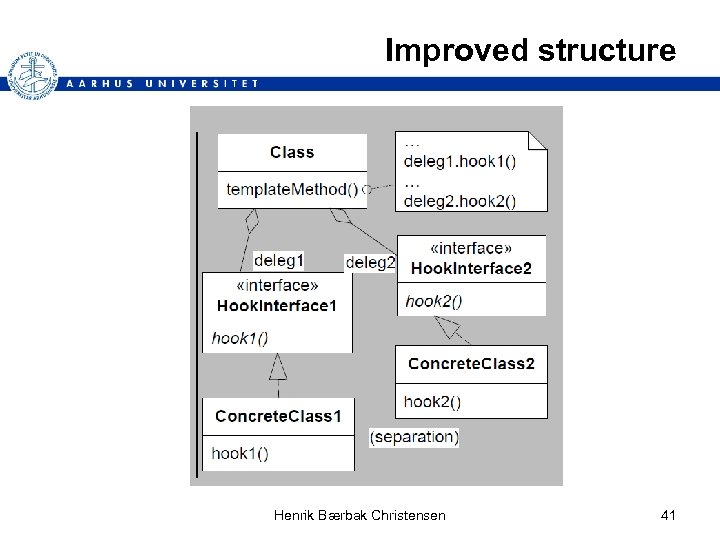 Improved structure Henrik Bærbak Christensen 41
 Another Case for Composition Henrik Bærbak Christensen 42
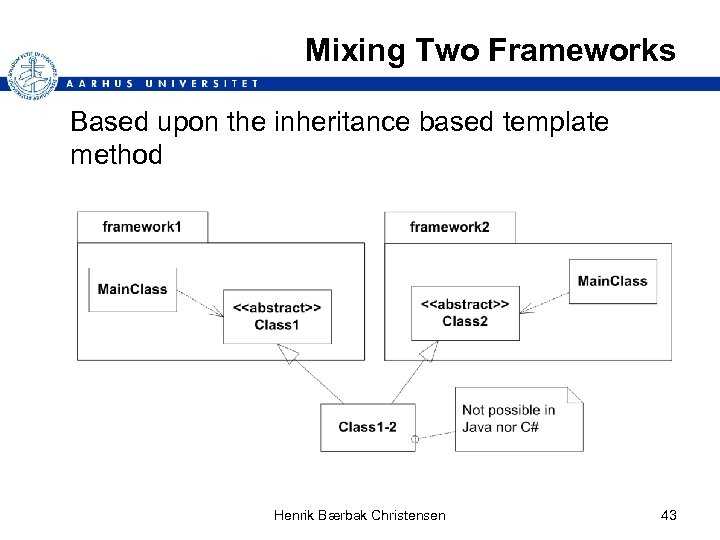 Mixing Two Frameworks Based upon the inheritance based template method Henrik Bærbak Christensen 43
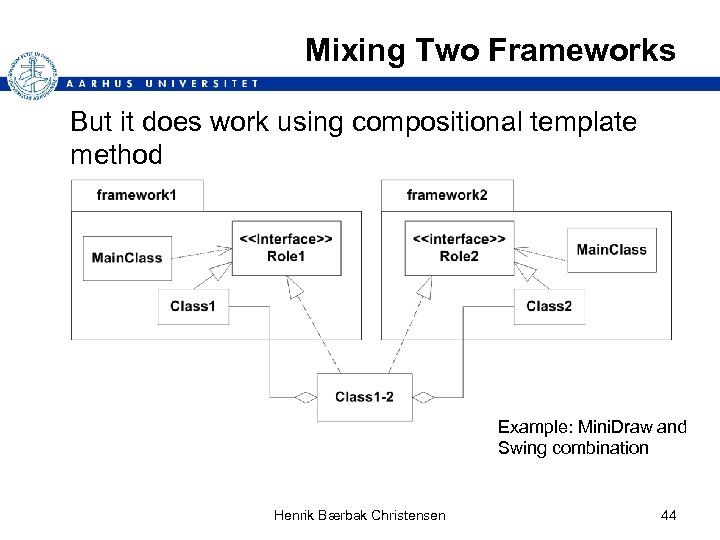 Mixing Two Frameworks But it does work using compositional template method Example: Mini. Draw and Swing combination Henrik Bærbak Christensen 44
 Software Reuse and Product Line Architectures Henrik Bærbak Christensen 45
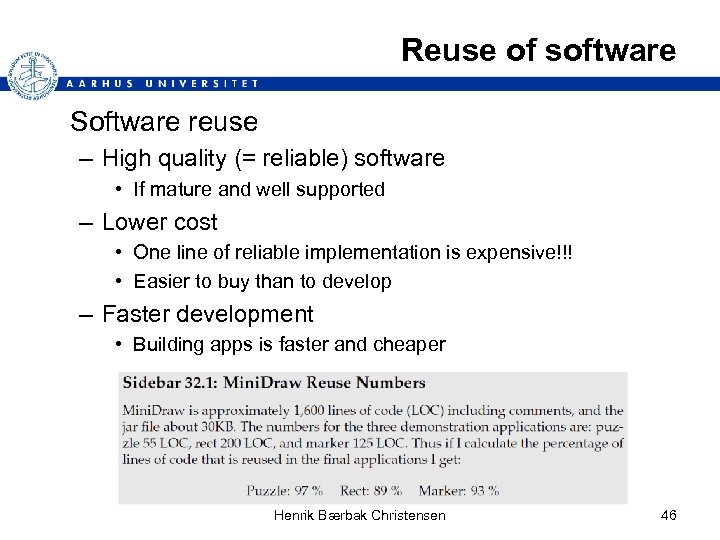 Reuse of software Software reuse – High quality (= reliable) software • If mature and well supported – Lower cost • One line of reliable implementation is expensive!!! • Easier to buy than to develop – Faster development • Building apps is faster and cheaper Henrik Bærbak Christensen 46
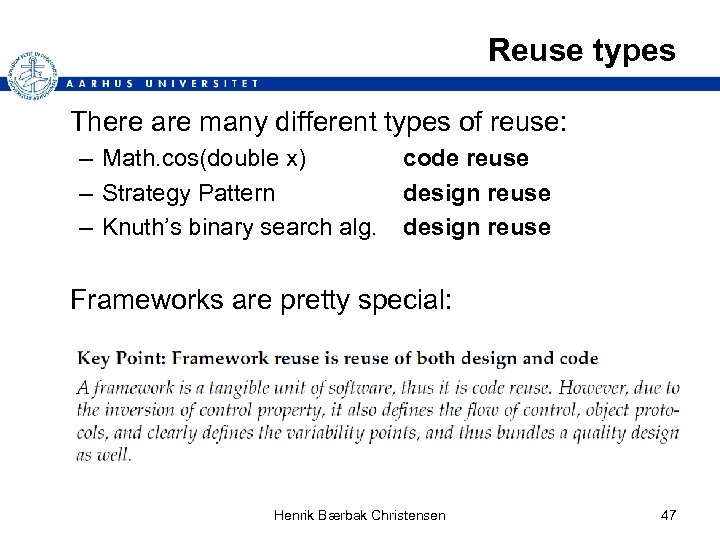 Reuse types There are many different types of reuse: – Math. cos(double x) – Strategy Pattern – Knuth’s binary search alg. code reuse design reuse Frameworks are pretty special: Henrik Bærbak Christensen 47
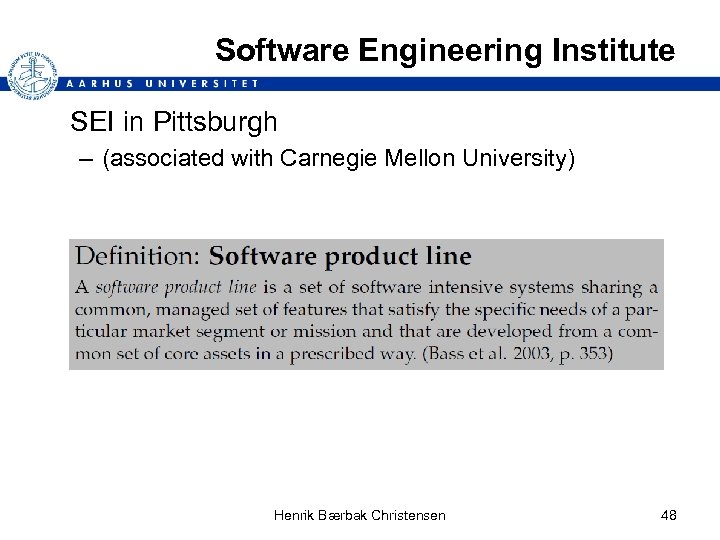 Software Engineering Institute SEI in Pittsburgh – (associated with Carnegie Mellon University) Henrik Bærbak Christensen 48
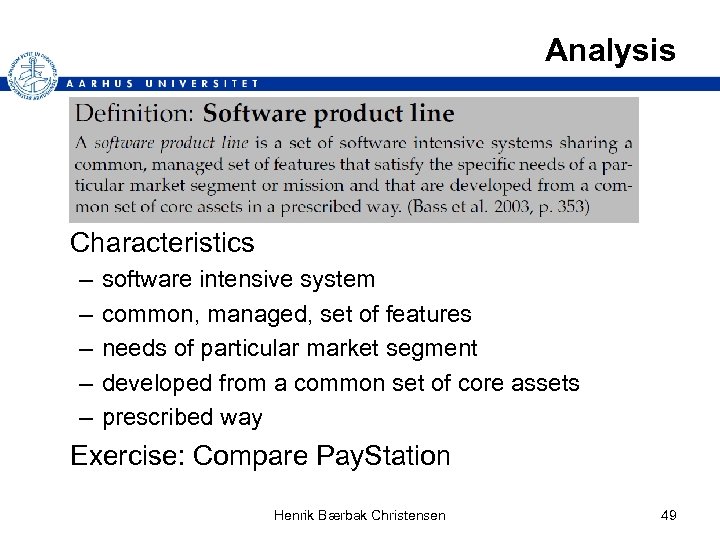 Analysis Characteristics – – – software intensive system common, managed, set of features needs of particular market segment developed from a common set of core assets prescribed way Exercise: Compare Pay. Station Henrik Bærbak Christensen 49
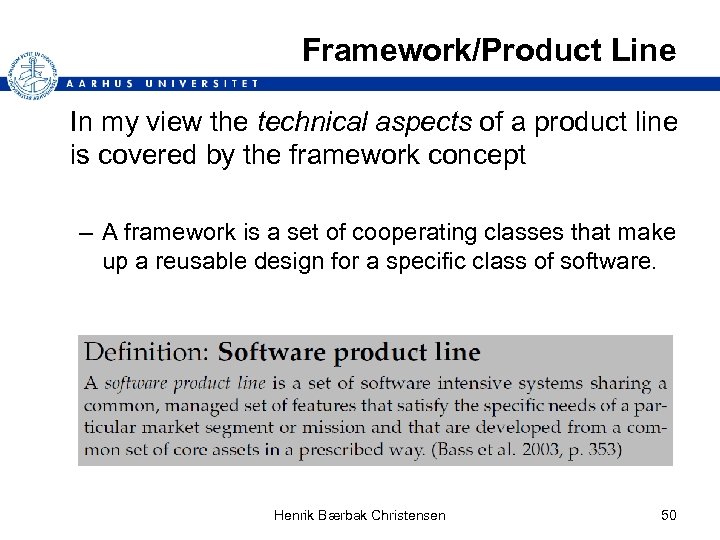 Framework/Product Line In my view the technical aspects of a product line is covered by the framework concept – A framework is a set of cooperating classes that make up a reusable design for a specific class of software. Henrik Bærbak Christensen 50
 Organisation Aspect The organisation aspect, however, is important: – managed set of features – developed in a prescribed way – market segment A lot of experience from industry point to the fact that software reuse and product line reuse is primarily a organisational challenge! – Who pays for making the code flexible? Not my project – I want to save my own a… Reuse is actually quite expensive in practice Henrik Bærbak Christensen 51