


 Скачать презентацию Framework for Marketing Eugene W Anderson Professor of
7af638b8aae622ebd18c8b419be400fd.ppt
- Количество слайдов: 17
 Framework for Marketing Eugene W. Anderson Professor of Marketing and Associate Dean for Degree Programs * copyright 2003 by Eugene W. Anderson. All rights reserved. 1
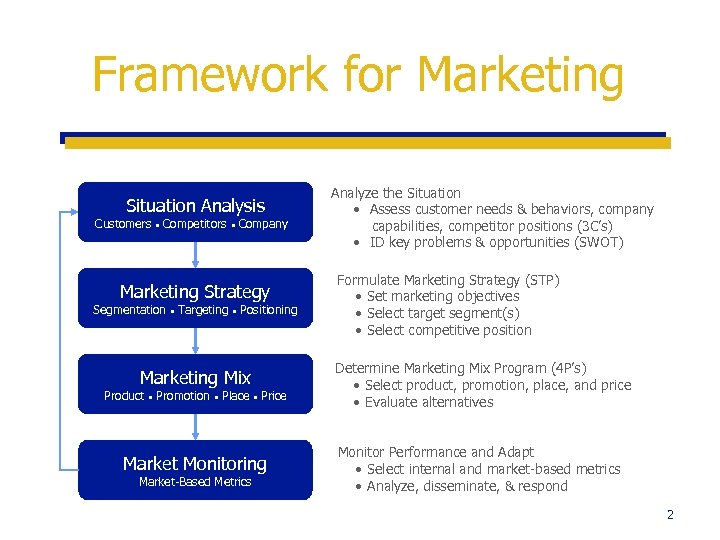 Framework for Marketing Situation Analysis Customers Competitors Company Marketing Strategy Segmentation Targeting Positioning Marketing Mix Product Promotion Place Price Market Monitoring Market-Based Metrics Analyze the Situation Assess customer needs & behaviors, company capabilities, competitor positions (3 C’s) ID key problems & opportunities (SWOT) Formulate Marketing Strategy (STP) Set marketing objectives Select target segment(s) Select competitive position Determine Marketing Mix Program (4 P’s) Select product, promotion, place, and price Evaluate alternatives Monitor Performance and Adapt Select internal and market-based metrics Analyze, disseminate, & respond 2
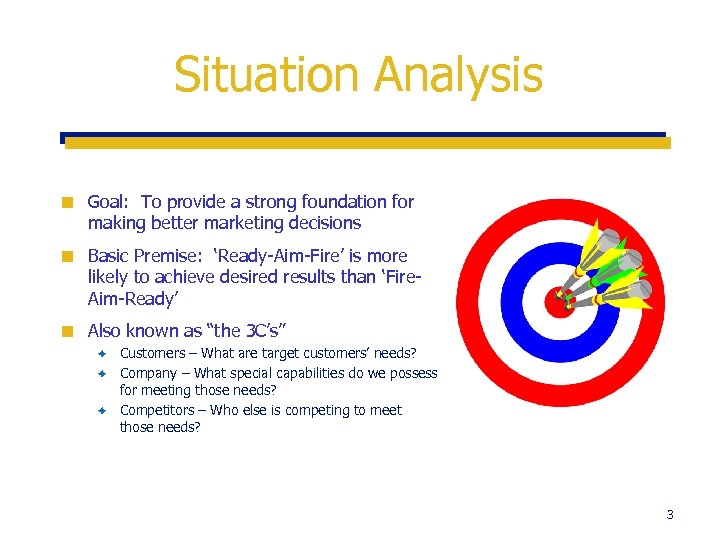 Situation Analysis ¢ Goal: To provide a strong foundation for making better marketing decisions ¢ Basic Premise: ‘Ready-Aim-Fire’ is more likely to achieve desired results than ‘Fire. Aim-Ready’ ¢ Also known as “the 3 C’s” Customers – What are target customers’ needs? è Company – What special capabilities do we possess for meeting those needs? è Competitors – Who else is competing to meet those needs? è 3
 Customers ¢ Ultimately, it is the customer that sets the rules of the game ¢ You will need to understand the rules to win è è è è How decisions are made Who is involved What information is used The trade-offs they are willing to make Where & when they are ready to buy How the product or service is used Etc 4
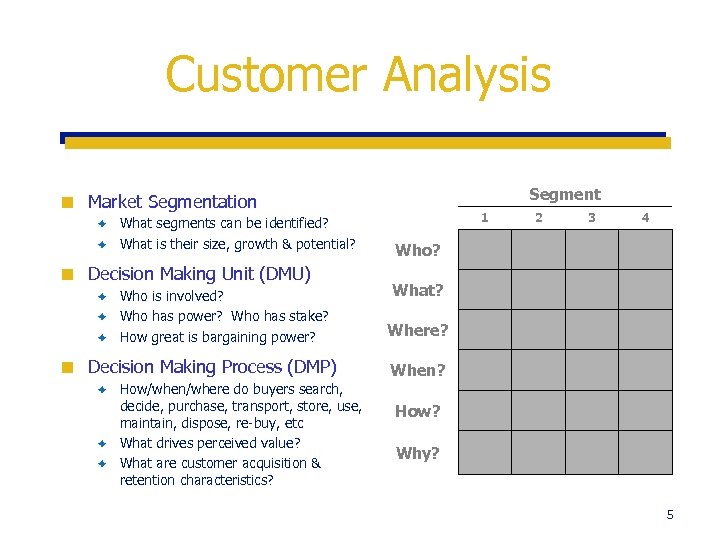 Customer Analysis ¢ Segment Market Segmentation What segments can be identified? è What is their size, growth & potential? 1 è ¢ Decision Making Unit (DMU) 3 4 Who? What? Who is involved? è Who has power? Who has stake? è How great is bargaining power? Where? Decision Making Process (DMP) When? è ¢ 2 How/when/where do buyers search, decide, purchase, transport, store, use, maintain, dispose, re-buy, etc è What drives perceived value? è What are customer acquisition & retention characteristics? è How? Why? 5
 Company ¢ What’s special about us (really)? ¢ Are we doing the right things? ¢ Are we doing things right? 6
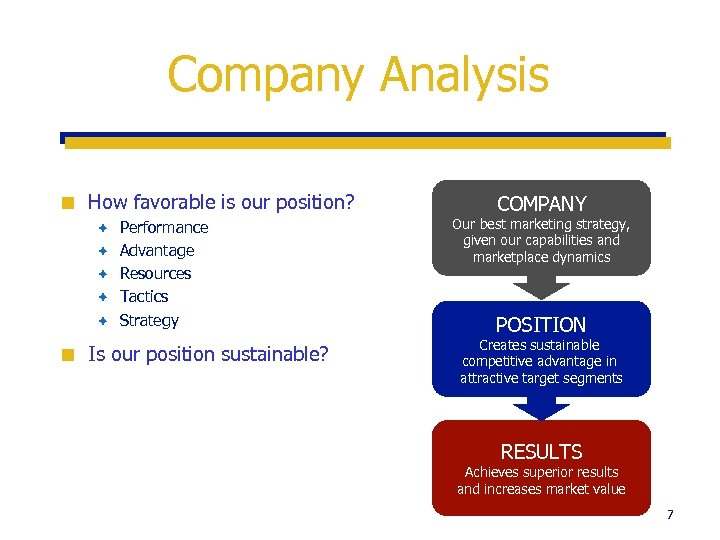 Company Analysis ¢ How favorable is our position? è è è ¢ Performance Advantage Resources Tactics Strategy Is our position sustainable? COMPANY Our best marketing strategy, given our capabilities and marketplace dynamics POSITION Creates sustainable competitive advantage in attractive target segments RESULTS Achieves superior results and increases market value 7
 Context ¢ What risks might environment factors and change present? 8
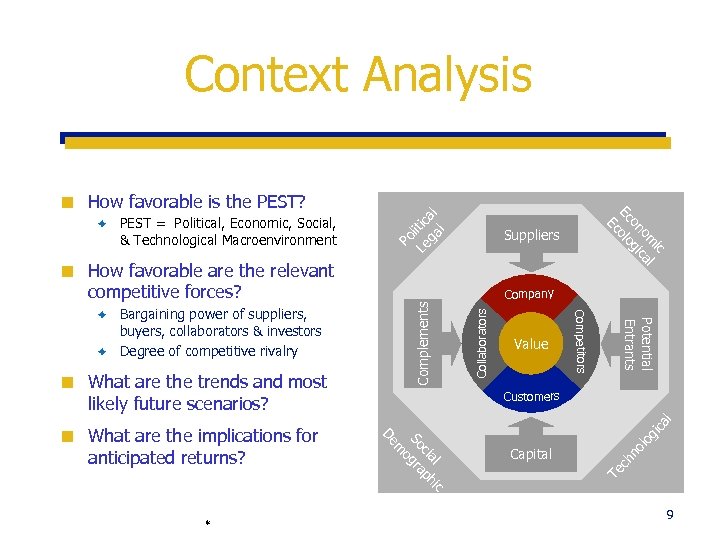 Context Analysis How favorable are the relevant competitive forces? Customers lo gi no ch Capital Te m l ic cia ph So gra o De * ca l What are the implications for anticipated returns? Collaborators ¢ Potential Entrants What are the trends and most likely future scenarios? Value Competitors Bargaining power of suppliers, buyers, collaborators & investors è Degree of competitive rivalry è ¢ Suppliers Company Complements ¢ PEST = Political, Economic, Social, & Technological Macroenvironment ic om cal on gi Ec olo Ec è Le litic ga al l How favorable is the PEST? Po ¢ 9
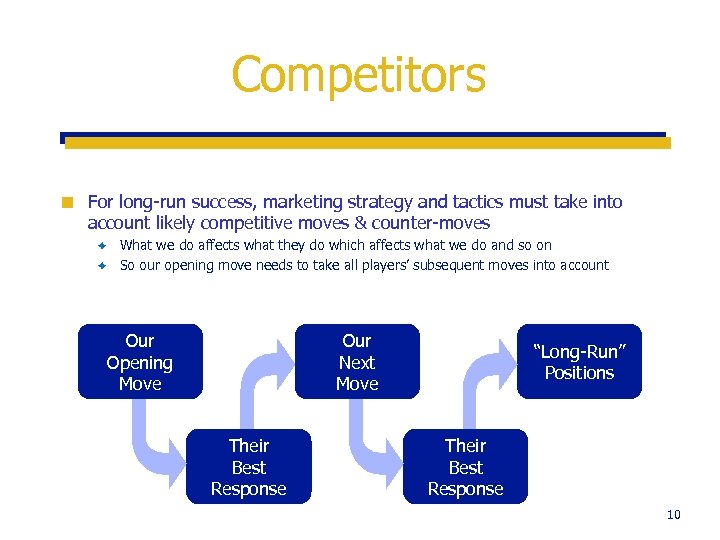 Competitors ¢ For long-run success, marketing strategy and tactics must take into account likely competitive moves & counter-moves What we do affects what they do which affects what we do and so on è So our opening move needs to take all players’ subsequent moves into account è Our Next Move Our Opening Move Their Best Response “Long-Run” Positions Their Best Response 10
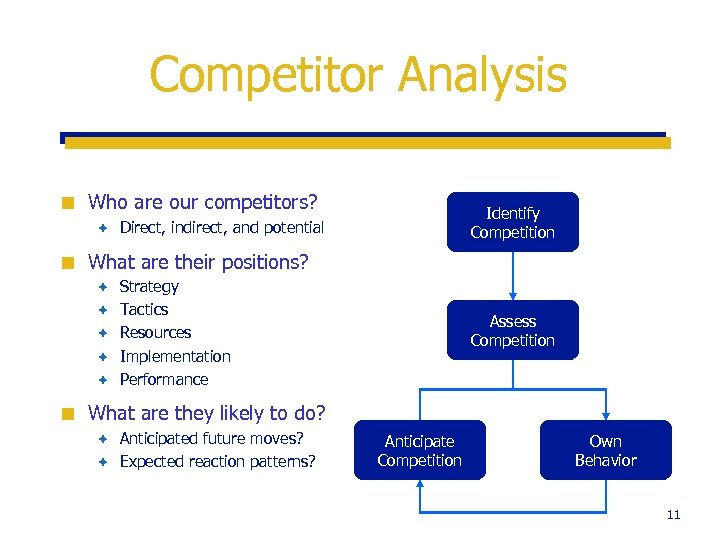 Competitor Analysis ¢ Who are our competitors? è ¢ Direct, indirect, and potential What are their positions? è è è ¢ Identify Competition Strategy Tactics Resources Implementation Performance Assess Competition What are they likely to do? Anticipated future moves? è Expected reaction patterns? è Anticipate Competition Own Behavior 11
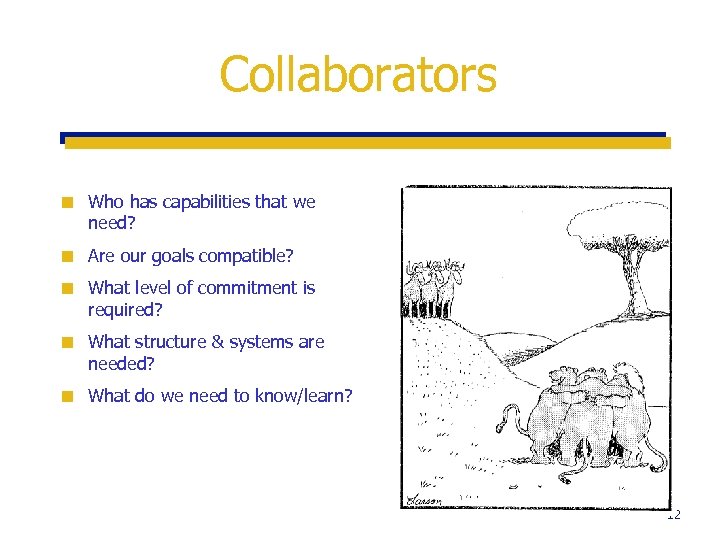 Collaborators ¢ Who has capabilities that we need? ¢ Are our goals compatible? ¢ What level of commitment is required? ¢ What structure & systems are needed? ¢ What do we need to know/learn? 12
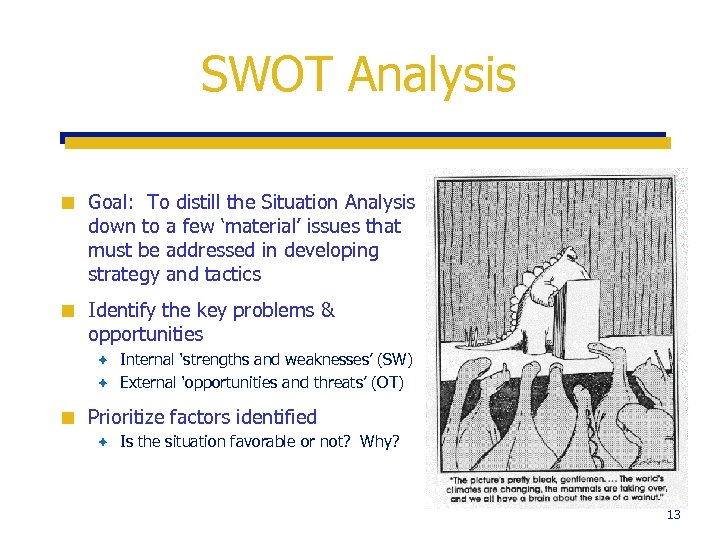 SWOT Analysis ¢ Goal: To distill the Situation Analysis down to a few ‘material’ issues that must be addressed in developing strategy and tactics ¢ Identify the key problems & opportunities Internal ‘strengths and weaknesses’ (SW) è External ‘opportunities and threats’ (OT) è ¢ Prioritize factors identified è Is the situation favorable or not? Why? 13
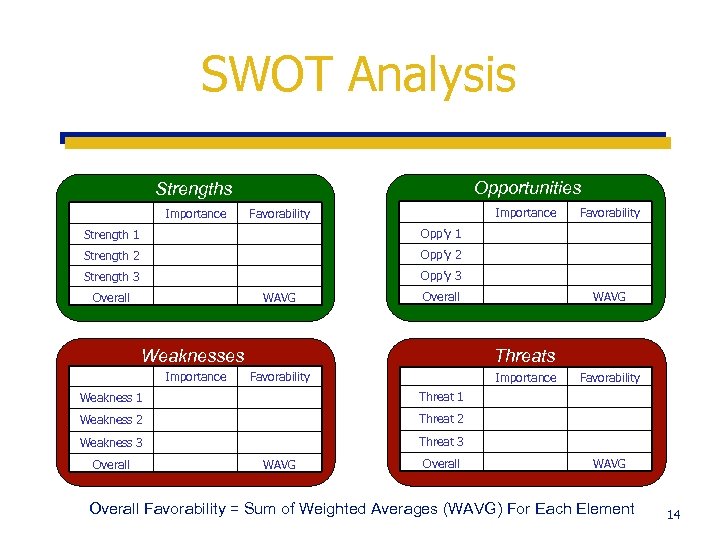 SWOT Analysis Opportunities Strengths Importance Favorability Strength 1 Opp’y 1 Strength 2 Opp’y 2 Strength 3 Favorability Opp’y 3 Overall WAVG Overall Weaknesses Importance WAVG Threats Favorability Importance Weakness 1 Threat 1 Weakness 2 Threat 2 Weakness 3 Favorability Threat 3 Overall WAVG Overall Favorability = Sum of Weighted Averages (WAVG) For Each Element 14
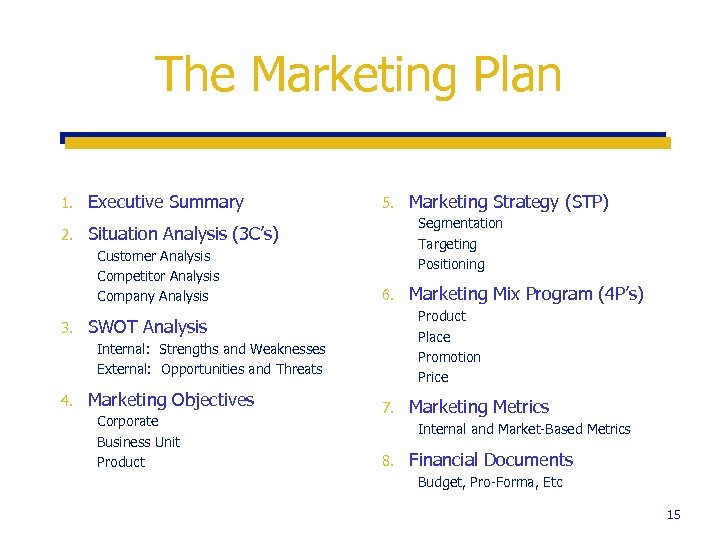 The Marketing Plan 1. Executive Summary 2. Situation Analysis (3 C’s) Customer Analysis Competitor Analysis Company Analysis 3. 5. Segmentation Targeting Positioning 6. Marketing Objectives Corporate Business Unit Product Marketing Mix Program (4 P’s) Product Place Promotion Price SWOT Analysis Internal: Strengths and Weaknesses External: Opportunities and Threats 4. Marketing Strategy (STP) 7. Marketing Metrics Internal and Market-Based Metrics 8. Financial Documents Budget, Pro-Forma, Etc 15
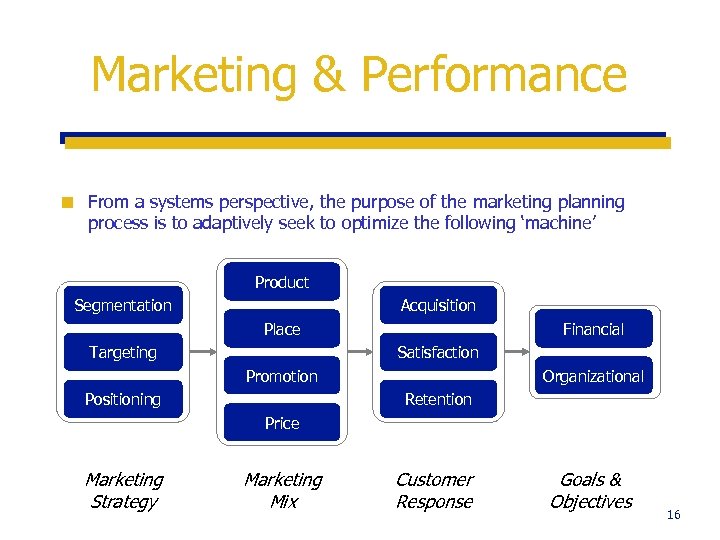 Marketing & Performance ¢ From a systems perspective, the purpose of the marketing planning process is to adaptively seek to optimize the following ‘machine’ Product Segmentation Acquisition Place Targeting Financial Satisfaction Promotion Positioning Organizational Retention Price Marketing Strategy Marketing Mix Customer Response Goals & Objectives 16
 Summary ¢ There is a logical process of marketing that works è ¢ The 3 C’s – STP – 4 P’s framework provides us with a ‘blueprint’ or ‘road map’ for developing successful marketing plans Although much of marketing often seems to be common sense, it is also not human nature Putting yourself in the other person’s shoes è Knowing your self è Thinking more than one step ahead è Being able to see the forest for the trees è 17