


 Скачать презентацию frames and cognitive linguistic development across the lifespan starting
7ebb1c10456b85ee1264f9427de82cc1.ppt
- Количество слайдов: 42
 frames and cognitive/linguistic development across the lifespan starting with the child
 Frames Kovecses: ‘a frame is a structured mental representation of a conceptual category’ -- script, scenario, scene, cultural model, cognitive model, domain, schema, gestalt knuckle: hand : : Friday: week/weekend
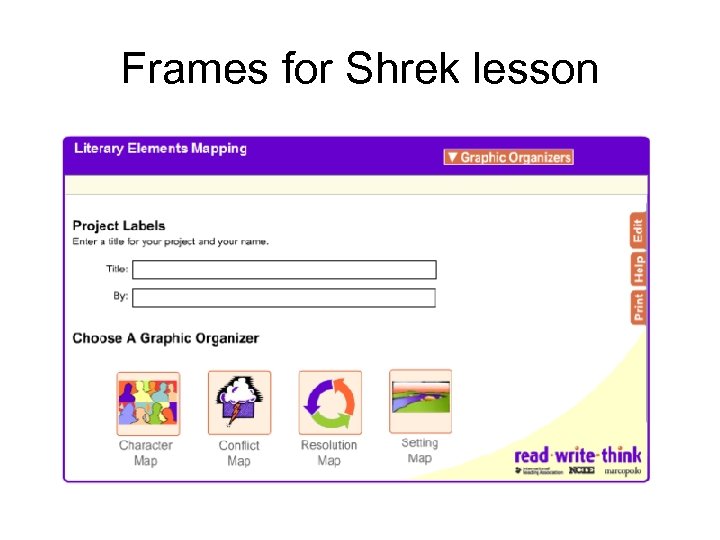 Frames for Shrek lesson
 characteristics of frames • • • Evoked by particular meanings of words Can be ‘profiled’ Impose a perspective on the situation Provide a history Assume larger cultural frames Are idealizations – linked to prototypes
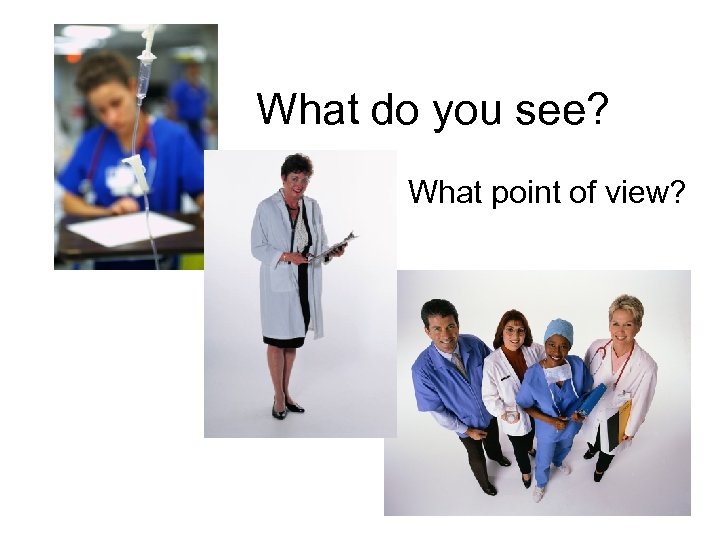 What do you see? What point of view?
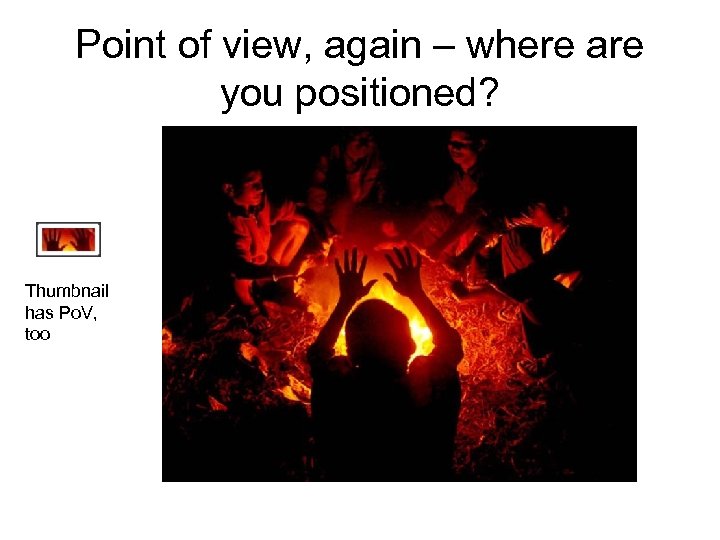 Point of view, again – where are you positioned? Thumbnail has Po. V, too
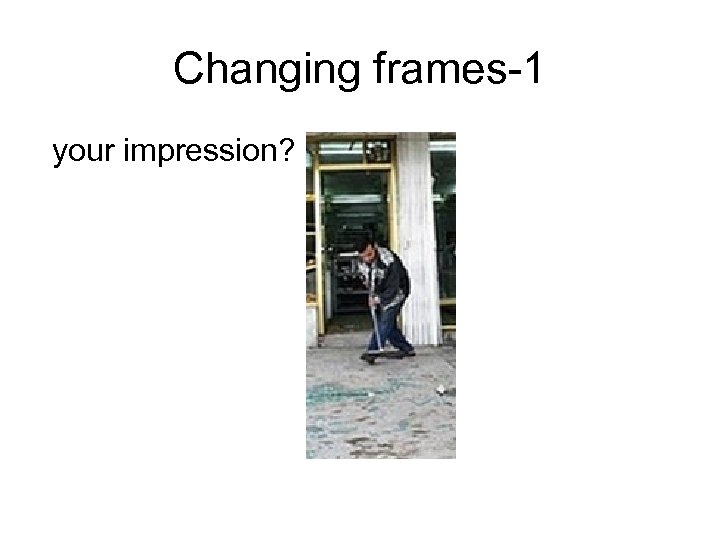 Changing frames-1 your impression?
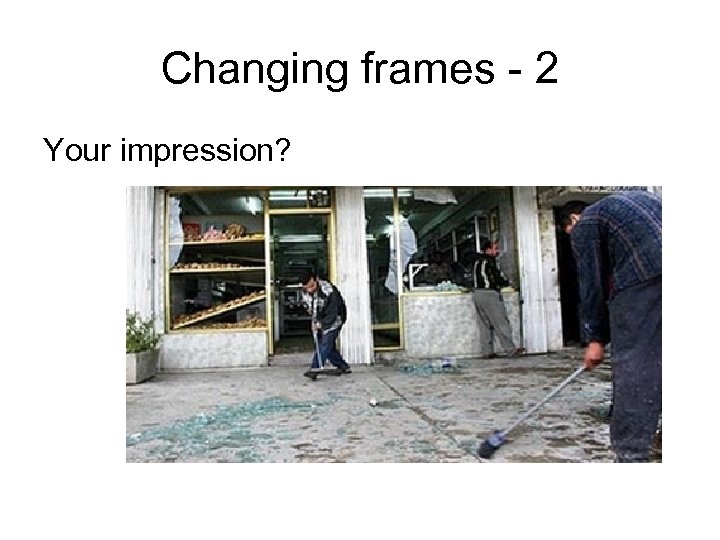 Changing frames - 2 Your impression?
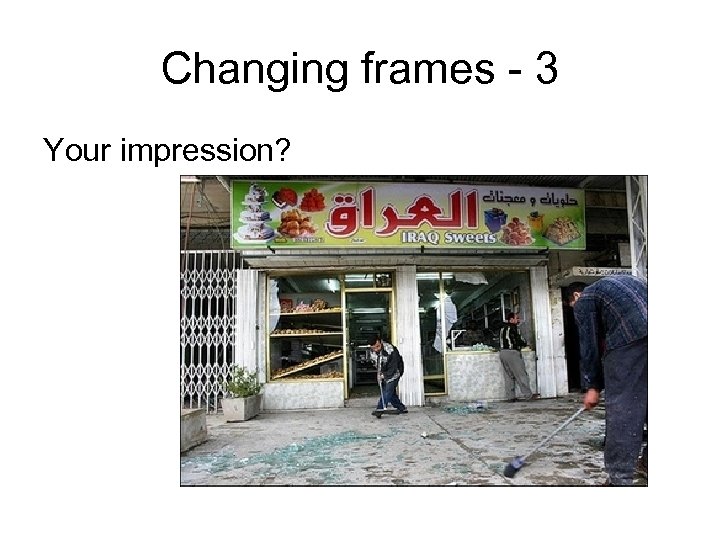 Changing frames - 3 Your impression?
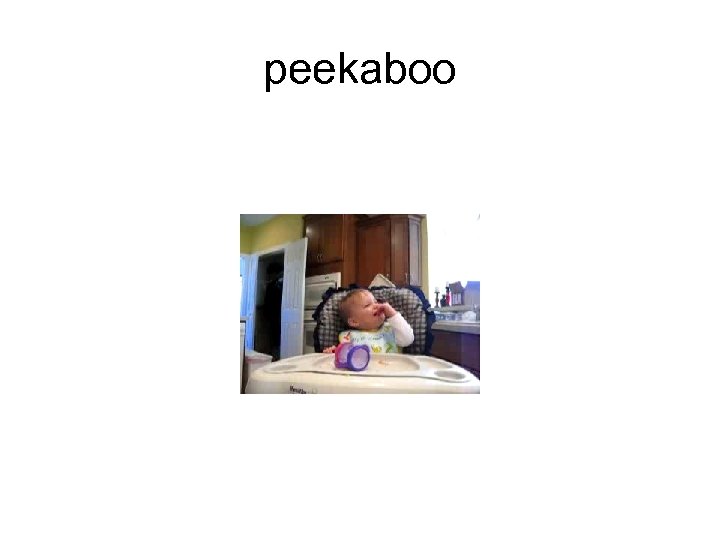
 Cognitive and language development: starting with the child The six discoveries: learning schemes, cause and effect, use of tools, object permanence, how objects fill space, imitation
 On learning language “Children’s mastery of a language in the first few years of their lives is one of the most remarkable things humans can do. Among their impressive achievements is word learning: children learn tens of thousands of words by age 8 or so (according to one study of English learners), averaging 10 or more per day for many years…. ” P. Brown, [Review] The Journal of the Learning Sciences, 14(2), 293 -4
 Words and concepts “Words label concepts; children either have to map sounds to concepts they already have or they have to create concepts on the basis of their experience with words” [nobody can agree on how this happens] P. Brown, [Review] The Journal of the Learning Sciences, 14(2), 2934
 Must infer words from context Words refer, but children have to infer from how they are used in contexts what they refer to. Since many different aspects of the situation could be being referred to when a particular word is used, children have to be attuned to the speaker’s communicative intention in the context, to figure out what aspect is the intended referent. The evidence children have for what words mean is indirect: no one explicitly teaches children the meanings of most words. P. Brown, [Review] The Journal of the Learning Sciences, 14(2), 293 -4
 Taking a perspective “People don’t always use the same word to label “the same” situation; children have to learn to take a perspective on a scene and to understand the perspective others are taking. They have to extend the meanings of words on the basis of their experience of how they are used in contexts; they have to create categories of many different kinds and levels of abstraction (e. g. , “dog”, “Michael”, “brother”, “run”, “nap”, “love”, and eventually, “debate”, “algorithm”). Many grammatical terms have abstract, subtle and elusive meanings that even adults often cannot articulate. ” P. Brown, [Review] The Journal of the Learning Sciences, 14(2), 293 -4
 Mintz 2003: Frequent frames • …”evidence from behavioral studies suggests that infants and adults • are sensitive to frame-like units, and that adults use them to categorize words. This evidence, • along with the success of frames in categorizing words, provides support for frames as a basis for the acquisition of grammatical categories.
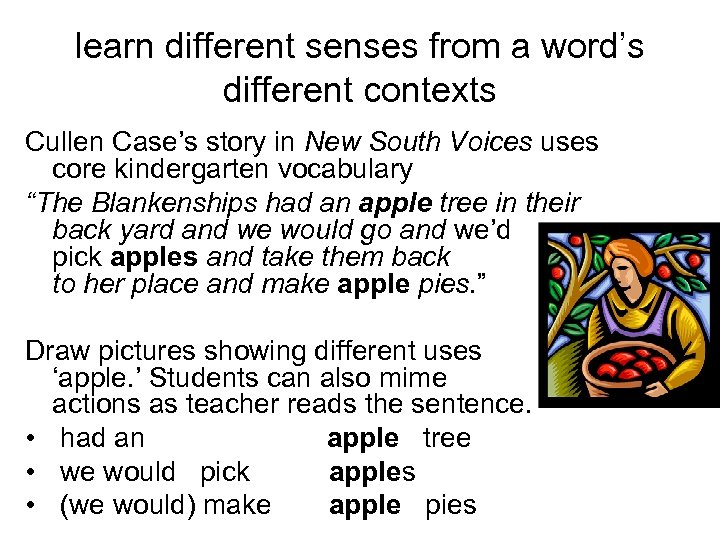 learn different senses from a word’s different contexts Cullen Case’s story in New South Voices uses core kindergarten vocabulary “The Blankenships had an apple tree in their back yard and we would go and we’d pick apples and take them back to her place and make apple pies. ” Draw pictures showing different uses ‘apple. ’ Students can also mime actions as teacher reads the sentence. • had an apple tree • we would pick apples • (we would) make apple pies of
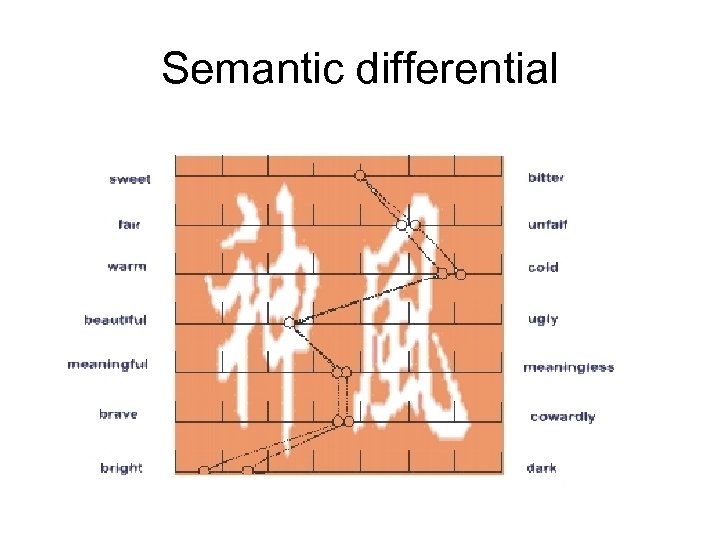 Semantic differential
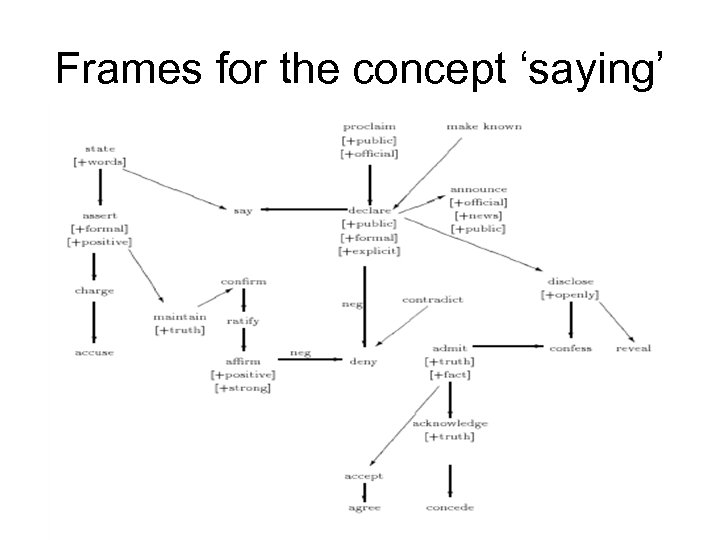 Frames for the concept ‘saying’
 Learning the verb ‘buy’ When we learn the verb buy, we also learn that the sentence holding the verb must have a person doing the buying – the buyer – and something to buy – the goods. We sometimes extend those features to new uses, such as phrasal verbs or idioms like buy in to or buy out. Sometimes the frame itself is the context cue for ‘guessing’ a new word or usage.
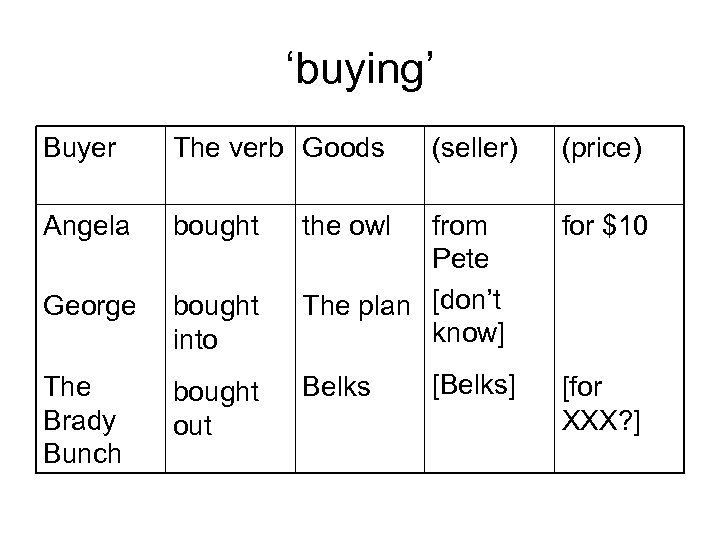 ‘buying’ Buyer The verb Goods Angela bought George bought into The Brady Bunch bought out (seller) the owl from Pete The plan [don’t know] Belks [Belks] (price) for $10 [for XXX? ]
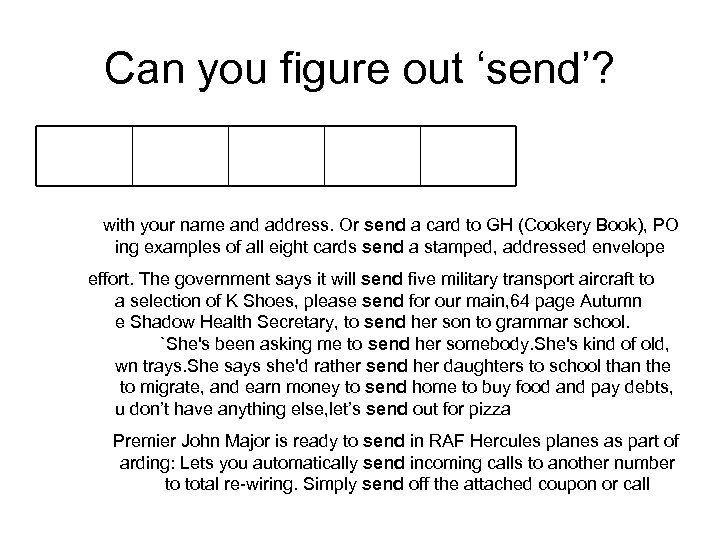 Can you figure out ‘send’? with your name and address. Or send a card to GH (Cookery Book), PO ing examples of all eight cards send a stamped, addressed envelope effort. The government says it will send five military transport aircraft to a selection of K Shoes, please send for our main, 64 page Autumn e Shadow Health Secretary, to send her son to grammar school. `She's been asking me to send her somebody. She's kind of old, wn trays. She says she'd rather send her daughters to school than the to migrate, and earn money to send home to buy food and pay debts, u don’t have anything else, let’s send out for pizza Premier John Major is ready to send in RAF Hercules planes as part of arding: Lets you automatically send incoming calls to another number to total re-wiring. Simply send off the attached coupon or call
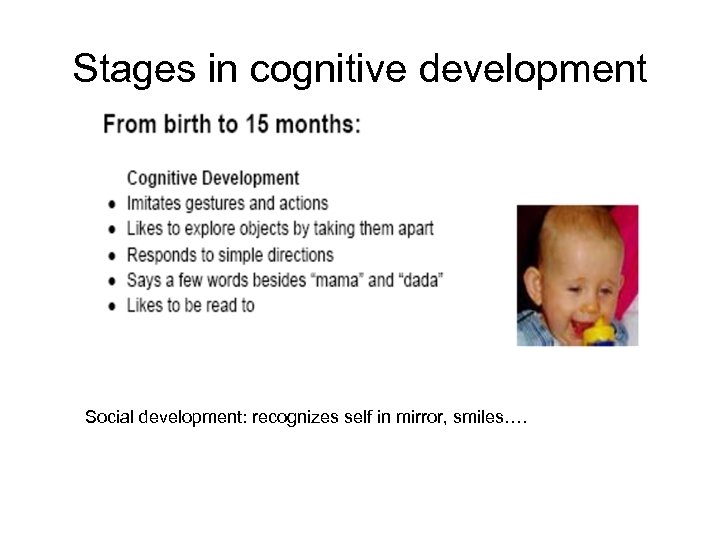 Stages in cognitive development Social development: recognizes self in mirror, smiles….
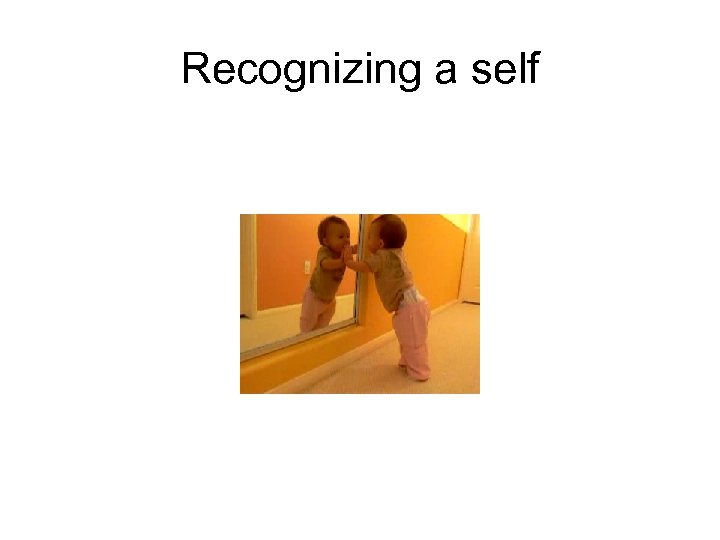 Recognizing a self
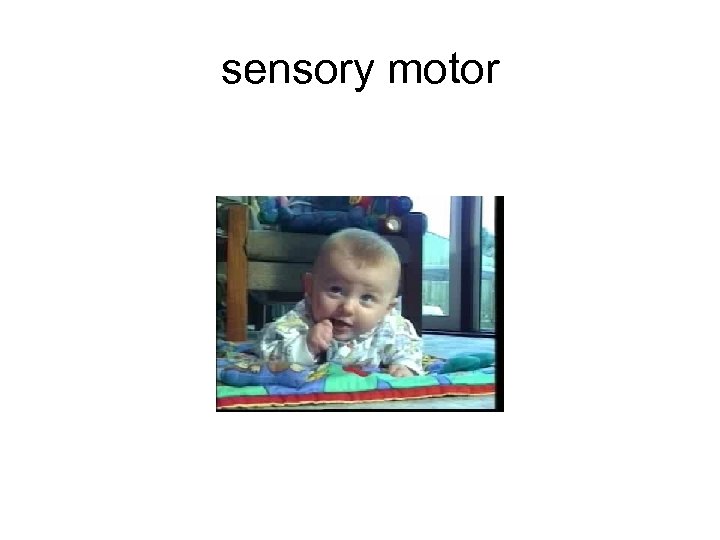
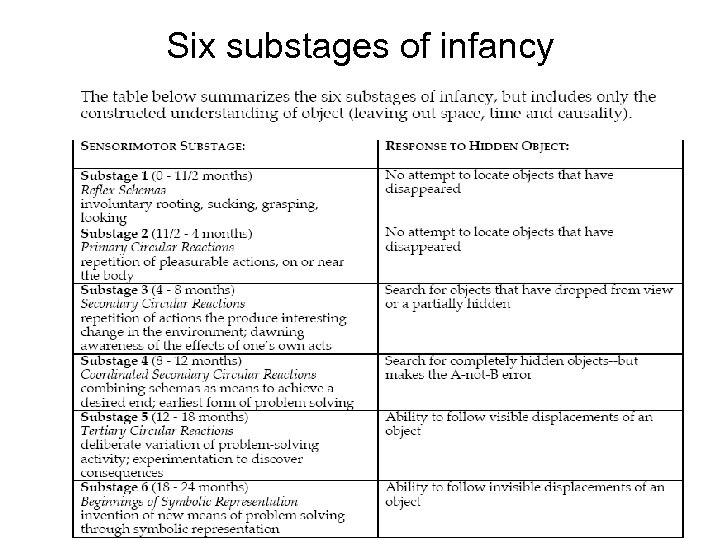 Six substages of infancy
 sensory motor
 CHILDES: baby sounds 3 months 9 months 6 months 12 months
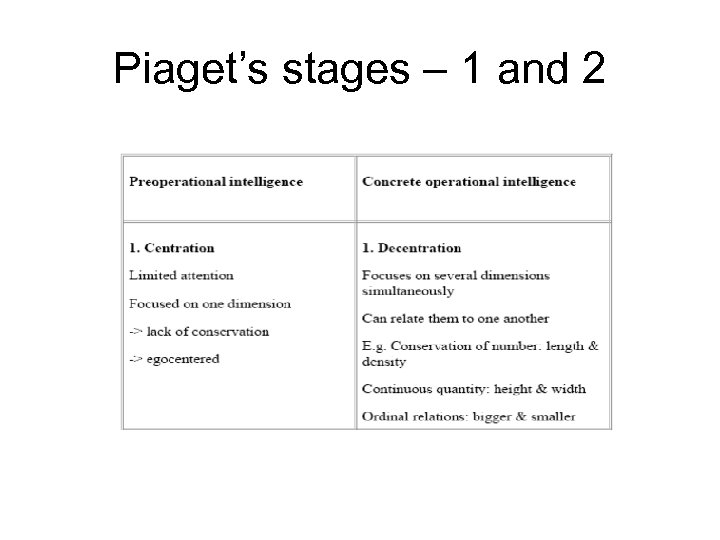
 Piaget’s stages
 peekaboo
 Jocie baby talk
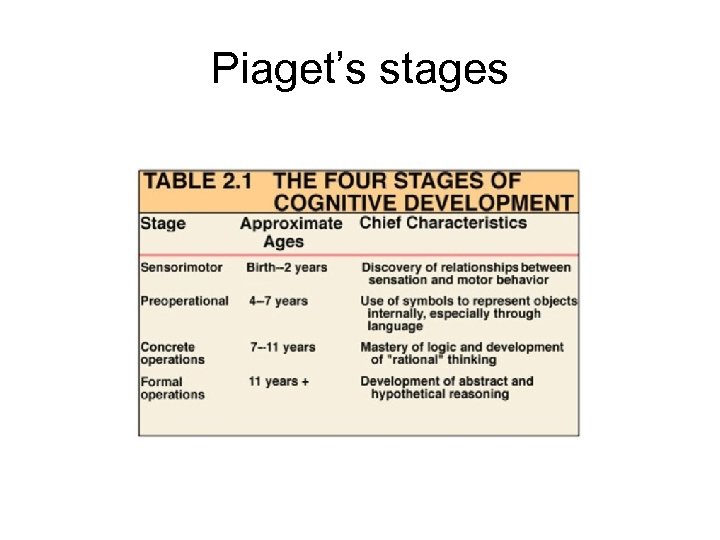
 Piaget’s stages – 1 and 2
 conservation
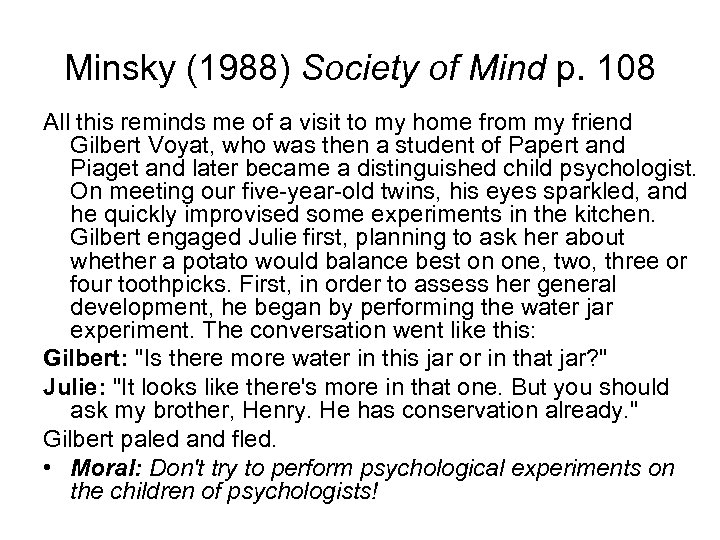 Minsky (1988) Society of Mind p. 108 All this reminds me of a visit to my home from my friend Gilbert Voyat, who was then a student of Papert and Piaget and later became a distinguished child psychologist. On meeting our five-year-old twins, his eyes sparkled, and he quickly improvised some experiments in the kitchen. Gilbert engaged Julie first, planning to ask her about whether a potato would balance best on one, two, three or four toothpicks. First, in order to assess her general development, he began by performing the water jar experiment. The conversation went like this: Gilbert: "Is there more water in this jar or in that jar? " Julie: "It looks like there's more in that one. But you should ask my brother, Henry. He has conservation already. " Gilbert paled and fled. • Moral: Don't try to perform psychological experiments on the children of psychologists!
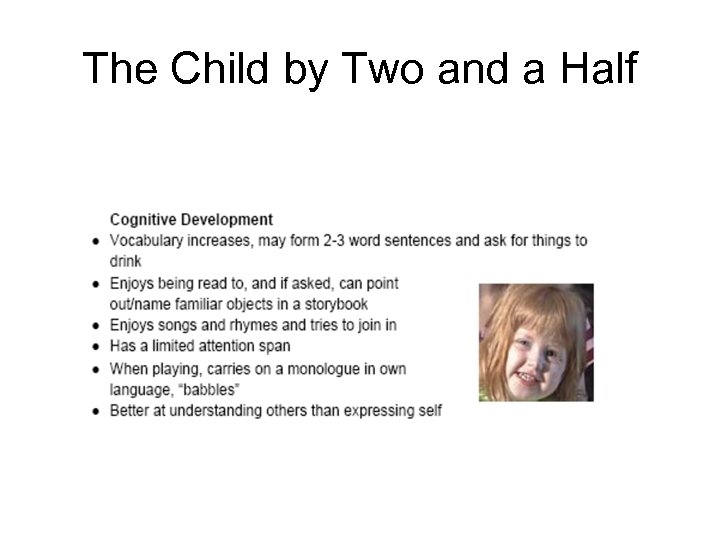 The Child by Two and a Half
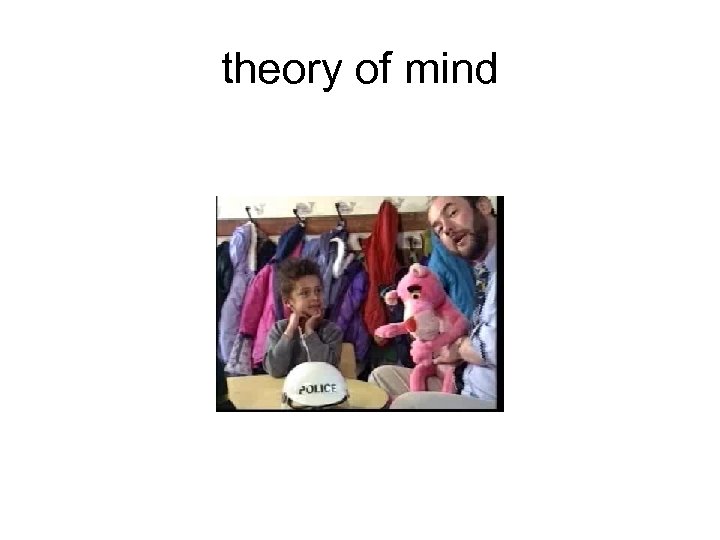 theory of mind
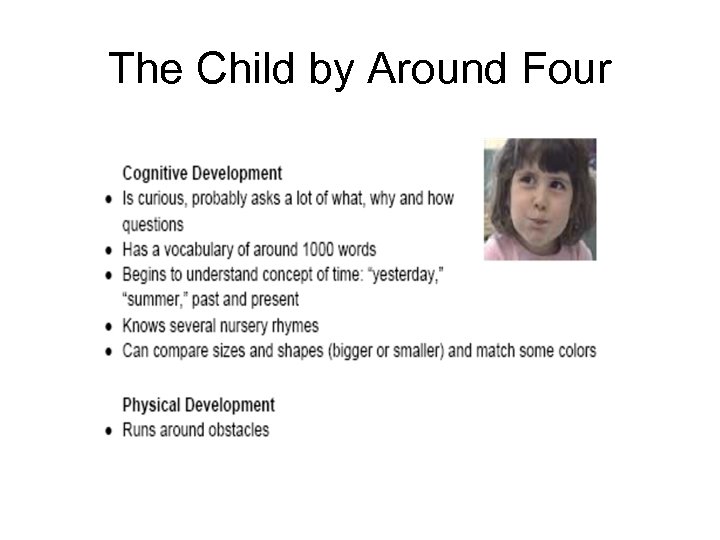 The Child by Around Four
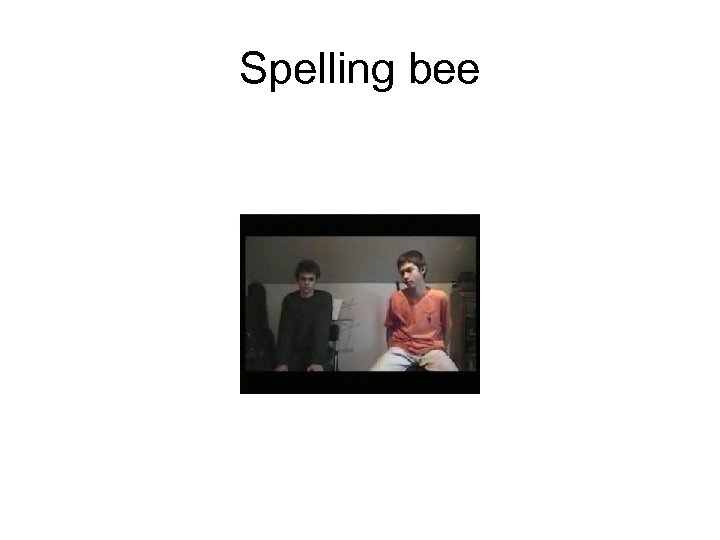 Spelling bee
 Spelling bee - oops
 tug of war a metaphor with which to look at adolescent and adult language & cognition
 Tannen, What’s in a frame
 Converting experience (however defined) into words Determine the schema which refers to the identification of the event Determine the frame for the sentence-level expression Choose category to name parts of event Match internal representation with prototypes Back to Shrek….
 Scripts/frames in conversation • The restaurant script • The telling-troubles script • The I don’t like you but we have to talk script (Antaki tutorial incorporates this) • The did I tell you about what happened to me on the way to class script • The I remember when… script (Norrick) • The you won’t believe…. script
 Scollon and Scollon handouts The Scollons ‘reframe’ politeness theory as Features of involvement and independence in conversations A very useful heuristic, particularly for our looking at those conversations in which somebody is trying to share memories or stories Linked on our website as Scollon handout, With an example by Jen Cleary, linked as Cleary