


 Скачать презентацию Frame Relay Option for Service Providers — Qo
698add927cb2882aa528b6f9d2fe4cb5.ppt
- Количество слайдов: 39
 Frame Relay Option for Service Providers - Qo. S Mechanisms and SLA Pre-conference workshop International IT Conference 2002 Colombo, Sri Lanka 4 th October 2002 R. Jayanthan. Bsc. Eng. (Hons), MIEEE, AMIE(SL) MCP, CCNA, NNCDS, NNCAS Team Leader – Design & Consultancy jayan@iee. org © 2002
 Objectives ~At the end of this workshop you will be able to: ðDefine how Frame Relay defers from other communication technology ðDescribe the features & benefits of Frame Relay technology ðExplain the Quality of Service mechanism built-in to Frame Relay technology ðDiscuss the Service Level Agreement Parameters and Measurements related to Frame Relay © 2002
 What is not Frame Relay ? ~Frame Relay is not a networking protocol ! ~Frame Relay ðIs an Interface Protocol used in wide area networking ðFrame Relay User - Network Interface (UNI) ðFrame Relay Network - Network Interface (NNI) © 2002
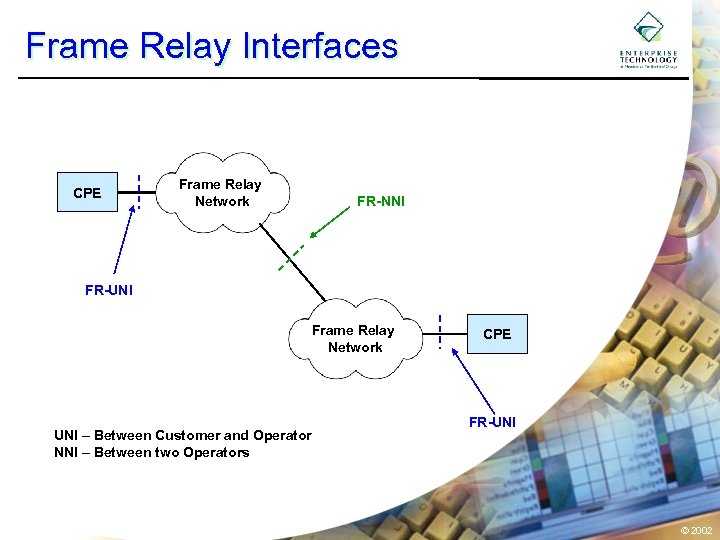 Frame Relay Interfaces CPE Frame Relay Network FR-NNI FR-UNI Frame Relay Network UNI – Between Customer and Operator NNI – Between two Operators CPE FR-UNI © 2002
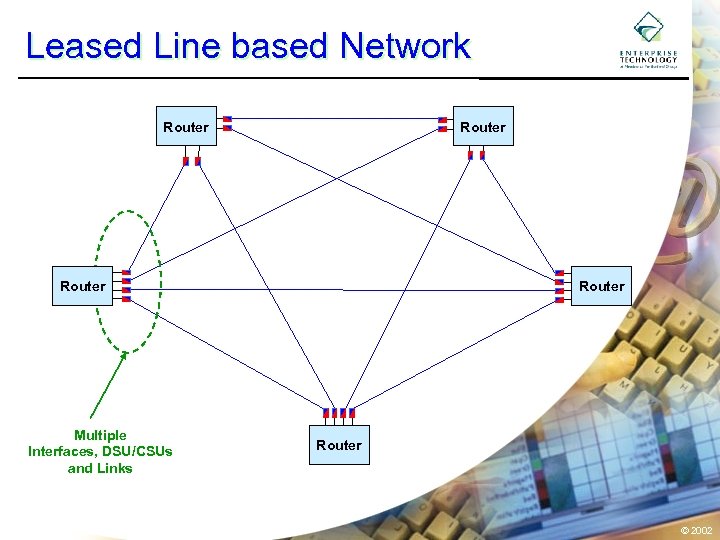 Leased Line based Network Router Multiple Interfaces, DSU/CSUs and Links Router © 2002
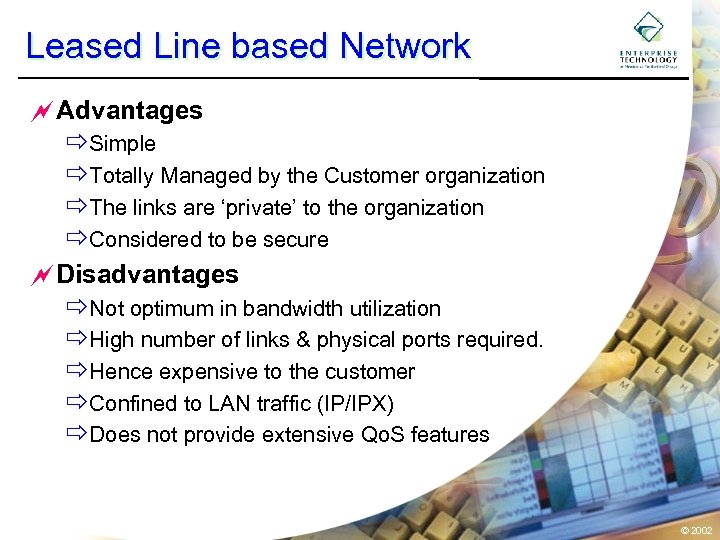 Leased Line based Network ~Advantages ðSimple ðTotally Managed by the Customer organization ðThe links are ‘private’ to the organization ðConsidered to be secure ~Disadvantages ðNot optimum in bandwidth utilization ðHigh number of links & physical ports required. ðHence expensive to the customer ðConfined to LAN traffic (IP/IPX) ðDoes not provide extensive Qo. S features © 2002
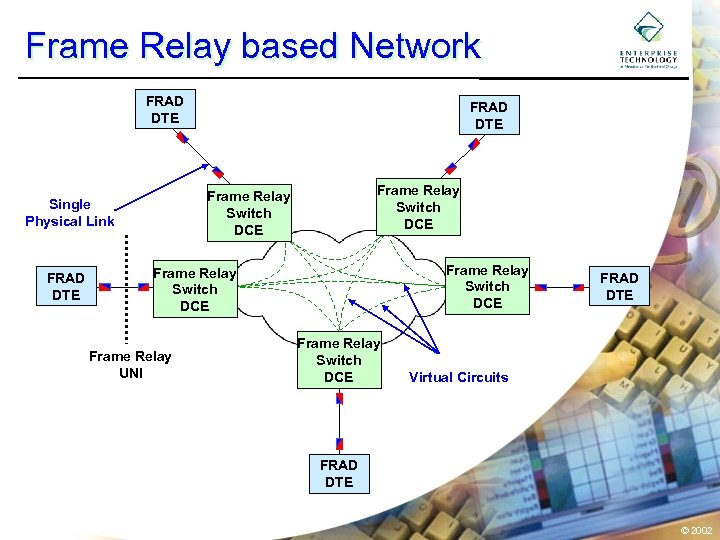 Frame Relay based Network FRAD DTE Frame Relay Switch DCE Single Physical Link FRAD DTE Frame Relay Switch DCE Frame Relay UNI Frame Relay Switch DCE FRAD DTE Virtual Circuits FRAD DTE © 2002
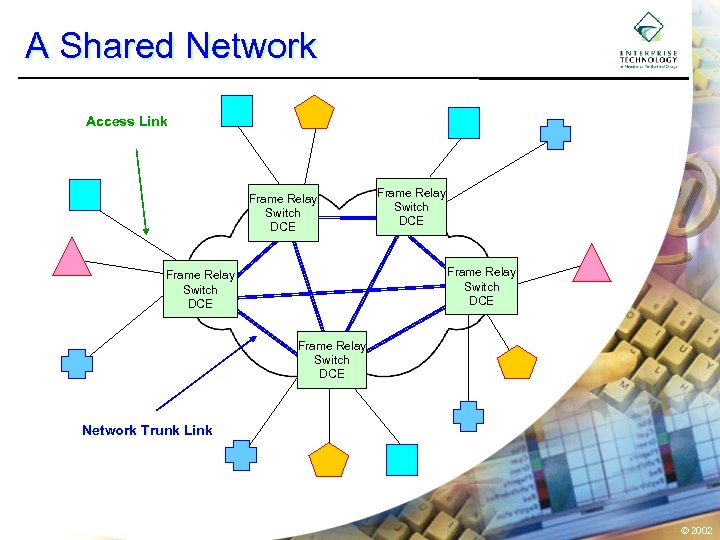 A Shared Network Access Link Frame Relay Switch DCE Frame Relay Switch DCE Network Trunk Link © 2002
 Frame Relay based Network ~ Network bandwidth is shared ~ Single physical port at CPE ~ Virtual Circuits are configured through software ~ Built-in Qo. S mechanism ~ Less frame overhead hence fast switching ~ Support for switched virtual circuit enables ondemand services viz. voice & video calls © 2002
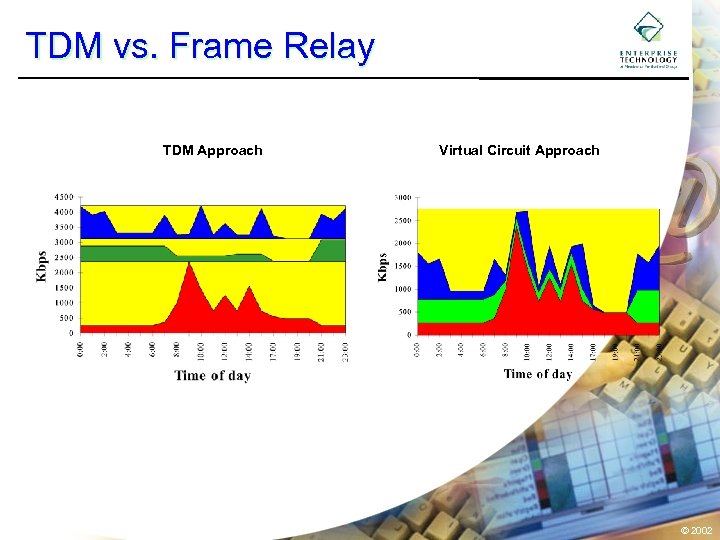 TDM vs. Frame Relay TDM Approach Virtual Circuit Approach © 2002
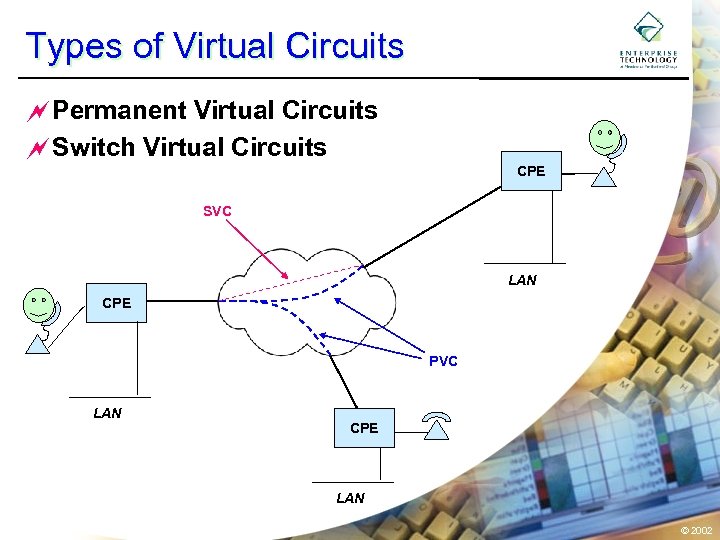 Types of Virtual Circuits ~Permanent Virtual Circuits ~Switch Virtual Circuits CPE SVC LAN CPE PVC LAN CPE LAN © 2002
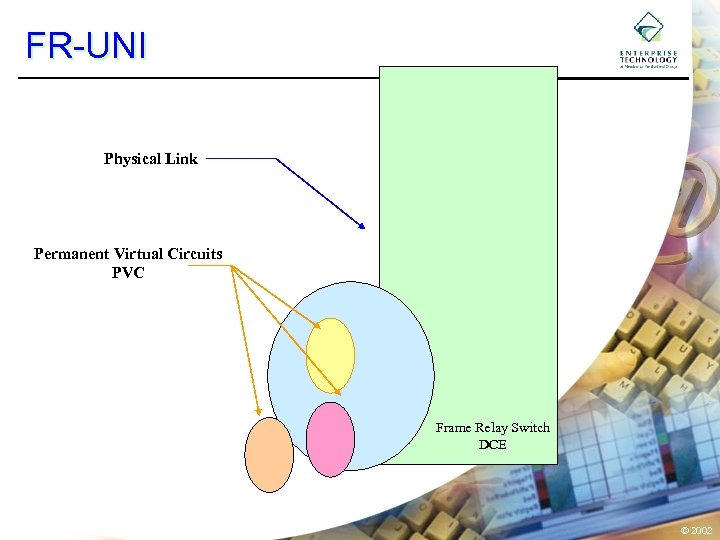 FR-UNI Physical Link Permanent Virtual Circuits PVC Frame Relay Switch DCE © 2002
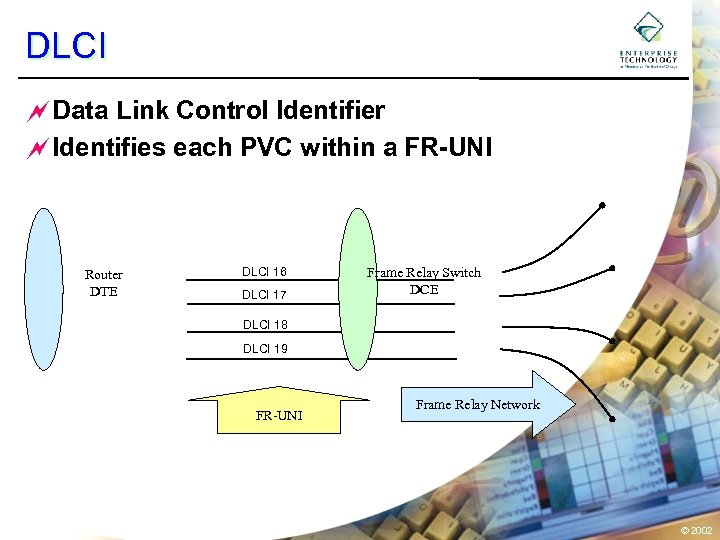 DLCI ~Data Link Control Identifier ~Identifies each PVC within a FR-UNI Router DTE DLCI 16 DLCI 17 Frame Relay Switch DCE DLCI 18 DLCI 19 FR-UNI Frame Relay Network © 2002
 DLCI (Cont…) ~Assigned unique to each logical channel (PVC) within one FR-UNI ~DLCI has only local significance ~DLCI values has to be provided by the Network Operator ~Can be from 16 to 1023 in value ð(DLCI 0 - 15 are reserved) © 2002
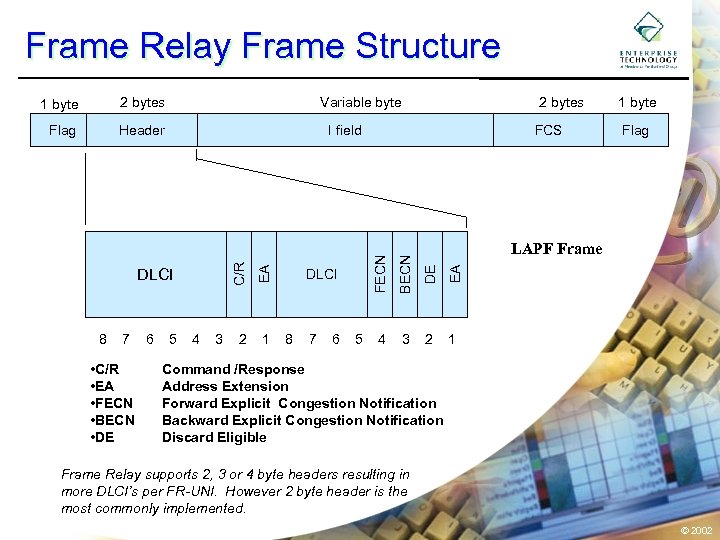 Frame Relay Frame Structure 2 bytes Header • C/R • EA • FECN • BECN • DE 4 3 2 1 8 7 6 5 Flag EA 5 DE 6 DLCI 1 byte LAPF Frame BECN 7 FCS FECN DLCI 8 2 bytes I field EA Flag Variable byte C/R 1 byte 4 3 2 1 Command /Response Address Extension Forward Explicit Congestion Notification Backward Explicit Congestion Notification Discard Eligible Frame Relay supports 2, 3 or 4 byte headers resulting in more DLCI’s per FR-UNI. However 2 byte header is the most commonly implemented. © 2002
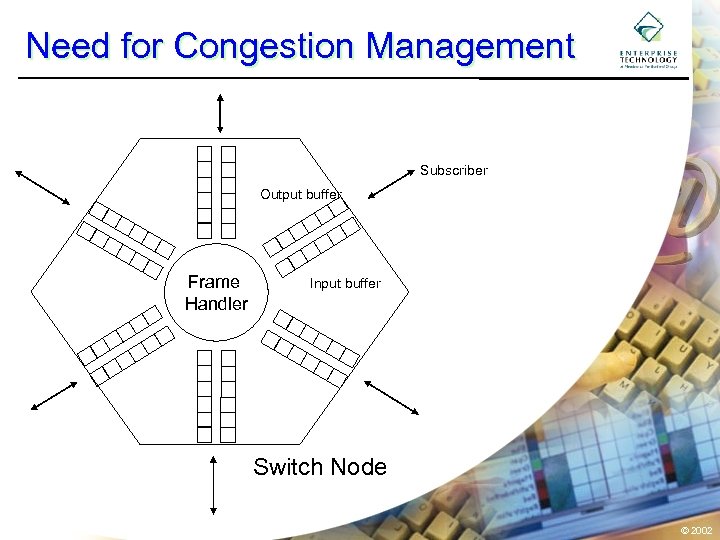 Need for Congestion Management Subscriber Output buffer Frame Handler Input buffer Switch Node © 2002
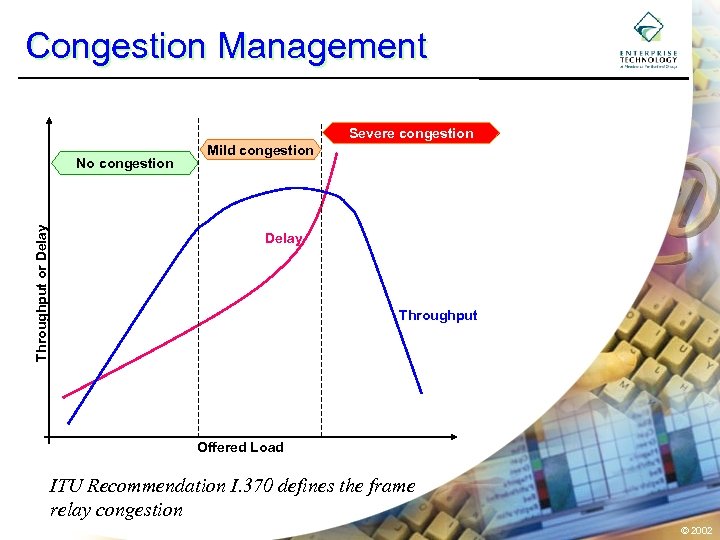 Congestion Management Severe congestion Throughput or Delay No congestion Mild congestion Delay Throughput Offered Load ITU Recommendation I. 370 defines the frame relay congestion © 2002
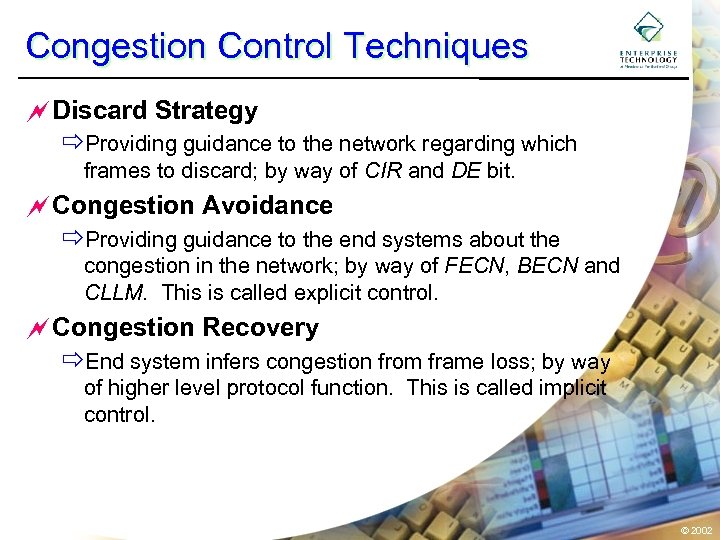 Congestion Control Techniques ~Discard Strategy ðProviding guidance to the network regarding which frames to discard; by way of CIR and DE bit. ~Congestion Avoidance ðProviding guidance to the end systems about the congestion in the network; by way of FECN, BECN and CLLM. This is called explicit control. ~Congestion Recovery ðEnd system infers congestion from frame loss; by way of higher level protocol function. This is called implicit control. © 2002
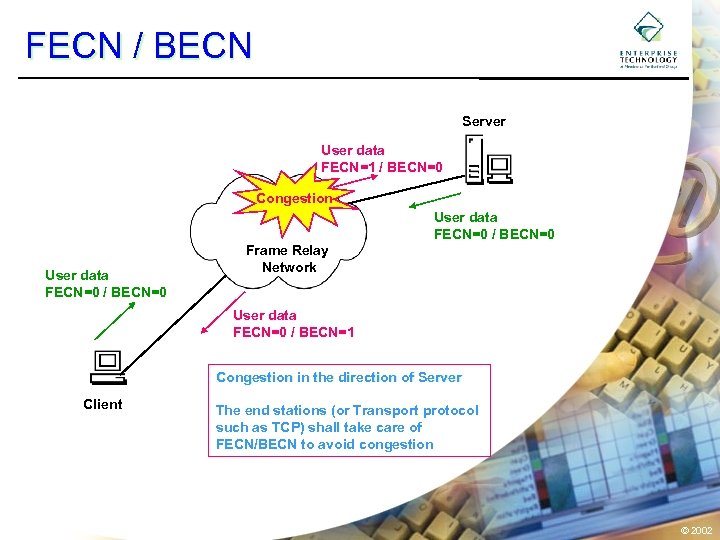 FECN / BECN Server User data FECN=1 / BECN=0 Congestion User data FECN=0 / BECN=0 Frame Relay Network User data FECN=0 / BECN=1 Congestion in the direction of Server Client The end stations (or Transport protocol such as TCP) shall take care of FECN/BECN to avoid congestion © 2002
 CLLM Message ~Consolidated Link Layer Management message ðIs a variation of BECN ðUsed when no reverse traffic is available ðCarries congestion information of multiple virtual circuits © 2002
 Implicit Control ~When a higher layer protocol detects frame discards, it can adapt rate control such as using sliding window technique. ~This function is independent of Frame Relay technology and usually handled by transport layer protocol like TCP. © 2002
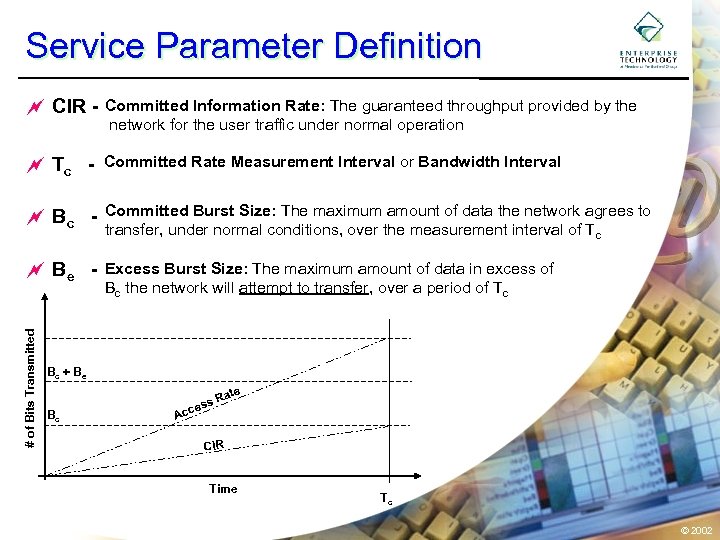 Service Parameter Definition ~ CIR - Committed Information Rate: The guaranteed throughput provided by the network for the user traffic under normal operation Committed Rate Measurement Interval or Bandwidth Interval ~ Bc - Committed Burst Size: The maximum amount of data the network agrees to transfer, under normal conditions, over the measurement interval of Tc ~ Be - Excess Burst Size: The maximum amount of data in excess of Bc the network will attempt to transfer, over a period of Tc # of Bits Transmitted ~ Tc - Bc + Be Bc ate s. R es Acc CIR Time Tc © 2002
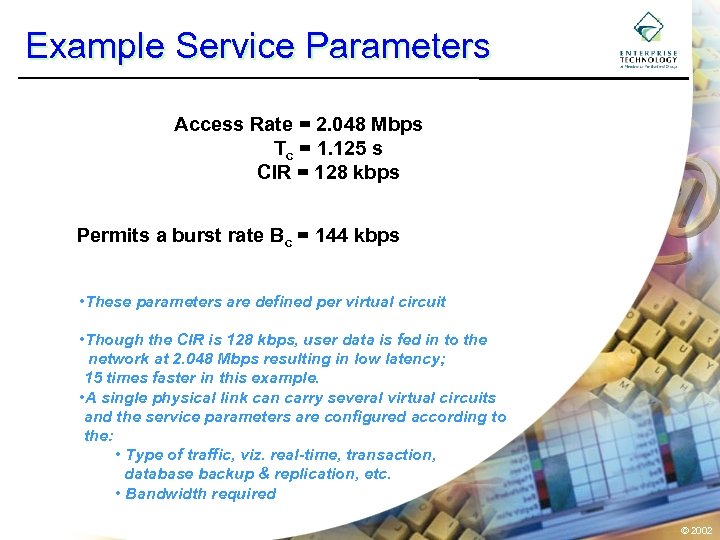 Example Service Parameters Access Rate = 2. 048 Mbps Tc = 1. 125 s CIR = 128 kbps Permits a burst rate Bc = 144 kbps • These parameters are defined per virtual circuit • Though the CIR is 128 kbps, user data is fed in to the network at 2. 048 Mbps resulting in low latency; 15 times faster in this example. • A single physical link can carry several virtual circuits and the service parameters are configured according to the: • Type of traffic, viz. real-time, transaction, database backup & replication, etc. • Bandwidth required © 2002
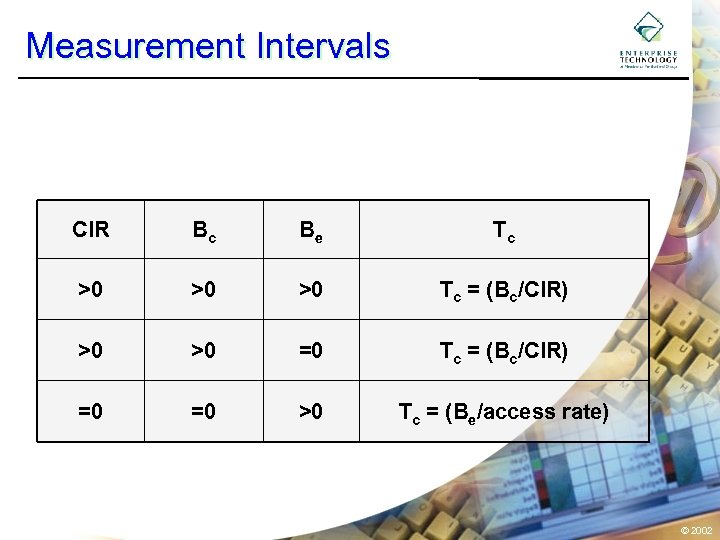 Measurement Intervals CIR Bc Be Tc >0 >0 >0 Tc = (Bc/CIR) >0 >0 =0 Tc = (Bc/CIR) =0 =0 >0 Tc = (Be/access rate) © 2002
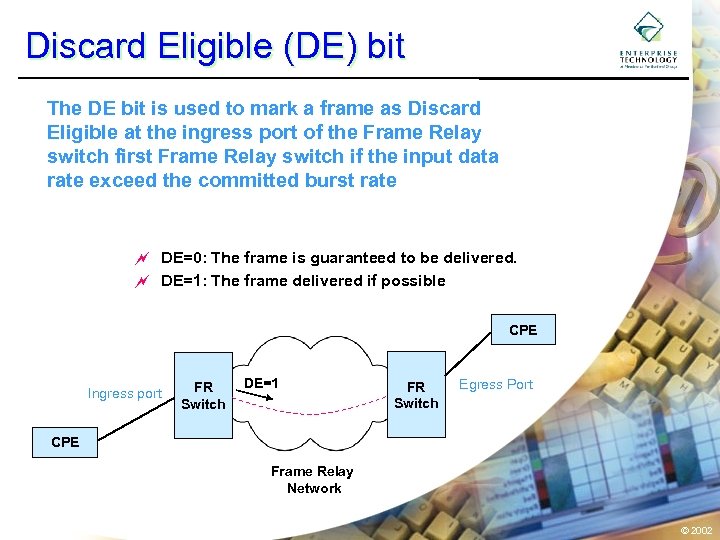 Discard Eligible (DE) bit The DE bit is used to mark a frame as Discard Eligible at the ingress port of the Frame Relay switch first Frame Relay switch if the input data rate exceed the committed burst rate ~ DE=0: The frame is guaranteed to be delivered. ~ DE=1: The frame delivered if possible CPE Ingress port FR Switch DE=1 FR Switch Egress Port CPE Frame Relay Network © 2002
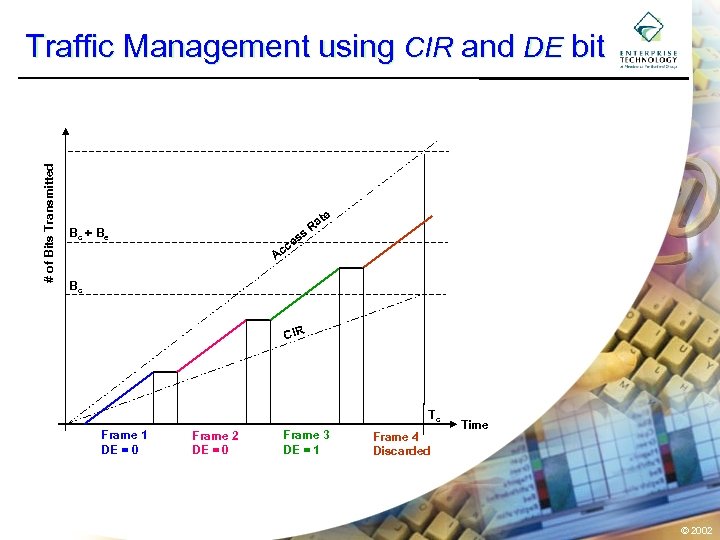 # of Bits Transmitted Traffic Management using CIR and DE bit te Bc + Be ss Ra e cc A Bc CIR Tc Frame 1 DE = 0 Frame 2 DE = 0 Frame 3 DE = 1 Frame 4 Discarded Time © 2002
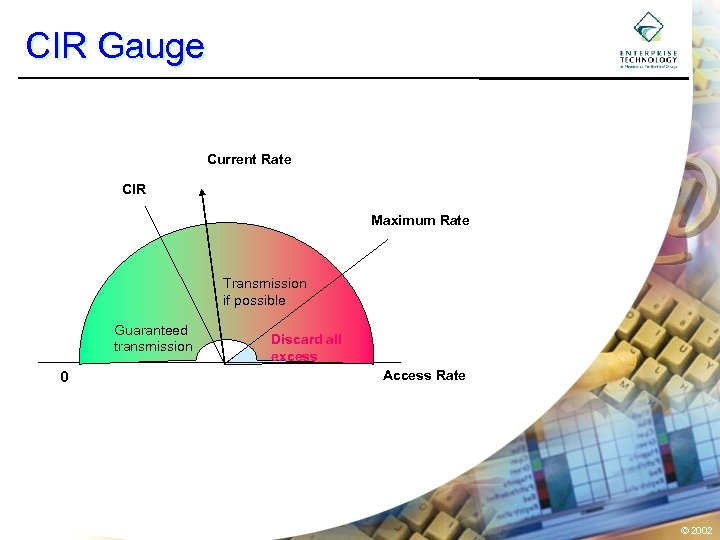 CIR Gauge Current Rate CIR Maximum Rate Transmission if possible Guaranteed transmission 0 Discard all excess Access Rate © 2002
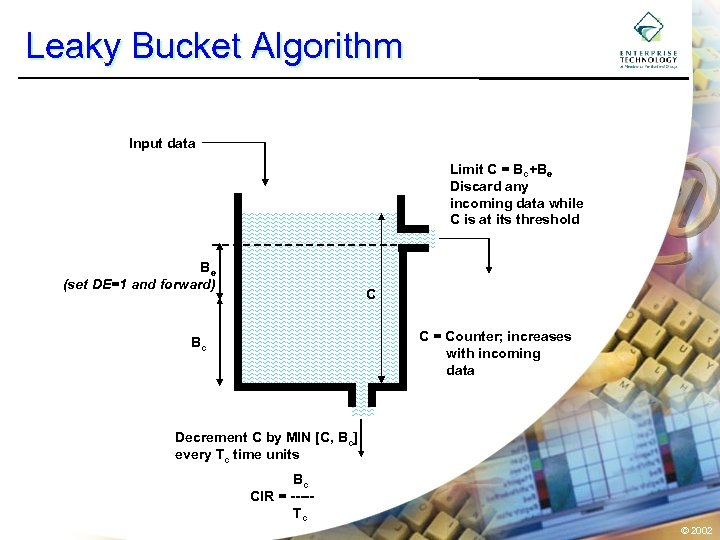 Leaky Bucket Algorithm Input data Limit C = Bc+Be Discard any incoming data while C is at its threshold Be (set DE=1 and forward) C C = Counter; increases with incoming data Bc Decrement C by MIN [C, Bc] every Tc time units Bc CIR = ----Tc © 2002
 Service Level Agreement Frame Relay service offerings are available from multiple service providers. Each provider describes the offering by specifying user information transfer parameters. End-users of the service utilize these parameters to: ~ Compare different service providers ~ Measure the quality of specific service ~ Enforce contractual commitments © 2002
 FRF. 13 Implementation Agreement ~Frame Relay Forum Implementation Agreement FRF. 13 specifies the SLA parameters that describes frame service performance ðFrame Transfer Delay (FTD) u The time required to transfer data through the network ðFrame Delivery Ratio (FDR, FDRc, FRDe) u Effectiveness in transporting offered load in one direction in a single virtual circuit ðData Delivery Ratio (DDR, DDRc, DDRe) u Effectiveness in transporting payload ðService Availability (FRVCA, FRMTTR, FRMTBSO) © 2002
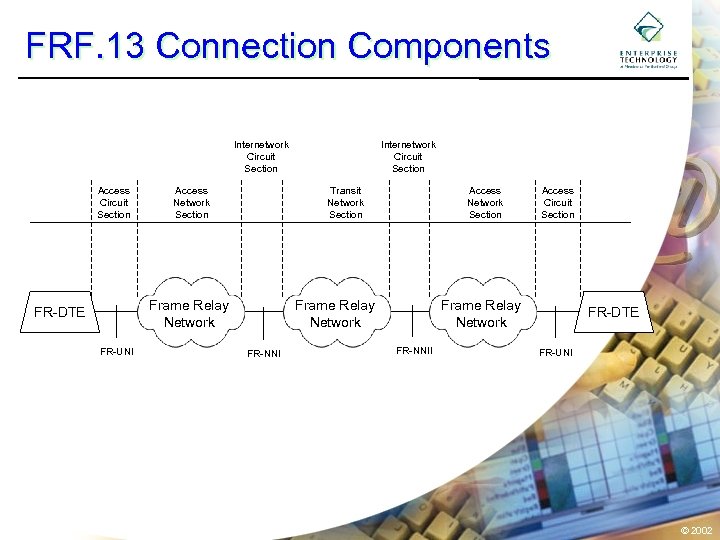 FRF. 13 Connection Components Internetwork Circuit Section Access Network Section Transit Network Section FR-UNI Access Network Section Frame Relay Network FR-DTE Internetwork Circuit Section FR-NNI Access Circuit Section Frame Relay Network FR-NNII FR-DTE FR-UNI © 2002
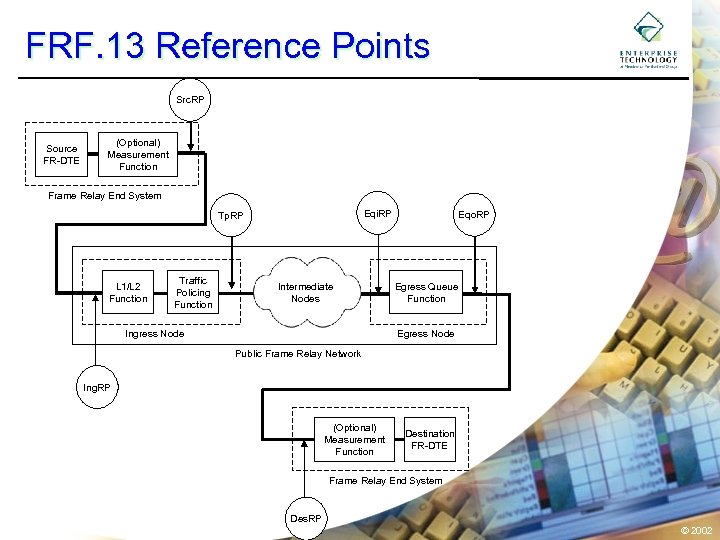 FRF. 13 Reference Points Src. RP Source FR-DTE (Optional) Measurement Function Frame Relay End System Eqi. RP Tp. RP L 1/L 2 Function Traffic Policing Function Intermediate Nodes Eqo. RP Egress Queue Function Egress Node Ingress Node Public Frame Relay Network Ing. RP (Optional) Measurement Function Destination FR-DTE Frame Relay End System Des. RP © 2002
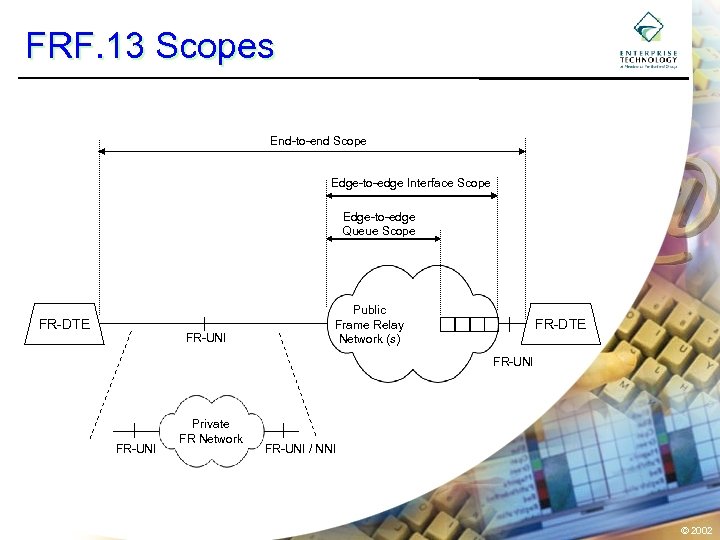 FRF. 13 Scopes End-to-end Scope Edge-to-edge Interface Scope Edge-to-edge Queue Scope FR-DTE FR-UNI Public Frame Relay Network (s) FR-DTE FR-UNI Private FR Network FR-UNI / NNI © 2002
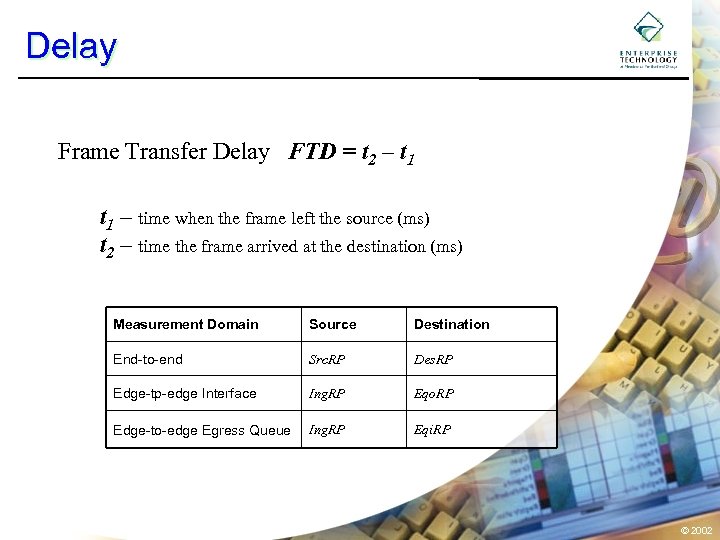 Delay Frame Transfer Delay FTD = t 2 – t 1 – time when the frame left the source (ms) t 2 – time the frame arrived at the destination (ms) Measurement Domain Source Destination End-to-end Src. RP Des. RP Edge-tp-edge Interface Ing. RP Eqo. RP Edge-to-edge Egress Queue Ing. RP Eqi. RP © 2002
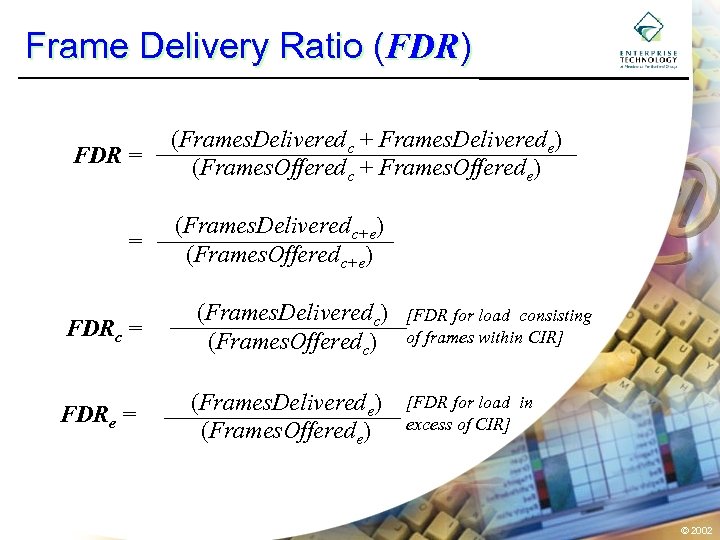 Frame Delivery Ratio (FDR) FDR = (Frames. Deliveredc + Frames. Deliverede) (Frames. Offeredc + Frames. Offerede) = (Frames. Deliveredc+e) (Frames. Offeredc+e) FDRc = (Frames. Deliveredc) (Frames. Offeredc) FDRe = (Frames. Deliverede) (Frames. Offerede) [FDR for load consisting of frames within CIR] [FDR for load in excess of CIR] © 2002
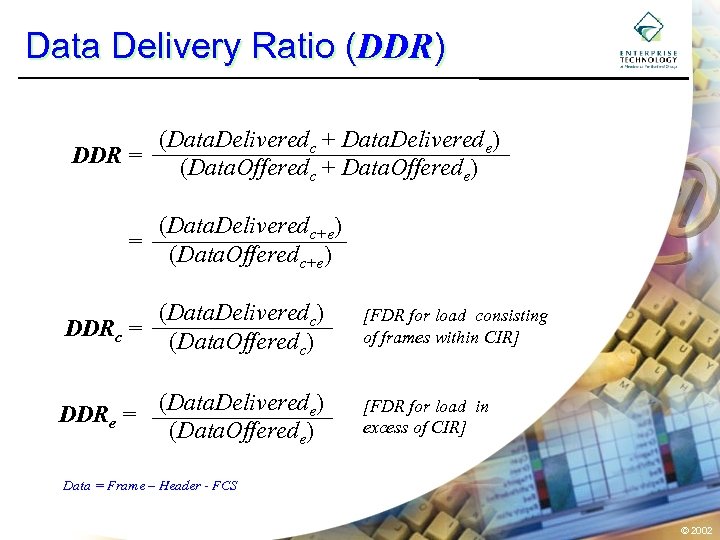 Data Delivery Ratio (DDR) (Data. Deliveredc + Data. Deliverede) DDR = (Data. Offeredc + Data. Offerede) (Data. Deliveredc+e) = (Data. Offeredc+e) (Data. Deliveredc) DDRc = (Data. Offeredc) DDRe = (Data. Deliverede) (Data. Offerede) [FDR for load consisting of frames within CIR] [FDR for load in excess of CIR] Data = Frame – Header - FCS © 2002
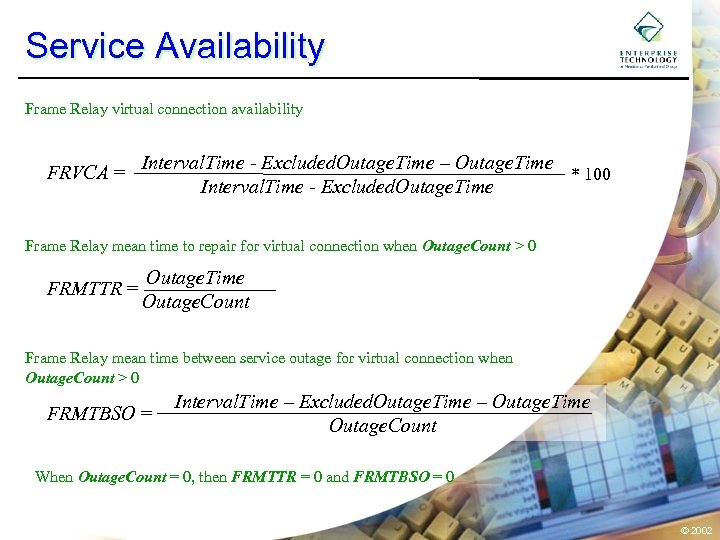 Service Availability Frame Relay virtual connection availability FRVCA = Interval. Time - Excluded. Outage. Time – Outage. Time * 100 Interval. Time - Excluded. Outage. Time Frame Relay mean time to repair for virtual connection when Outage. Count > 0 FRMTTR = Outage. Time Outage. Count Frame Relay mean time between service outage for virtual connection when Outage. Count > 0 FRMTBSO = Interval. Time – Excluded. Outage. Time – Outage. Time Outage. Count When Outage. Count = 0, then FRMTTR = 0 and FRMTBSO = 0 © 2002
 Summary ~ Frame Relay standards only define Interface Protocols. ~ It enables network sharing and bandwidth optimization. ~ The Frame Relay UNI & NNI have traffic management And congestion control mechanisms built-in. ~ SLA parameters are defined to measure the network performance on a per virtual circuit basis. © 2002
 Reference ~ Further reading: ðUyless Black: Frame Relay Networks, Mc. Graw-Hill, 1998 ðWilliam Stallings: ISDN and Broadband ISDN with Frame Relay and ATM, Prentice Hall, 2000 ðConfiguring Frame Relay Services: Bay. RS documentation - WAN Suite Protocols. ðNortel MAGELAN Training Manual: Network Engineering Volume 1 & 2 ðFrame Relay Forum web site www. frforum. com © 2002