 Скачать презентацию Frame Net Meets the Semantic Web Srini Narayanan
eee0fb900713991e4ae01b6e3e0e87e7.ppt
- Количество слайдов: 155



Frame. Net Meets the Semantic Web Srini Narayanan Charles Fillmore Collin Baker Miriam Petruck
Outline of Presentation • • • Semantic Frames and the Frame. Net Project Status of Frame. Net Data and Software Details on the Frame. Net process Comparison to other ontologies/resources Afternoon session: Going through the annotation process demo.
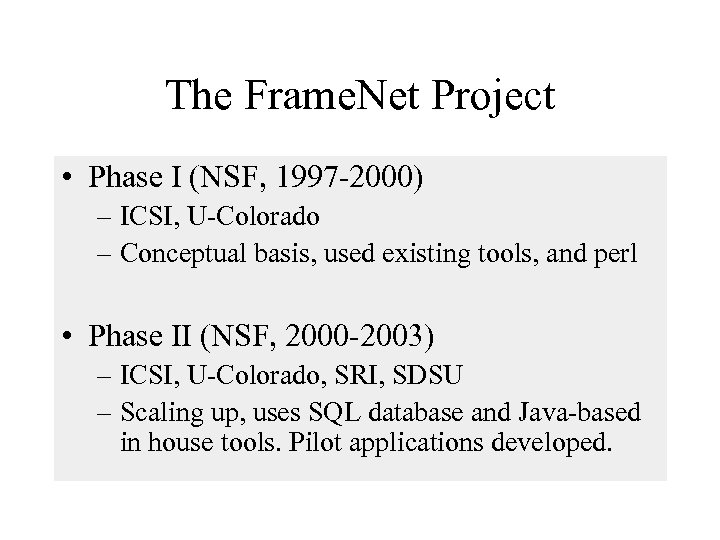
The Frame. Net Project • Phase I (NSF, 1997 -2000) – ICSI, U-Colorado – Conceptual basis, used existing tools, and perl • Phase II (NSF, 2000 -2003) – ICSI, U-Colorado, SRI, SDSU – Scaling up, uses SQL database and Java-based in house tools. Pilot applications developed.
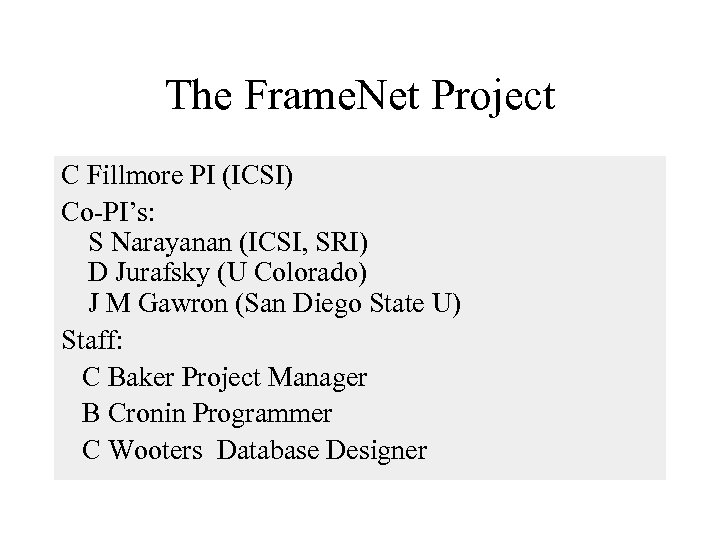
The Frame. Net Project C Fillmore PI (ICSI) Co-PI’s: S Narayanan (ICSI, SRI) D Jurafsky (U Colorado) J M Gawron (San Diego State U) Staff: C Baker Project Manager B Cronin Programmer C Wooters Database Designer
Applications An important goal of our work is to present information about the words in a form that will prove usable in various NLP applications: 1. Question Answering (Berkeley, Colorado) 2. Semantic Extraction (Berkeley, SRI, Colorado) 3. Machine Translation (San Diego State)
Frames and Understanding • Hypothesis: People understand things by performing mental operations on what they already know. Such knowledge is describable in terms of information packets called frames.
Frame. Net in the Larger Context • The long-term goal is to reason about the world in a way that humans understand agree with. • Such a system requires a knowledge representation that includes the level of frames. • Frame. Net can provide such knowledge for a number of domains. • Frame. Net representations complement ontologies and lexicons.
The core work of Frame. Net 1. 2. 3. 4. 5. 6. characterize frames find words that fit the frames develop descriptive terminology extract sample sentences annotate selected examples derive "valence" descriptions
Lexicon Building • We study words, • describe the frames or conceptual structures which underlie them, • examine sentences that contain them (from a vast corpus of written English), • and record the ways in which information from the associated frames are expressed in these sentences.
The Core Data The basic data on which Frame. Net descriptions are based take the form of a collection of annotated sentences, each coded for the combinatorial properties of one word in it. The annotation is done manually, but several steps are computerassisted.
The Process • Sentences containing a given word are extracted from the corpus and made available for annotation. • Student annotators select the phrases that identify particular semantic roles in the sentences, and tag them with the name of these roles. • Automatic processes then provide grammatical information about the tagged phrases.
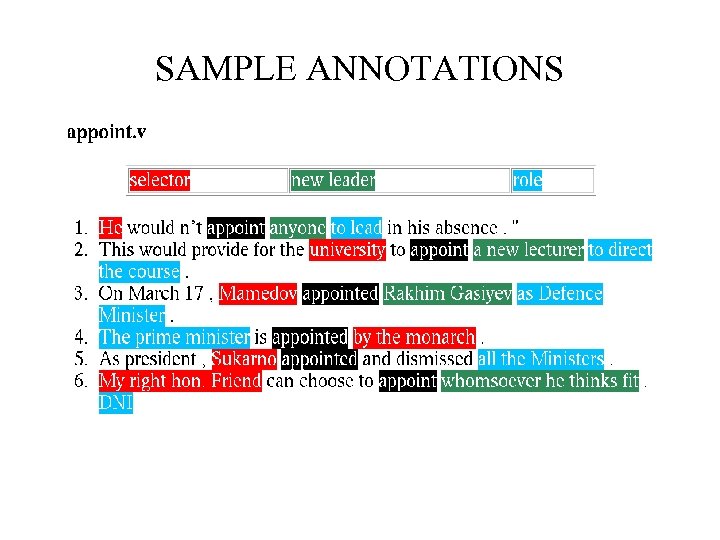
SAMPLE ANNOTATIONS
Types of Words / Frames o o o o events artifacts, built objects natural kinds, parts and aggregates terrain features institutions, belief systems, practices space, time, location, motion etc.
Event Frames Event frames have temporal structure, and generally have constraints on what precedes them, what happens during them, and what state the world is in once the event has been completed.
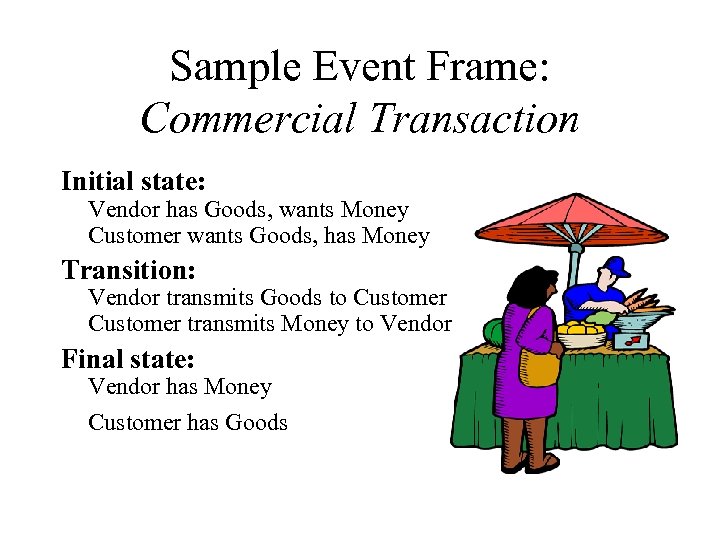
Sample Event Frame: Commercial Transaction Initial state: Vendor has Goods, wants Money Customer wants Goods, has Money Transition: Vendor transmits Goods to Customer transmits Money to Vendor Final state: Vendor has Money Customer has Goods
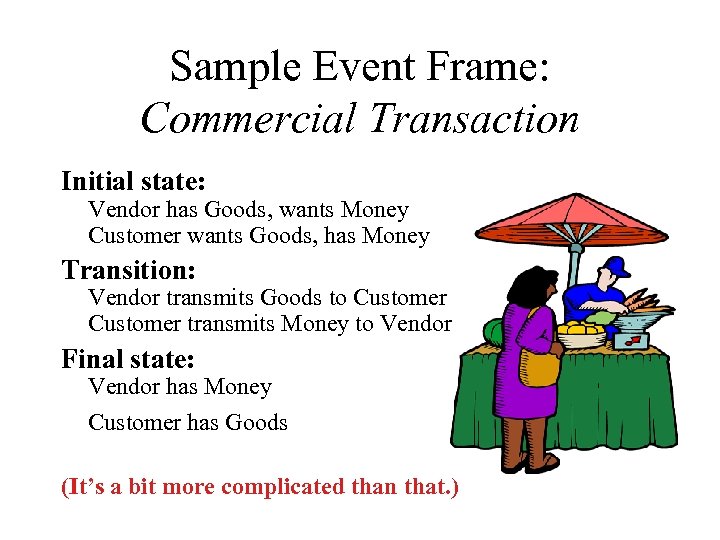
Sample Event Frame: Commercial Transaction Initial state: Vendor has Goods, wants Money Customer wants Goods, has Money Transition: Vendor transmits Goods to Customer transmits Money to Vendor Final state: Vendor has Money Customer has Goods (It’s a bit more complicated than that. )
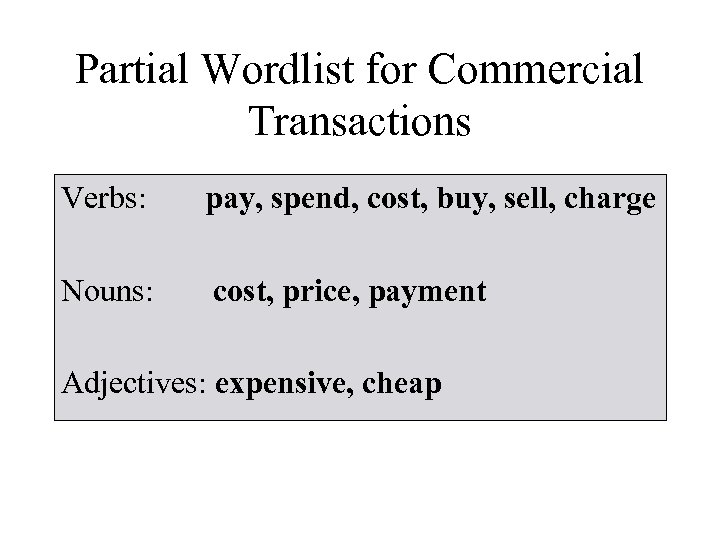
Partial Wordlist for Commercial Transactions Verbs: pay, spend, cost, buy, sell, charge Nouns: cost, price, payment Adjectives: expensive, cheap
Meaning and Syntax § The various verbs that evoke this frame introduce the elements of the frame in different ways. § The identities of the buyer, seller, goods and money § Information expressed in sentences containing these verbs occurs in different places in the sentence depending on the verb.
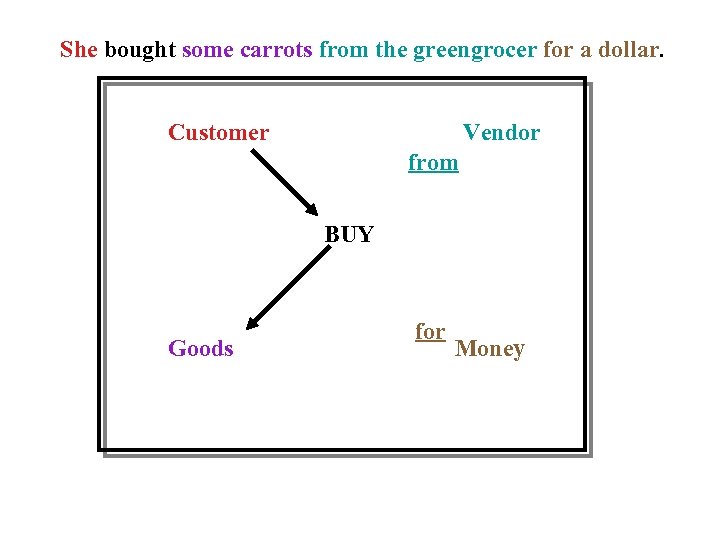
She bought some carrots from the greengrocer for a dollar. Customer Vendor from BUY Goods for Money
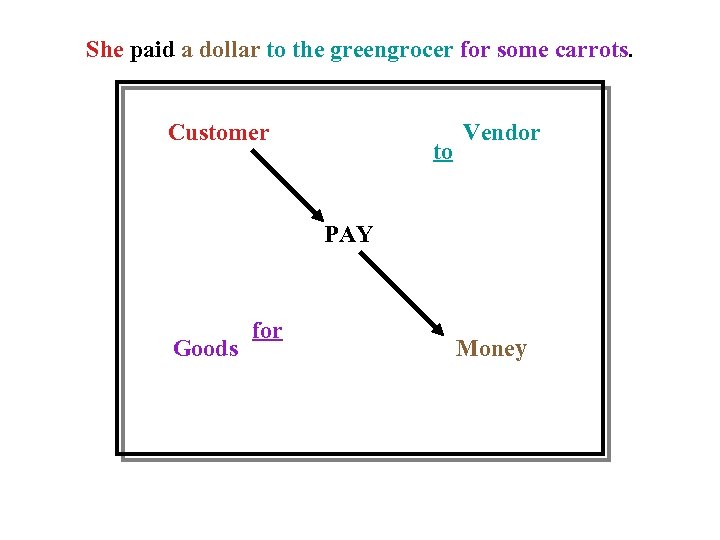
She paid a dollar to the greengrocer for some carrots. Customer to Vendor PAY Goods for Money
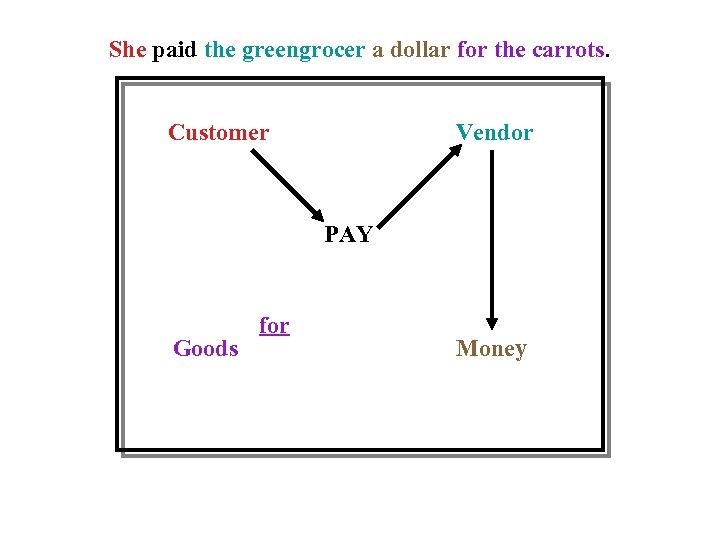
She paid the greengrocer a dollar for the carrots. Customer Vendor PAY Goods for Money
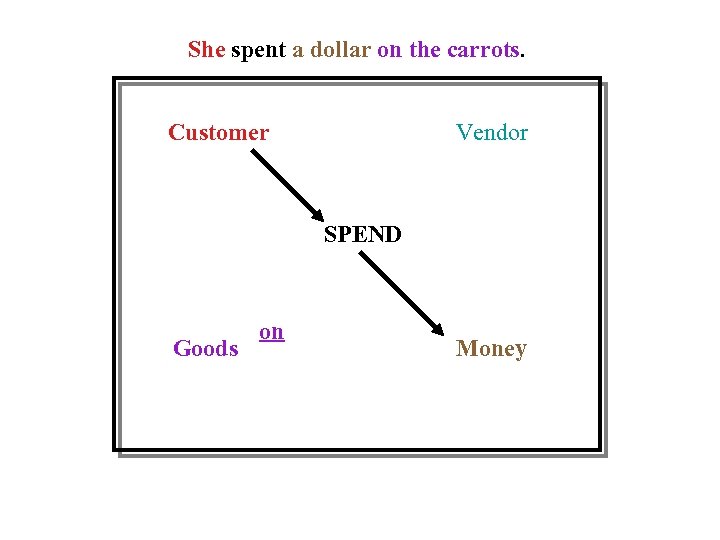
She spent a dollar on the carrots. Customer Vendor SPEND Goods on Money
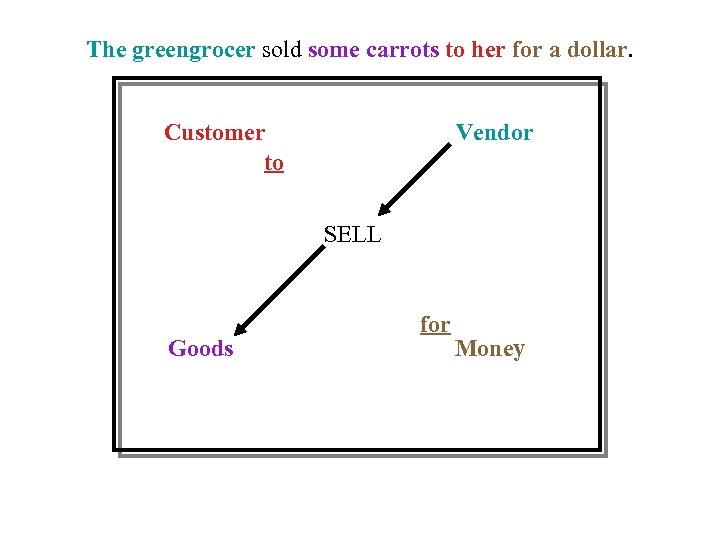
The greengrocer sold some carrots to her for a dollar. Customer to Vendor SELL Goods for Money
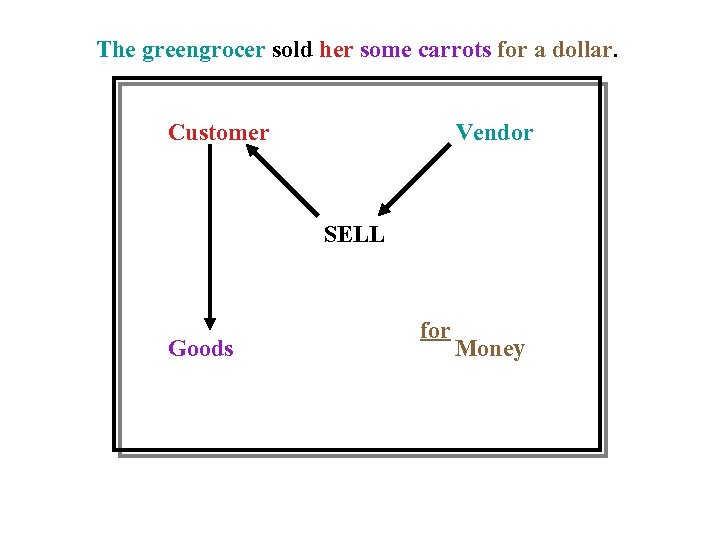
The greengrocer sold her some carrots for a dollar. Customer Vendor SELL Goods for Money
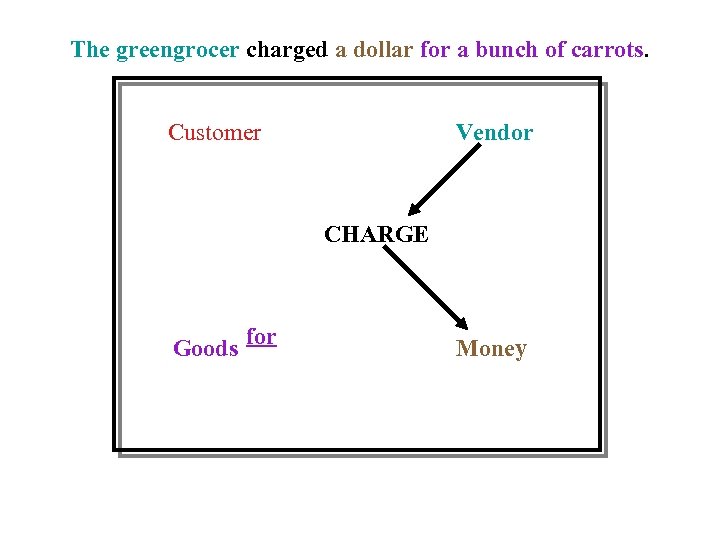
The greengrocer charged a dollar for a bunch of carrots. Customer Vendor CHARGE Goods for Money
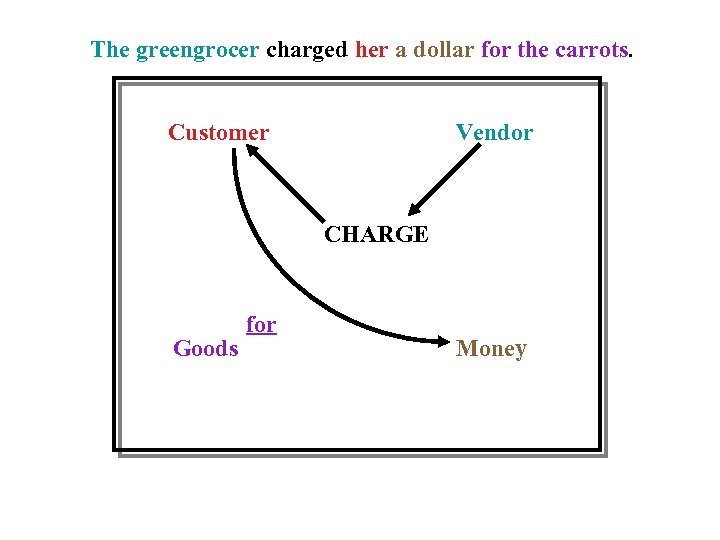
The greengrocer charged her a dollar for the carrots. Customer Vendor CHARGE Goods for Money
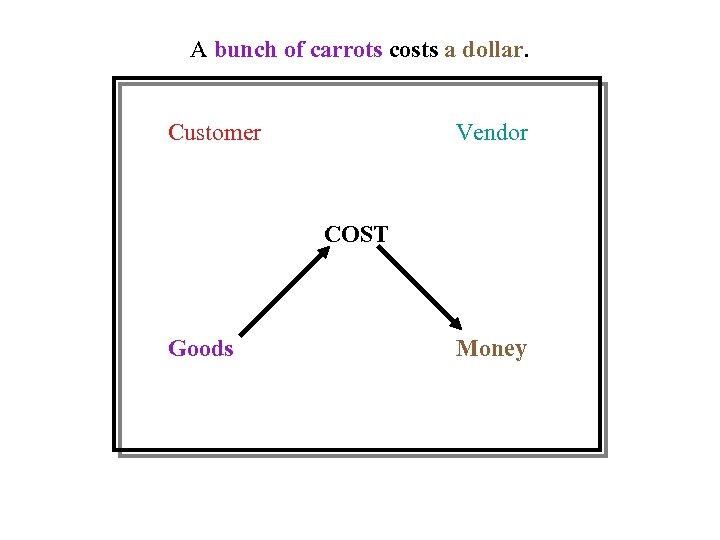
A bunch of carrots costs a dollar. Customer Vendor COST Goods Money
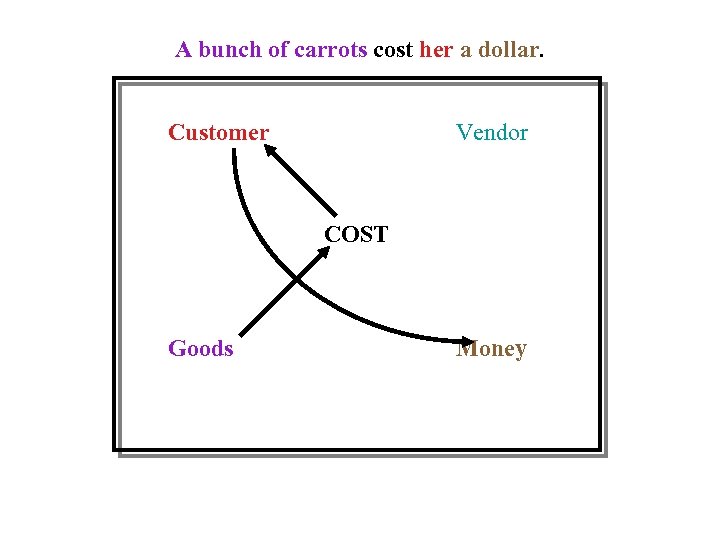
A bunch of carrots cost her a dollar. Customer Vendor COST Goods Money
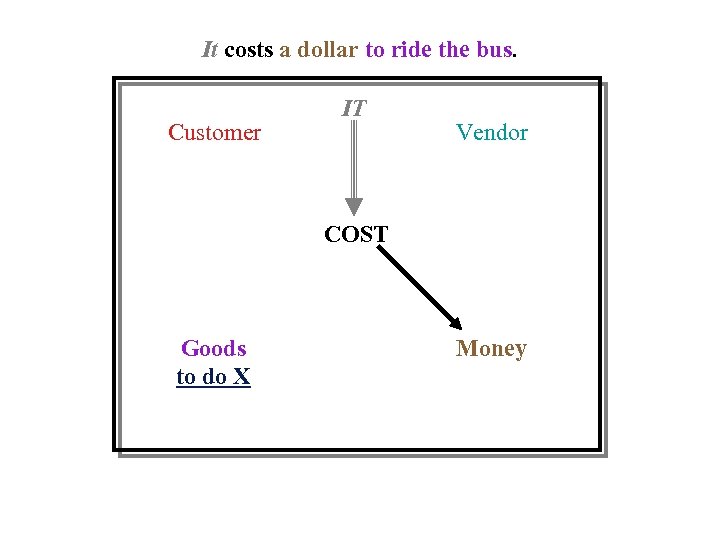
It costs a dollar to ride the bus. Customer IT Vendor COST Goods to do X Money
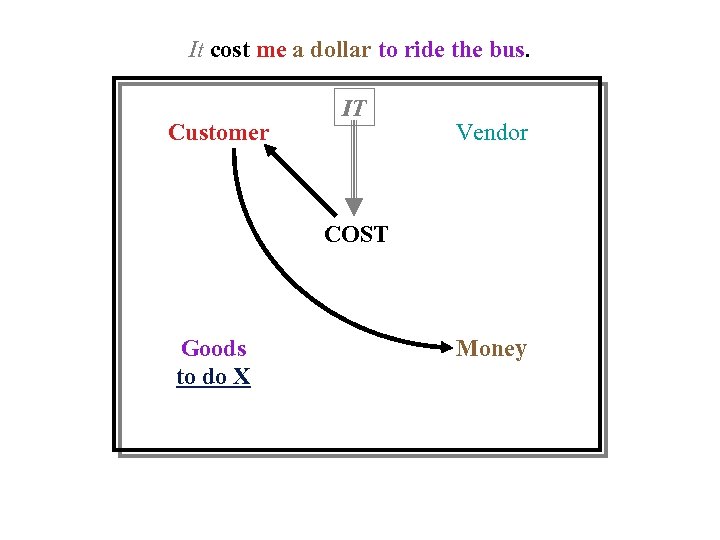
It cost me a dollar to ride the bus. Customer IT Vendor COST Goods to do X Money
Frame. Net Product • For every target word, • describe the frames or conceptual structures which underlie them, • and annotate example sentences that cover the ways in which information from the associated frames are expressed in these sentences.
FN work: characterizing frames • One of the things we do is characterize such information packets - beginning with informal descriptions. • We can begin with Revenge.
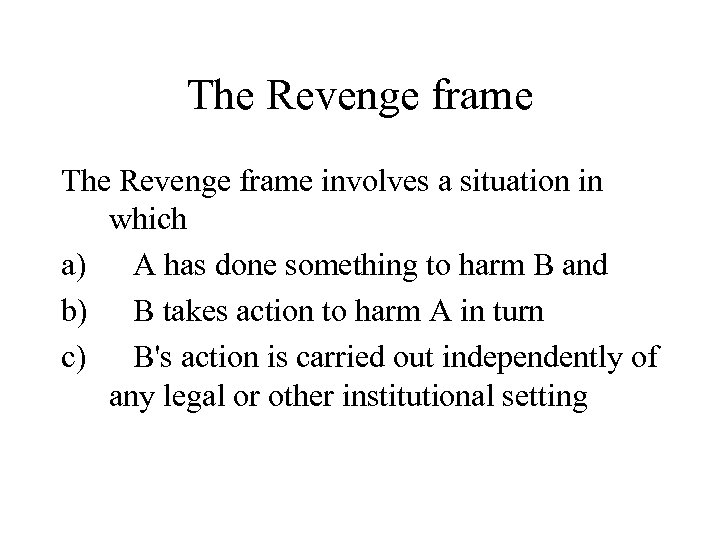
The Revenge frame involves a situation in which a) A has done something to harm B and b) B takes action to harm A in turn c) B's action is carried out independently of any legal or other institutional setting
FN work: finding words in frame • We look for words in the language that bring to mind the individual frames. • We say that the words evoke the frames.
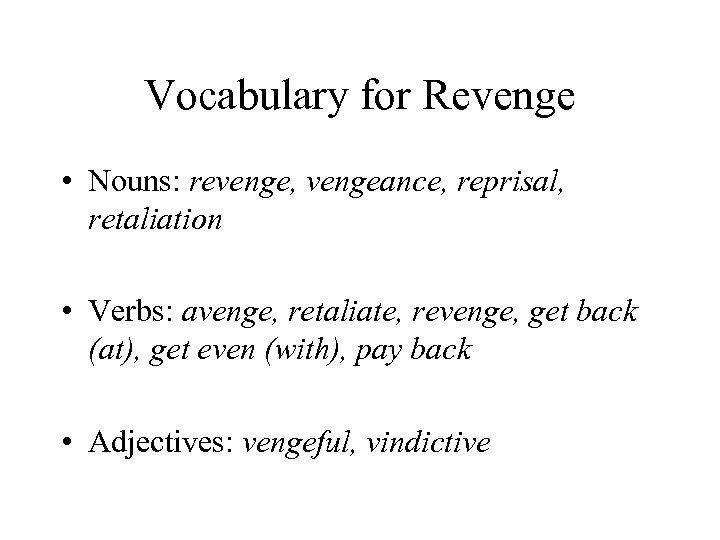
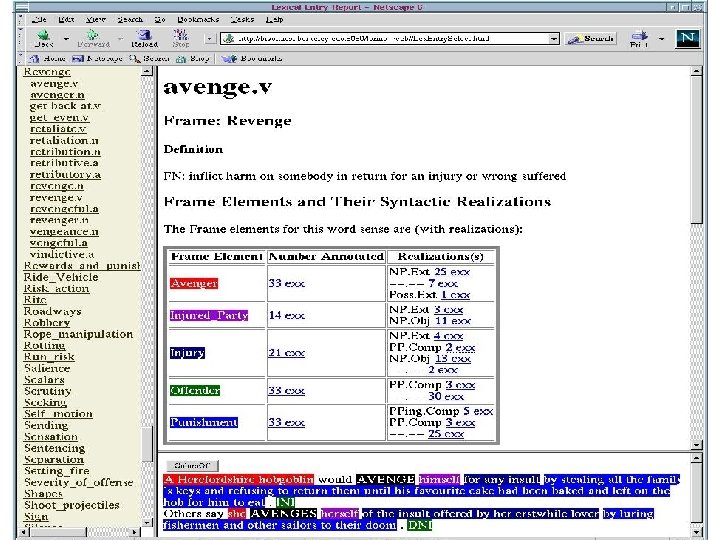
Vocabulary for Revenge • Nouns: revenge, vengeance, reprisal, retaliation • Verbs: avenge, retaliate, revenge, get back (at), get even (with), pay back • Adjectives: vengeful, vindictive
FN work: choosing FE names • We develop a descriptive vocabulary for the components of each frame, called frame elements (FEs). • We use FE names in labeling the constituents of sentences exhibiting the frame.
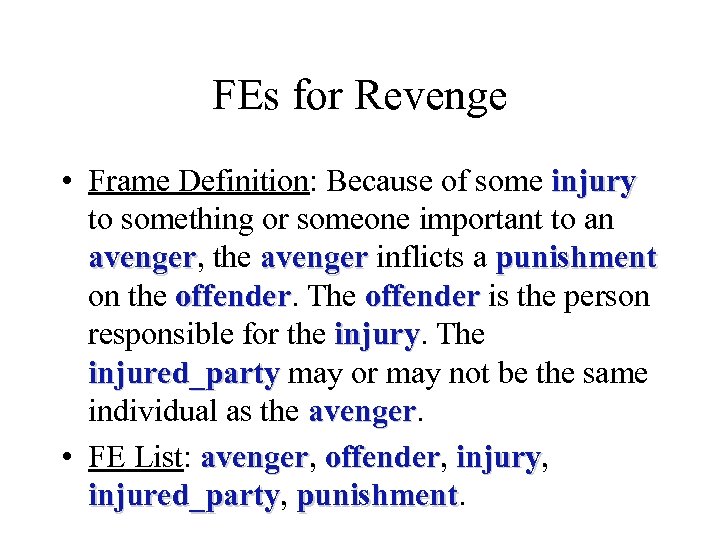
FEs for Revenge • Frame Definition: Because of some injury to something or someone important to an avenger, the avenger inflicts a punishment avenger on the offender. The offender is the person offender responsible for the injury. The injury injured_party may or may not be the same individual as the avenger • FE List: avenger, offender, injury, avenger offender injury injured_party, punishment. injured_party punishment
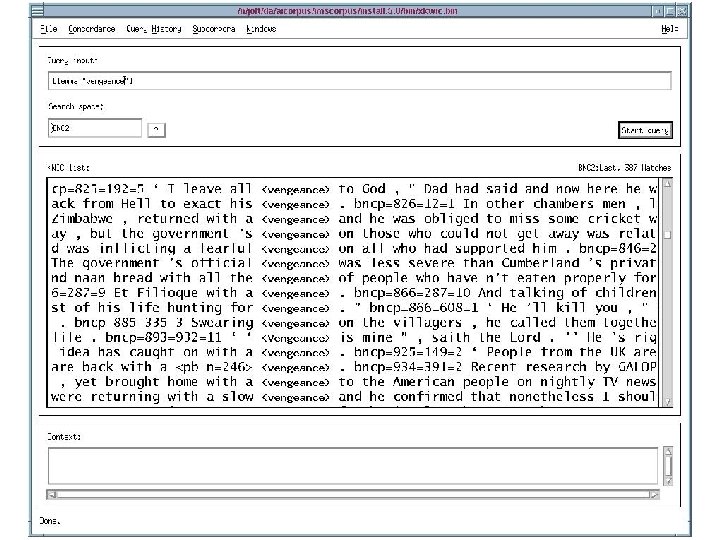
FN work: collecting examples • We extract from our corpus examples of sentences showing the uses of each word in the frame.
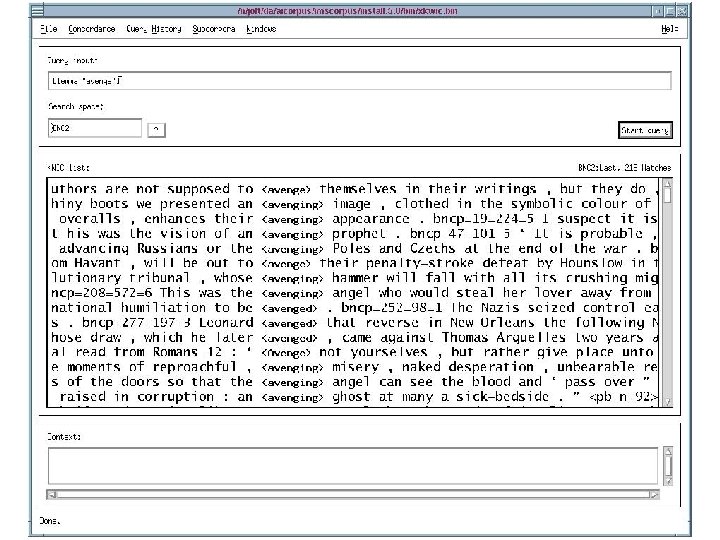
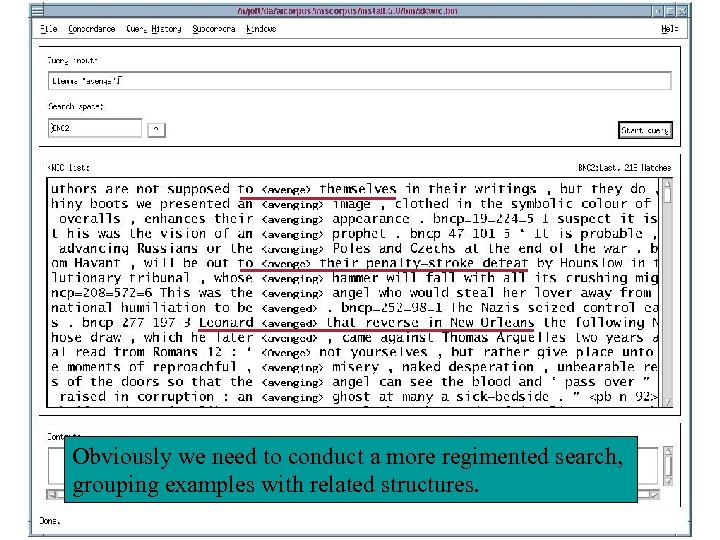
Obviously we need to conduct a more regimented search, grouping examples with related structures.
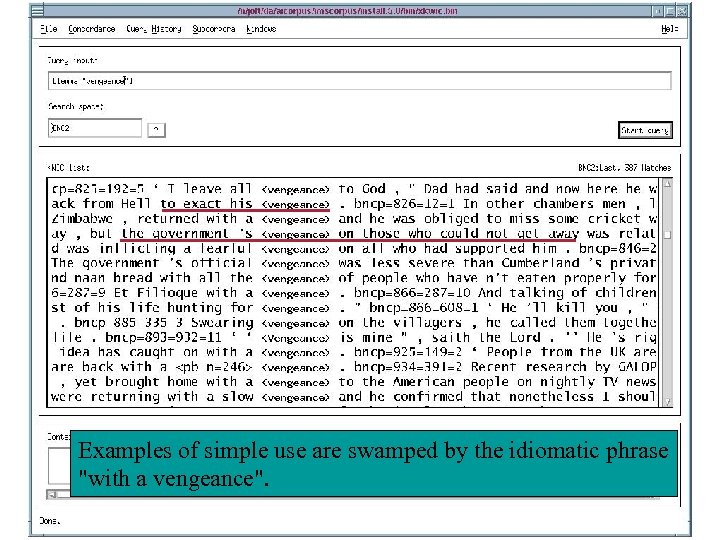
Examples of simple use are swamped by the idiomatic phrase "with a vengeance".
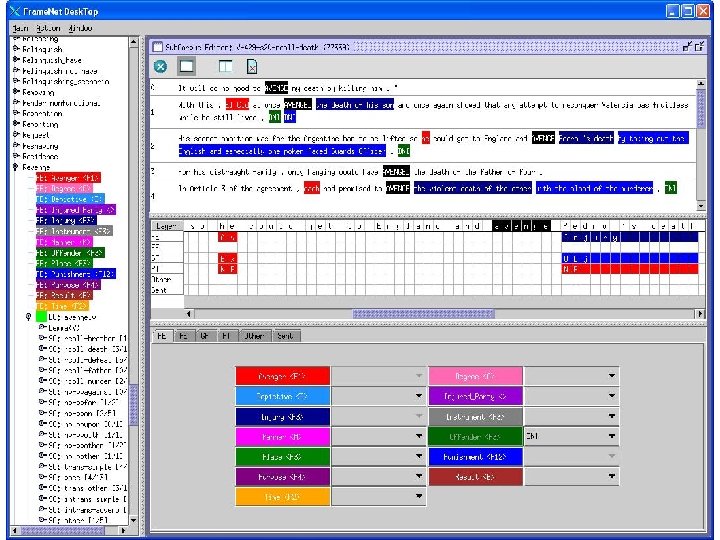
FN work: annotating examples • We select sentences exhibiting common collocations and showing all major syntactic contexts. • Using the names assigned to FEs in the frame, we label the constituents of sentences that express these FEs.
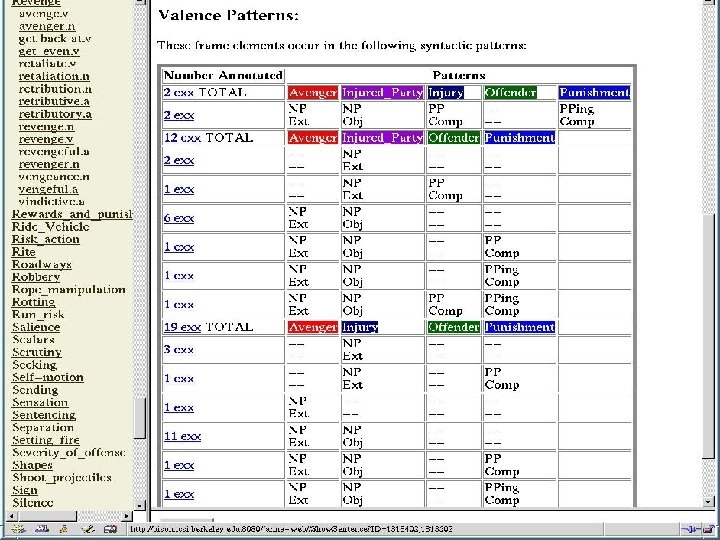
FN work: summarizing results • Automatic processes summarize the results, linking FEs with information about their grammatical realization. • The output is presented in the form of various reports in the public website, in XML format in the data release.
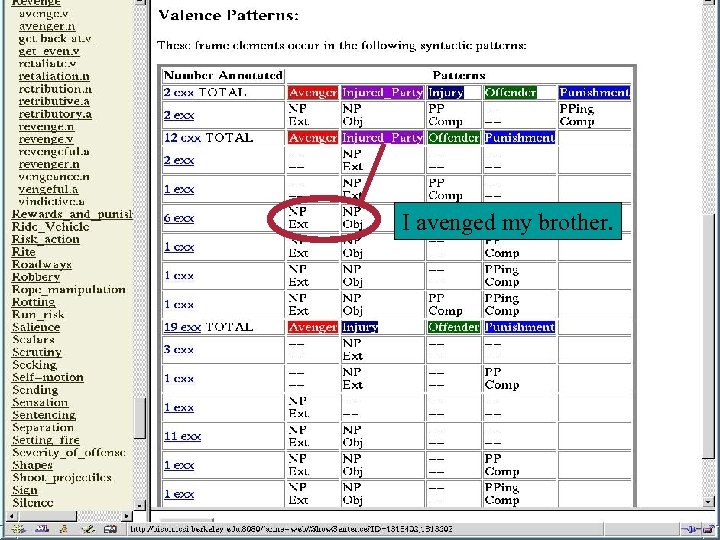
I avenged my brother.
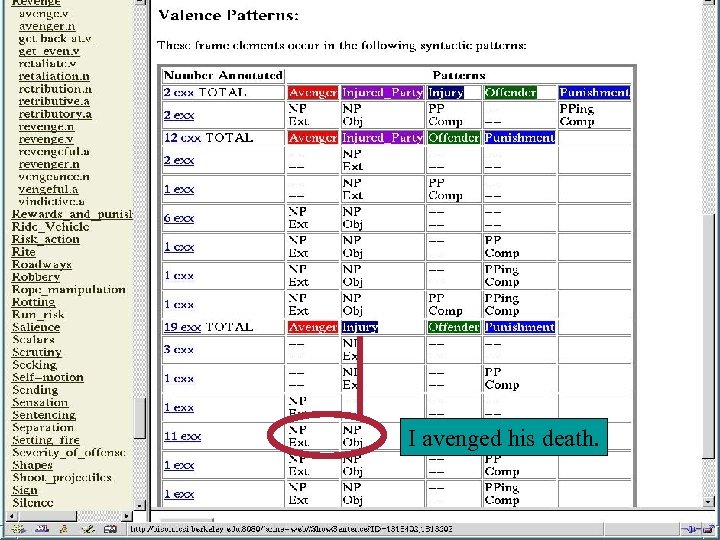
I avenged his death.
Querying the data: meaning to form Through various viewers built on the FN database we can, for example, ask how particular FEs get expressed in sentences evoking a given frame.
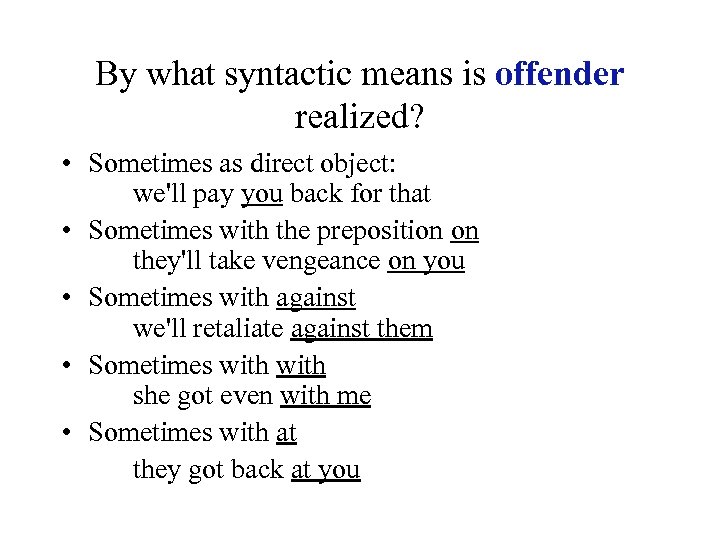
By what syntactic means is offender realized? • Sometimes as direct object: we'll pay you back for that • Sometimes with the preposition on they'll take vengeance on you • Sometimes with against we'll retaliate against them • Sometimes with she got even with me • Sometimes with at they got back at you
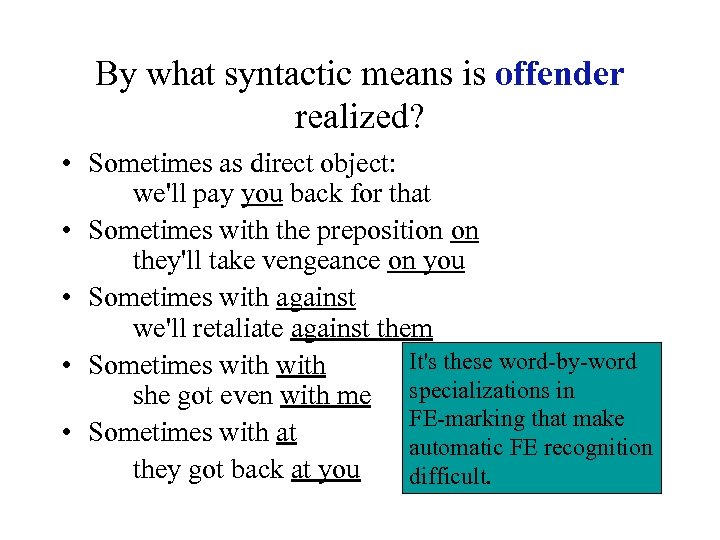
By what syntactic means is offender realized? • Sometimes as direct object: we'll pay you back for that • Sometimes with the preposition on they'll take vengeance on you • Sometimes with against we'll retaliate against them It's these word-by-word • Sometimes with she got even with me specializations in FE-marking that make • Sometimes with at automatic FE recognition they got back at you difficult.
Querying the data: form to meaning Or, going from the grammar to the meaning, we can choose particular grammatical contexts and ask which FEs get expressed in them.
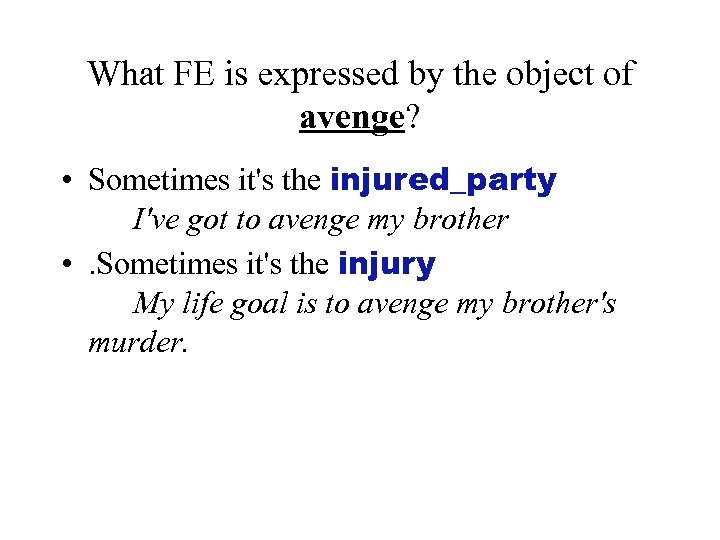
What FE is expressed by the object of avenge? • Sometimes it's the injured_party I've got to avenge my brother • . Sometimes it's the injury My life goal is to avenge my brother's murder.
Evaluation • Lexical coverage. We want to get all of the important words associated with each frame. • Combinatorics. We want to get all of the syntactic patterns in which each word functions to express the frame.
Evaluation • We do not ourselves collect frequency data. That will wait until methods of automatic tagging get perfected. • In any case, the results will differ according to the type of corpus - financial news, children's literature, technical manuals, etc.
What do we end up with? • Frames • Lexical entries • Annotations
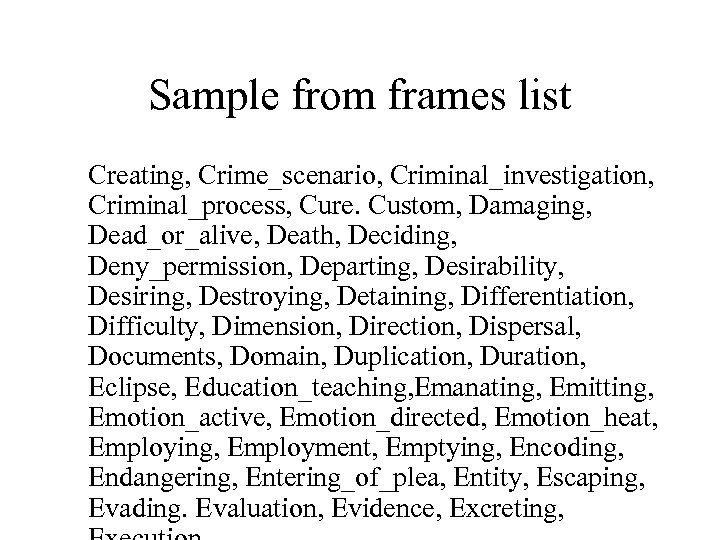
Sample from frames list Creating, Crime_scenario, Criminal_investigation, Criminal_process, Cure. Custom, Damaging, Dead_or_alive, Death, Deciding, Deny_permission, Departing, Desirability, Desiring, Destroying, Detaining, Differentiation, Difficulty, Dimension, Direction, Dispersal, Documents, Domain, Duplication, Duration, Eclipse, Education_teaching, Emanating, Emitting, Emotion_active, Emotion_directed, Emotion_heat, Employing, Employment, Emptying, Encoding, Endangering, Entering_of_plea, Entity, Escaping, Evading. Evaluation, Evidence, Excreting,
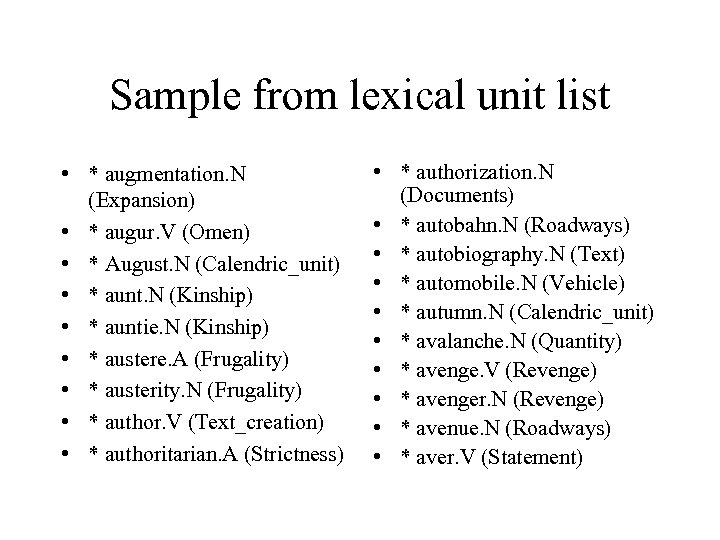
Sample from lexical unit list • * augmentation. N (Expansion) • * augur. V (Omen) • * August. N (Calendric_unit) • * aunt. N (Kinship) • * auntie. N (Kinship) • * austere. A (Frugality) • * austerity. N (Frugality) • * author. V (Text_creation) • * authoritarian. A (Strictness) • * authorization. N (Documents) • * autobahn. N (Roadways) • * autobiography. N (Text) • * automobile. N (Vehicle) • * autumn. N (Calendric_unit) • * avalanche. N (Quantity) • * avenge. V (Revenge) • * avenger. N (Revenge) • * avenue. N (Roadways) • * aver. V (Statement)
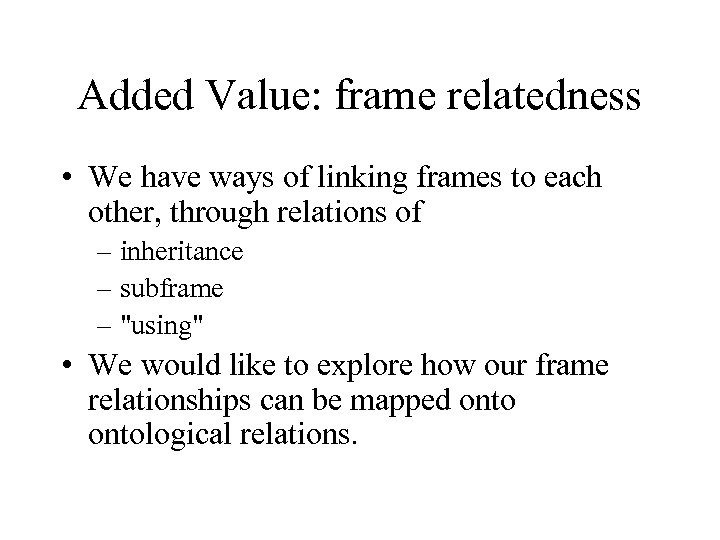
Added Value: frame relatedness • We have ways of linking frames to each other, through relations of – inheritance – subframe – "using" • We would like to explore how our frame relationships can be mapped ontological relations.
Frame-to-frame relations • Revenge inherits Punishment/Reward • Revenge uses the Hostile_encounter frame • (see existing tentative frame hierarchy)
Added Value: semantic types • We also have the means of adding semantic types to words, frames and frame elements. • Some of these: – negative vs. positive (disaster vs. bonanza), – punctual vs. stative (arrive vs. reside), – artifact vs. natural kind (building vs. tree).
Added Value: semantic types • For the kinds of nouns that occupy particular FE slots in given frames, we should be able to use the Word. Net noun taxonomies. • This is done in some related work
Added Value: support verbs • In the case of the event nouns, we keep track of which verbs can combine with which nouns to signal occurrences of the frame evoked by the noun. – – – take a bath (bathe) have an argument (argue) wreak vengeance, take revenge, exact retribution.
Can annotation be automated? Gildea, D & D Jurafsky, 2000, Automatic labeling of semantic roles, Association for Computational Linguistics, Hong Kong. Mohit & Narayanan, 2003, Semantic Extraction using Wide-coverage lexical resources, HLT-NAACL 2003.
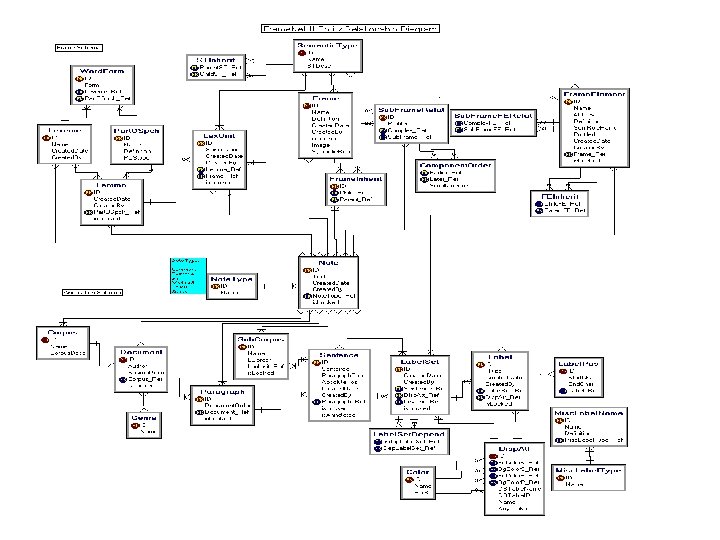
The Database The information collected from the data (and a certain amount of information inserted manually by the lexicographers) is stored in a My. SQL database.
Current Status • Current: 7700 Lexical Units – FN 1: 1600 Lexical units – FN 2: 4400 Lexical Units – Created (not yet annotated): 1280 LU – Other : in process, problems, etc.
Current Status • 500 Frames • 7700 Lexical Units • 130, 000 Annotated sentences
Data Distribution Distributed as XML files with accompanying DTDs Separate files and DTDs for – Frame and FE data – –Annotation data – Frame relation data • Easy to parse with standard XML tools. – Approximately 100 research groups have been authorized to download release 1. 0 of the FN data (Oct. , 2002). • Next release scheduled for August, 2003
Frame. Net Software Distribution • All software is pure Java, and can be run on any platform for which a JVM is available • Has been successfully run on Solaris, Linux, Mac OS X, and Windows 9 x/2000 with very minor modifications • Server and clients currently being used in Barcelona for annotation in Spanish FN. • We will streamline the installation process if demand warrants • We plan to publicly release the full software suite in August, 2003.
Multi-Lingual Frame. Nets • Spanish Frame. Net – Prof. Carlos Subirats, U A Barcelona – Parallel to English Frame. Net, using same frames • German Frame. Net – Prof. Manfred Pinkal, U Saarlandes – Complete annotation of existing parsed corpus, – using English frames where possible • Japanese Frame. Net – Prof. Kyoko Ohara, Keio U – Collecting own corpus, building search tools
Some Comparisons
Is FN an ontology? • Not exactly, but some users use FN frames as an ontology of event types.
Is FN a thesaurus? Yes, because it groups words into meaning categories, by way of shared membership in frames.
How is FN different from WN? FN does not explicitly display semantic relations between words of the sort found in Word. Net. (synonymy, antonymy, hyponymy, meronymy, etc. ) Furthermore, FN includes many opposing pairs (hot, cold; tall, short) in the same frame.
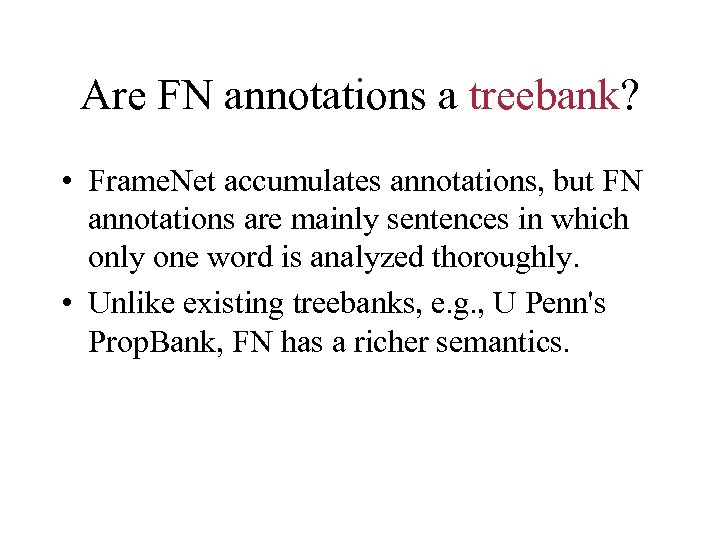
Are FN annotations a treebank? • Frame. Net accumulates annotations, but FN annotations are mainly sentences in which only one word is analyzed thoroughly. • Unlike existing treebanks, e. g. , U Penn's Prop. Bank, FN has a richer semantics.
Comparison with Dictionaries
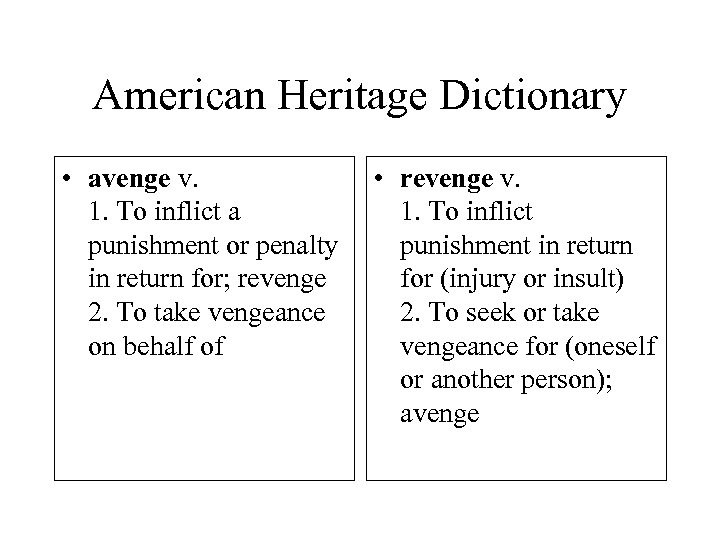
American Heritage Dictionary • avenge v. 1. To inflict a punishment or penalty in return for; revenge 2. To take vengeance on behalf of • revenge v. 1. To inflict punishment in return for (injury or insult) 2. To seek or take vengeance for (oneself or another person); avenge
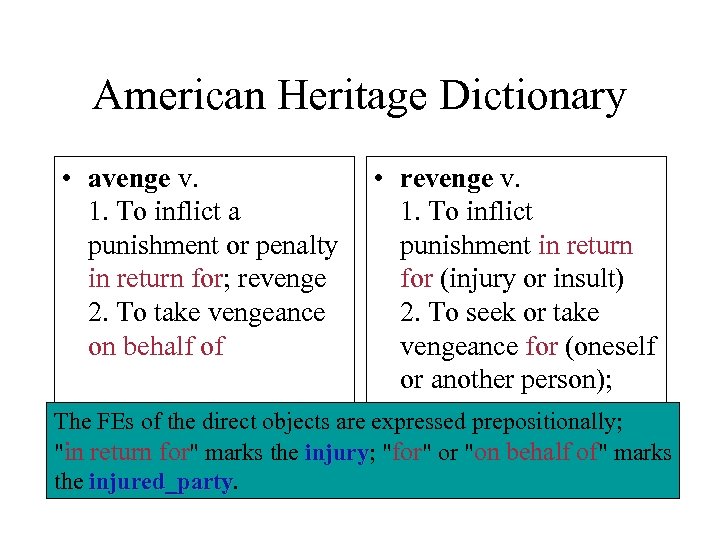
American Heritage Dictionary • avenge v. 1. To inflict a punishment or penalty in return for; revenge 2. To take vengeance on behalf of • revenge v. 1. To inflict punishment in return for (injury or insult) 2. To seek or take vengeance for (oneself or another person); avenge The FEs of the direct objects are expressed prepositionally; "in return for" marks the injury; "for" or "on behalf of" marks injury the injured_party
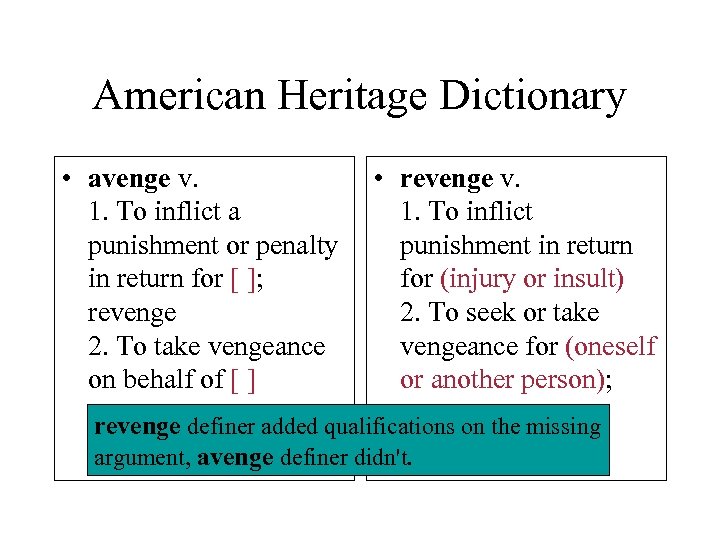
American Heritage Dictionary • avenge v. 1. To inflict a punishment or penalty in return for [ ]; revenge 2. To take vengeance on behalf of [ ] • revenge v. 1. To inflict punishment in return for (injury or insult) 2. To seek or take vengeance for (oneself or another person); avenge revenge definer added qualifications on the missing argument, avenge definer didn't.
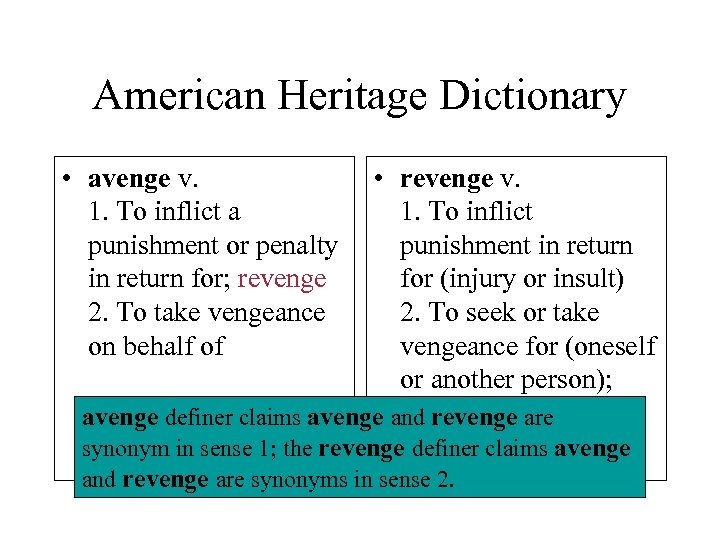
American Heritage Dictionary • avenge v. 1. To inflict a punishment or penalty in return for; revenge 2. To take vengeance on behalf of • revenge v. 1. To inflict punishment in return for (injury or insult) 2. To seek or take vengeance for (oneself or another person); avenge definer claims avenge and revenge are synonym in sense 1; the revenge definer claims avenge and revenge are synonyms in sense 2.
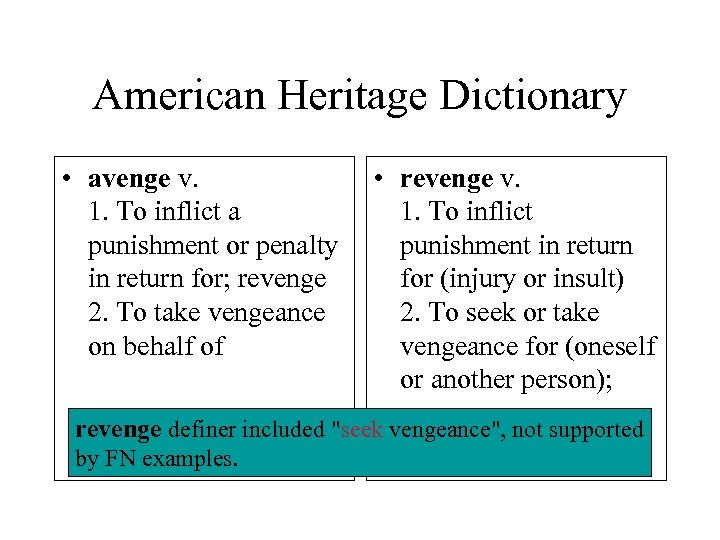
American Heritage Dictionary • avenge v. 1. To inflict a punishment or penalty in return for; revenge 2. To take vengeance on behalf of • revenge v. 1. To inflict punishment in return for (injury or insult) 2. To seek or take vengeance for (oneself or another person); avenge revenge definer included "seek vengeance", not supported by FN examples.
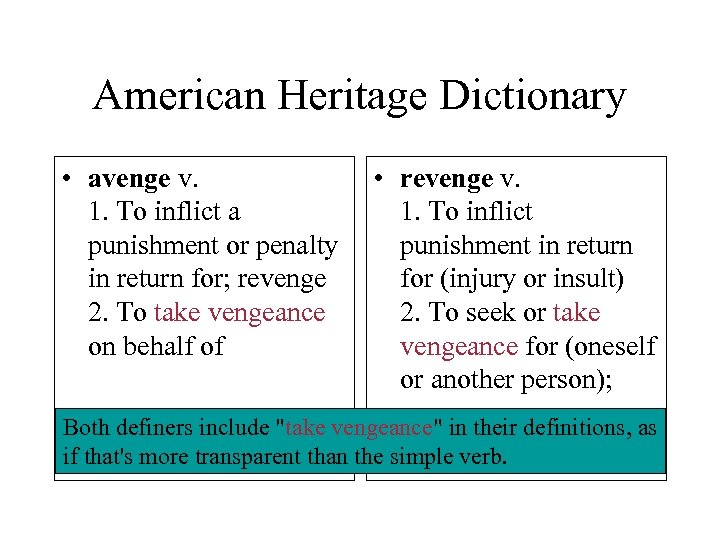
American Heritage Dictionary • avenge v. 1. To inflict a punishment or penalty in return for; revenge 2. To take vengeance on behalf of • revenge v. 1. To inflict punishment in return for (injury or insult) 2. To seek or take vengeance for (oneself or another person); avenge Both definers include "take vengeance" in their definitions, as if that's more transparent than the simple verb.
Comparison with Word. Net
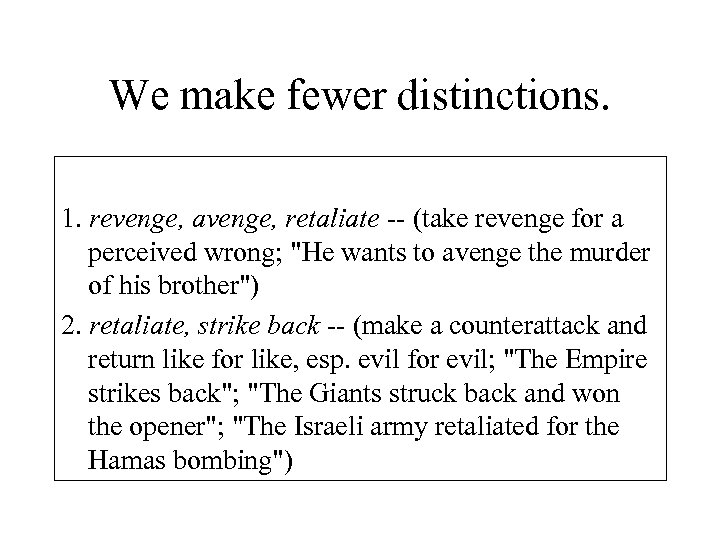
We make fewer distinctions. 1. revenge, avenge, retaliate -- (take revenge for a perceived wrong; "He wants to avenge the murder of his brother") 2. retaliate, strike back -- (make a counterattack and return like for like, esp. evil for evil; "The Empire strikes back"; "The Giants struck back and won the opener"; "The Israeli army retaliated for the Hamas bombing")
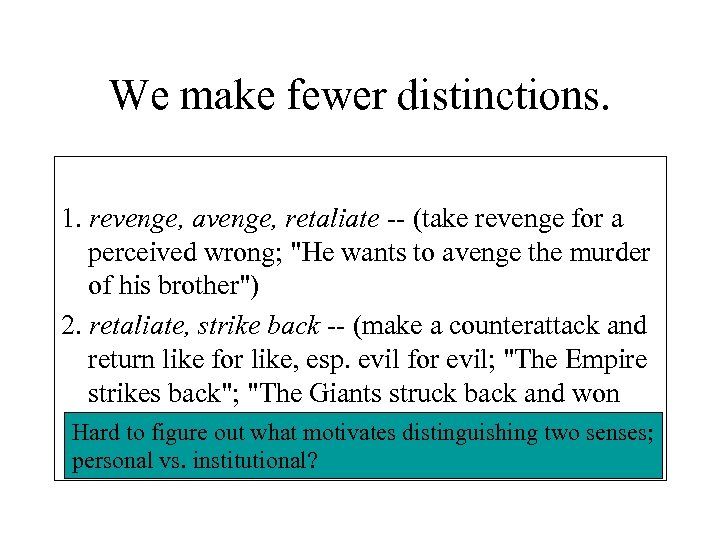
We make fewer distinctions. 1. revenge, avenge, retaliate -- (take revenge for a perceived wrong; "He wants to avenge the murder of his brother") 2. retaliate, strike back -- (make a counterattack and return like for like, esp. evil for evil; "The Empire strikes back"; "The Giants struck back and won the opener"; "The motivates distinguishing for senses; Hard to figure out what. Israeli army retaliated two the personal vs. institutional? Hamas bombing")
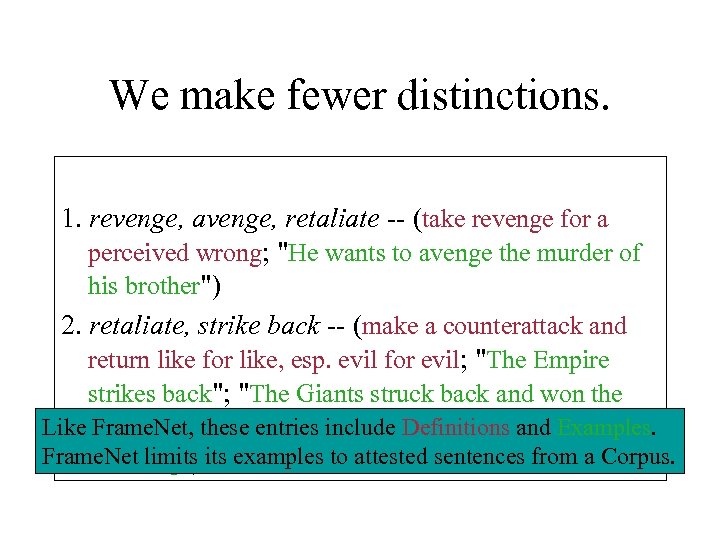
We make fewer distinctions. 1. revenge, avenge, retaliate -- (take revenge for a perceived wrong; "He wants to avenge the murder of his brother") 2. retaliate, strike back -- (make a counterattack and return like for like, esp. evil for evil; "The Empire strikes back"; "The Giants struck back and won the Like opener"; "The Israeli army retaliated for the Hamas Frame. Net, these entries include Definitions and Examples. Frame. Net limits examples to attested sentences from a Corpus. bombing")
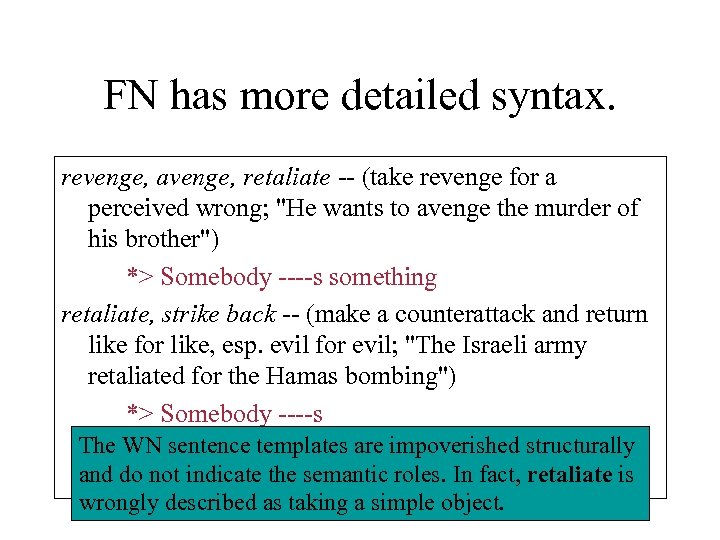
FN has more detailed syntax. revenge, avenge, retaliate -- (take revenge for a perceived wrong; "He wants to avenge the murder of his brother") *> Somebody ----s something retaliate, strike back -- (make a counterattack and return like for like, esp. evil for evil; "The Israeli army retaliated for the Hamas bombing") *> Somebody ----s The WNSomebody ----s PPare impoverished structurally *> sentence templates and do not indicate the semantic roles. In fact, retaliate is wrongly described as taking a simple object.
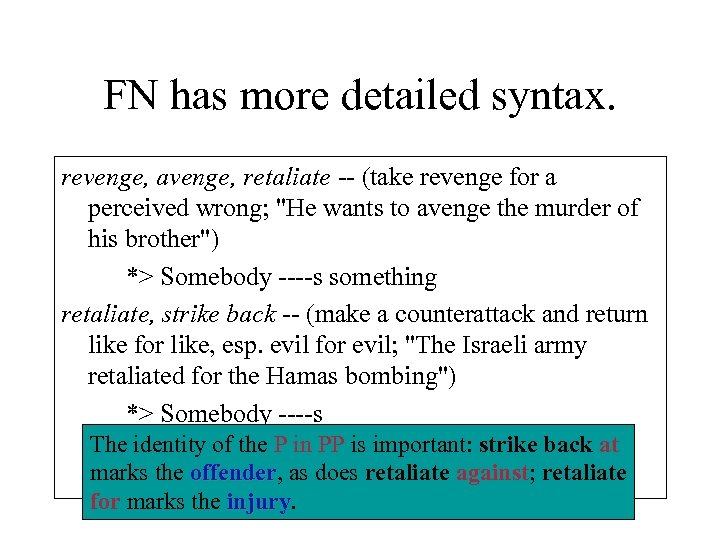
FN has more detailed syntax. revenge, avenge, retaliate -- (take revenge for a perceived wrong; "He wants to avenge the murder of his brother") *> Somebody ----s something retaliate, strike back -- (make a counterattack and return like for like, esp. evil for evil; "The Israeli army retaliated for the Hamas bombing") *> Somebody ----s The*> Somebody P in PP is important: strike back at identity of the ----s PP marks the offender, as does retaliate against; retaliate offender for marks the injury
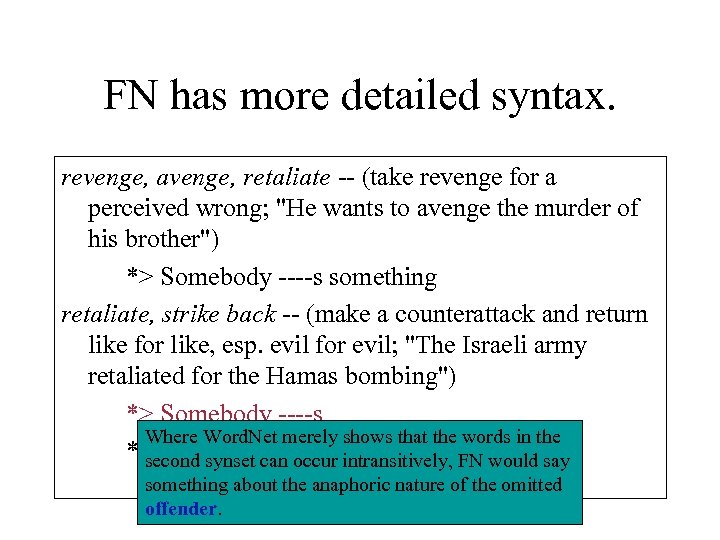
FN has more detailed syntax. revenge, avenge, retaliate -- (take revenge for a perceived wrong; "He wants to avenge the murder of his brother") *> Somebody ----s something retaliate, strike back -- (make a counterattack and return like for like, esp. evil for evil; "The Israeli army retaliated for the Hamas bombing") *> Somebody ----s Where Word. Net merely shows that the words in the *> Somebody ----s PP second synset can occur intransitively, FN would say something about the anaphoric nature of the omitted offender.
Comparison with ontologies
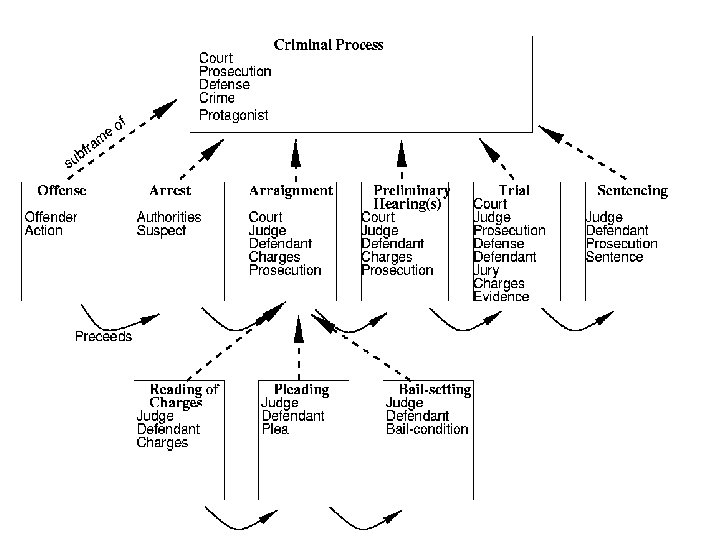
Switching frames • Revenge is a simple frame, but neither SUMO nor Open. CYC seem to have any conceptual link to it. • A particular family of frames that we have concentrated on are those that make up the steps and institutions of Criminal_process.
Complex Frames • With Criminal_process we have, for example, – sub-frame relations (one frame is a component of a larger more abstract frame) and – temporal relations (one process precedes another)
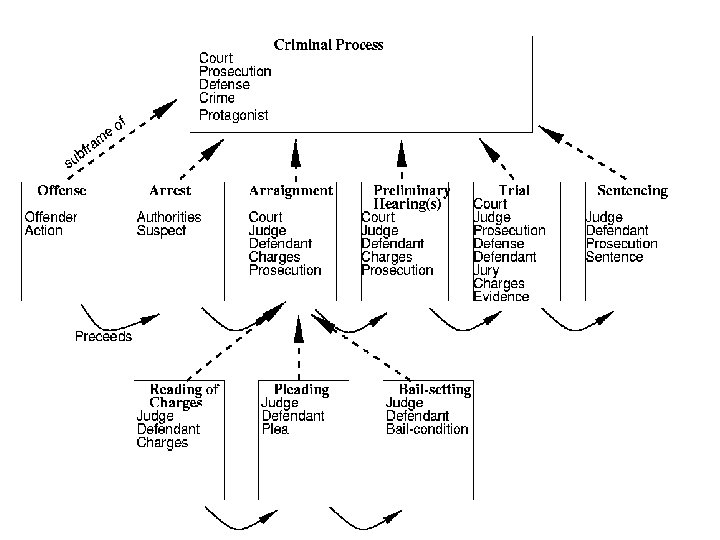
Inferencing • These are the frames with which we are trying to set up inferencing rules for texts about crime reports. (Details in the presentation later. )
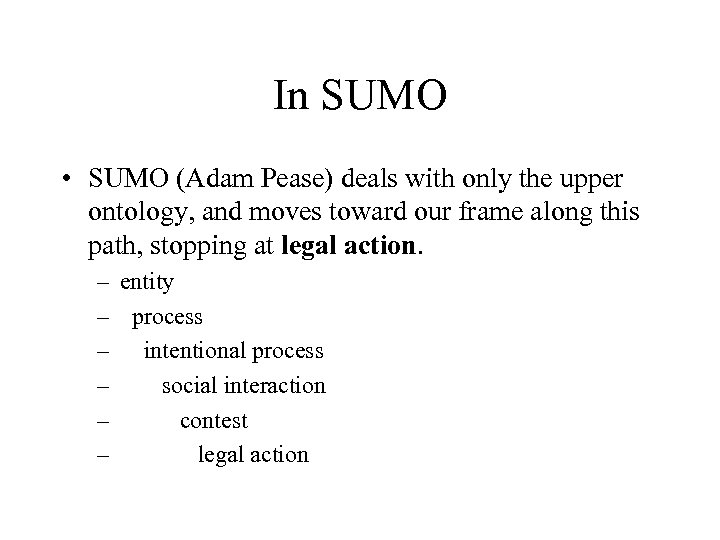
In SUMO • SUMO (Adam Pease) deals with only the upper ontology, and moves toward our frame along this path, stopping at legal action. – entity – process – intentional process – social interaction – contest – legal action
In Open. CYC: Arresting. Someone: "A specialization of Social Occurrence and Capturing. Animal. In each instances of Arresting. Someone a law enforcement officer arrests another person, who is then taken into custody. See the related constant #$Held. Captive. "
![Trial comment : [[Def]] "The subcollection of #$Legal. Conflict events whose instances are heard](https://present5.com/presentation/eee0fb900713991e4ae01b6e3e0e87e7/image-99.jpg "Trial comment : [[Def]] \"The subcollection of #$Legal. Conflict events whose instances are heard")
Trial comment : [[Def]] "The subcollection of #$Legal. Conflict events whose instances are heard and decided by a court and are officiated by a #$Judge. " required. Actor. Slots : [[Mon]] plaintiffs [[Mon]] defendants
![Legal activities comment : [[Def]] "The collection of all events performed with the purpose](https://present5.com/presentation/eee0fb900713991e4ae01b6e3e0e87e7/image-100.jpg "Legal activities comment : [[Def]] \"The collection of all events performed with the purpose")
Legal activities comment : [[Def]] "The collection of all events performed with the purpose of enforcing laws, that are performed by people officially charged with this duty. Includes most activities of law enforcement officials (such as police) including detection of crime, identification of offenders, and arrests. "
![Law. Enforcement. Officer comment : [[Def]] "An instance of Person. Type. By. Occupation, and](https://present5.com/presentation/eee0fb900713991e4ae01b6e3e0e87e7/image-101.jpg "Law. Enforcement. Officer comment : [[Def]] \"An instance of Person. Type. By. Occupation, and")
Law. Enforcement. Officer comment : [[Def]] "An instance of Person. Type. By. Occupation, and a specialization of Person. With. Occupation. Each instance of Law. Enforcement. Officer is a person whose job is to detect, stop, and/or punish people engaged in illegal activities. The collection Law. Enforcement. Officer includes members of local, state, and special police (e. g. , transit police) forces, as well as federal agents (e. g. , members of border patrols, national security agents). Consequently, a given instance of Law Enforcement. Officer typically also belongs to one of the following collections: #$State. Employee, #$Local. Government Employee, or National. Government. Employee (see Public Sector. Employee). "
Frame. Net for Applications • Semantic Web (http: //www. semanticweb. org) – FN database in DAML+OIL (http: //www. ai. sri. com/~narayana/frame-desc. daml) • Semantic Extraction using Frame. Net • Frame Simulation and Inference – Translation from frame structure to a simulation based inference tool (Karma. SIM) • (COLING 2002)
Talk Outline • Frame. Net • A DAML + OIL Representation of Frame. Net • An Example: Encoding the Criminal Process Frame • Web Applications of Frame. Net. • Summary and Future Work
Semantic Web • The World Wide Web (WWW) contains a large and expanding information base. • HTML is accessible to humans but does not formally describe data in a machine interpretable form. • XML remedies this by allowing for the use of tags to describe data (ex. disambiguating crawl) • Ontologies are useful to describe objects and their inter-relationships. • DAML+OIL (http: //www. daml. org) is an markup language based on XML and RDF that is grounded in description logic and is designed to allow for ontology development, transfer, and use on the web.
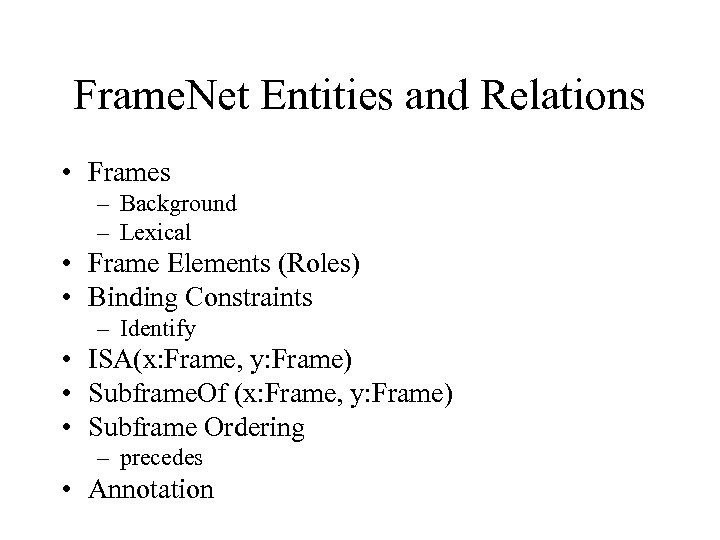
Frame. Net Entities and Relations • Frames – Background – Lexical • Frame Elements (Roles) • Binding Constraints – Identify • ISA(x: Frame, y: Frame) • Subframe. Of (x: Frame, y: Frame) • Subframe Ordering – precedes • Annotation
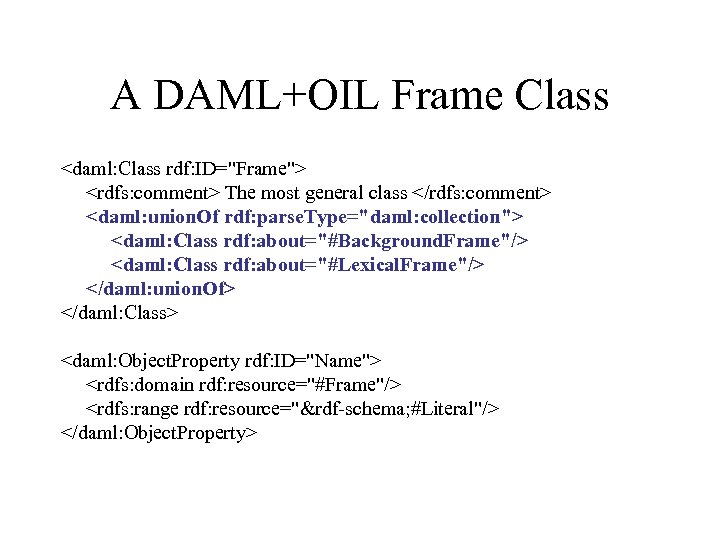
A DAML+OIL Frame Class <daml: Class rdf: ID="Frame"> <rdfs: comment> The most general class </rdfs: comment> <daml: union. Of rdf: parse. Type="daml: collection"> <daml: Class rdf: about="#Background. Frame"/> <daml: Class rdf: about="#Lexical. Frame"/> </daml: union. Of> </daml: Class> <daml: Object. Property rdf: ID="Name"> <rdfs: domain rdf: resource="#Frame"/> <rdfs: range rdf: resource="&rdf-schema; #Literal"/> </daml: Object. Property>
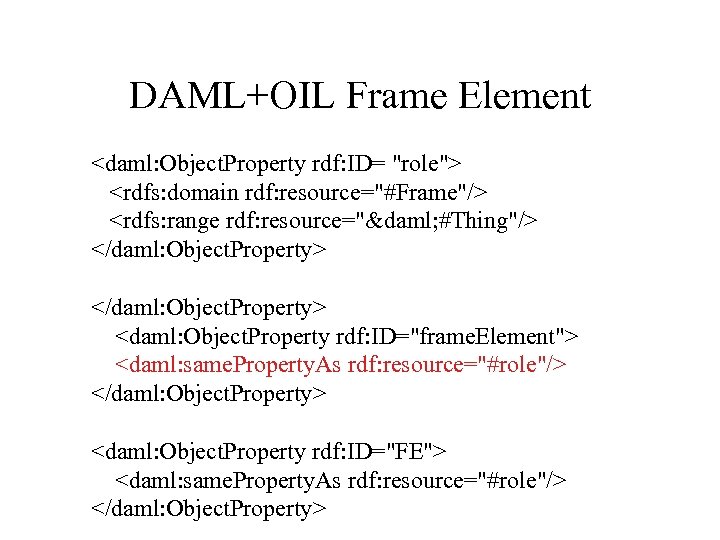
DAML+OIL Frame Element <daml: Object. Property rdf: ID= "role"> <rdfs: domain rdf: resource="#Frame"/> <rdfs: range rdf: resource="&daml; #Thing"/> </daml: Object. Property> <daml: Object. Property rdf: ID="frame. Element"> <daml: same. Property. As rdf: resource="#role"/> </daml: Object. Property> <daml: Object. Property rdf: ID="FE"> <daml: same. Property. As rdf: resource="#role"/> </daml: Object. Property>
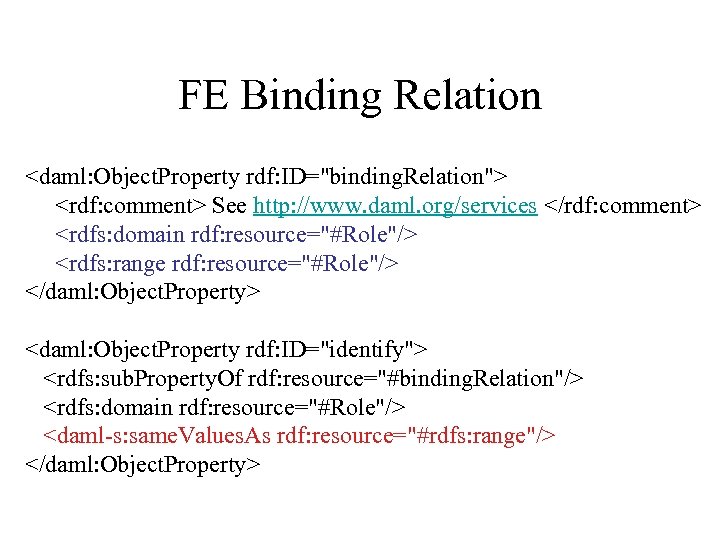
FE Binding Relation <daml: Object. Property rdf: ID="binding. Relation"> <rdf: comment> See http: //www. daml. org/services </rdf: comment> <rdfs: domain rdf: resource="#Role"/> <rdfs: range rdf: resource="#Role"/> </daml: Object. Property> <daml: Object. Property rdf: ID="identify"> <rdfs: sub. Property. Of rdf: resource="#binding. Relation"/> <rdfs: domain rdf: resource="#Role"/> <daml-s: same. Values. As rdf: resource="#rdfs: range"/> </daml: Object. Property>
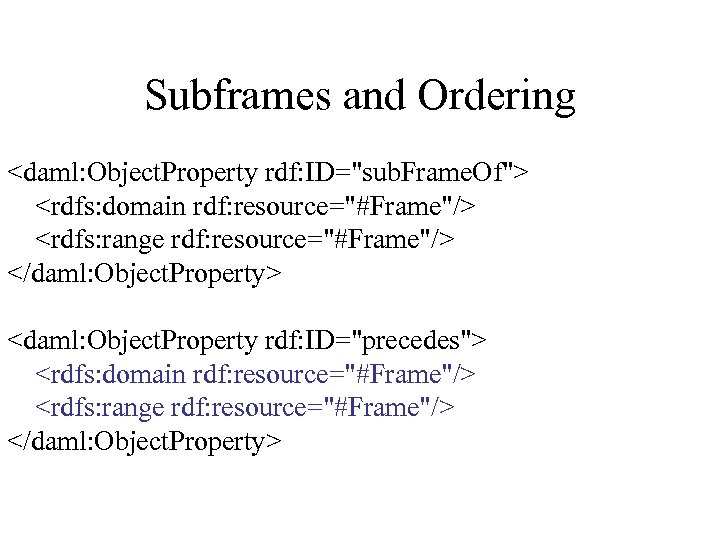
Subframes and Ordering <daml: Object. Property rdf: ID="sub. Frame. Of"> <rdfs: domain rdf: resource="#Frame"/> <rdfs: range rdf: resource="#Frame"/> </daml: Object. Property> <daml: Object. Property rdf: ID="precedes"> <rdfs: domain rdf: resource="#Frame"/> <rdfs: range rdf: resource="#Frame"/> </daml: Object. Property>
Talk Outline • Frame. Net • A DAML + OIL Representation of Frame. Net • An Example: Encoding the Criminal Process Frame • Applications of Frame. Net. • Summary and Future Work
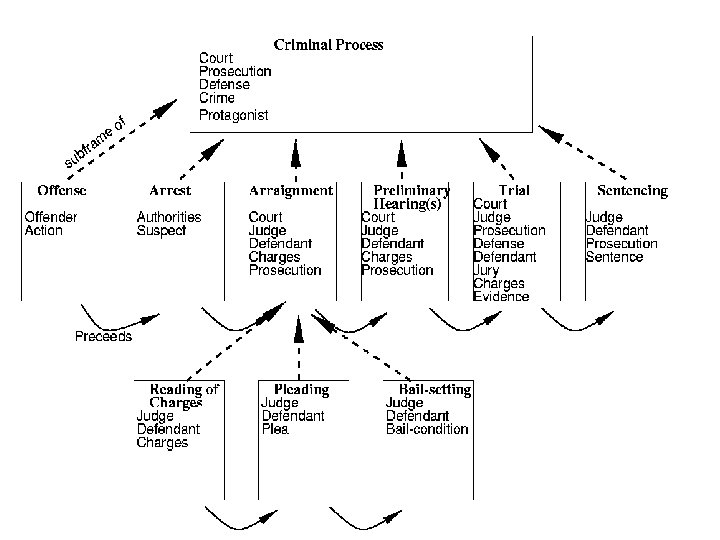
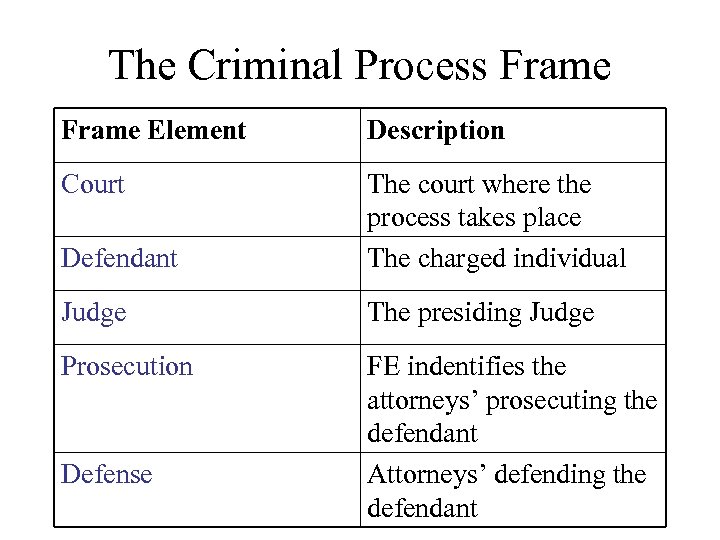
The Criminal Process Frame Element Description Court Defendant The court where the process takes place The charged individual Judge The presiding Judge Prosecution FE indentifies the attorneys’ prosecuting the defendant Attorneys’ defending the defendant Defense
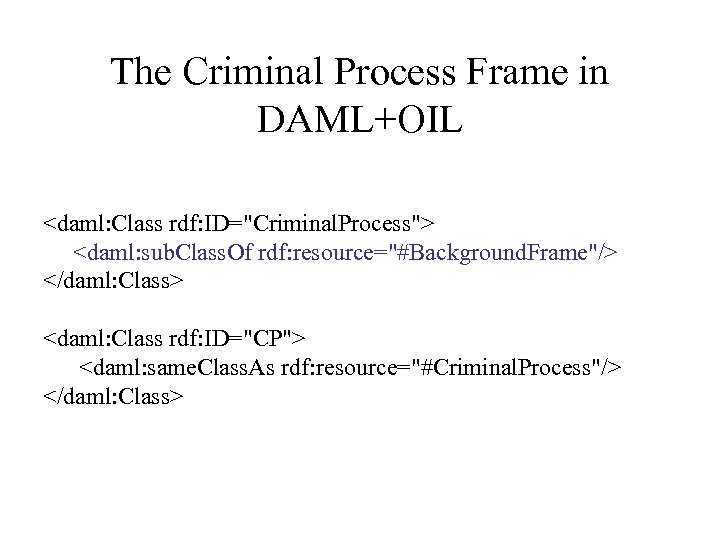
The Criminal Process Frame in DAML+OIL <daml: Class rdf: ID="Criminal. Process"> <daml: sub. Class. Of rdf: resource="#Background. Frame"/> </daml: Class> <daml: Class rdf: ID="CP"> <daml: same. Class. As rdf: resource="#Criminal. Process"/> </daml: Class>
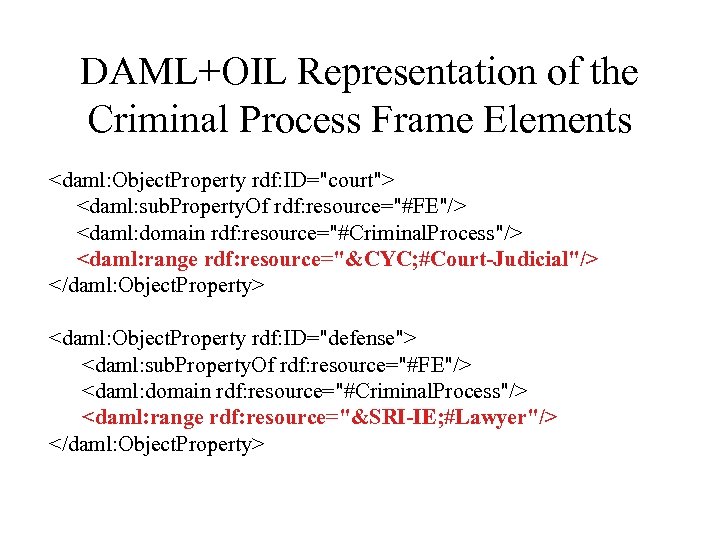
DAML+OIL Representation of the Criminal Process Frame Elements <daml: Object. Property rdf: ID="court"> <daml: sub. Property. Of rdf: resource="#FE"/> <daml: domain rdf: resource="#Criminal. Process"/> <daml: range rdf: resource="&CYC; #Court-Judicial"/> </daml: Object. Property> <daml: Object. Property rdf: ID="defense"> <daml: sub. Property. Of rdf: resource="#FE"/> <daml: domain rdf: resource="#Criminal. Process"/> <daml: range rdf: resource="&SRI-IE; #Lawyer"/> </daml: Object. Property>
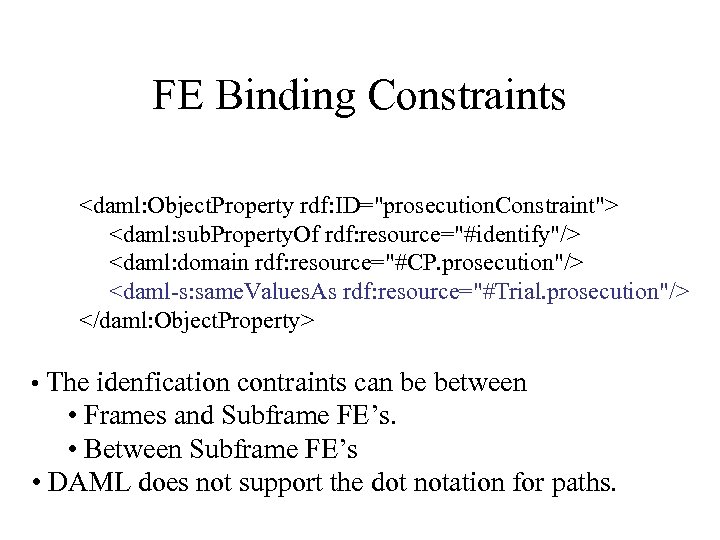
FE Binding Constraints <daml: Object. Property rdf: ID="prosecution. Constraint"> <daml: sub. Property. Of rdf: resource="#identify"/> <daml: domain rdf: resource="#CP. prosecution"/> <daml-s: same. Values. As rdf: resource="#Trial. prosecution"/> </daml: Object. Property> • The idenfication contraints can be between • Frames and Subframe FE’s. • Between Subframe FE’s • DAML does not support the dot notation for paths.
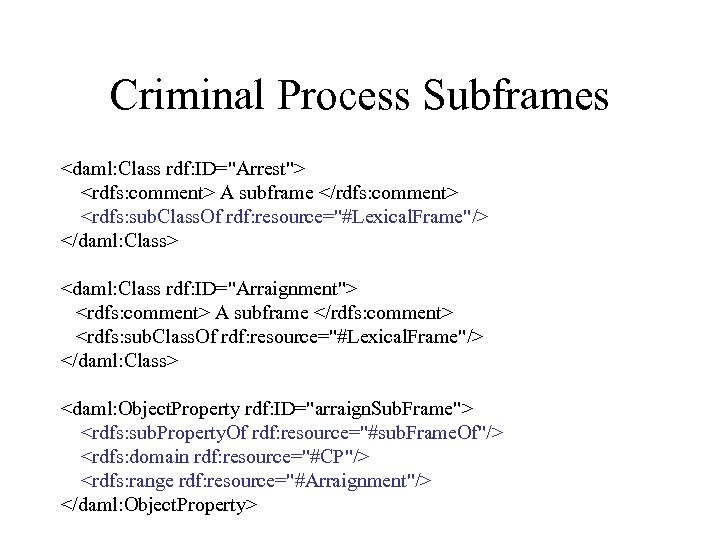
Criminal Process Subframes <daml: Class rdf: ID="Arrest"> <rdfs: comment> A subframe </rdfs: comment> <rdfs: sub. Class. Of rdf: resource="#Lexical. Frame"/> </daml: Class> <daml: Class rdf: ID="Arraignment"> <rdfs: comment> A subframe </rdfs: comment> <rdfs: sub. Class. Of rdf: resource="#Lexical. Frame"/> </daml: Class> <daml: Object. Property rdf: ID="arraign. Sub. Frame"> <rdfs: sub. Property. Of rdf: resource="#sub. Frame. Of"/> <rdfs: domain rdf: resource="#CP"/> <rdfs: range rdf: resource="#Arraignment"/> </daml: Object. Property>
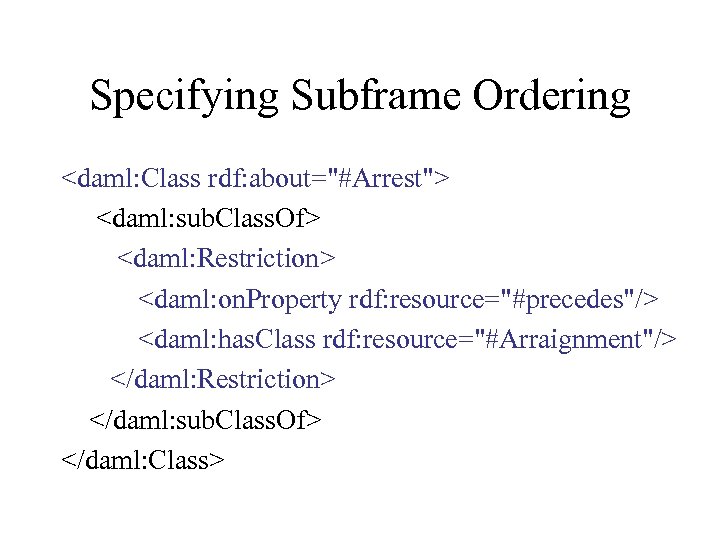
Specifying Subframe Ordering <daml: Class rdf: about="#Arrest"> <daml: sub. Class. Of> <daml: Restriction> <daml: on. Property rdf: resource="#precedes"/> <daml: has. Class rdf: resource="#Arraignment"/> </daml: Restriction> </daml: sub. Class. Of> </daml: Class>
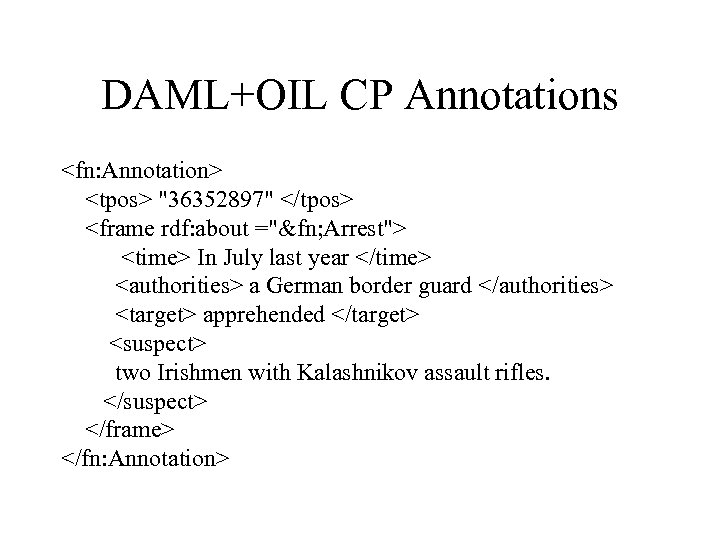
DAML+OIL CP Annotations <fn: Annotation> <tpos> "36352897" </tpos> <frame rdf: about ="&fn; Arrest"> <time> In July last year </time> <authorities> a German border guard </authorities> <target> apprehended </target> <suspect> two Irishmen with Kalashnikov assault rifles. </suspect> </frame> </fn: Annotation>
Current Status of DAML Encoding • All Frame. Net 1 data is available in DAML+OIL – annotations – frame descriptions. • The translator has also been updated to handle the more complex semantic relations (both frame and frame element based) in Frame. Net 2. • We plan to release both the XML and the DAML+OIL versions of all Frame. Net 2 releases.
Talk Outline • Frame. Net • A DAML + OIL Representation of Frame. Net • An Example: Encoding the Criminal Process Frame • Applications of Frame. Net. • Summary and Future Work
Frame. Net for Applications • Semantic Web (http: //www. semanticweb. org) – FN database in DAML+OIL (http: //www. ai. sri. com/~narayana/frame-desc. daml) • Semantic Extraction using Frame. Net • Or can Frame. Net be automated • Frame Simulation and Inference – Translation from frame structure to a simulation based inference tool (Karma. SIM) • (COLING 2002)
Semantic Extraction • Behrang Mohit and Srini Narayanan – HLT-NAACL 2003.
Enhancing IE Techniques • IE techniques currently use no inference (mostly!) – Robert Pickett was charged with felony possession of a handgun and sentenced to 5 years in a federal prison. • Says Pickett was arrested • Frame-based inferences can be useful for a variety of applications including individual/topic tracking, bridging inferences/co-reference resolution. • Frame. Net subframe structure and bindings can be exploited for this purpose.
A Simulation Semantics for Inference • Frame Structure and bindings specify parameters for a simulation/enactment of the event • Based on previous work (IJCAI 99, AAAI 99, Cog. Sci 2000, COLING 2002, WWW 2002) – using an “X-schema” based representation, we simulate the temporal and inferential structure of the Frame. Element and Frame/Subframe relations from Frame. Net. – Direct translation from both the my. SQL FN database and the DAML+OIL representation
Reasoning about Events for NL applications (QA, NLU) • Reasoning about dynamics – Complex event structure • Multiple stages, interruptions, resources, framing – Evolving events • Conditional events, presuppositions. – Nested temporal and aspectual references • Past, future event references – Metaphoric references • Use of motion domain to describe complex events. • Reasoning with Uncertainty – Combining Evidence from Multiple, unreliable sources – Non-monotonic inference • Retracting previous assertions • Conditioning on partial evidence
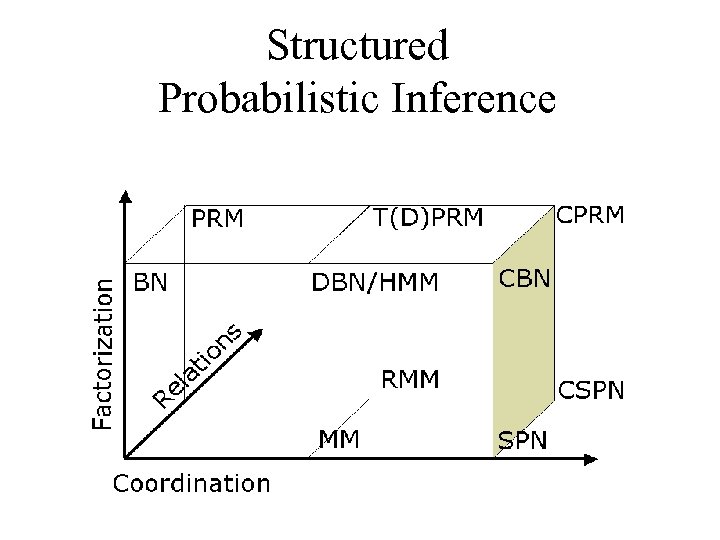
Previous work • Models of event structure that are able to deal with the temporal and aspectual structure of events • Models frame-based and metaphoric inference about event structure. • Based on an active semantics of events and a factorized graphical model of complex states. – Models event stages, embedding, multi-level perspectives and coordination. – Event model based on a Stochastic Petri Net representation with extensions allowing hierarchical decomposition. – State is represented as a Temporal Bayes Net (T(D)BN). – The Event-State representation requires branching time bayes nets with synchronization or Coordinated Bayes Nets (CBN)
States • Factorized Representation of State uses Dynamic Belief Nets (DBN’s) – Probabilistic Semantics – Structured Representation
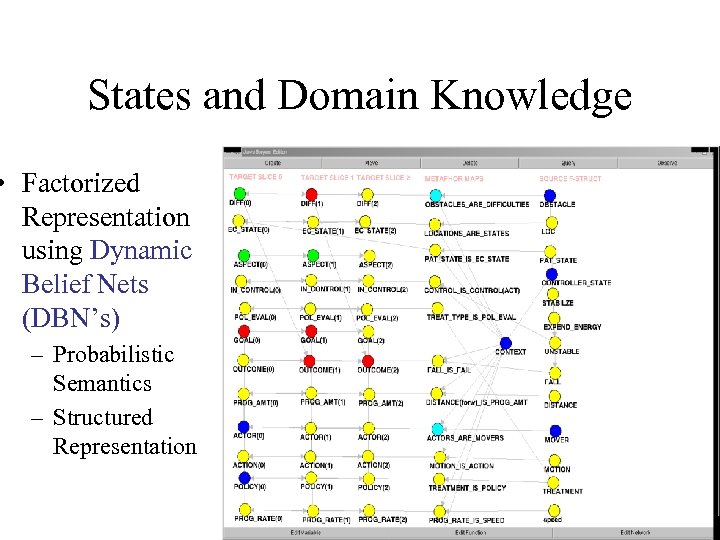
States and Domain Knowledge • Factorized Representation using Dynamic Belief Nets (DBN’s) – Probabilistic Semantics – Structured Representation
Active Event Representations • Actions and events are coded in active representations called x-schemas which are extensions to Stochastic Petri nets. • x-schemas are fine-grained and can be used for monitoring and control as well as for inference. • Badler’s (U Penn) group uses same idea for commanding simulated robots (Jack). Nilsson (SU) uses a similar idea for robot planning called Teleo-Reactive programs. • Semantic basis for DAML-S, process descriptions of the Semantic Web
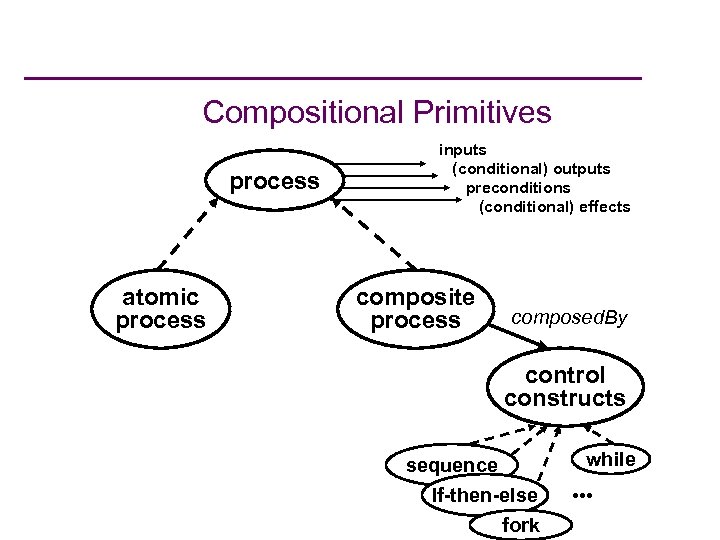
Compositional Primitives process atomic process inputs (conditional) outputs preconditions (conditional) effects composite process composed. By control constructs sequence If-then-else fork while . . .
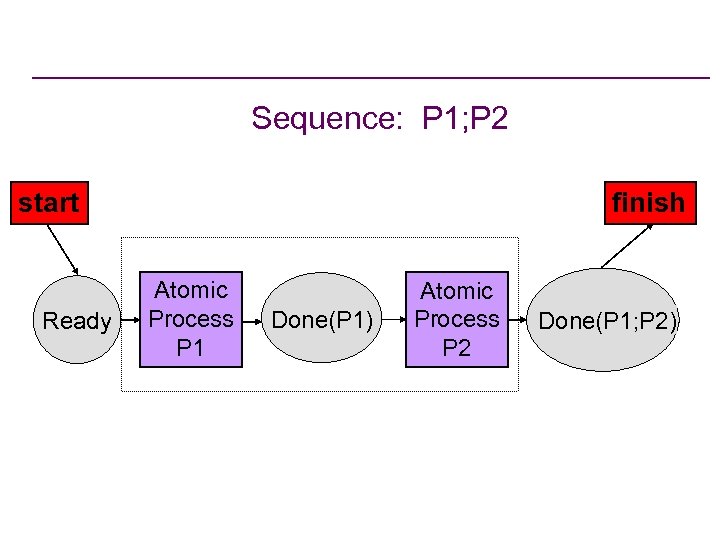
Sequence: P 1; P 2 start Ready finish Atomic Process P 1 Done(P 1) Atomic Process P 2 Done(P 1; P 2)
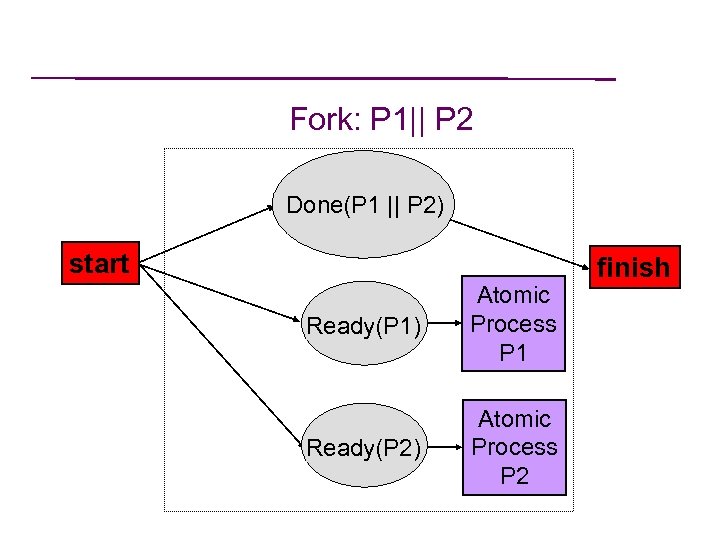
Fork: P 1|| P 2 Done(P 1 || P 2) start Ready(P 1) Atomic Process P 1 Ready(P 2) Atomic Process P 2 finish
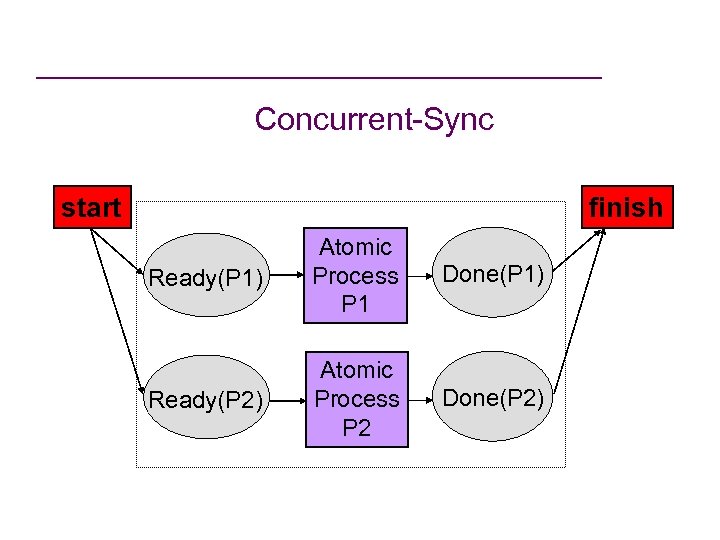
Concurrent-Sync start finish Ready(P 1) Atomic Process P 1 Done(P 1) Ready(P 2) Atomic Process P 2 Done(P 2)
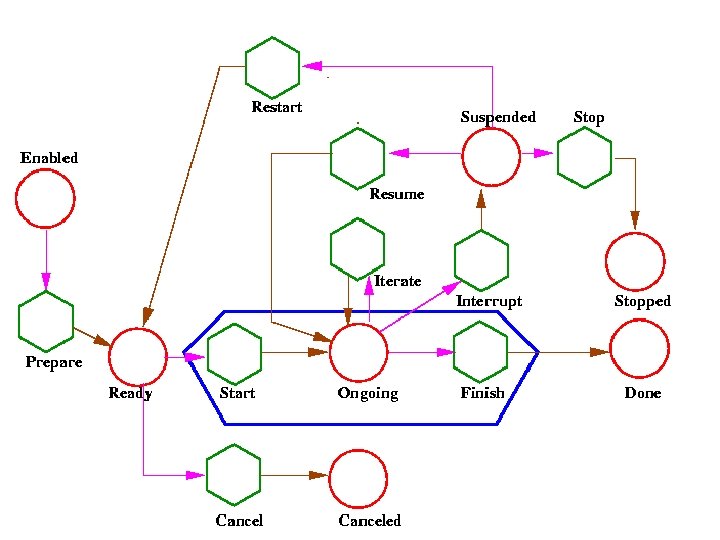
![Implementation DAML-S translation to the modeling environment Karma. SIM [Narayanan, 97] (http: //www. icsi.](https://present5.com/presentation/eee0fb900713991e4ae01b6e3e0e87e7/image-136.jpg "Implementation DAML-S translation to the modeling environment Karma. SIM [Narayanan, 97] (http: //www. icsi.")
Implementation DAML-S translation to the modeling environment Karma. SIM [Narayanan, 97] (http: //www. icsi. berkeley. edu/~snarayan) Basic Program: Input: DAML-S description of Frame relations Output: Network Description of Frames in Karma. SIM Procedure: • Recursively construct a sub-network for each control construct. Bottom out at atomic frame. • Construct a net for each atomic frame • Return network
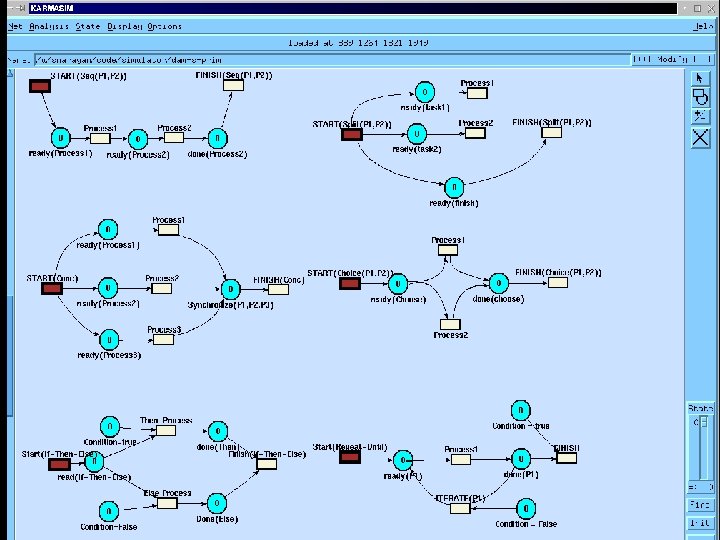
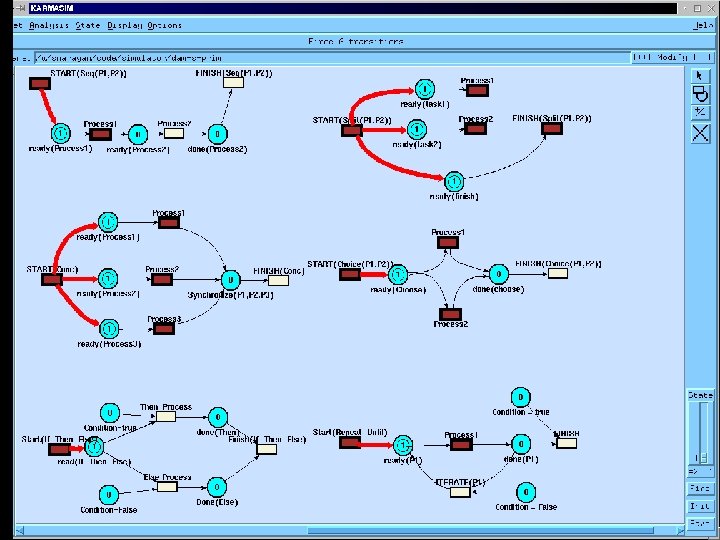
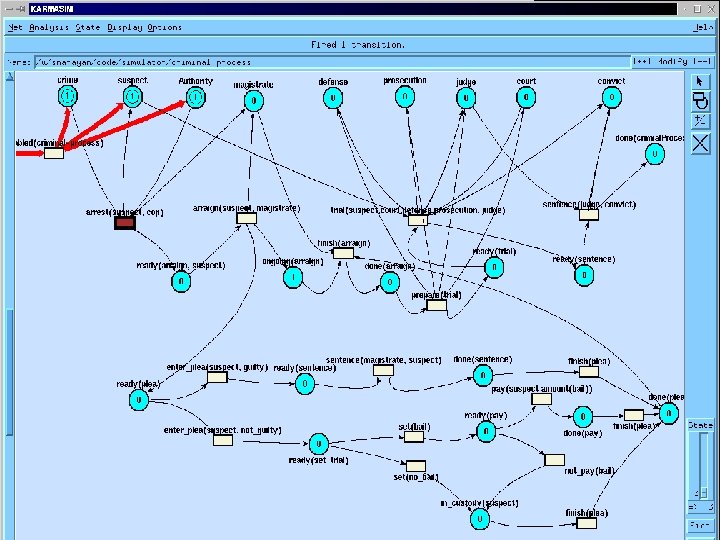
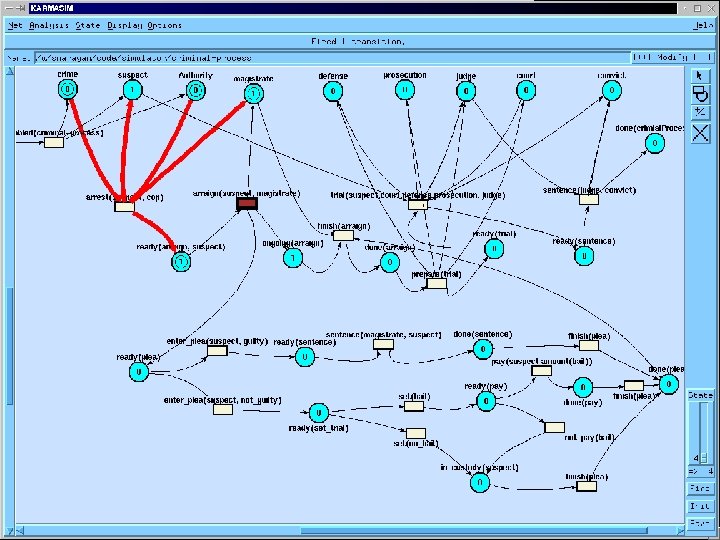
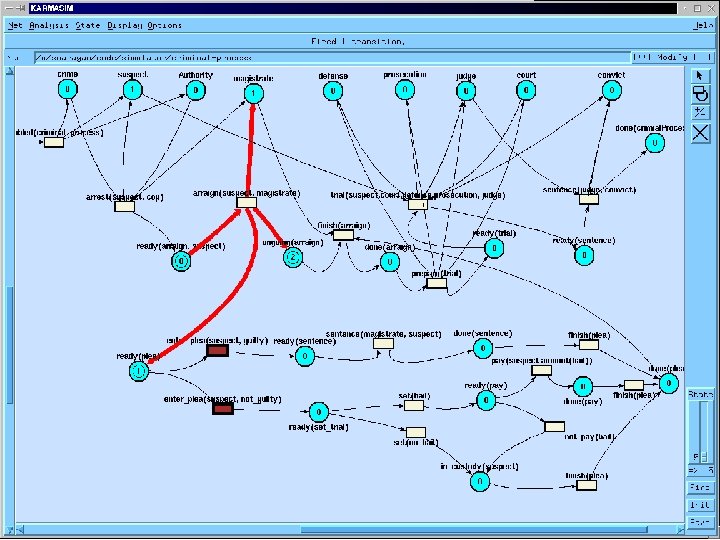
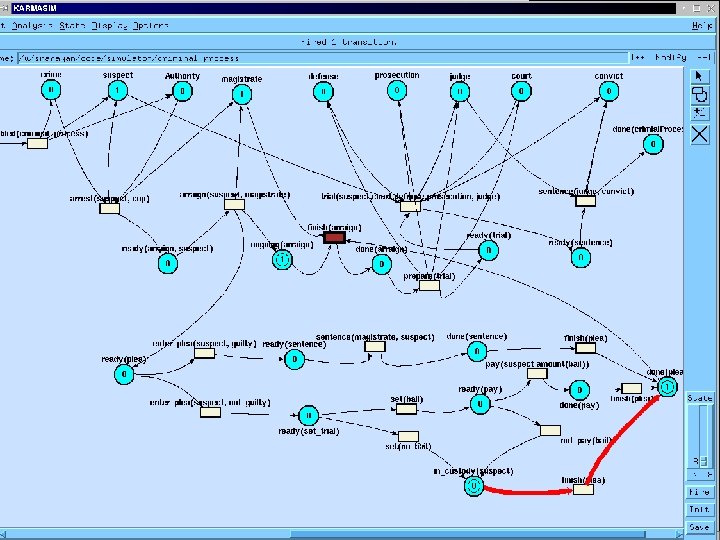
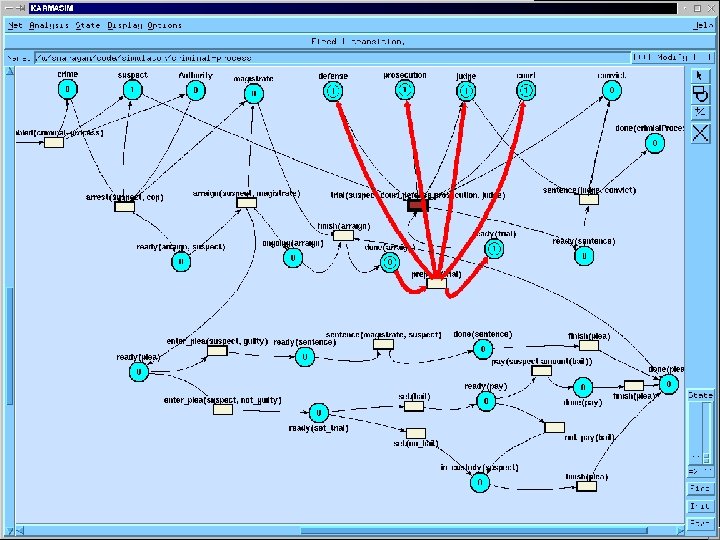
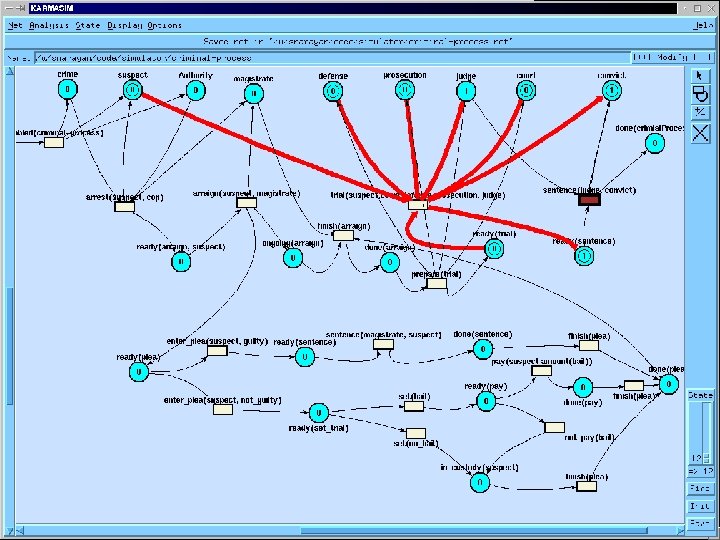
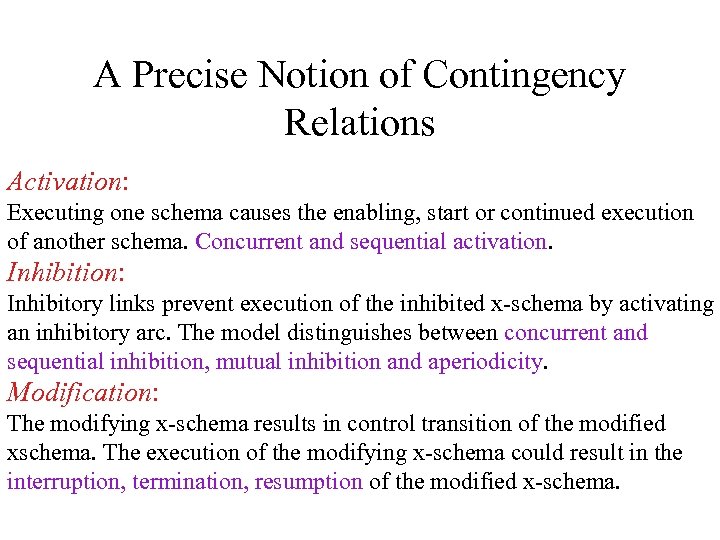
A Precise Notion of Contingency Relations Activation: Executing one schema causes the enabling, start or continued execution of another schema. Concurrent and sequential activation. Inhibition: Inhibitory links prevent execution of the inhibited x-schema by activating an inhibitory arc. The model distinguishes between concurrent and sequential inhibition, mutual inhibition and aperiodicity. Modification: The modifying x-schema results in control transition of the modified xschema. The execution of the modifying x-schema could result in the interruption, termination, resumption of the modified x-schema.
Results of Model • Captures fine grained distinctions needed for interpretation – Frame-based Inferences (COLING 02) – Aspectual Inferences (Cogsci 98, Cog. Sci 01, IJCAI 99, CL 03) – Metaphoric Inferences (AAAI 99) – Biological Evidence (Cog. Sci 03, BL 03) • Sufficient Inductive bias for verb learning (Bailey 97, Cog. Sci 99), construction learning (Chang 03, to Appear) • Model for DAML-S (ISWC 02, WWW 02, Computer Networks 03)
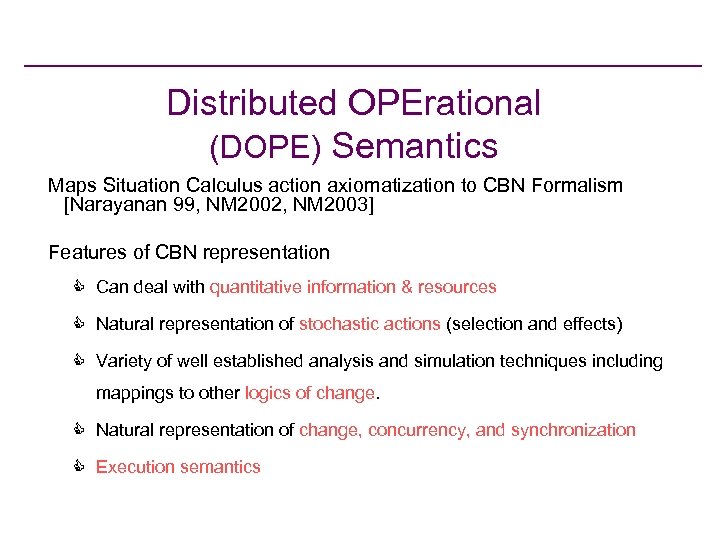
Distributed OPErational (DOPE) Semantics Maps Situation Calculus action axiomatization to CBN Formalism [Narayanan 99, NM 2002, NM 2003] Features of CBN representation C Can deal with quantitative information & resources C Natural representation of stochastic actions (selection and effects) C Variety of well established analysis and simulation techniques including mappings to other logics of change. C Natural representation of change, concurrency, and synchronization C Execution semantics
Problems with T(D)BN • Scaling up to relational structures • Supports linear (sequence) but not branching (concurrency, coordination) dynamics
Structured Probabilistic Inference
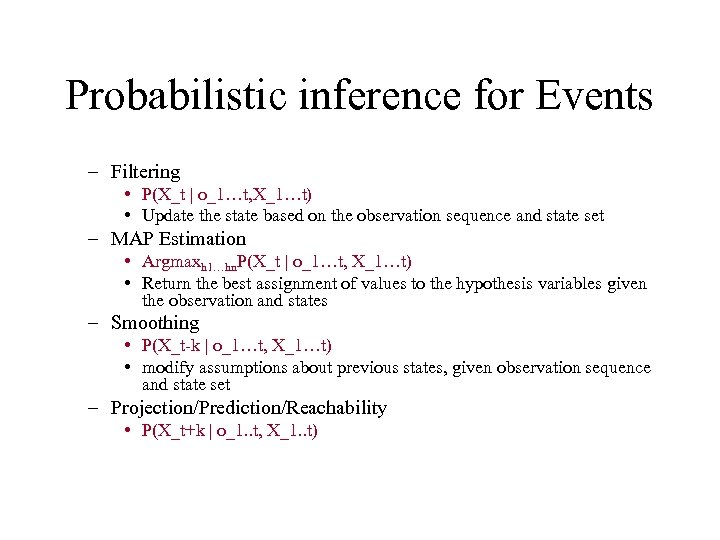
Probabilistic inference for Events – Filtering • P(X_t | o_1…t, X_1…t) • Update the state based on the observation sequence and state set – MAP Estimation • Argmaxh 1…hn. P(X_t | o_1…t, X_1…t) • Return the best assignment of values to the hypothesis variables given the observation and states – Smoothing • P(X_t-k | o_1…t, X_1…t) • modify assumptions about previous states, given observation sequence and state set – Projection/Prediction/Reachability • P(X_t+k | o_1. . t, X_1. . t)
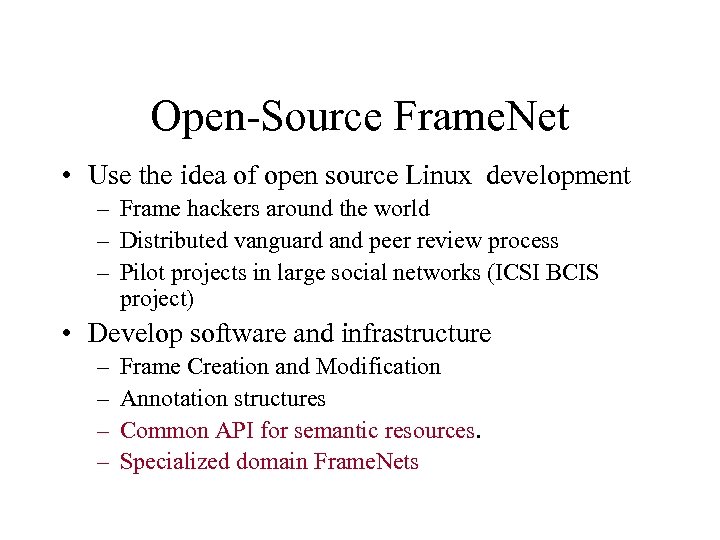
Open-Source Frame. Net • Use the idea of open source Linux development – Frame hackers around the world – Distributed vanguard and peer review process – Pilot projects in large social networks (ICSI BCIS project) • Develop software and infrastructure – – Frame Creation and Modification Annotation structures Common API for semantic resources. Specialized domain Frame. Nets
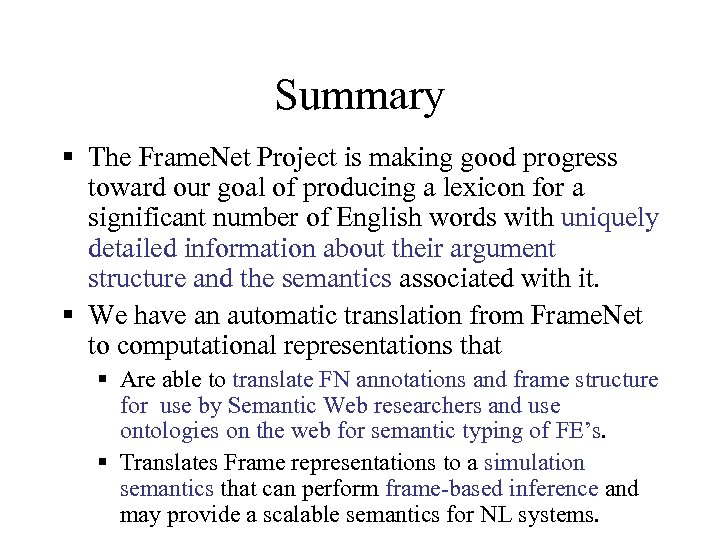
Summary § The Frame. Net Project is making good progress toward our goal of producing a lexicon for a significant number of English words with uniquely detailed information about their argument structure and the semantics associated with it. § We have an automatic translation from Frame. Net to computational representations that § Are able to translate FN annotations and frame structure for use by Semantic Web researchers and use ontologies on the web for semantic typing of FE’s. § Translates Frame representations to a simulation semantics that can perform frame-based inference and may provide a scalable semantics for NL systems.
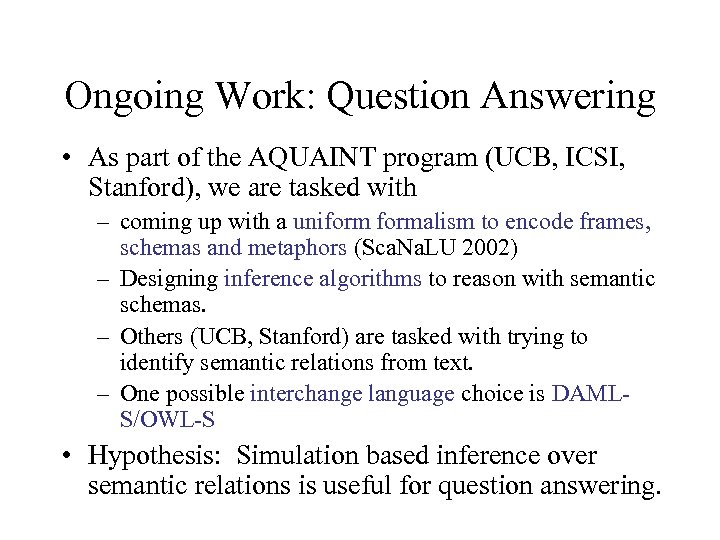
Ongoing Work: Question Answering • As part of the AQUAINT program (UCB, ICSI, Stanford), we are tasked with – coming up with a uniformalism to encode frames, schemas and metaphors (Sca. Na. LU 2002) – Designing inference algorithms to reason with semantic schemas. – Others (UCB, Stanford) are tasked with trying to identify semantic relations from text. – One possible interchange language choice is DAMLS/OWL-S • Hypothesis: Simulation based inference over semantic relations is useful for question answering.
http: //www. icsi. berkeley. edu/NTL http: //www. icsi. berkeley. edu/framenet
http: //www. icsi. berkeley. edu/NTL http: //www. icsi. berkeley. edu/framenet
Скачать презентацию Frame Net Meets the Semantic Web Srini Narayanan
eee0fb900713991e4ae01b6e3e0e87e7.ppt