 Скачать презентацию Frame-Aggregated Concurrent Matching Switch Bill Lin University of
d02e6e12bbe0fabcfc9b18a8b722d472.ppt
- Количество слайдов: 38



Frame-Aggregated Concurrent Matching Switch Bill Lin (University of California, San Diego) Isaac Keslassy (Technion, Israel) Spring 2005 044114
Background • The Concurrent Matching Switch (CMS) architecture was first presented at INFOCOM 2006 • Based on any fixed configuration switch fabric and fully distributed and independent schedulers Ø Ø • 100% throughput Packet ordering O(1) amortized time complexity Good delay results in simulations Proofs for 100% throughput, packet ordering, and O(1) complexity provided in INFOCOM 2006 paper, but no delay guarantee was provided 2
This Talk • Focus of this talk is to provide a delay bound • Show O(N log N) delay is provably achievable while retaining O(1) complexity, 100% throughput, and packet ordering • Show No Scheduling is required to achieve O(N log N) delay by modifying original CMS architecture • Improves over best previously-known O(N 2) delay bound given same switch properties 3
This Talk • Concurrent Matching Switch • General Delay Bound • O(N log N) delay with Fair-Frame Scheduling • O(N log N) delay and O(1) complexity with Frame Aggregation instead of Scheduling 4

The Problem Higher Performance Routers Needed to Keep Up 5
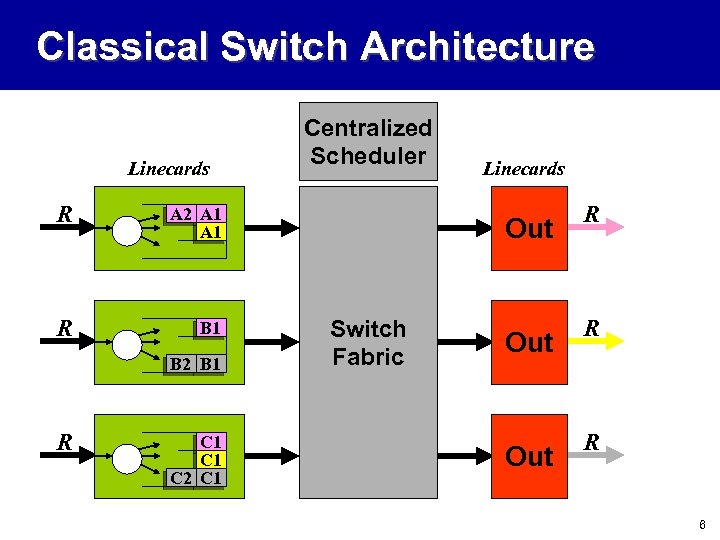
Classical Switch Architecture Linecards R A 2 A 1 R B 1 Centralized Scheduler B 2 B 1 R C 1 C 2 C 1 Linecards Out Switch Fabric Out R R R 6
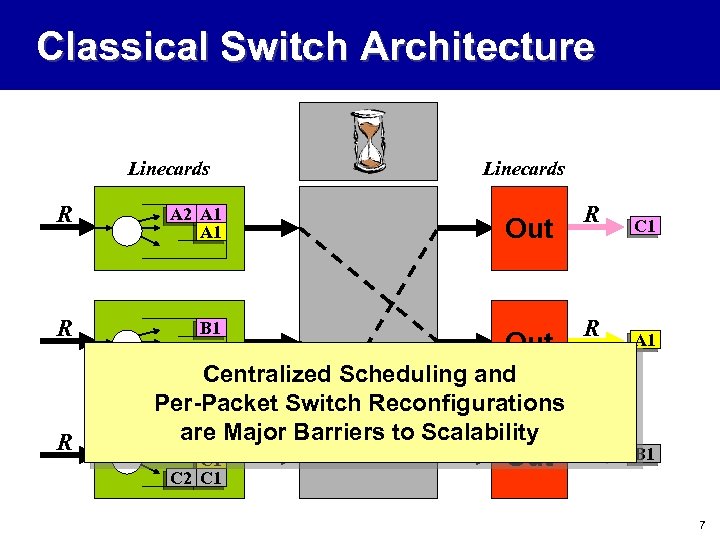
Classical Switch Architecture Linecards R A 2 A 1 R B 1 R C 1 R A 1 Centralized Scheduling and Per-Packet Switch Reconfigurations are Major Barriers to Scalability C 1 R B 1 B 2 B 1 R Linecards C 1 C 2 C 1 Out Out 7
![Recent Approaches • Scalable architectures Ø Load-Balanced Switch [Chang 2002] [Keslassy 2003] Ø Concurrent](https://present5.com/presentation/d02e6e12bbe0fabcfc9b18a8b722d472/image-8.jpg "Recent Approaches • Scalable architectures Ø Load-Balanced Switch [Chang 2002] [Keslassy 2003] Ø Concurrent")
Recent Approaches • Scalable architectures Ø Load-Balanced Switch [Chang 2002] [Keslassy 2003] Ø Concurrent Matching Switch [INFOCOM 2006] • Characteristics Ø Both based on two identical stages of fixed configuration switches and fully decentralized processing Ø No per-packet switch reconfigurations Ø Constant time local processing at each linecard Ø 100% throughput Ø Amenable to scalable implementation using optics 8
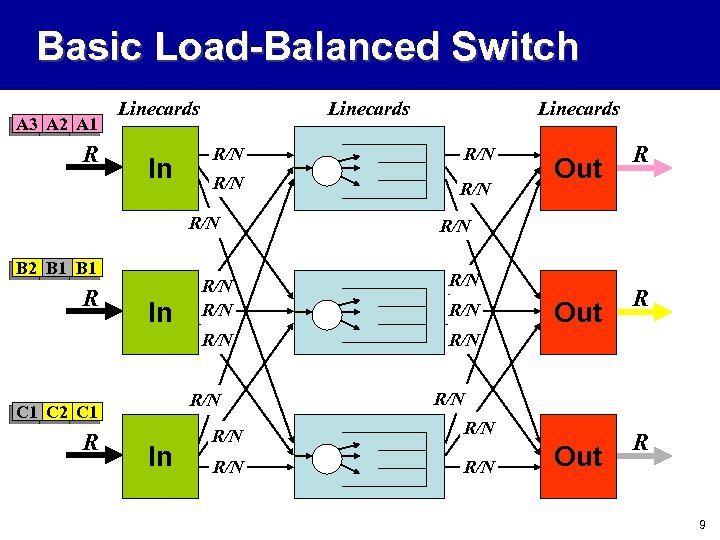
Basic Load-Balanced Switch A 3 A 2 A 1 R Linecards In Linecards R/N R/N R/N B 2 B 1 Linecards R/N In R/N R/N C 1 C 2 C 1 R R/N R/N R In Out R R/N R/N R/N Out R 9
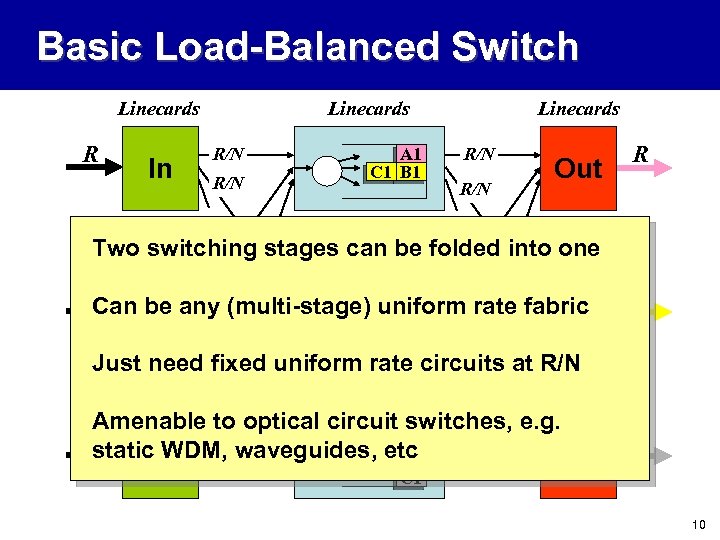
Basic Load-Balanced Switch Linecards R In Linecards R/N A 1 C 1 B 1 R/N Linecards R/N Out R R/N Two switching stages can be folded into one R Can be In R/N any (multi-stage) R/N R/N A 2 uniform rate fabric R/N C 2 Out B 1 R R/N Just need fixed uniform rate circuits at R/N R/N Amenable to optical circuit switches, e. g. R/N A 3 R static WDM, waveguides, etc B 2 In Out R/N C 1 R R/N 10
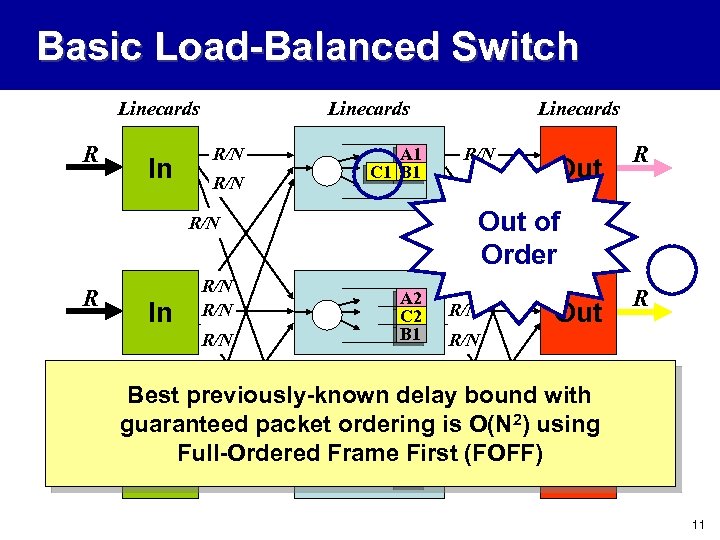
Basic Load-Balanced Switch Linecards R In Linecards R/N A 1 C 1 B 1 R/N R In R/N R/N Linecards R/N R/N A 2 C 2 B 1 Out of Order R/N Out C 1 R R/N Best previously-known delay bound with R/N guaranteed packet ordering is R/N 2) using O(N R/N A 3 R First (FOFF) Out In Full-Ordered Frame B 2 R/N R R R/N 11
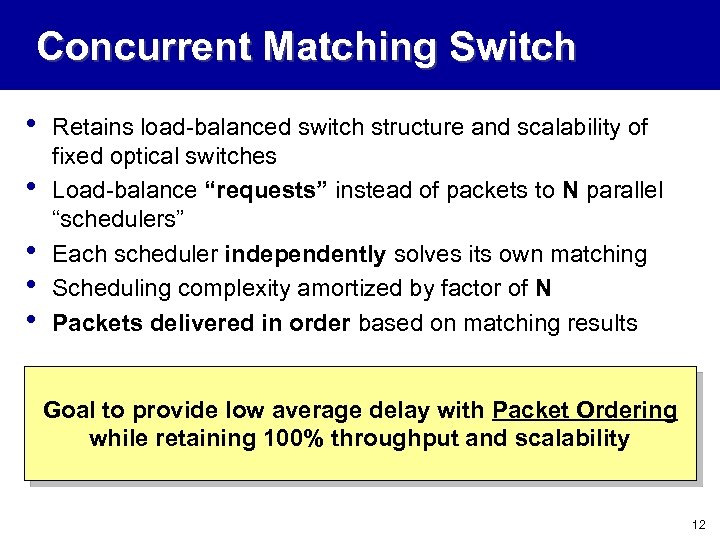
Concurrent Matching Switch • • • Retains load-balanced switch structure and scalability of fixed optical switches Load-balance “requests” instead of packets to N parallel “schedulers” Each scheduler independently solves its own matching Scheduling complexity amortized by factor of N Packets delivered in order based on matching results Goal to provide low average delay with Packet Ordering while retaining 100% throughput and scalability 12
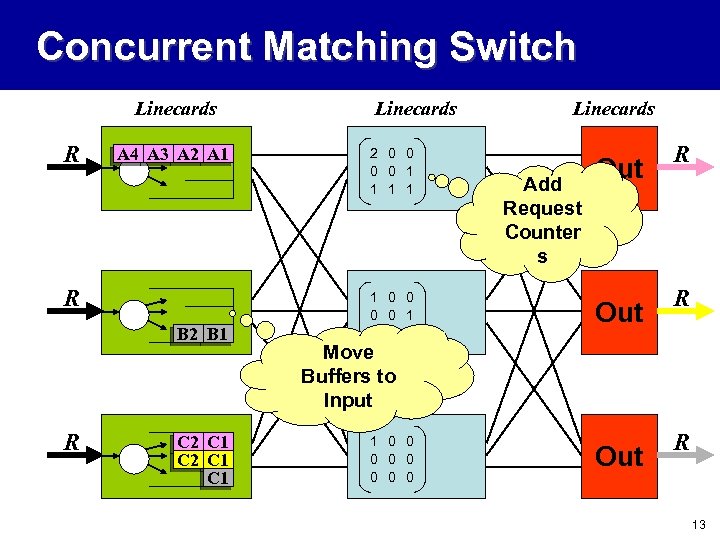
Concurrent Matching Switch Linecards R A 4 A 3 A 2 A 1 R B 2 B 1 R C 2 C 1 C 1 Linecards 2 0 0 1 1 1 0 Linecards Add Request Counter s Out R R Move Buffers to Input 1 0 0 0 0 Out R 13
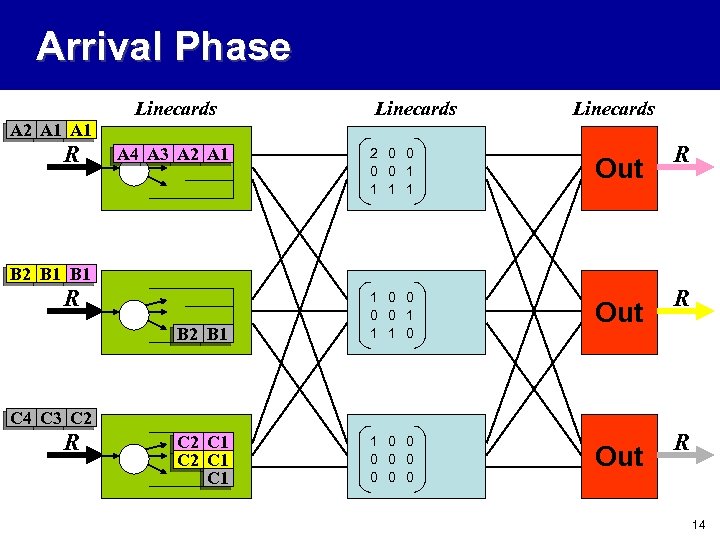
Arrival Phase A 2 A 1 R Linecards A 4 A 3 A 2 A 1 Linecards 2 0 0 1 1 Linecards Out R B 2 B 1 1 0 0 1 1 1 0 C 2 C 1 C 1 1 0 0 0 0 Out R C 4 C 3 C 2 R Out R 14
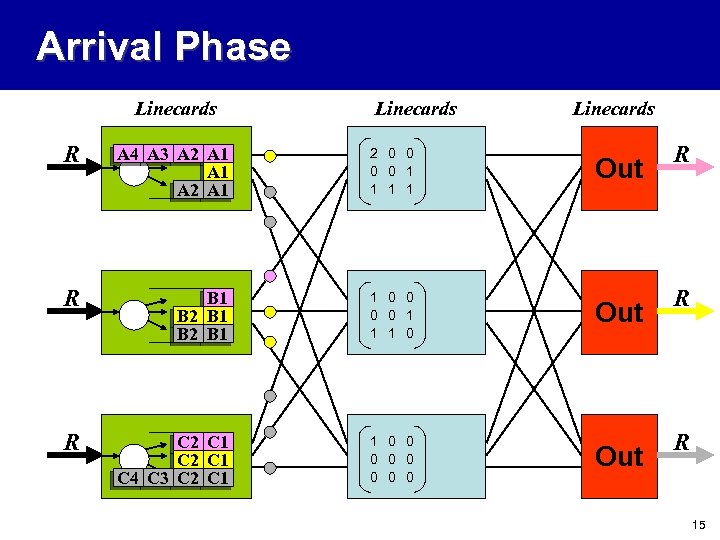
Arrival Phase Linecards R A 4 A 3 A 2 A 1 2 0 0 1 1 R B 1 B 2 B 1 1 0 0 1 1 1 0 R C 2 C 1 C 4 C 3 C 2 C 1 1 0 0 0 0 Linecards Out Out R R R 15
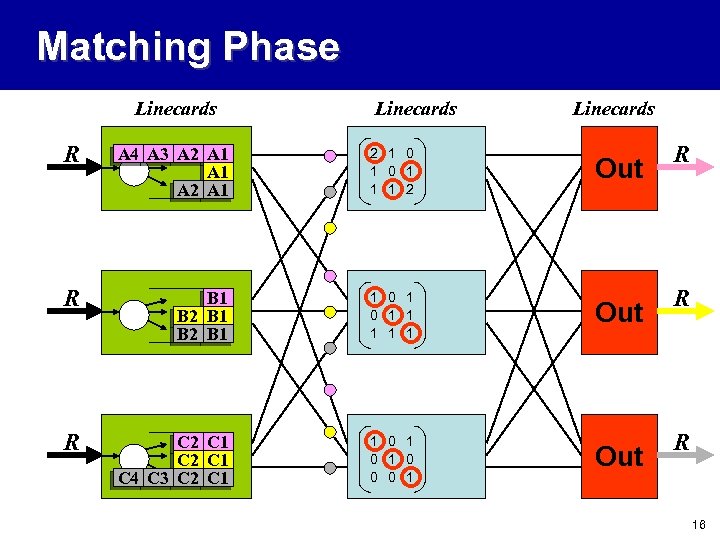
Matching Phase Linecards R A 4 A 3 A 2 A 1 2 1 0 1 1 1 2 R B 1 B 2 B 1 1 0 1 1 1 R C 2 C 1 C 4 C 3 C 2 C 1 1 0 1 0 0 0 1 Linecards Out Out R R R 16
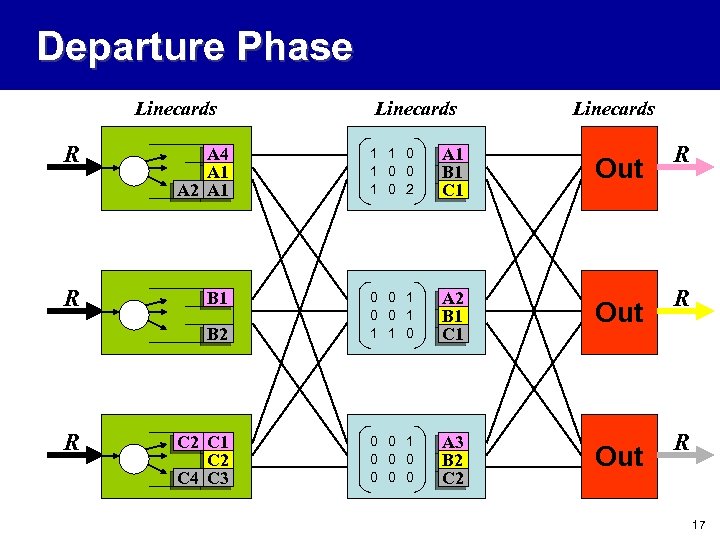
Departure Phase Linecards R A 4 A 1 A 2 A 1 1 1 0 0 1 0 2 A 1 B 1 C 1 R B 1 B 2 0 0 1 1 1 0 A 2 B 1 C 2 C 4 C 3 0 0 1 0 0 0 A 3 B 2 C 2 R Linecards Out Out R R R 17
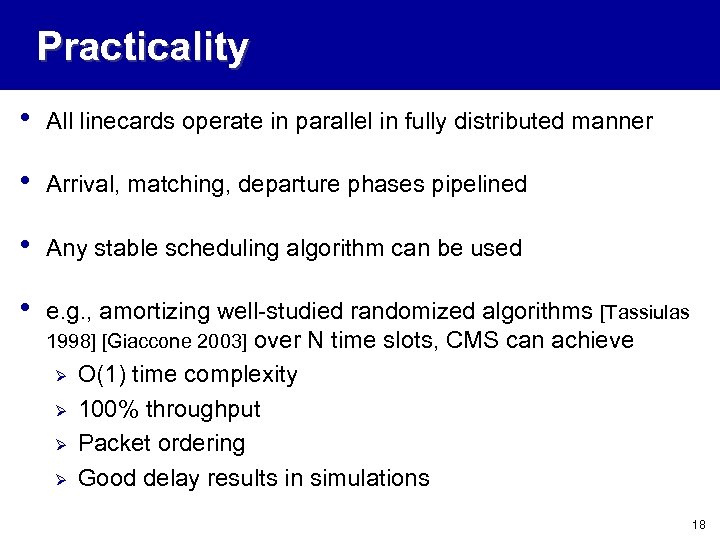
Practicality • All linecards operate in parallel in fully distributed manner • Arrival, matching, departure phases pipelined • Any stable scheduling algorithm can be used • e. g. , amortizing well-studied randomized algorithms [Tassiulas 1998] [Giaccone 2003] over N time slots, CMS can achieve Ø O(1) time complexity Ø 100% throughput Ø Packet ordering Ø Good delay results in simulations 18
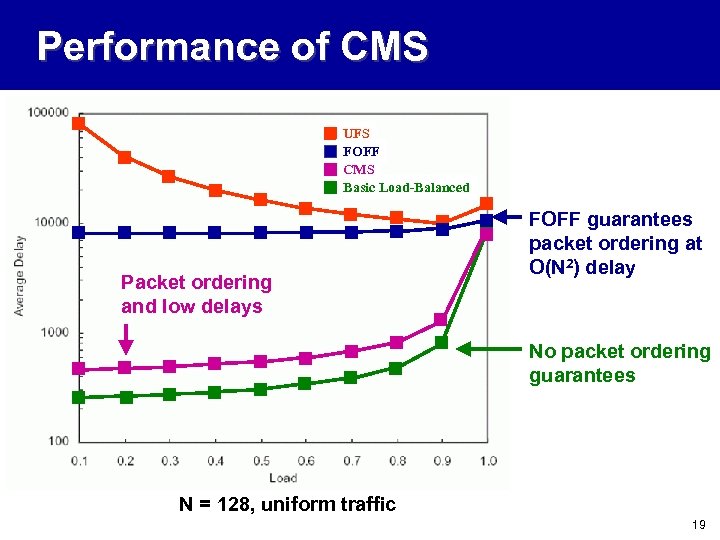
Performance of CMS UFS FOFF CMS Basic Load-Balanced Packet ordering and low delays FOFF guarantees packet ordering at O(N 2) delay No packet ordering guarantees N = 128, uniform traffic 19
This Talk • Concurrent Matching Switch • General Delay Bound • O(N log N) delay with Fair-Frame Scheduling • O(N log N) delay and O(1) complexity with Frame Aggregation 20
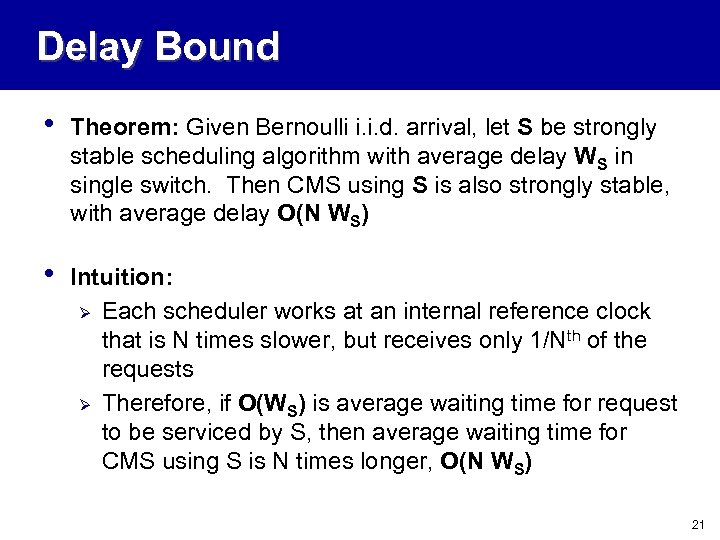
Delay Bound • Theorem: Given Bernoulli i. i. d. arrival, let S be strongly stable scheduling algorithm with average delay WS in single switch. Then CMS using S is also strongly stable, with average delay O(N WS) • Intuition: Ø Each scheduler works at an internal reference clock that is N times slower, but receives only 1/Nth of the requests Ø Therefore, if O(WS) is average waiting time for request to be serviced by S, then average waiting time for CMS using S is N times longer, O(N WS) 21
Delay Bound • Any stable scheduling algorithm can be used with CMS • Although we previously showed good delay simulations using a randomized algorithm called SERENA [Giaccone 2003] that is amortizable to O(1) complexity, no delay bounds (WS) are known for this class of algorithms • Therefore, delay bounds for CMS using these algorithms are also unknown 22
O(N log N) Delay • In this talk, we want to show CMS can be provably bounded by O(N log N) delay for Bernoulli i. i. d. arrival, improving over the previous O(N 2) bound provided by FOFF • This can be achieved using a known logarithmic delay scheduling algorithm called Fair-Frame Scheduling [Neely 2004], i. e. WS = O(log N), therefore O(N log N) for CMS 23
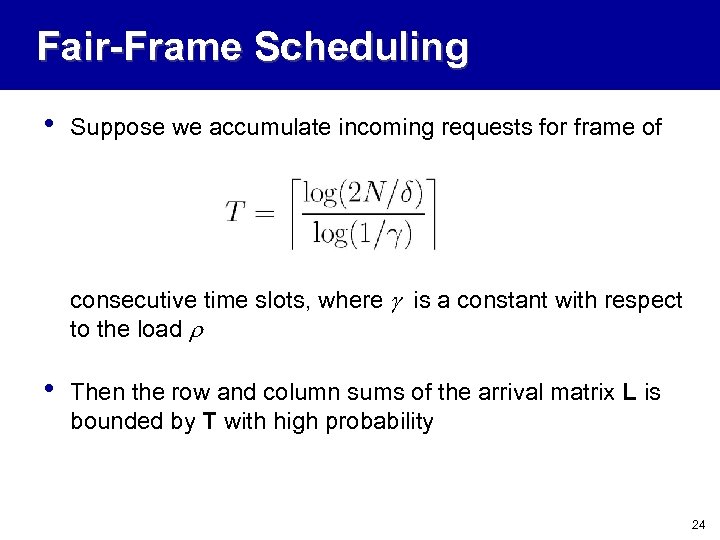
Fair-Frame Scheduling • Suppose we accumulate incoming requests for frame of consecutive time slots, where g is a constant with respect to the load r • Then the row and column sums of the arrival matrix L is bounded by T with high probability 24
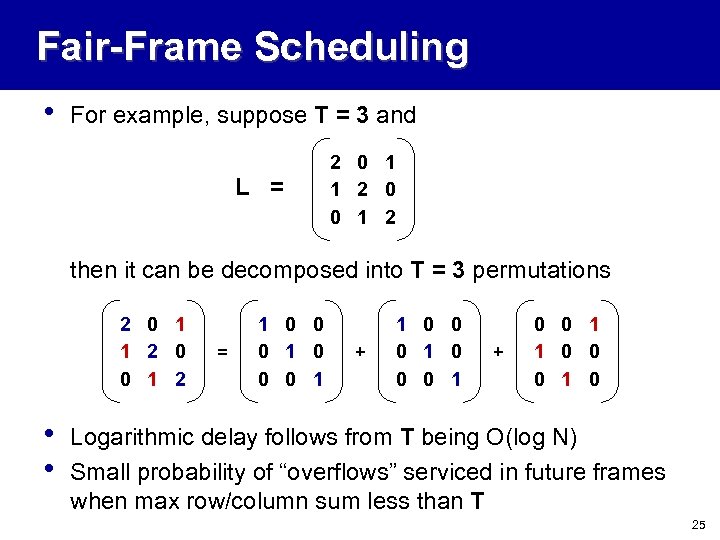
Fair-Frame Scheduling • For example, suppose T = 3 and L = 2 0 1 1 2 0 0 1 2 then it can be decomposed into T = 3 permutations 2 0 1 1 2 0 0 1 2 • • = 1 0 0 0 1 + 0 0 1 1 0 0 0 1 0 Logarithmic delay follows from T being O(log N) Small probability of “overflows” serviced in future frames when max row/column sum less than T 25
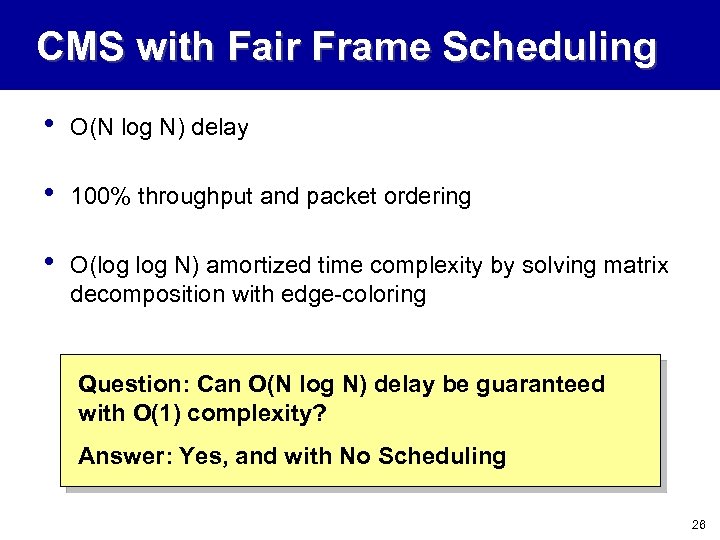
CMS with Fair Frame Scheduling • O(N log N) delay • 100% throughput and packet ordering • O(log N) amortized time complexity by solving matrix decomposition with edge-coloring Question: Can O(N log N) delay be guaranteed with O(1) complexity? Answer: Yes, and with No Scheduling 26
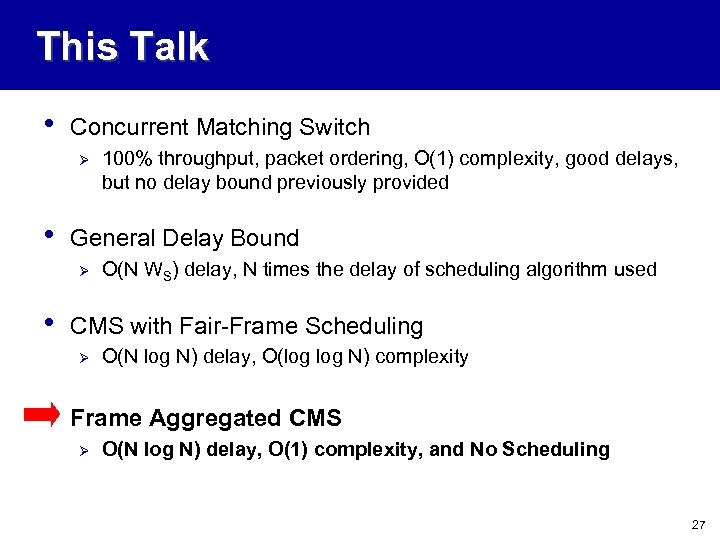
This Talk • Concurrent Matching Switch Ø • General Delay Bound Ø • O(N WS) delay, N times the delay of scheduling algorithm used CMS with Fair-Frame Scheduling Ø • 100% throughput, packet ordering, O(1) complexity, good delays, but no delay bound previously provided O(N log N) delay, O(log N) complexity Frame Aggregated CMS Ø O(N log N) delay, O(1) complexity, and No Scheduling 27
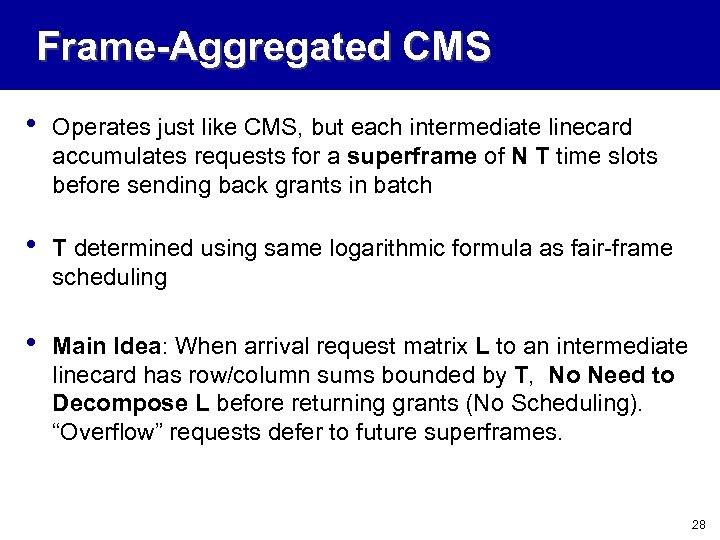
Frame-Aggregated CMS • Operates just like CMS, but each intermediate linecard accumulates requests for a superframe of N T time slots before sending back grants in batch • T determined using same logarithmic formula as fair-frame scheduling • Main Idea: When arrival request matrix L to an intermediate linecard has row/column sums bounded by T, No Need to Decompose L before returning grants (No Scheduling). “Overflow” requests defer to future superframes. 28
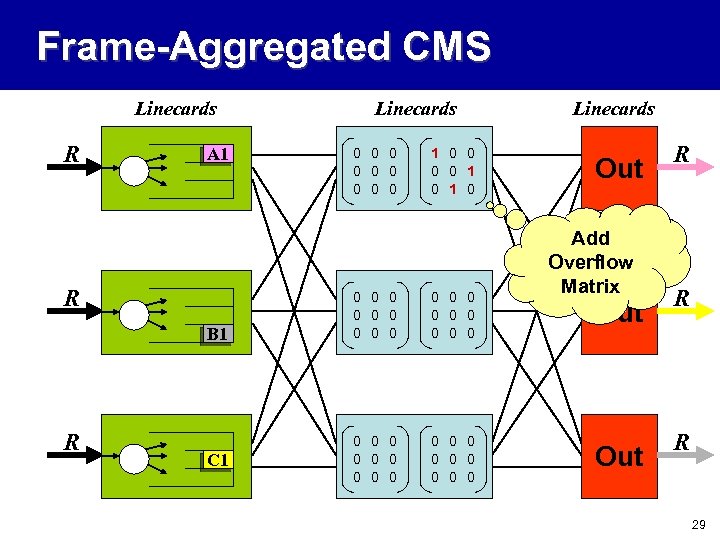
Frame-Aggregated CMS Linecards R A 1 R B 1 R C 1 Linecards 0 0 0 0 0 1 0 0 0 0 0 0 0 0 0 0 Linecards Out Add Overflow Matrix Out R R R 29
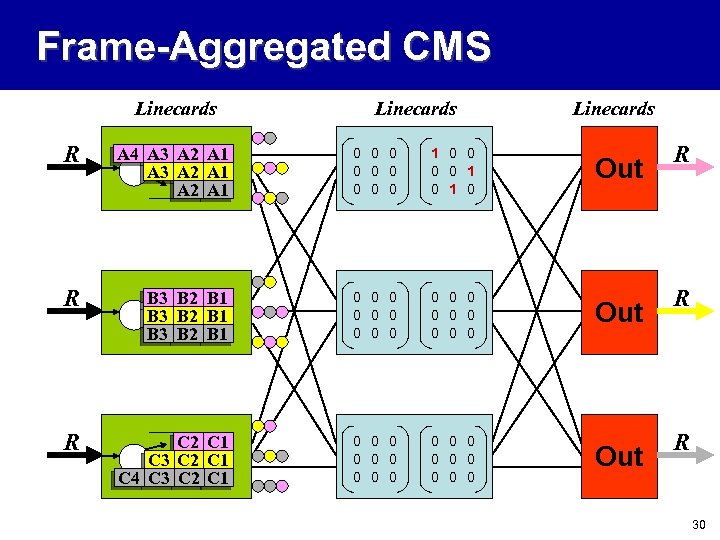
Frame-Aggregated CMS Linecards R A 4 A 3 A 2 A 1 0 0 0 0 0 1 0 R B 3 B 2 B 1 0 0 0 0 0 R C 2 C 1 C 3 C 2 C 1 C 4 C 3 C 2 C 1 0 0 0 0 0 Linecards Out Out R R R 30
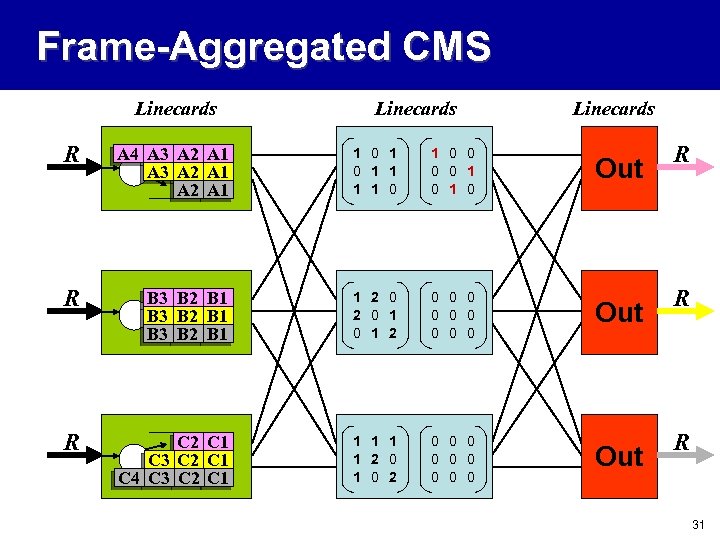
Frame-Aggregated CMS Linecards R A 4 A 3 A 2 A 1 1 0 1 0 0 1 0 R B 3 B 2 B 1 1 2 0 1 0 1 2 0 0 0 0 0 R C 2 C 1 C 3 C 2 C 1 C 4 C 3 C 2 C 1 1 1 2 0 1 0 2 0 0 0 0 0 Linecards Out Out R R R 31
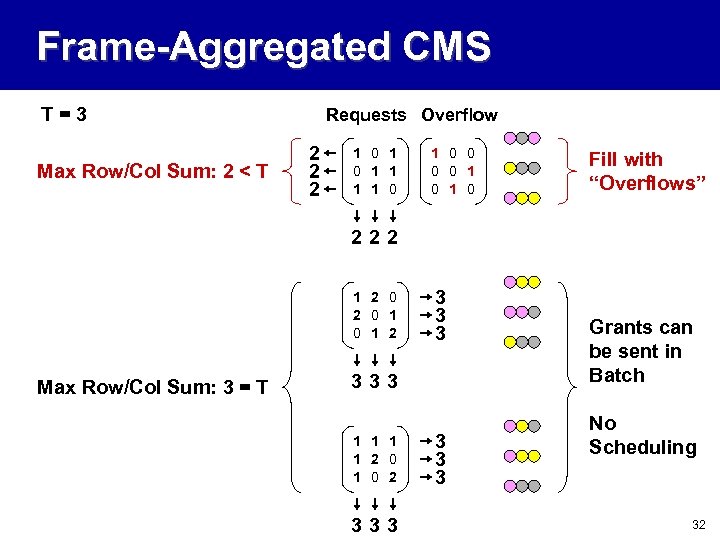
Frame-Aggregated CMS T=3 Max Row/Col Sum: 2 < T Requests Overflow 2 2 2 1 0 1 0 0 1 0 Fill with “Overflows” 222 1 2 0 1 0 1 2 Max Row/Col Sum: 3 = T 3 333 1 1 2 0 1 0 2 333 3 Grants can be sent in Batch No Scheduling 32
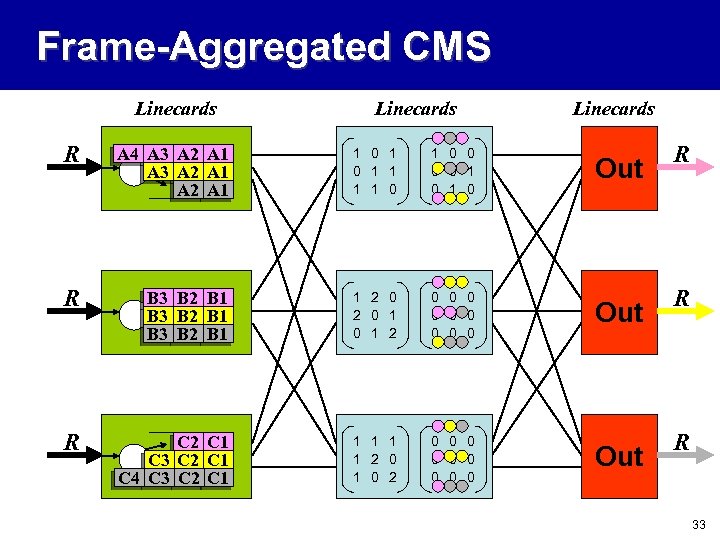
Frame-Aggregated CMS Linecards R A 4 A 3 A 2 A 1 1 0 1 0 0 1 0 R B 3 B 2 B 1 1 2 0 1 0 1 2 0 0 0 0 0 R C 2 C 1 C 3 C 2 C 1 C 4 C 3 C 2 C 1 1 1 2 0 1 0 2 0 0 0 0 0 Linecards Out Out R R R 33
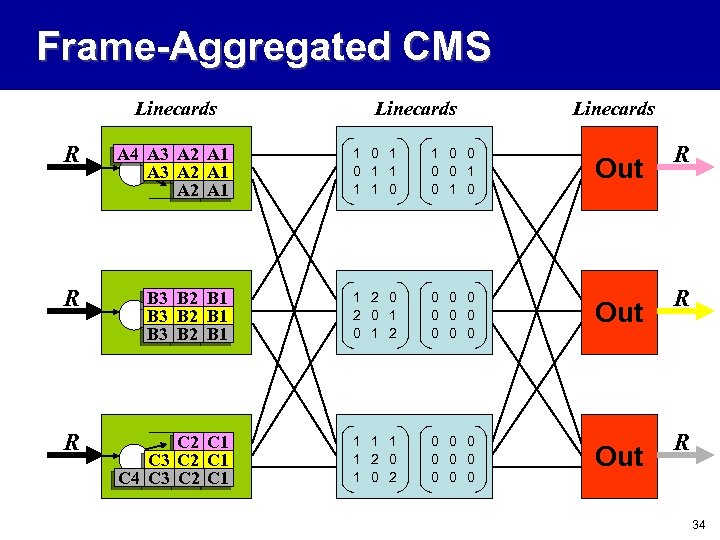
Frame-Aggregated CMS Linecards R A 4 A 3 A 2 A 1 1 0 1 0 0 1 0 R B 3 B 2 B 1 1 2 0 1 0 1 2 0 0 0 0 0 R C 2 C 1 C 3 C 2 C 1 C 4 C 3 C 2 C 1 1 1 2 0 1 0 2 0 0 0 0 0 Linecards Out Out R R R 34
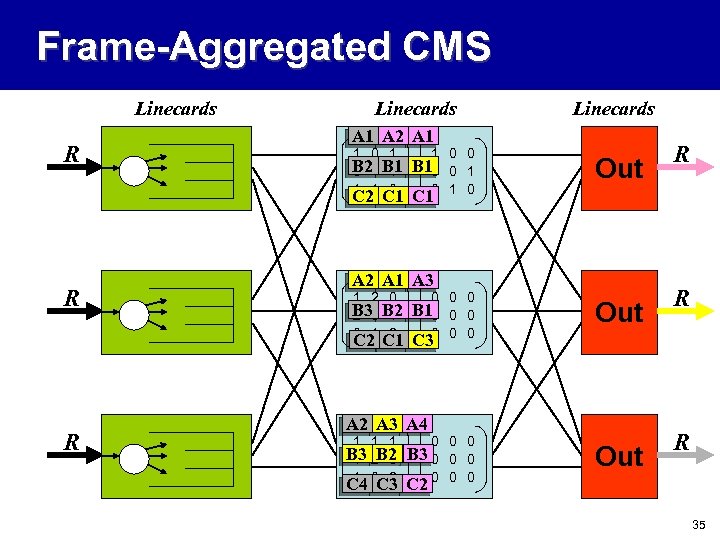
Frame-Aggregated CMS Linecards R Linecards A 1 A 2 A 1 1 0 0 0 1 0 B 21 B 10 0 1 1 0 C 21 C 1 R Out A 2 A 1 A 3 1 2 0 0 0 0 0 B 30 B 2 B 10 2 1 0 1 2 C 1 C 3 R Linecards Out A 2 A 3 A 4 1 1 1 0 0 0 0 B 3 2 B 2 B 3 0 1 2 C 4 0 C 3 C 2 Out R R R 35
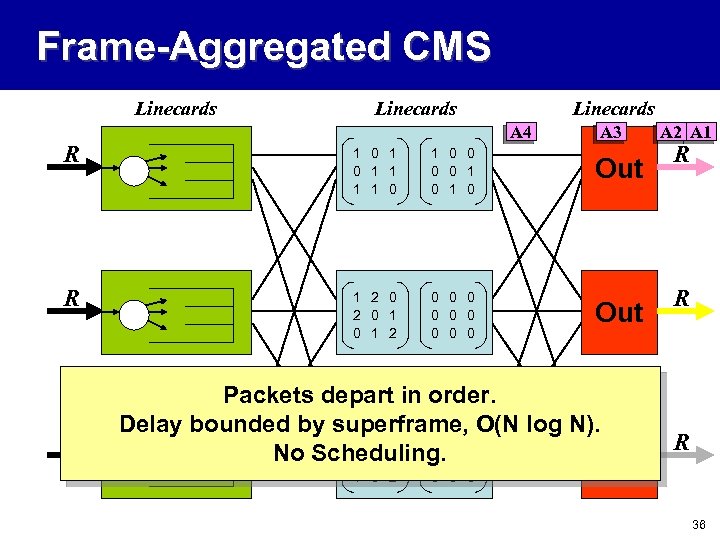
Frame-Aggregated CMS Linecards A 4 R 1 0 1 0 0 1 0 R 1 2 0 1 0 1 2 0 0 0 0 0 R Linecards A 3 Out Packets depart in order. Delay bounded by superframe, O(N log N). 1 1 1 0 0 0 No Scheduling. 0 0 1 2 0 0 Out 1 0 2 A 1 R R R 0 0 0 36
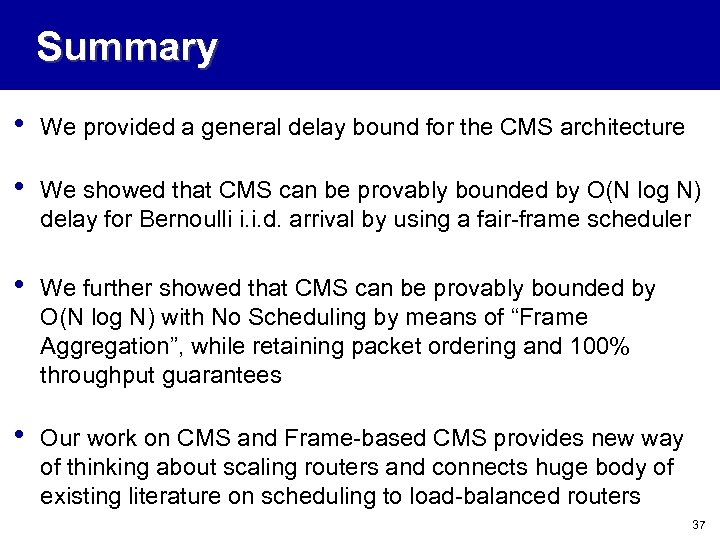
Summary • We provided a general delay bound for the CMS architecture • We showed that CMS can be provably bounded by O(N log N) delay for Bernoulli i. i. d. arrival by using a fair-frame scheduler • We further showed that CMS can be provably bounded by O(N log N) with No Scheduling by means of “Frame Aggregation”, while retaining packet ordering and 100% throughput guarantees • Our work on CMS and Frame-based CMS provides new way of thinking about scaling routers and connects huge body of existing literature on scheduling to load-balanced routers 37
Thank You Spring 2005 044114
Скачать презентацию Frame-Aggregated Concurrent Matching Switch Bill Lin University of
d02e6e12bbe0fabcfc9b18a8b722d472.ppt