


 Скачать презентацию FPGA Design of an Integrated CAN and EDAC
3aa97d302d8c92ded2ce2e87d3301d3a.ppt
- Количество слайдов: 21
 FPGA Design of an Integrated CAN and EDAC Soft Core for Spacecraft Applications Antonio Roldao Lopes 1/21 MAPLD 2005/P 168
 CONTENTS → Space Engineering Approaches → New missions, New Challenges → Commercial off-the-shelf Components → Taking Advantage of FPGAs → Experiences with EDACAN Soft-core → Triple Modular Redundancy → Controller Area Network for Spacecraft-Usage → Future: Satellite Generic System-on-Chip Antonio Roldao Lopes 2 2/21 MAPLD 2005/P 168
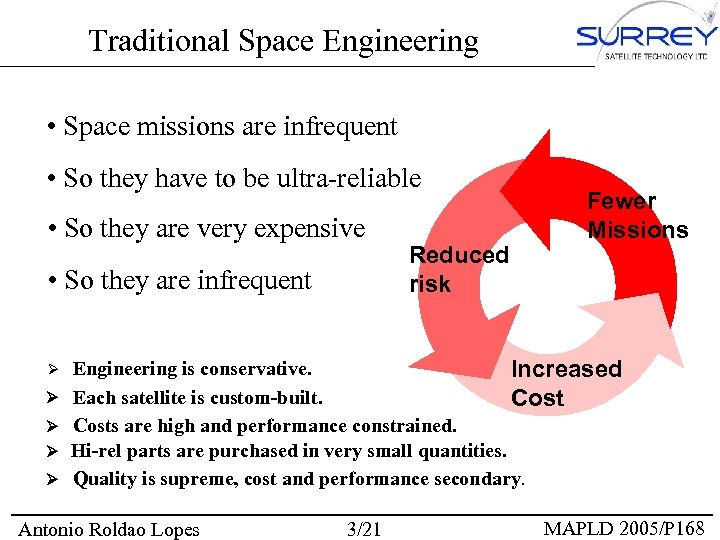 Traditional Space Engineering • Space missions are infrequent • So they have to be ultra-reliable • So they are very expensive • So they are infrequent Ø Ø Ø Reduced risk Fewer Missions Engineering is conservative. Increased Each satellite is custom-built. Costs are high and performance constrained. Hi-rel parts are purchased in very small quantities. Quality is supreme, cost and performance secondary. Antonio Roldao Lopes 3 3/21 MAPLD 2005/P 168
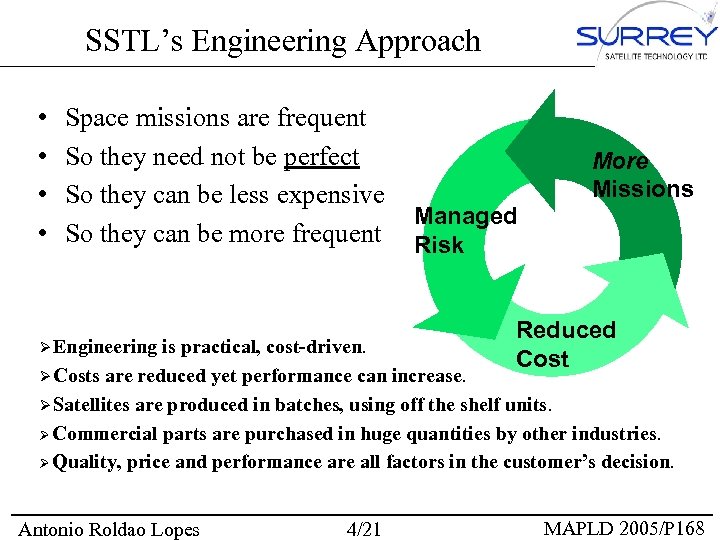 SSTL’s Engineering Approach • • Space missions are frequent So they need not be perfect So they can be less expensive So they can be more frequent Managed Risk More Missions Reduced Cost Ø Engineering is practical, cost-driven. Ø Costs are reduced yet performance can increase. Ø Satellites are produced in batches, using off the shelf units. Ø Commercial parts are purchased in huge quantities by other industries. Ø Quality, price and performance are all factors in the customer’s decision. Antonio Roldao Lopes 4/21 MAPLD 2005/P 168
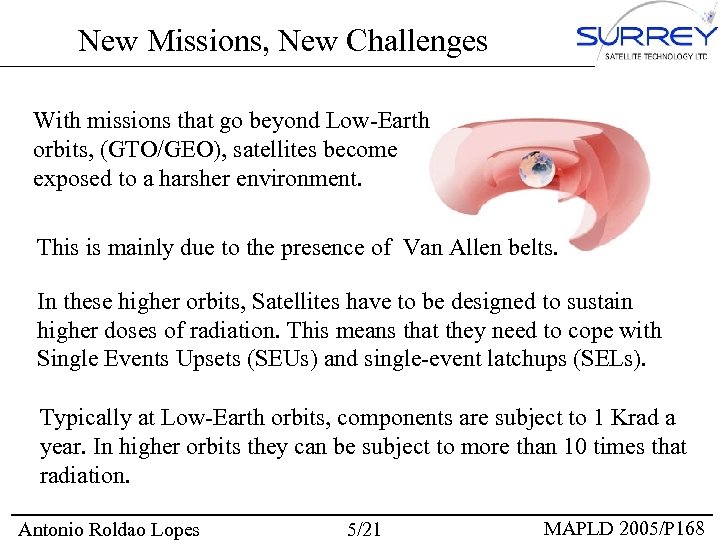 New Missions, New Challenges With missions that go beyond Low-Earth orbits, (GTO/GEO), satellites become exposed to a harsher environment. This is mainly due to the presence of Van Allen belts. In these higher orbits, Satellites have to be designed to sustain higher doses of radiation. This means that they need to cope with Single Events Upsets (SEUs) and single-event latchups (SELs). Typically at Low-Earth orbits, components are subject to 1 Krad a year. In higher orbits they can be subject to more than 10 times that radiation. Antonio Roldao Lopes 5/21 MAPLD 2005/P 168
 Commercial off-the-shelf Components • Usually very few “common” COTS parts fail at less than 5 Krad. • Space qualified components that sustain higher radiation doses are scarce and their costs can ramp up exponentially. To keep in sync with the SSTL’s engineering approach, of maintaining satellites at the lowest cost possible, a combination of technologies and risk management techniques are put into practice. An example of such risk management techniques is the use of TMR memories; where errors on individual COTS modules can be corrected provided the majority are in agreement. In terms of technologies, one that is applied in almost all the subsystems is Anti-fuse FPGAs. Antonio Roldao Lopes 6/21 MAPLD 2005/P 168
 Taking Advantage of FPGAs This devices are available with capacities that range from couple hundred to multi-million gates. Coming in a range of packages, they also include radiation tolerant versions. These devices are also revolutionizing the whole of the electronics and computing domain by providing the following features: • Parallelism • Reconfigurability (not in the case of Anti-fuse) • Integration • Flexibility • Reduced Time Scales • Software Nature Antonio Roldao Lopes 7/21 MAPLD 2005/P 168
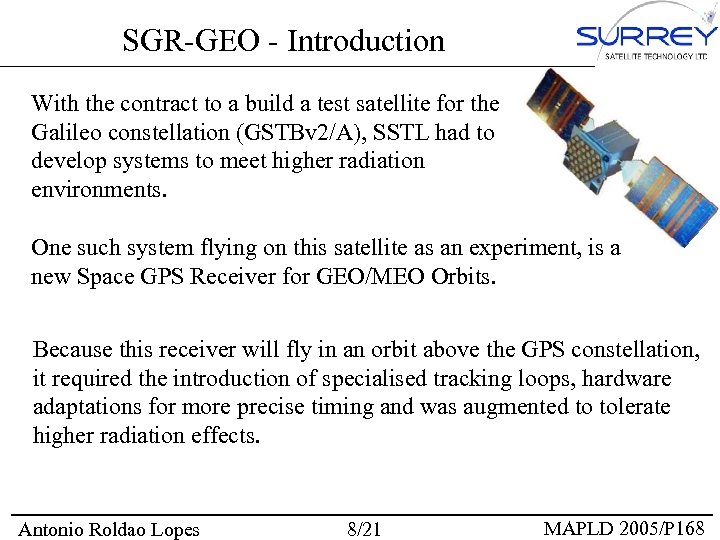 SGR-GEO - Introduction With the contract to a build a test satellite for the Galileo constellation (GSTBv 2/A), SSTL had to develop systems to meet higher radiation environments. One such system flying on this satellite as an experiment, is a new Space GPS Receiver for GEO/MEO Orbits. Because this receiver will fly in an orbit above the GPS constellation, it required the introduction of specialised tracking loops, hardware adaptations for more precise timing and was augmented to tolerate higher radiation effects. Antonio Roldao Lopes 8/21 MAPLD 2005/P 168
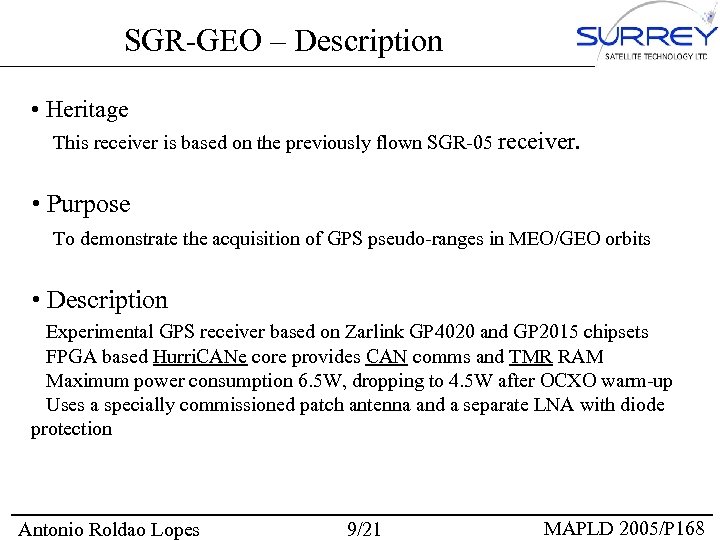 SGR-GEO – Description • Heritage This receiver is based on the previously flown SGR-05 receiver. • Purpose To demonstrate the acquisition of GPS pseudo-ranges in MEO/GEO orbits • Description Experimental GPS receiver based on Zarlink GP 4020 and GP 2015 chipsets FPGA based Hurri. CANe core provides CAN comms and TMR RAM Maximum power consumption 6. 5 W, dropping to 4. 5 W after OCXO warm-up Uses a specially commissioned patch antenna and a separate LNA with diode protection Antonio Roldao Lopes 9/21 MAPLD 2005/P 168
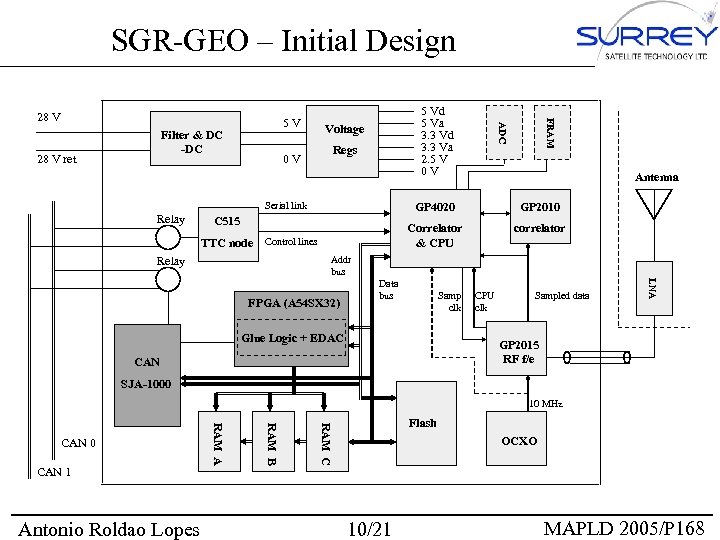 SGR-GEO – Initial Design Filter & DC -DC 28 V ret 0 V 5 Vd 5 Va 3. 3 Vd 3. 3 Va 2. 5 V 0 V Voltage Regs Serial link Relay Antenna GP 4020 Control lines GP 2010 Correlator & CPU C 515 TTC node FRAM 5 V ADC 28 V correlator Addr bus Relay Samp clk Glue Logic + EDAC CPU clk Sampled data LNA FPGA (A 54 SX 32) Data bus GP 2015 RF f/e CAN SJA-1000 10 MHz RAM C Antonio Roldao Lopes RAM B CAN 1 RAM A CAN 0 Flash OCXO 10/21 MAPLD 2005/P 168
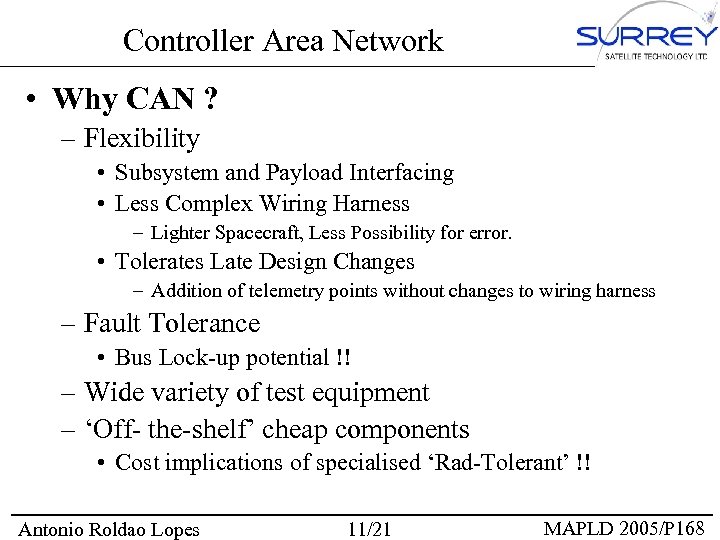 Controller Area Network • Why CAN ? – Flexibility • Subsystem and Payload Interfacing • Less Complex Wiring Harness – Lighter Spacecraft, Less Possibility for error. • Tolerates Late Design Changes – Addition of telemetry points without changes to wiring harness – Fault Tolerance • Bus Lock-up potential !! – Wide variety of test equipment – ‘Off- the-shelf’ cheap components • Cost implications of specialised ‘Rad-Tolerant’ !! Antonio Roldao Lopes 11/21 MAPLD 2005/P 168
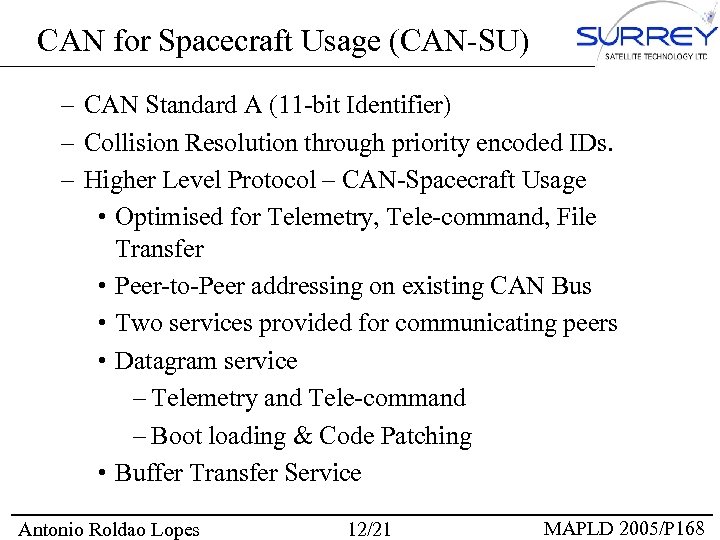 CAN for Spacecraft Usage (CAN-SU) – CAN Standard A (11 -bit Identifier) – Collision Resolution through priority encoded IDs. – Higher Level Protocol – CAN-Spacecraft Usage • Optimised for Telemetry, Tele-command, File Transfer • Peer-to-Peer addressing on existing CAN Bus • Two services provided for communicating peers • Datagram service – Telemetry and Tele-command – Boot loading & Code Patching • Buffer Transfer Service Antonio Roldao Lopes 12/21 MAPLD 2005/P 168
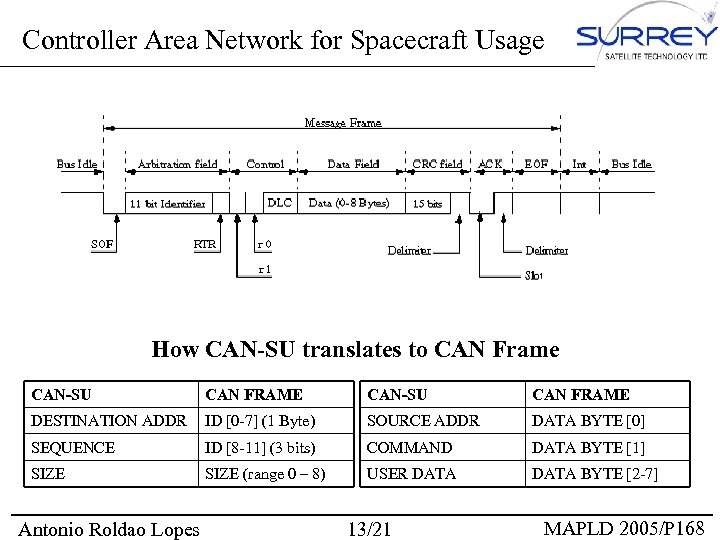 Controller Area Network for Spacecraft Usage How CAN-SU translates to CAN Frame CAN-SU CAN FRAME DESTINATION ADDR ID [0 -7] (1 Byte) SOURCE ADDR DATA BYTE [0] SEQUENCE ID [8 -11] (3 bits) COMMAND DATA BYTE [1] SIZE (range 0 – 8) USER DATA BYTE [2 -7] Antonio Roldao Lopes 13/21 MAPLD 2005/P 168
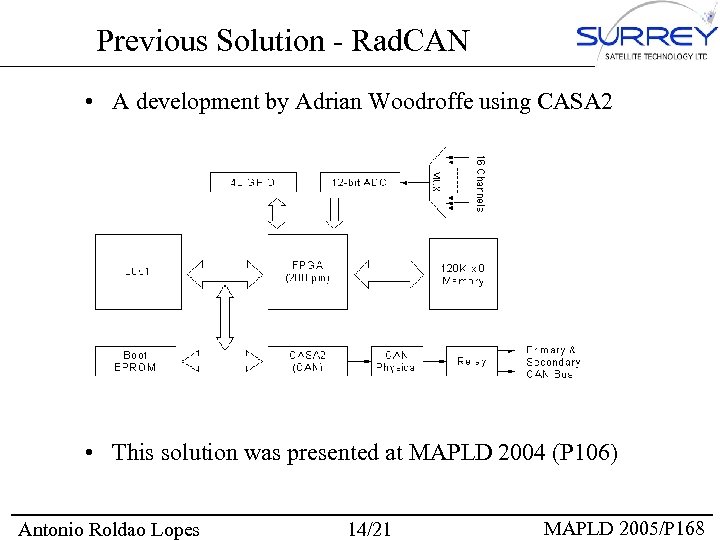 Previous Solution - Rad. CAN • A development by Adrian Woodroffe using CASA 2 • This solution was presented at MAPLD 2004 (P 106) Antonio Roldao Lopes 14/21 MAPLD 2005/P 168
 Current Development - EDACAN • EDACAN Comprises of – – Simple glue logic for memory decoding EDAC (Error Detection and Correction) IP Core Controller Area Network IP Core, based on Hurri. CANe Purpose built wrapper for especially tailored for CAN-SU • Advantages of EDACAN over Rad. CAN – Flexibility to adapt the core to meet new demands – Possibility to further integrate saving PCB space and power – Freedom between radiation tolerant or industrial FPGAs Antonio Roldao Lopes 15/21 MAPLD 2005/P 168
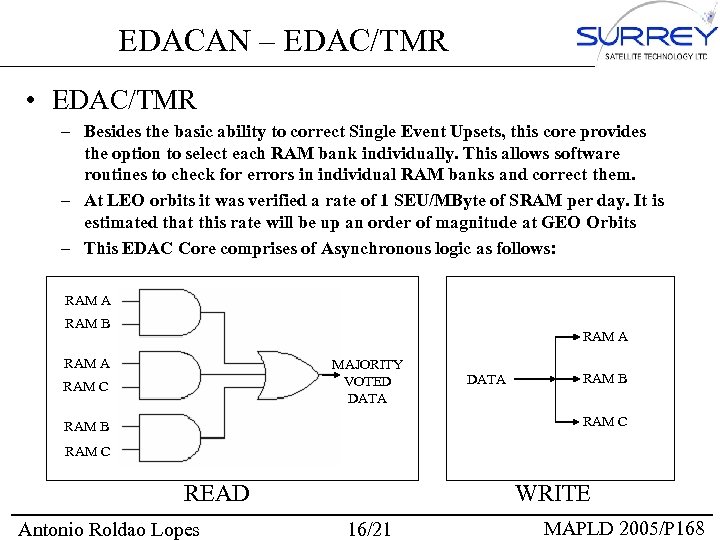 EDACAN – EDAC/TMR • EDAC/TMR – Besides the basic ability to correct Single Event Upsets, this core provides the option to select each RAM bank individually. This allows software routines to check for errors in individual RAM banks and correct them. – At LEO orbits it was verified a rate of 1 SEU/MByte of SRAM per day. It is estimated that this rate will be up an order of magnitude at GEO Orbits – This EDAC Core comprises of Asynchronous logic as follows: RAM A RAM B RAM A MAJORITY VOTED DATA RAM C DATA RAM B RAM C READ Antonio Roldao Lopes WRITE 16/21 MAPLD 2005/P 168
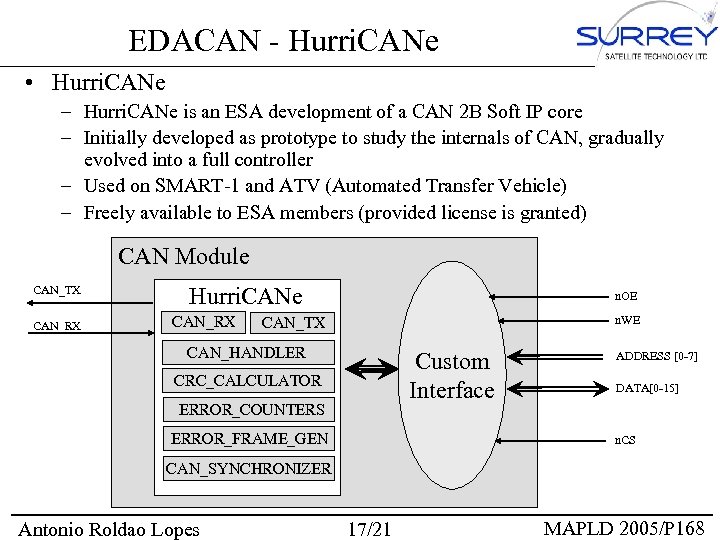 EDACAN - Hurri. CANe • Hurri. CANe – Hurri. CANe is an ESA development of a CAN 2 B Soft IP core – Initially developed as prototype to study the internals of CAN, gradually evolved into a full controller – Used on SMART-1 and ATV (Automated Transfer Vehicle) – Freely available to ESA members (provided license is granted) CAN Module CAN_TX CAN_RX Hurri. CANe CAN_RX n. OE n. WE CAN_TX CAN_HANDLER Custom Interface CRC_CALCULATOR ERROR_COUNTERS ERROR_FRAME_GEN ADDRESS [0 -7] DATA[0 -15] n. CS CAN_SYNCHRONIZER Antonio Roldao Lopes 17/21 MAPLD 2005/P 168
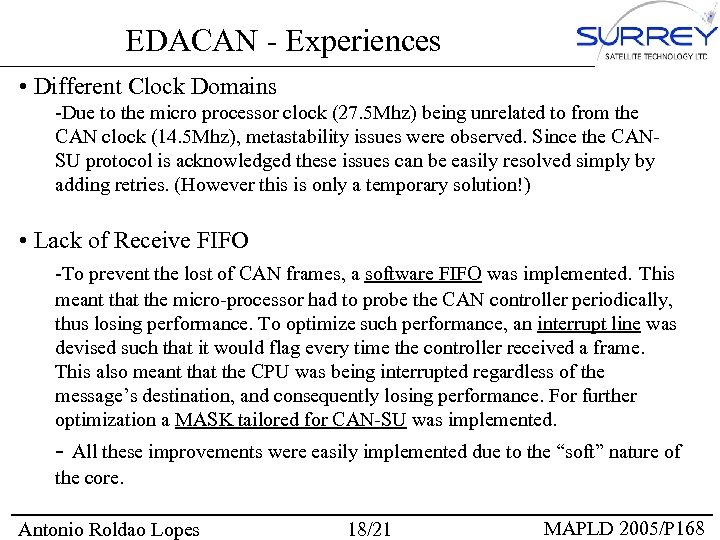 EDACAN - Experiences • Different Clock Domains -Due to the micro processor clock (27. 5 Mhz) being unrelated to from the CAN clock (14. 5 Mhz), metastability issues were observed. Since the CANSU protocol is acknowledged these issues can be easily resolved simply by adding retries. (However this is only a temporary solution!) • Lack of Receive FIFO -To prevent the lost of CAN frames, a software FIFO was implemented. This meant that the micro-processor had to probe the CAN controller periodically, thus losing performance. To optimize such performance, an interrupt line was devised such that it would flag every time the controller received a frame. This also meant that the CPU was being interrupted regardless of the message’s destination, and consequently losing performance. For further optimization a MASK tailored for CAN-SU was implemented. - All these improvements were easily implemented due to the “soft” nature of the core. Antonio Roldao Lopes 18/21 MAPLD 2005/P 168
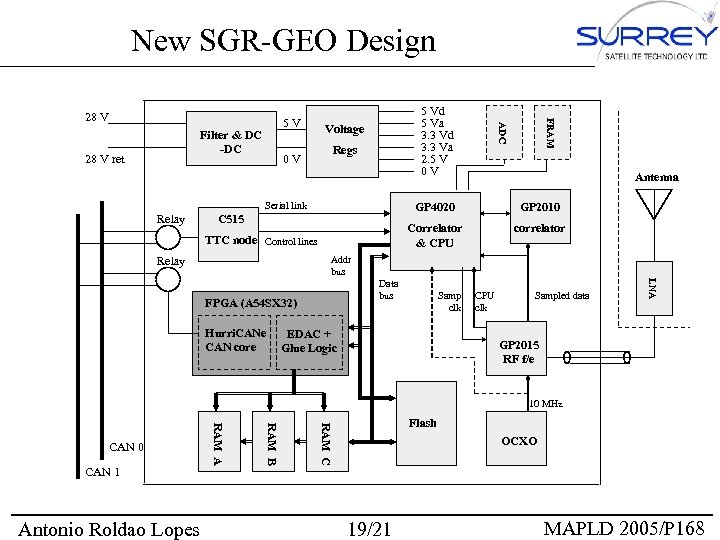 New SGR-GEO Design Filter & DC -DC 28 V ret 0 V 5 Vd 5 Va 3. 3 Vd 3. 3 Va 2. 5 V 0 V Voltage Regs Serial link Relay FRAM 5 V ADC 28 V Antenna GP 4020 TTC node Control lines GP 2010 Correlator & CPU C 515 correlator Addr bus Relay FPGA (A 54 SX 32) Hurri. CANe CAN core Samp clk EDAC + Glue Logic CPU clk Sampled data LNA Data bus GP 2015 RF f/e 10 MHz RAM C Antonio Roldao Lopes RAM B CAN 1 RAM A CAN 0 Flash OCXO 19/21 MAPLD 2005/P 168
 Satellite Generic System-on-Chip (SG-So. C) • FUTURE DEVELOPMENT - In keeping with the trend of further integrating devices into the FPGA, the next step would be to incorporate the micro-processor - Currently set of requirements being put together to determine generic system that could be easily adapted to any specific application - This system should be reconfigurable and technology independent - Once this platform is implemented, turning it into a GPS receiver would only require plugging-in GPS specific modules (e. g. correlators) and providing a proper interface to external chips (e. g. RF Front-end) Antonio Roldao Lopes 20/21 MAPLD 2005/P 168
 Acknowledgements 3 Dr Alex da Silva Curiel Hans Tiggeler 1 4 Luca Stagnaro 3 Dr Martin Unwin Michael Meier 3 Simon Prasad 3 2 Dr Tanya Vladimirova Saros – 1 Surrey Space Centre – 2 Antonio Roldao Lopes 3 – Surrey Satellite Technology Ltd 4 – European Space Agency 21/21 MAPLD 2005/P 168