


 Скачать презентацию FP 7 Structure Work Programmes Search for partners
814de4bb7cd64ad808acfd04419759a4.ppt
- Количество слайдов: 59
 FP 7 Structure Work Programmes Search for partners ERA-NIS workshop, Chisinau-Oct. 2007 1
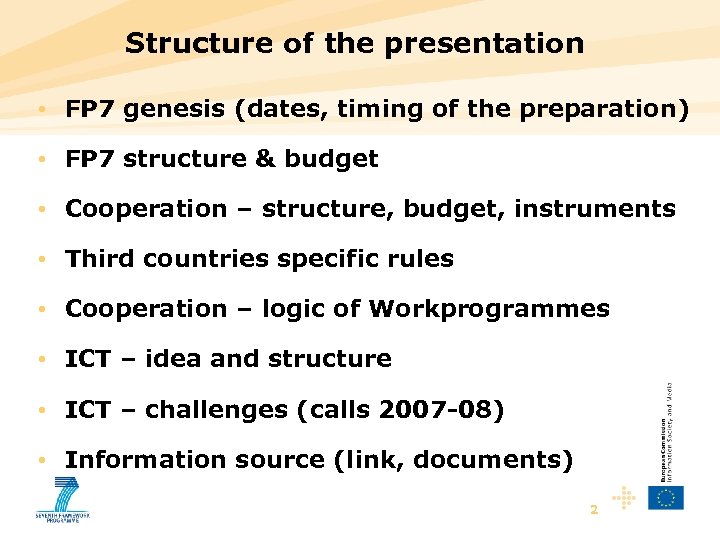 Structure of the presentation • FP 7 genesis (dates, timing of the preparation) • FP 7 structure & budget • Cooperation – structure, budget, instruments • Third countries specific rules • Cooperation – logic of Workprogrammes • ICT – idea and structure • ICT – challenges (calls 2007 -08) • Information source (link, documents) 2
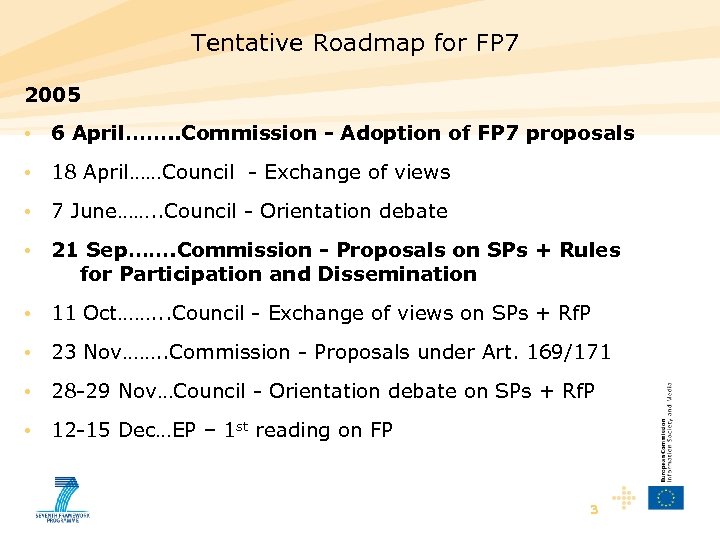 Tentative Roadmap for FP 7 2005 • 6 April……. . Commission - Adoption of FP 7 proposals • 18 April……Council - Exchange of views • 7 June……. . Council - Orientation debate • 21 Sep……. Commission - Proposals on SPs + Rules for Participation and Dissemination • 11 Oct……. . . Council - Exchange of views on SPs + Rf. P • 23 Nov……. . Commission - Proposals under Art. 169/171 • 28 -29 Nov…Council - Orientation debate on SPs + Rf. P • 12 -15 Dec…EP – 1 st reading on FP 3
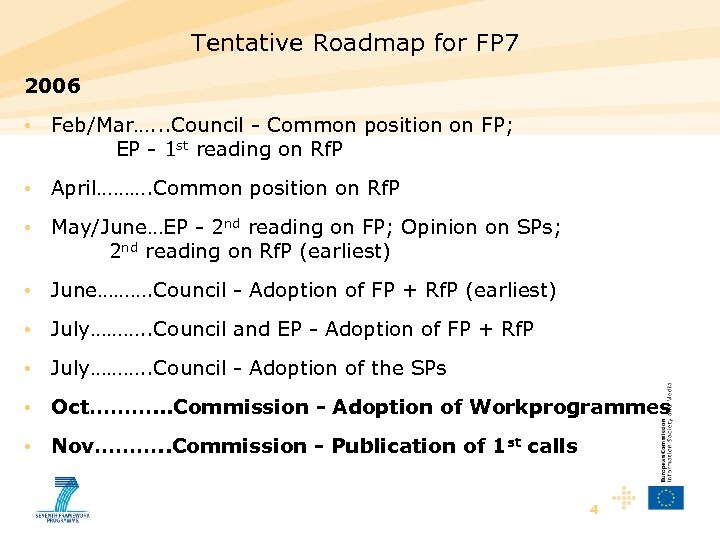 Tentative Roadmap for FP 7 2006 • Feb/Mar…. . . Council - Common position on FP; EP - 1 st reading on Rf. P • April………. Common position on Rf. P • May/June…EP - 2 nd reading on FP; Opinion on SPs; 2 nd reading on Rf. P (earliest) • June………. Council - Adoption of FP + Rf. P (earliest) • July………. . Council and EP - Adoption of FP + Rf. P • July………. . Council - Adoption of the SPs • Oct………. . . Commission - Adoption of Workprogrammes • Nov………. . Commission - Publication of 1 st calls 4
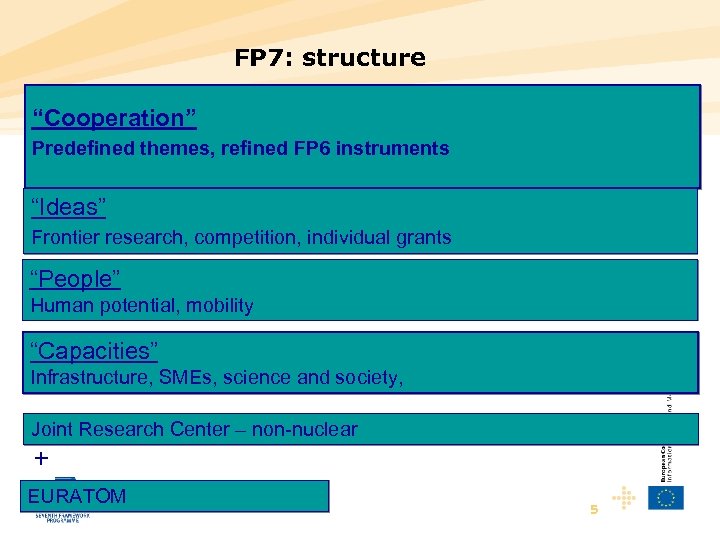 FP 7: structure “Cooperation” Predefined themes, refined FP 6 instruments “Ideas” Frontier research, competition, individual grants “People” Human potential, mobility “Capacities” Infrastructure, SMEs, science and society, Joint Research Center – non-nuclear + EURATOM 5
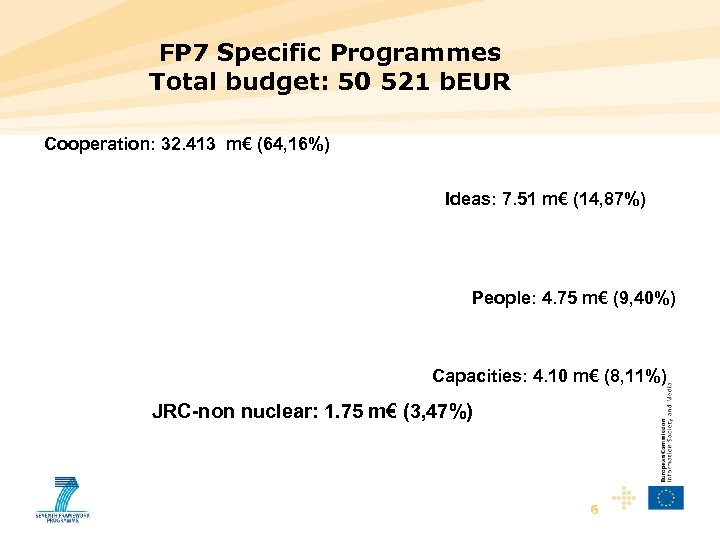 FP 7 Specific Programmes Total budget: 50 521 b. EUR Cooperation: 32. 413 m€ (64, 16%) Ideas: 7. 51 m€ (14, 87%) People: 4. 75 m€ (9, 40%) Capacities: 4. 10 m€ (8, 11%) JRC-non nuclear: 1. 75 m€ (3, 47%) 6
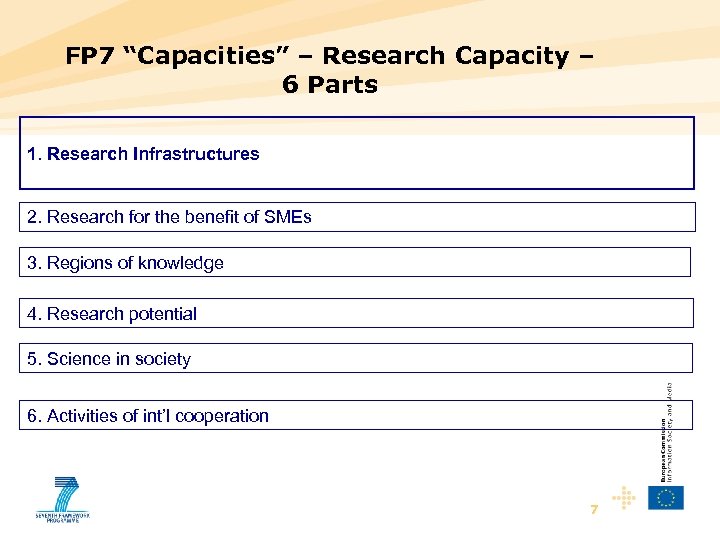 FP 7 “Capacities” – Research Capacity – 6 Parts 1. Research Infrastructures 2. Research for the benefit of SMEs 3. Regions of knowledge 4. Research potential 5. Science in society 6. Activities of int’l cooperation 7
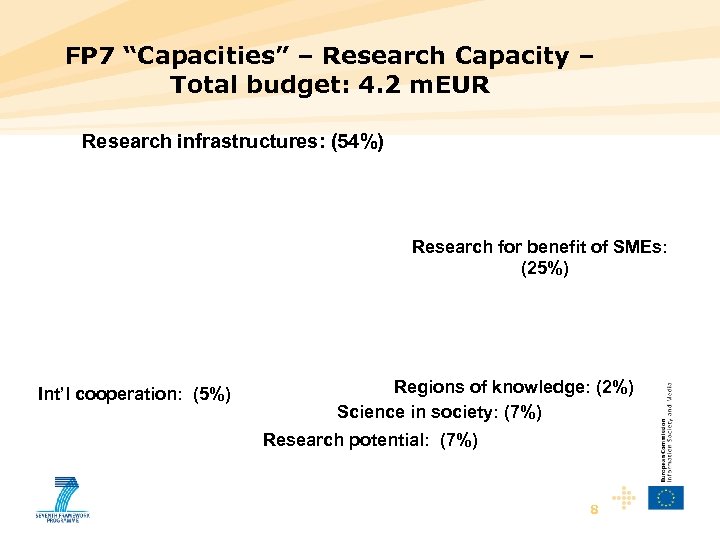 FP 7 “Capacities” – Research Capacity – Total budget: 4. 2 m. EUR Research infrastructures: (54%) Research for benefit of SMEs: (25%) Int’l cooperation: (5%) Regions of knowledge: (2%) Science in society: (7%) Research potential: (7%) 8
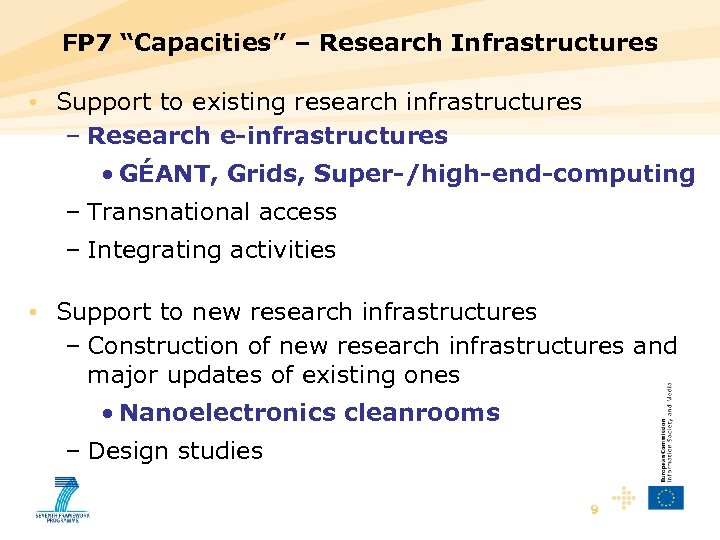 FP 7 “Capacities” – Research Infrastructures • Support to existing research infrastructures – Research e-infrastructures • GÉANT, Grids, Super-/high-end-computing – Transnational access – Integrating activities • Support to new research infrastructures – Construction of new research infrastructures and major updates of existing ones • Nanoelectronics cleanrooms – Design studies 9
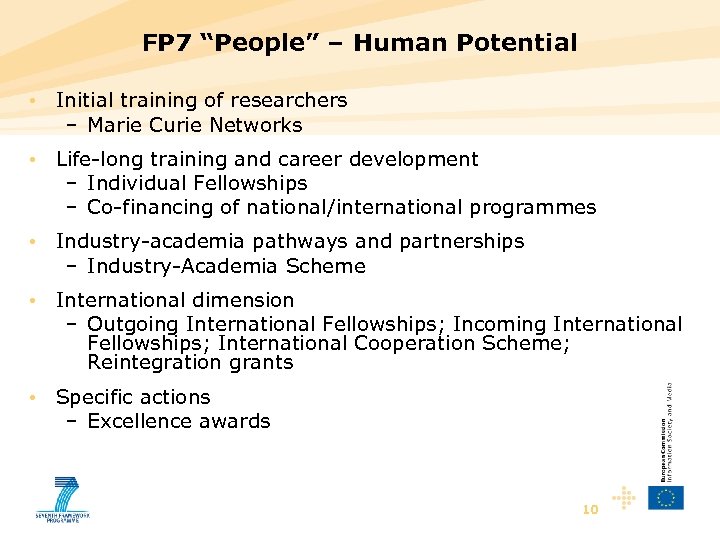 FP 7 “People” – Human Potential • Initial training of researchers – Marie Curie Networks • Life-long training and career development – Individual Fellowships – Co-financing of national/international programmes • Industry-academia pathways and partnerships – Industry-Academia Scheme • International dimension – Outgoing International Fellowships; Incoming International Fellowships; International Cooperation Scheme; Reintegration grants • Specific actions – Excellence awards 10
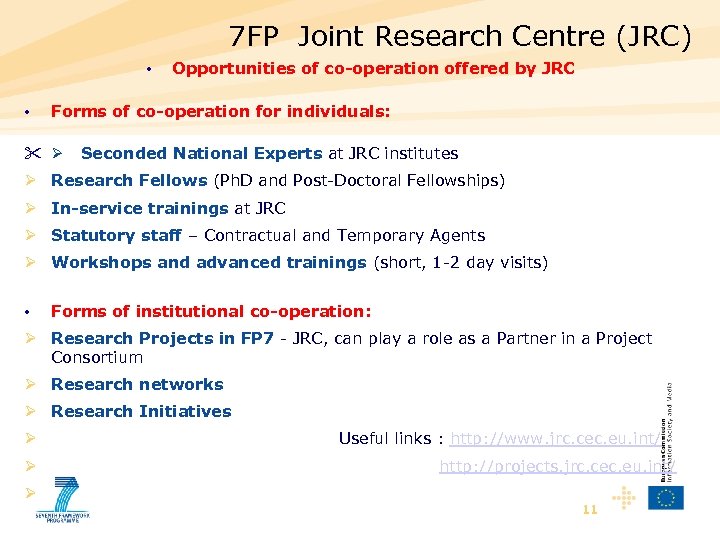 7 FP Joint Research Centre (JRC) • • Opportunities of co-operation offered by JRC Forms of co-operation for individuals: Seconded National Experts at JRC institutes Research Fellows (Ph. D and Post-Doctoral Fellowships) In-service trainings at JRC Statutory staff – Contractual and Temporary Agents Workshops and advanced trainings (short, 1 -2 day visits) • Forms of institutional co-operation: Research Projects in FP 7 - JRC, can play a role as a Partner in a Project Consortium Research networks Research Initiatives Useful links : http: //www. jrc. cec. eu. int/ http: //projects. jrc. cec. eu. int/ 11
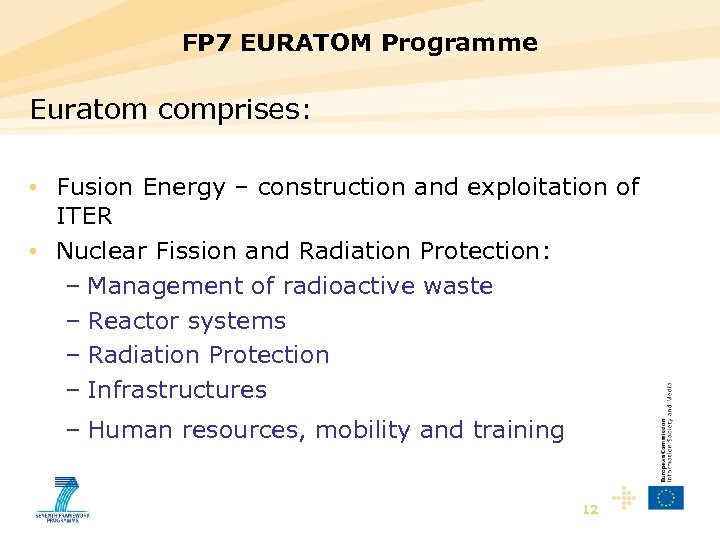 FP 7 EURATOM Programme Euratom comprises: • Fusion Energy – construction and exploitation of ITER • Nuclear Fission and Radiation Protection: – Management of radioactive waste – Reactor systems – Radiation Protection – Infrastructures – Human resources, mobility and training 12
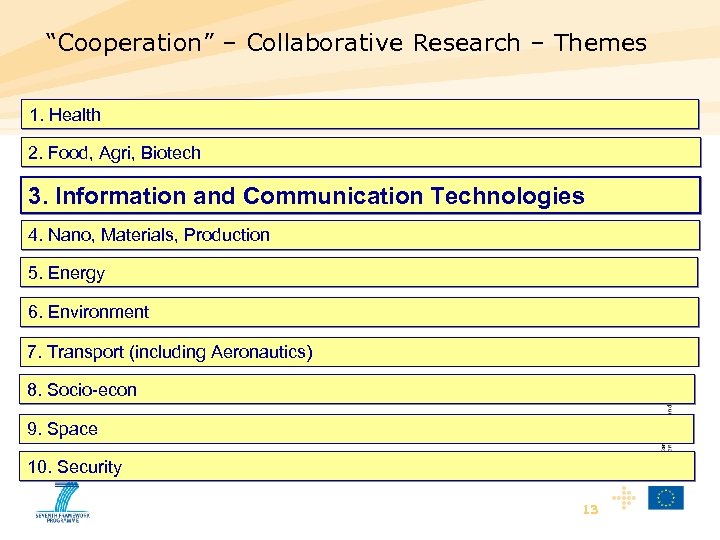 “Cooperation” – Collaborative Research – Themes 1. Health 2. Food, Agri, Biotech 3. Information and Communication Technologies 4. Nano, Materials, Production 5. Energy 6. Environment 7. Transport (including Aeronautics) 8. Socio-econ 9. Space 10. Security 13
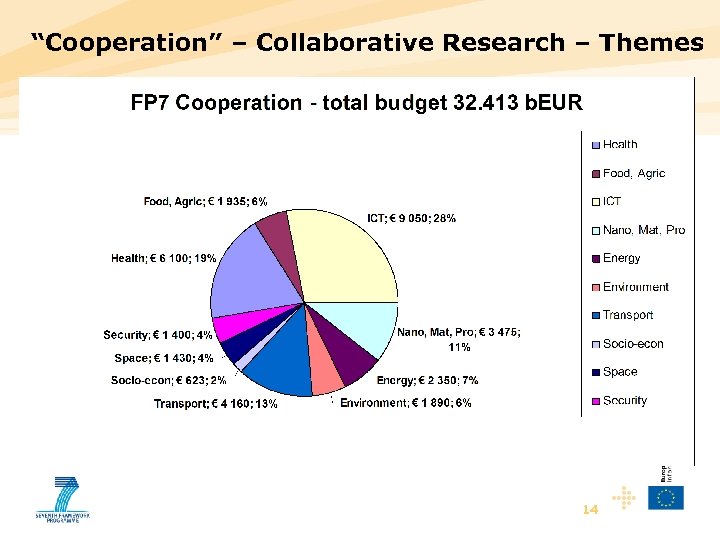 “Cooperation” – Collaborative Research – Themes 14
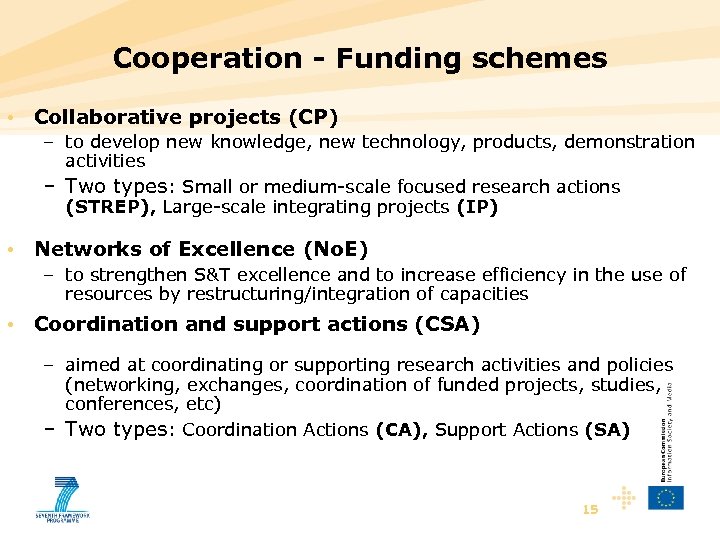 Cooperation - Funding schemes • Collaborative projects (CP) – to develop new knowledge, new technology, products, demonstration activities – Two types: Small or medium-scale focused research actions (STREP), Large-scale integrating projects (IP) • Networks of Excellence (No. E) – to strengthen S&T excellence and to increase efficiency in the use of resources by restructuring/integration of capacities • Coordination and support actions (CSA) – aimed at coordinating or supporting research activities and policies (networking, exchanges, coordination of funded projects, studies, conferences, etc) – Two types: Coordination Actions (CA), Support Actions (SA) 15
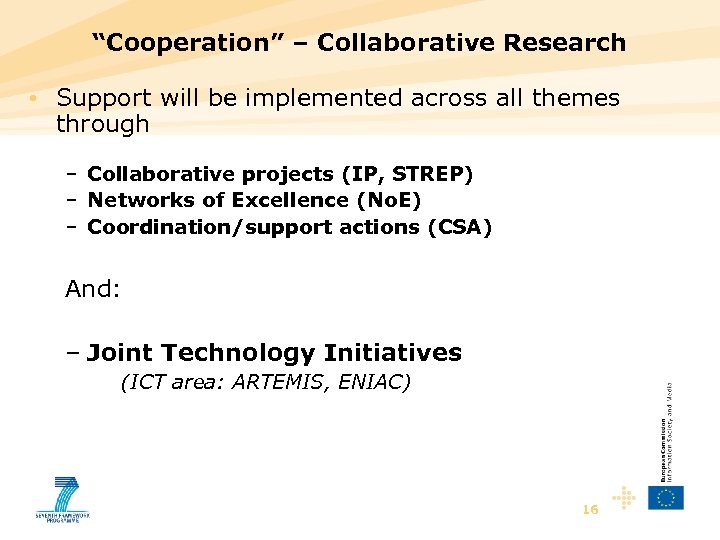 “Cooperation” – Collaborative Research • Support will be implemented across all themes through – Collaborative projects (IP, STREP) – Networks of Excellence (No. E) – Coordination/support actions (CSA) And: – Joint Technology Initiatives (ICT area: ARTEMIS, ENIAC) 16
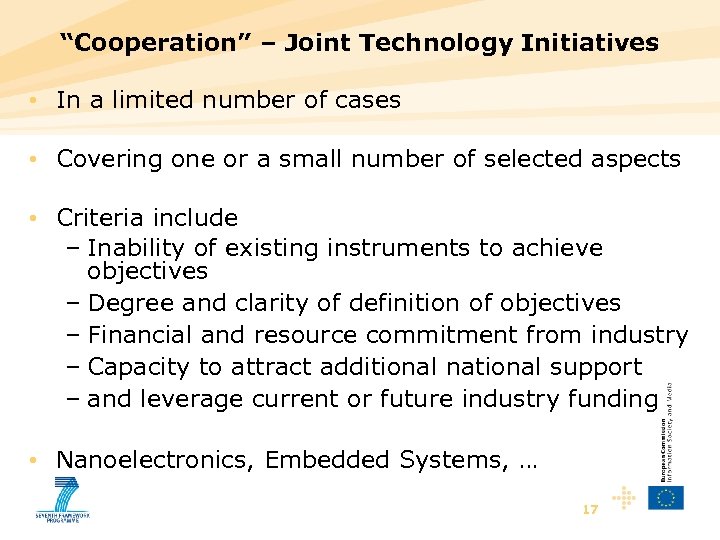 “Cooperation” – Joint Technology Initiatives • In a limited number of cases • Covering one or a small number of selected aspects • Criteria include – Inability of existing instruments to achieve objectives – Degree and clarity of definition of objectives – Financial and resource commitment from industry – Capacity to attract additional national support – and leverage current or future industry funding • Nanoelectronics, Embedded Systems, … 17
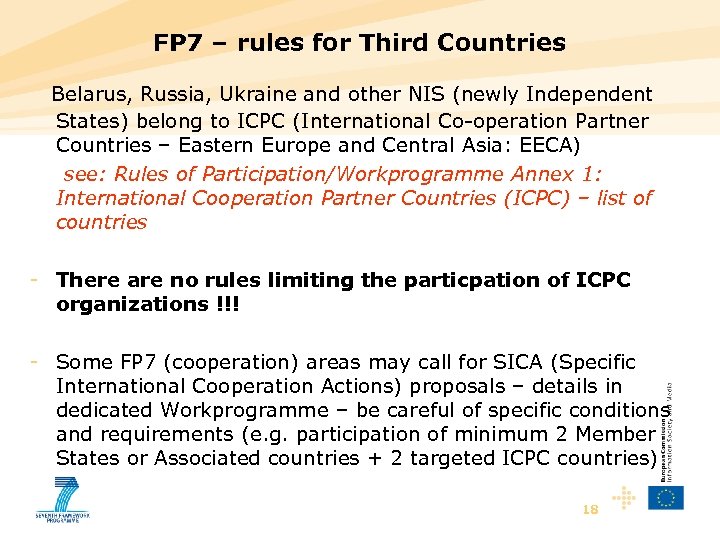 FP 7 – rules for Third Countries Belarus, Russia, Ukraine and other NIS (newly Independent States) belong to ICPC (International Co-operation Partner Countries – Eastern Europe and Central Asia: EECA) see: Rules of Participation/Workprogramme Annex 1: International Cooperation Partner Countries (ICPC) – list of countries - There are no rules limiting the particpation of ICPC organizations !!! - Some FP 7 (cooperation) areas may call for SICA (Specific International Cooperation Actions) proposals – details in dedicated Workprogramme – be careful of specific conditions and requirements (e. g. participation of minimum 2 Member States or Associated countries + 2 targeted ICPC countries) 18
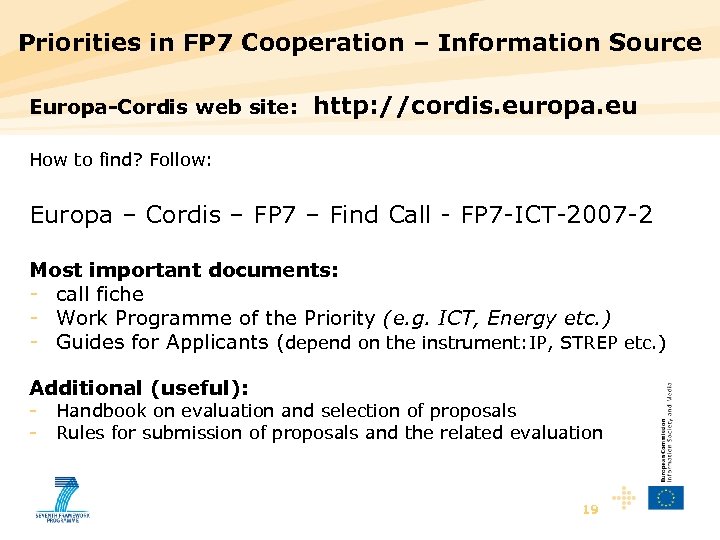 Priorities in FP 7 Cooperation – Information Source Europa-Cordis web site: http: //cordis. europa. eu How to find? Follow: Europa – Cordis – FP 7 – Find Call - FP 7 -ICT-2007 -2 Most important documents: - call fiche - Work Programme of the Priority (e. g. ICT, Energy etc. ) - Guides for Applicants (depend on the instrument: IP, STREP etc. ) Additional (useful): - Handbook on evaluation and selection of proposals - Rules for submission of proposals and the related evaluation 19
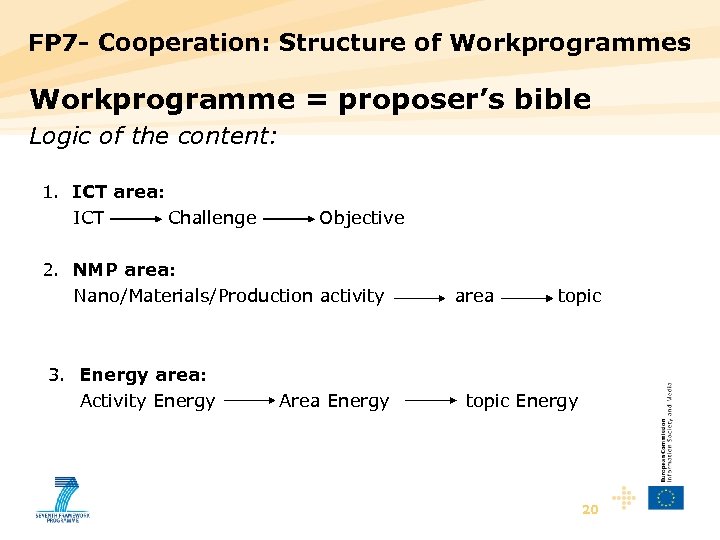 FP 7 - Cooperation: Structure of Workprogrammes Workprogramme = proposer’s bible Logic of the content: 1. ICT area: ICT Challenge Objective 2. NMP area: Nano/Materials/Production activity 3. Energy area: Activity Energy Area Energy area topic Energy 20
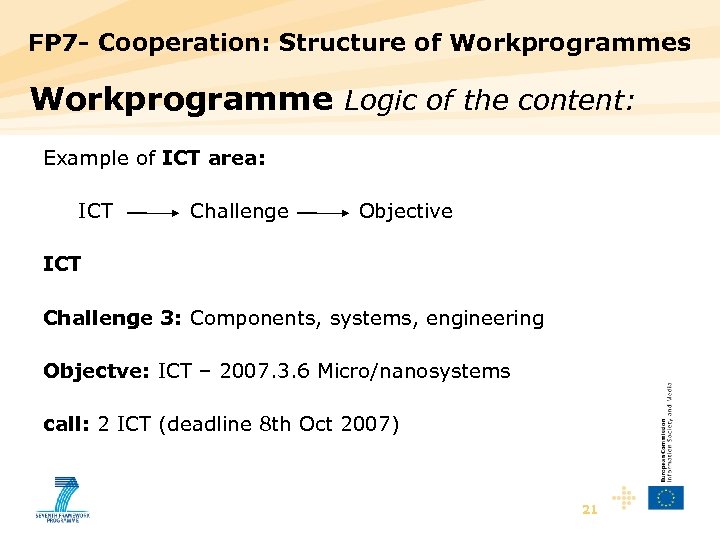 FP 7 - Cooperation: Structure of Workprogrammes Workprogramme Logic of the content: Example of ICT area: ICT Challenge Objective ICT Challenge 3: Components, systems, engineering Objectve: ICT – 2007. 3. 6 Micro/nanosystems call: 2 ICT (deadline 8 th Oct 2007) 21
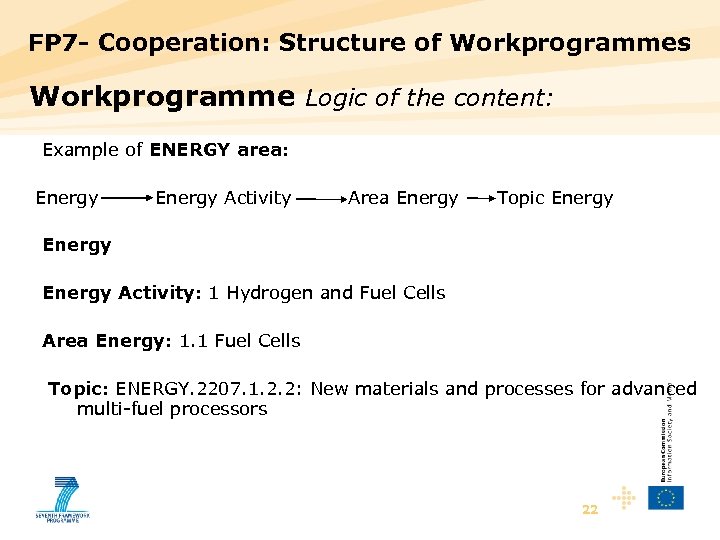 FP 7 - Cooperation: Structure of Workprogrammes Workprogramme Logic of the content: Example of ENERGY area: Energy Activity Area Energy Topic Energy Activity: 1 Hydrogen and Fuel Cells Area Energy: 1. 1 Fuel Cells Topic: ENERGY. 2207. 1. 2. 2: New materials and processes for advanced multi-fuel processors 22
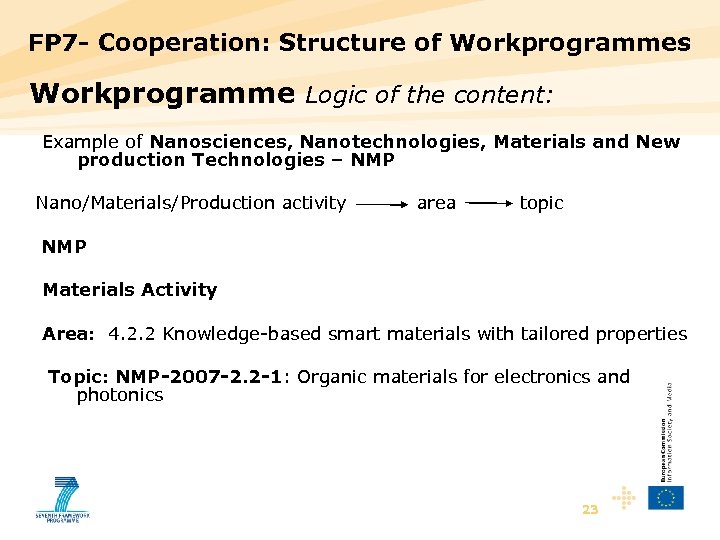 FP 7 - Cooperation: Structure of Workprogrammes Workprogramme Logic of the content: Example of Nanosciences, Nanotechnologies, Materials and New production Technologies – NMP Nano/Materials/Production activity area topic NMP Materials Activity Area: 4. 2. 2 Knowledge-based smart materials with tailored properties Topic: NMP-2007 -2. 2 -1: Organic materials for electronics and photonics 23
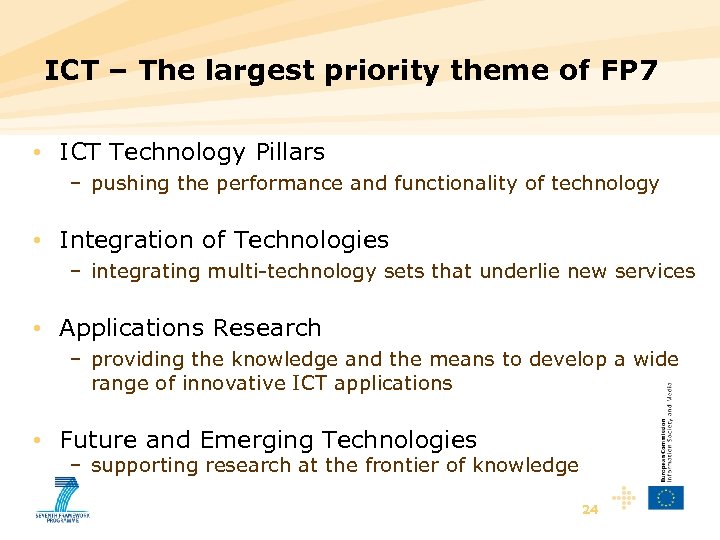 ICT – The largest priority theme of FP 7 • ICT Technology Pillars – pushing the performance and functionality of technology • Integration of Technologies – integrating multi-technology sets that underlie new services • Applications Research – providing the knowledge and the means to develop a wide range of innovative ICT applications • Future and Emerging Technologies – supporting research at the frontier of knowledge 24
 Priorities based on wide consultations • Reinforce Europe’s strongholds – Europe’s industry and technology position • Seize new opportunities for Europe – (r)evolutions and potential impacts: industrial competitiveness, socio-economic goals • Ensure that interventions are significant and that Europe has the capacities to implement – high-risk, medium-to-long term, trans-national collaborative research 25
 Reinforce Europe’s strongholds • Network and service infrastructures – communication equipment and services, business software, security solutions … • Components and embedded systems – semiconductors, equipment, photonics, plastic electronics, integrated micro/nano systems … embedded systems in vertical markets: cars, planes, medical, telecom … • A strong academic research community – in core ICT fields and in other disciplines relevant for ICT: biotech, materials, cognitive sciences … 26
 Seize new opportunities for Europe • New technology paths – more “intelligent” technology: ICT systems that learn & reason, that contextualise & adapt, that interact & act autonomously – driven by developments in cognitive systems, sensing and interaction and advanced robotics • Growing demand new ways of using ICT – – digital content and knowledge creation and use sustainable and personalised healthcare intelligent and safe transport, sustainable development independent living and inclusion 27
 Work Programme approach and structure • A limited set of Challenges aiming at – overcoming technology roadblocks to achieve specific characteristics, and/or – end-to-end systems targeting specific socio-economic goals • A Challenge is addressed through a limited set of Objectives that form the basis of Calls for Proposals • An Objective is described in terms of – target outcome - in terms of characteristics – expected impact - in terms of industrial competitiveness, societal goal, technology progress etc. • A total of 24 Objectives expressed within 7 Challenges 28
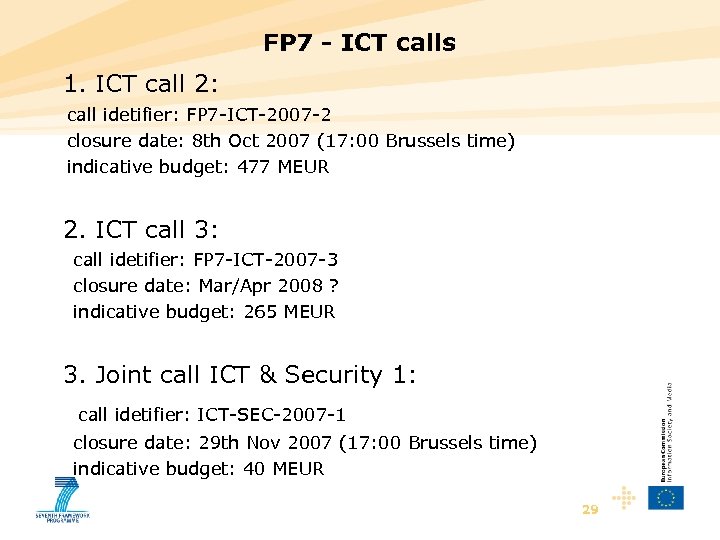 FP 7 - ICT calls 1. ICT call 2: call idetifier: FP 7 -ICT-2007 -2 closure date: 8 th Oct 2007 (17: 00 Brussels time) indicative budget: 477 MEUR 2. ICT call 3: call idetifier: FP 7 -ICT-2007 -3 closure date: Mar/Apr 2008 ? indicative budget: 265 MEUR 3. Joint call ICT & Security 1: call idetifier: ICT-SEC-2007 -1 closure date: 29 th Nov 2007 (17: 00 Brussels time) indicative budget: 40 MEUR 29
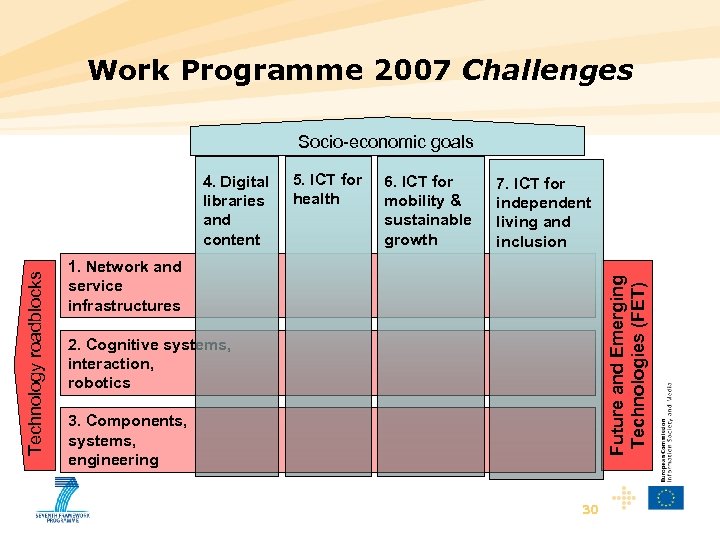 Work Programme 2007 Challenges Socio-economic goals 5. ICT for health 6. ICT for mobility & sustainable growth 7. ICT for independent living and inclusion 1. Network and service infrastructures Future and Emerging Technologies (FET) Technology roadblocks 4. Digital libraries and content 2. Cognitive systems, interaction, robotics 3. Components, systems, engineering 30
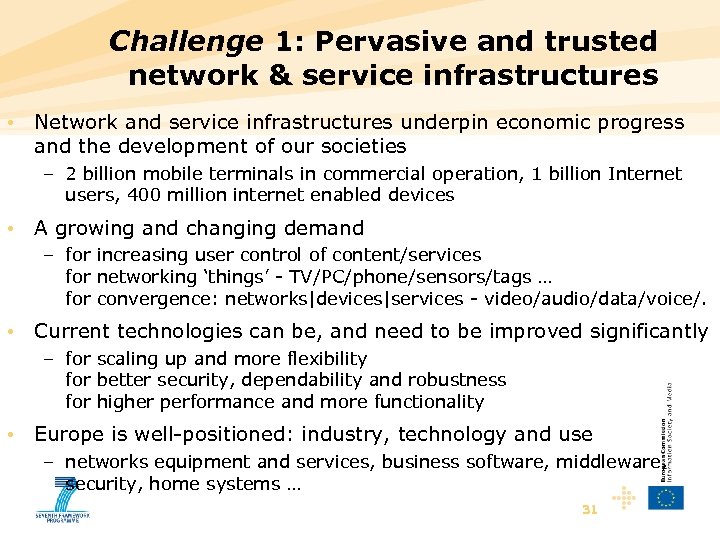 Challenge 1: Pervasive and trusted network & service infrastructures • Network and service infrastructures underpin economic progress and the development of our societies – 2 billion mobile terminals in commercial operation, 1 billion Internet users, 400 million internet enabled devices • A growing and changing demand – for increasing user control of content/services for networking ‘things’ - TV/PC/phone/sensors/tags … for convergence: networks|devices|services - video/audio/data/voice/. • Current technologies can be, and need to be improved significantly – for scaling up and more flexibility for better security, dependability and robustness for higher performance and more functionality • Europe is well-positioned: industry, technology and use – networks equipment and services, business software, middleware, security, home systems … 31
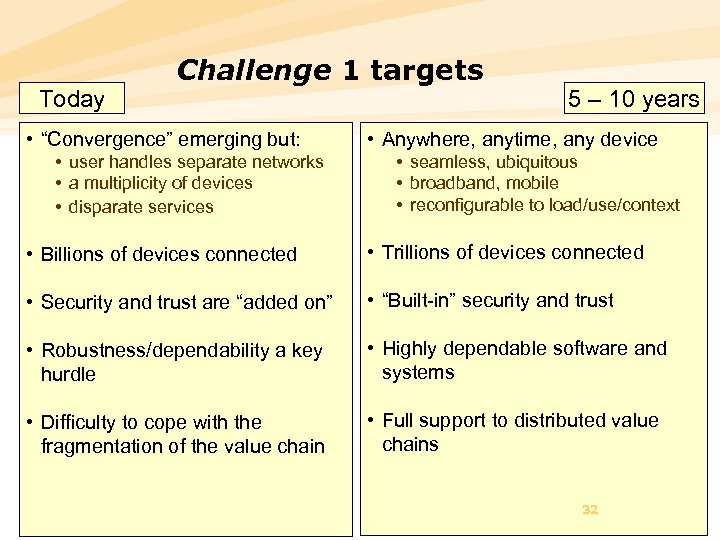 Today Challenge 1 targets • “Convergence” emerging but: • user handles separate networks • a multiplicity of devices • disparate services 5 – 10 years • Anywhere, anytime, any device • seamless, ubiquitous • broadband, mobile • reconfigurable to load/use/context • Billions of devices connected • Trillions of devices connected • Security and trust are “added on” • “Built-in” security and trust • Robustness/dependability a key hurdle • Highly dependable software and systems • Difficulty to cope with the fragmentation of the value chain • Full support to distributed value chains 32
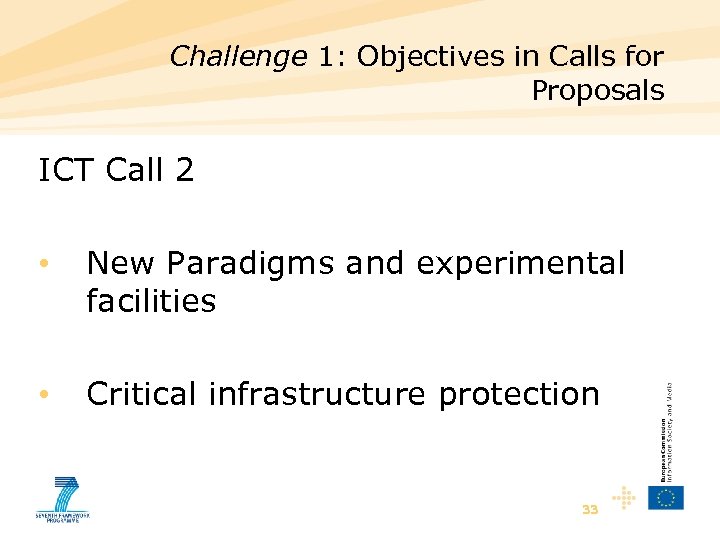 Challenge 1: Objectives in Calls for Proposals ICT Call 2 • New Paradigms and experimental facilities • Critical infrastructure protection 33
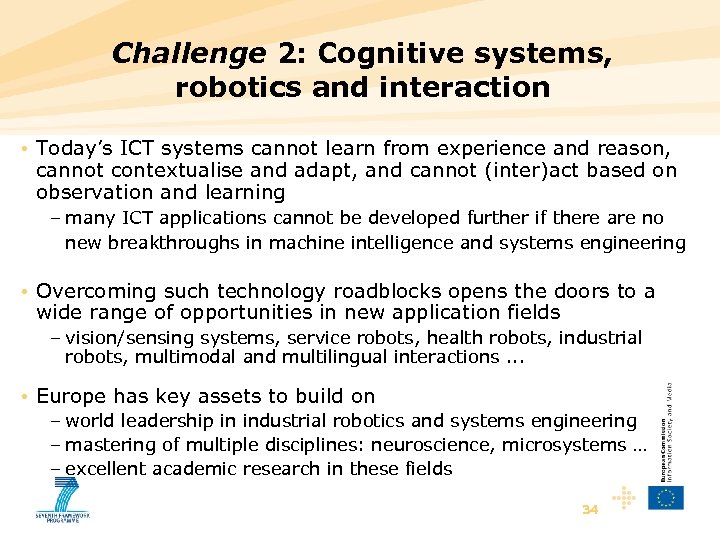 Challenge 2: Cognitive systems, robotics and interaction • Today’s ICT systems cannot learn from experience and reason, cannot contextualise and adapt, and cannot (inter)act based on observation and learning – many ICT applications cannot be developed further if there are no new breakthroughs in machine intelligence and systems engineering • Overcoming such technology roadblocks opens the doors to a wide range of opportunities in new application fields – vision/sensing systems, service robots, health robots, industrial robots, multimodal and multilingual interactions. . . • Europe has key assets to build on – world leadership in industrial robotics and systems engineering – mastering of multiple disciplines: neuroscience, microsystems … – excellent academic research in these fields 34
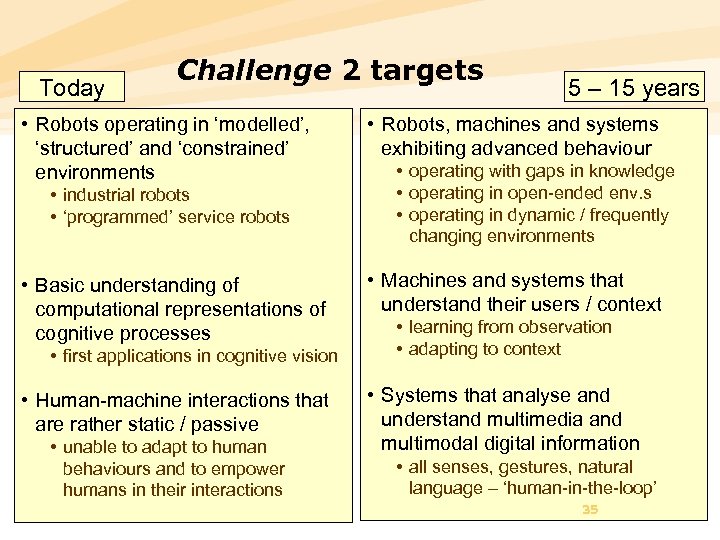 Today Challenge 2 targets • Robots operating in ‘modelled’, ‘structured’ and ‘constrained’ environments • industrial robots • ‘programmed’ service robots • Basic understanding of computational representations of cognitive processes • first applications in cognitive vision • Human-machine interactions that are rather static / passive • unable to adapt to human behaviours and to empower humans in their interactions 5 – 15 years • Robots, machines and systems exhibiting advanced behaviour • operating with gaps in knowledge • operating in open-ended env. s • operating in dynamic / frequently changing environments • Machines and systems that understand their users / context • learning from observation • adapting to context • Systems that analyse and understand multimedia and multimodal digital information • all senses, gestures, natural language – ‘human-in-the-loop’ 35
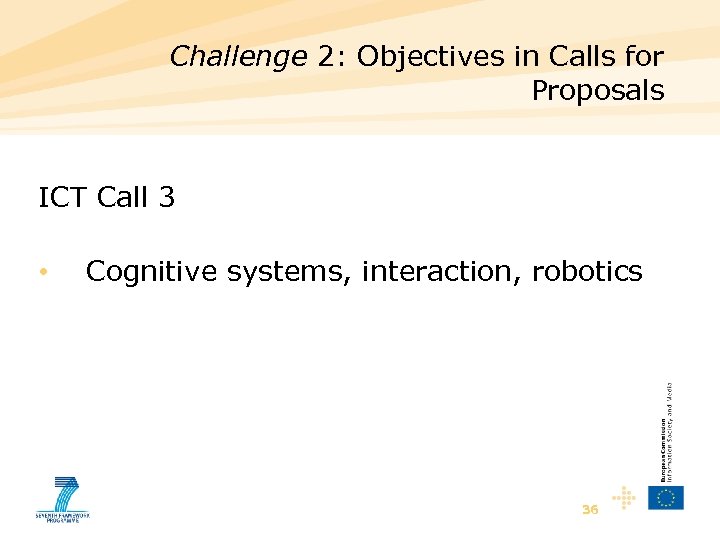 Challenge 2: Objectives in Calls for Proposals ICT Call 3 • Cognitive systems, interaction, robotics 36
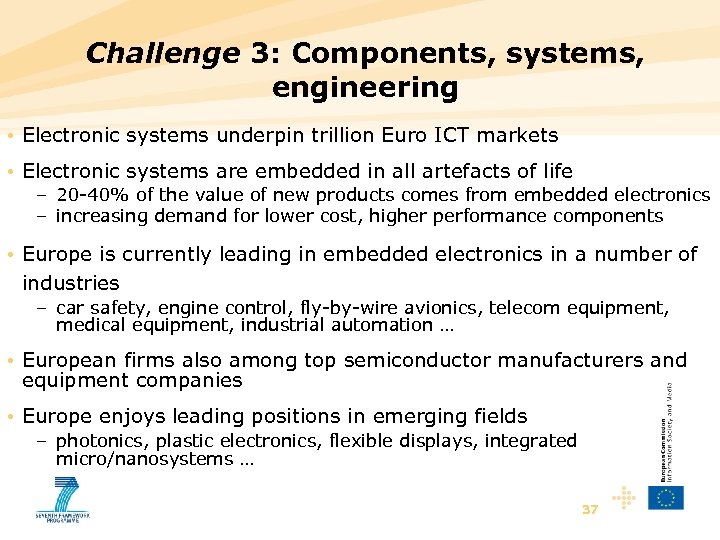 Challenge 3: Components, systems, engineering • Electronic systems underpin trillion Euro ICT markets • Electronic systems are embedded in all artefacts of life – 20 -40% of the value of new products comes from embedded electronics – increasing demand for lower cost, higher performance components • Europe is currently leading in embedded electronics in a number of industries – car safety, engine control, fly-by-wire avionics, telecom equipment, medical equipment, industrial automation … • European firms also among top semiconductor manufacturers and equipment companies • Europe enjoys leading positions in emerging fields – photonics, plastic electronics, flexible displays, integrated micro/nanosystems … 37
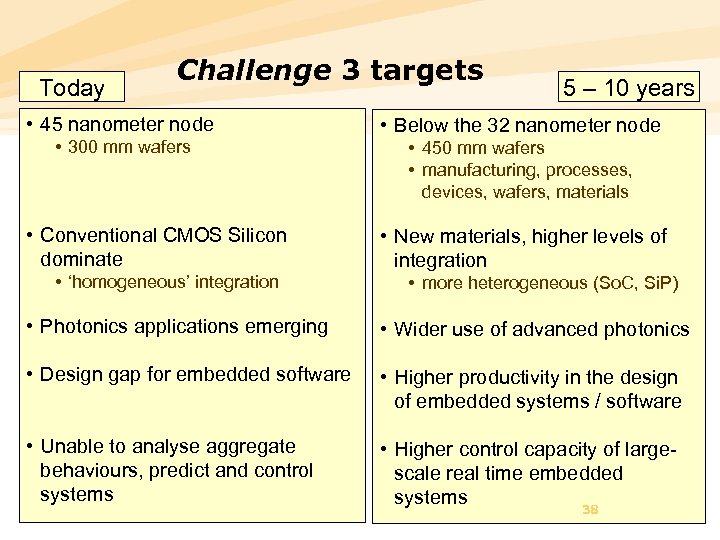 Today Challenge 3 targets • 45 nanometer node • 300 mm wafers • Conventional CMOS Silicon dominate • ‘homogeneous’ integration 5 – 10 years • Below the 32 nanometer node • 450 mm wafers • manufacturing, processes, devices, wafers, materials • New materials, higher levels of integration • more heterogeneous (So. C, Si. P) • Photonics applications emerging • Wider use of advanced photonics • Design gap for embedded software • Higher productivity in the design of embedded systems / software • Unable to analyse aggregate behaviours, predict and control systems • Higher control capacity of largescale real time embedded systems 38
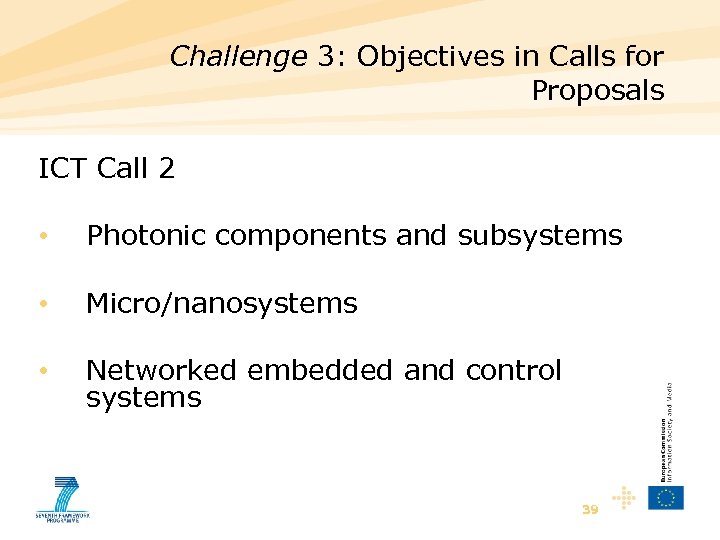 Challenge 3: Objectives in Calls for Proposals ICT Call 2 • Photonic components and subsystems • Micro/nanosystems • Networked embedded and control systems 39
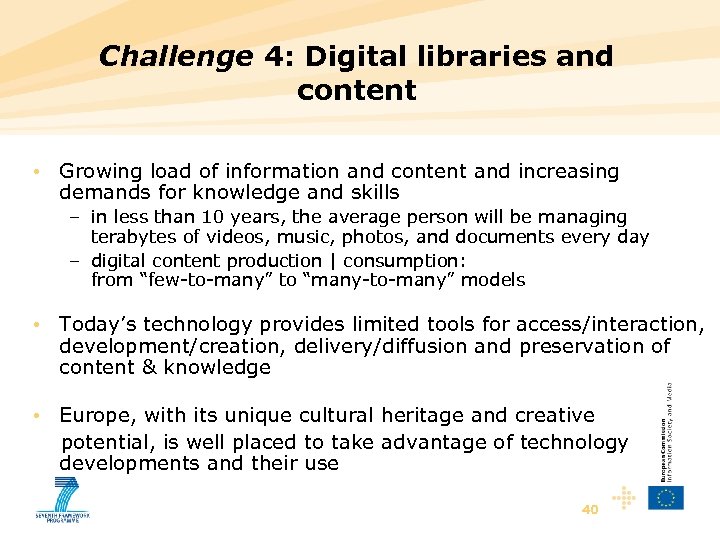 Challenge 4: Digital libraries and content • Growing load of information and content and increasing demands for knowledge and skills – in less than 10 years, the average person will be managing terabytes of videos, music, photos, and documents every day – digital content production | consumption: from “few-to-many” to “many-to-many” models • Today’s technology provides limited tools for access/interaction, development/creation, delivery/diffusion and preservation of content & knowledge • Europe, with its unique cultural heritage and creative potential, is well placed to take advantage of technology developments and their use 40
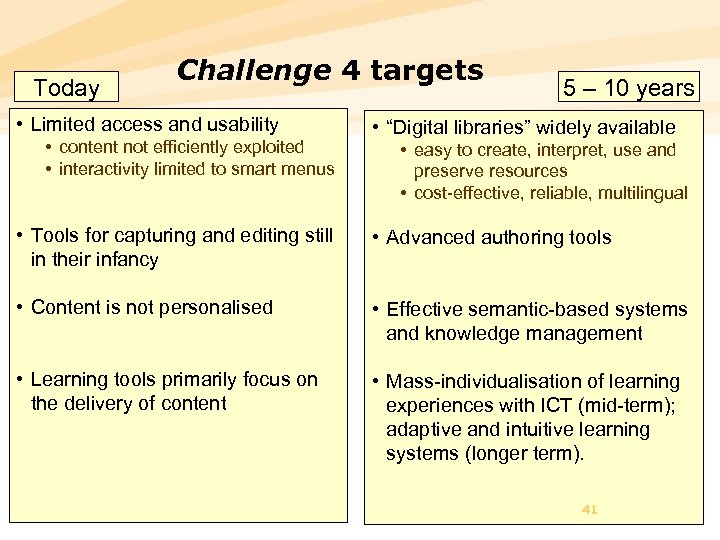 Today Challenge 4 targets • Limited access and usability • content not efficiently exploited • interactivity limited to smart menus 5 – 10 years • “Digital libraries” widely available • easy to create, interpret, use and preserve resources • cost-effective, reliable, multilingual • Tools for capturing and editing still in their infancy • Advanced authoring tools • Content is not personalised • Effective semantic-based systems and knowledge management • Learning tools primarily focus on the delivery of content • Mass-individualisation of learning experiences with ICT (mid-term); adaptive and intuitive learning systems (longer term). 41
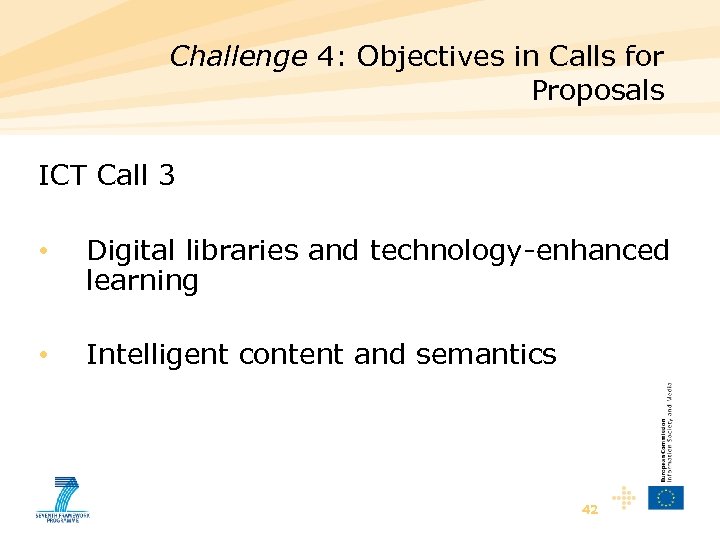 Challenge 4: Objectives in Calls for Proposals ICT Call 3 • Digital libraries and technology-enhanced learning • Intelligent content and semantics 42
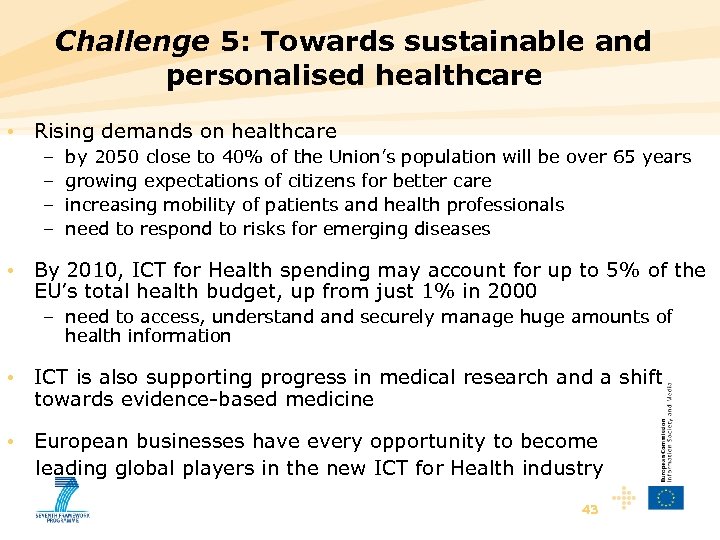 Challenge 5: Towards sustainable and personalised healthcare • Rising demands on healthcare – – by 2050 close to 40% of the Union’s population will be over 65 years growing expectations of citizens for better care increasing mobility of patients and health professionals need to respond to risks for emerging diseases • By 2010, ICT for Health spending may account for up to 5% of the EU’s total health budget, up from just 1% in 2000 – need to access, understand securely manage huge amounts of health information • ICT is also supporting progress in medical research and a shift towards evidence-based medicine • European businesses have every opportunity to become leading global players in the new ICT for Health industry 43
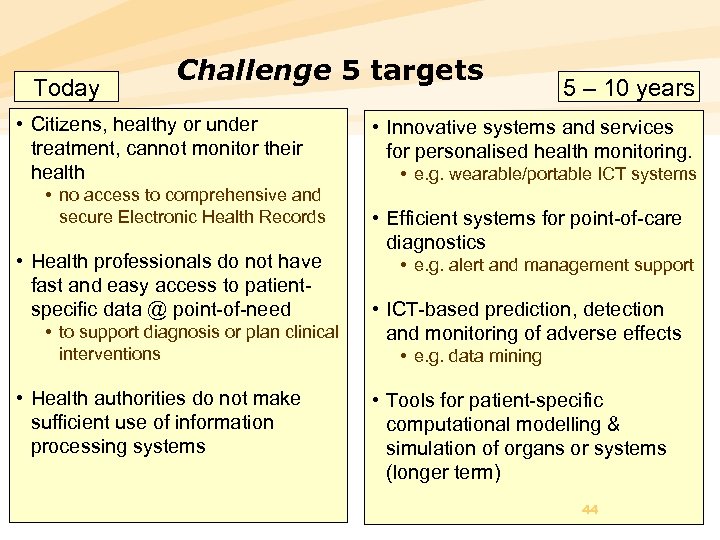 Today Challenge 5 targets • Citizens, healthy or under treatment, cannot monitor their health • no access to comprehensive and secure Electronic Health Records • Health professionals do not have fast and easy access to patientspecific data @ point-of-need • to support diagnosis or plan clinical interventions • Health authorities do not make sufficient use of information processing systems 5 – 10 years • Innovative systems and services for personalised health monitoring. • e. g. wearable/portable ICT systems • Efficient systems for point-of-care diagnostics • e. g. alert and management support • ICT-based prediction, detection and monitoring of adverse effects • e. g. data mining • Tools for patient-specific computational modelling & simulation of organs or systems (longer term) 44
 Challenge 5: Objectives in Calls for Proposals ICT Call 2 • Virtual physiological human 45
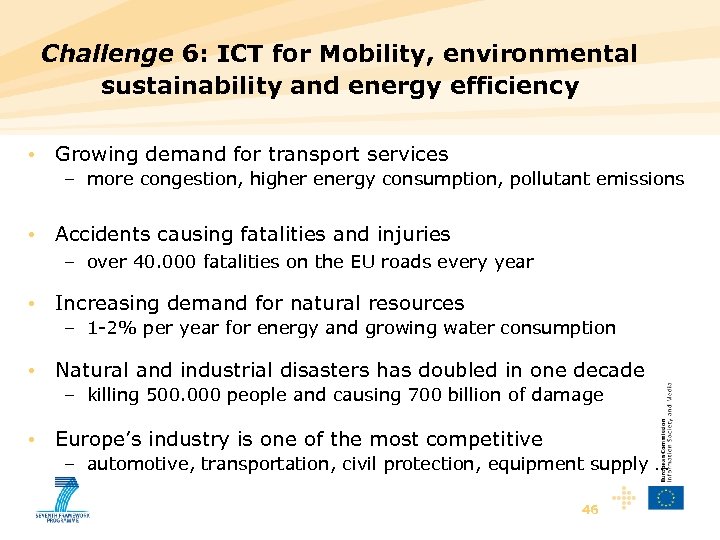 Challenge 6: ICT for Mobility, environmental sustainability and energy efficiency • Growing demand for transport services – more congestion, higher energy consumption, pollutant emissions • Accidents causing fatalities and injuries – over 40. 000 fatalities on the EU roads every year • Increasing demand for natural resources – 1 -2% per year for energy and growing water consumption • Natural and industrial disasters has doubled in one decade – killing 500. 000 people and causing 700 billion of damage • Europe’s industry is one of the most competitive – automotive, transportation, civil protection, equipment supply … 46
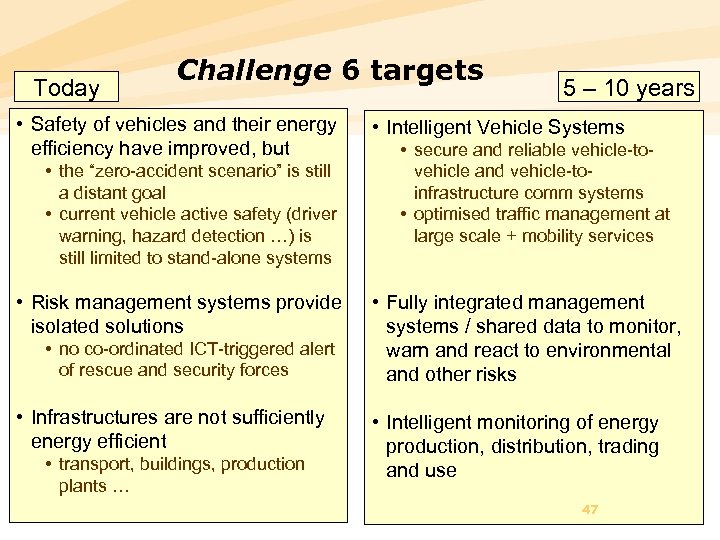 Today Challenge 6 targets • Safety of vehicles and their energy efficiency have improved, but • the “zero-accident scenario” is still a distant goal • current vehicle active safety (driver warning, hazard detection …) is still limited to stand-alone systems • Risk management systems provide isolated solutions • no co-ordinated ICT-triggered alert of rescue and security forces • Infrastructures are not sufficiently energy efficient • transport, buildings, production plants … 5 – 10 years • Intelligent Vehicle Systems • secure and reliable vehicle-tovehicle and vehicle-toinfrastructure comm systems • optimised traffic management at large scale + mobility services • Fully integrated management systems / shared data to monitor, warn and react to environmental and other risks • Intelligent monitoring of energy production, distribution, trading and use 47
 Challenge 6: Objectives in Calls for Proposals ICT Call 2 • ICT for cooperative systems • ICT for the environmental management and energy efficiency 48
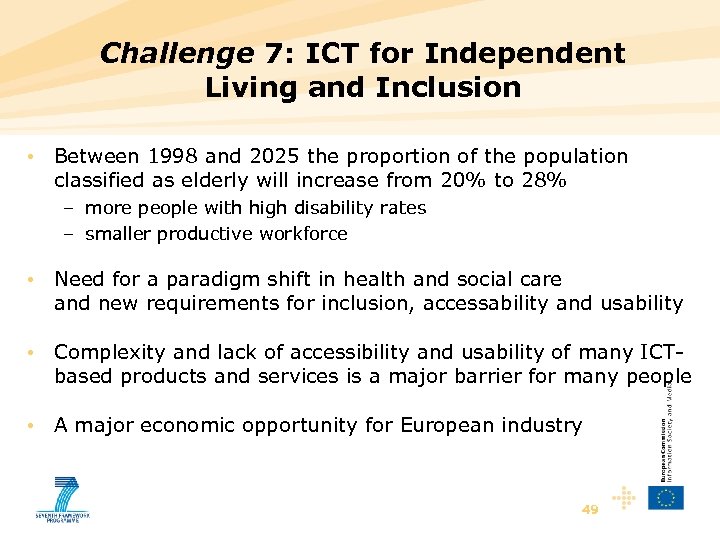 Challenge 7: ICT for Independent Living and Inclusion • Between 1998 and 2025 the proportion of the population classified as elderly will increase from 20% to 28% – more people with high disability rates – smaller productive workforce • Need for a paradigm shift in health and social care and new requirements for inclusion, accessability and usability • Complexity and lack of accessibility and usability of many ICTbased products and services is a major barrier for many people • A major economic opportunity for European industry 49
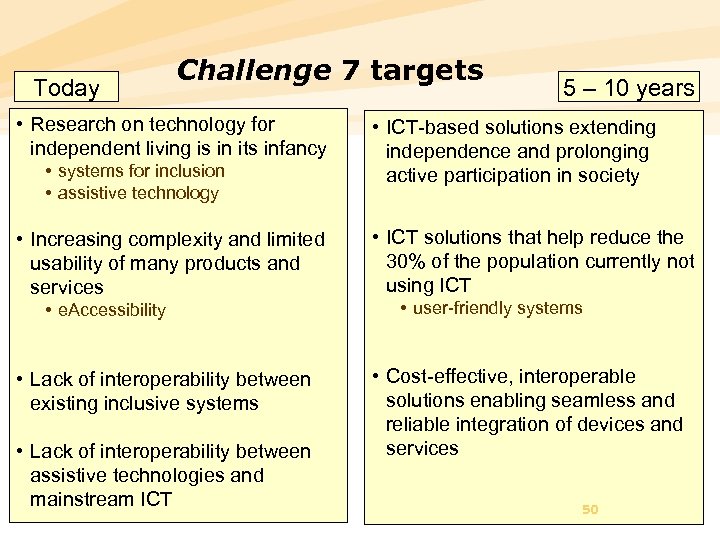 Today Challenge 7 targets • Research on technology for independent living is in its infancy • systems for inclusion • assistive technology • Increasing complexity and limited usability of many products and services • e. Accessibility • Lack of interoperability between existing inclusive systems • Lack of interoperability between assistive technologies and mainstream ICT 5 – 10 years • ICT-based solutions extending independence and prolonging active participation in society • ICT solutions that help reduce the 30% of the population currently not using ICT • user-friendly systems • Cost-effective, interoperable solutions enabling seamless and reliable integration of devices and services 50
 Challenge 7: Objectives in Calls for Proposals ICT Call 2 • Accessible and inclusive ICT 51
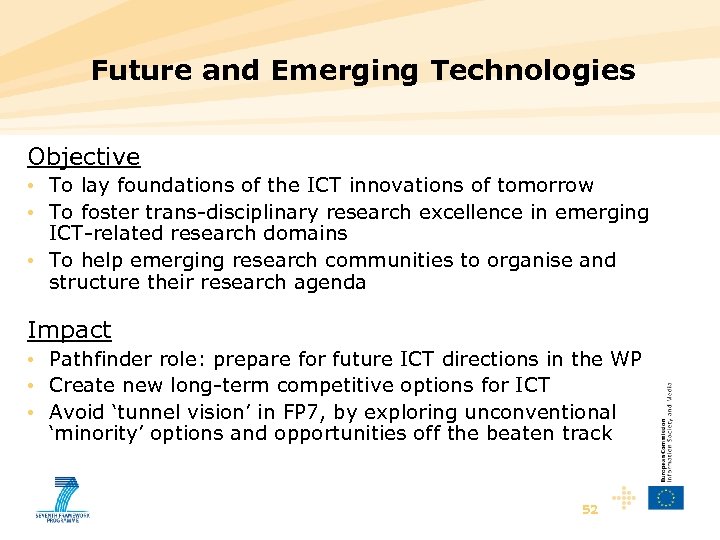 Future and Emerging Technologies Objective • To lay foundations of the ICT innovations of tomorrow • To foster trans-disciplinary research excellence in emerging ICT-related research domains • To help emerging research communities to organise and structure their research agenda Impact • Pathfinder role: prepare for future ICT directions in the WP • Create new long-term competitive options for ICT • Avoid ‘tunnel vision’ in FP 7, by exploring unconventional ‘minority’ options and opportunities off the beaten track 52
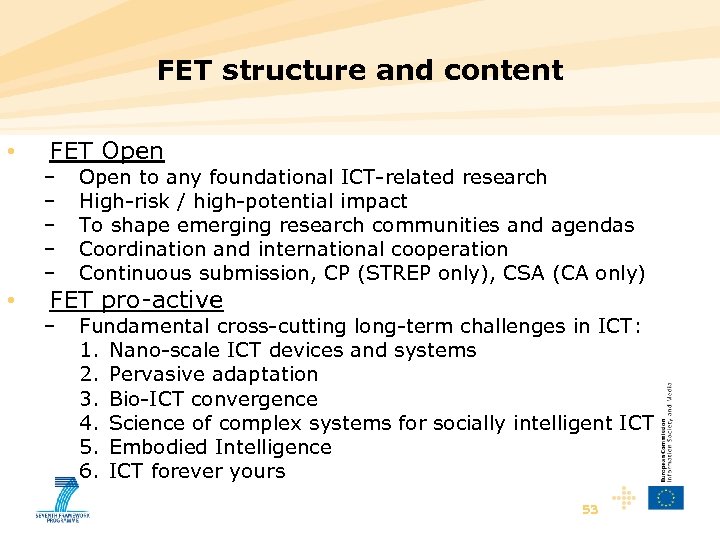 FET structure and content • • FET Open – – – Open to any foundational ICT-related research High-risk / high-potential impact To shape emerging research communities and agendas Coordination and international cooperation Continuous submission, CP (STREP only), CSA (CA only) – Fundamental cross-cutting long-term challenges in ICT: 1. Nano-scale ICT devices and systems 2. Pervasive adaptation 3. Bio-ICT convergence 4. Science of complex systems for socially intelligent ICT 5. Embodied Intelligence 6. ICT forever yours FET pro-active 53
 Horizontal support actions • International cooperation – to pave the way for strategic partnerships in view of developing global standards and interoperable solutions and strengthening EU competitiveness – to widen the diffusion of the information society, especially in developing countries and strengthened the EU policy for development • Trans-national co-operation among National Contact Points – one proposal including officially appointed NCPs – to improve NCP service across Europe – to help to simplify access to FP 7 calls – to lower the entry barriers for newcomers – to raise the quality of submitted proposals 54
 ICT in FP 7 – Information Source Europa-Cordis web site: http: //cordis. europa. eu How to find? Follow: Europa – Cordis – FP 7 – Find Call - FP 7 -ICT-2007 -1 Most important documents: - call fiche - ICT Work Programme - Guides for Applicants (depend on the instrument: IP, STREP etc. ) Additional (useful): - Handbook on evaluation and selection of proposals - Rules for submission of proposals and the related evaluation 55
 FP 7 – Searching for partners How and where find a good coordinator/partner? 1. 2. 3. 4. 5. 6. Personal contacts (have already cooperation with organization/person? ) My friends/partners cooperate with others, ask them Contact your NCP, prepare your profile and interest or project’s idea Internet tools : Cordis, Ideal-ist (ICT area) Search for SSA projects in your thematic area (contacts, data bases, publications) Visit events such as thematic conferences, workshops, infodays etc. 56
 FP 7 – Searching for partners Partner search tools: CORDIS: www. cordis. lu Or http: //cordis. europa. eu/en/home. html European Union research Funding Key • • Find a partner: search fields: Search term (key word) proposal/profile Programme Country 57
 FP 7 – Searching for partners Partner search tools: Attention! Concerns only ICT area Ideal-ist: www. ideal-ist. net Selection of project’s ideas by • Calls • Keywords • Challenge • Objective …and other parameters 58
 Thank you for your attention! Krzysztof Trojanowski IPPT PAN ICT NCP Poland Warszawa, ul. Żwirki i Wigury 81 e-mail: krzysztof. trojanowski@kpk. gov. pl tel: +48 22 828 74 83 59