


 Скачать презентацию FP 7 Marie Curie Initial Training Networks Dr
35700f789a76b9843687f11650cd7190.ppt
- Количество слайдов: 27
 FP 7 Marie Curie Initial Training Networks Dr Conor O’Carroll, IUA Wednesday, 29 th September 2010 www. iua. ie
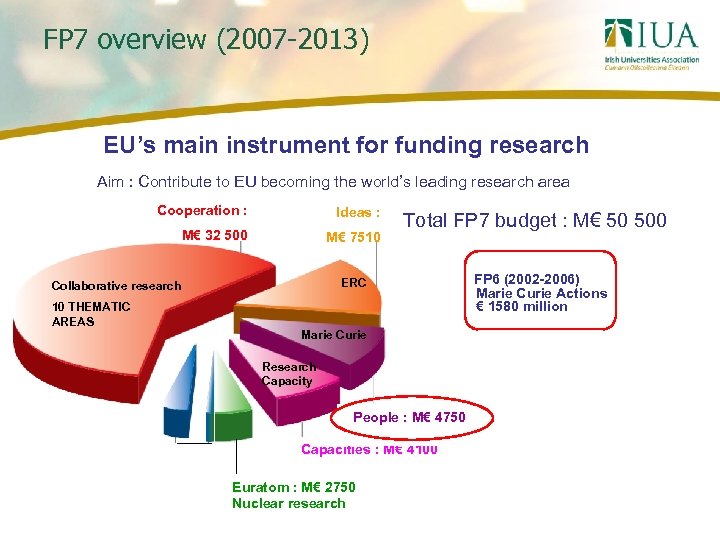 FP 7 overview (2007 -2013) EU’s main instrument for funding research Aim : Contribute to EU becoming the world’s leading research area Cooperation : Ideas : M€ 32 500 M€ 7510 ERC Collaborative research 10 THEMATIC AREAS Total FP 7 budget : M€ 50 500 Marie Curie Research Capacity People : M€ 4750 JRC : M€ 1750 Capacities : M€ 4100 Euratom : M€ 2750 Nuclear research FP 6 (2002 -2006) Marie Curie Actions € 1580 million
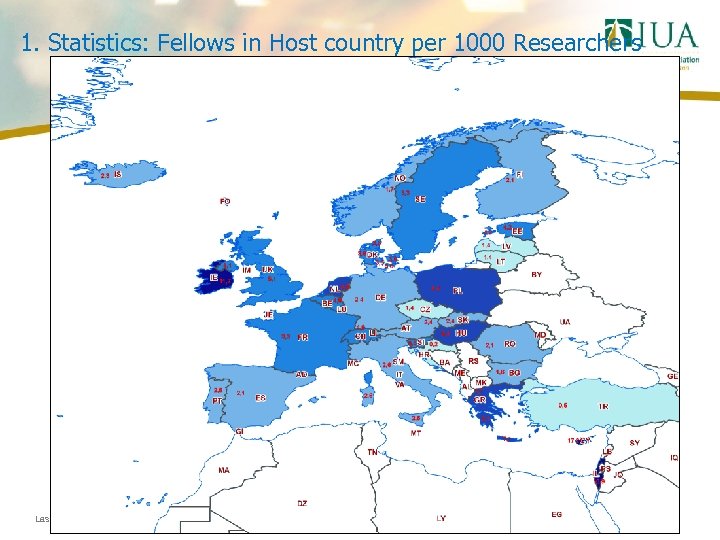 1. Statistics: Fellows in Host country per 1000 Researchers Last updated 15/03/2018 15: 16
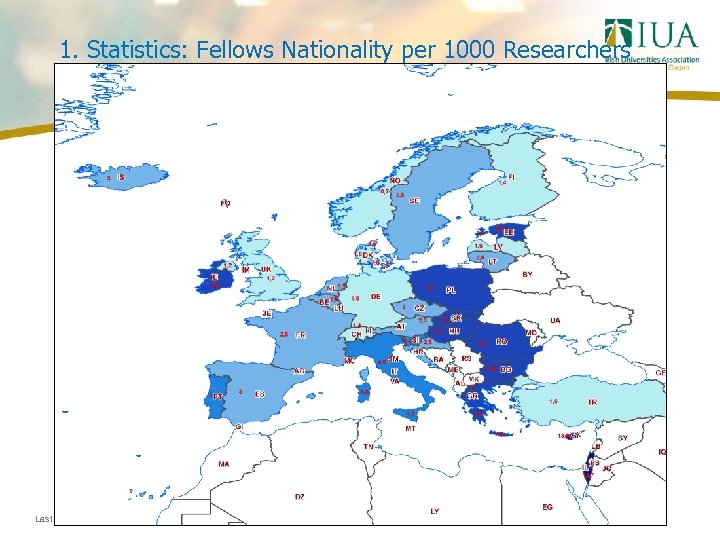 1. Statistics: Fellows Nationality per 1000 Researchers Last updated 15/03/2018 15: 16
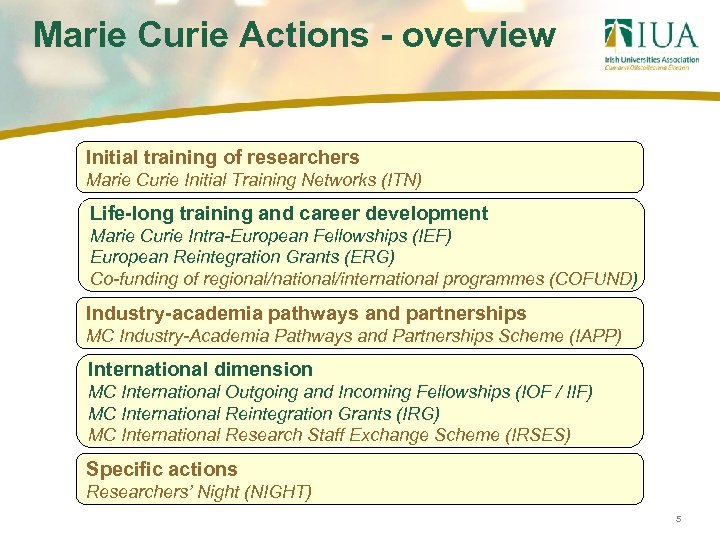 Marie Curie Actions - overview Initial training of researchers Marie Curie Initial Training Networks (ITN) Life-long training and career development Marie Curie Intra-European Fellowships (IEF) European Reintegration Grants (ERG) Co-funding of regional/national/international programmes (COFUND) Industry-academia pathways and partnerships MC Industry-Academia Pathways and Partnerships Scheme (IAPP) International dimension MC International Outgoing and Incoming Fellowships (IOF / IIF) MC International Reintegration Grants (IRG) MC International Research Staff Exchange Scheme (IRSES) Specific actions Researchers’ Night (NIGHT) 5
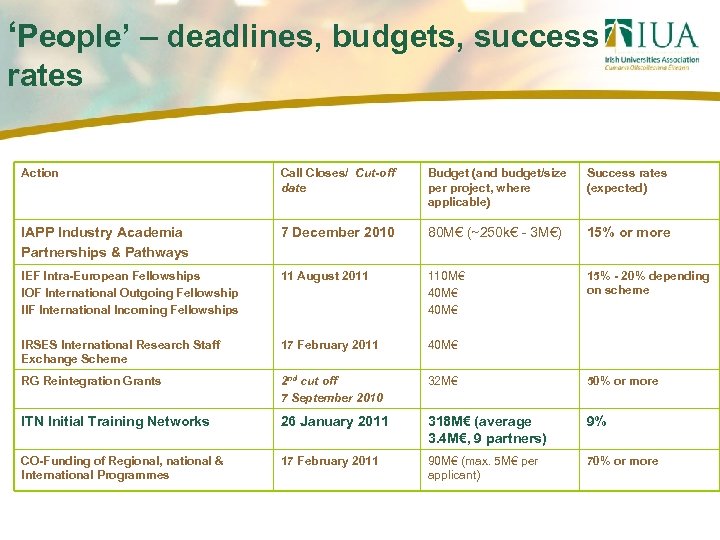 ‘People’ – deadlines, budgets, success rates Action Call Closes/ Cut-off date Budget (and budget/size per project, where applicable) Success rates (expected) IAPP Industry Academia Partnerships & Pathways 7 December 2010 80 M€ (~250 k€ - 3 M€) 15% or more IEF Intra-European Fellowships IOF International Outgoing Fellowship IIF International Incoming Fellowships 11 August 2011 110 M€ 40 M€ 15% - 20% depending on scheme IRSES International Research Staff Exchange Scheme 17 February 2011 40 M€ RG Reintegration Grants 2 nd cut off 7 September 2010 32 M€ 50% or more ITN Initial Training Networks 26 January 2011 318 M€ (average 3. 4 M€, 9 partners) 9% CO-Funding of Regional, national & International Programmes 17 February 2011 90 M€ (max. 5 M€ per applicant) 70% or more
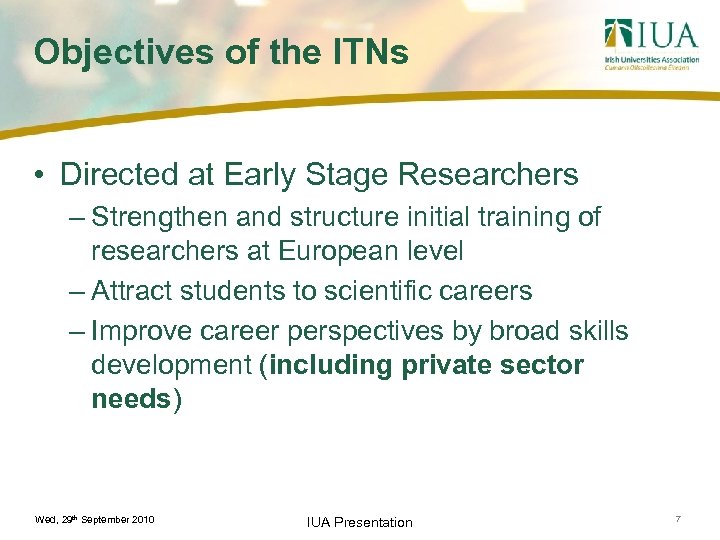 Objectives of the ITNs • Directed at Early Stage Researchers – Strengthen and structure initial training of researchers at European level – Attract students to scientific careers – Improve career perspectives by broad skills development (including private sector needs) Wed, 29 th September 2010 IUA Presentation 7
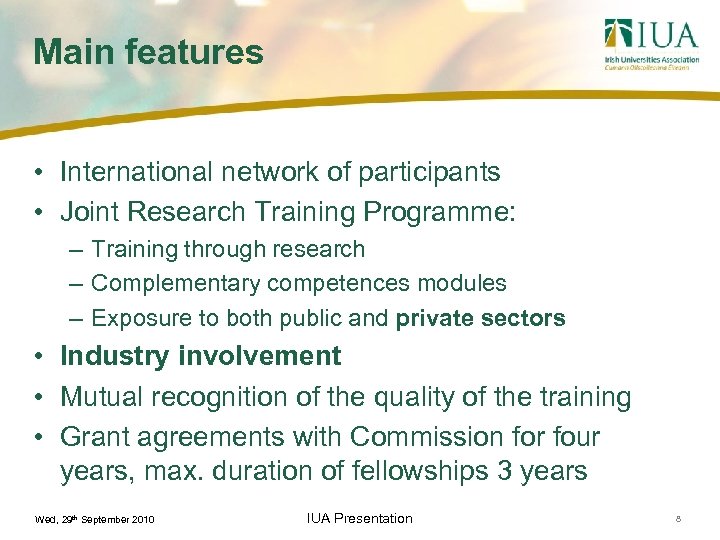 Main features • International network of participants • Joint Research Training Programme: – Training through research – Complementary competences modules – Exposure to both public and private sectors • Industry involvement • Mutual recognition of the quality of the training • Grant agreements with Commission for four years, max. duration of fellowships 3 years Wed, 29 th September 2010 IUA Presentation 8
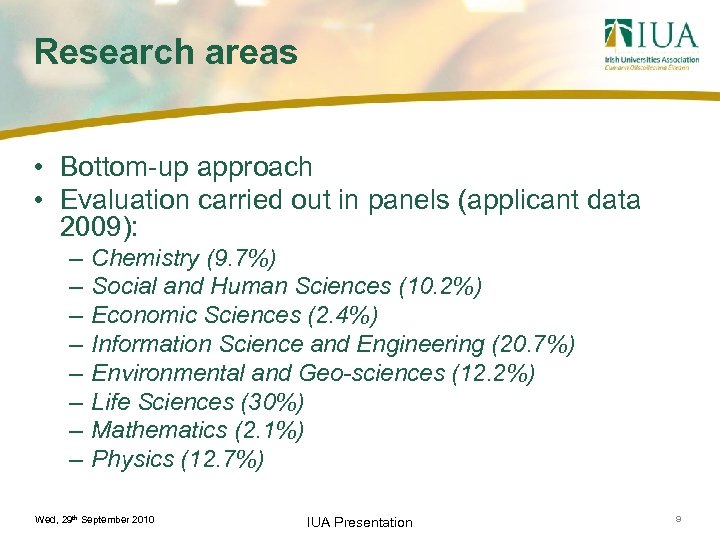 Research areas • Bottom-up approach • Evaluation carried out in panels (applicant data 2009): – – – – Chemistry (9. 7%) Social and Human Sciences (10. 2%) Economic Sciences (2. 4%) Information Science and Engineering (20. 7%) Environmental and Geo-sciences (12. 2%) Life Sciences (30%) Mathematics (2. 1%) Physics (12. 7%) Wed, 29 th September 2010 IUA Presentation 9
 Who are the participants? • Organisations that are actively involved in research and/or research training: – – – – Universities/Institutes of Technology Private and public research institutes Companies big and small International Organisations (CERN, UNESCO, …) The European Commission’s Joint Research Centre NGO’s Etc. Wed, 29 th September 2010 IUA Presentation 10
 Which countries can they come from? • 27 Member States (MS) • 12 Associated Countries (AC) – Iceland, Liechtenstein, Norway, Israel, Switzerland, Albania, Bosnia-Herzegovina, Croatia, FYR Macedonia, Montenegro, Serbia, Turkey • Third Countries (TC) – More than 140 International Cooperation Partner Countries (ICPC) – can receive funding – Other Third Countries (OTC) – normally self funded Wed, 29 th September 2010 IUA Presentation 11
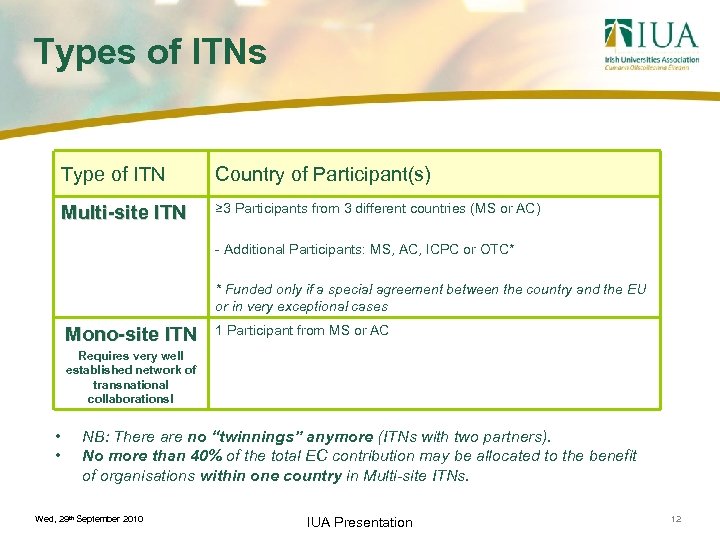 Types of ITNs Type of ITN Country of Participant(s) Multi-site ITN ≥ 3 Participants from 3 different countries (MS or AC) - Additional Participants: MS, AC, ICPC or OTC* * Funded only if a special agreement between the country and the EU or in very exceptional cases Mono-site ITN 1 Participant from MS or AC Requires very well established network of transnational collaborations! • • NB: There are no “twinnings” anymore (ITNs with two partners). No more than 40% of the total EC contribution may be allocated to the benefit of organisations within one country in Multi-site ITNs. Wed, 29 th September 2010 IUA Presentation 12
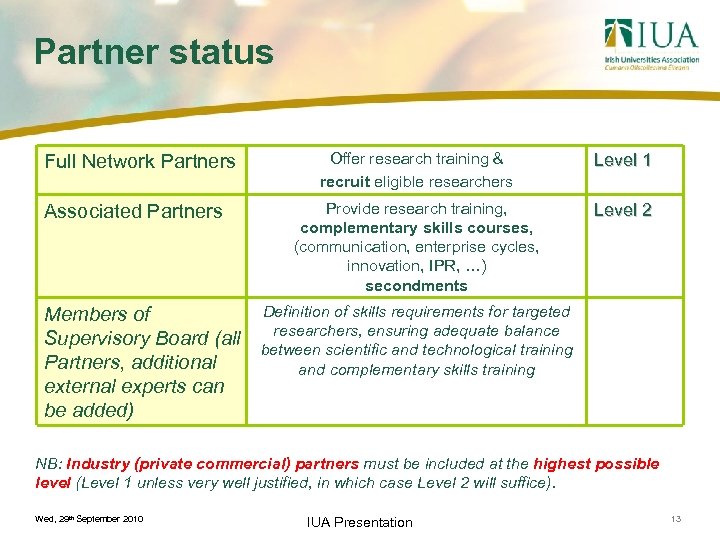 Partner status Full Network Partners Associated Partners Members of Supervisory Board (all Partners, additional external experts can be added) Offer research training & recruit eligible researchers Level 1 Provide research training, complementary skills courses, (communication, enterprise cycles, innovation, IPR, …) secondments Level 2 Definition of skills requirements for targeted researchers, ensuring adequate balance between scientific and technological training and complementary skills training NB: Industry (private commercial) partners must be included at the highest possible level (Level 1 unless very well justified, in which case Level 2 will suffice). Wed, 29 th September 2010 IUA Presentation 13
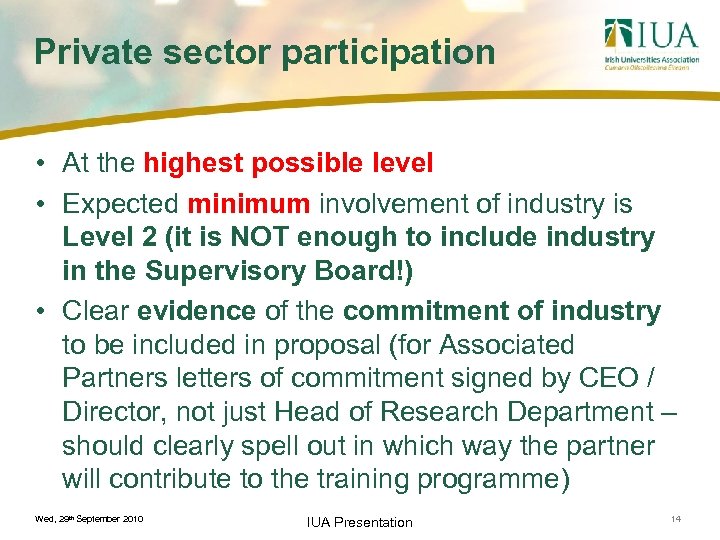 Private sector participation • At the highest possible level • Expected minimum involvement of industry is Level 2 (it is NOT enough to include industry in the Supervisory Board!) • Clear evidence of the commitment of industry to be included in proposal (for Associated Partners letters of commitment signed by CEO / Director, not just Head of Research Department – should clearly spell out in which way the partner will contribute to the training programme) Wed, 29 th September 2010 IUA Presentation 14
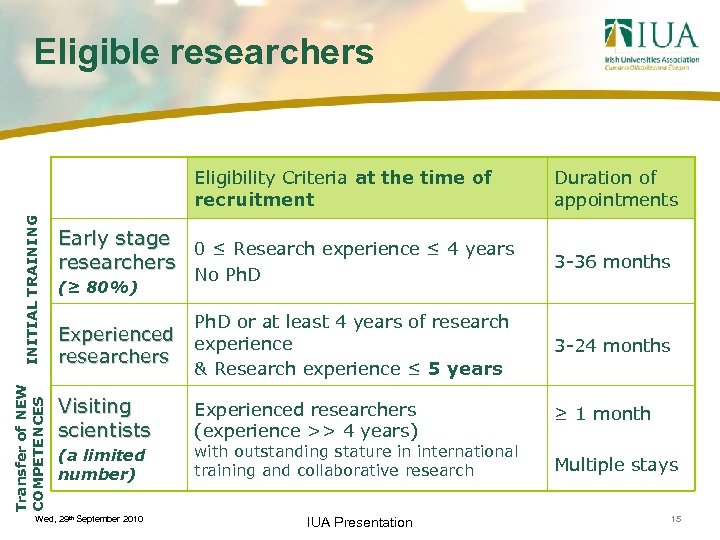 Eligible researchers Transfer of NEW COMPETENCES INITIAL TRAINING Eligibility Criteria at the time of recruitment Early stage 0 ≤ Research experience ≤ 4 years researchers (≥ 80%) No Ph. D Duration of appointments 3 -36 months Experienced researchers Ph. D or at least 4 years of research experience & Research experience ≤ 5 years 3 -24 months Visiting scientists Experienced researchers (experience >> 4 years) ≥ 1 month (a limited number) Wed, 29 th September 2010 with outstanding stature in international training and collaborative research IUA Presentation Multiple stays 15
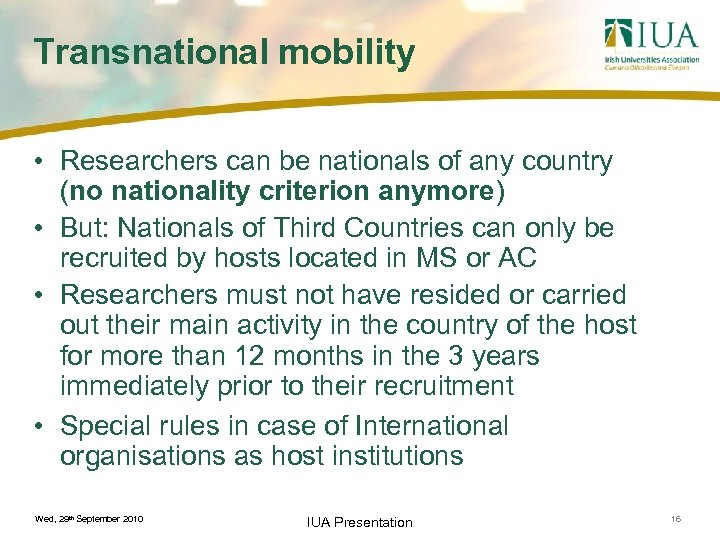 Transnational mobility • Researchers can be nationals of any country (no nationality criterion anymore) • But: Nationals of Third Countries can only be recruited by hosts located in MS or AC • Researchers must not have resided or carried out their main activity in the country of the host for more than 12 months in the 3 years immediately prior to their recruitment • Special rules in case of International organisations as host institutions Wed, 29 th September 2010 IUA Presentation 16
 Role of visiting scientists • Complement the network’s capacity to transfer new knowledge • Strengthen supervision of the network-wide training activities • Exceptional and duly justified, with explicit reference to the punctual training events he/she will provide or organise • Reasonable duration of appointment Wed, 29 th September 2010 IUA Presentation 17
 Typical ITN activities • Training • Networking • International conferences, workshops and other training and dissemination events (can / should to some extent be open to external researchers) Wed, 29 th September 2010 IUA Presentation 18
 Training activities • Training on scientific and technological knowledge through research: individual personalised projects within the framework of the research topics defined by the network • Provision of structured training courses: tutoring, lecture courses, teaching – Available either locally or from another participant of the network – Local training programmes to be coordinated to maximise added value Wed, 29 th September 2010 IUA Presentation 19
 Training activities • Intersectorial visits and secondments • Development of network-wide training activities : workshops, summer schools – Exploitation of the interdisciplinary and intersectoral aspects of the project – Exposure of the participants to different schools of thought – Provide complementary training in IPR, project management, presentation skills, language courses, ethics, communication, entrepreneurship, proposal writing, task coordination… – Coordinated by a clearly identified Supervisory Board Wed, 29 th September 2010 IUA Presentation 20
 Training activities • Personal Career Development Plan – For researchers recruited for ≥ 6 months • Early Post-Docs – Intersectoral or interdisciplinary Transfer of Knowledge – Taking part in the management of the research project – Organisation of training events Training objective: to make them more independent and to provide them with the skills to become team leaders in the near future Wed, 29 th September 2010 IUA Presentation 21
 Networking activities • Organisation of scientific/managerial network meetings • Invitation of external experts • Attendance at international conferences and workshops • Electronic networking • Collaboration with other ITNs • Organisation of a final network conference Wed, 29 th September 2010 IUA Presentation 22
 International training and dissemination events • International conferences, workshops, seminars, summer schools, etc. • Should provide an opportunity to – exchange knowledge with more experienced researchers – disseminate the skills and knowledge of the network – should at least to some extent be open to external researchers Friday, 18 th September 2009 IUA Presentation 23
 Supervisory Board • Clearly identified • Ensures that scientific and technological training is balanced with complementary skills training • Composed of representatives of each of the participants in the network as well as external representatives • Industry involvement Friday, 18 th September 2009 IUA Presentation 24
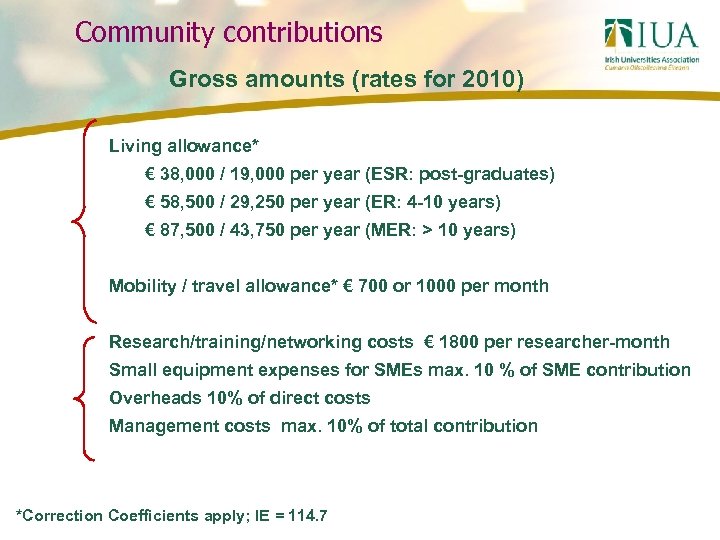 Community contributions Host Fellow expenses Gross amounts (rates for 2010) Living allowance* € 38, 000 / 19, 000 per year (ESR: post-graduates) € 58, 500 / 29, 250 per year (ER: 4 -10 years) € 87, 500 / 43, 750 per year (MER: > 10 years) Mobility / travel allowance* € 700 or 1000 per month Research/training/networking costs € 1800 per researcher-month Small equipment expenses for SMEs max. 10 % of SME contribution Overheads 10% of direct costs Management costs max. 10% of total contribution *Correction Coefficients apply; IE = 114. 7
 Further Information • Full call docs and Guide for Applicants http: //cordis. europa. eu/fp 7/dc/index. cfm? fuseaction=User. Site. People. Details. Call. Page&call_id=314 • Financial Assistance for proposal preparation • • Academic - Coordination & Travel Companies (EI/IDA) – Proposal preparaton
 Further Information • Planning a proposal writing workshop October • Also see following brochure for examples http: //www. iua. ie/publications/documents/publications/2009/ IUA_Marie_Curie_2009_IAPP_Success_Stories. pdf