 Скачать презентацию Fourth Jordan National Tempus Day 25 th February
aa886b70ea26641b934bc2b1a6bb22f1.ppt
- Количество слайдов: 32



Fourth Jordan National Tempus Day 25 th February 2009 Seventh Framework Programme Germana Topolovec Economic and Trade Section Delegation of the European Commission to Jordan
What is FP 7? § FP 7 is the short name for the Seventh Framework Programme for Research and Technological Development FP 7 is the European Union’s main instrument for funding research in Europe § Period covered : 2007 to 2013 § Budget € 53. 27 billion. § 2
What is new in FP 7? Main new element compared to FP 6: § Duration increased from 5 to 7 years § Annual Budget increased significantly § New Structure: 4 Specific Programmes: Cooperation, Ideas (ERC), People, Capacities (plus Joint Research Center and EURATOM) § Simpler procedure at every step of the process § Easier financial rules: • No more cost models • Possibility of using lump sums for third countries • Co-financing for several eligible costs: hiring people, buying consumables, part of equipment, travels, dissemination, IPR costs, etc. 3
What is new in FP 7? § Joint Technology Initiatives (JTI) § Risk Sharing Finance Facility aimed at fostering private investment in research § Flexible funding schemes § Creation of a European Research Council for funding best of European science § Development of Regions of Knowledge § Integration of the international dimension into all four Specific Programmes 4
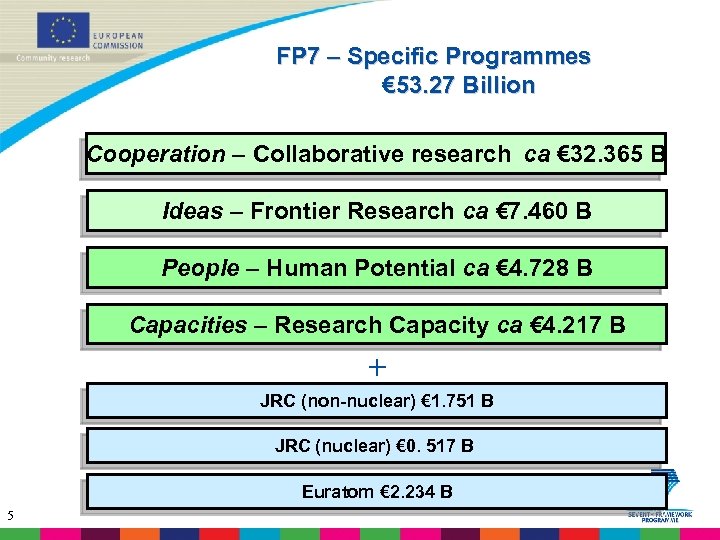
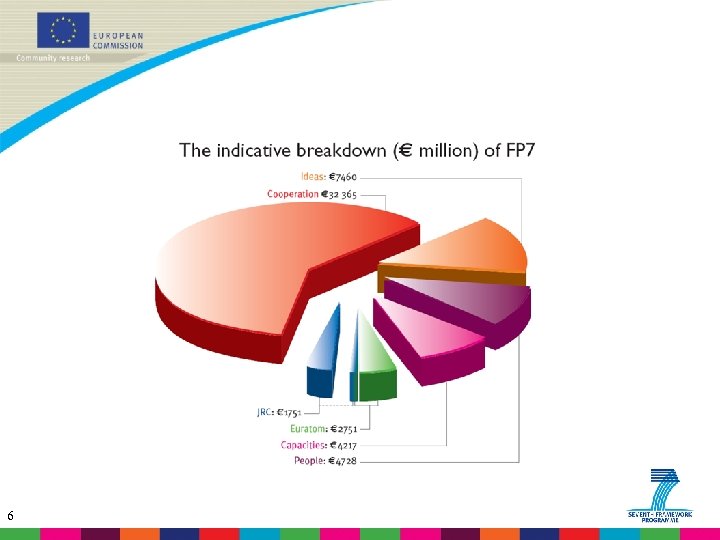
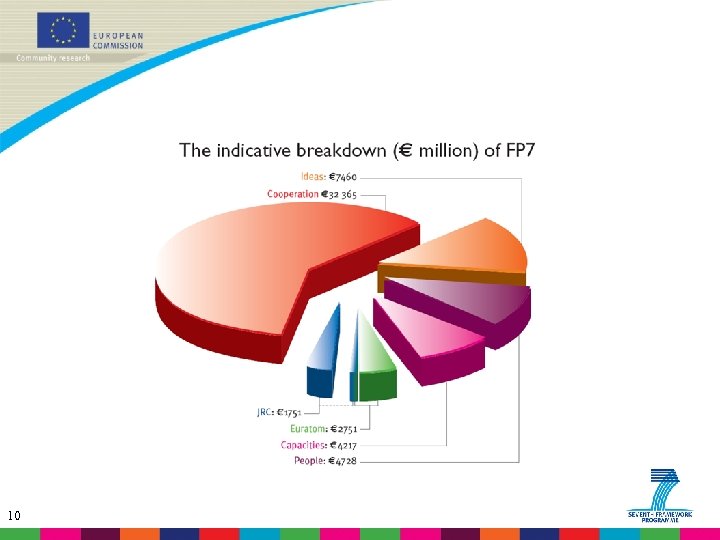
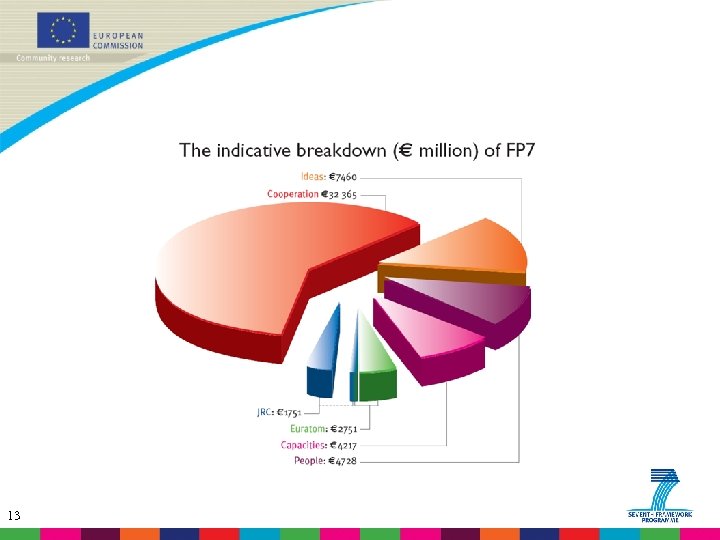
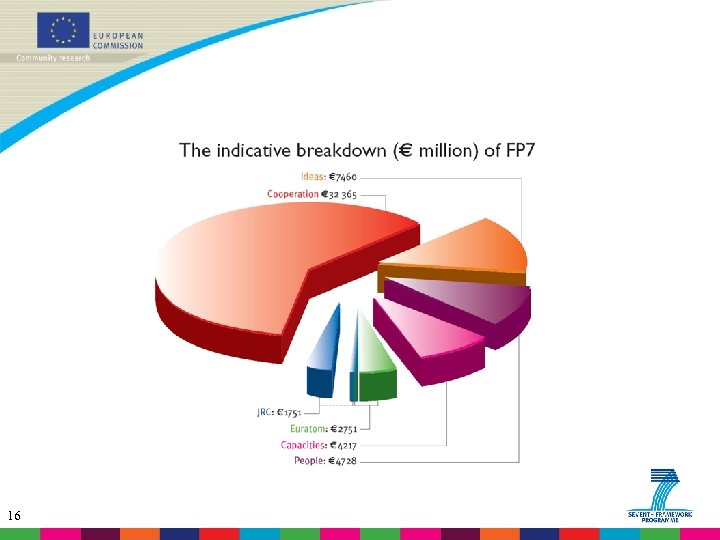
FP 7 – Specific Programmes € 53. 27 Billion Cooperation – Collaborative research ca € 32. 365 B Ideas – Frontier Research ca € 7. 460 B People – Human Potential ca € 4. 728 B Capacities – Research Capacity ca € 4. 217 B + JRC (non-nuclear) € 1. 751 B JRC (nuclear) € 0. 517 B Euratom € 2. 234 B 5
6
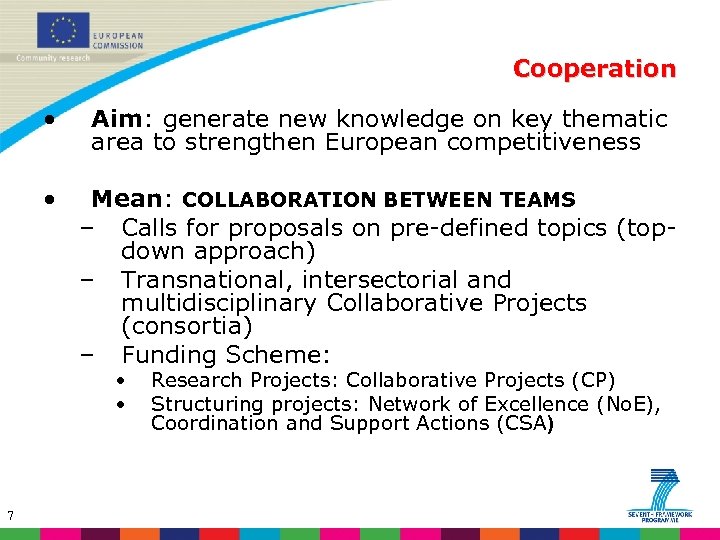
Cooperation • Aim: generate new knowledge on key thematic area to strengthen European competitiveness • Mean: COLLABORATION BETWEEN TEAMS – Calls for proposals on pre-defined topics (topdown approach) – Transnational, intersectorial and multidisciplinary Collaborative Projects (consortia) – Funding Scheme: • • 7 Research Projects: Collaborative Projects (CP) Structuring projects: Network of Excellence (No. E), Coordination and Support Actions (CSA)
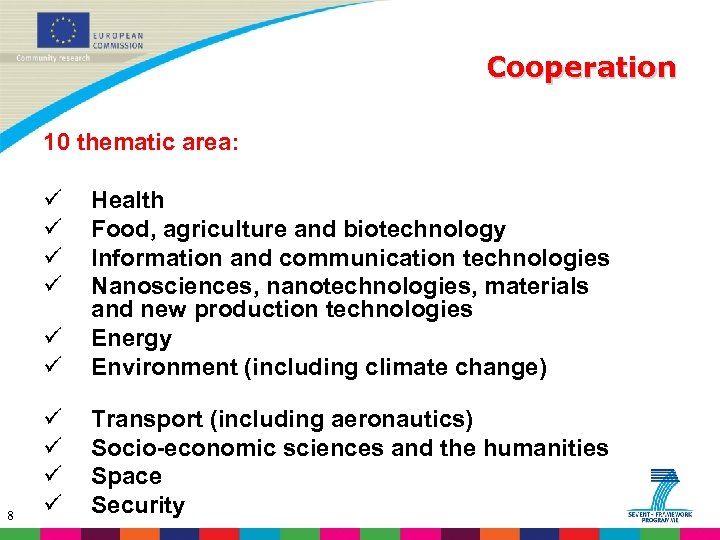
Cooperation 10 thematic area: ü ü ü 8 Health Food, agriculture and biotechnology Information and communication technologies Nanosciences, nanotechnologies, materials and new production technologies Energy Environment (including climate change) ü ü Transport (including aeronautics) Socio-economic sciences and the humanities Space Security
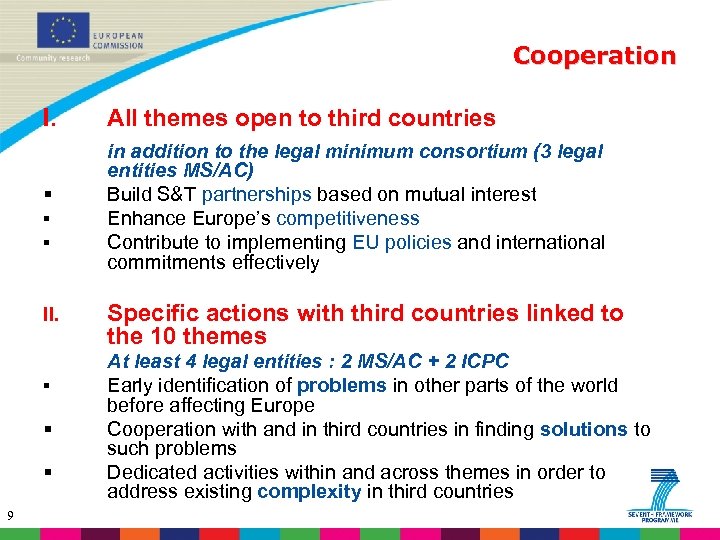
Cooperation I. § § § II. § § § 9 All themes open to third countries in addition to the legal minimum consortium (3 legal entities MS/AC) Build S&T partnerships based on mutual interest Enhance Europe’s competitiveness Contribute to implementing EU policies and international commitments effectively Specific actions with third countries linked to the 10 themes At least 4 legal entities : 2 MS/AC + 2 ICPC Early identification of problems in other parts of the world before affecting Europe Cooperation with and in third countries in finding solutions to such problems Dedicated activities within and across themes in order to address existing complexity in third countries
10
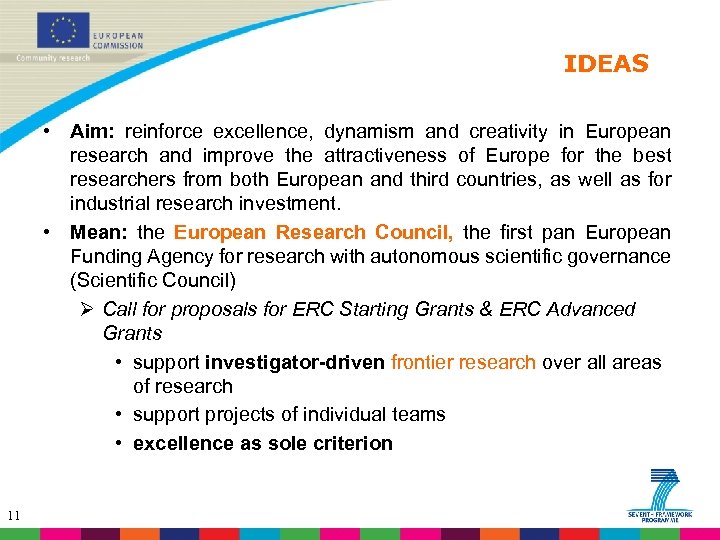
IDEAS • Aim: reinforce excellence, dynamism and creativity in European research and improve the attractiveness of Europe for the best researchers from both European and third countries, as well as for industrial research investment. • Mean: the European Research Council, the first pan European Funding Agency for research with autonomous scientific governance (Scientific Council) Ø Call for proposals for ERC Starting Grants & ERC Advanced Grants • support investigator-driven frontier research over all areas of research • support projects of individual teams • excellence as sole criterion 11
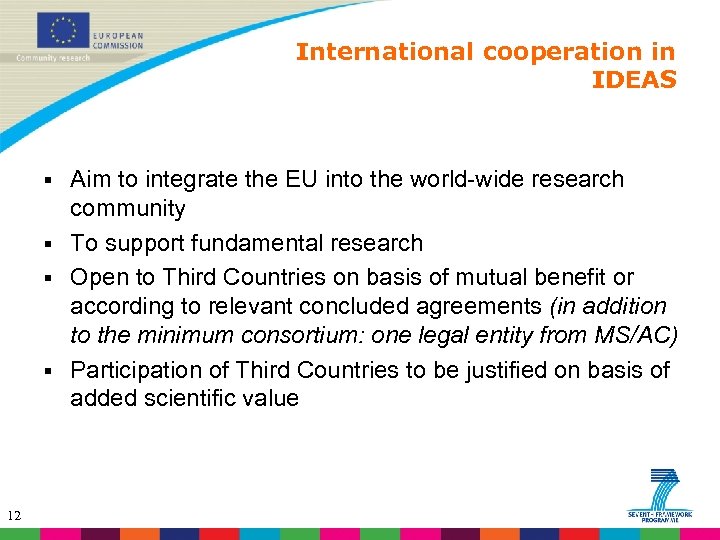
International cooperation in IDEAS Aim to integrate the EU into the world-wide research community § To support fundamental research § Open to Third Countries on basis of mutual benefit or according to relevant concluded agreements (in addition to the minimum consortium: one legal entity from MS/AC) § Participation of Third Countries to be justified on basis of added scientific value § 12
13
FP 7 PEOPLE • Aim: Support scientific career and strengthen European attractiveness for Researchers. Towards the achievement of a single market for Researchers. • Mean: Marie Curie Grants to encourage mobility • Activities: Ø Initial training for young researchers Marie Curie Networks* Ø Life-long training and career development: • Individual fellowship: IEF & ERG • Co-financing Region/EC: COFUND Ø Industry-Academia pathways and partnership Industry-Academia Knowledge–sharing Scheme* Ø International Dimension : • Individual fellowship: : IIF, IOF & IRG Ø Specific Actions : • Marie Curie Prizes, • Researchers ’ Nights 14
International cooperation in PEOPLE § § International incoming fellowships § Partnerships to support exchange of researchers § Support of common initiatives between European organizations and countries with S&T agreements § 15 International outgoing fellowships Measures to counter the risk of ‘brain drain’ from ICPC (developing countries/emerging economies…)
16
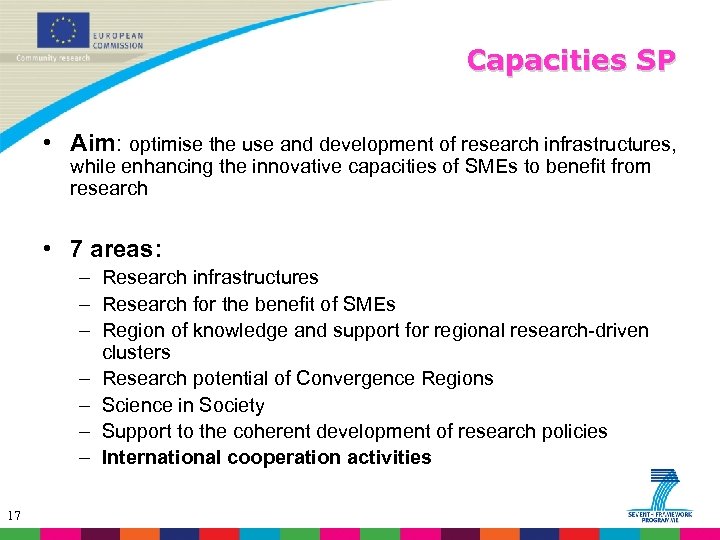
Capacities SP • Aim: optimise the use and development of research infrastructures, while enhancing the innovative capacities of SMEs to benefit from research • 7 areas: – Research infrastructures – Research for the benefit of SMEs – Region of knowledge and support for regional research-driven clusters – Research potential of Convergence Regions – Science in Society – Support to the coherent development of research policies – International cooperation activities 17
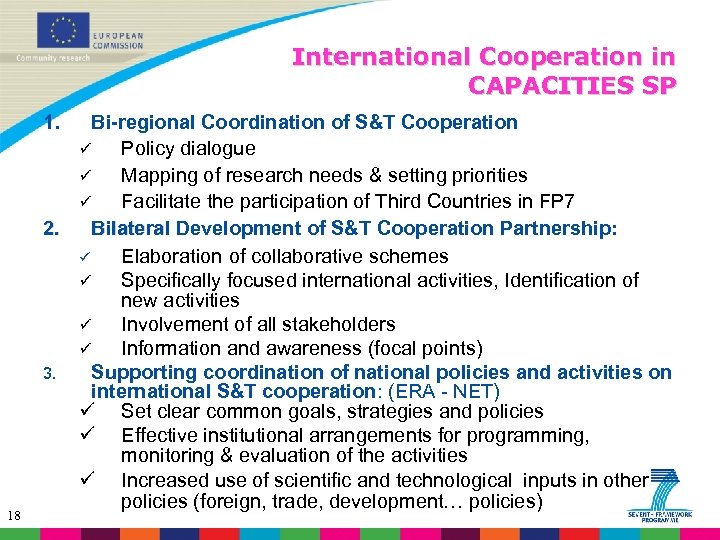
International Cooperation in CAPACITIES SP 1. 18 Bi-regional Coordination of S&T Cooperation ü Policy dialogue ü Mapping of research needs & setting priorities ü Facilitate the participation of Third Countries in FP 7 2. Bilateral Development of S&T Cooperation Partnership: Bilateral ü Elaboration of collaborative schemes ü Specifically focused international activities, Identification of new activities ü Involvement of all stakeholders ü Information and awareness (focal points) 3. Supporting coordination of national policies and activities on international S&T cooperation: (ERA - NET) ü Set clear common goals, strategies and policies ü Effective institutional arrangements for programming, monitoring & evaluation of the activities ü Increased use of scientific and technological inputs in other policies (foreign, trade, development… policies)
7 th Framework Programme Participation Rules 19
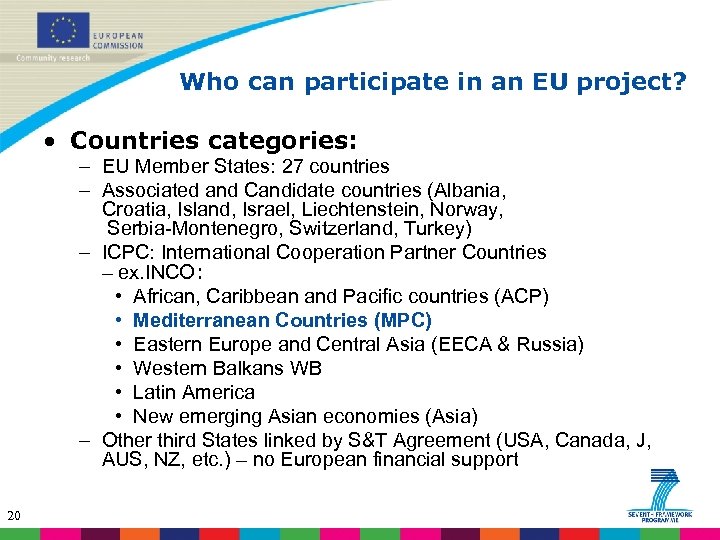
Who can participate in an EU project? • Countries categories: – EU Member States: 27 countries – Associated and Candidate countries (Albania, Croatia, Island, Israel, Liechtenstein, Norway, Serbia-Montenegro, Switzerland, Turkey) – ICPC: International Cooperation Partner Countries – ex. INCO: • African, Caribbean and Pacific countries (ACP) • Mediterranean Countries (MPC) • Eastern Europe and Central Asia (EECA & Russia) • Western Balkans WB • Latin America • New emerging Asian economies (Asia) – Other third States linked by S&T Agreement (USA, Canada, J, AUS, NZ, etc. ) – no European financial support 20
Participation Rules • Consortia – the minimum thresholds – For ‘normal’ projects: • CP, CA: minimum of 3 legal entities coming from 3 Member States or Associated countries • SA: minimum 1 legal entity – For SICA projects : Minimum of 4 legal entities • Minimum of 2 legal entities coming from 2 different MS or AC • AND minimum of 2 ICPC states from the same region (or two different regions within Russia, China, India, Brazil) • Regional dimension (cooperation between countries of the same ‘bloc’) is essential for the success of the project 21
Participation Rules in Marie Curie Actions • International Incoming Fellowships (IIF) Who can apply? Researchers from third countries in possession of a doctoral degree or with at least 4 years full time equivalent research experience Which research are supported? Proposals from all areas of scientific and technological research How does it work? Proposals are submitted by researcher in liaison with the organisation that will host him/her in a MS or AC. Financial support will be provided for a period of 1 to 2 years. Possible financing of 1 year reintegration phase. What does the funding cover? Salary of the researcher and a contribution to towards researchrelated costs. 22
Participation Rules in Marie Curie Actions International Outgoing Fellowships for career development (IOF) Who can apply? Researchers from a MS or AC in possession of a doctoral degree or with at least 4 years full time equivalent research experience Which research are supported? Proposals from all areas of scientific and technological research How does it work? Proposals are submitted by researcher in liaison with the return host organisation in a MS or AC. Financial support will be provided for a period up to 3 years: 1 to 2 years outgoing phase + mandatory 1 year reintegration phase. What does the funding cover? Salary of the researcher and a contribution to towards researchrelated costs. 23
Participation Rules in Marie Curie Actions International Research Staff Exchange Scheme (IRSES) – new action Who can apply? Public and Private bodies which carry out research in partnership (at least 2 MS or AC and one organisation in a country with S&T agreement or ENP) Which research are supported? Proposals from all areas of scientific and technological research How does it work? Duration of the staff exchange programme: 2 to 4 years. Max duration of the individual staff exchange: 12 months What does the funding cover? Subsistence allowance to cover mobility costs 24
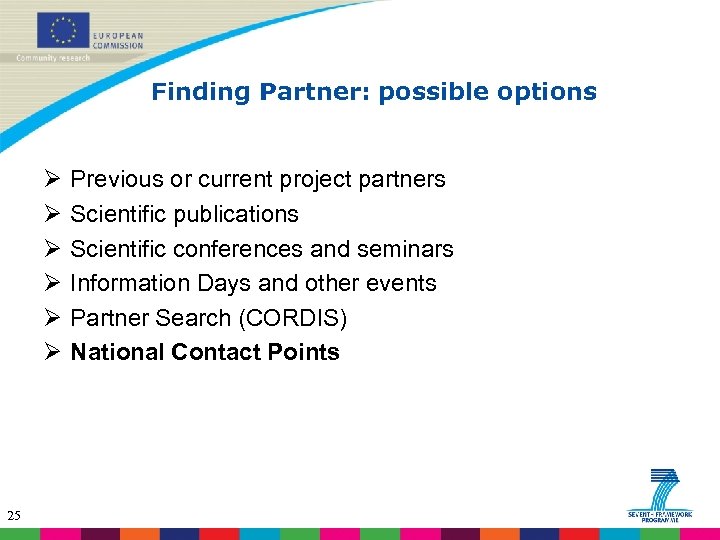
Finding Partner: possible options Ø Ø Ø 25 Previous or current project partners Scientific publications Scientific conferences and seminars Information Days and other events Partner Search (CORDIS) National Contact Points
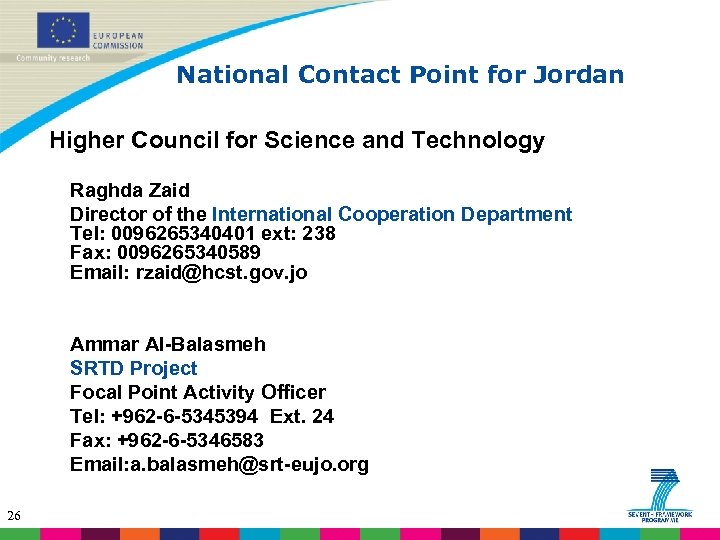
National Contact Point for Jordan Higher Council for Science and Technology Raghda Zaid Director of the International Cooperation Department Tel: 0096265340401 ext: 238 Fax: 0096265340589 Email: rzaid@hcst. gov. jo Ammar Al-Balasmeh SRTD Project Focal Point Activity Officer Tel: +962 -6 -5345394 Ext. 24 Fax: +962 -6 -5346583 Email: a. balasmeh@srt-eujo. org 26
7 th 27 Jordan participation in the Framework Programme
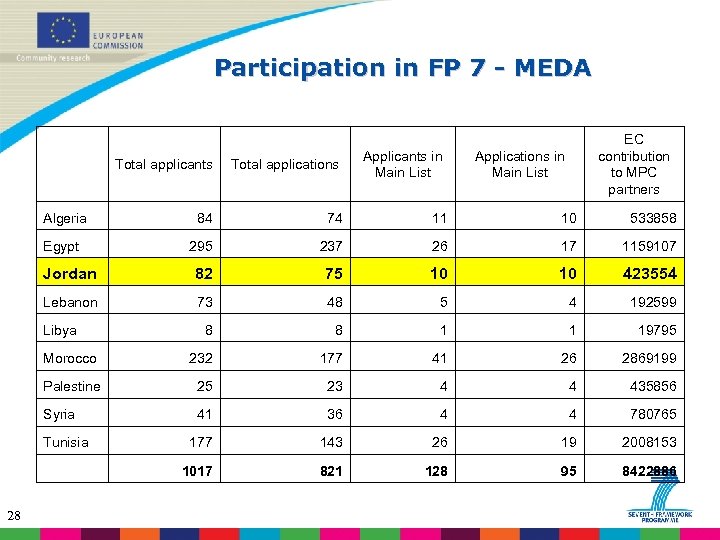
Participation in FP 7 - MEDA EC contribution to MPC partners Total applicants Total applications Applicants in Main List Applications in Main List Algeria 84 74 11 10 533858 Egypt 295 237 26 17 1159107 Jordan 82 75 10 10 423554 Lebanon 73 48 5 4 192599 8 8 1 1 19795 Morocco 232 177 41 26 2869199 Palestine 25 23 4 4 435856 Syria 41 36 4 4 780765 177 143 26 19 2008153 1017 821 128 95 8422886 Libya Tunisia 28
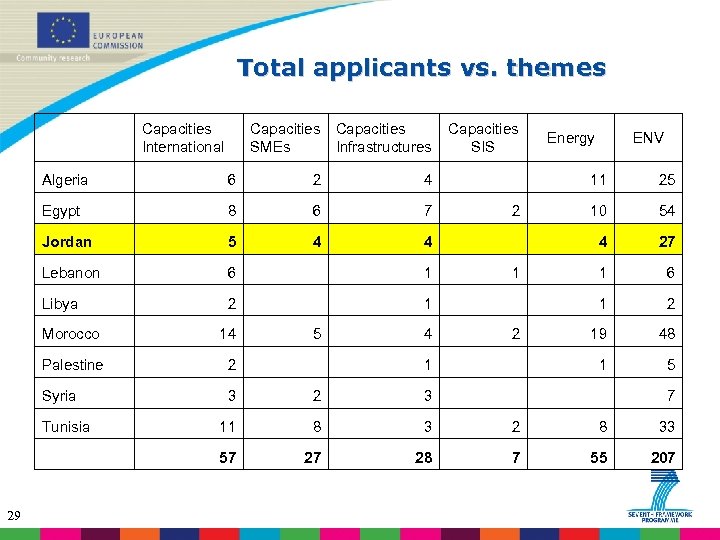
Total applicants vs. themes Capacities International Capacities SMEs Infrastructures Capacities SIS Algeria 6 2 4 Egypt 8 6 7 Jordan 5 4 4 Lebanon 6 1 Libya 2 Energy 1 Morocco 14 5 4 ENV 11 10 2 19 48 1 5 Palestine 2 Syria 3 2 3 Tunisia 11 8 3 2 8 33 29 1 6 1 2 27 1 1 54 4 2 25 57 27 28 7 55 207 7
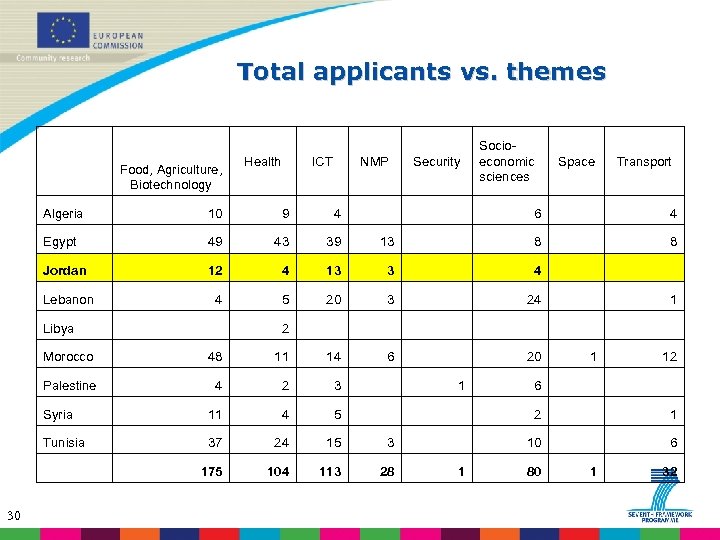
Total applicants vs. themes Food, Agriculture, Biotechnology Health ICT NMP Algeria 10 9 4 Egypt 49 43 39 Jordan 12 4 Lebanon 4 5 Libya 2 4 13 8 8 13 3 4 20 3 24 48 11 14 Palestine 4 2 3 Syria 11 4 5 Tunisia 30 Transport 6 Morocco 37 24 15 3 175 104 113 28 Space Security Socioeconomic sciences 6 1 20 1 1 12 6 2 1 10 6 1 80 1 32
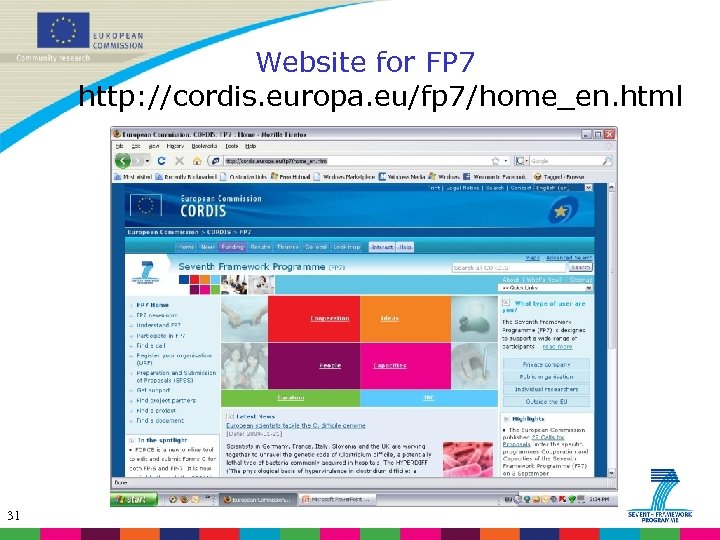
Website for FP 7 http: //cordis. europa. eu/fp 7/home_en. html 31
For additional information Germana Topolovec Economic and Trade Section Delegation of the European Commission to the Hashemite Kingdom of Jordan Tel. (962 -6) 4607000 ext. 142 Fax (962 -6) 4607001 germana. topolovec@ec. europa. eu 32
Скачать презентацию Fourth Jordan National Tempus Day 25 th February
aa886b70ea26641b934bc2b1a6bb22f1.ppt