 Скачать презентацию Four types of marketing strategies Done by Abdrakhman
Презентация1.pptx
- Количество слайдов: 43



Four types of marketing strategies Done by: Abdrakhman Aida Bolatova Bakhyt Nursadyk Nazym Stanbaeva Assel
PIMS The Profit Impact of Market Strategies (PIMS) is a comprehensive, long-term study of the performance of strategic business units (SBUs) in 3, 000 companies in all major industries. The PIMS project began at General Electric in the mid-1960 s. It was conducted at Harvard University between 1972 and 1974. In 1975 PIMS was taken over by a Massachusetts-based nonprofit organization, formed for that purpose, called The Strategic Planning Institute (SPI). Since then, SPI researchers and consultants have continued working on the development and application of PIMS data. The PIMS database is available to individuals for a subscription price (in 2006) of $995 for one month's use and $2, 500 for three months' use. Longer periods of subscription are available from SPI by special arrangement.
• SWOT Analysis Tool • Get a free 30 day trial of Mindjet the leading Mindmapping tool! Background Starting in 1972, Profit Impact of Market Strategy research assembled a database of 450 companies and 3, 000 business units with information on market strategy and company performance. The PIMS database set the stage for later studies on how specific strategic elements affect company profits. Based on the PIMS information and more recent data, companies can increase profitability by a focused approach in their market strategy. • Advertising One of the aims of market strategy is to build brand awareness and develop a positive image for a brand. Advertising is one of the key elements of market strategy that helps meet this goal. Companies that advertise, especially during economic downturns, outperform companies that cut back on advertising. In the short term, ads generate sales that impact profits. In the long term, they build brand value, which allows higher pricing and profitability.
• • • Promotions that offer discounts or incentives have a slightly different effect than ads. Over the short term, promotions increase sales and may increase profitability; over the long term, however, discounts tend to hurt the brand. This means promotions can be a short-term strategic tool to address particular problems such as overstocks or end-of-line issues. In the long term, their impact on profit is neutral or possibly negative. Customer Service While customer service is not directly a marketing function, market strategies can focus on developing superior customer service as a competitive advantage. The broad elements of customer service are awareness, association, attitude, attachment and experience. Advertising affects some of these elements, but the key is to maximize customer satisfaction through customer focus at all aspects of the purchase and ownership experience. A successful strategy results in high customer retention, lower customer acquisition costs and higher profitability. Quality Underpinning the other elements of market strategy is quality. Without a quality product or service, it is difficult to maintain profitability. When market strategy focuses on quality, market share, employee productivity and customer satisfaction all increase. Quality in this sense means meeting and exceeding customer expectations. Advertising reinforces those expectations, and achieving high levels of customer satisfaction consumes fewer resources. These savings, combined with increased volume from higher market share and better productivity, result in higher profits.
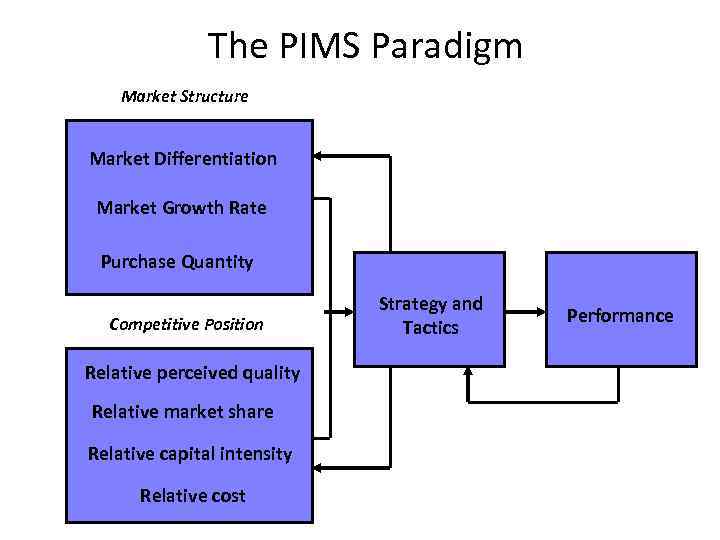
The PIMS Paradigm Market Structure Market Differentiation Market Growth Rate Purchase Quantity Competitive Position Relative perceived quality Relative market share Relative capital intensity Relative cost Strategy and Tactics Performance
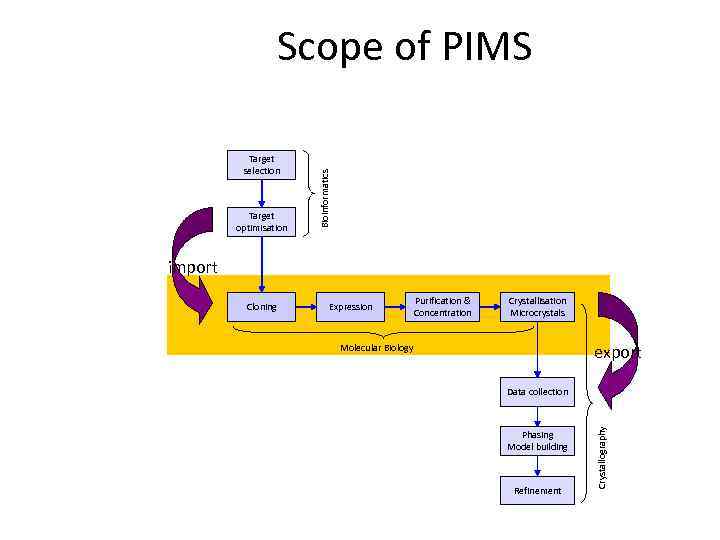
Target selection Target optimisation Bioinformatics Scope of PIMS import Expression Purification & Concentration Crystallisation Microcrystals export Molecular Biology Data collection Phasing Model building Refinement Crystallography Cloning
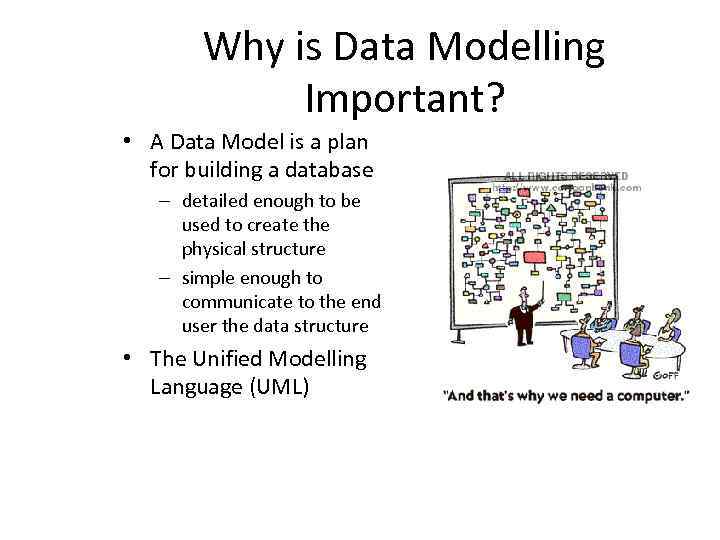
Why is Data Modelling Important? • A Data Model is a plan for building a database – detailed enough to be used to create the physical structure – simple enough to communicate to the end user the data structure • The Unified Modelling Language (UML)
• What can PIMS do for you? • • Not a lot right now Whatever you want, eventually. . . as long as it's data management for protein production
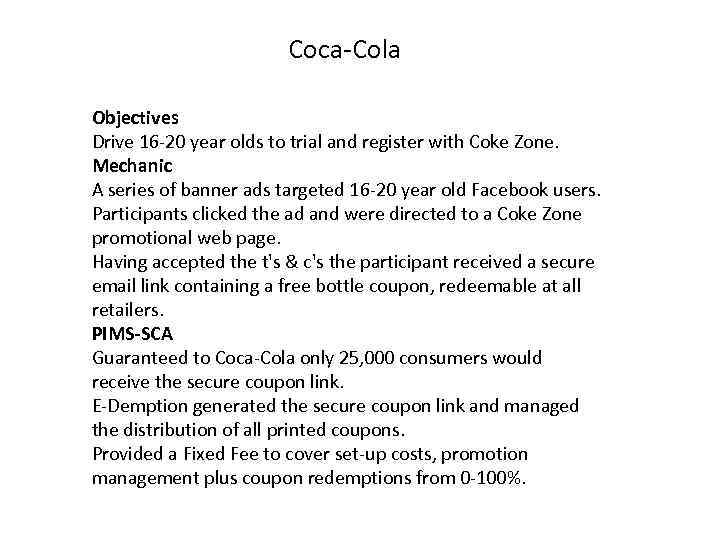
Coca-Cola Objectives Drive 16 -20 year olds to trial and register with Coke Zone. Mechanic A series of banner ads targeted 16 -20 year old Facebook users. Participants clicked the ad and were directed to a Coke Zone promotional web page. Having accepted the t's & c's the participant received a secure email link containing a free bottle coupon, redeemable at all retailers. PIMS-SCA Guaranteed to Coca-Cola only 25, 000 consumers would receive the secure coupon link. E-Demption generated the secure coupon link and managed the distribution of all printed coupons. Provided a Fixed Fee to cover set-up costs, promotion management plus coupon redemptions from 0 -100%.
The Porter Competitive Model Used to understand evaluate the structure of an industry’s business environment and the threats of competition to a specific company.
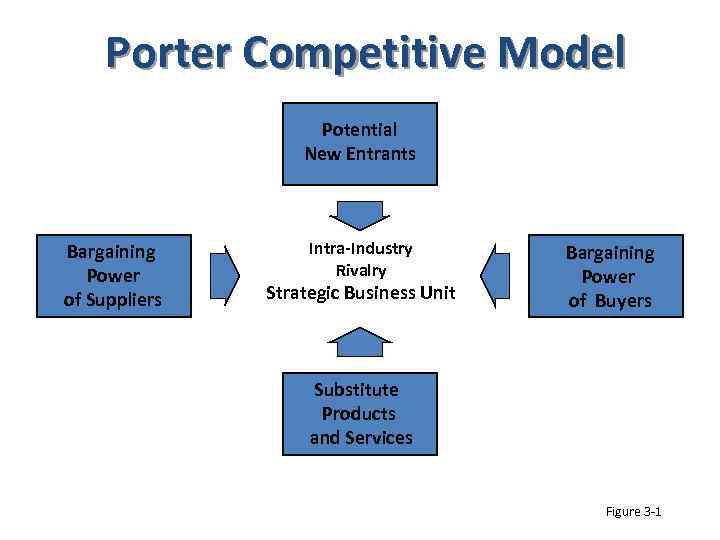
Porter Competitive Model Potential New Entrants Bargaining Power of Suppliers Intra-Industry Rivalry Strategic Business Unit Bargaining Power of Buyers Substitute Products and Services Figure 3 -1
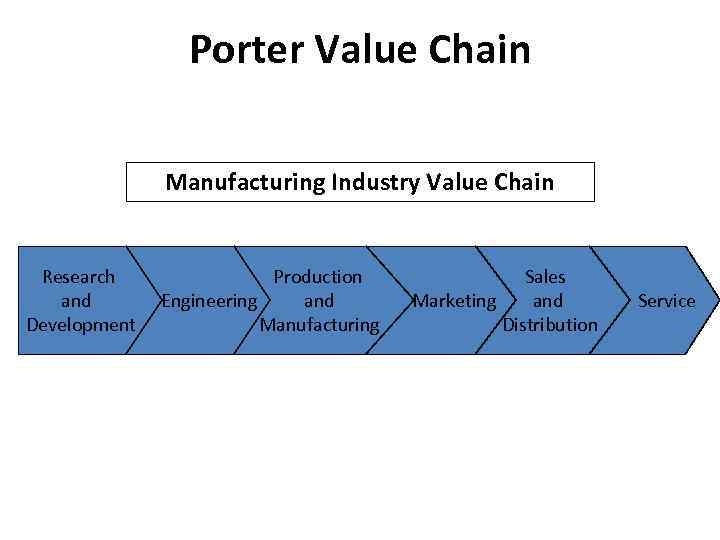
Porter Value Chain Manufacturing Industry Value Chain Research Production Sales and Engineering and Marketing and Service Development Manufacturing Distribution
Definitions New Entrant: An existing company or a startup that has not previously competed with the SBU in its geographic market. It can also be an existing company that through a shift in business strategy begins to compete with the SBU. Substitute Product or Service: An alternative to doing business with the SBU. This depends on the willingness of the buyers to substitute, the relative price/performance of the substitute and/or the level of the switching cost.
Rivalry Likelihood? • Profit margins. • Industry growth rate and potential. • A lack of capacity to satisfy the market. • Fixed costs. • Competitor concentration and balance. • Diversity of competitors. • Existing brand identity. • Switching costs. • Exit barriers.
A Buyer Has Power If: 1. It has large, concentrated buying power that enables it to gain volume discounts and/or special terms or services. 2. What it is buying is standard or undifferentiated and there are multiple alternative sources. 3. It earns low profit margins so it has great incentive to lower its purchasing costs. 4. It has a strong potential to backward integrate. 5. The product is unimportant to the quality of the buyers’ products or services.
A Supplier Has Power If: 1. There is domination of supply by a few companies. 2. Its product is unique or at least differentiated. 3. It has built up switching costs. 4. It provides benefits through geographic proximity to its customers. 5. It poses a definite threat to forward integrate into its customers’ business. 6. A long time working relationship provides unique capabilities.
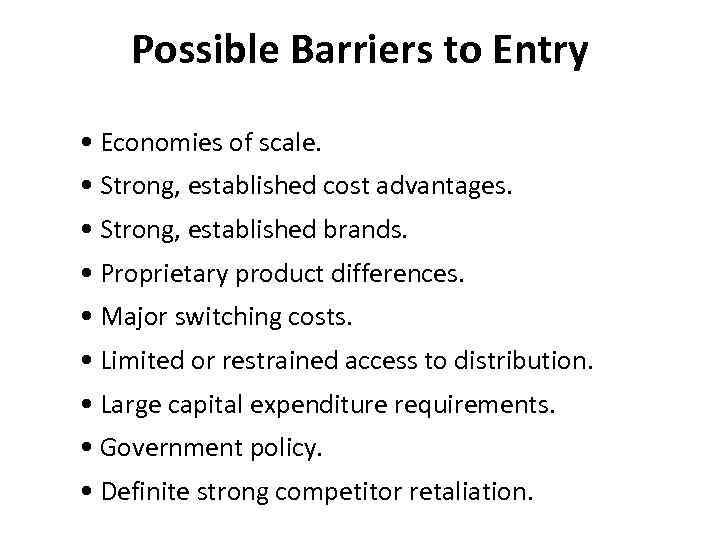
Possible Barriers to Entry • Economies of scale. • Strong, established cost advantages. • Strong, established brands. • Proprietary product differences. • Major switching costs. • Limited or restrained access to distribution. • Large capital expenditure requirements. • Government policy. • Definite strong competitor retaliation.
Substitute Threats • Buyer propensity to substitute. • Relative price/performance of substitutes. • Switching costs.
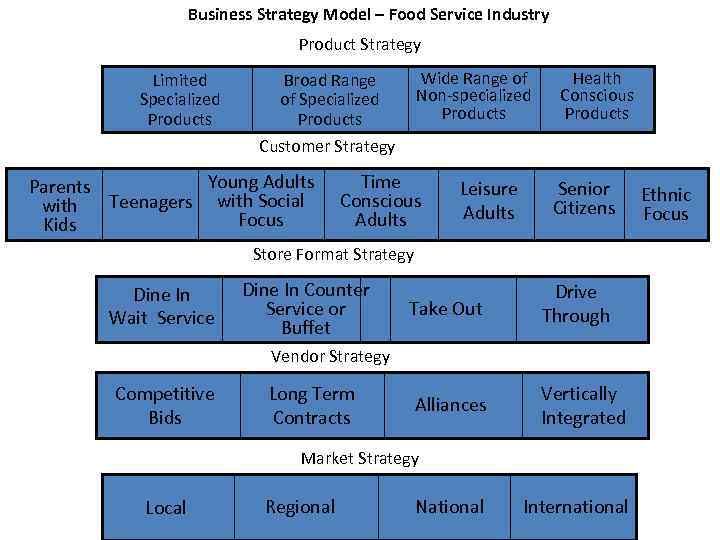
Business Strategy Model – Food Service Industry Product Strategy Limited Specialized Products Wide Range of Non-specialized Products Broad Range of Specialized Products Health Conscious Products Customer Strategy Young Adults Parents with Teenagers with Social Focus Kids Time Conscious Adults Leisure Adults Senior Citizens Store Format Strategy Dine In Wait Service Dine In Counter Service or Buffet Take Out Drive Through Alliances Vertically Integrated Vendor Strategy Competitive Bids Long Term Contracts Market Strategy Local Regional National International Ethnic Focus
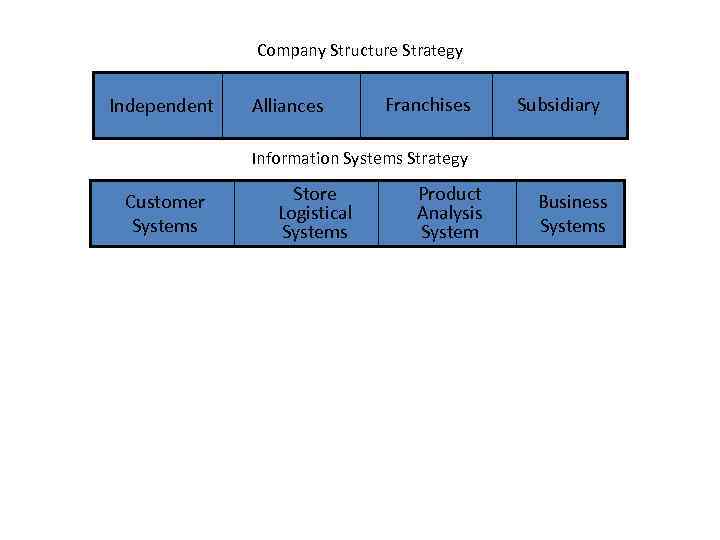
Company Structure Strategy Independent Alliances Franchises Subsidiary Information Systems Strategy Customer Systems Store Logistical Systems Product Analysis System Business Systems
Coca - Cola Threat of Substitute Products: Medium to High pressure There are many kinds of energy drink s/soda/juice products in the market. Cocacola doesn’t really have an entirely unique flavor. In a blind taste test, people can’t tell the difference between Coca-Cola and Pepsi. The Bargaining Power of Buyers: Low pressure The individual buyer no pressure on Coca-Cola Large retailers, like Wal-Mart, have bargaining power because of the large order quantity, but the bargaining power is lessened because of the end consumer brand loyalty. The Bargaining Power of Suppliers: Low pressure The main ingredients for soft drink include carbonated water, phosphoric acid, sweetener, and caffeine. The suppliers are not concentrated or differentiated. Coca-Cola is likely a large, or the largest customer of any of these suppliers. Rivalry Among Existing Firms: High Pressure Currently, the main competitor is Pepsi which also has a wide range of beverage products under its brand. Both Coca-Cola and Pepsi are the predominant carbonated beverages and committed heavily to sponsoring outdoor events and activities. There are other soda brands in the market that become popular, like Dr. Pepper, because of their unique flavors. These other brands have failed to reach the success that Pepsi or Coke have enjoyed.

ANSOFF
Background • Long-term business strategy is dependant on planning for their introduction • Ansoff Matrix represents the different options open to a marketing manager when considering new opportunities for sales growth
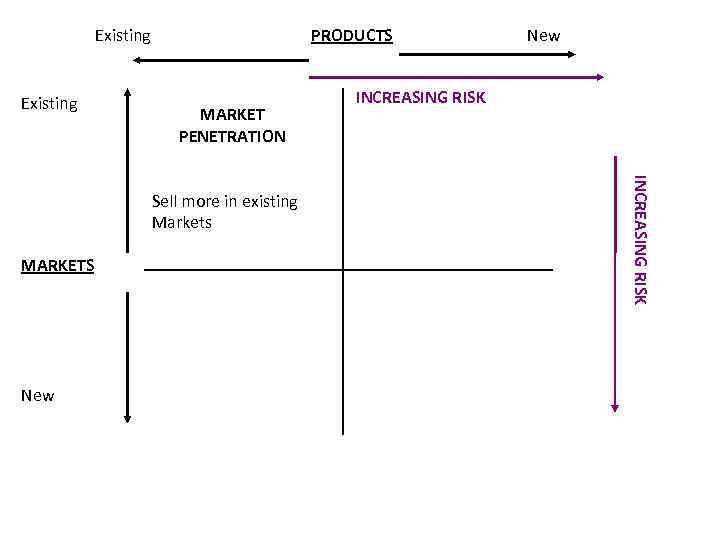
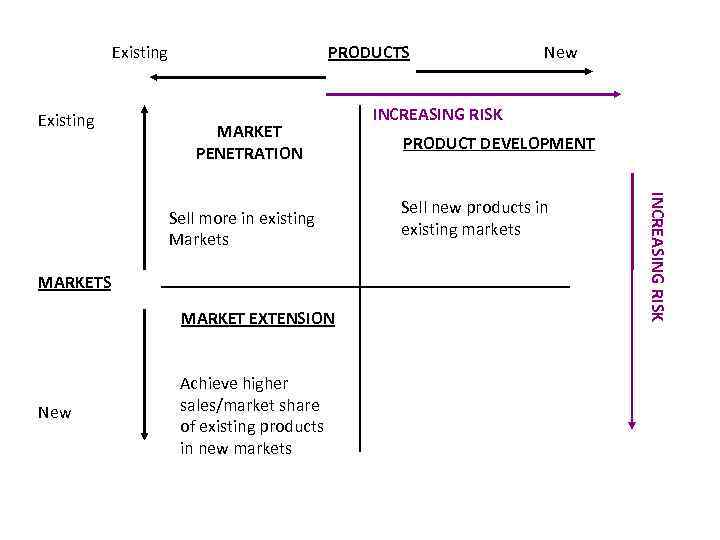
Variables in the matrix Two variables in Strategic marketing Decisions: – The market in which the firm was going to operate – The product intended for sale In terms of the market, managers had two options: – Remain in the existing market – Enter new ones
In terms of the product, the two options are: – selling existing products – developing new ones
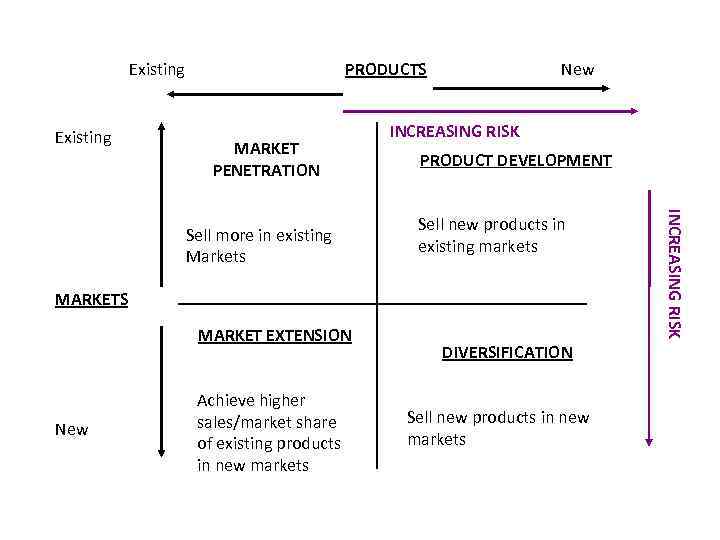
Existing PRODUCTS MARKET PENETRATION New INCREASING RISK PRODUCT DEVELOPMENT Sell new products in existing markets MARKETS MARKET EXTENSION New Achieve higher sales/market share of existing products in new markets DIVERSIFICATION Sell new products in new markets INCREASING RISK Sell more in existing Markets
Existing PRODUCTS MARKET PENETRATION MARKETS New INCREASING RISK Sell more in existing Markets
Existing PRODUCTS MARKET PENETRATION MARKETS MARKET EXTENSION New Achieve higher sales/market share of existing products in new markets New INCREASING RISK PRODUCT DEVELOPMENT Sell new products in existing markets INCREASING RISK Sell more in existing Markets
PRODUCT DEVELOPMENT • Least risky of all four strategies • This involves taking an existing product and developing it in existing markets – E. g. Coca-Cola. This has been developed to have vanilla, lime, cherry and diet varieties (amongst others) in the SOFT DRINKS market
Using Coca Cola to Explain Ansoff’s Matrix is a useful tool for examining a company’s product range. The four main options are: • Market penetration • Product development • Market development • Diversification Information about some of the products produced by Coca Cola is given below. Read this information and complete the tasks over the page:
1. Diet Coke Since being introduced in 1982 as a result of a growing trend towards dieting and healthier living, Diet Coke has been a highly successful product for the Coca Cola company, selling millions of units per year. Throughout this time, Coca Cola has constantly adapted aspects of the marketing mix for Diet Coke in order to continually match customer trends and fashions. 2. Coca Cola Vanilla Having had a successful launch in America, Coca Cola decided to launch it’s new Vanilla flavoured version in Great Britain. Prior to doing so, Coca Cola carried out taste tests and developed the graphical ‘look’ of the Diet Coke brand. When they did this, they took great care to incorporate aspects of the Coca Cola brand, but still differentiating it so consumers would see it as an alternative to Coke. 1. Fanta Icy Lemon The development of a new flavour sparkling drink by Coca Cola was as a direct result of listening to c the company’s Careline telephone service. The business conducted taste tests prior to the 2001 laun 1. Coca Cola Share Size 1. 5 l Bottle Desk research showed Coca Cola that a growing number of households contained 1 -2 people, which led them to believe that a smaller version of the 2 litre family sized bottle would sell well to th In launching this product (simply sell existing brands such as Coca Cola, Diet Coke etc), Coke did product itself, merely different aspects of the marketing mix.
The Boston Matrix • The Boston Matrix: – A means of analysing the product portfolio and informing decision making about possible marketing strategies – Developed by the Boston Consulting Group – a business strategy and marketing consultancy in 1968 – Links growth rate, market share and cash flow
The Boston Matrix • Classifies Products into four simple categories: • Stars – products in markets experiencing high growth rates with a high or increasing share of the market - Potential for high revenue growth Coca-Cola = Vitamin Water
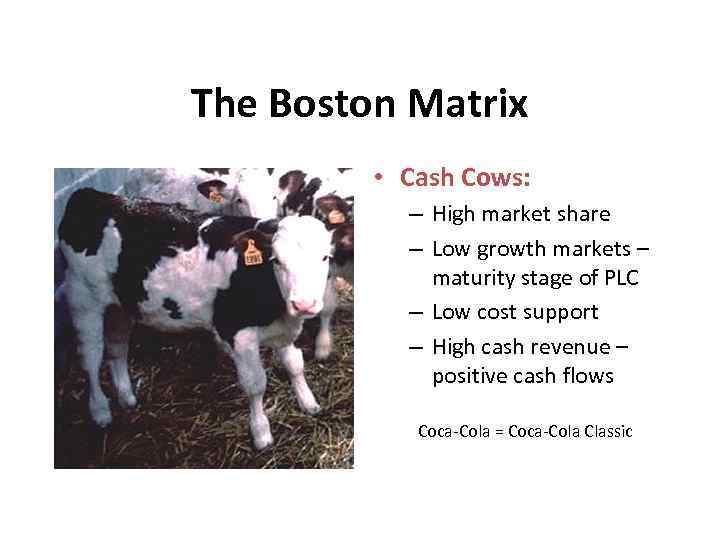
The Boston Matrix • Cash Cows: – High market share – Low growth markets – maturity stage of PLC – Low cost support – High cash revenue – positive cash flows Coca-Cola = Coca-Cola Classic
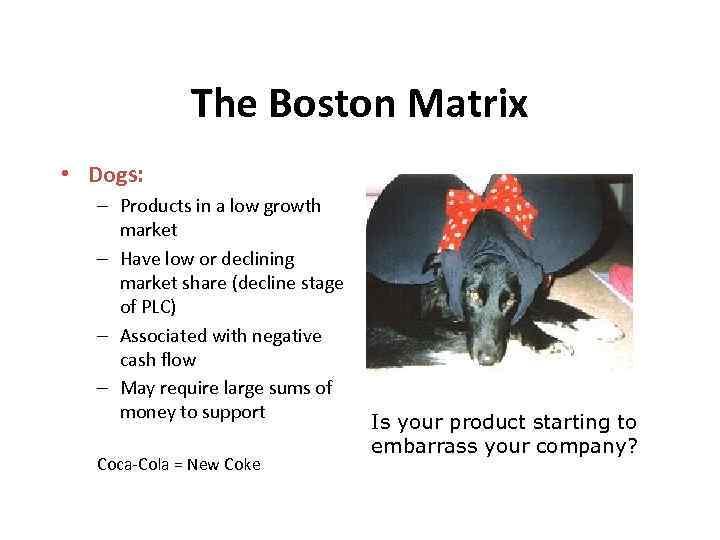
The Boston Matrix • Dogs: – Products in a low growth market – Have low or declining market share (decline stage of PLC) – Associated with negative cash flow – May require large sums of money to support Coca-Cola = New Coke Is your product starting to embarrass your company?
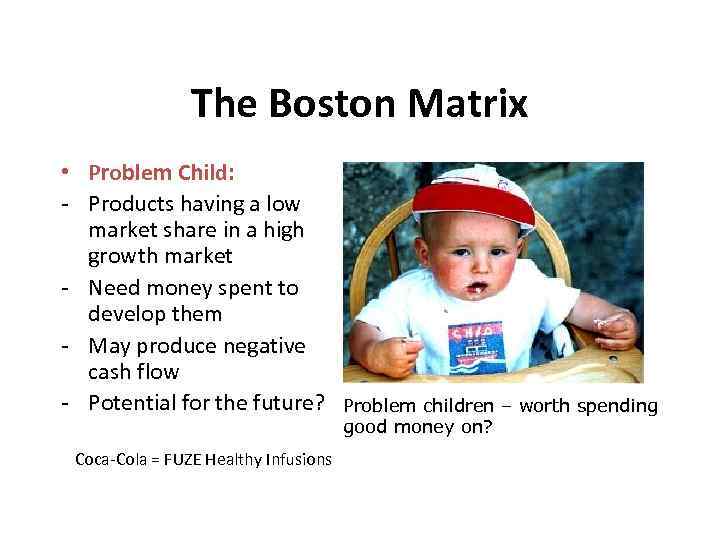
The Boston Matrix • Problem Child: - Products having a low market share in a high growth market - Need money spent to develop them - May produce negative cash flow - Potential for the future? Coca-Cola = FUZE Healthy Infusions Problem children – worth spending good money on?
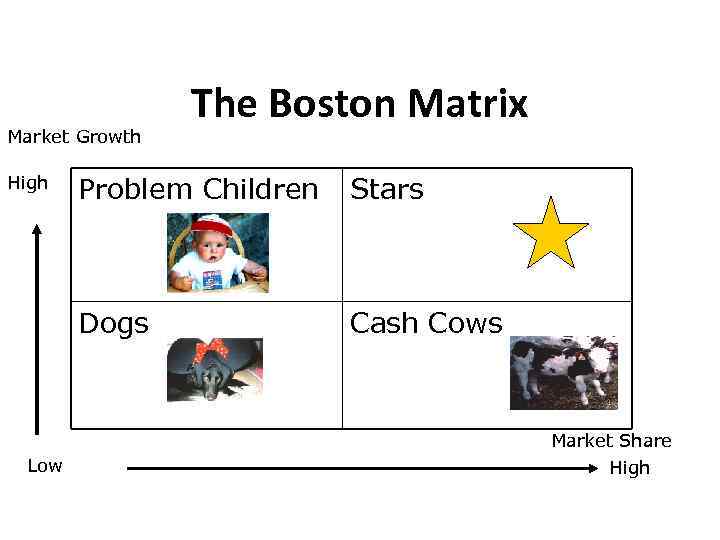
Market Growth High The Boston Matrix Stars Dogs Low Problem Children Cash Cows Market Share High
The Boston Matrix • Implications: • Dogs: Are they worth persevering with? How much are they costing? Could they be revived in some way? How much would it cost to continue to support such products? – How much would it cost to remove from the market? – –
The Boston Matrix • Implications: • Problem Children: – What are the chances of these products securing a hold in the market? – How much will it cost to promote them to a stronger position? – Is it worth it?
The Boston Matrix • Implications: • Stars: – Huge potential – May have been expensive to develop – Worth spending money to promote – Consider the extent of their product life cycle in decision making
The Boston Matrix • Implications: • Cash Cows: – Cheap to promote – Generate large amounts of cash – use for further R&D? – Costs of developing and promoting have largely gone – Need to monitor their performance – the long term? – At the maturity stage of the PLC?
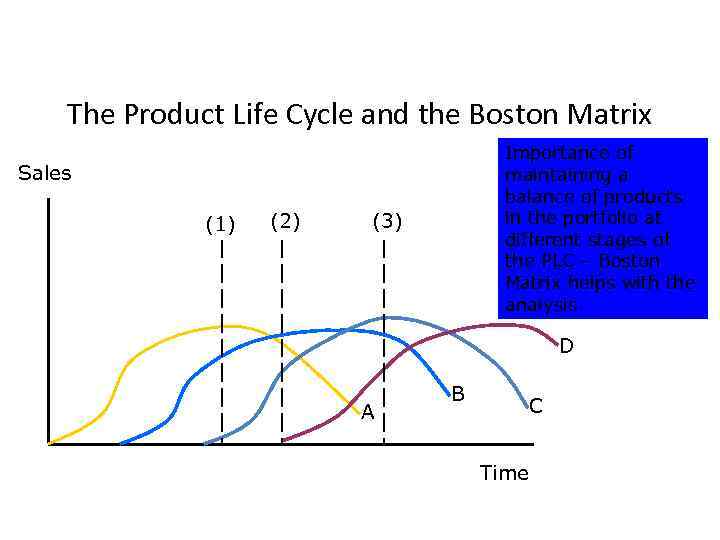
The Product Life Cycle and the Boston Matrix Importance of (3) Cash from ‘C’ (2) ‘A’ is at maturity maintaining a (1) Cash from ‘B’ The product used tocash cow. ‘C’ balance support used to of products stage – supportfolio –‘D’ and four growth of funds for in the portfolio at Generates through growth products to finance possibly stages of different in the of the development stage and to portfolio Boston the PLC ‘D’. strategy extension ‘A’ now ‘D’ launch – Matrix helps with the for ‘B’? a dog? possibly analysis Sales (1) (2) (3) D A B C Time
 Скачать презентацию Four types of marketing strategies Done by Abdrakhman
Презентация1.pptx