


 Скачать презентацию Foundations of Technology Third Edition Technology Engineering and
b26fc7780f9499ddb8ae35e34c2dcd1e.ppt
- Количество слайдов: 22
 Foundations of Technology, Third Edition/ Technology, Engineering, and Design Presentation 2. 2. 1 © 2011 International Technology and Engineering Educators Association STEM Center for Teaching and Learning™ Foundations of Technology, Third Edition/ Technology, Engineering, and Design
 The Big Idea Technology is in a constant state of change as humans continue to improve and innovate “old” technologies for “new” applications. © 2011 International Technology and Engineering Educators Association STEM Center for Teaching and Learning™ Foundations of Technology, Third Edition/ Technology, Engineering, and Design
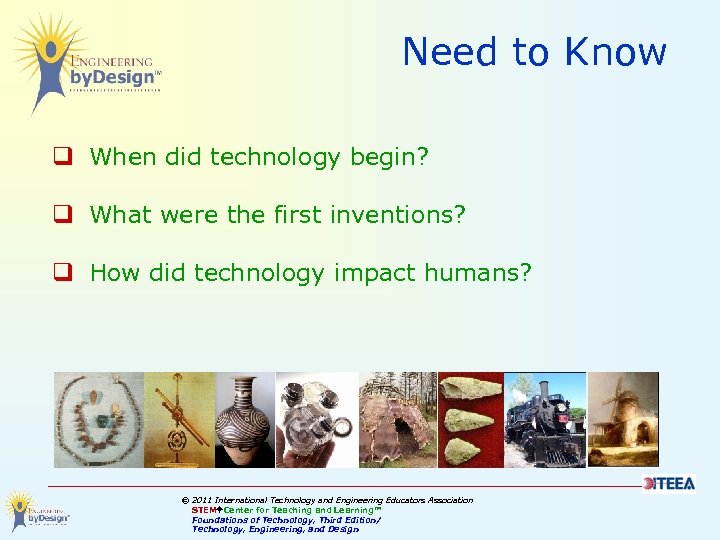 Need to Know q When did technology begin? q What were the first inventions? q How did technology impact humans? © 2011 International Technology and Engineering Educators Association STEM Center for Teaching and Learning™ Foundations of Technology, Third Edition/ Technology, Engineering, and Design
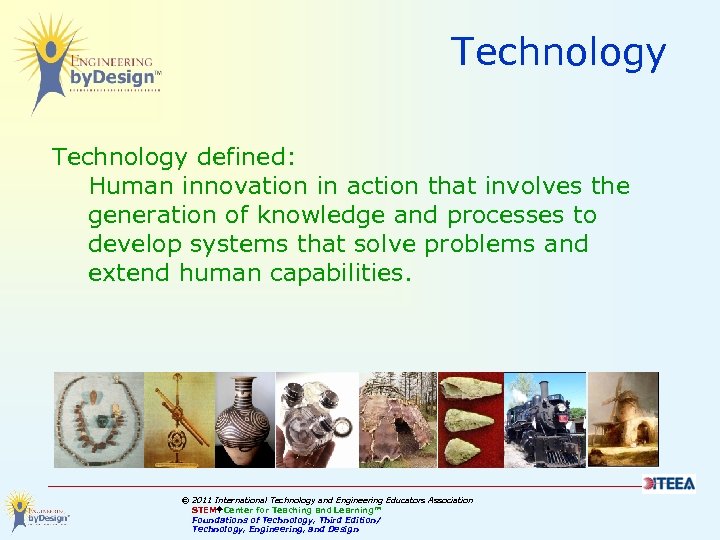 Technology defined: Human innovation in action that involves the generation of knowledge and processes to develop systems that solve problems and extend human capabilities. © 2011 International Technology and Engineering Educators Association STEM Center for Teaching and Learning™ Foundations of Technology, Third Edition/ Technology, Engineering, and Design
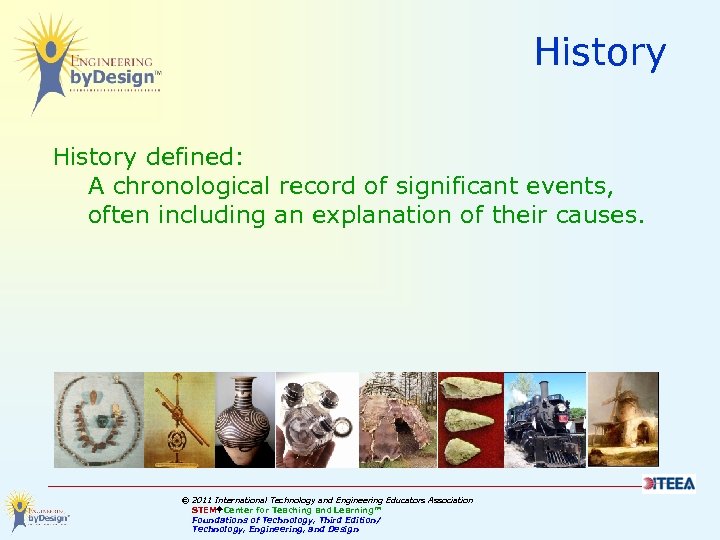 History defined: A chronological record of significant events, often including an explanation of their causes. © 2011 International Technology and Engineering Educators Association STEM Center for Teaching and Learning™ Foundations of Technology, Third Edition/ Technology, Engineering, and Design
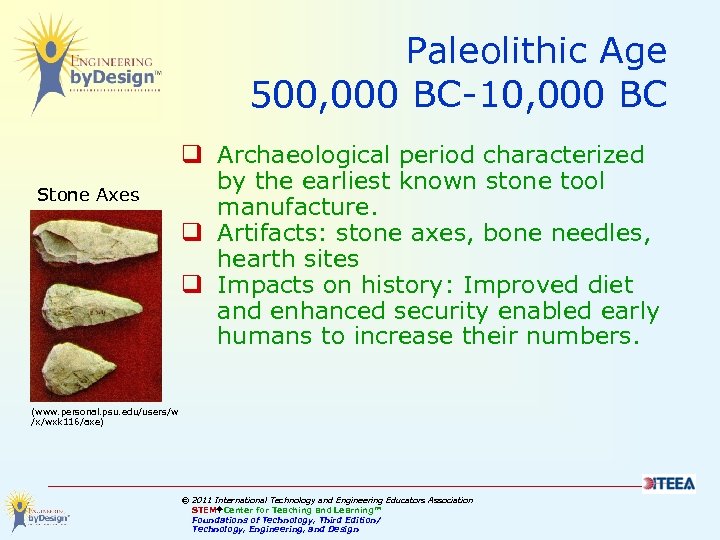 Paleolithic Age 500, 000 BC-10, 000 BC Stone Axes q Archaeological period characterized by the earliest known stone tool manufacture. q Artifacts: stone axes, bone needles, hearth sites q Impacts on history: Improved diet and enhanced security enabled early humans to increase their numbers. (www. personal. psu. edu/users/w /x/wxk 116/axe) © 2011 International Technology and Engineering Educators Association STEM Center for Teaching and Learning™ Foundations of Technology, Third Edition/ Technology, Engineering, and Design
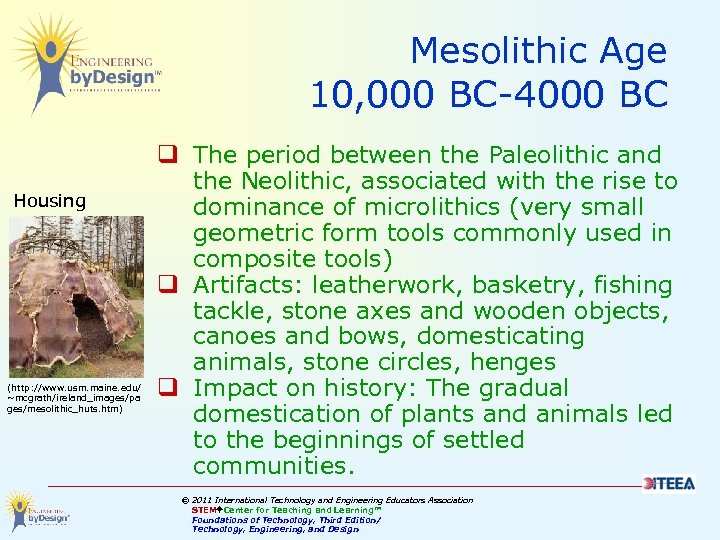 Mesolithic Age 10, 000 BC-4000 BC Housing (http: //www. usm. maine. edu/ ~mcgrath/ireland_images/pa ges/mesolithic_huts. htm) q The period between the Paleolithic and the Neolithic, associated with the rise to dominance of microlithics (very small geometric form tools commonly used in composite tools) q Artifacts: leatherwork, basketry, fishing tackle, stone axes and wooden objects, canoes and bows, domesticating animals, stone circles, henges q Impact on history: The gradual domestication of plants and animals led to the beginnings of settled communities. © 2011 International Technology and Engineering Educators Association STEM Center for Teaching and Learning™ Foundations of Technology, Third Edition/ Technology, Engineering, and Design
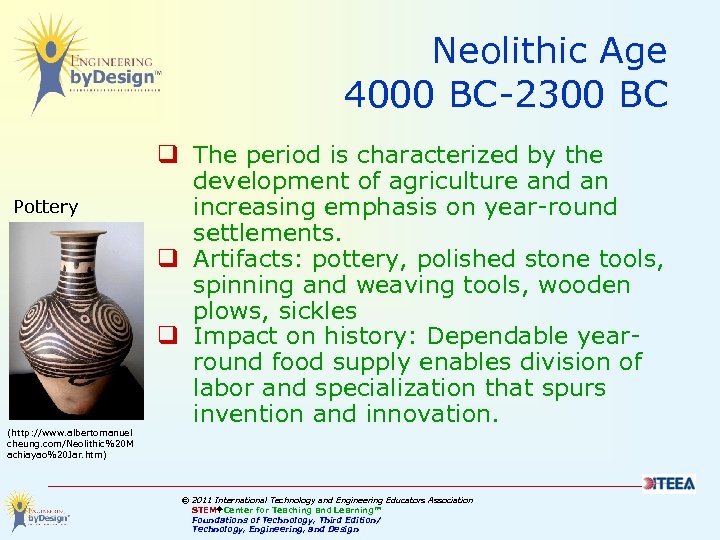 Neolithic Age 4000 BC-2300 BC Pottery (http: //www. albertomanuel cheung. com/Neolithic%20 M achiayao%20 Jar. htm) q The period is characterized by the development of agriculture and an increasing emphasis on year-round settlements. q Artifacts: pottery, polished stone tools, spinning and weaving tools, wooden plows, sickles q Impact on history: Dependable yearround food supply enables division of labor and specialization that spurs invention and innovation. © 2011 International Technology and Engineering Educators Association STEM Center for Teaching and Learning™ Foundations of Technology, Third Edition/ Technology, Engineering, and Design
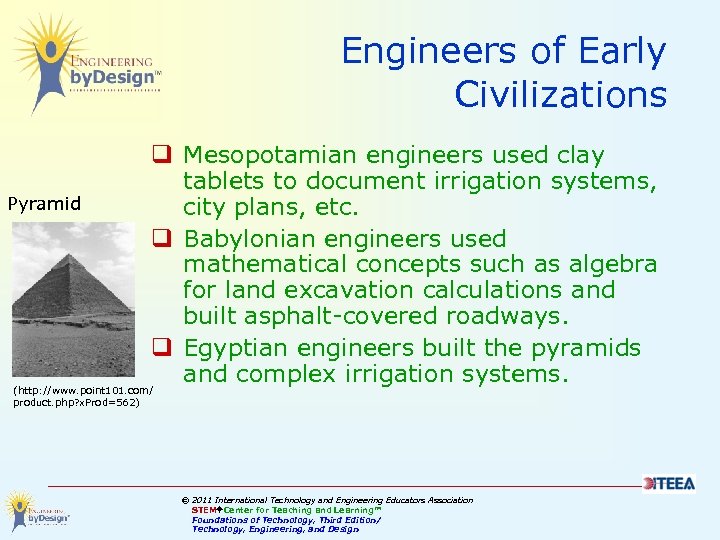 Engineers of Early Civilizations q Mesopotamian engineers used clay tablets to document irrigation systems, Pyramid city plans, etc. q Babylonian engineers used mathematical concepts such as algebra for land excavation calculations and built asphalt-covered roadways. q Egyptian engineers built the pyramids and complex irrigation systems. (http: //www. point 101. com/ product. php? x. Prod=562) © 2011 International Technology and Engineering Educators Association STEM Center for Teaching and Learning™ Foundations of Technology, Third Edition/ Technology, Engineering, and Design
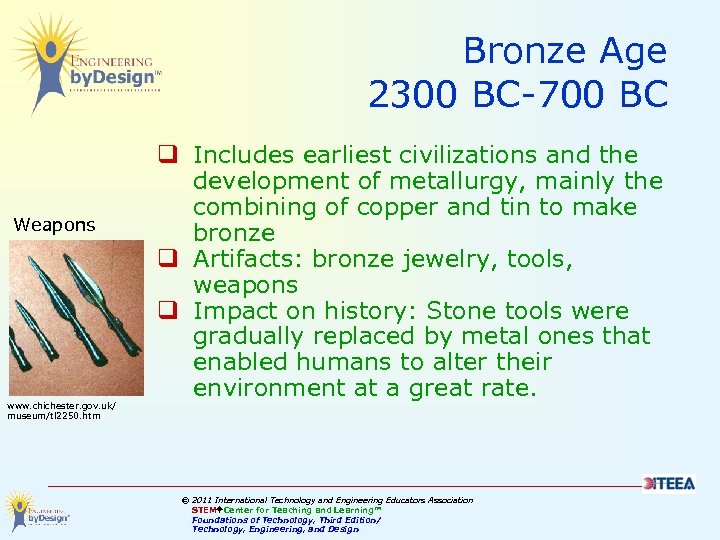 Bronze Age 2300 BC-700 BC Weapons www. chichester. gov. uk/ museum/tl 2250. htm) q Includes earliest civilizations and the development of metallurgy, mainly the combining of copper and tin to make bronze q Artifacts: bronze jewelry, tools, weapons q Impact on history: Stone tools were gradually replaced by metal ones that enabled humans to alter their environment at a great rate. © 2011 International Technology and Engineering Educators Association STEM Center for Teaching and Learning™ Foundations of Technology, Third Edition/ Technology, Engineering, and Design
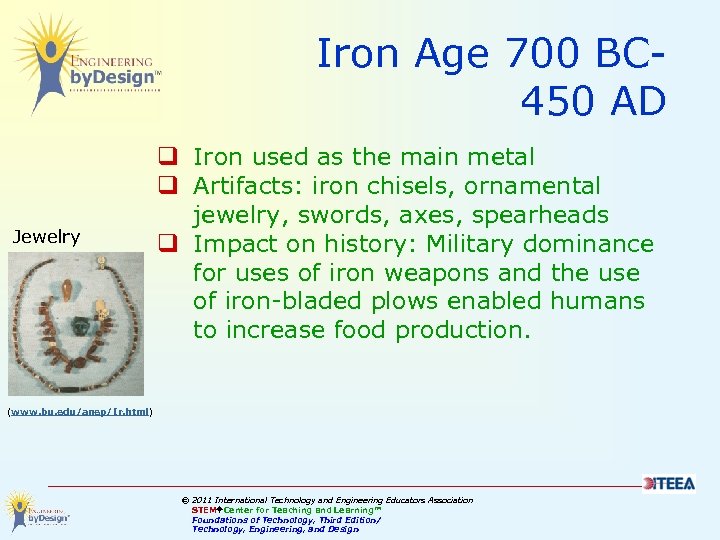 Iron Age 700 BC 450 AD Jewelry q Iron used as the main metal q Artifacts: iron chisels, ornamental jewelry, swords, axes, spearheads q Impact on history: Military dominance for uses of iron weapons and the use of iron-bladed plows enabled humans to increase food production. (www. bu. edu/anep/Ir. html) © 2011 International Technology and Engineering Educators Association STEM Center for Teaching and Learning™ Foundations of Technology, Third Edition/ Technology, Engineering, and Design
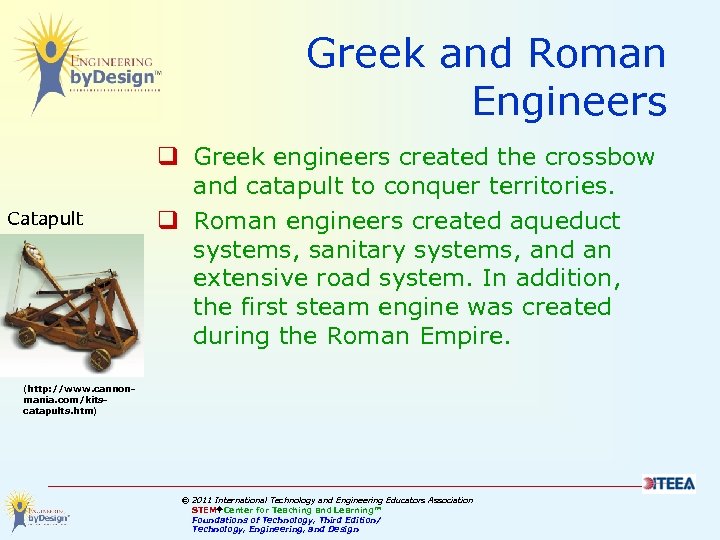 Greek and Roman Engineers Catapult q Greek engineers created the crossbow and catapult to conquer territories. q Roman engineers created aqueduct systems, sanitary systems, and an extensive road system. In addition, the first steam engine was created during the Roman Empire. (http: //www. cannonmania. com/kitscatapults. htm) © 2011 International Technology and Engineering Educators Association STEM Center for Teaching and Learning™ Foundations of Technology, Third Edition/ Technology, Engineering, and Design
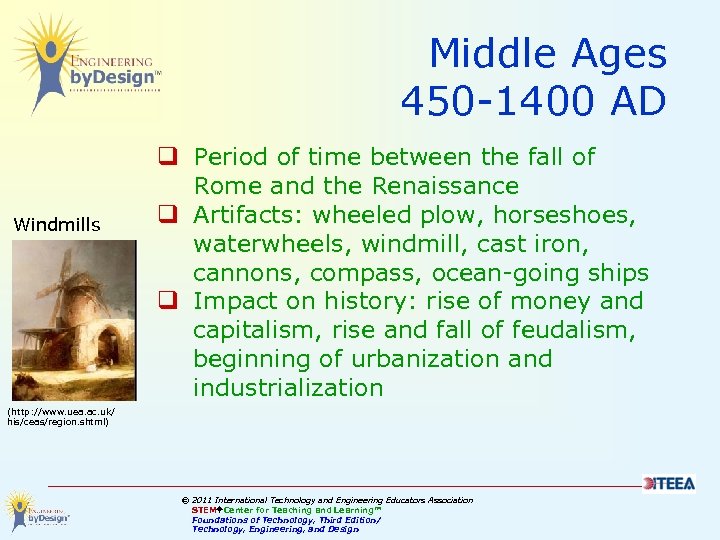 Middle Ages 450 -1400 AD Windmills q Period of time between the fall of Rome and the Renaissance q Artifacts: wheeled plow, horseshoes, waterwheels, windmill, cast iron, cannons, compass, ocean-going ships q Impact on history: rise of money and capitalism, rise and fall of feudalism, beginning of urbanization and industrialization (http: //www. uea. ac. uk/ his/ceas/region. shtml) © 2011 International Technology and Engineering Educators Association STEM Center for Teaching and Learning™ Foundations of Technology, Third Edition/ Technology, Engineering, and Design
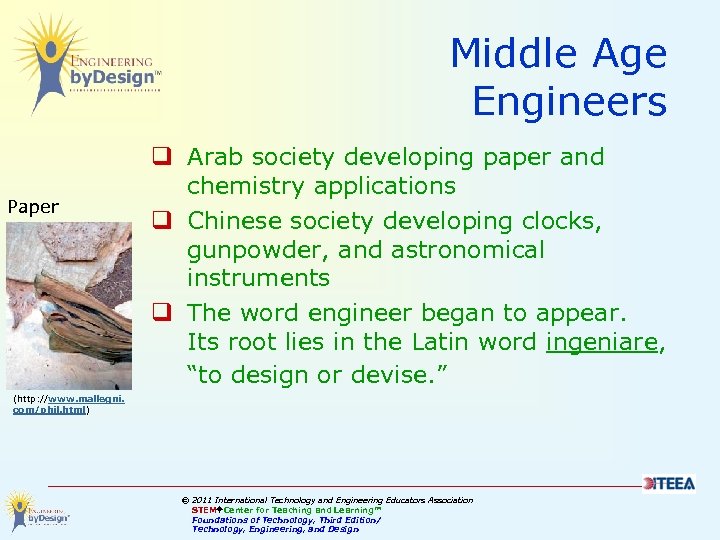 Middle Age Engineers Paper q Arab society developing paper and chemistry applications q Chinese society developing clocks, gunpowder, and astronomical instruments q The word engineer began to appear. Its root lies in the Latin word ingeniare, “to design or devise. ” (http: //www. mallegni. com/phil. html) © 2011 International Technology and Engineering Educators Association STEM Center for Teaching and Learning™ Foundations of Technology, Third Edition/ Technology, Engineering, and Design
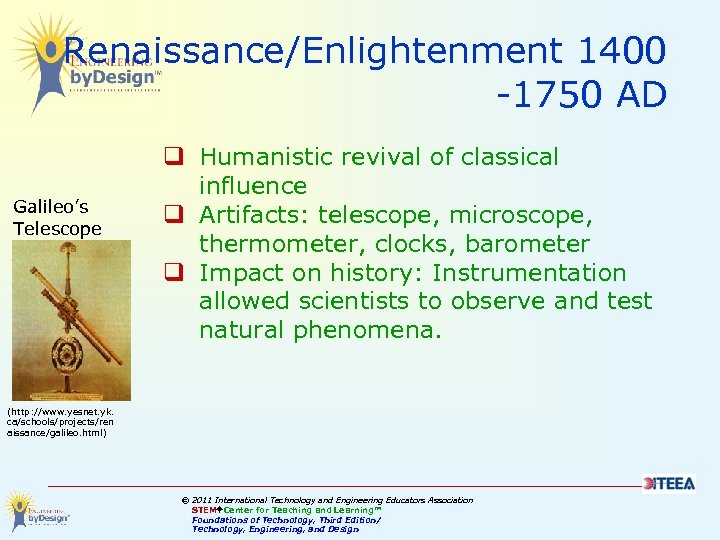 Renaissance/Enlightenment 1400 -1750 AD Galileo’s Telescope q Humanistic revival of classical influence q Artifacts: telescope, microscope, thermometer, clocks, barometer q Impact on history: Instrumentation allowed scientists to observe and test natural phenomena. (http: //www. yesnet. yk. ca/schools/projects/ren aissance/galileo. html) © 2011 International Technology and Engineering Educators Association STEM Center for Teaching and Learning™ Foundations of Technology, Third Edition/ Technology, Engineering, and Design
 da Vinci Leonardo was born in Italy in 1452. Beginning his career as an artist, painting and sculpting, he was soon put to work designing weapons, buildings, and machinery. See the interactive site below for some of his discoveries. Exploring Leonardo: http: //www. mos. org/sln/Leonardo/ © 2011 International Technology and Engineering Educators Association STEM Center for Teaching and Learning™ Foundations of Technology, Third Edition/ Technology, Engineering, and Design
 Galileo was born in Italy in 1564. Throughout his career, Galileo discovered many physics properties. See the interactive sites below for some of his discoveries. Experiments: http: //www. pbs. org/wgbh/nova/galileo/experiments. html Link to video from NOVA program on Galileo: http: //www. pbs. org/wgbh/nova/galileo/science. html © 2011 International Technology and Engineering Educators Association STEM Center for Teaching and Learning™ Foundations of Technology, Third Edition/ Technology, Engineering, and Design
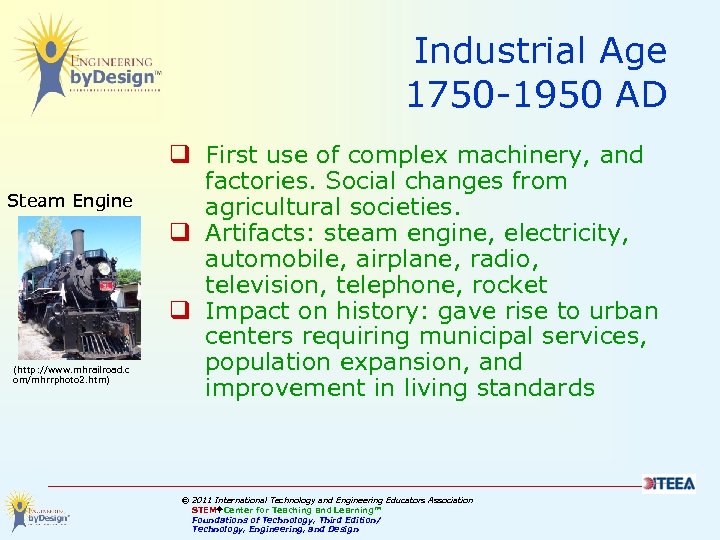 Industrial Age 1750 -1950 AD Steam Engine (http: //www. mhrailroad. c om/mhrrphoto 2. htm) q First use of complex machinery, and factories. Social changes from agricultural societies. q Artifacts: steam engine, electricity, automobile, airplane, radio, television, telephone, rocket q Impact on history: gave rise to urban centers requiring municipal services, population expansion, and improvement in living standards © 2011 International Technology and Engineering Educators Association STEM Center for Teaching and Learning™ Foundations of Technology, Third Edition/ Technology, Engineering, and Design
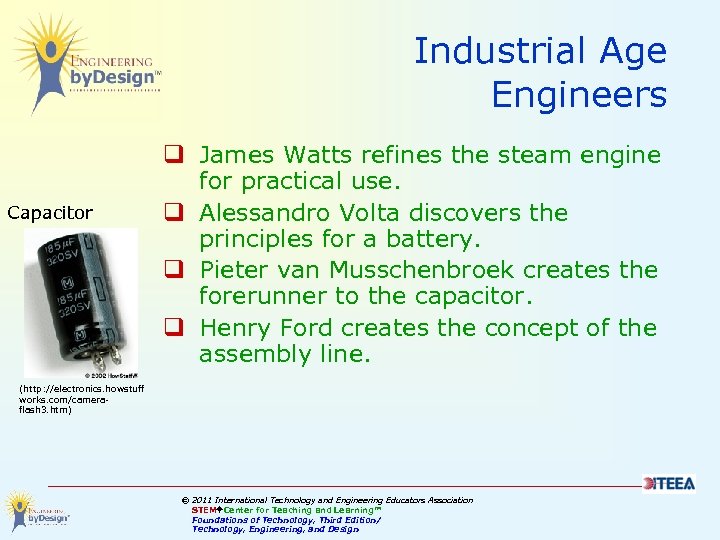 Industrial Age Engineers Capacitor q James Watts refines the steam engine for practical use. q Alessandro Volta discovers the principles for a battery. q Pieter van Musschenbroek creates the forerunner to the capacitor. q Henry Ford creates the concept of the assembly line. (http: //electronics. howstuff works. com/cameraflash 3. htm) © 2011 International Technology and Engineering Educators Association STEM Center for Teaching and Learning™ Foundations of Technology, Third Edition/ Technology, Engineering, and Design
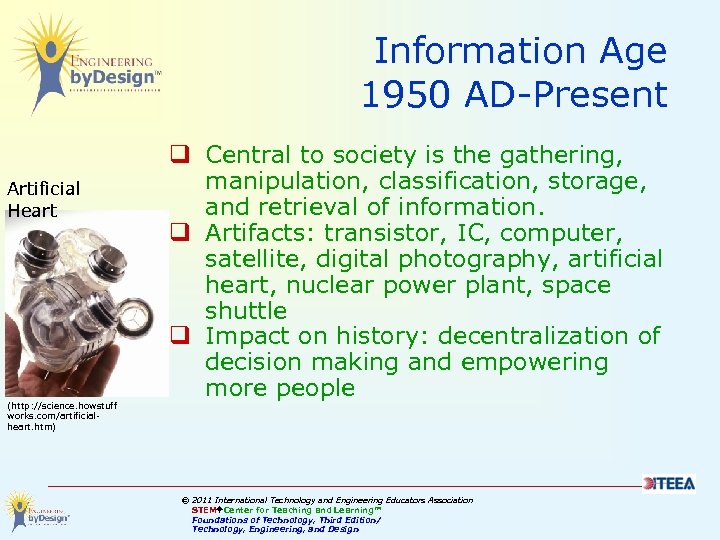 Information Age 1950 AD-Present Artificial Heart (http: //science. howstuff works. com/artificialheart. htm) q Central to society is the gathering, manipulation, classification, storage, and retrieval of information. q Artifacts: transistor, IC, computer, satellite, digital photography, artificial heart, nuclear power plant, space shuttle q Impact on history: decentralization of decision making and empowering more people © 2011 International Technology and Engineering Educators Association STEM Center for Teaching and Learning™ Foundations of Technology, Third Edition/ Technology, Engineering, and Design
 Resources Text information taken from Foundations of Technology draft document, International Technology and Engineering Educators Association (formerly ITEA), CATTS © 2011 International Technology and Engineering Educators Association STEM Center for Teaching and Learning™ Foundations of Technology, Third Edition/ Technology, Engineering, and Design
 References Text Needed © 2011 International Technology and Engineering Educators Association STEM Center for Teaching and Learning™ Foundations of Technology, Third Edition/ Technology, Engineering, and Design