 Скачать презентацию Foundations of Network and Computer Security John Black
d1e5fd742fd990e8b389e479a56b3006.ppt
- Количество слайдов: 40



Foundations of Network and Computer Security John Black Lecture #9 Sep 22 nd 2005 CSCI 6268/TLEN 5831, Fall 2005

Announcements • Midterm #1, next class (Tues, Sept 27 th) – All lecture materials and readings through today – Full 1: 15 class period – Same difficulty as quiz, but twice as long • Exams are closed notes, calculators allowed • Remember to consult the class calendar
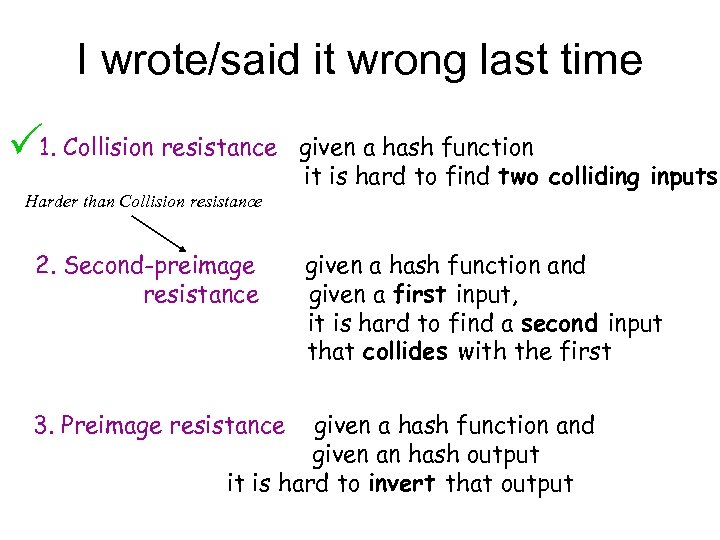
I wrote/said it wrong last time P 1. Collision resistance Harder than Collision resistance 2. Second-preimage resistance 3. Preimage resistance given a hash function it is hard to find two colliding inputs given a hash function and given a first input, it is hard to find a second input that collides with the first given a hash function and given an hash output it is hard to invert that output
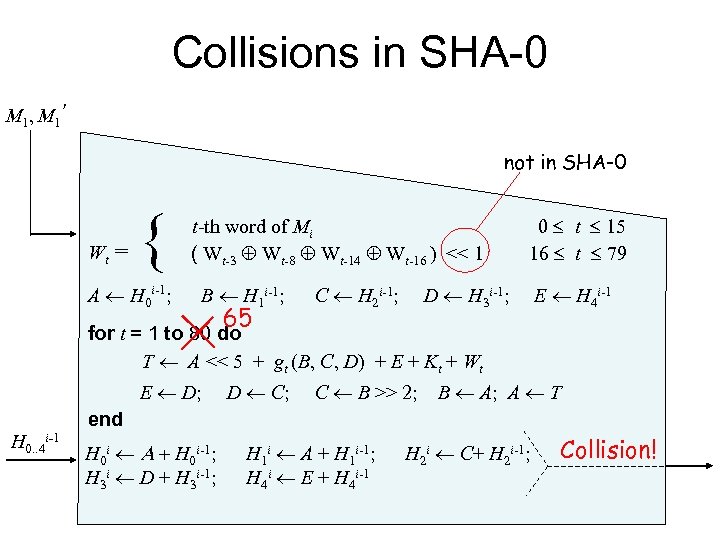
Collisions in SHA-0 M 1 , M 1 ’ not in SHA-0 Wt = { A ¬ H 0 i-1; t-th word of Mi ( Wt-3 Å Wt-8 Å Wt-14 Å Wt-16 ) << 1 B ¬ H 1 i-1; 65 C ¬ H 2 i-1; 0 £ t £ 15 16 £ t £ 79 D ¬ H 3 i-1; E ¬ H 4 i-1 for t = 1 to 80 do T ¬ A << 5 + gt (B, C, D) + E + Kt + Wt E ¬ D; D ¬ C; C ¬ B >> 2; B ¬ A; A ¬ T end H 0. . 4 i-1 H 0 i ¬ A + H 0 i-1; H 3 i ¬ D + H 3 i-1; H 1 i ¬ A + H 1 i-1; H 4 i ¬ E + H 4 i-1 H 2 i ¬ C+ H 2 i-1; Collision!
What Does this Mean? • Who knows – Methods are not yet completely understood – Will undoubtedly be extended to more attacks – But maybe everything will come tumbling down? ! • But we have OTHER ways to build hash functions
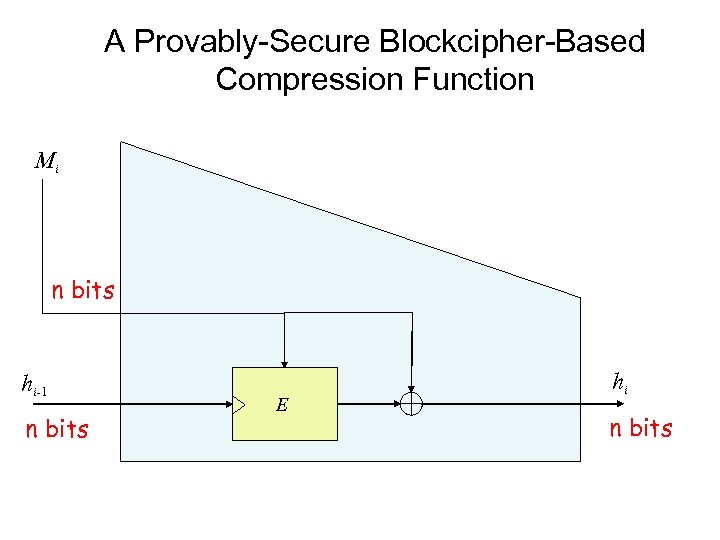
A Provably-Secure Blockcipher-Based Compression Function Mi n bits hi-1 n bits E hi n bits
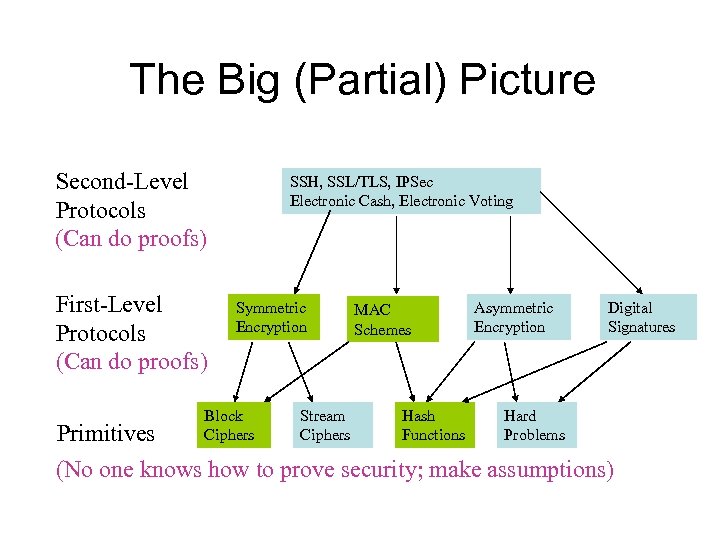
The Big (Partial) Picture Second-Level Protocols (Can do proofs) First-Level Protocols (Can do proofs) SSH, SSL/TLS, IPSec Electronic Cash, Electronic Voting Symmetric Encryption Block Ciphers Stream Ciphers MAC Schemes Hash Functions Asymmetric Encryption Hard Problems Digital Signatures Primitives (No one knows how to prove security; make assumptions)
Symmetric vs. Asymmetric • Thus far we have been in the symmetric key model – We have assumed that Alice and Bob share some random secret string – In practice, this is a big limitation • Bootstrap problem • Forces Alice and Bob to meet in person or use some mechanism outside our protocol • Not practical when you want to buy books at Amazon • We need the Asymmetric Key model!
Asymmetric Cryptography • In this model, we no longer require an initial shared key – First envisioned by Diffie in the late 70’s – Some thought it was impossible – MI 6 purportedly already knew a method – Diffie-Hellman key exchange was first public system • Later turned into El Gamal public-key system – RSA system announced shortly thereafter
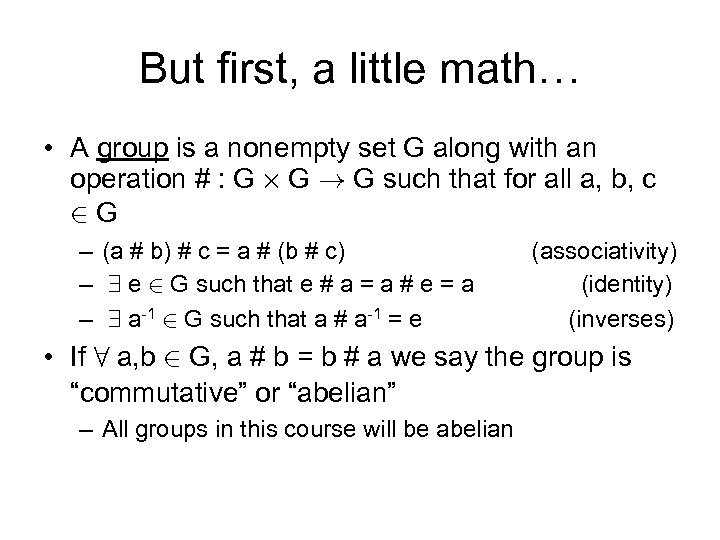
But first, a little math… • A group is a nonempty set G along with an operation # : G £ G ! G such that for all a, b, c 2 G – (a # b) # c = a # (b # c) – 9 e 2 G such that e # a = a # e = a – 9 a-1 2 G such that a # a-1 = e (associativity) (identity) (inverses) • If 8 a, b 2 G, a # b = b # a we say the group is “commutative” or “abelian” – All groups in this course will be abelian
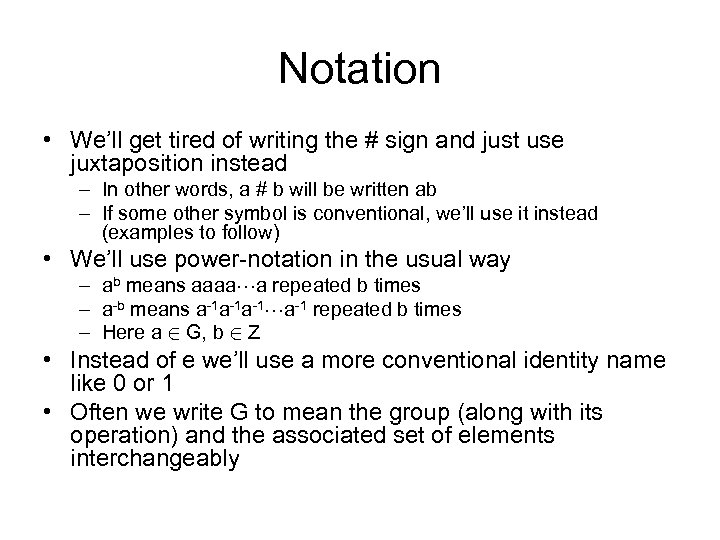
Notation • We’ll get tired of writing the # sign and just use juxtaposition instead – In other words, a # b will be written ab – If some other symbol is conventional, we’ll use it instead (examples to follow) • We’ll use power-notation in the usual way – ab means aaaa a repeated b times – a-b means a-1 a-1 a-1 repeated b times – Here a 2 G, b 2 Z • Instead of e we’ll use a more conventional identity name like 0 or 1 • Often we write G to mean the group (along with its operation) and the associated set of elements interchangeably
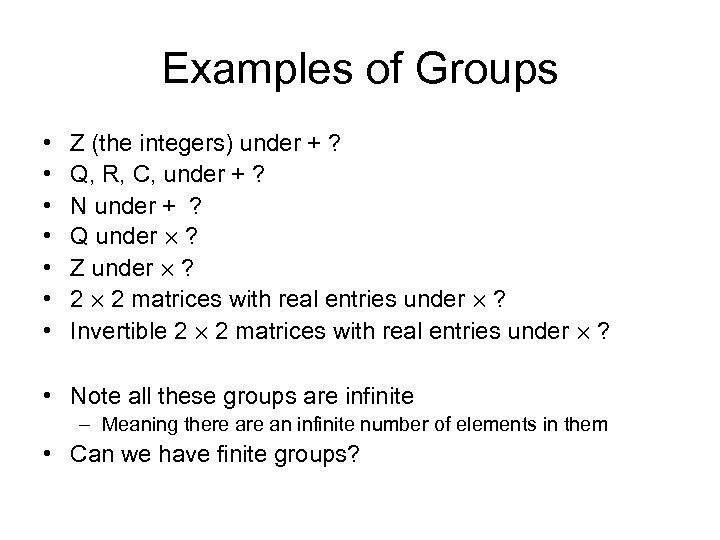
Examples of Groups • • Z (the integers) under + ? Q, R, C, under + ? N under + ? Q under £ ? Z under £ ? 2 £ 2 matrices with real entries under £ ? Invertible 2 £ 2 matrices with real entries under £ ? • Note all these groups are infinite – Meaning there an infinite number of elements in them • Can we have finite groups?
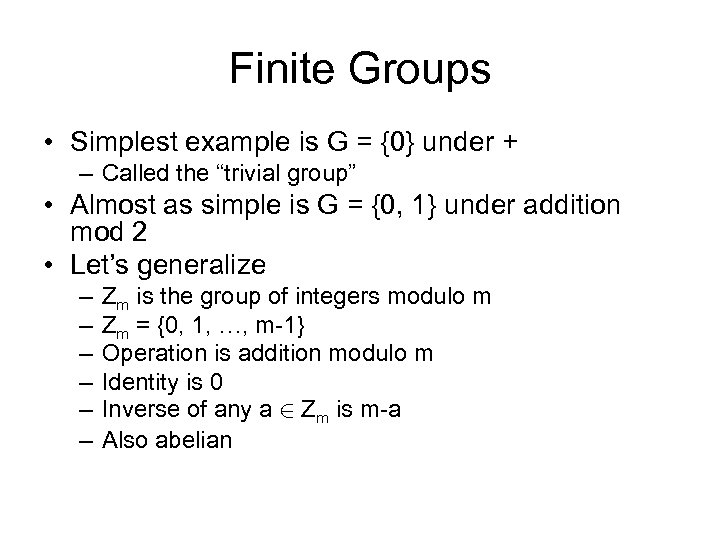
Finite Groups • Simplest example is G = {0} under + – Called the “trivial group” • Almost as simple is G = {0, 1} under addition mod 2 • Let’s generalize – – – Zm is the group of integers modulo m Zm = {0, 1, …, m-1} Operation is addition modulo m Identity is 0 Inverse of any a 2 Zm is m-a Also abelian
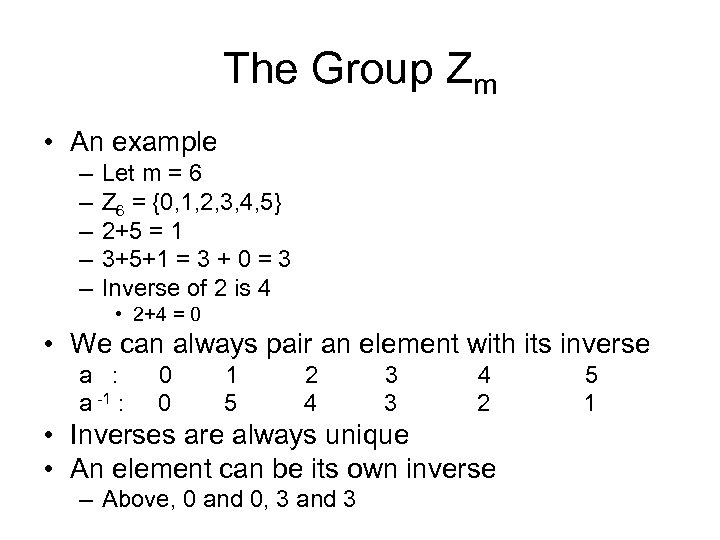
The Group Zm • An example – – – Let m = 6 Z 6 = {0, 1, 2, 3, 4, 5} 2+5 = 1 3+5+1 = 3 + 0 = 3 Inverse of 2 is 4 • 2+4 = 0 • We can always pair an element with its inverse a : a -1 : 0 0 1 5 2 4 3 3 4 2 • Inverses are always unique • An element can be its own inverse – Above, 0 and 0, 3 and 3 5 1
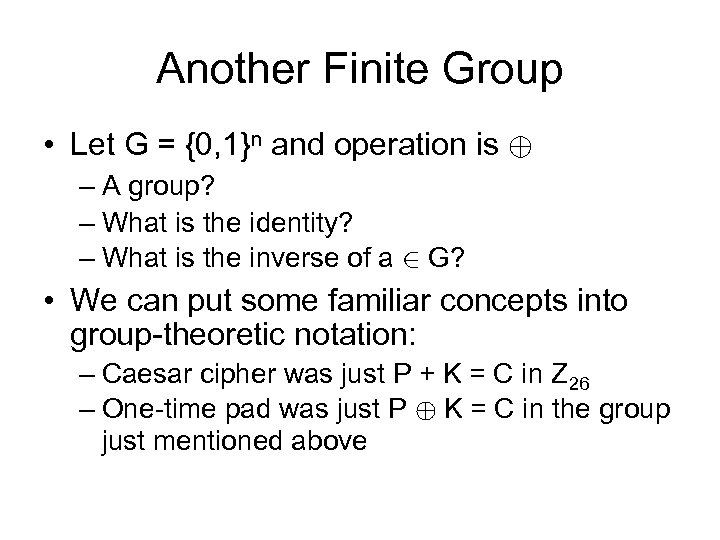
Another Finite Group • Let G = {0, 1}n and operation is © – A group? – What is the identity? – What is the inverse of a 2 G? • We can put some familiar concepts into group-theoretic notation: – Caesar cipher was just P + K = C in Z 26 – One-time pad was just P © K = C in the group just mentioned above
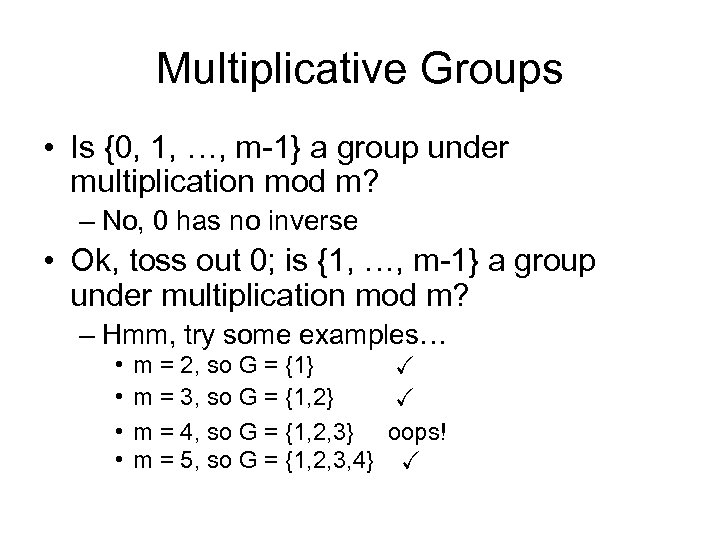
Multiplicative Groups • Is {0, 1, …, m-1} a group under multiplication mod m? – No, 0 has no inverse • Ok, toss out 0; is {1, …, m-1} a group under multiplication mod m? – Hmm, try some examples… • • m = 2, so G = {1} X m = 3, so G = {1, 2} X m = 4, so G = {1, 2, 3} oops! m = 5, so G = {1, 2, 3, 4} X
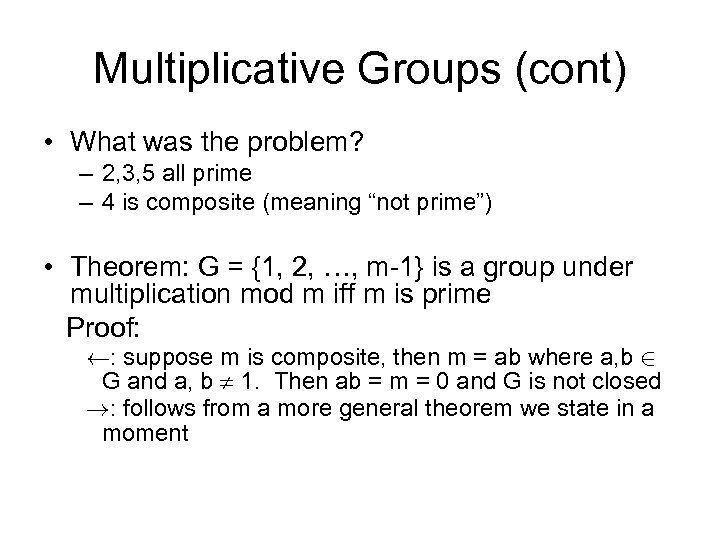
Multiplicative Groups (cont) • What was the problem? – 2, 3, 5 all prime – 4 is composite (meaning “not prime”) • Theorem: G = {1, 2, …, m-1} is a group under multiplication mod m iff m is prime Proof: Ã: suppose m is composite, then m = ab where a, b 2 G and a, b 1. Then ab = m = 0 and G is not closed !: follows from a more general theorem we state in a moment
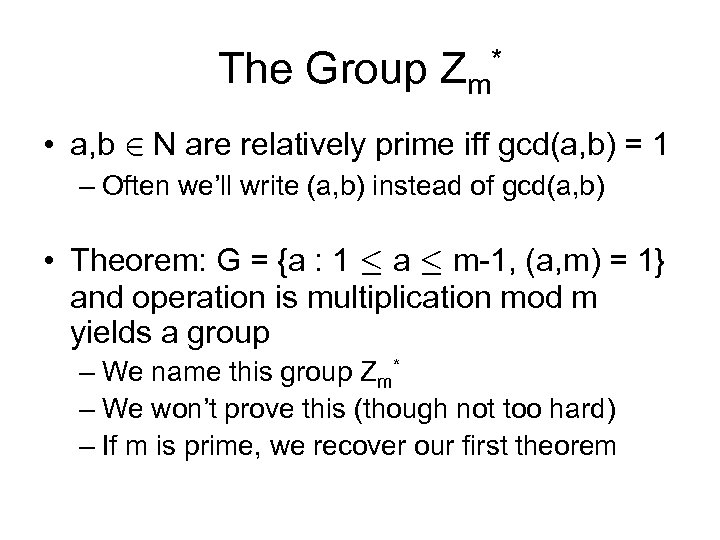
The Group Zm* • a, b 2 N are relatively prime iff gcd(a, b) = 1 – Often we’ll write (a, b) instead of gcd(a, b) • Theorem: G = {a : 1 · a · m-1, (a, m) = 1} and operation is multiplication mod m yields a group – We name this group Zm* – We won’t prove this (though not too hard) – If m is prime, we recover our first theorem
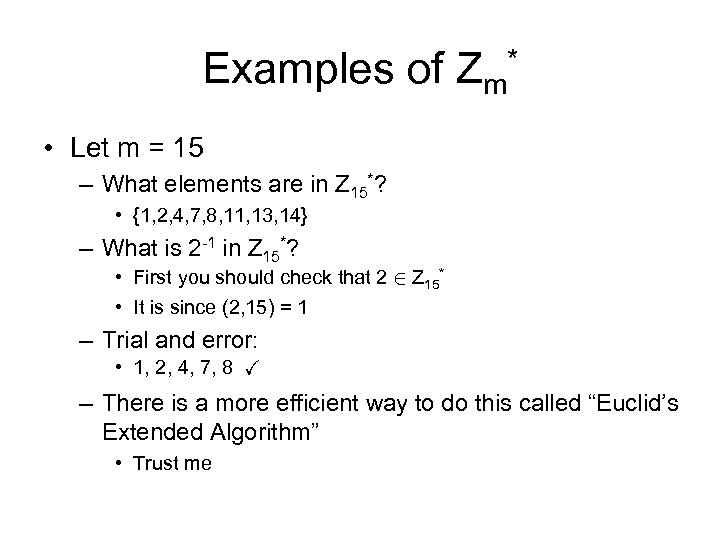
Examples of Zm* • Let m = 15 – What elements are in Z 15*? • {1, 2, 4, 7, 8, 11, 13, 14} – What is 2 -1 in Z 15*? • First you should check that 2 2 Z 15* • It is since (2, 15) = 1 – Trial and error: • 1, 2, 4, 7, 8 X – There is a more efficient way to do this called “Euclid’s Extended Algorithm” • Trust me
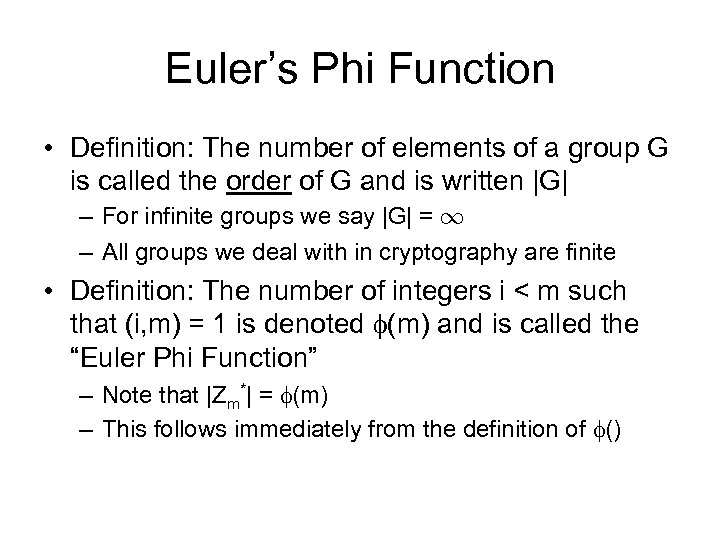
Euler’s Phi Function • Definition: The number of elements of a group G is called the order of G and is written |G| – For infinite groups we say |G| = 1 – All groups we deal with in cryptography are finite • Definition: The number of integers i < m such that (i, m) = 1 is denoted (m) and is called the “Euler Phi Function” – Note that |Zm*| = (m) – This follows immediately from the definition of ()
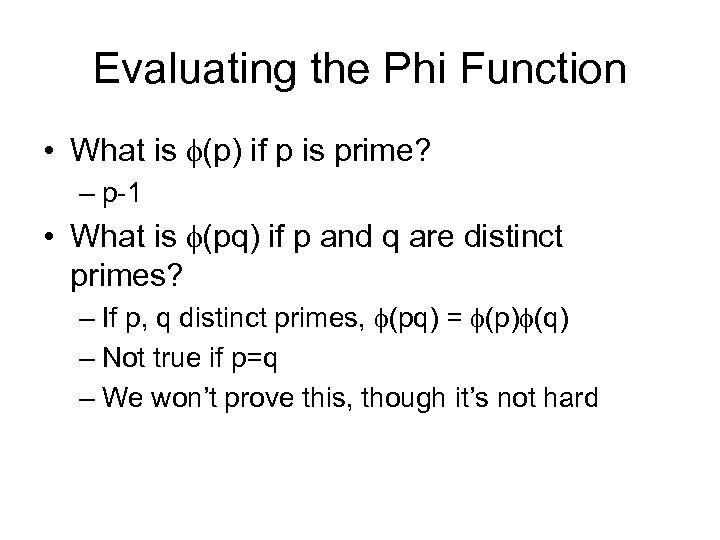
Evaluating the Phi Function • What is (p) if p is prime? – p-1 • What is (pq) if p and q are distinct primes? – If p, q distinct primes, (pq) = (p) (q) – Not true if p=q – We won’t prove this, though it’s not hard
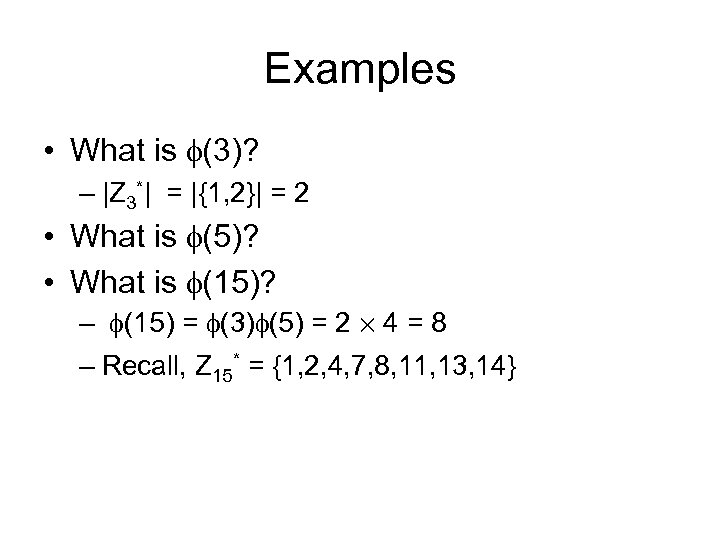
Examples • What is (3)? – |Z 3*| = |{1, 2}| = 2 • What is (5)? • What is (15)? – (15) = (3) (5) = 2 £ 4 = 8 – Recall, Z 15* = {1, 2, 4, 7, 8, 11, 13, 14}
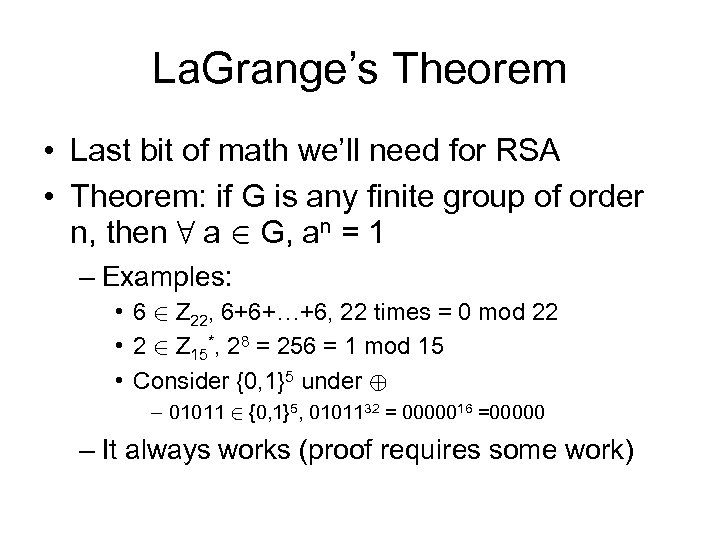
La. Grange’s Theorem • Last bit of math we’ll need for RSA • Theorem: if G is any finite group of order n, then 8 a 2 G, an = 1 – Examples: • 6 2 Z 22, 6+6+…+6, 22 times = 0 mod 22 • 2 2 Z 15*, 28 = 256 = 1 mod 15 • Consider {0, 1}5 under © – 01011 2 {0, 1}5, 0101132 = 0000016 =00000 – It always works (proof requires some work)
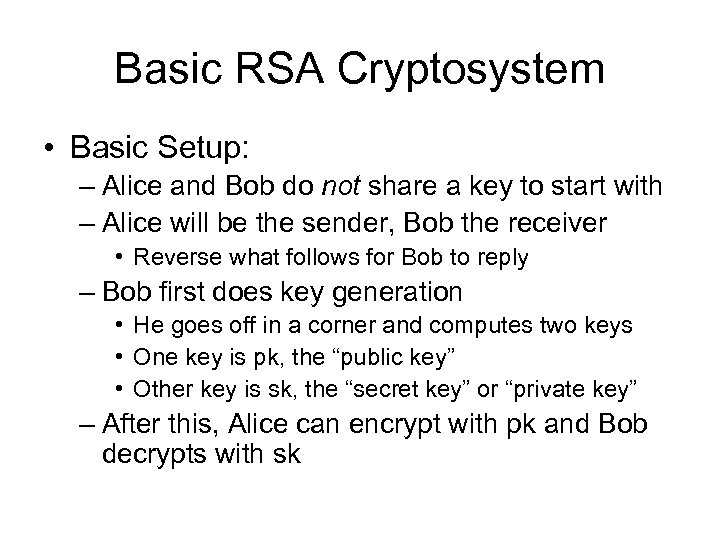
Basic RSA Cryptosystem • Basic Setup: – Alice and Bob do not share a key to start with – Alice will be the sender, Bob the receiver • Reverse what follows for Bob to reply – Bob first does key generation • He goes off in a corner and computes two keys • One key is pk, the “public key” • Other key is sk, the “secret key” or “private key” – After this, Alice can encrypt with pk and Bob decrypts with sk
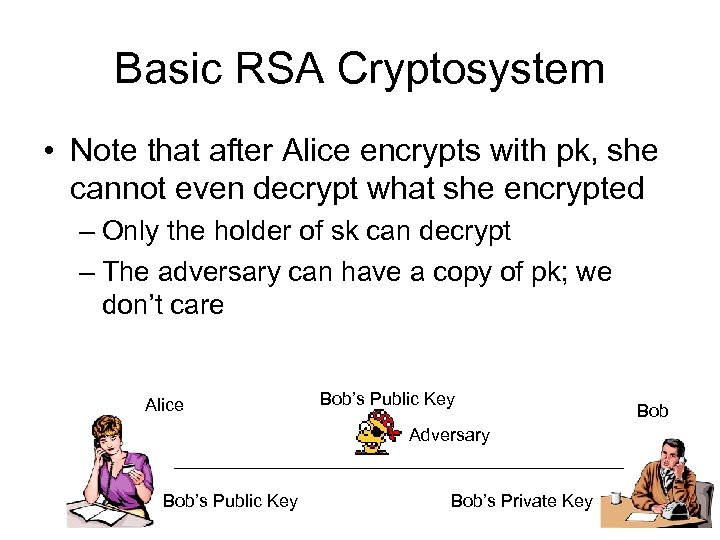
Basic RSA Cryptosystem • Note that after Alice encrypts with pk, she cannot even decrypt what she encrypted – Only the holder of sk can decrypt – The adversary can have a copy of pk; we don’t care Alice Bob’s Public Key Adversary Bob’s Public Key Bob’s Private Key Bob
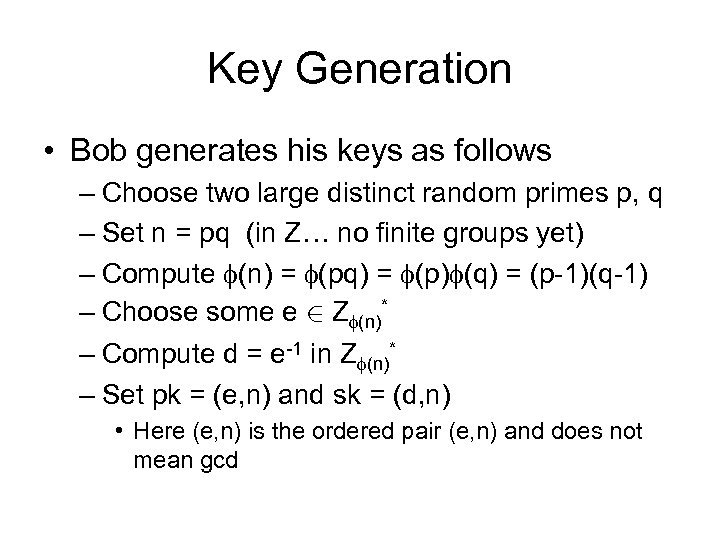
Key Generation • Bob generates his keys as follows – Choose two large distinct random primes p, q – Set n = pq (in Z… no finite groups yet) – Compute (n) = (pq) = (p) (q) = (p-1)(q-1) – Choose some e 2 Z (n)* – Compute d = e-1 in Z (n)* – Set pk = (e, n) and sk = (d, n) • Here (e, n) is the ordered pair (e, n) and does not mean gcd
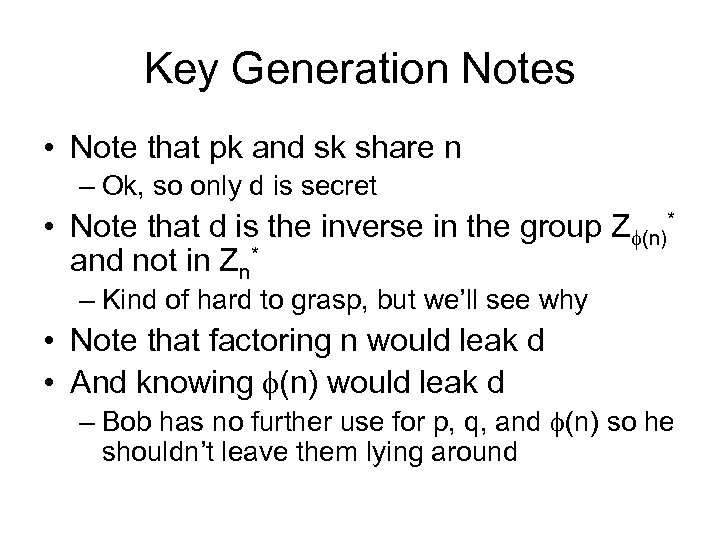
Key Generation Notes • Note that pk and sk share n – Ok, so only d is secret • Note that d is the inverse in the group Z (n)* and not in Zn* – Kind of hard to grasp, but we’ll see why • Note that factoring n would leak d • And knowing (n) would leak d – Bob has no further use for p, q, and (n) so he shouldn’t leave them lying around
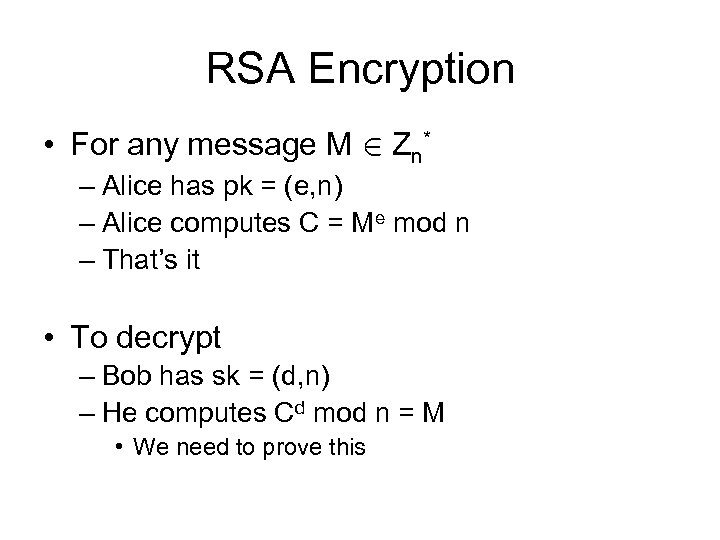
RSA Encryption • For any message M 2 Zn* – Alice has pk = (e, n) – Alice computes C = Me mod n – That’s it • To decrypt – Bob has sk = (d, n) – He computes Cd mod n = M • We need to prove this
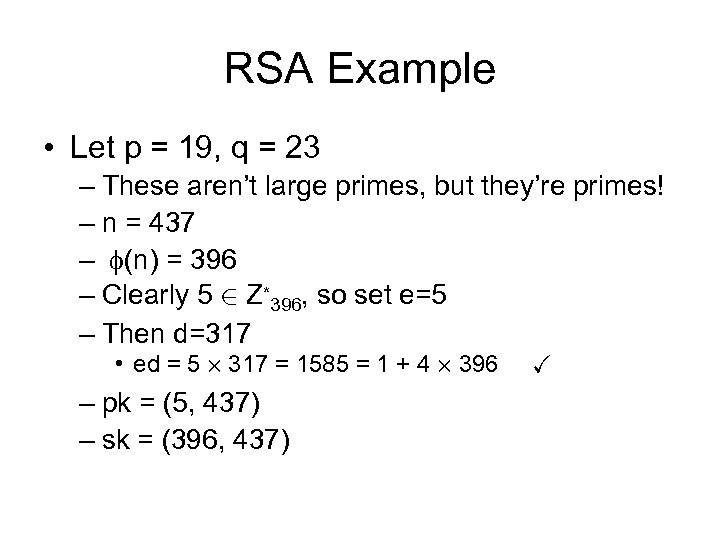
RSA Example • Let p = 19, q = 23 – These aren’t large primes, but they’re primes! – n = 437 – (n) = 396 – Clearly 5 2 Z*396, so set e=5 – Then d=317 • ed = 5 £ 317 = 1585 = 1 + 4 £ 396 – pk = (5, 437) – sk = (396, 437) X
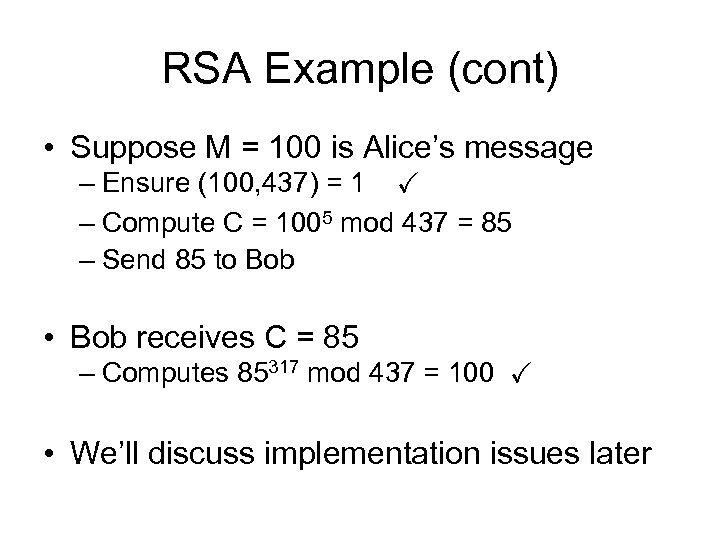
RSA Example (cont) • Suppose M = 100 is Alice’s message – Ensure (100, 437) = 1 X – Compute C = 1005 mod 437 = 85 – Send 85 to Bob • Bob receives C = 85 – Computes 85317 mod 437 = 100 X • We’ll discuss implementation issues later
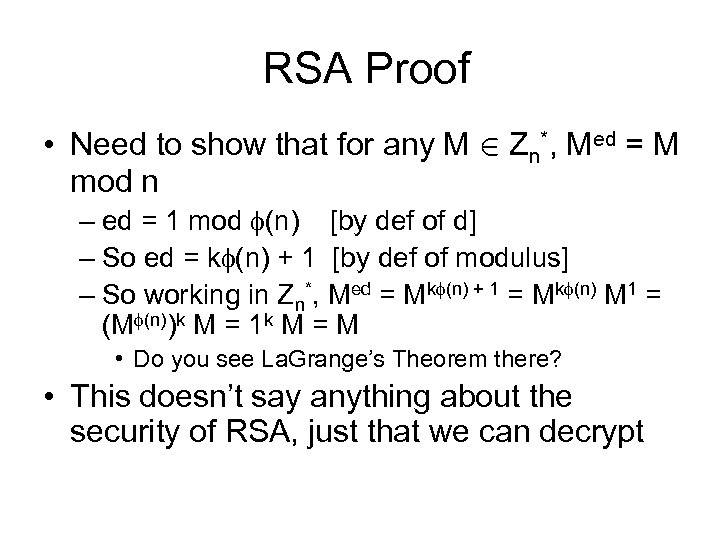
RSA Proof • Need to show that for any M 2 Zn*, Med = M mod n – ed = 1 mod (n) [by def of d] – So ed = k (n) + 1 [by def of modulus] – So working in Zn*, Med = Mk (n) + 1 = Mk (n) M 1 = (M (n))k M = 1 k M = M • Do you see La. Grange’s Theorem there? • This doesn’t say anything about the security of RSA, just that we can decrypt
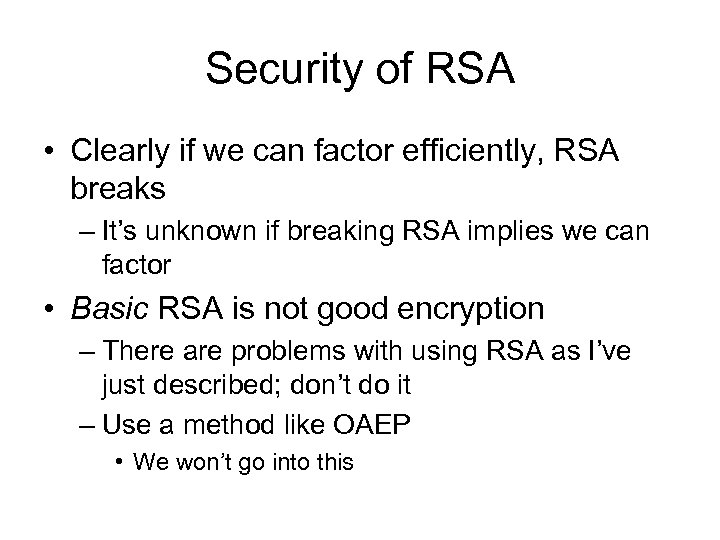
Security of RSA • Clearly if we can factor efficiently, RSA breaks – It’s unknown if breaking RSA implies we can factor • Basic RSA is not good encryption – There are problems with using RSA as I’ve just described; don’t do it – Use a method like OAEP • We won’t go into this
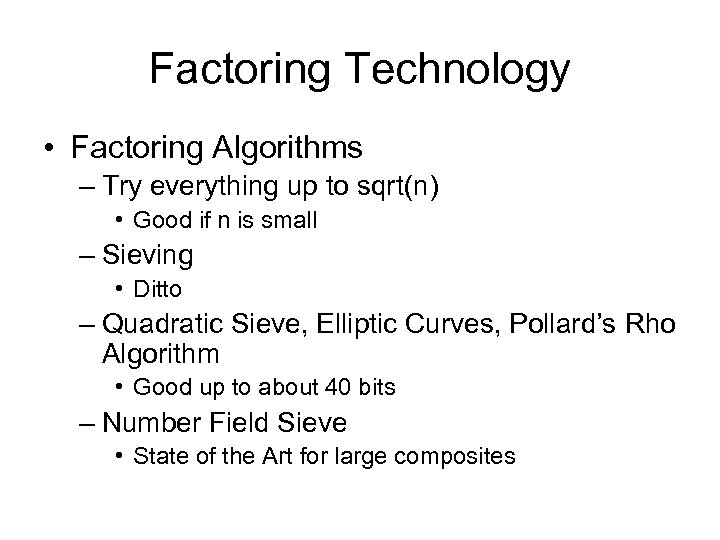
Factoring Technology • Factoring Algorithms – Try everything up to sqrt(n) • Good if n is small – Sieving • Ditto – Quadratic Sieve, Elliptic Curves, Pollard’s Rho Algorithm • Good up to about 40 bits – Number Field Sieve • State of the Art for large composites
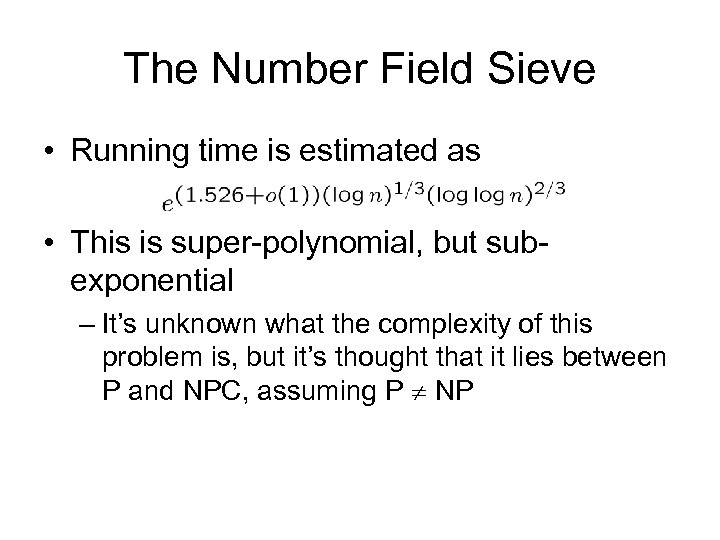
The Number Field Sieve • Running time is estimated as • This is super-polynomial, but subexponential – It’s unknown what the complexity of this problem is, but it’s thought that it lies between P and NPC, assuming P NP
NFS (cont) • How it works (sort of) – The first step is called “sieving” and it can be widely distributed – The second step builds and solves a system of equations in a large matrix and must be done on a large computer • Massive memory requirements • Usually done on a large supercomputer
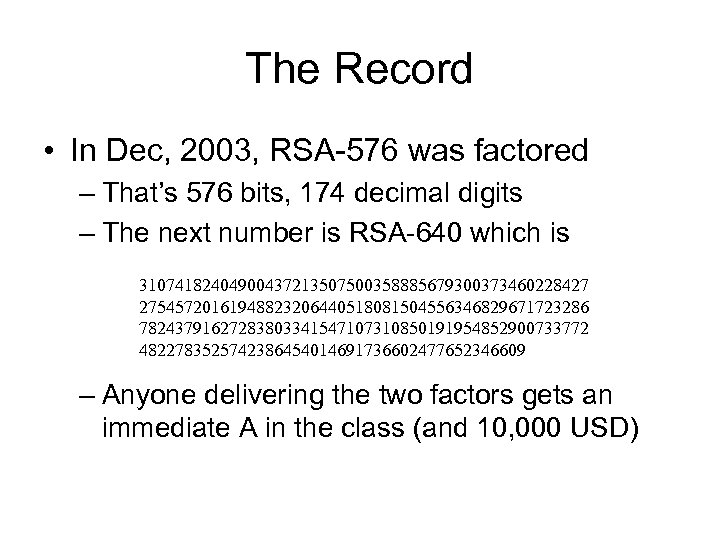
The Record • In Dec, 2003, RSA-576 was factored – That’s 576 bits, 174 decimal digits – The next number is RSA-640 which is 31074182404900437213507500358885679300373460228427 27545720161948823206440518081504556346829671723286 78243791627283803341547107310850191954852900733772 4822783525742386454014691736602477652346609 – Anyone delivering the two factors gets an immediate A in the class (and 10, 000 USD)
On the Forefront • Other methods in the offing – Bernstein’s Integer Factoring Circuits – TWIRL and TWINKLE • Using lights and mirrors – Shamir and Tromer’s methods • They estimate that factoring a 1024 bit RSA modulus would take 10 M USD to build and one year to run – Some skepticism has been expressed – And the beat goes on… • I wonder what the NSA knows
Implementation Notes • We didn’t say anything about how to implement RSA – What were the hard steps? ! • Key generation: – Two large primes – Finding inverses mode (n) • Encryption – Computing Me mod n for large M, e, n – All this can be done reasonably efficiently
Implementation Notes (cont) • Finding inverses – Linear time with Euclid’s Extended Algorithm • Modular exponentiation – Use repeated squaring and reduce by the modulus to keep things manageable • Primality Testing – Sieve first, use pseudo-prime test, then Rabin-Miller if you want to be sure • Primality testing is the slowest part of all this • Ever generate keys for PGP, GPG, Open. SSL, etc?
Note on Primality Testing • Primality testing is different from factoring – Kind of interesting that we can tell something is composite without being able to actually factor it • Recent result from IIT trio – Recently it was shown that deterministic primality testing could be done in polynomial time • Complexity was like O(n 12), though it’s been slightly reduced since then – One of our faculty thought this meant RSA was broken! • Randomized algorithms like Rabin-Miller are far more efficient than the IIT algorithm, so we’ll keep using those
Скачать презентацию Foundations of Network and Computer Security John Black
d1e5fd742fd990e8b389e479a56b3006.ppt