 Скачать презентацию FOUNDATIONS OF ENTREPRENEURSHIP CLASS SEVEN BUILD OR BUY
d7226e3eb5003b4074bfd6aa673d73fb.ppt
- Количество слайдов: 21



FOUNDATIONS OF ENTREPRENEURSHIP CLASS SEVEN: BUILD OR BUY? & IDEA GENERATION Elikem Nutifafa Kuenyehia
Class Agenda • • • Mid-term assignment Recap of last class Build or Buy? Idea Generation Guest Speaker: Shirley Frimpong-Manso, Managing Director, Sparrow Productions
Mid-term Assignment • Questions and issues
Recap of last class • What did you learn from legal and regulatory considerations? • What did you learn from the Stellar Group’s acquisition story?
Build or Buy? • A key decision entrepreneurs may have to make early is whether to build or buy? • Build – start a business from scratch • Buy – buy an existing business • Need to carefully evaluate options available before making a decision • Most people become entrepreneurs by starting enterprises from scratch with only a small number buying existing enterprises
Buying an existing enterprise • • Assets purchase Share purchase Purchase a share in a partnership What is included in an acquisition? – Real Estate – Staff – Technology – Customers and contracts – Suppliers – Branding and intellectual property
Pros of buying vs. starting from scratch • • ‘Easier’ route to entrepreneurship A history of success Predictability of income stream Experience of the previous owner Lower risk Easier to find finance Eliminate competitor(s) Eliminate barriers to entry
Difficulties of buying vs. starting own enterprise • Legacy issues • Culture/Employee related issues • Difficulty to get an enterprise that suits the entrepreneur’s idea • Customer and supplier relationships may not be inherited • Obsolete technology and/or inventory • Special talent by owner • Enterprise may be overpriced • Valuation difficulties • Lack of choice
Due diligence guidelines • Ask Questions • When you hear an answer, make sure you also see the answer • Use the Colombo method • When co-investing, do your own due diligence • Painstakingly review information about all aspects of the company
The buying stages • • • Identification of opportunities Screening opportunities Evaluating Valuation Negotiation Heads of terms or term sheet or letter of intent • Acquisition/purchasing
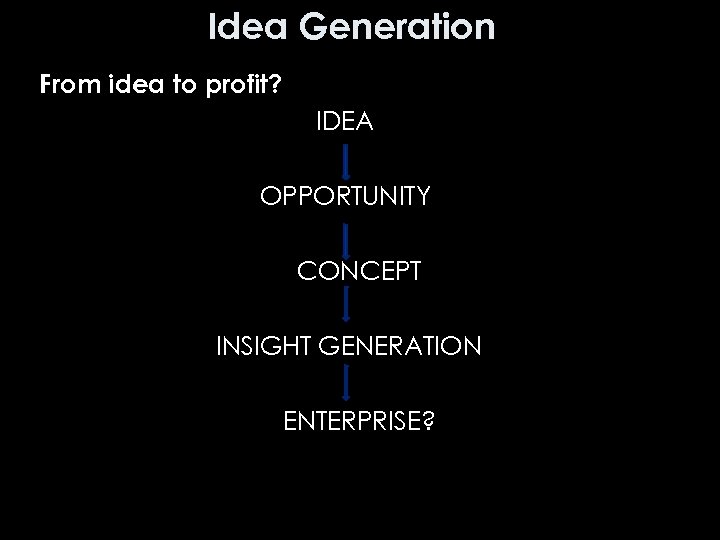
Idea Generation From idea to profit? IDEA OPPORTUNITY CONCEPT INSIGHT GENERATION ENTERPRISE?
What is an idea? • An idea is a conception or plan formed by mental effort • Every entrepreneurial venture rests on at least one fundamental business idea • It is an entrepreneur’s initial dream & mental picture for his enterprise
Nature of ideas • Need not be outstanding/complicated • Need not be original – Search & Spin – Though some entrepreneur are inventors • To form the basis of a business, must provide a solution to a customer need – Customer Pain (Gari Soakings) • An unmet need • Existing enterprises may fall short unless – Using additional features & benefits
Sources of ideas • Opportunity & Environment Scanning – Keeping eyes wide open/alert to opportunities – Various changes: • Social • Economic • Technological • Changing customer tastes & preferences • Media – In all forms – NB: what you might not typical pay attention to
Sources of ideas (cont’d) • • Reading Travel Government Personal Experience and Frustration Skill Set Franchises Conferences, Workshops, Exhibitions Brainstorming
Idea. Quest • Be very observant – Keep your eyes open for inspiration: use a notebook • Interest: what you like doing • Take a critical look at your major irritations • Skills – what are you good at? (irrespective of whether you like doing them) • Personality/Work Styles • What product or service will make my life easier?
Which comes first? IDEA THE DESIRE TO START A BUSINESS?
Ideas vs. Opportunity • A good idea is not enough • It must be underpinned by an opportunity • An idea may be underpinned by opportunity through: – Patent Opportunity – Tacit Discovery
Ideas vs. Opportunity For an idea to be considered an opportunity it must: • Meet a customer need • Create value for the customers • Create value for stakeholders – depends on: Number of potential buyers Purchasing power of potential buyers Return on investment • Be the right fit Reflect values, interests, aspirations Match resources & skills • Pass the realistic/sense check
Concept Development • What is the customer pain that the enterprise will remove? • How is the pain dealt with at present (competitor products/substitutes)? • How it will remove the pain (customer value proposition and how different is it from the competition)? • Description of target market • Distribution – how will you distribute the product? • Production – how you will make the product? • Idea of cost of set up/production and key resources required • Idea of pricing ?
Guest Speaker • Shirley Frimpong-Manso, Managing Director, Sparrow Productions
Скачать презентацию FOUNDATIONS OF ENTREPRENEURSHIP CLASS SEVEN BUILD OR BUY
d7226e3eb5003b4074bfd6aa673d73fb.ppt