


 Скачать презентацию Foundations of Art and Design Chapter 3 Shape
8623f0aea0c35a34472aab5830df5f5d.ppt
- Количество слайдов: 31
 Foundations of Art and Design Chapter 3: Shape
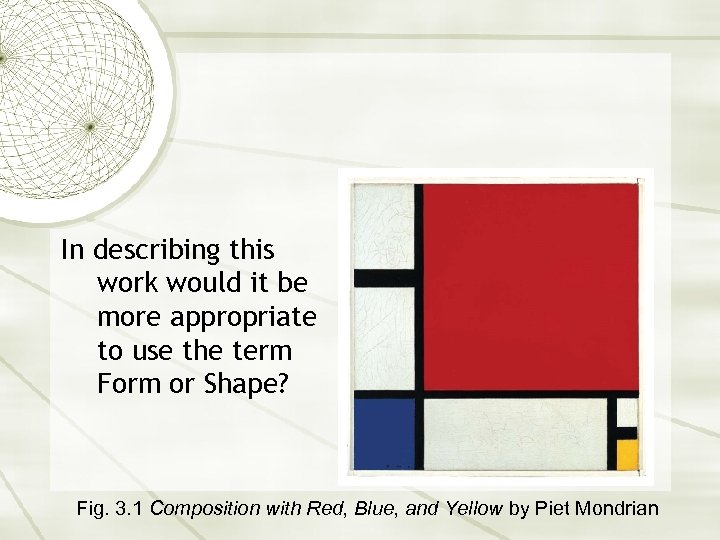 In describing this work would it be more appropriate to use the term Form or Shape? Fig. 3. 1 Composition with Red, Blue, and Yellow by Piet Mondrian
 In describing this work would it be more appropriate to use the term Form or Shape? 1. Form 2. Shape Fig. 3. 1 Composition with Red, Blue, and Yellow by Piet Mondrian
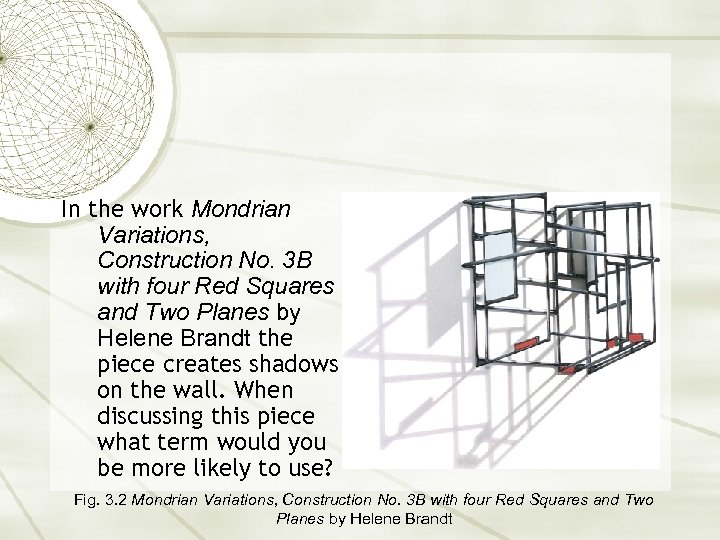 In the work Mondrian Variations, Construction No. 3 B with four Red Squares and Two Planes by Helene Brandt the piece creates shadows on the wall. When discussing this piece what term would you be more likely to use? Fig. 3. 2 Mondrian Variations, Construction No. 3 B with four Red Squares and Two Planes by Helene Brandt
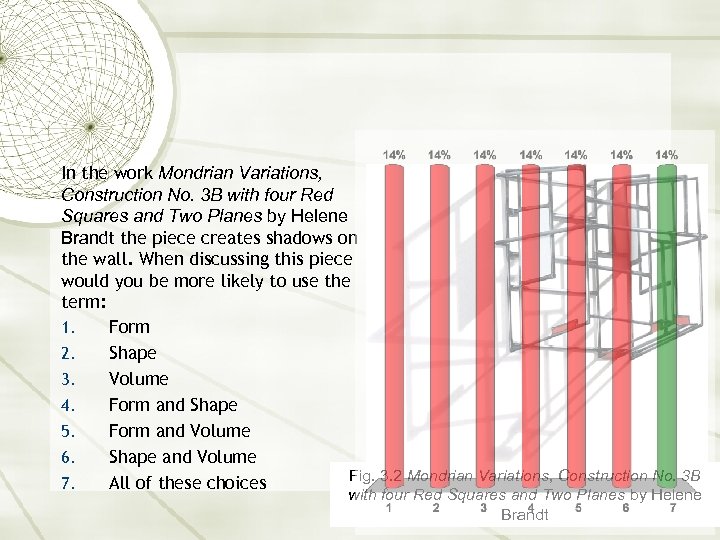 In the work Mondrian Variations, Construction No. 3 B with four Red Squares and Two Planes by Helene Brandt the piece creates shadows on the wall. When discussing this piece would you be more likely to use the term: 1. Form 2. Shape 3. Volume 4. Form and Shape 5. Form and Volume 6. Shape and Volume Fig. 3. 2 Mondrian Variations, Construction No. 3 B 7. All of these choices with four Red Squares and Two Planes by Helene Brandt
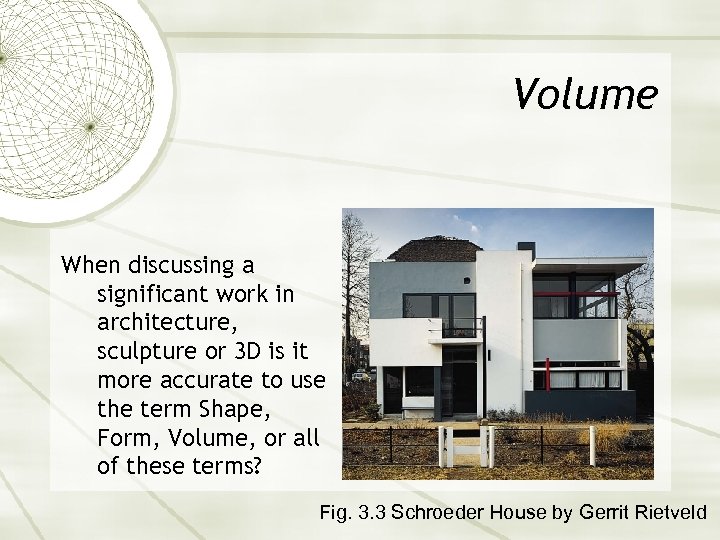 Volume When discussing a significant work in architecture, sculpture or 3 D is it more accurate to use the term Shape, Form, Volume, or all of these terms? Fig. 3. 3 Schroeder House by Gerrit Rietveld
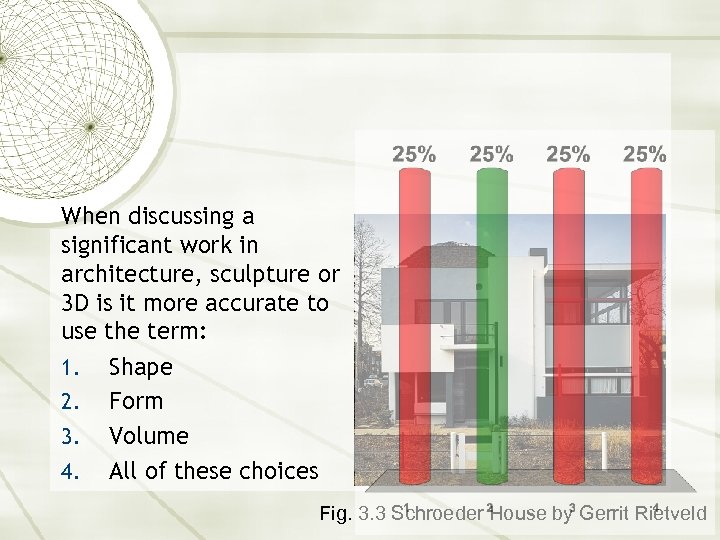 When discussing a significant work in architecture, sculpture or 3 D is it more accurate to use the term: 1. Shape 2. Form 3. Volume 4. All of these choices Fig. 3. 3 Schroeder House by Gerrit Rietveld
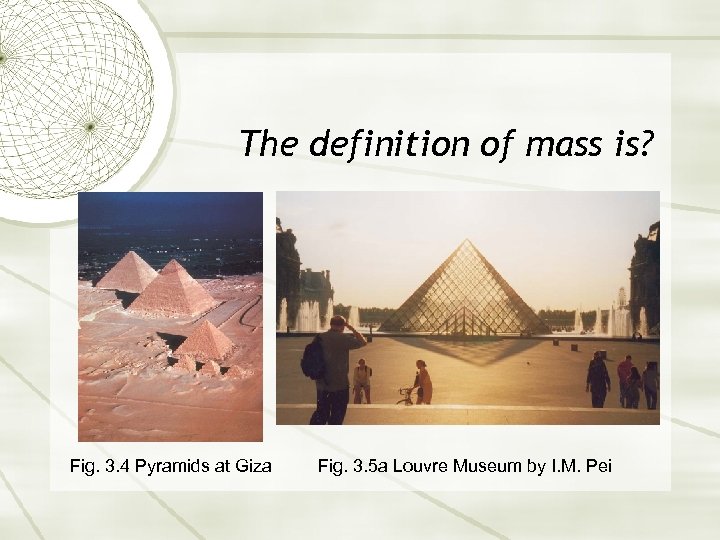 The definition of mass is? Fig. 3. 4 Pyramids at Giza Fig. 3. 5 a Louvre Museum by I. M. Pei
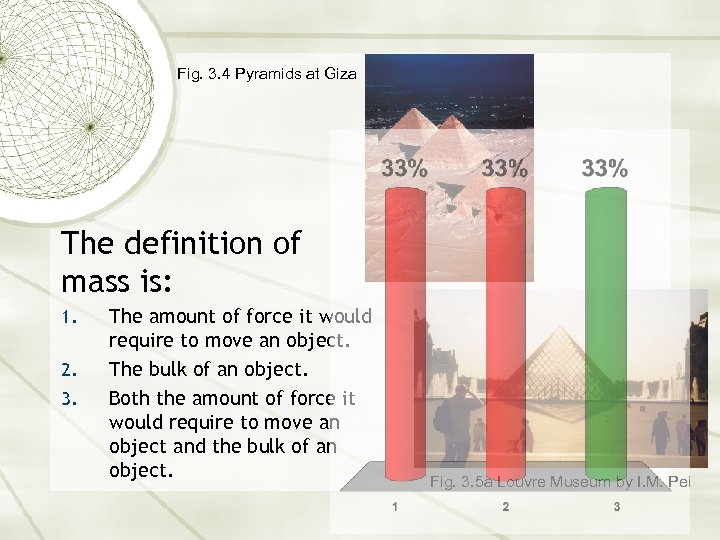 Fig. 3. 4 Pyramids at Giza The definition of mass is: 1. 2. 3. The amount of force it would require to move an object. The bulk of an object. Both the amount of force it would require to move an object and the bulk of an object. Fig. 3. 5 a Louvre Museum by I. M. Pei
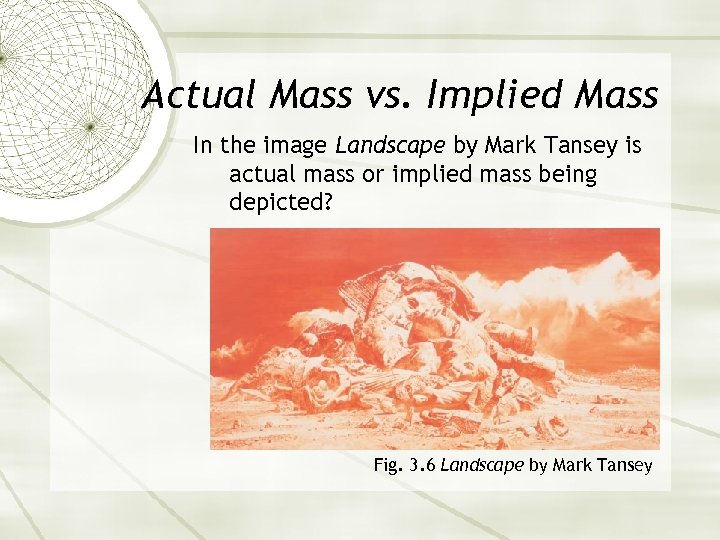 Actual Mass vs. Implied Mass In the image Landscape by Mark Tansey is actual mass or implied mass being depicted? Fig. 3. 6 Landscape by Mark Tansey
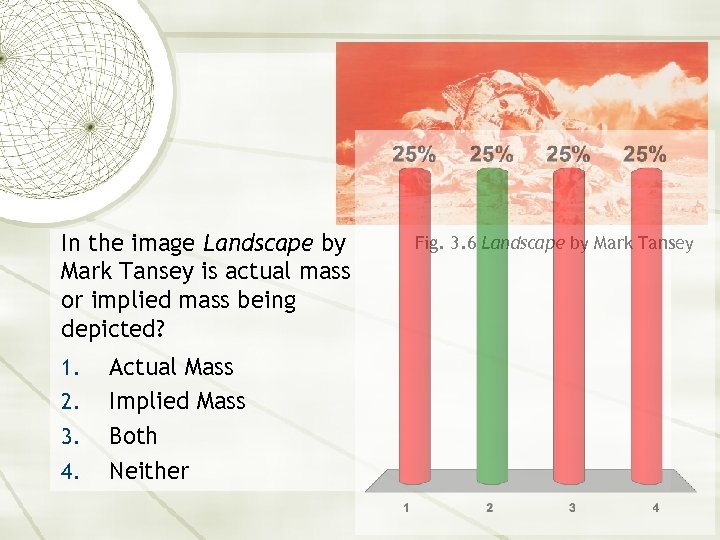 In the image Landscape by Mark Tansey is actual mass or implied mass being depicted? 1. 2. 3. 4. Actual Mass Implied Mass Both Neither Fig. 3. 6 Landscape by Mark Tansey
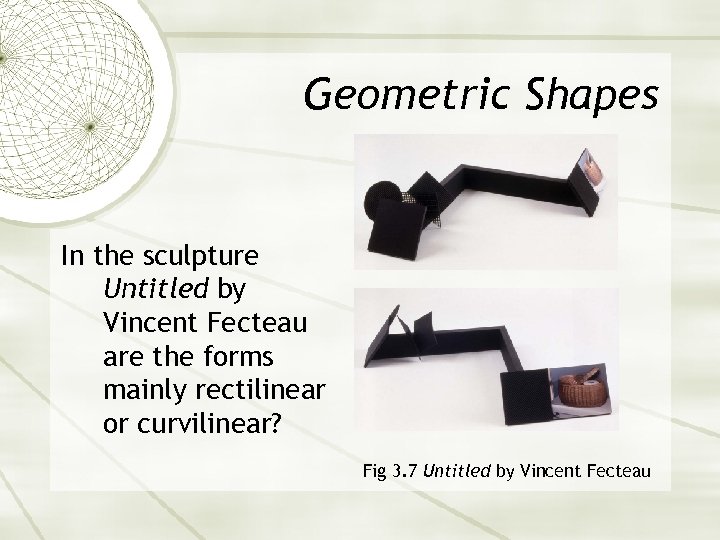 Geometric Shapes In the sculpture Untitled by Vincent Fecteau are the forms mainly rectilinear or curvilinear? Fig 3. 7 Untitled by Vincent Fecteau
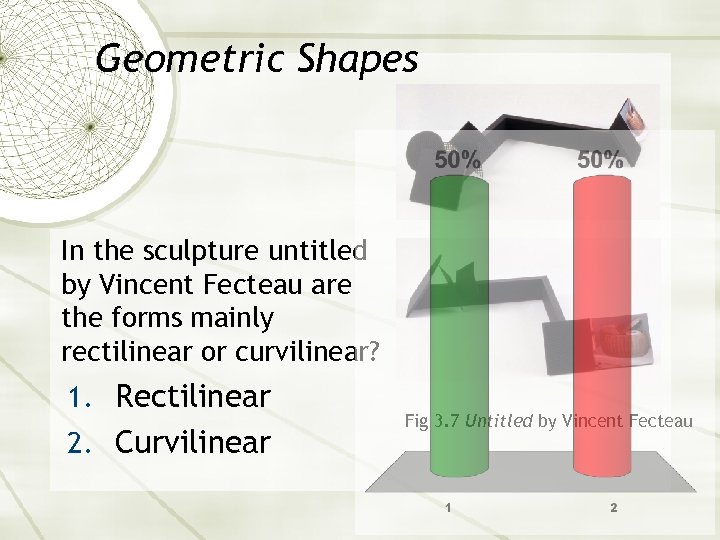 Geometric Shapes In the sculpture untitled by Vincent Fecteau are the forms mainly rectilinear or curvilinear? 1. Rectilinear 2. Curvilinear Fig 3. 7 Untitled by Vincent Fecteau
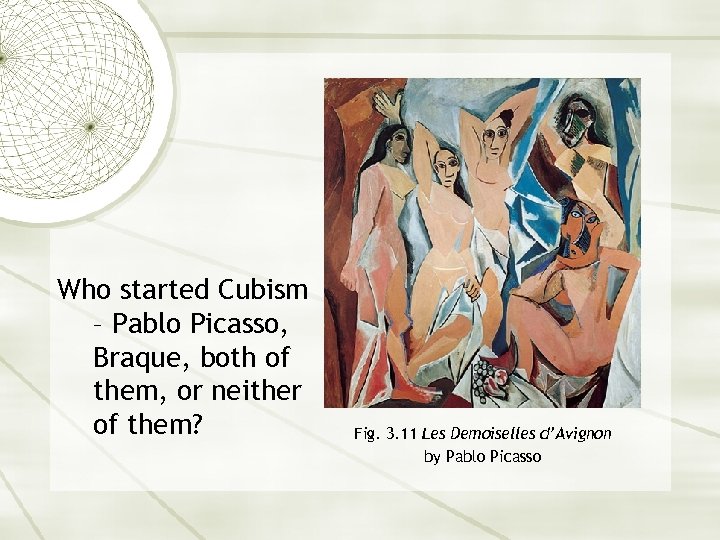 Who started Cubism – Pablo Picasso, Braque, both of them, or neither of them? Fig. 3. 11 Les Demoiselles d’Avignon by Pablo Picasso
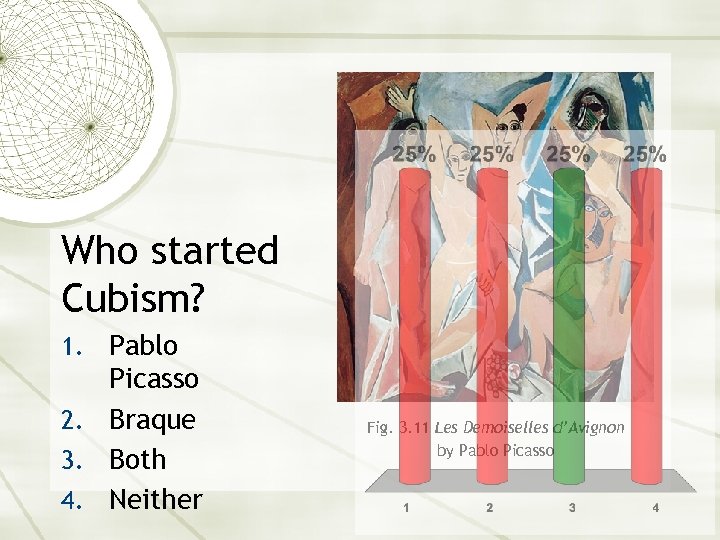 Who started Cubism? 1. Pablo Picasso 2. Braque 3. Both 4. Neither Fig. 3. 11 Les Demoiselles d’Avignon by Pablo Picasso
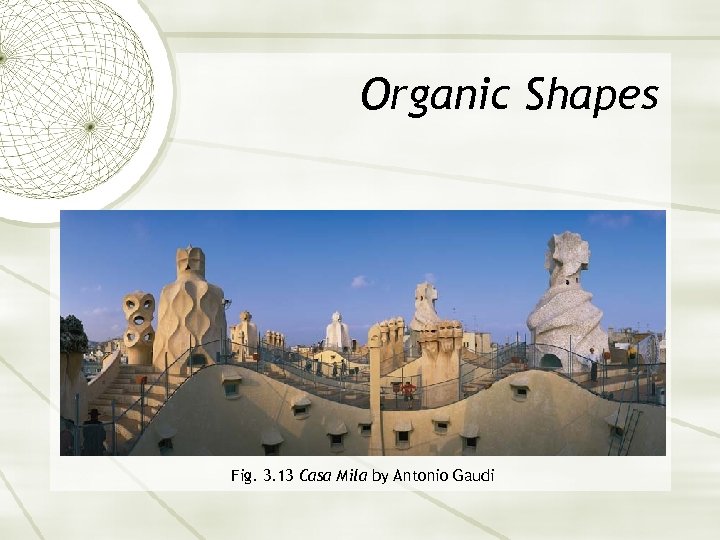 Organic Shapes Fig. 3. 13 Casa Mila by Antonio Gaudi
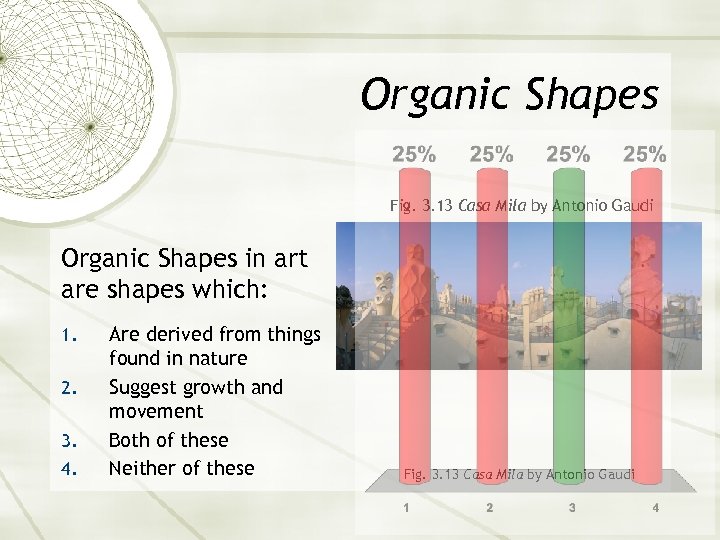 Organic Shapes Fig. 3. 13 Casa Mila by Antonio Gaudi Organic Shapes in art are shapes which: 1. 2. 3. 4. Are derived from things found in nature Suggest growth and movement Both of these Neither of these Fig. 3. 13 Casa Mila by Antonio Gaudi
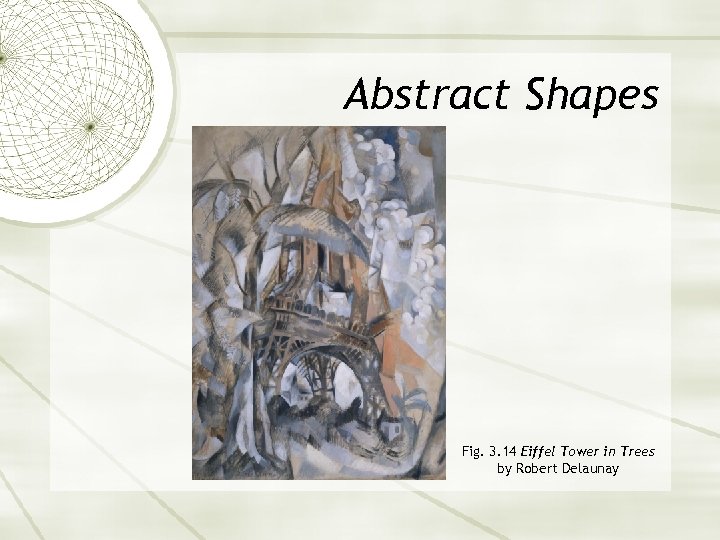 Abstract Shapes Fig. 3. 14 Eiffel Tower in Trees by Robert Delaunay
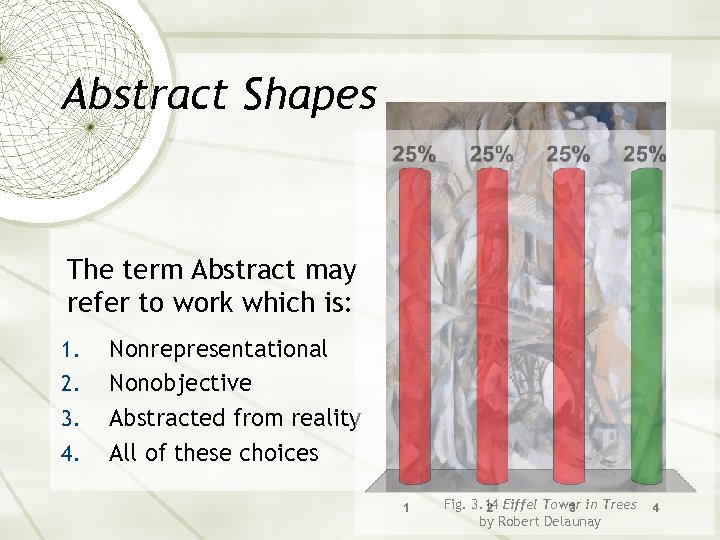 Abstract Shapes The term Abstract may refer to work which is: 1. 2. 3. 4. Nonrepresentational Nonobjective Abstracted from reality All of these choices Fig. 3. 14 Eiffel Tower in Trees by Robert Delaunay
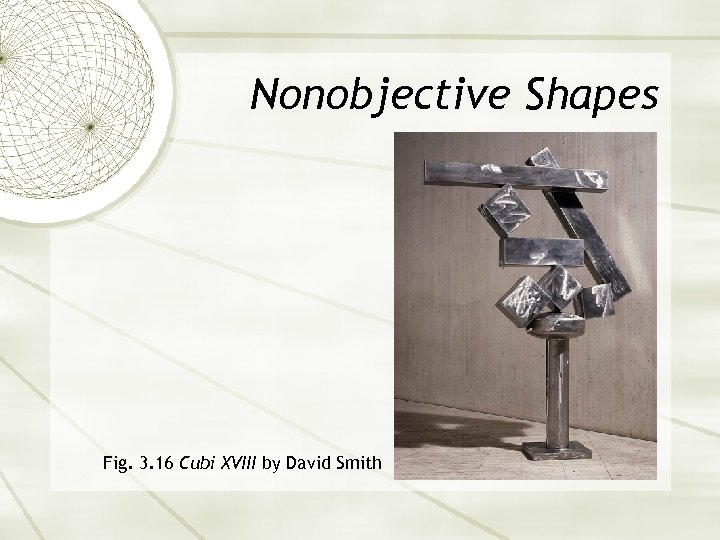 Nonobjective Shapes Fig. 3. 16 Cubi XVIII by David Smith
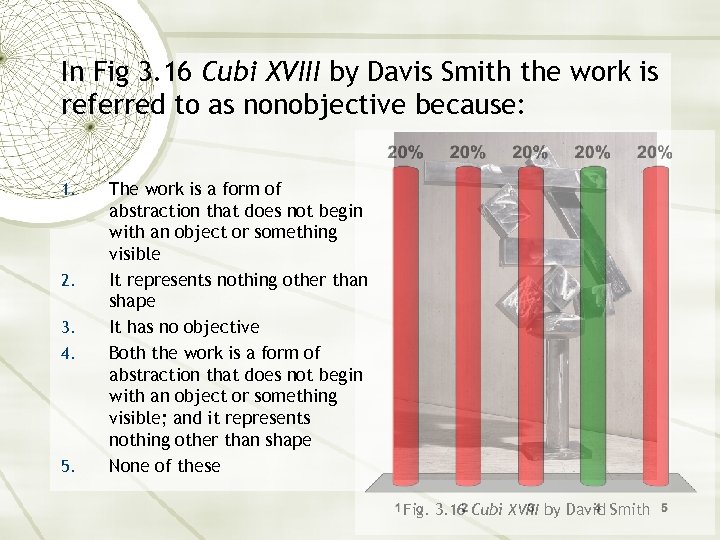 In Fig 3. 16 Cubi XVIII by Davis Smith the work is referred to as nonobjective because: 1. 2. 3. 4. 5. The work is a form of abstraction that does not begin with an object or something visible It represents nothing other than shape It has no objective Both the work is a form of abstraction that does not begin with an object or something visible; and it represents nothing other than shape None of these Fig. 3. 16 Cubi XVIII by David Smith
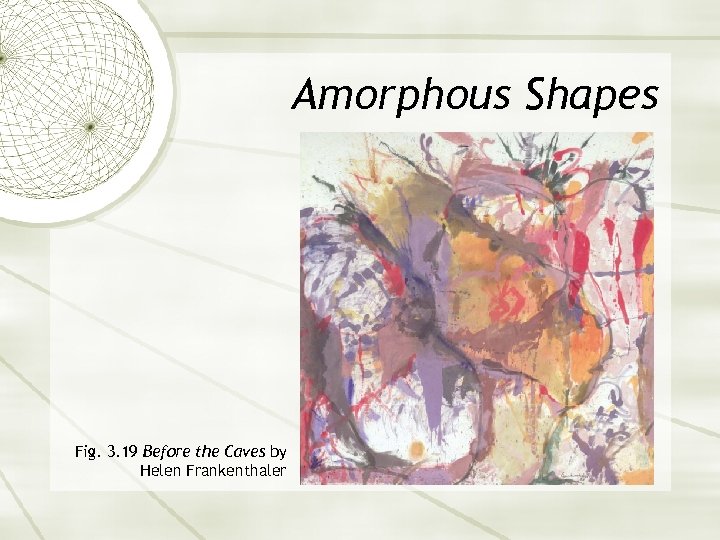 Amorphous Shapes Fig. 3. 19 Before the Caves by Helen Frankenthaler
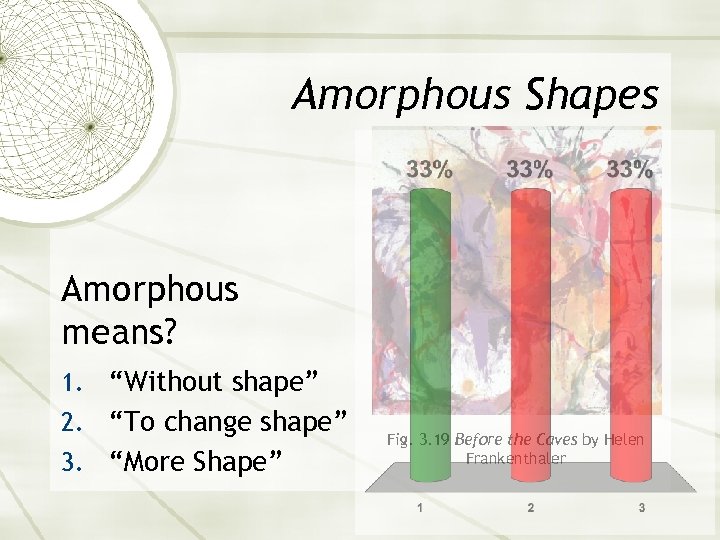 Amorphous Shapes Amorphous means? 1. “Without shape” 2. “To change shape” 3. “More Shape” Fig. 3. 19 Before the Caves by Helen Frankenthaler
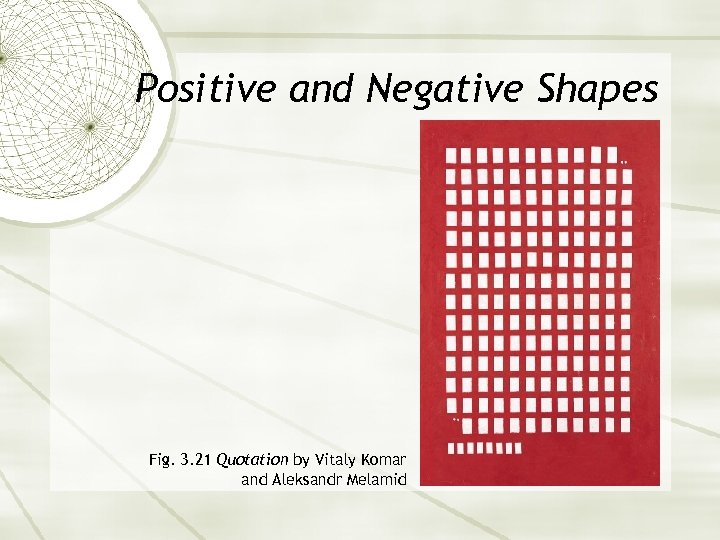 Positive and Negative Shapes Fig. 3. 21 Quotation by Vitaly Komar and Aleksandr Melamid
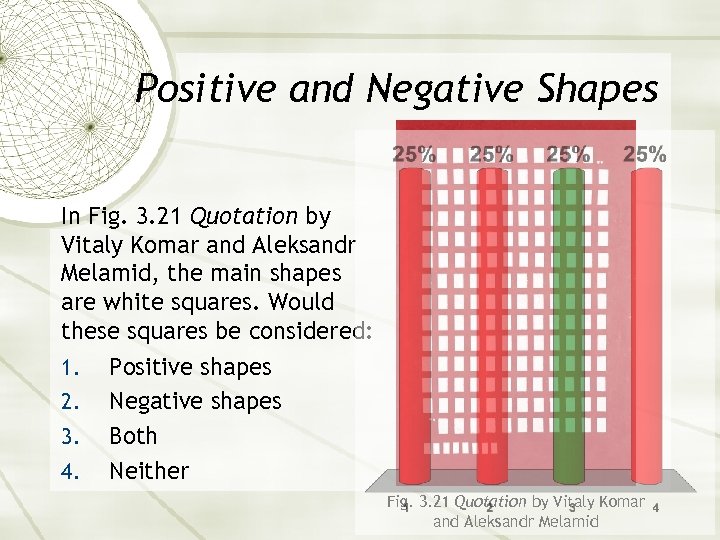 Positive and Negative Shapes In Fig. 3. 21 Quotation by Vitaly Komar and Aleksandr Melamid, the main shapes are white squares. Would these squares be considered: 1. Positive shapes 2. Negative shapes 3. Both 4. Neither Fig. 3. 21 Quotation by Vitaly Komar and Aleksandr Melamid
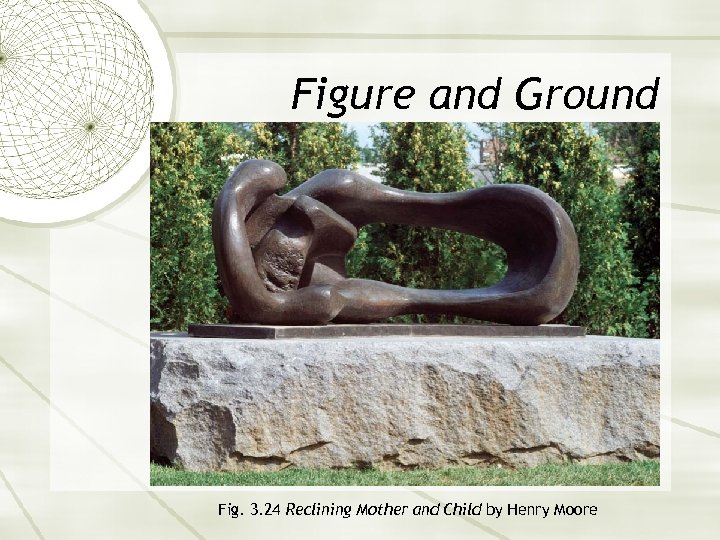 Figure and Ground Fig. 3. 24 Reclining Mother and Child by Henry Moore
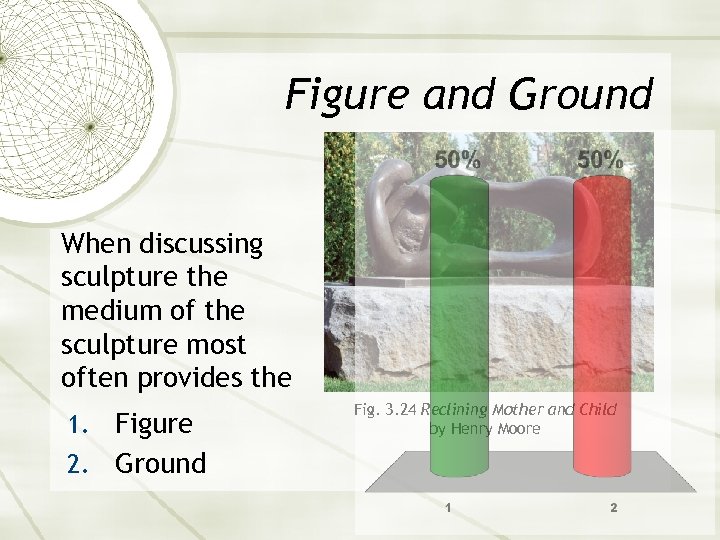 Figure and Ground When discussing sculpture the medium of the sculpture most often provides the 1. Figure 2. Ground Fig. 3. 24 Reclining Mother and Child by Henry Moore
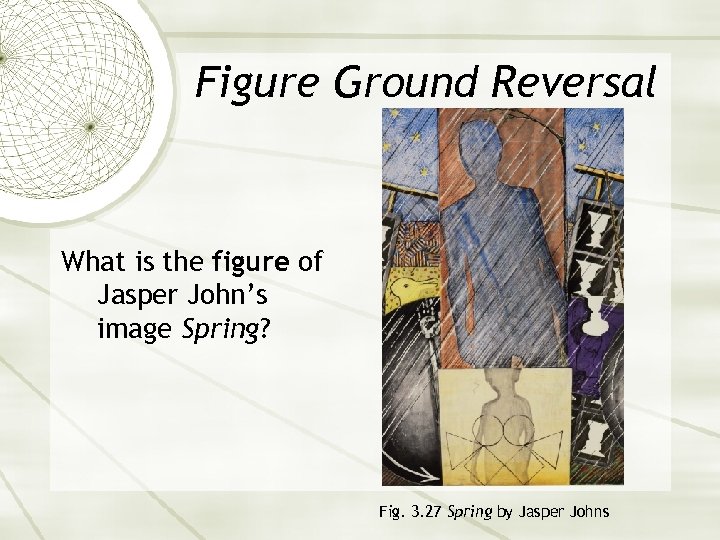 Figure Ground Reversal What is the figure of Jasper John’s image Spring? Fig. 3. 27 Spring by Jasper Johns
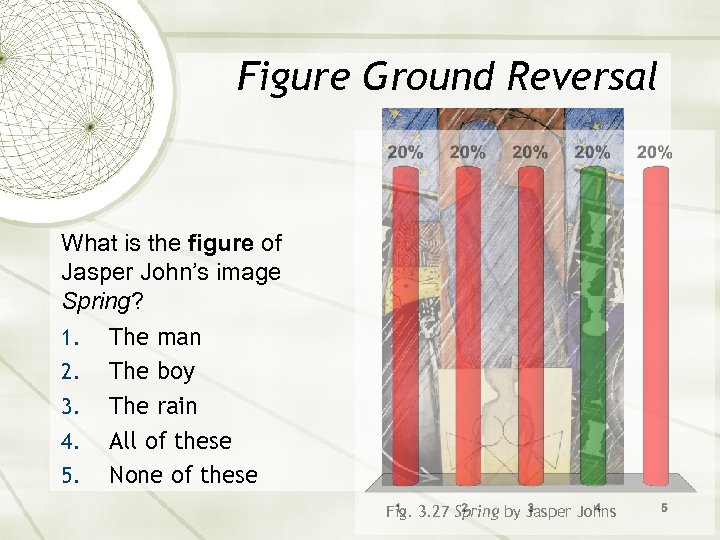 Figure Ground Reversal What is the figure of Jasper John’s image Spring? 1. The man 2. The boy 3. The rain 4. All of these 5. None of these Fig. 3. 27 Spring by Jasper Johns
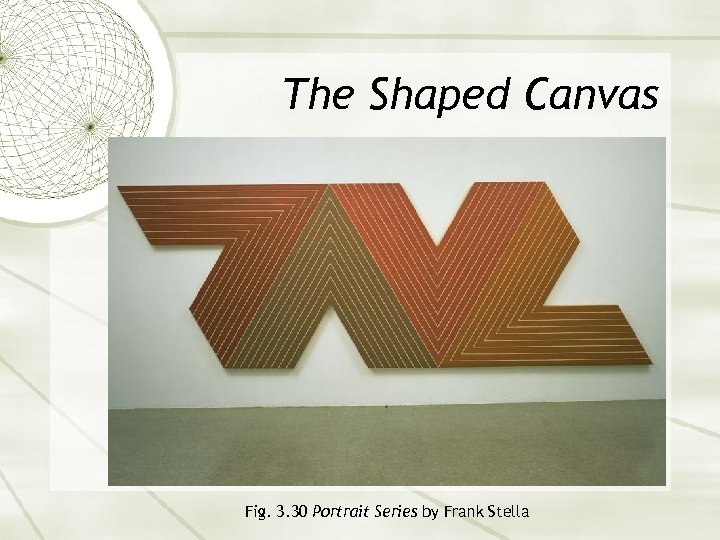 The Shaped Canvas Fig. 3. 30 Portrait Series by Frank Stella
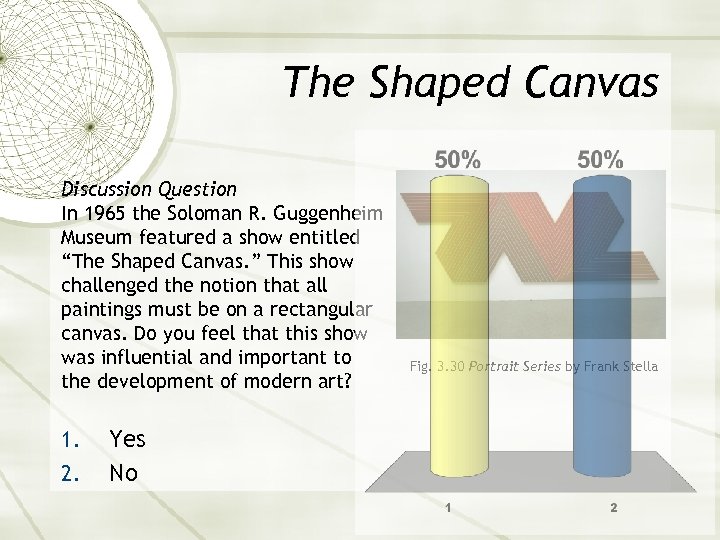 The Shaped Canvas Discussion Question In 1965 the Soloman R. Guggenheim Museum featured a show entitled “The Shaped Canvas. ” This show challenged the notion that all paintings must be on a rectangular canvas. Do you feel that this show was influential and important to the development of modern art? 1. 2. Yes No Fig. 3. 30 Portrait Series by Frank Stella