 Скачать презентацию FOUNDATIONS AND B-C e COMMERCE 1 Foundations of
0bea081a4e897d22d8799dd052c18bd6.ppt
- Количество слайдов: 41



FOUNDATIONS AND B-C e. COMMERCE 1. Foundations of e. Commerce 1. 1 Definition, history and scope 1. 2 Interogranisational IS and electronic markets 1. 3 Benefits and limitations of e. Commerce 1. 4 The process of e. Commerce 2. Business-to-consumer applications 2. 1 Advertising, online publishing, push technology 2. 2 Cyberbanking, personal finance and stock trading 2. 3 The job market and auctions 2. 4 Travel and real estate 2. 5 Electronic retailing and malls 1 Foundations of e. Commerce Prof. G. Doukidis
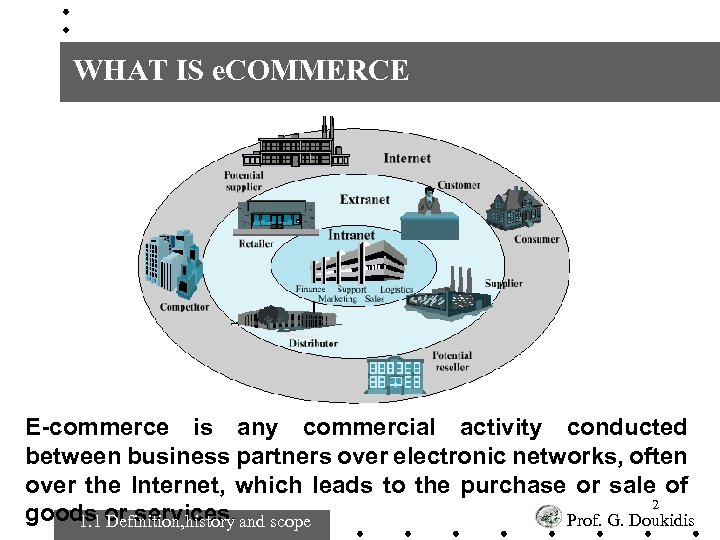
WHAT IS e. COMMERCE E-commerce is any commercial activity conducted between business partners over electronic networks, often over the Internet, which leads to the purchase or sale of 2 goods or services. and scope Prof. G. Doukidis 1. 1 Definition, history
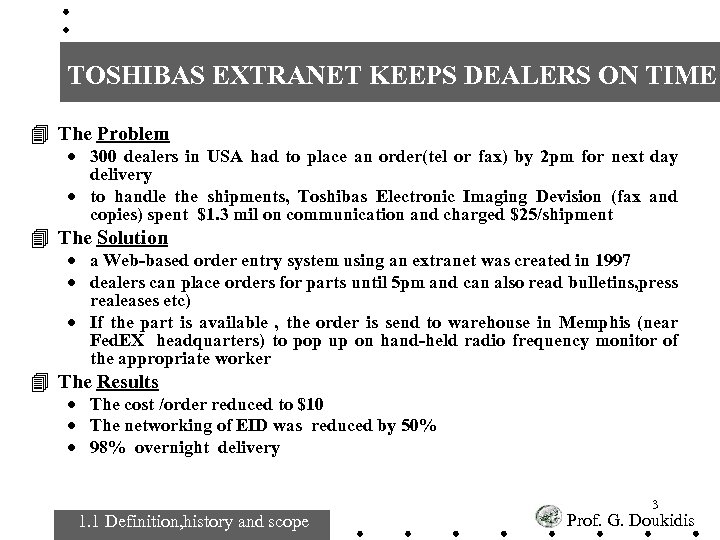
TOSHIBAS EXTRANET KEEPS DEALERS ON TIME 4 The Problem · 300 dealers in USA had to place an order(tel or fax) by 2 pm for next day delivery · to handle the shipments, Toshibas Electronic Imaging Devision (fax and copies) spent $1. 3 mil on communication and charged $25/shipment 4 The Solution · a Web-based order entry system using an extranet was created in 1997 · dealers can place orders for parts until 5 pm and can also read bulletins, press realeases etc) · If the part is available , the order is send to warehouse in Memphis (near Fed. EX headquarters) to pop up on hand-held radio frequency monitor of the appropriate worker 4 The Results · The cost /order reduced to $10 · The networking of EID was reduced by 50% · 98% overnight delivery 1. 1 Definition, history and scope 3 Prof. G. Doukidis
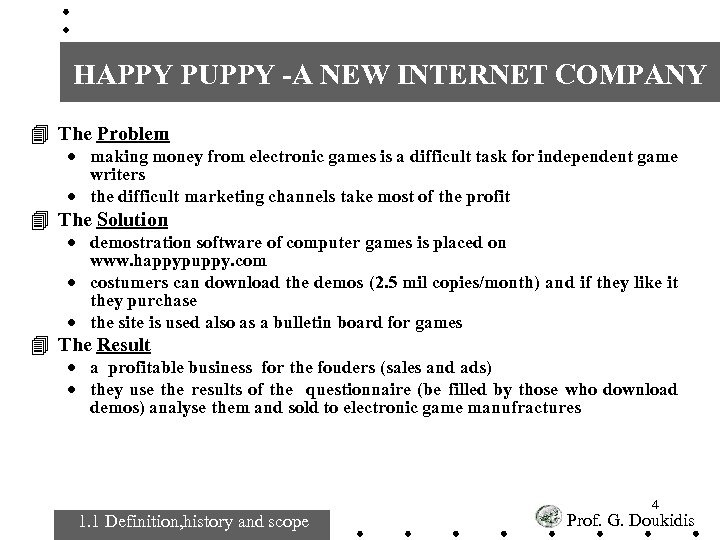
HAPPY PUPPY -A NEW INTERNET COMPANY 4 The Problem · making money from electronic games is a difficult task for independent game writers · the difficult marketing channels take most of the profit 4 The Solution · demostration software of computer games is placed on www. happypuppy. com · costumers can download the demos (2. 5 mil copies/month) and if they like it they purchase · the site is used also as a bulletin board for games 4 The Result · a profitable business for the fouders (sales and ads) · they use the results of the questionnaire (be filled by those who download demos) analyse them and sold to electronic game manufractures 1. 1 Definition, history and scope 4 Prof. G. Doukidis
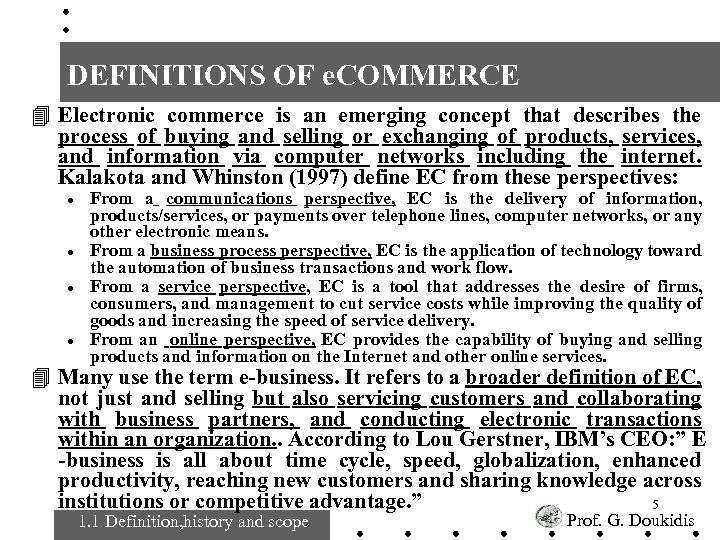
DEFINITIONS OF e. COMMERCE 4 Electronic commerce is an emerging concept that describes the process of buying and selling or exchanging of products, services, and information via computer networks including the internet. Kalakota and Whinston (1997) define EC from these perspectives: l l From a communications perspective, EC is the delivery of information, products/services, or payments over telephone lines, computer networks, or any other electronic means. From a business process perspective, EC is the application of technology toward the automation of business transactions and work flow. From a service perspective, EC is a tool that addresses the desire of firms, consumers, and management to cut service costs while improving the quality of goods and increasing the speed of service delivery. From an online perspective, EC provides the capability of buying and selling products and information on the Internet and other online services. 4 Many use the term e-business. It refers to a broader definition of EC, not just and selling but also servicing customers and collaborating with business partners, and conducting electronic transactions within an organization. . According to Lou Gerstner, IBM’s CEO: ” E -business is all about time cycle, speed, globalization, enhanced productivity, reaching new customers and sharing knowledge across institutions or competitive advantage. ” 5 1. 1 Definition, history and scope Prof. G. Doukidis
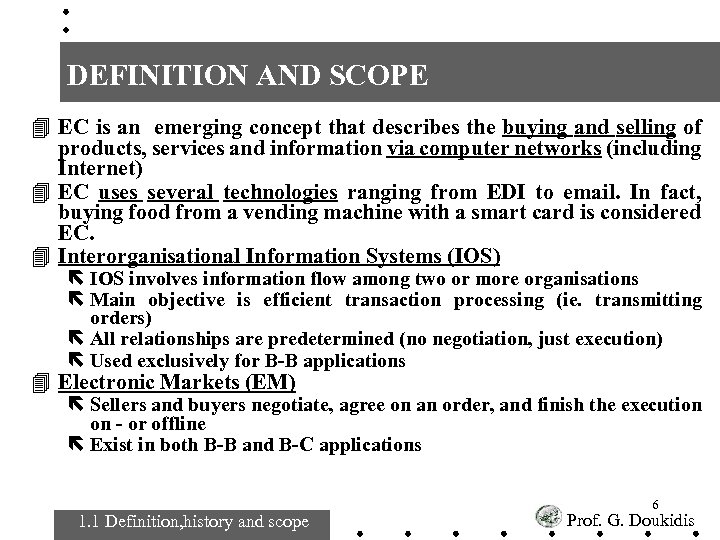
DEFINITION AND SCOPE 4 EC is an emerging concept that describes the buying and selling of products, services and information via computer networks (including Internet) 4 EC uses several technologies ranging from EDI to email. In fact, buying food from a vending machine with a smart card is considered EC. 4 Interorganisational Information Systems (IOS) ë IOS involves information flow among two or more organisations ë Main objective is efficient transaction processing (ie. transmitting orders) ë All relationships are predetermined (no negotiation, just execution) ë Used exclusively for B-B applications 4 Electronic Markets (EM) ë Sellers and buyers negotiate, agree on an order, and finish the execution on - or offline ë Exist in both B-B and B-C applications 1. 1 Definition, history and scope 6 Prof. G. Doukidis
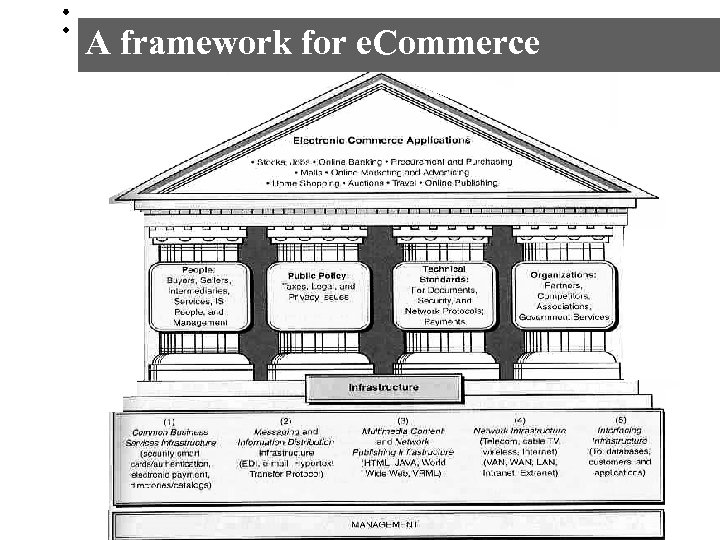
A framework for e. Commerce Prof. G. Doukidis
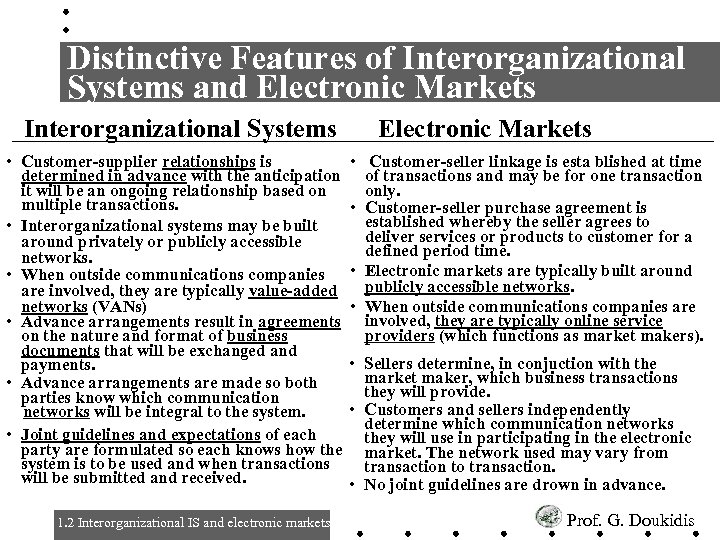
Distinctive Features of Interorganizational Systems and Electronic Markets Interorganizational Systems • Customer-supplier relationships is • determined in advance with the anticipation it will be an ongoing relationship based on multiple transactions. • • Interorganizational systems may be built around privately or publicly accessible networks. • When outside communications companies • are involved, they are typically value-added • networks (VANs) • Advance arrangements result in agreements on the nature and format of business documents that will be exchanged and • payments. • Advance arrangements are made so both parties know which communication • networks will be integral to the system. • Joint guidelines and expectations of each party are formulated so each knows how the system is to be used and when transactions will be submitted and received. • 1. 2 Interorganizational IS and electronic markets Electronic Markets Customer-seller linkage is esta blished at time of transactions and may be for one transaction only. Customer-seller purchase agreement is established whereby the seller agrees to deliver services or products to customer for a defined period time. Electronic markets are typically built around publicly accessible networks. When outside communications companies are involved, they are typically online service providers (which functions as market makers). Sellers determine, in conjuction with the market maker, which business transactions they will provide. Customers and sellers independently determine which communication networks they will use in participating in the electronic market. The network used may vary from transaction to transaction. No joint guidelines are drown in advance. Prof. G. Doukidis
DRIVERS OF INTERORGANIZATIONAL SYSTEMS IOSs are a direct result of the growing desirability of interconnecting business partners to streamline business processes by: 4 reducing the costs of routine business transactions 4 improving the quality of the information flow by reducing or eliminating errors. 4 compressing cycle time in the fulfillment of business transactions regardless of geographical distance. 4 eliminating paper, inefficiencies, and costs associated with paper processing. 4 making the trading process easy for users 9 1. 2 Interorganizational ISand electronic markets Prof. G. Doukidis
TYPES OF INTERORGANIZATIONAL SYSTEMS 4 4 Electronic data interchange (EDI) Electronic funds transfer (EFT) Electronic forms Integrated messaging. Delivery of electronic mail and fax documents through a single electronic transmission system that can combine EDI, electronic mail, and electronic forms 4 Shared databases. Information stored in repositories is shared between trading partners and is accessible to both. Such databases are often used to reduce elapsed time in communicating information between parties as well as arranging cooperative activities. 10 1. 2 Interorganizational IS andelecronic markets Prof. G. Doukidis
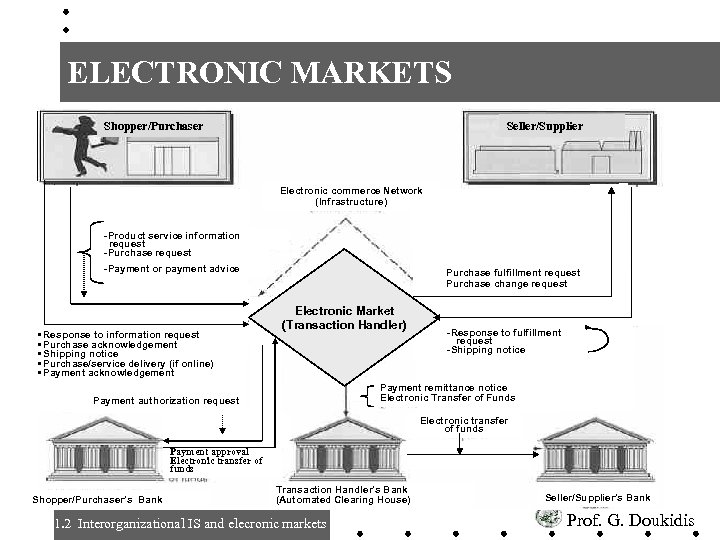
ELECTRONIC MARKETS Shopper/Purchaser Seller/Supplier Electronic commerce Network (Infrastructure) -Product service information request -Purchase request -Payment or payment advice • Response to information request • Purchase acknowledgement • Shipping notice • Purchase/service delivery (if online) • Payment acknowledgement Purchase fulfillment request Purchase change request Electronic Market (Transaction Handler) -Response to fulfillment request -Shipping notice Payment remittance notice Electronic Transfer of Funds Payment authorization request Electronic transfer of funds Payment approval Electronic transfer of funds Shopper/Purchaser’s Bank Transaction Handler’s Bank (Automated Clearing House) 1. 2 Interorganizational IS and elecronic markets Seller/Supplier’s Bank Prof. G. Doukidis
e. COMMERCE BENEFITS TO ORGANIZATIONS (1) 4 e. Commerce decreases the cost of creating, processing, distributing, storing, and retreiving paper-based information. 4 e. Commerce allows reduced inventories and overhead by facilitating "pull"-type supply chain management. In a pull-type system the process starts from customer orders and uses just-in-time processing. This allows product customization and lower inventory costs. 4 e. Commerce reduces the time between the outlay of capital and the receipt of products and services. 4 Electronic commerce supports BPR efforts. When processes are changed, productivity of salespeople, knowledge workers, and administrators can increase by 100 percent or more. 4 Electronic commerce lowers telecommunications cost; the Internet is muth cheaper than value-added networks (VANs). 12 1. 3 Benefits and limitations of e. Commerce Prof. G. Doukidis
e. COMMERCE BENEFITS TO ORGANIZATIONS (2) 4 e. Commerce helps small businesses to compete against large companies. In February 1998, Egghead Software closed all its stores because of its inability to compete with large software distributors, such as Comp. USA, and moved completely to the Web. 4 e. Commerce enables organizations to reach customers outside their immediate area at a minimum cost. 4 e. Commerce allows organizations to reach a wide range of suppliers, thereby reducing the cost of supplies and services. 4 e. Commerce permits the creation of efficient markets in an industry in which buyers and sellers can share benefits. 4 e. Commerce allows companies to auction surpluses or obsolete products quickly with little expences. 4 e. Commerce facilitates global trade, allowing companies to penetrate foreign markets. 13 1. 3 Benefits and limitations of e. Commerce Prof. G. Doukidis
e. COMMERCE BENEFITS TO CUSTOMERS 4 e. Commerce provides customers with more choices; they can select from many vendors and from more products. 4 e. Commerce frequently provides customers with less expensive products and services by allowing them to shop in many places and conduct quick comparisons. 4 In some cases, electronic commerce allows quick delivery of products and services. 4 e. Commerce enables customers to shop or do other transactions 24 hours a day, year round, from almost any location. 4 Customers can receive relevant and detailed information in seconds, rather than in days or weeks. 4 e. Commerce enables consumers to get customized products from PCs to cars at competitive prices. 4 e. Commerce makes it possible to participate in virtual auctions. 14 1. 3 Benefits and limitations of e. Commerce Prof. G. Doukidis
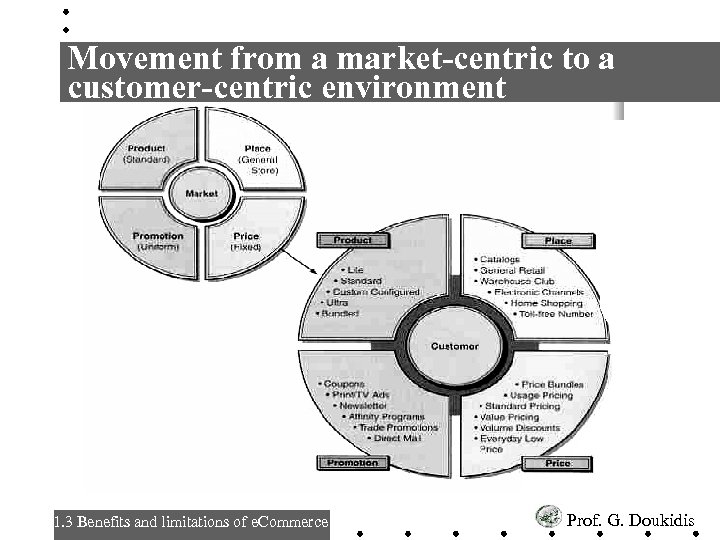
Movement from a market-centric to a customer-centric environment 1. 3 Benefits and limitations of e. Commerce Prof. G. Doukidis
e. COMMERCE BENEFITS TO SOCIETY 4 e. Commerce enables more individuals to work at home and to do less traveling, resulting in less traffic on the roads and lower air pollution. 4 e. Commerce allows some merchandise to be sold at lower prices, so less affluent people can buy more and increase their standard of living. 4 e. Commerce enables people in third world countries and rural areas to enjoy products and services that otherwise are not available to them. This includes opportunities to learn professions and earn college degrees. 4 e. Commerce facilitates delivery of public services, such as government entitlements, reducing the cost of distribution and increasing the quality of the distributing system. 16 1. 3 Benefits and limitations of e. Commerce Prof. G. Doukidis
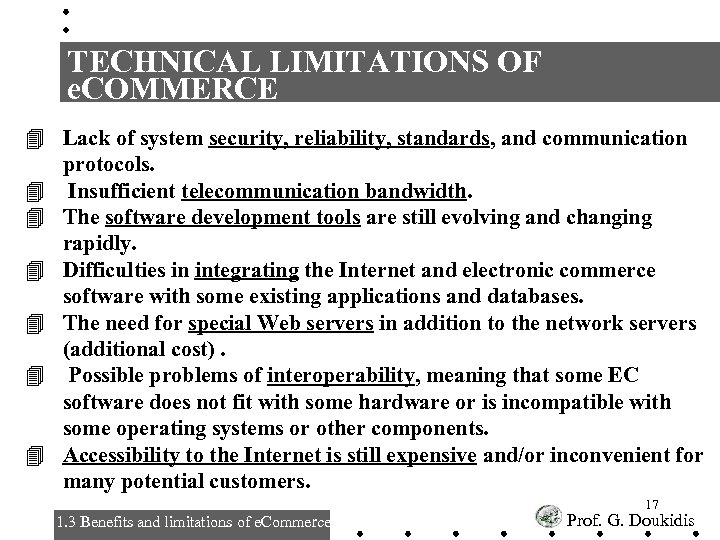
TECHNICAL LIMITATIONS OF e. COMMERCE 4 Lack of system security, reliability, standards, and communication protocols. 4 Insufficient telecommunication bandwidth. 4 The software development tools are still evolving and changing rapidly. 4 Difficulties in integrating the Internet and electronic commerce software with some existing applications and databases. 4 The need for special Web servers in addition to the network servers (additional cost). 4 Possible problems of interoperability, meaning that some EC software does not fit with some hardware or is incompatible with some operating systems or other components. 4 Accessibility to the Internet is still expensive and/or inconvenient for many potential customers. 17 1. 3 Benefits and limitations of e. Commerce Prof. G. Doukidis
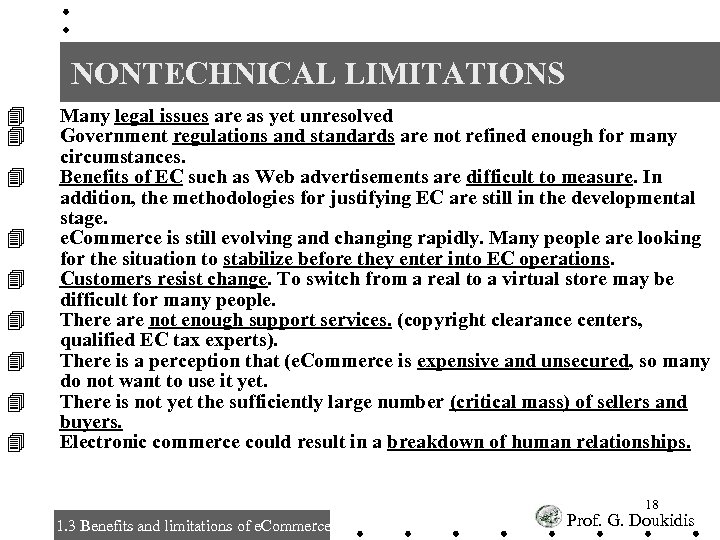
NONTECHNICAL LIMITATIONS 4 4 4 4 4 Many legal issues are as yet unresolved Government regulations and standards are not refined enough for many circumstances. Benefits of EC such as Web advertisements are difficult to measure. In addition, the methodologies for justifying EC are still in the developmental stage. e. Commerce is still evolving and changing rapidly. Many people are looking for the situation to stabilize before they enter into EC operations. Customers resist change. To switch from a real to a virtual store may be difficult for many people. There are not enough support services. (copyright clearance centers, qualified EC tax experts). There is a perception that (e. Commerce is expensive and unsecured, so many do not want to use it yet. There is not yet the sufficiently large number (critical mass) of sellers and buyers. Electronic commerce could result in a breakdown of human relationships. 18 1. 3 Benefits and limitations of e. Commerce Prof. G. Doukidis
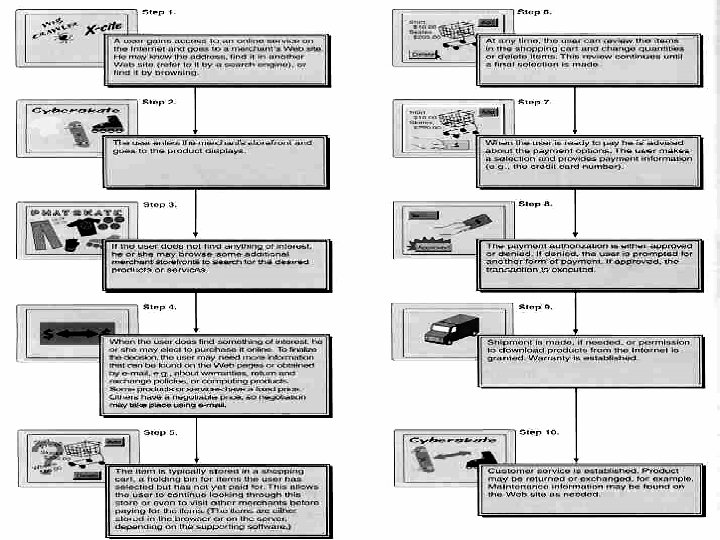
How does an electronic market work? Prof. G. Doukidis
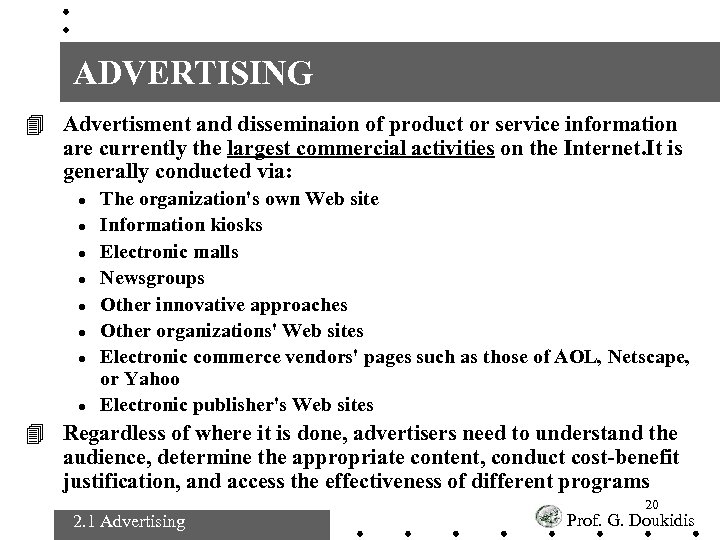
ADVERTISING 4 Advertisment and disseminaion of product or service information are currently the largest commercial activities on the Internet. It is generally conducted via: l l l l The organization's own Web site Information kiosks Electronic malls Newsgroups Other innovative approaches Other organizations' Web sites Electronic commerce vendors' pages such as those of AOL, Netscape, or Yahoo Electronic publisher's Web sites 4 Regardless of where it is done, advertisers need to understand the audience, determine the appropriate content, conduct cost-benefit justification, and access the effectiveness of different programs 2. 1 Advertising 20 Prof. G. Doukidis
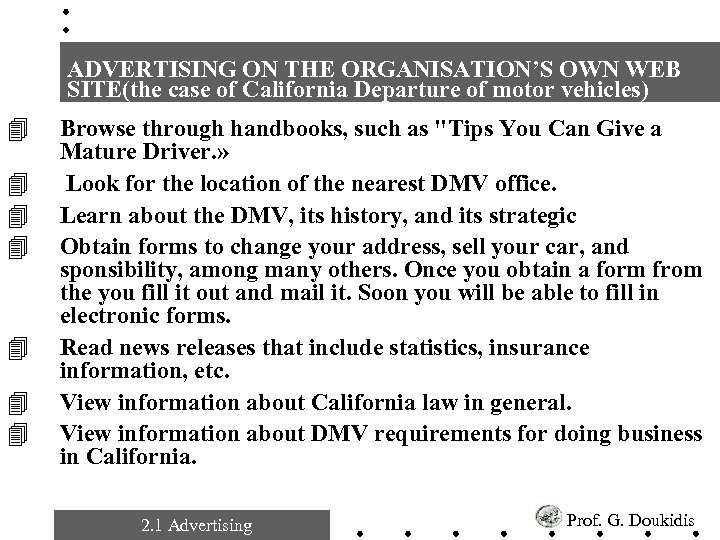
ADVERTISING ON THE ORGANISATION’S OWN WEB SITE(the case of California Departure of motor vehicles) 4 4 4 4 Browse through handbooks, such as "Tips You Can Give a Mature Driver. » Look for the location of the nearest DMV office. Learn about the DMV, its history, and its strategic Obtain forms to change your address, sell your car, and sponsibility, among many others. Once you obtain a form from the you fill it out and mail it. Soon you will be able to fill in electronic forms. Read news releases that include statistics, insurance information, etc. View information about California law in general. View information about DMV requirements for doing business in California. 2. 1 Advertising Prof. G. Doukidis
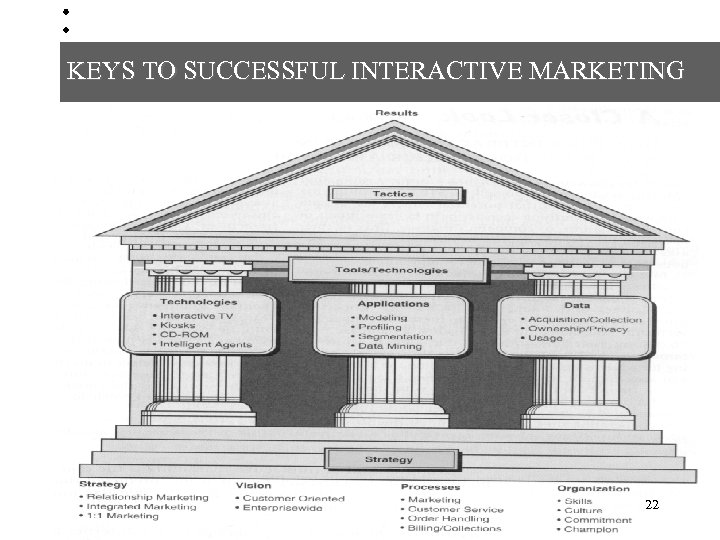
KEYS TO SUCCESSFUL INTERACTIVE MARKETING 22 Prof. G. Doukidis
INTERACTIVE ADVERTISING/MARKETING 4 Advertisements on the net can be interactive · potential costumers can e-mail questions and receive answers · they can also participate in games, quizzes and auctions 4 In interactive marketing advertisers use costumised , one advertising follwed by a sale · the term “interactive” points to the ability to address an individual , to gather and remember the responses of the individual , and to serve that customer based on his/her previous, unique responser 4 Gartner Group suggest strategies for interactive marketing l l Serve the customers before selling to them. Think of interactive marketing as a way to capture data. Learn to control information flow even though it lies with the customer. Understand how all parts of the marketing strategy fit together, including interactive marketing, and create each part to serve a unique purpose and market group. 23 2. 1 Advertising Prof. G. Doukidis
HOW DOES INTERACTIVE MARKETING WORK? THE DOUBLECLICK APPROACH Interactive marketing can take many forms. Assume that 3 M Corporation wants to sell its $10, 000 multimedia projectors. It knows that potential buyers are people who work in advertising agencies or in IS departments of large corporations, or companies that use Unix as their operating system. 3 M approaches Double. Click Inc. and asks the firm to identify such potential customers. How does Double. Click find them? Clever and simple. In 1997, Double. Click (www. doubleclick. net) monitored people browsing the Web sites of about 100 cooperating companies such as Quicken, Travelocity, and Virtual Comics and Books That Work. By inspecting Internet addresses of the visitors to these 100 companies' Web sites and matching them against a database with 70, 000 Internet domain names that include a line-ofbusiness code, Double. Click can find those people working for advertising agencies. By checking the browsers, it can also find out which visitor is using a Unix system. While Double. Click cannot find out your name, it build a dossier on you, attached to an ID number that was assigned to you during your first visit to any of the 100 sites. As you continue to visit any of the 100 cooperating site, an intelligent software agent builds a relatively complete dossier on you, your spending, and your computing habits. This process is done with a device known as a cookie, a file created at the request of a Web server and stored on the user's hard drive. So, the Web site can remember" your past behavior on the Internet. Double. Click then prepares an ad for 3 M projectors. The ad is targeted for people whose profile matches what is needed for 3 M. So, if you are a Unix user or employed by an advertising agency, on your next browsing trip in any of the 100 participating Web sites, you will be surprised to find exactly what you wanted: information about the multimedia projector. How is all this financed? 3 M pays Double. Click for the ad. The fee is then split with the Web sites that carry the 3 M ads, based on how many times the ad is matched with a visitor. NOTE: You can avoid the creation of a cookie on your hard drive if you elect to do so, using software such as Cookie Cutter. However, only a few people know this can fact. In most cases the cookie is placed on your hard drive without your knowledge. SOURCE: Condensed from Moukheiber (1996). 24 Prof. G. Doukidis
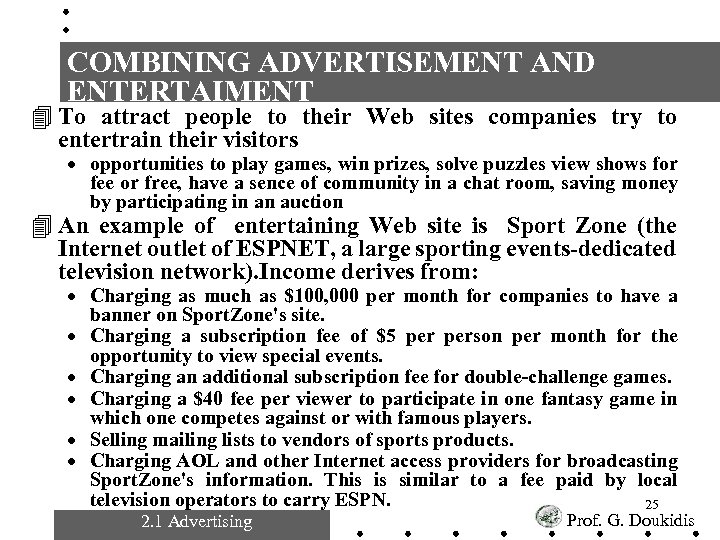
COMBINING ADVERTISEMENT AND ENTERTAIMENT 4 To attract people to their Web sites companies try to entertrain their visitors · opportunities to play games, win prizes, solve puzzles view shows for fee or free, have a sence of community in a chat room, saving money by participating in an auction 4 An example of entertaining Web site is Sport Zone (the Internet outlet of ESPNET, a large sporting events-dedicated television network). Income derives from: · Charging as much as $100, 000 per month for companies to have a banner on Sport. Zone's site. · Charging a subscription fee of $5 person per month for the opportunity to view special events. · Charging an additional subscription fee for double-challenge games. · Charging a $40 fee per viewer to participate in one fantasy game in which one competes against or with famous players. · Selling mailing lists to vendors of sports products. · Charging AOL and other Internet access providers for broadcasting Sport. Zone's information. This is similar to a fee paid by local television operators to carry ESPN. 25 2. 1 Advertising Prof. G. Doukidis
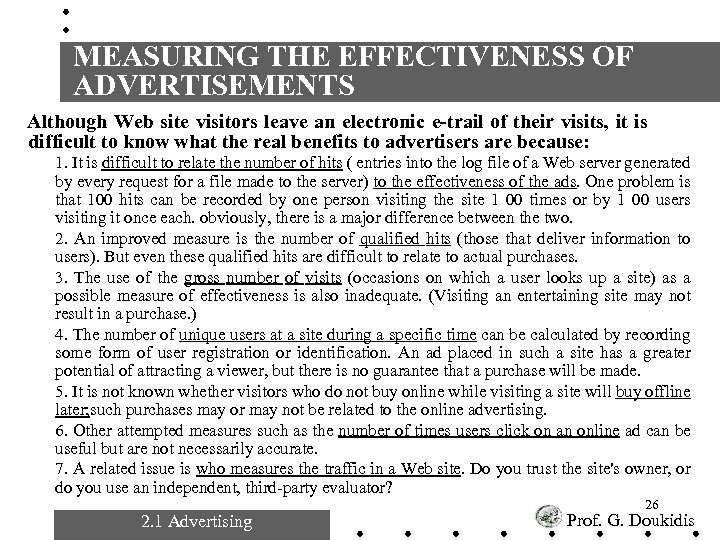
MEASURING THE EFFECTIVENESS OF ADVERTISEMENTS Although Web site visitors leave an electronic e-trail of their visits, it is difficult to know what the real benefits to advertisers are because: 1. It is difficult to relate the number of hits ( entries into the log file of a Web server generated by every request for a file made to the server) to the effectiveness of the ads. One problem is that 100 hits can be recorded by one person visiting the site 1 00 times or by 1 00 users visiting it once each. obviously, there is a major difference between the two. 2. An improved measure is the number of qualified hits (those that deliver information to users). But even these qualified hits are difficult to relate to actual purchases. 3. The use of the gross number of visits (occasions on which a user looks up a site) as a possible measure of effectiveness is also inadequate. (Visiting an entertaining site may not result in a purchase. ) 4. The number of unique users at a site during a specific time can be calculated by recording some form of user registration or identification. An ad placed in such a site has a greater potential of attracting a viewer, but there is no guarantee that a purchase will be made. 5. It is not known whether visitors who do not buy online while visiting a site will buy offline later; such purchases may or may not be related to the online advertising. 6. Other attempted measures such as the number of times users click on an online ad can be useful but are not necessarily accurate. 7. A related issue is who measures the traffic in a Web site. Do you trust the site's owner, or do you use an independent, third-party evaluator? 2. 1 Advertising 26 Prof. G. Doukidis
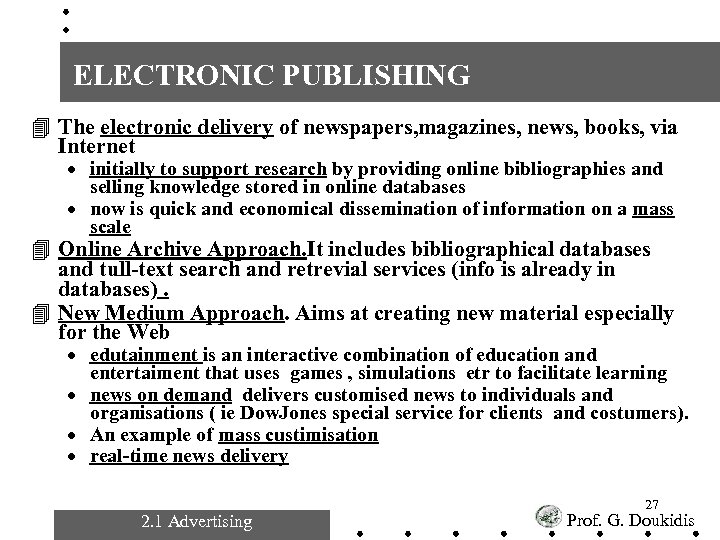
ELECTRONIC PUBLISHING 4 The electronic delivery of newspapers, magazines, news, books, via Internet · initially to support research by providing online bibliographies and selling knowledge stored in online databases · now is quick and economical dissemination of information on a mass scale 4 Online Archive Approach. It includes bibliographical databases and tull-text search and retrevial services (info is already in databases). 4 New Medium Approach. Aims at creating new material especially for the Web · edutainment is an interactive combination of education and entertaiment that uses games , simulations etr to facilitate learning · news on demand delivers customised news to individuals and organisations ( ie Dow. Jones special service for clients and costumers). · An example of mass custimisation · real-time news delivery 2. 1 Advertising 27 Prof. G. Doukidis
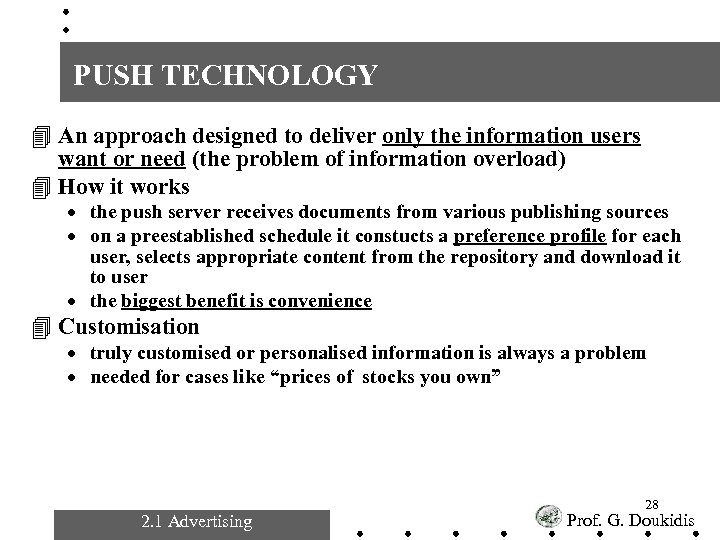
PUSH TECHNOLOGY 4 An approach designed to deliver only the information users want or need (the problem of information overload) 4 How it works · the push server receives documents from various publishing sources · on a preestablished schedule it constucts a preference profile for each user, selects appropriate content from the repository and download it to user · the biggest benefit is convenience 4 Customisation · truly customised or personalised information is always a problem · needed for cases like “prices of stocks you own” 2. 1 Advertising 28 Prof. G. Doukidis
POINTCASTING-DELIVERING CUSTOMIZED INFORMATION Point. Cast's major product is Point. Casting, a one-to-one service that delivers breaking news according to the user's interests. Point. Cast's major strength is the integration of newswires from several competing broadcasters, such as CNN and Reuters. The consolidated service is implemented on the customer's LAN and PCs where news can be distributed to all users. This service is available on PCN (Point. Cast Network), which is divided into several “channels” such as News (general), Weather, Sports, Companies, Industries, and Life Style. Each channel is divided into subcategories. For example, News can be national, or international. The user selects items from a hierarchy of menus. 2. 1 Advertising The information (such as stock quotes or sports scores) is delivered as a screen saver while the user is not using the computer. An alternative to the screen saver option is to turn on the computer to PCN at agreed-upon times to receive the news. Details can be obtained by clicking on the headlines. The service is available free with most Internet access services. Point. Cast services are also available on intranets, enabling companies to broadcast internal news alongside the public channels. 29 Prof. G. Doukidis
ELECTRONIC BANKING/CYBERBANKING 4 Includes various banking activities (paying bills, secure a loan) conducted electrousially and not a physical bank location 4 In addition to regular banks that are adding online services, we see the emergence of virtual banks solely dedicated to Internet transactions (ie Security First Network Bank -SFNB) 4 Personal Finance Online. Connection of home banking with portfolio management and personal finance · Bill paying and electronic check writing · Tracking bank accounts, expenditures, and credit cards · Portfolio management, including reports and capital gains (losses) computations · Investment tracking and monitoring of securities · Quotes and tradeline historical and current prices · Budget organization · Record keeping of cash flow and profit and loss computations · Tax computations · Retirement goals, planning, and budgeting 2. 2 Cyberbanking 30 Prof. G. Doukidis
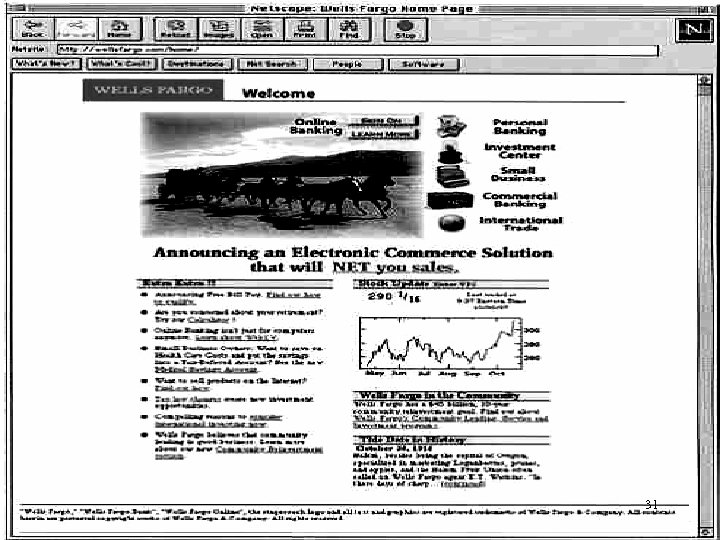
CYBERBANKING AT WELLS FARGO 31 Prof. G. Doukidis
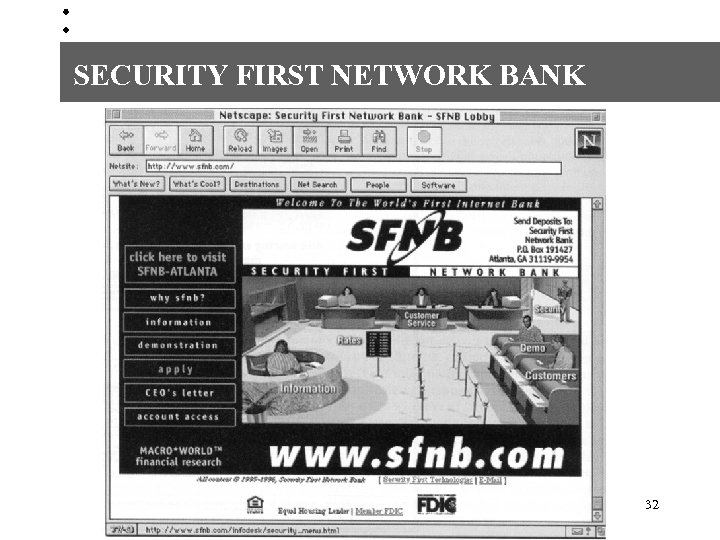
SECURITY FIRST NETWORK BANK 32 Prof. G. Doukidis
ONLINE STOCK TRADING 4 By mid of 1998, 4 million people in USA traded on-line stocks, bonds etc 4 The cost was $7 -$20 compared to $35 -$100 in typical cases 4 Advantages · · no waiting on busy telephone lines the chanse of making mistakes is small orders can be placed from anywhere and anytime considerable amount of extra information 4 Charles Schwab (1995), Merrill Lynch (1997) (More than 60 firms by 1999). 4 It works (www. Schwab. com/schwoboline) in a very friendly enviroment (access from a mobile as well). 4 E*trade is the most well-known example. 2. 2 Cyberbanking 33 Prof. G. Doukidis
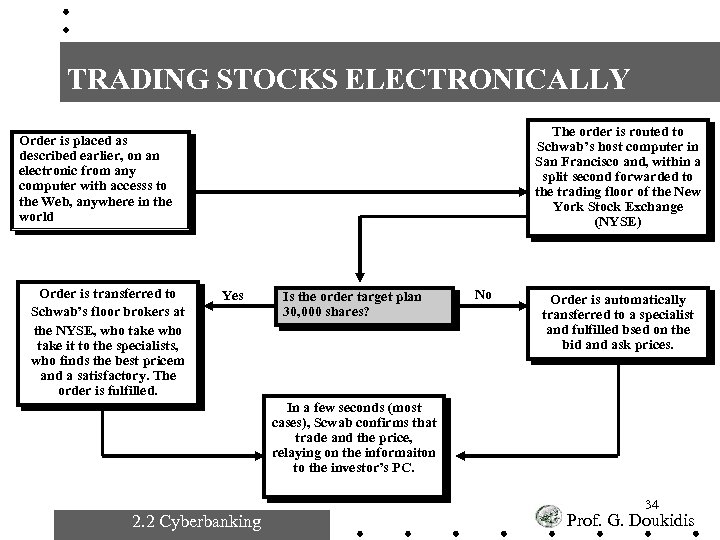
TRADING STOCKS ELECTRONICALLY The order is routed to Schwab’s host computer in San Francisco and, within a split second forwarded to the trading floor of the New York Stock Exchange (NYSE) Order is placed as described earlier, on an electronic from any computer with accesss to the Web, anywhere in the world Order is transferred to Schwab’s floor brokers at the NYSE, who take it to the specialists, who finds the best pricem and a satisfactory. The order is fulfilled. Yes Is the order target plan 30, 000 shares? No Order is automatically transferred to a specialist and fulfilled bsed on the bid and ask prices. In a few seconds (most cases), Scwab confirms that trade and the price, relaying on the informaiton to the investor’s PC. 2. 2 Cyberbanking 34 Prof. G. Doukidis
THE El. ECTRONIC JOB MARKET IS USED BY: 1. Job seekers can reply to employment ads. Alternatively, they can take the initiative and place resumes on their own home pages or on others' Web sites, send messages to members of newsgroups asking for referrals, and use recruiting firms such as Career Mosaic (www. careermosaic. com), Job Center (www. jobcenter. com), and Monster Board (www. monster. com). For entry-level jobs and internships for newly minted graduates, job seekers can use www. jobdirect. com. 2. Job offerers. Many organizations advertise openings on their Web site. Othrecruit potential employees. ers use advertising possibilities ranging from popular sites to online ser vices, bulletin boards, and recruiting firms. 3. Recruiting firms. Thousands of job placement brokers are active on the Web. They use their own Web pages to post available job descriptions and advertise their services in electronic malls and in others' Web sites. Recruiters use newsgroups, online forums, bulletin boards, Internet commercial resume services, and providers such as AOL (see their E-span service at www. espan. com) and Compu. Serve. Jobfinding brokers (such as Resume-Link) help candidates write their resumes and get the most exposure. 2. 3 The job market and auctions 35 Prof. G. Doukidis
ELECTRONIC AUCTIONS 1. Auctioning cars to dealers. Manheim online (www. lanheim. com) brings the Web to the used car supply chain-auto dealers, banks, leasing and rental companies, and users of fleet vehicles. Manheim conducts auctions for dealers only. It takes possession of a car from the seller and handles all the administrative and title work and any reconditioning to prepare the car for auction. Dealers visit "cyberlots" where they see pictures of the cars. A transaction can be from many locations, thus a buyer in city A can buy a car in city B; therefore, transportation costs are also quoted online. The potential buyer sees the price at which the car is available and then offers a bid at the requested price or lower, by filling in an electronic form. the deal is closed, a contract is emailed or faxed. The buyer signs the conttract and arranges for payment. In the near future the site will add an electronic payment option. 2. Onsale conducts live online auctions, mostly of computers amd electronic consumer products, on the Internet (www. onsale. com). There are several types of auctions. For example. Yankee Auction, with identical items offered for sale, closing on April 28, 1997. The seven highest bids are shown. In order to be included, enter a bid at least $25 above the lowest bid. The highest bidders win the available inventory at their offered price. A detailed list of all the product specifications warrantees and so forth is included and purchases are made using a credit card. 3. Art auctions. Artwork is sold online at various sites, including. onlineart. com), Auctions On-line (www. auctions-online. com), and Internet Liquidators. 4. Airlines. In an attempt to encourage visitors to return to its web site American Airlines (www. americanair. com) offers a "silent auction. " Consumers bid on auction items and the winner usually recieves two trip tickets. All types of items are auctioned and the proceeds go to charitable organizations. Some airlines auction first class tickets a few days the departure if seats are available (such as Cathey Pacific; see www. cathey. usa. com). BIDDINGS 2. 2 Cyberbanking BARTERING 36 Prof. G. Doukidis
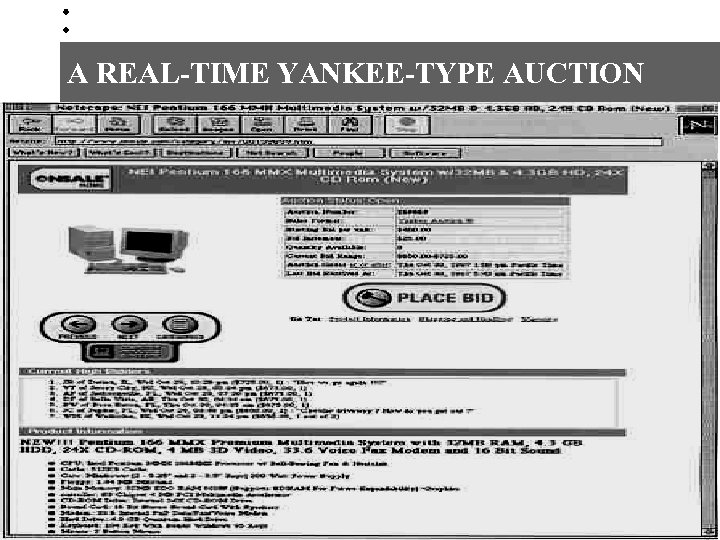
A REAL-TIME YANKEE-TYPE AUCTION Prof. G. Doukidis

TRAVEL AND REAL ESTATE 4 Travel and Tourism (the largest Internet market) · Examles: travelocity, travelweb. com, expedia. com · Microsoft’s expedia. com allows you to purchase airline tickets, reserve hotel rooms, rent cars AND a friendly and fun itienarry-based interface (e-mail for low cost flights) AND news stories that may affect travel plans (weather etc) AND frequent flier deals and special discounts 4 Real Estate is an ideal area for e. Commerce, because: · you can view many properties on the screen, saving time · you can sort and organise properties according to your critiria · you can find delaited information about the properties and frequently get even more detail than brokers will provide 38 2. 3 The job market and auctions Prof. G. Doukidis
ELECTRONIC RETAILING AND MALLS 4 Electronic retailing is direct sale (business to customers) through electronic storefronts, usually around a catalog format (two types of vendors) 4 Solo electronic storefronts · they can be extensions of physical stores (ie Wal-mart Online) · new business (only online) (ie Amazon, Peapod, Virtual Vineyards, etoy) 4 Ellectronic Malls or Cybermalls · include diverse stores or one type of goods (ie sporting goods) · Internet shopping Mall listed over 27, 000 stores in 1997 · problems with this new business model 4 Metamalls · one-stop shopping over multiple malls (use one search engine and pay once) · other useful services: comparative pricing and finding substitute products 2. 4 Travel and real estate 39 Prof. G. Doukidis
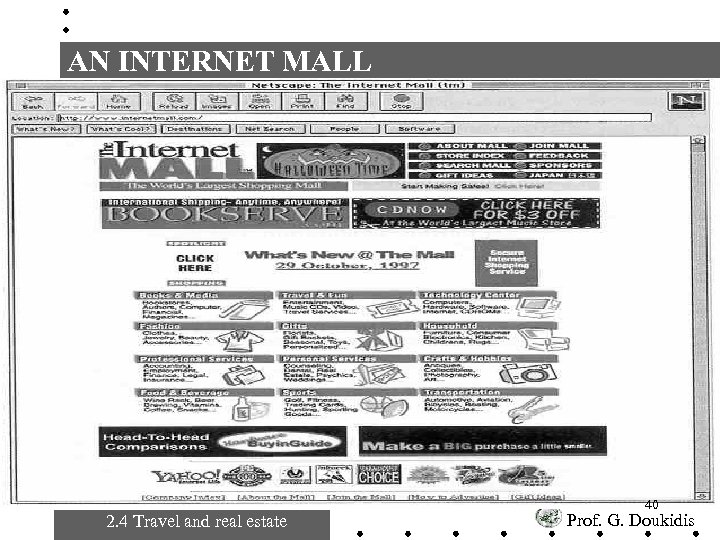
AN INTERNET MALL 2. 4 Travel and real estate 40 Prof. G. Doukidis
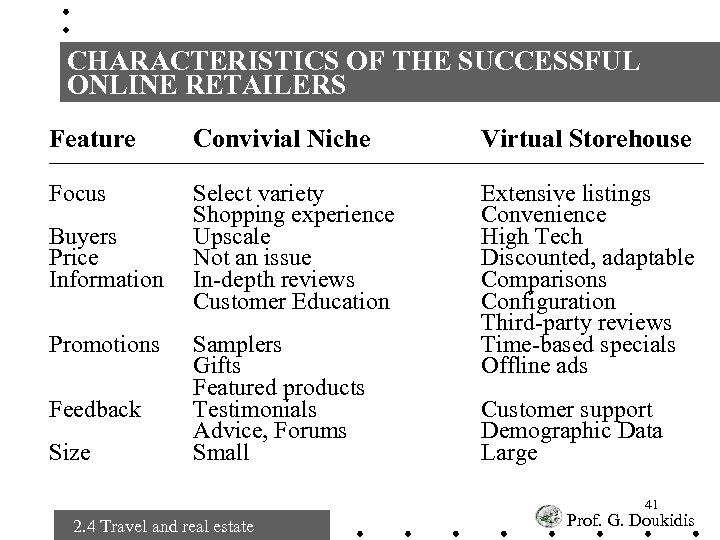
CHARACTERISTICS OF THE SUCCESSFUL ONLINE RETAILERS Feature Convivial Niche Virtual Storehouse Focus Select variety Shopping experience Upscale Not an issue In-depth reviews Customer Education Extensive listings Convenience High Tech Discounted, adaptable Comparisons Configuration Third-party reviews Time-based specials Offline ads Buyers Price Information Promotions Feedback Size Samplers Gifts Featured products Testimonials Advice, Forums Small Customer support Demographic Data Large 41 2. 4 Travel and real estate Prof. G. Doukidis
Скачать презентацию FOUNDATIONS AND B-C e COMMERCE 1 Foundations of
0bea081a4e897d22d8799dd052c18bd6.ppt