


 Скачать презентацию FOUNDATIONAL ONTOLOGY Srihari Sadagoparamanujam Agenda Introduction Characteristics
2efa82ddea642e1db279cdddefb9616d.ppt
- Количество слайдов: 31
 FOUNDATIONAL ONTOLOGY Srihari Sadagoparamanujam
 Agenda Introduction Characteristics CYC
 INTRODUCTION
 Introduction A foundational ontology, sometimes also called ‘upper level ontology’, defines a range of top-level domain-independent ontological categories, which form a general foundation for more elaborated domain-specific ontologies. The core ingredients of foundational semantics are thus, on the one hand, a foundational ontology allowing to express elementary things about the world, but also linguistic components such as a lexical ontology, linking language to the world (e. g. Word. Net) as well as lexical semantic resources such as Frame. Net or Prop. Bank, providing case frames with their corresponding roles as well as sub categorization structures for verbs, adjectives, nouns etc.
 Why an upper ontology is completely not feasible There is no self-evident way of dividing the world up into concepts, and certainly no non-controversial one. There is no neutral ground that can serve as a means of translating between specialized (or "lower" or "application-specific") ontologies. Human language itself is already an arbitrary approximation of just one among many possible conceptual maps.
 Examples CYC BFO – Basic Formal Ontology DOLCE - Descriptive Ontology for Linguistic and Cognitive Engineering GFO – General Formal Ontology Word. Net SUMO – Suggested Upper Merged Ontology
 CHARACTERISTICS
 Characteristics Strong axiomatization Explicit ontological commitment Minimality
 CYC
CYC
 CYC Started in 1984 by Douglas Lenat at MCC and is developed by company Cycorp. Goal: Enable AI applications to perform human-like reasoning. The first version of Cyc(Open. Cyc) was released in spring 2002 and contained only 6, 000 concepts and 60, 000 facts. The knowledge base now contains 47, 000 concepts and 306, 000 facts and can be browsed on the Open. Cyc website.
 What is CYC? The Cyc Knowledge Server is a very large, multicontextual knowledge base and inference engine developed by Cycorp. Cyc is intended to provide a "deep" layer of understanding that can be used by other programs to make them more flexible.
 What ‘s in CYC? The Cyc technology includes the following components: The Cyc Knowledge Base The Cyc Inference Engine The Cyc. L Representation Language The Natural Language Processing Subsystem Cyc Semantic Integration Bus Cyc Developer Toolsets
 The Cyc Knowledge Base The Cyc knowledge base (KB) is a formalized representation of a vast quantity of fundamental human knowledge: facts, rules of thumb, and heuristics for reasoning about the objects and events of everyday life. The medium of representation is the formal language Cyc. L.
 The Cyc Inference Engine The Cyc inference engine performs general logical deduction (including modus ponens, modus tollens, and universal and existential quantification), with AI's well-known named inference mechanisms (inheritance, automatic classification, etc. ) as special cases.
 The Cyc. L Representation Language Cyc. L, the Cyc representation language, is a large and extraordinarily flexible knowledge representation language. It is essentially an augmentation of firstorder predicate calculus (FOPC), with extensions to handle equality, default reasoning, skolemization, and some second-order features.
 The Natural Language Processing System Natural-language (NL) processing is among the most studied -- and most intractable -- outstanding challenges of software engineering. Cyc-like common sense is a prerequisite for humanlevel competence at this task.
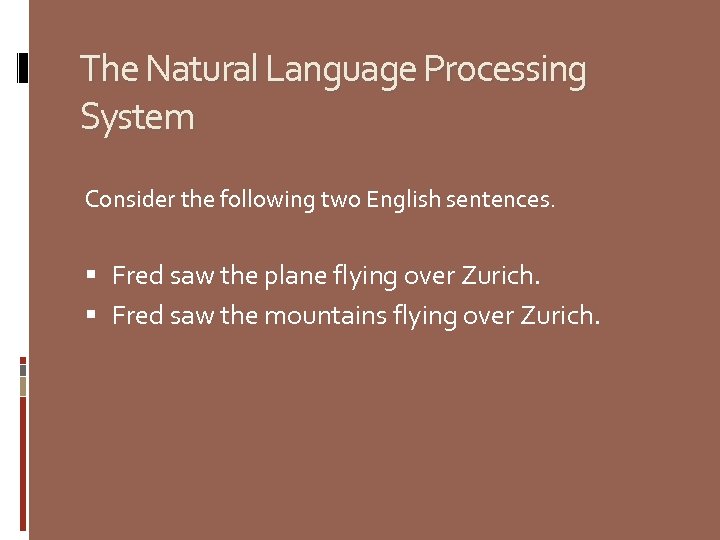 The Natural Language Processing System Consider the following two English sentences. Fred saw the plane flying over Zurich. Fred saw the mountains flying over Zurich.
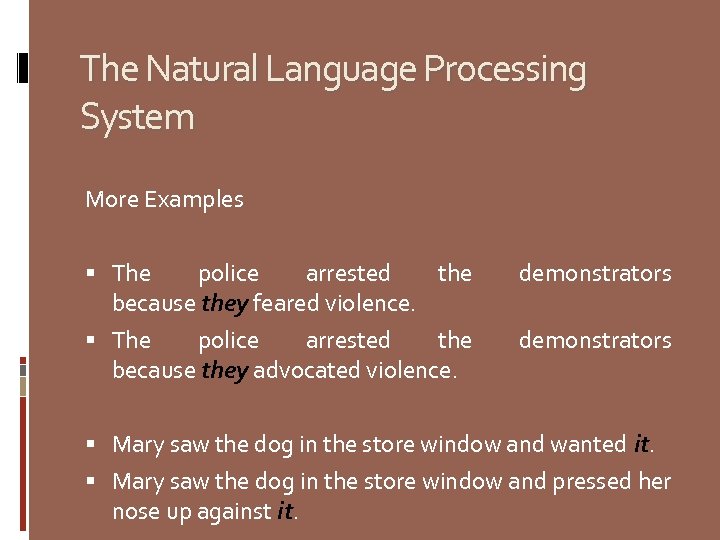 The Natural Language Processing System More Examples The police arrested the because they feared violence. demonstrators The police arrested the because they advocated violence. demonstrators Mary saw the dog in the store window and wanted it. Mary saw the dog in the store window and pressed her nose up against it.
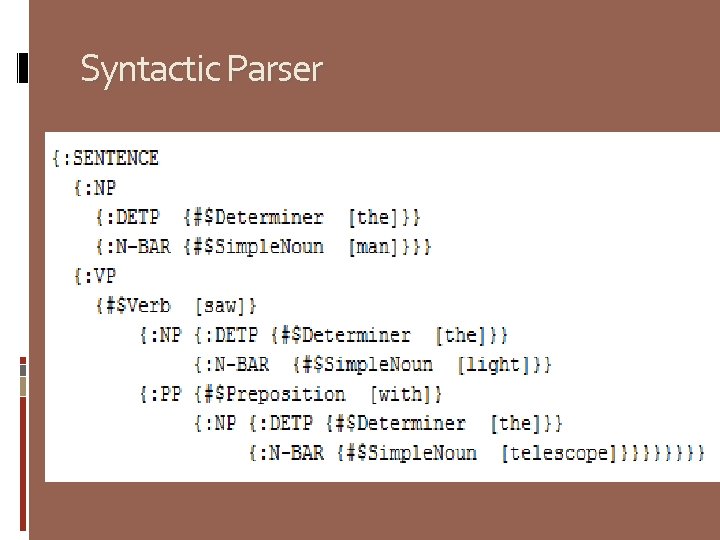
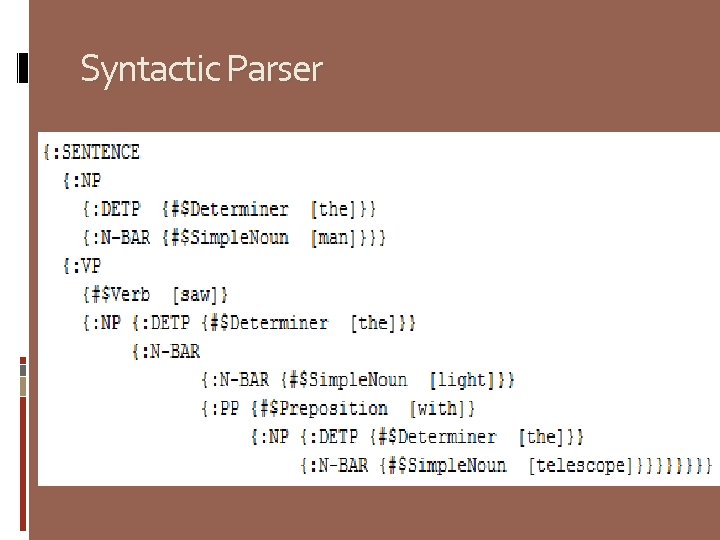
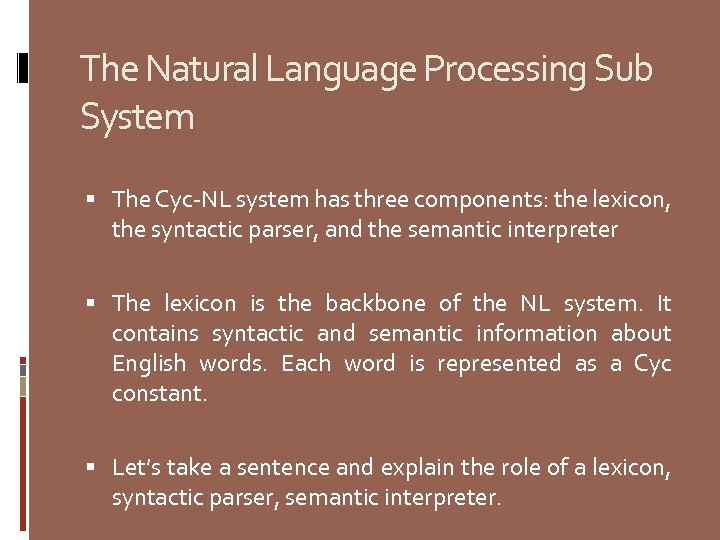 The Natural Language Processing Sub System The Cyc-NL system has three components: the lexicon, the syntactic parser, and the semantic interpreter The lexicon is the backbone of the NL system. It contains syntactic and semantic information about English words. Each word is represented as a Cyc constant. Let’s take a sentence and explain the role of a lexicon, syntactic parser, semantic interpreter.
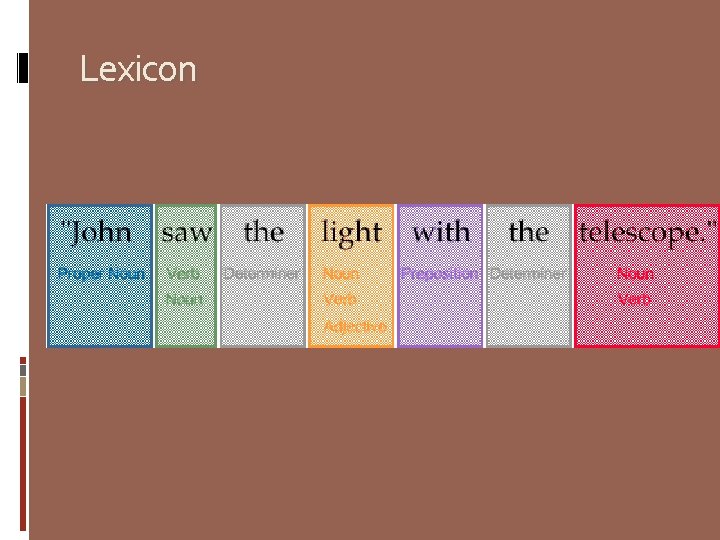
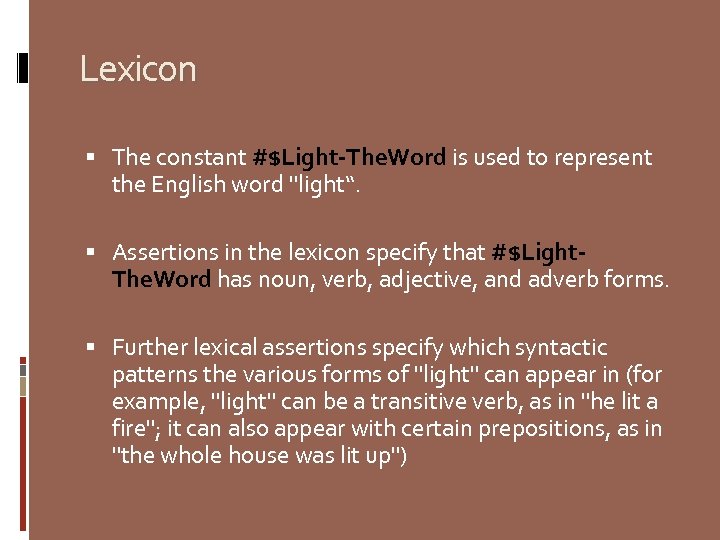 Lexicon The constant #$Light-The. Word is used to represent the English word "light“. Assertions in the lexicon specify that #$Light. The. Word has noun, verb, adjective, and adverb forms. Further lexical assertions specify which syntactic patterns the various forms of "light" can appear in (for example, "light" can be a transitive verb, as in "he lit a fire"; it can also appear with certain prepositions, as in "the whole house was lit up")
 Lexicon
 Syntactic Parser
 Syntactic Parser
 Syntactic Parser From first tree: "John used a telescope to see the light“ From second tree: "John saw the light which had a telescope“ These two sentences are sent to the semantic interpreter to get the final output.
 Semantic Interpreter In the example "the man saw the light with the telescope", the semantic component would consult the KB to find out whether telescopes are typically used as instruments in seeing, and whether lights are the kinds of things that usually have telescopes. Based on the results of asking the KB, the semantic component would reject the second parse as invalid, and produce a Cyc. L translation of the first parse.
 WWW Information Retrieval Cyc is used even for retrieving information from the world wide web. Let’s consider IMDB A quick browse of the IMD demonstrates that it embodies virtually everything there is to know about movies; that it can respond to queries for particular actors, movies, etc.
 WWW Information Retrieval For example, let's say a user asks Cyc, "What movies did Ronald Reagan act in? ". This might be represented in Cyc. L as: (#$acted. In. Movie #$Ronald. Reagan ? x)
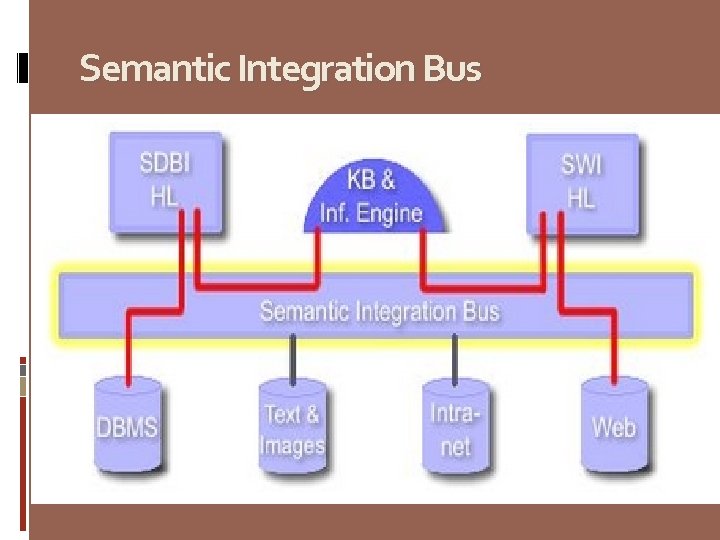 Semantic Integration Bus
 Developer Tool Sets The Cyc system also includes a variety of interface tools that permit the user to browse, edit, and extend the Cyc KB, to pose queries to the inference engine, and to interact with the natural-language The most commonly-used tool, our HTML browser, allows the user to view the KB in a hypertexty way and database integration modules.
 References http: //en. wikipedia. org http: //www. cyc. com “A Unified Foundational Ontology and some Applications of it in Business Modeling” - Giancarlo Guizzardi and Gerd Wagner “Towards Foundational Semantics” - Phillip Cimiano and Uwe Reyle “The Role of Foundational Ontologies for Conceptual Modeling and Domain Ontology Representation” – Giancarlo Guizzardi
 Thank You!