


 Скачать презентацию Foundation Year Program Discovering Science Seminar 1 a
Seminar 1 pesentation.pptx
- Количество слайдов: 26
 Foundation Year Program Discovering Science Seminar 1 a 2015 -16
 Foundation Year Program Water shortage 2015 -16
 Foundation Year Program • Water scarcity is the lack of sufficient available water resources to meet the demands of water usage within a region. It already affects every continent and around 2. 8 billion people around the world at least one month out of every year. More than 1. 2 billion people lack access to clean drinking water (Ref : Wikipedia) 2015 -16
 Foundation Year Program • Water scarcity can be a result of two mechanisms: physical (absolute) water scarcity and economic water scarcity, where physical water scarcity is a result of inadequate natural water resources to supply a region's demand, and economic water scarcity is a result of poor management of the sufficient available water resources. 2015 -16
 Foundation Year Program • The water crisis is the #1 global risk based on impact to society (as a measure of devastation), and the #8 global risk based on likelihood (of occurring within 10 years) as announced by the World Economic Forum, January 2015. • 750 million people around the world lack access to safe water; approximately one in nine people. • Diarrhea caused by inadequate drinking water, sanitation, and hygiene kills an estimated 842, 000 people every year globally, or approximately 2, 300 people per day. • 82% of those who lack access to improved water live in rural areas, while just 18% live in urban areas. 2015 -16
 Foundation Year Program • "A shortage of water resources could spell increased conflicts in the future. Population growth will make the problem worse. So will climate change. As the global economy grows, so will its thirst. Many more conflicts lie just over the horizon. " -- Ban Ki-Moon Read more: http: //www. businessinsider. com/15 facts-about-the-coming-water-crisis-20103#ixzz 3 l. Ebze. R 3 h 2015 -16
 Foundation Year Program Kazakhstan water issues • Irtysh river issue : China taking a major chunk of water. • Mangystau issue : Desalination expenses • Aral Sea issue : Drying up of water base 2015 -16
 Foundation Year Program 6 Ways The World Can Cope With Water Shortages AGRICULTURAL WATER PRODUCTIVITY • Farming accounts for about 70% of all water use, so the sector presents the greatest opportunity for saving. The paper says a 0. 5% increase in productivity per year (producing the same amount of food with less water) would produce a 20% saving by 2050, and a 2% improvement in the population affected by water stress. "New cultivars of important crops, such as wheat or rice, can be used to optimize water irrigation efficiency, " Gleeson wrote in an email. IRRIGATION EFFICIENCY • A lot of water is wasted during crop irrigation, because instead of actually watering crops, water is sent every which way. Shifting away from flood irrigation and sprinklers to drip and precision systems could improve efficiency 1% a year until 2050, though heavy investment would be needed. DOMESTIC AND INDUSTRIAL USE • Plugging leaks in domestic and industrial systems would provide another wedge—enough to produce a 20% stress reduction by 2050. As with the first two options, this may not be that difficult. "Because all three uses of water are currently inefficient in many water-stressed regions, significant gains in these three wedges are plausible, " the authors write. 2015 -16
 Foundation Year Program 6 Ways The World Can Cope With Water Shortages LIMITING POPULATION GROWTH • The fourth option isn't directly about water but could have an important impact: tempering population increases. "A full wedge of water-stress relief would require keeping the population in 2050 below 8. 5 billion, for example, through help with family planning and tax incentives, " the paper says. INCREASING WATER STORAGE • As well as what the researchers call "soft measures, " they also propose "hard measures" involving upgrades to essential infrastructure. These include making reservoirs larger, so they can hold more water. To supply a full wedge, they say 600 cubic kilometers of water storage would be needed, which is a lot. DESALINATION OF SEAWATER • Another costly option: investing in desalination plants. "A 50 -fold increase would be required for one wedge, which would imply significant capital and energy costs, " the paper says. • The authors mention other options, including rainwater harvesting for agriculture and reducing meat production, which is a big drain on supplies. But they don't quantify their impact. ( Ref : Nature Geo. Science) 2015 -16
 Foundation Year Program • References • Tropical Medicine and International Health. 19, no. 8 (2014): 894 - 905. Burden of disease from inadequate water, sanitation and hygiene in low- and middle-income settings: a retrospective analysis of data from 145 countries. • World Health Organization and UNICEF Joint Monitoring Programme (JMP). (2014). Progress on Drinking Water and Sanitation, 2014 Update. • United States Census Bureau Estimates. (2014). U. S. Census Bureau, International Data Base. • World Economic Forum (2015). Global Risks 2015 Report. • Map data sourced from WHO/UNICEF Joint Monitoring Programme for Water Supply and Sanitation. (2014). Pg. 14. Based on 2012 Data. Progress on Drinking Water and Sanitation, 2014 Update. 2015 -16
 Foundation Year Program Food security 2015 -16
 Foundation Year Program Food Security Definition What is food security? The World Food Summit of 1996 defined food security as existing “when all people at all times have access to sufficient, safe, nutritious food to maintain a healthy and active life”. 2015 -16
 Foundation Year Program Causes of the Problem Increasing population - In 2009, the world population was 6 billion. By 2050, it is predicted to reach 9 billion. Our current output of food is not enough to feed a population of 9 billion. Changing diets - As countries develop and people become richer they tend to eat a more varied diet, including more meat, which requires more energy to produce. This also means there is more competition for the same types of food. Reduced arable land - The drive to produce more biofuels for transport uses edible crops and has reduced arable land. 2015 -16
 Foundation Year Program Factors Affecting Food Security Ctd • Transport costs - The relatively high price of oil in recent years has increased the price of food storage and distribution (not so recent days). • Climate change - Climate change is leading to a warmer world which will affect what crops can be grown where. Climate change can also lead to more frequent extreme weather events (e. g. floods) which can damage crops. • Pests and diseases - Pests and diseases are becoming more resistant to pesticides and sprays. The changing climate is also bringing pest and diseases into new areas where they could not previously survive. • Biofuel production – crops are used for fuel production 2015 -16
 Foundation Year Program Food Belt Around Astana • There are 128 food suppliers around Astana • 77 cattle and 4 chicken farms • 13 vegetable farms • 34 food processing plants They produced in 2015: • Milk 12, 8 thousand tons • Meat and meat products - 4, 38 thousand tons • Eggs – 56, 4 millions http: //ush. akmol. kz/informacia_po_razvitiu_prodovolstvennogo_poasa_vokryg_go roda_astani. html 2015 -16
 Foundation Year Program What Can Be Done q. Invest in human resources, so more productive labor is possible q. Improve access to productive resources and remunerative employment q. Improve markets, infrastructure, and institutions q. Expand appropriate research, knowledge, and technology q. Improve natural resource management q. Promote good governance q. Support sound national and international trade and macroeconomic policies 2015 -16
 Foundation Year Program Energy security 2015 -16
 Foundation Year Program Energy security - definiton International Energy Agency: „Adequate, affordable and reliable access to energy fuels and services, it includes availability of resources, decreasing dependence on imports, decreasing pressures on the environment, competition and market efficiency, reliance on indigenous resources that are environmentally clean, and energy services that are affordable and equitably shared 2015 -16
 Foundation Year Program Energy security threats • Political instability of several energy producing countries • Manipulation of energy supplies • Competition over energy sources • Attacks on supply infrastructure • Accidents, natural disasters, terrorism, and reliance on foreign countries for oil 2015 -16
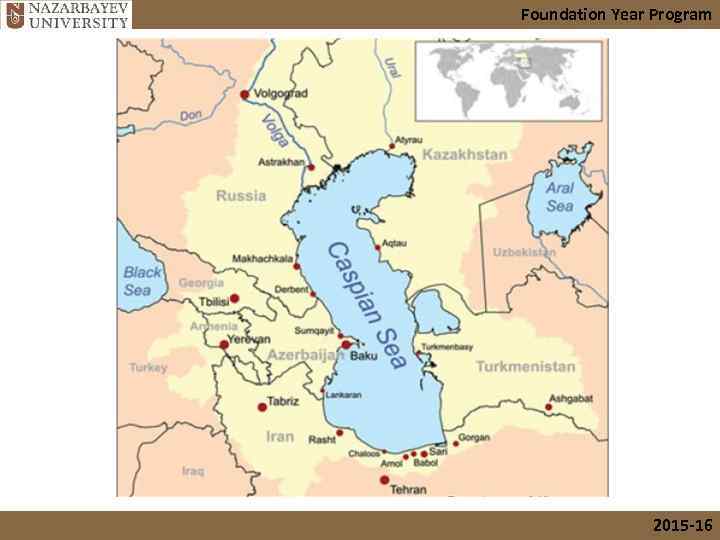
 Foundation Year Program Energy resources – conflict potential • Energy – potential both for interstate conflict and cooperation Border-delimitation conflicts Border hotspots: Iran-Qatar (South Pars field); Spratly Islands in the South China Sea (China X Vietnam); East China Sea (China X Japan) Potential conflict areas? • Arctic Circle • Caspian Sea 2015 -16
 Foundation Year Program 2015 -16
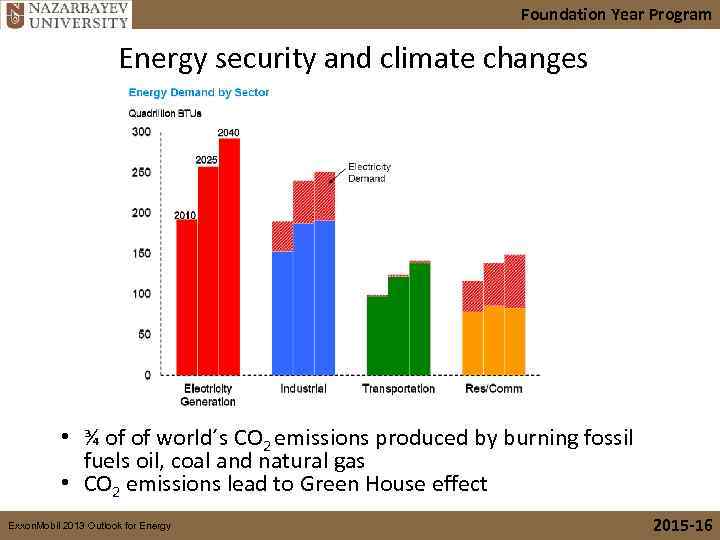 Foundation Year Program Energy security and climate changes • ¾ of of world´s CO 2 emissions produced by burning fossil fuels oil, coal and natural gas • CO 2 emissions lead to Green House effect Exxon. Mobil 2013 Outlook for Energy 2015 -16
 Foundation Year Program Worldwide Commercial Energy Production 2015 -16
 Foundation Year Program Nuclear Power plant in KZ. Yes or No? 2015 -16
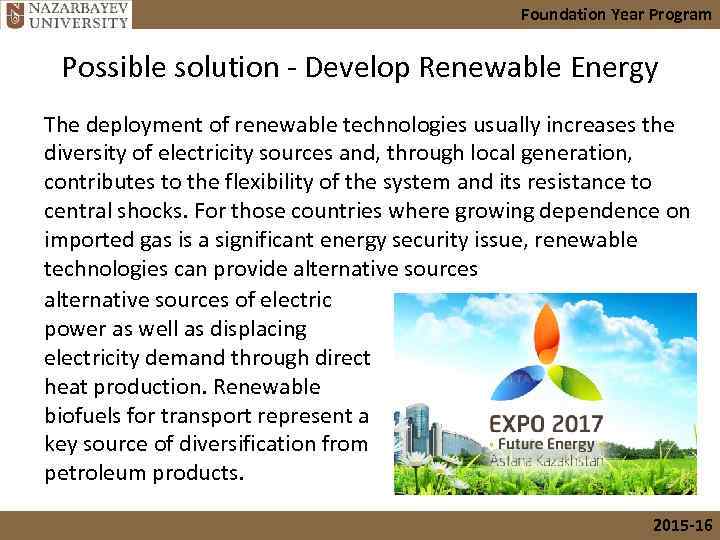 Foundation Year Program Possible solution - Develop Renewable Energy The deployment of renewable technologies usually increases the diversity of electricity sources and, through local generation, contributes to the flexibility of the system and its resistance to central shocks. For those countries where growing dependence on imported gas is a significant energy security issue, renewable technologies can provide alternative sources of electric power as well as displacing electricity demand through direct heat production. Renewable biofuels for transport represent a key source of diversification from petroleum products. 2015 -16
 Foundation Year Program Solutions • Renewable energy!!! • Energy saving technologies (electric vehicles etc. ) • Decrease industrial energy consumption by introducing recycling technologies 2015 -16