


 Скачать презентацию Foundation for the Advancement of Economics and Friedrich
09715012f309f079549703c5db38f08d.ppt
- Количество слайдов: 22
 Foundation for the Advancement of Economics and Friedrich Ebert Stiftung (Belgrade) lecture series The impact of European FDI in the EU 'neighbourhood': relative size, geographical scale and spatial selectivity Vassilis Monastiriotis (with Mireia Borrell) LSEE – LSE Research on South Eastern European Institute, London School of Economics (Contact: v. monastiriotis@lse. ac. uk) Faculty of Economics, University of Belgrade, 10 September 2013
 Introduction q General motivation / context Ø EU “approximation” a ‘policy distortion’ ü Preferential trade, trade re-orientation, institutional convergence Ø But is the “EU influence” good? Institutional Political Economic (capacities) (democratisation) (modernisation/growth) Often, these advantages are assumed (‘given’), even in the context of ‘conditionality without accession’ (!) Ø Here, we examine only aspect of the ‘economic’: FDI spillovers ü One aspect but not a side-issue: impacts on domestic productivity and thus on industrial structure and international competitiveness ü Because of FDI’s contribution to political transition (Grabbe, 2006; Bevan/Estrin, 2004) ü Because of its contribution to economic development (Markusen/Venables, 1999) Ø Why should we care? ü Iff the ‘EU influence’ is not unidirectional, then there is a role (and responsibility) for the EU to correct and/or compensate
 Introduction q FDI in ENP (vs in CEE) Ø In CEE, prospect of accession paramount in mobilising foreign investments ü Part of changing geographical organisation of production (spatial Do. L) ü Part of a wider process of restructuring for the European industry Deeper integration process, stronger / more organic linkages => stronger technology transfers to domestic firms Ø In ENP (and SEE? ) less FDI and with different motives ü Less integration, more market capture & resource ‘expropriation’ ü Still, pref’l framework a motive for more organic / less speculative FDI
 Introduction q Research questions Ø Does EU FDI have positive productivity spillovers? ü To justify the FDI attraction policies Ø Does EU FDI have a spillover advantage over FDI of other origins? ü To justify the ‘approximation’ policies Ø Does (EU) FDI have different impacts in ENP than in CEE? ü Would suggest need to combine openness w/ deeper/political integration… Ø Does (EU) FDI create spatial distortions despite its overall +ve effects? ü Would necessitate corrective policy interventions q Empirical analysis Ø Firm-level data (10 k+) from BEEPS (28 countries, 2002 -2009) Ø Production-function approach to estimate direct and intra-industry productivity spillovers, looking in particular at: ü ü How these vary across country groups How they vary by origin The geographical scale of spillovers (nat’l/sectoral v reg’l/localised) The spatial selectivity of spillovers (capitals v the rest)
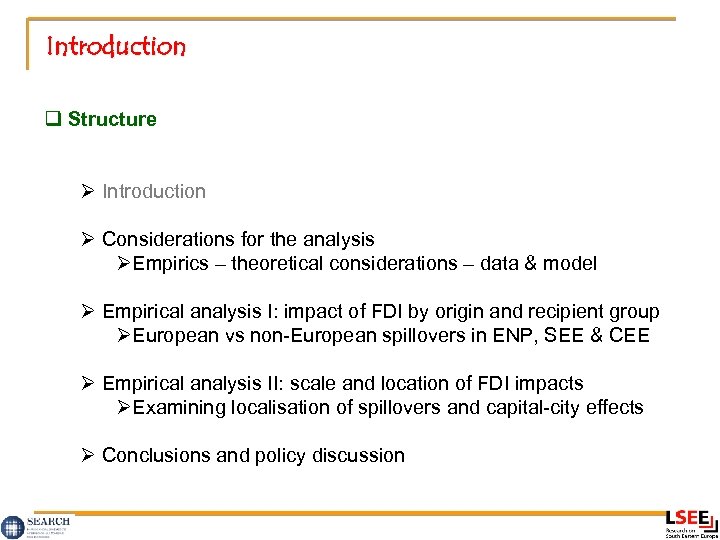 Introduction q Structure Ø Introduction Ø Considerations for the analysis ØEmpirics – theoretical considerations – data & model Ø Empirical analysis I: impact of FDI by origin and recipient group ØEuropean vs non-European spillovers in ENP, SEE & CEE Ø Empirical analysis II: scale and location of FDI impacts ØExamining localisation of spillovers and capital-city effects Ø Conclusions and policy discussion
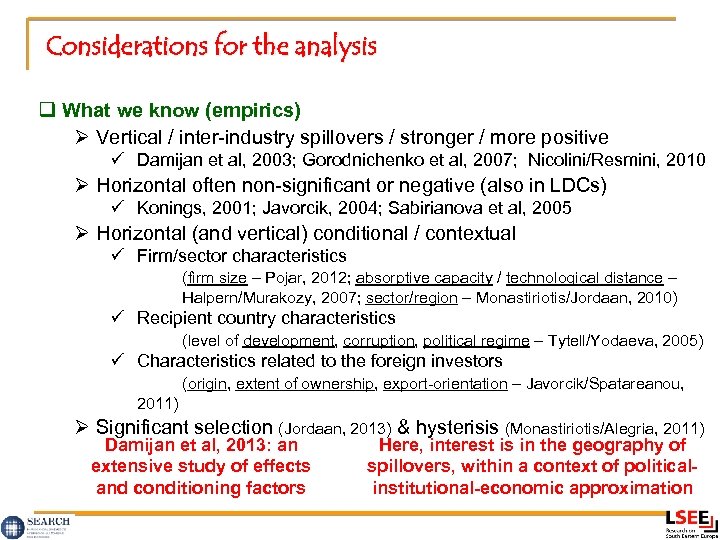 Considerations for the analysis q What we know (empirics) Ø Vertical / inter-industry spillovers / stronger / more positive ü Damijan et al, 2003; Gorodnichenko et al, 2007; Nicolini/Resmini, 2010 Ø Horizontal often non-significant or negative (also in LDCs) ü Konings, 2001; Javorcik, 2004; Sabirianova et al, 2005 Ø Horizontal (and vertical) conditional / contextual ü Firm/sector characteristics (firm size – Pojar, 2012; absorptive capacity / technological distance – Halpern/Murakozy, 2007; sector/region – Monastiriotis/Jordaan, 2010) ü Recipient country characteristics (level of development, corruption, political regime – Tytell/Yodaeva, 2005) ü Characteristics related to the foreign investors (origin, extent of ownership, export-orientation – Javorcik/Spatareanou, 2011) Ø Significant selection (Jordaan, 2013) & hysterisis (Monastiriotis/Alegria, 2011) Damijan et al, 2013: an extensive study of effects and conditioning factors Here, interest is in the geography of spillovers, within a context of politicalinstitutional-economic approximation
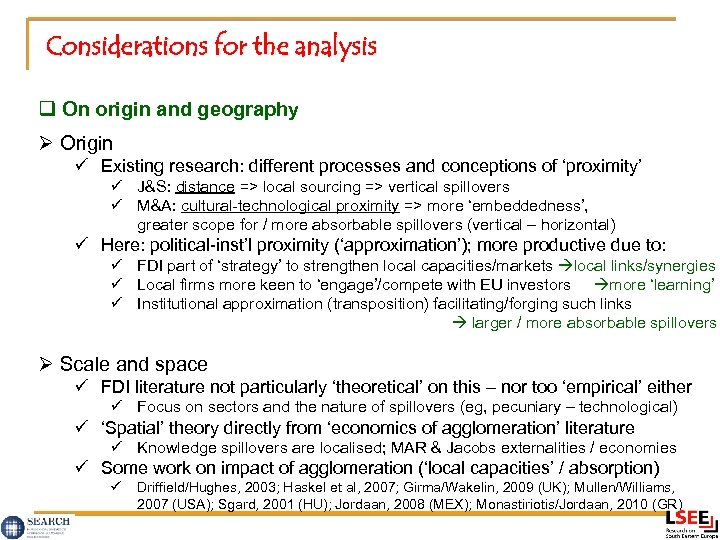 Considerations for the analysis q On origin and geography Ø Origin ü Existing research: different processes and conceptions of ‘proximity’ ü J&S: distance => local sourcing => vertical spillovers ü M&A: cultural-technological proximity => more ‘embeddedness’, greater scope for / more absorbable spillovers (vertical – horizontal) ü Here: political-inst’l proximity (‘approximation’); more productive due to: ü FDI part of ‘strategy’ to strengthen local capacities/markets local links/synergies ü Local firms more keen to ‘engage’/compete with EU investors more ‘learning’ ü Institutional approximation (transposition) facilitating/forging such links larger / more absorbable spillovers Ø Scale and space ü FDI literature not particularly ‘theoretical’ on this – nor too ‘empirical’ either ü Focus on sectors and the nature of spillovers (eg, pecuniary – technological) ü ‘Spatial’ theory directly from ‘economics of agglomeration’ literature ü Knowledge spillovers are localised; MAR & Jacobs externalities / economies ü Some work on impact of agglomeration (‘local capacities’ / absorption) ü Driffield/Hughes, 2003; Haskel et al, 2007; Girma/Wakelin, 2009 (UK); Mullen/Williams, 2007 (USA); Sgard, 2001 (HU); Jordaan, 2008 (MEX); Monastiriotis/Jordaan, 2010 (GR)
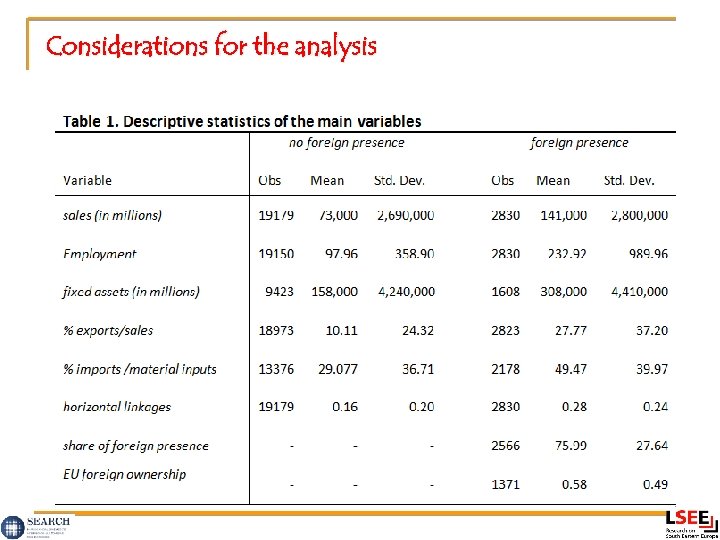
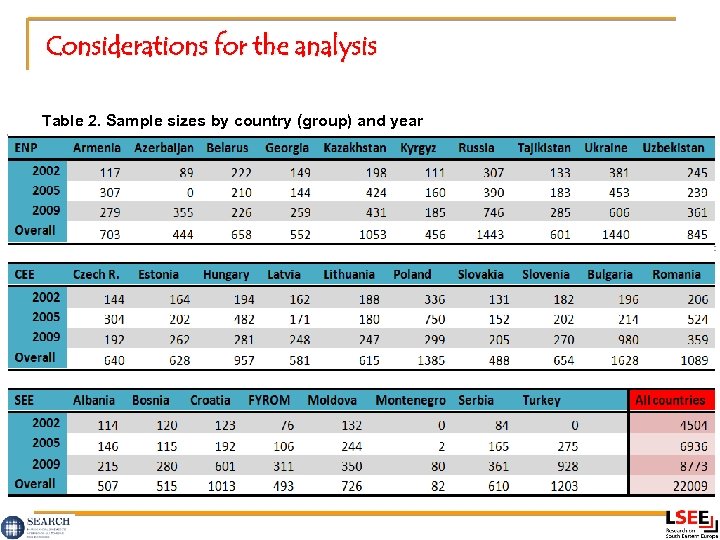
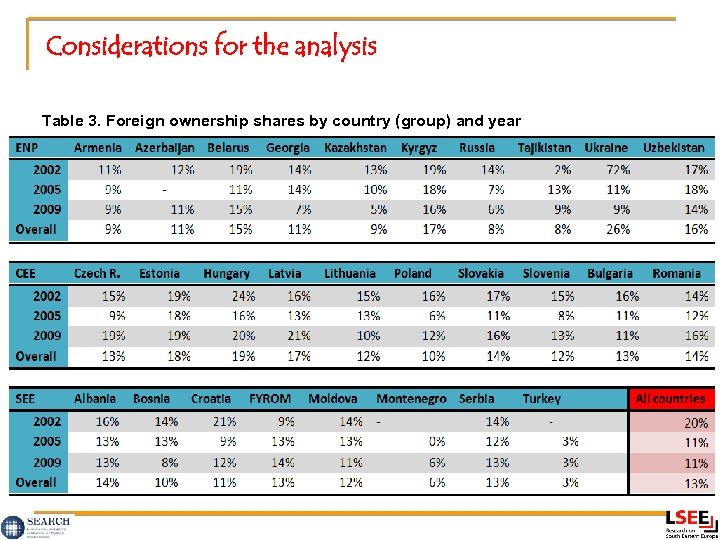
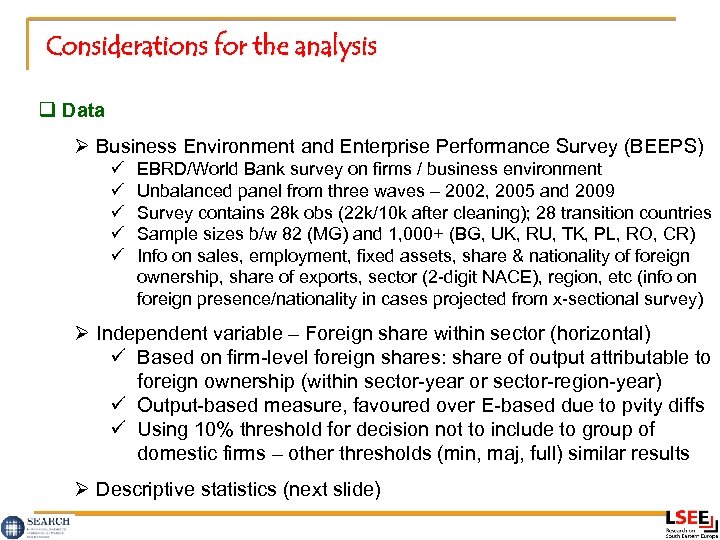 Considerations for the analysis q Data Ø Business Environment and Enterprise Performance Survey (BEEPS) ü ü ü EBRD/World Bank survey on firms / business environment Unbalanced panel from three waves – 2002, 2005 and 2009 Survey contains 28 k obs (22 k/10 k after cleaning); 28 transition countries Sample sizes b/w 82 (MG) and 1, 000+ (BG, UK, RU, TK, PL, RO, CR) Info on sales, employment, fixed assets, share & nationality of foreign ownership, share of exports, sector (2 -digit NACE), region, etc (info on foreign presence/nationality in cases projected from x-sectional survey) Ø Independent variable – Foreign share within sector (horizontal) ü Based on firm-level foreign shares: share of output attributable to foreign ownership (within sector-year or sector-region-year) ü Output-based measure, favoured over E-based due to pvity diffs ü Using 10% threshold for decision not to include to group of domestic firms – other thresholds (min, maj, full) similar results Ø Descriptive statistics (next slide)
 Considerations for the analysis
 Considerations for the analysis Table 2. Sample sizes by country (group) and year
 Considerations for the analysis Table 3. Foreign ownership shares by country (group) and year
 Considerations for the analysis Table 4. FDI inflows as share of GDP (UNDP data)
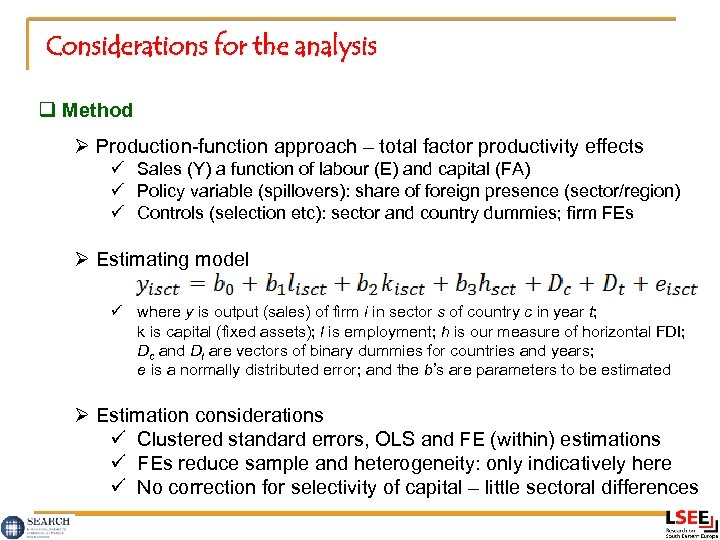 Considerations for the analysis q Method Ø Production-function approach – total factor productivity effects ü Sales (Y) a function of labour (E) and capital (FA) ü Policy variable (spillovers): share of foreign presence (sector/region) ü Controls (selection etc): sector and country dummies; firm FEs Ø Estimating model ü where y is output (sales) of firm i in sector s of country c in year t; k is capital (fixed assets); l is employment; h is our measure of horizontal FDI; Dc and Dt are vectors of binary dummies for countries and years; e is a normally distributed error; and the b’s are parameters to be estimated Ø Estimation considerations ü Clustered standard errors, OLS and FE (within) estimations ü FEs reduce sample and heterogeneity: only indicatively here ü No correction for selectivity of capital – little sectoral differences
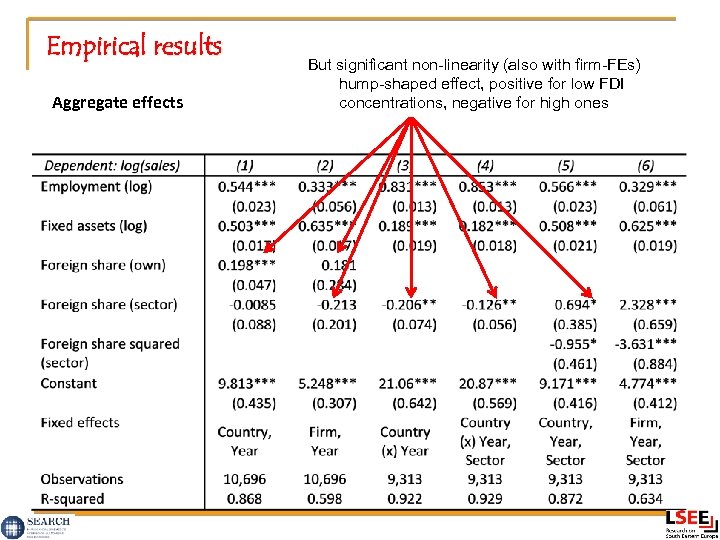 Empirical results Aggregate effects But significant non-linearity (also with firm-FEs) hump-shaped interactive suggesting, FEs Effect way, external (horizontal) effect But significant with sector-FEs, country-year if Either smaller with effect, positive for low FDI anything, trends / country-specifichigh (national and effect into low-productivity sectors negativewhennon-significant selectionones effects) But concentrations, strong and positive Direct (own) controlling for temporal not selection negative
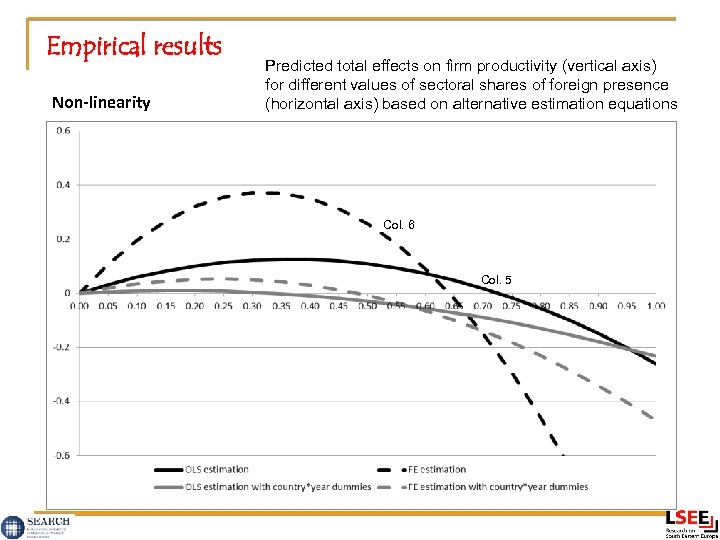 Empirical results Non-linearity Predicted total effects on firm productivity (vertical axis) for different values of sectoral shares of foreign presence (horizontal axis) based on alternative estimation equations Col. 6 Col. 5
 Empirical results q Stock-taking – aggregate analysis Ø Overall, in our sample countries, foreign investments offer little benefits to the sectors in which they locate (in terms of spillovers) Ø There is a direct positive effect for the firms that receive the foreign investment – although, still, this may be subject to self-selection Ø Some evidence of positive spillovers in sectors where foreign presence is (positive but) at rather low levels – although country differences in temporal dynamics may exaggerate this effect Ø Firms in sectors that are dominated by foreign-owned production (well above 50%) show in fact lower productivity Ø When restricting the sample to surviving domestic firms only (FE estimation) the effect becomes more negative ü This suggests that this effect is not compositional (e. g. , creaming-off via take-overs or crowding-out via exit) but a pure negative externality
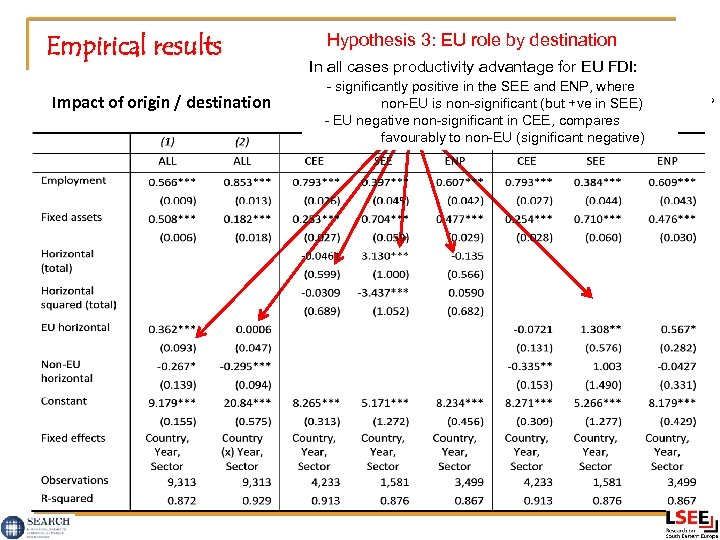 Empirical results Impact of origin / destination Hypothesis 1: origin matters / EU advantage 3: EU role by matters 2: destination In all cases productivity advantage for EU FDI: But verythe effecthump-shaped non-linear specifications In ENP remains also the SEE and ENP, where Differenceinsignificant with. FE & (essentiallytime effects, Althoughstrongly highlyin country-specific always - significantly positive in insignificant: positive)has. SEE: is non-significant (but +ve linear innon-EU suggesting perhaps asignificantly capital/technology (EU FDI negative lack of FDI remains (andin SEE) negative) difference from non-EU domestic non-EU is significant) hump-shaped effect, more advantageous H 1 confirmed: EUinsignificant in (absorption) issue? Impact FDI capacity CEE: benefits exhausted? base? negative non-significant in CEE, compares - EU favourably to non-EU (significant negative)
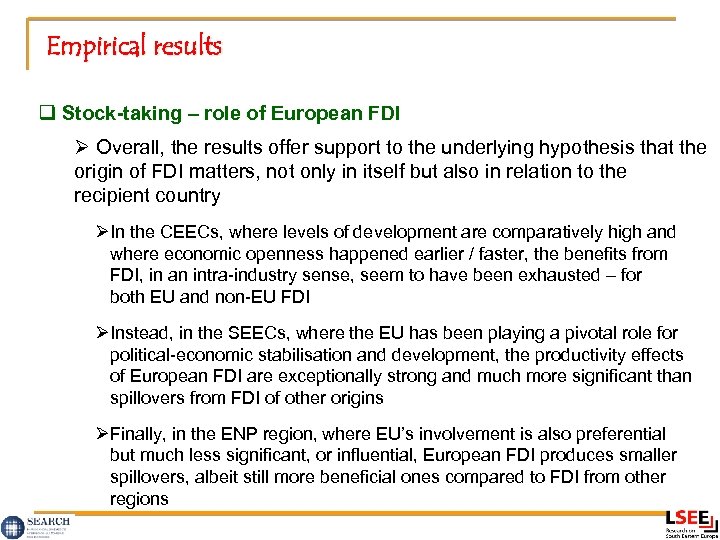 Empirical results q Stock-taking – role of European FDI Ø Overall, the results offer support to the underlying hypothesis that the origin of FDI matters, not only in itself but also in relation to the recipient country ØIn the CEECs, where levels of development are comparatively high and where economic openness happened earlier / faster, the benefits from FDI, in an intra-industry sense, seem to have been exhausted – for both EU and non-EU FDI ØInstead, in the SEECs, where the EU has been playing a pivotal role for political-economic stabilisation and development, the productivity effects of European FDI are exceptionally strong and much more significant than spillovers from FDI of other origins ØFinally, in the ENP region, where EU’s involvement is also preferential but much less significant, or influential, European FDI produces smaller spillovers, albeit still more beneficial ones compared to FDI from other regions
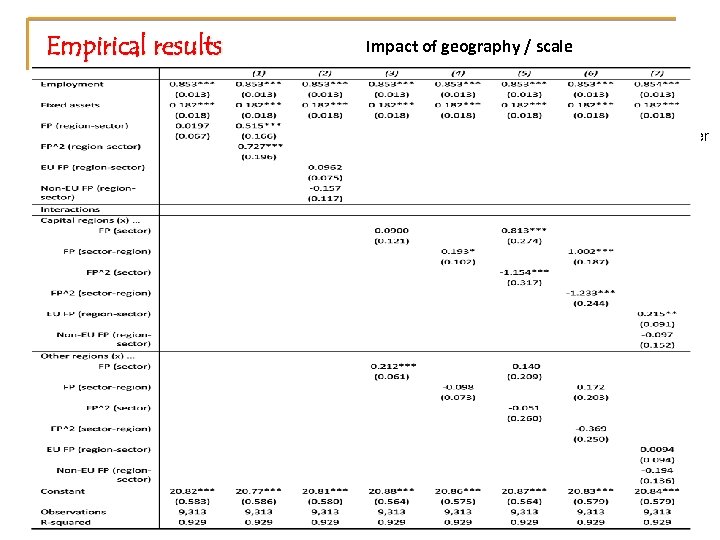 Empirical results Impact of geography / scale Is the absence of strong results due to our focus at the national-sectoral level? Counter to still more beneficial, consistently either As before, strong evidence also but effect non. The. EU FDI expectations, is of non-linearity (across hump-shaped effect no localised effects specifications): by allcountry matters (adversely) flatter for the three evidence, intra-industry significant: concentration Are spillovers (more) localised? butblocks (and only Effect (at least) positive, insignificant in SEE) (horizontal) spillovers are not localised (also with firm-FEs, non-interactive dummies, etc) But the effect is flatter, suggesting little localisation and probably evidence of spatial heterogeneity But note that the region-wide These patterns appear to we examine But forcase of the region- be strongest in The picture is similarat intra-industry when In the measure (not region-sector) CEE the weakest in least, and effects appear (not shown): non-linearities: Concerning the origin. SEE specific measure, FDI distinction: returns strong positive spillovers to be heterogeneous in returns a positive spillover Especially inmore advantageous in Spillovers are inter-industry space: FDIregions, strong hump-shaped For capital the EU in capital regions CEECs, negative both spillovers /of regionsis of benefits comes exhaustion thetypes and effect negative stronger with co-location (region-wide): urbanisation, not from theby domesticregions (spillovers are localised) driven peripheral Spillover effect more localisation, effects firms in of any origin FDI the periphery positive everywhere, more advantageous For other regions, spillovers are in capital regions suggesting that insignificant / negative localisation matters, but (although still less EU FDI in capital regions produces rather differently in so with co-location) clear positive spillovers different types of regions
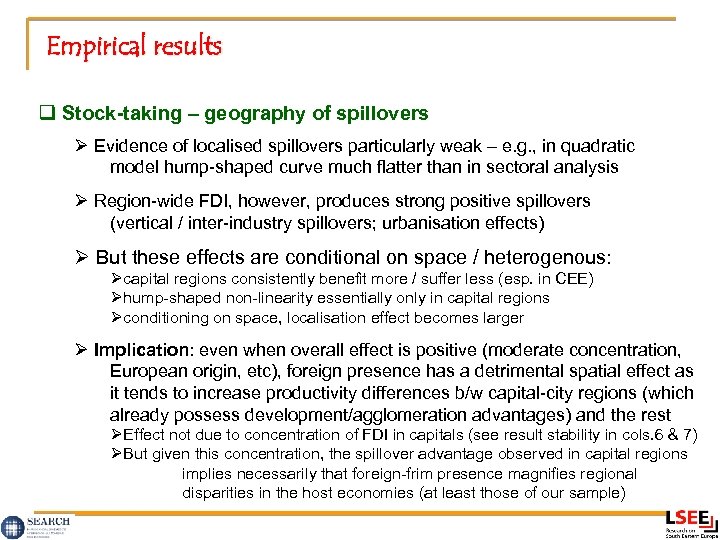 Empirical results q Stock-taking – geography of spillovers Ø Evidence of localised spillovers particularly weak – e. g. , in quadratic model hump-shaped curve much flatter than in sectoral analysis Ø Region-wide FDI, however, produces strong positive spillovers (vertical / inter-industry spillovers; urbanisation effects) Ø But these effects are conditional on space / heterogenous: Øcapital regions consistently benefit more / suffer less (esp. in CEE) Øhump-shaped non-linearity essentially only in capital regions Øconditioning on space, localisation effect becomes larger Ø Implication: even when overall effect is positive (moderate concentration, European origin, etc), foreign presence has a detrimental spatial effect as it tends to increase productivity differences b/w capital-city regions (which already possess development/agglomeration advantages) and the rest ØEffect not due to concentration of FDI in capitals (see result stability in cols. 6 & 7) ØBut given this concentration, the spillover advantage observed in capital regions implies necessarily that foreign-frim presence magnifies regional disparities in the host economies (at least those of our sample)
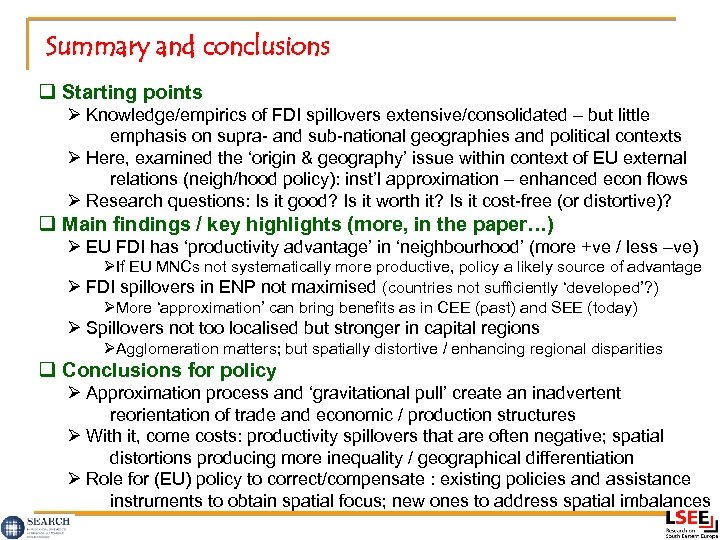 Summary and conclusions q Starting points Ø Knowledge/empirics of FDI spillovers extensive/consolidated – but little emphasis on supra- and sub-national geographies and political contexts Ø Here, examined the ‘origin & geography’ issue within context of EU external relations (neigh/hood policy): inst’l approximation – enhanced econ flows Ø Research questions: Is it good? Is it worth it? Is it cost-free (or distortive)? q Main findings / key highlights (more, in the paper…) Ø EU FDI has ‘productivity advantage’ in ‘neighbourhood’ (more +ve / less –ve) ØIf EU MNCs not systematically more productive, policy a likely source of advantage Ø FDI spillovers in ENP not maximised (countries not sufficiently ‘developed’? ) ØMore ‘approximation’ can bring benefits as in CEE (past) and SEE (today) Ø Spillovers not too localised but stronger in capital regions ØAgglomeration matters; but spatially distortive / enhancing regional disparities q Conclusions for policy Ø Approximation process and ‘gravitational pull’ create an inadvertent reorientation of trade and economic / production structures Ø With it, come costs: productivity spillovers that are often negative; spatial distortions producing more inequality / geographical differentiation Ø Role for (EU) policy to correct/compensate : existing policies and assistance instruments to obtain spatial focus; new ones to address spatial imbalances
 About LSEE . Research unit at the European Institute, LSE bringing together LSE’s expertise on SEE, complementing the work of the HO and the Contemporary Turkish Studies Programme Aims to provide a platform for high quality, independent research & facilitate research collaborations and public dialogue on SEE, including via academic visits & public events LSEE has developed an extensive network of research and institutional collaborations with a range of academic, governmental and international bodies, including the EC and the RCC. LSEE researchers and research affiliates are engaged in a broad range of in-house and externally funded projects in the region, along three broad themes: Social Cohesion (social policy, regional policy, labour markets) Macroeconomy (European integration, institutional reform, growth) Security/Minorities (international relations, state-building, civil society) http: //www. lse. ac. uk/LSEE