 Скачать презентацию FORUM ON NEXT GENERATION STANDARDIZATION Colombo Sri Lanka
cafe6bfd8ceb2fc2329c9bda0a5301e5.ppt
- Количество слайдов: 42



FORUM ON NEXT GENERATION STANDARDIZATION (Colombo, Sri Lanka, 7 -10 April 2009) Migration Towards Converged Networks Dr. Ghassem Koleyni Colombo, Sri Lanka, 7 -10 April 2009
Content q Telecommunications network q Network evolution q Needs and expectations q What is NGN? q PSTN & ISDN evolution to NGN q Standardization activities q Conclusion Colmbo, Sri Lanka, 7 -10 April 2009 2
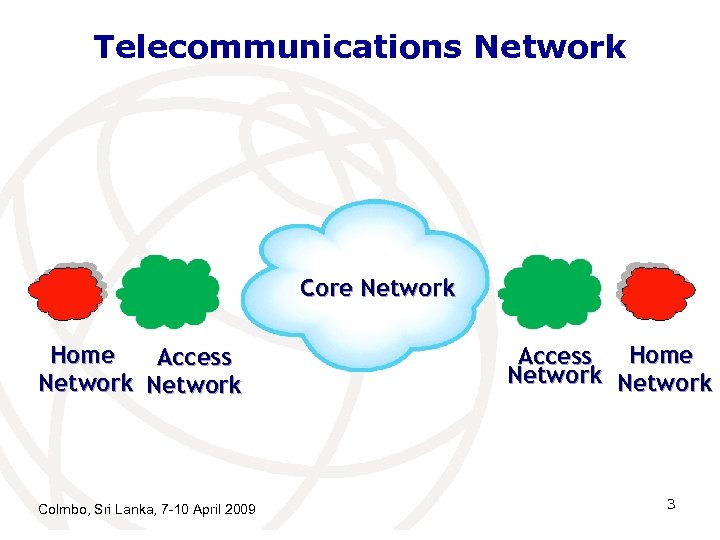
Telecommunications Network Core Network Home Access Network Colmbo, Sri Lanka, 7 -10 April 2009 Home Access Network 3
Network Evolution IP: Mid to late 1970’s (No Qo. S guaranteed) q Ethernet: 1973 -1975 at Xerox q ISDN: Mid to late 1980’s (Qo. S guaranteed while increasing the bandwidth, many new services ) q X. 25: Mid to late 1980’s (transmission of data without loss nor duplication) q FR: Mid to late 1980’s (Qo. S guaranteed while increasing the bandwidth) q ATM: Early 1990’s (guaranteed Qo. S, increased bandwidth, combined switching and transport capability with high level of performance and scalability) q Sri Lanka, 7 -10 April 2009 4 Colmbo, q
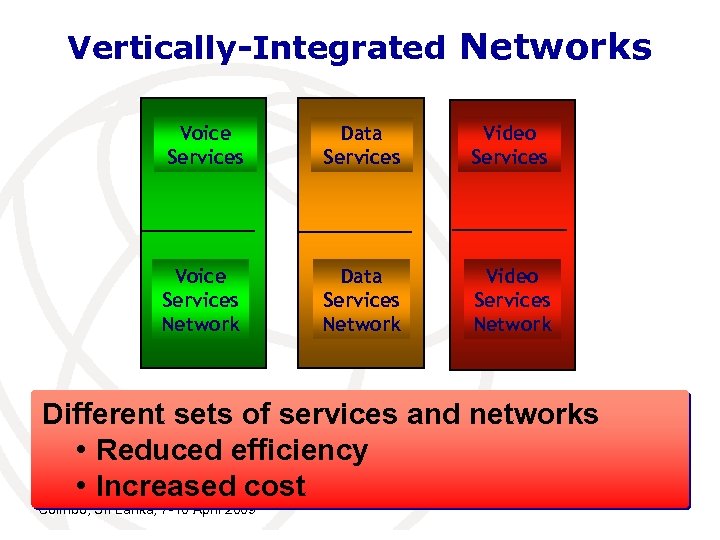
Vertically-Integrated Networks Voice Services Data Services Video Services Voice Services Network Data Services Network Video Services Network Different sets of services and networks • Reduced efficiency • Increased cost Colmbo, Sri Lanka, 7 -10 April 2009 5
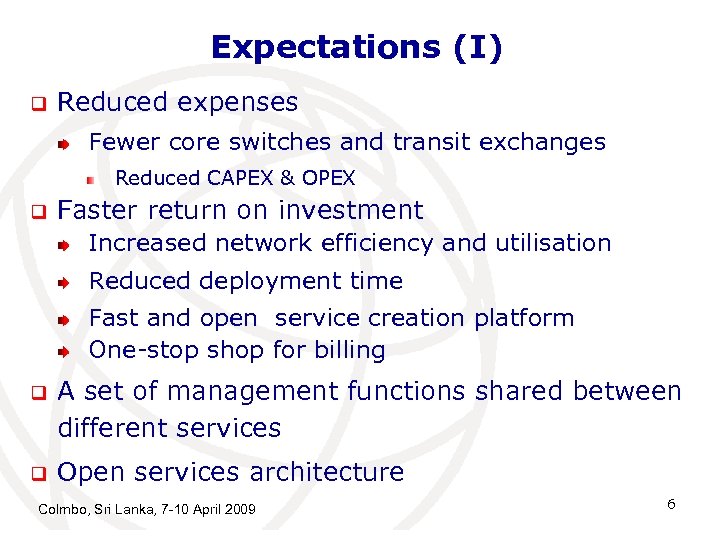
Expectations (I) q Reduced expenses Fewer core switches and transit exchanges Reduced CAPEX & OPEX q Faster return on investment Increased network efficiency and utilisation Reduced deployment time Fast and open service creation platform One-stop shop for billing q A set of management functions shared between different services q Open services architecture Colmbo, Sri Lanka, 7 -10 April 2009 6
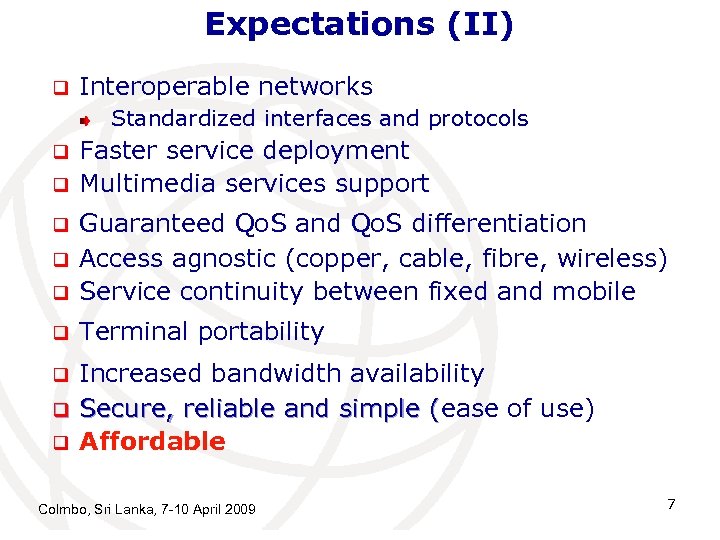
Expectations (II) q Interoperable networks Standardized interfaces and protocols q q Faster service deployment Multimedia services support q Guaranteed Qo. S and Qo. S differentiation Access agnostic (copper, cable, fibre, wireless) Service continuity between fixed and mobile q Terminal portability q Increased bandwidth availability Secure, reliable and simple (ease of use) Secure, reliable and simple ( Affordable q q Colmbo, Sri Lanka, 7 -10 April 2009 7
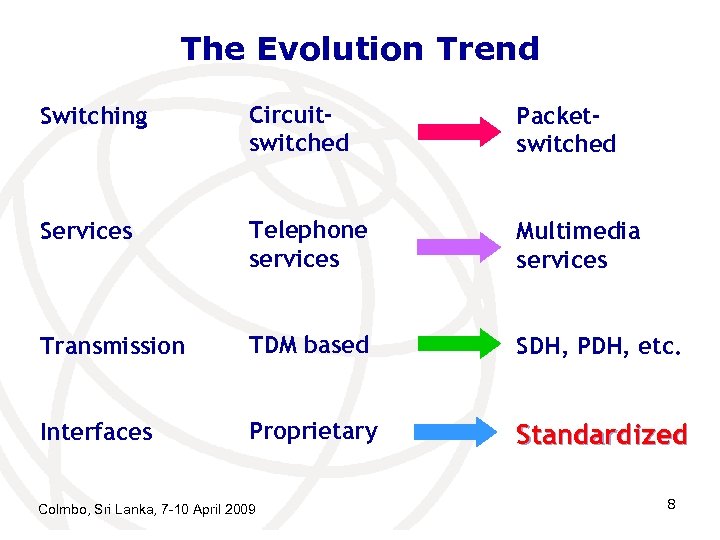
The Evolution Trend Switching Circuitswitched Packetswitched Services Telephone services Multimedia services Transmission TDM based SDH, PDH, etc. Interfaces Proprietary Standardized Colmbo, Sri Lanka, 7 -10 April 2009 8
NGN standardization in ITU-T Colmbo, Sri Lanka, 7 -10 April 2009 9
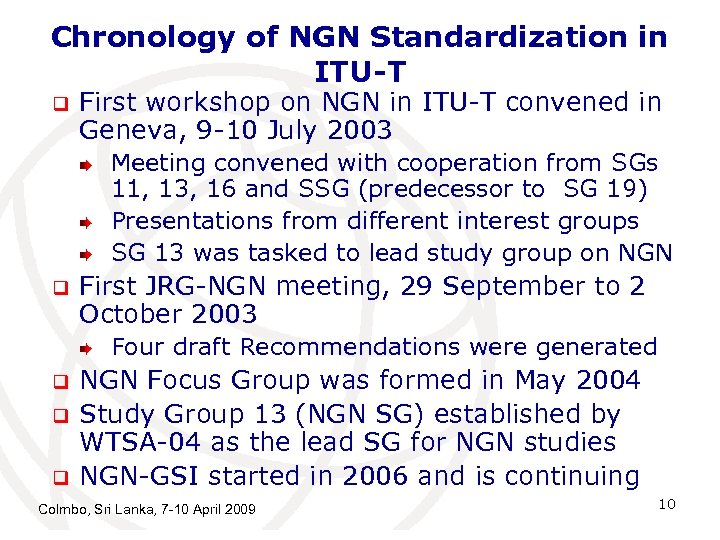
Chronology of NGN Standardization in ITU-T q First workshop on NGN in ITU-T convened in Geneva, 9 -10 July 2003 Meeting convened with cooperation from SGs 11, 13, 16 and SSG (predecessor to SG 19) Presentations from different interest groups SG 13 was tasked to lead study group on NGN q First JRG-NGN meeting, 29 September to 2 October 2003 Four draft Recommendations were generated q q q NGN Focus Group was formed in May 2004 Study Group 13 (NGN SG) established by WTSA-04 as the lead SG for NGN studies NGN-GSI started in 2006 and is continuing Colmbo, Sri Lanka, 7 -10 April 2009 10
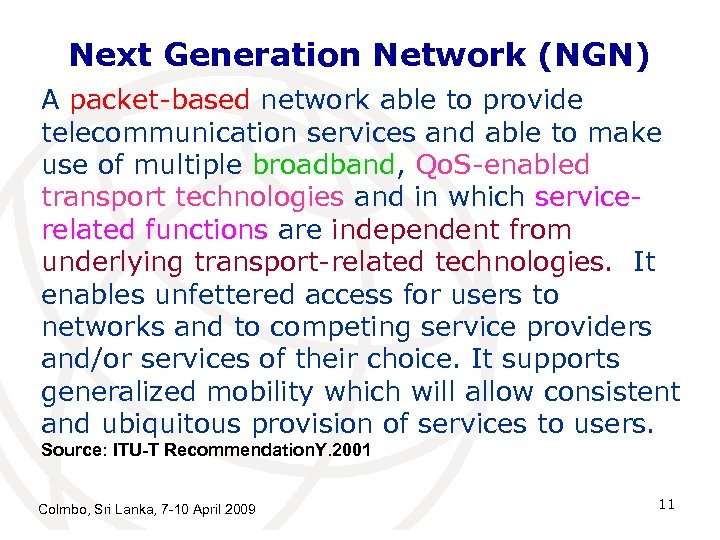
Next Generation Network (NGN) A packet-based network able to provide telecommunication services and able to make use of multiple broadband, Qo. S-enabled transport technologies and in which servicerelated functions are independent from underlying transport-related technologies. It enables unfettered access for users to networks and to competing service providers and/or services of their choice. It supports generalized mobility which will allow consistent and ubiquitous provision of services to users. Source: ITU-T Recommendation. Y. 2001 Colmbo, Sri Lanka, 7 -10 April 2009 11
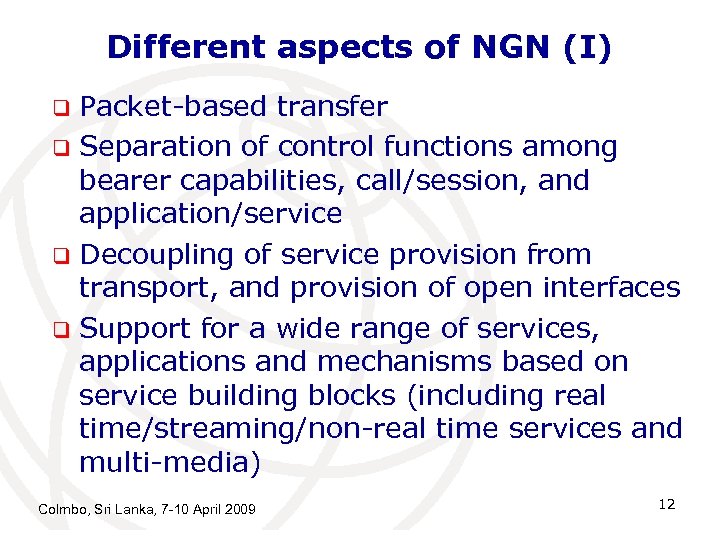
Different aspects of NGN (I) Packet-based transfer q Separation of control functions among bearer capabilities, call/session, and application/service q Decoupling of service provision from transport, and provision of open interfaces q Support for a wide range of services, applications and mechanisms based on service building blocks (including real time/streaming/non-real time services and multi-media) q Colmbo, Sri Lanka, 7 -10 April 2009 12
Different aspects of NGN (II) Broadband capabilities with end-to-end Qo. S and transparency q Interworking with legacy networks via open interfaces q Generalised mobility q Unfettered access by users to different service providers q A variety of identification schemes which can be resolved to IP addresses for the purposes of routing in IP networks q Colmbo, Sri Lanka, 7 -10 April 2009 13
Different aspects of NGN (III) Unified service characteristics for the same service as perceived by the user q Converged services between Fixed and Mobile networks q Independence of service-related functions from underlying transport technologies q Support of multiple last mile technologies q Compliant with all Regulatory requirements, for example concerning emergency communications and security/privacy q Colmbo, Sri Lanka, 7 -10 April 2009 14
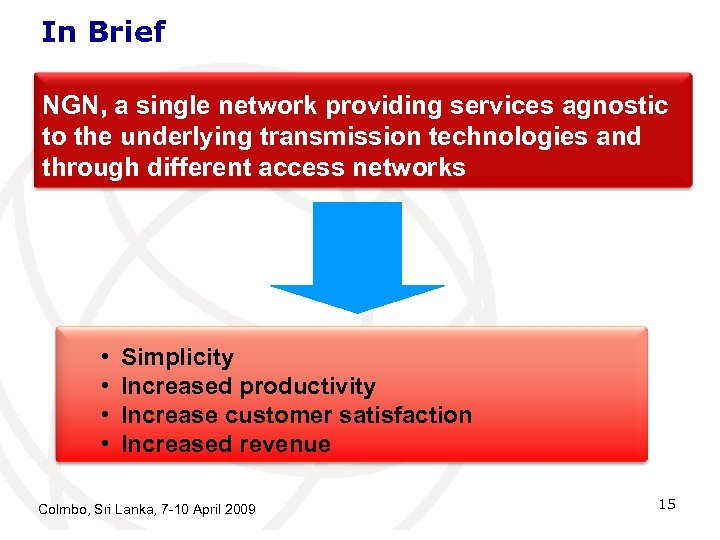
In Brief NGN, a single network providing services agnostic to the underlying transmission technologies and through different access networks • • Simplicity Increased productivity Increase customer satisfaction Increased revenue Colmbo, Sri Lanka, 7 -10 April 2009 15
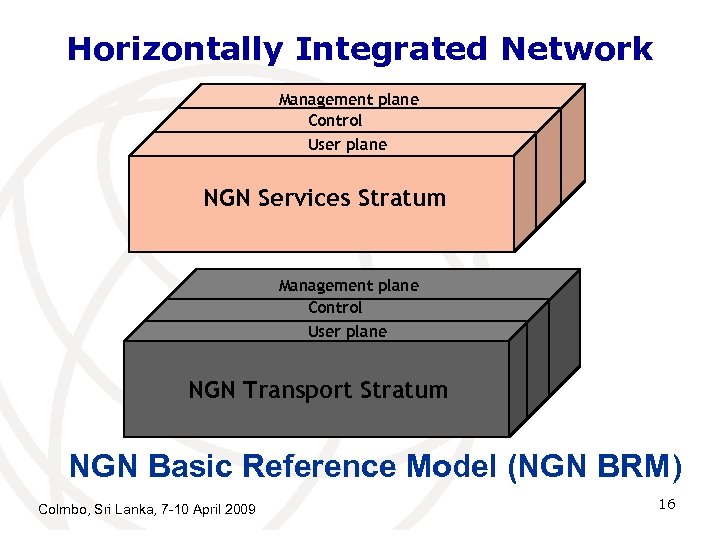
Horizontally Integrated Network Management plane Control User plane NGN Services Stratum Management plane Control User plane NGN Transport Stratum NGN Basic Reference Model (NGN BRM) Colmbo, Sri Lanka, 7 -10 April 2009 16
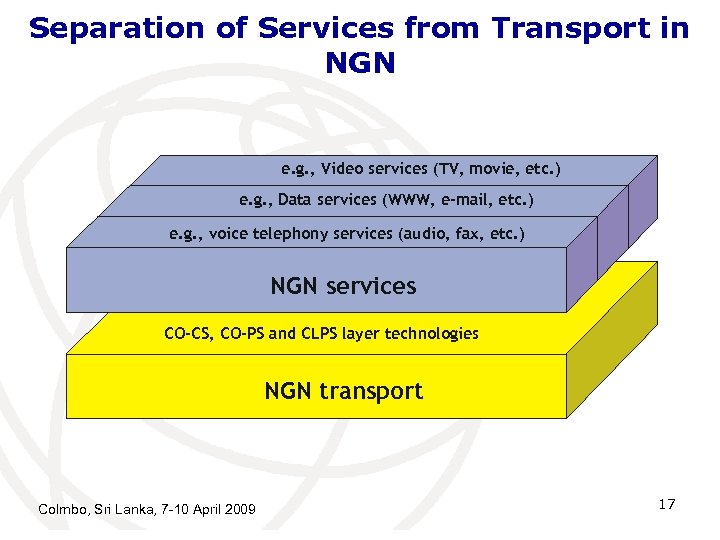
Separation of Services from Transport in NGN e. g. , Video services (TV, movie, etc. ) e. g. , Data services (WWW, e-mail, etc. ) e. g. , voice telephony services (audio, fax, etc. ) NGN services CO-CS, CO-PS and CLPS layer technologies NGN transport Colmbo, Sri Lanka, 7 -10 April 2009 17
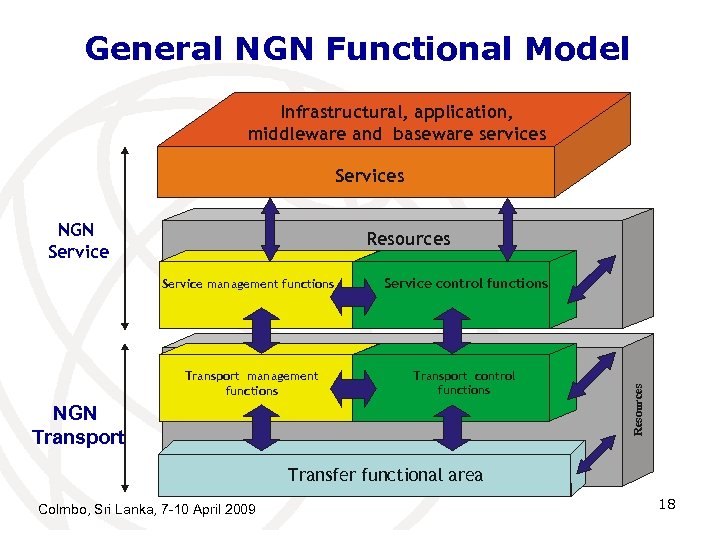
General NGN Functional Model Infrastructural, application, middleware and baseware services Services NGN Service Resources Service control functions Transport management functions Transport control functions NGN Transport Resources Service management functions Transfer functional area Colmbo, Sri Lanka, 7 -10 April 2009 18
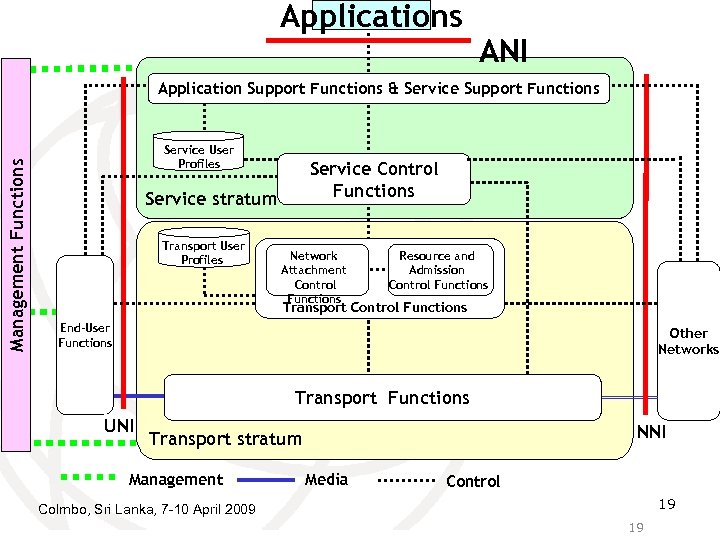
Applications ANI Management Functions Application Support Functions & Service Support Functions Service User Profiles Service Control Functions Service stratum Transport User Profiles Network Attachment Control Functions Resource and Admission Control Functions Transport Control Functions End-User Functions Other Networks Transport Functions UNI NNI Transport stratum Management Media Control 19 Colmbo, Sri Lanka, 7 -10 April 2009 19
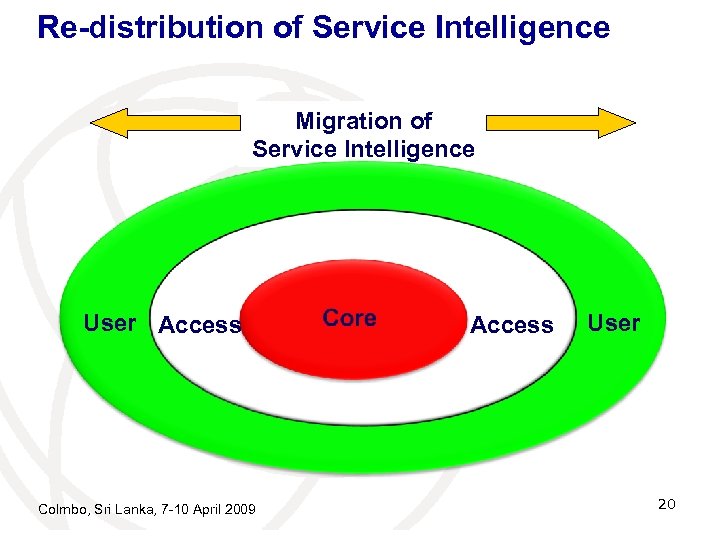
Re-distribution of Service Intelligence Migration of Service Intelligence User Access Colmbo, Sri Lanka, 7 -10 April 2009 Access User 20
PSTN & ISDN Evolution to NGN Colmbo, Sri Lanka, 7 -10 April 2009 21
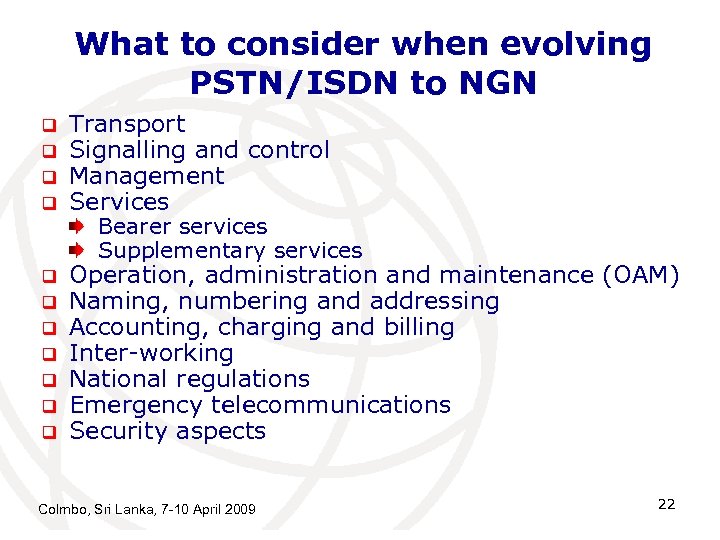
What to consider when evolving PSTN/ISDN to NGN q q Transport Signalling and control Management Services q q q q Operation, administration and maintenance (OAM) Naming, numbering and addressing Accounting, charging and billing Inter-working National regulations Emergency telecommunications Security aspects Bearer services Supplementary services Colmbo, Sri Lanka, 7 -10 April 2009 22
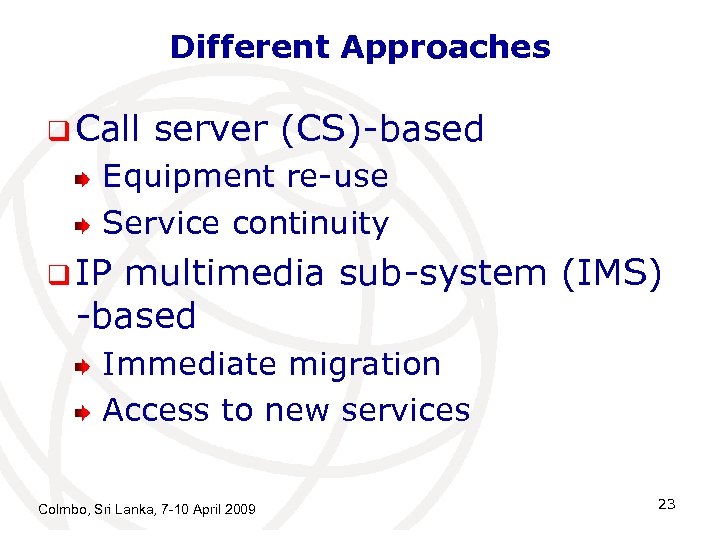
Different Approaches q Call server (CS)-based Equipment re-use Service continuity q IP multimedia sub-system (IMS) -based Immediate migration Access to new services Colmbo, Sri Lanka, 7 -10 April 2009 23
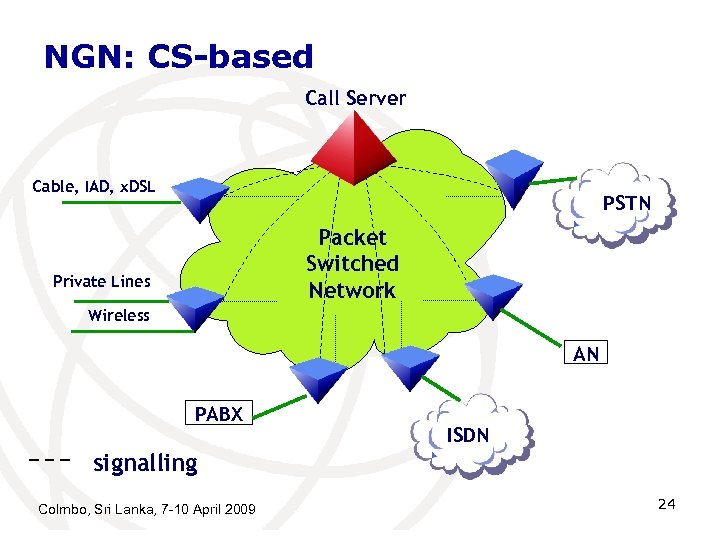
NGN: CS-based Call Server Cable, IAD, x. DSL PSTN Packet Switched Network Private Lines Wireless AN PABX ISDN signalling Colmbo, Sri Lanka, 7 -10 April 2009 24
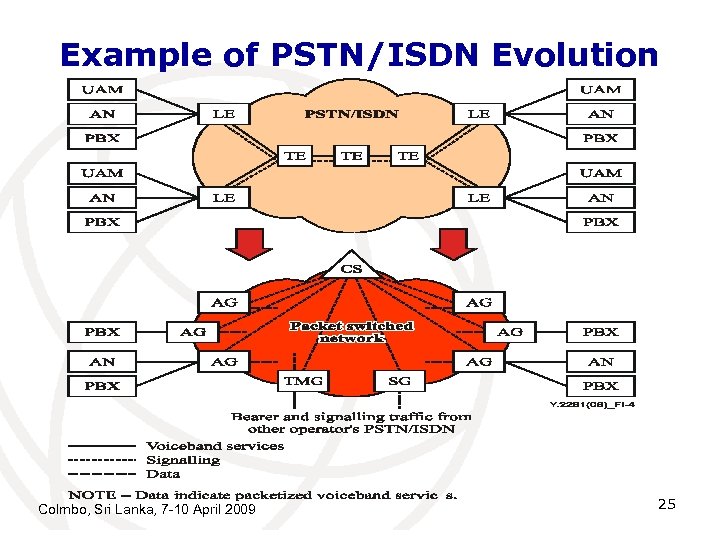
Example of PSTN/ISDN Evolution Colmbo, Sri Lanka, 7 -10 April 2009 25
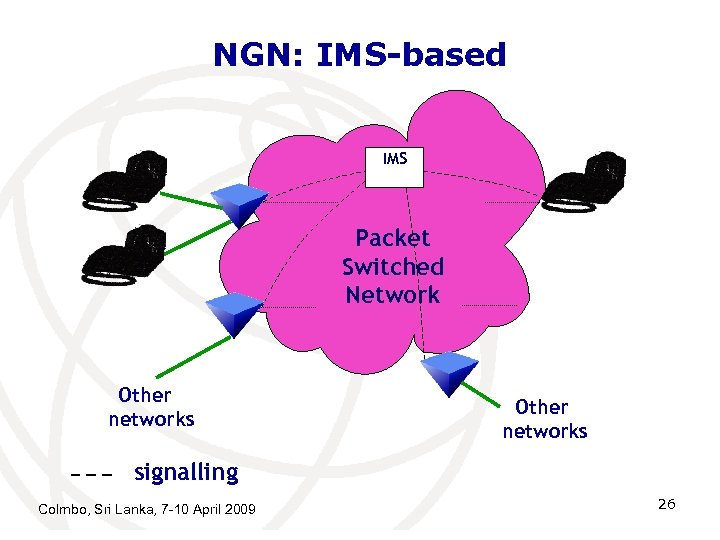
NGN: IMS-based IMS Packet Switched Network Other networks signalling Colmbo, Sri Lanka, 7 -10 April 2009 26
PSTN/ISDN Emulation & Simulation PSTN/ISDN emulation Provides PSTN/ISDN service capabilities and interfaces using adaptation to an IP infrastructure. PSTN/ISDN simulation Provides PSTN/ISDN-like service capabilities using session control over IP interfaces and infrastructure. Colmbo, Sri Lanka, 7 -10 April 2009 27
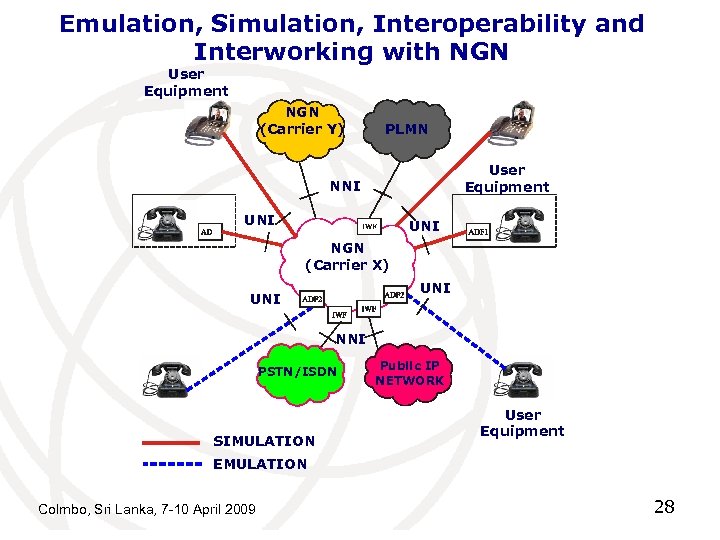
Emulation, Simulation, Interoperability and Interworking with NGN User Equipment NGN (Carrier Y) PLMN User Equipment NNI UNI NGN (Carrier X) UNI NNI PSTN/ISDN SIMULATION Public IP NETWORK User Equipment EMULATION Colmbo, Sri Lanka, 7 -10 April 2009 28
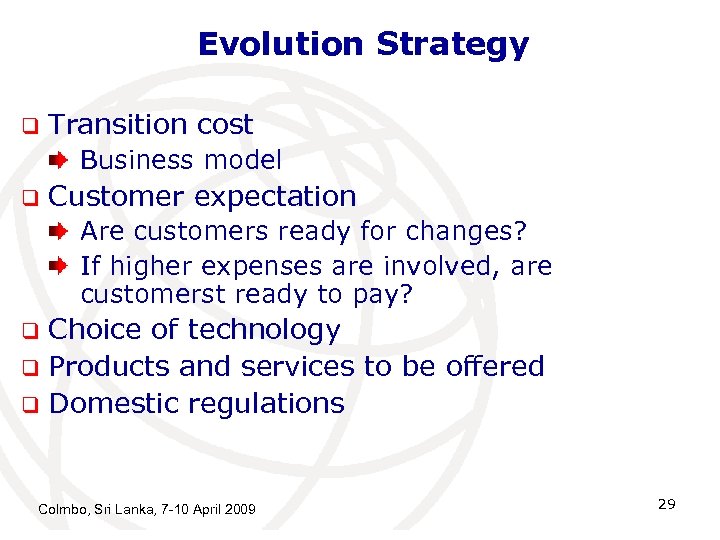
Evolution Strategy q Transition cost Business model q Customer expectation Are customers ready for changes? If higher expenses are involved, are customerst ready to pay? Choice of technology q Products and services to be offered q Domestic regulations q Colmbo, Sri Lanka, 7 -10 April 2009 29
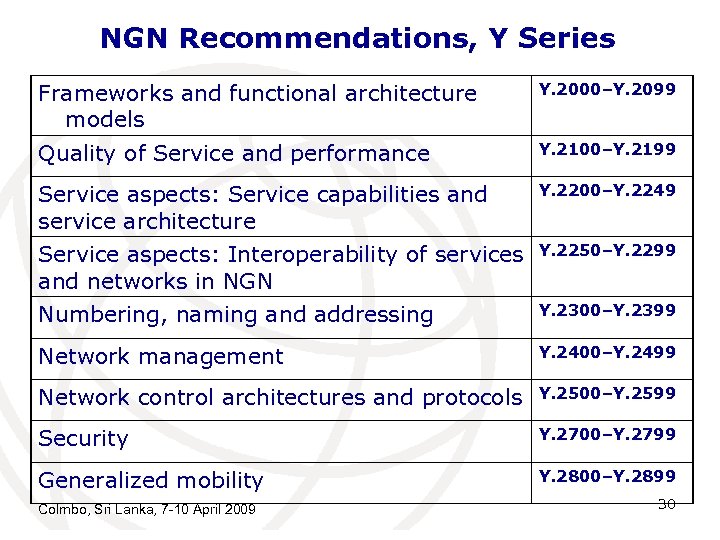
NGN Recommendations, Y Series Frameworks and functional architecture models Y. 2000–Y. 2099 Quality of Service and performance Y. 2100–Y. 2199 Service aspects: Service capabilities and service architecture Y. 2200–Y. 2249 Service aspects: Interoperability of services and networks in NGN Y. 2250–Y. 2299 Numbering, naming and addressing Y. 2300–Y. 2399 Network management Y. 2400–Y. 2499 Network control architectures and protocols Y. 2500–Y. 2599 Security Y. 2700–Y. 2799 Generalized mobility Y. 2800–Y. 2899 Colmbo, Sri Lanka, 7 -10 April 2009 30
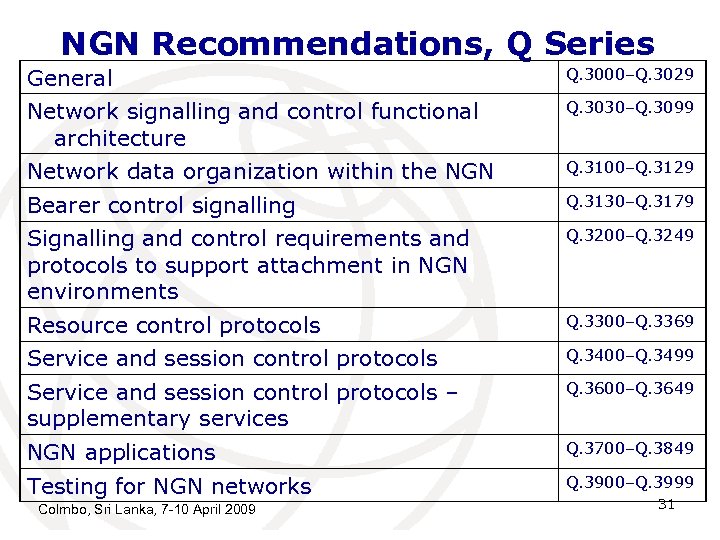
NGN Recommendations, Q Series General Q. 3000–Q. 3029 Network signalling and control functional architecture Q. 3030–Q. 3099 Network data organization within the NGN Q. 3100–Q. 3129 Bearer control signalling Q. 3130–Q. 3179 Signalling and control requirements and protocols to support attachment in NGN environments Q. 3200–Q. 3249 Resource control protocols Q. 3300–Q. 3369 Service and session control protocols Q. 3400–Q. 3499 Service and session control protocols – supplementary services Q. 3600–Q. 3649 NGN applications Q. 3700–Q. 3849 Testing for NGN networks Q. 3900–Q. 3999 Colmbo, Sri Lanka, 7 -10 April 2009 31
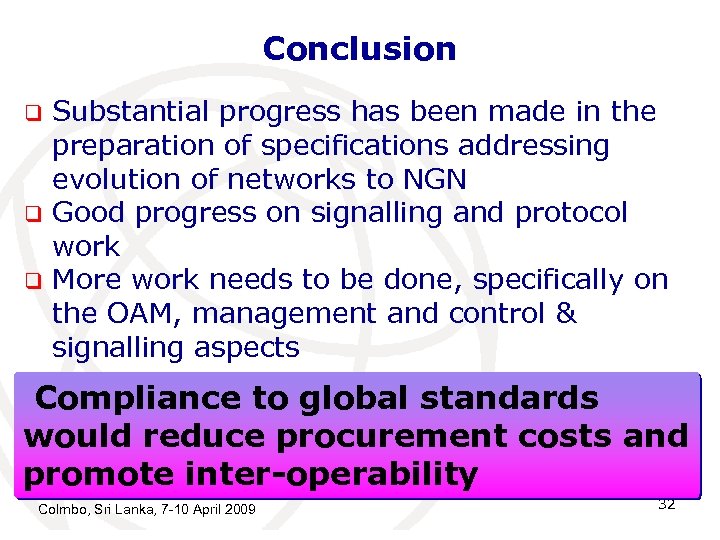
Conclusion q q q Substantial progress has been made in the preparation of specifications addressing evolution of networks to NGN Good progress on signalling and protocol work More work needs to be done, specifically on the OAM, management and control & signalling aspects Compliance to global standards would reduce procurement costs and promote inter-operability Colmbo, Sri Lanka, 7 -10 April 2009 32
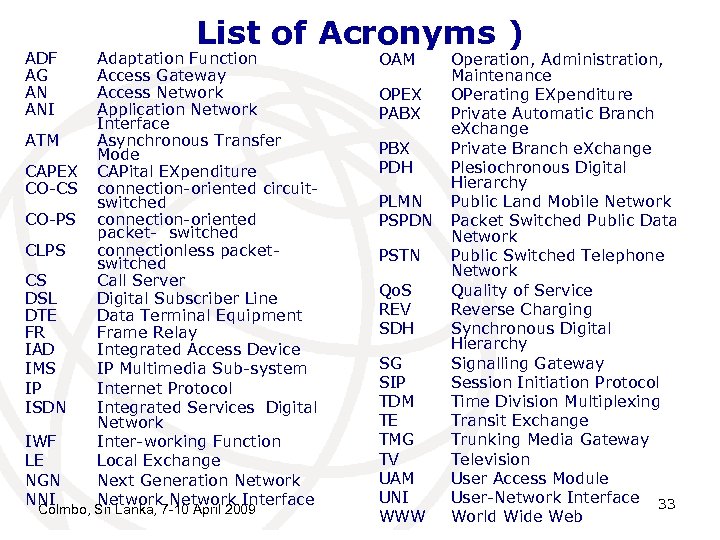
ADF AG AN ANI List of Acronyms ) Adaptation Function Access Gateway Access Network Application Network Interface ATM Asynchronous Transfer Mode CAPEX CAPital EXpenditure CO-CS connection-oriented circuitswitched CO-PS connection-oriented packet- switched CLPS connectionless packetswitched CS Call Server DSL Digital Subscriber Line DTE Data Terminal Equipment FR Frame Relay IAD Integrated Access Device IMS IP Multimedia Sub-system IP Internet Protocol ISDN Integrated Services Digital Network IWF Inter-working Function LE Local Exchange NGN Next Generation Network NNI Network Interface Colmbo, Sri Lanka, 7 -10 April 2009 OAM OPEX PABX PDH PLMN PSPDN PSTN Qo. S REV SDH SG SIP TDM TE TMG TV UAM UNI WWW Operation, Administration, Maintenance OPerating EXpenditure Private Automatic Branch e. Xchange Private Branch e. Xchange Plesiochronous Digital Hierarchy Public Land Mobile Network Packet Switched Public Data Network Public Switched Telephone Network Quality of Service Reverse Charging Synchronous Digital Hierarchy Signalling Gateway Session Initiation Protocol Time Division Multiplexing Transit Exchange Trunking Media Gateway Television User Access Module User-Network Interface 33 World Wide Web

Thank you for your attention Dr. Ghassem Koleyni Email: ghassem@rogers. com Tel: +1 613 592 5344 Colmbo, Sri Lanka, 7 -10 April 2009 34

Back up slides Colmbo, Sri Lanka, 7 -10 April 2009 35
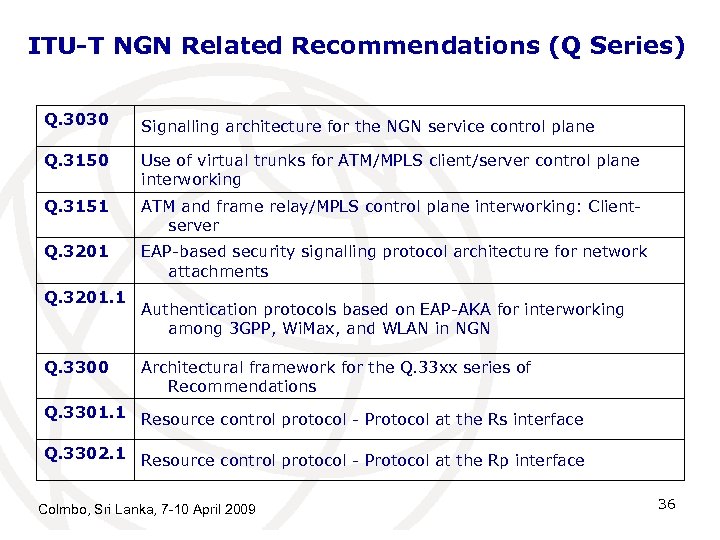
ITU-T NGN Related Recommendations (Q Series) Q. 3030 Signalling architecture for the NGN service control plane Q. 3150 Use of virtual trunks for ATM/MPLS client/server control plane interworking Q. 3151 ATM and frame relay/MPLS control plane interworking: Clientserver Q. 3201 EAP-based security signalling protocol architecture for network attachments Q. 3201. 1 Q. 3300 Authentication protocols based on EAP-AKA for interworking among 3 GPP, Wi. Max, and WLAN in NGN Architectural framework for the Q. 33 xx series of Recommendations Q. 3301. 1 Resource control protocol - Protocol at the Rs interface Q. 3302. 1 Resource control protocol - Protocol at the Rp interface Colmbo, Sri Lanka, 7 -10 April 2009 36
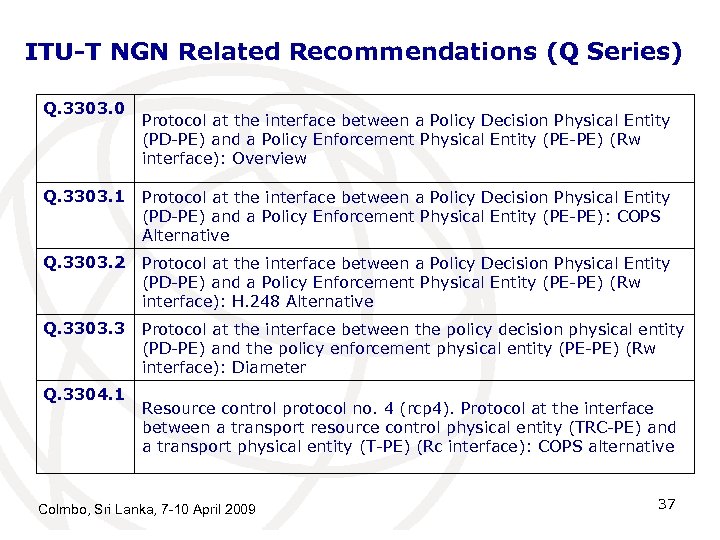
ITU-T NGN Related Recommendations (Q Series) Q. 3303. 0 Protocol at the interface between a Policy Decision Physical Entity (PD-PE) and a Policy Enforcement Physical Entity (PE-PE) (Rw interface): Overview Q. 3303. 1 Protocol at the interface between a Policy Decision Physical Entity (PD-PE) and a Policy Enforcement Physical Entity (PE-PE): COPS Alternative Q. 3303. 2 Protocol at the interface between a Policy Decision Physical Entity (PD-PE) and a Policy Enforcement Physical Entity (PE-PE) (Rw interface): H. 248 Alternative Q. 3303. 3 Protocol at the interface between the policy decision physical entity (PD-PE) and the policy enforcement physical entity (PE-PE) (Rw interface): Diameter Q. 3304. 1 Resource control protocol no. 4 (rcp 4). Protocol at the interface between a transport resource control physical entity (TRC-PE) and a transport physical entity (T-PE) (Rc interface): COPS alternative Colmbo, Sri Lanka, 7 -10 April 2009 37
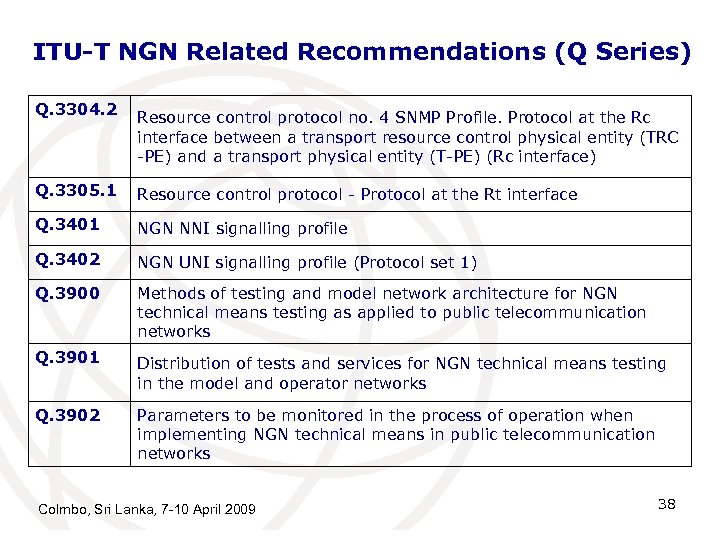
ITU-T NGN Related Recommendations (Q Series) Q. 3304. 2 Resource control protocol no. 4 SNMP Profile. Protocol at the Rc interface between a transport resource control physical entity (TRC -PE) and a transport physical entity (T-PE) (Rc interface) Q. 3305. 1 Resource control protocol - Protocol at the Rt interface Q. 3401 NGN NNI signalling profile Q. 3402 NGN UNI signalling profile (Protocol set 1) Q. 3900 Methods of testing and model network architecture for NGN technical means testing as applied to public telecommunication networks Q. 3901 Distribution of tests and services for NGN technical means testing in the model and operator networks Q. 3902 Parameters to be monitored in the process of operation when implementing NGN technical means in public telecommunication networks Colmbo, Sri Lanka, 7 -10 April 2009 38
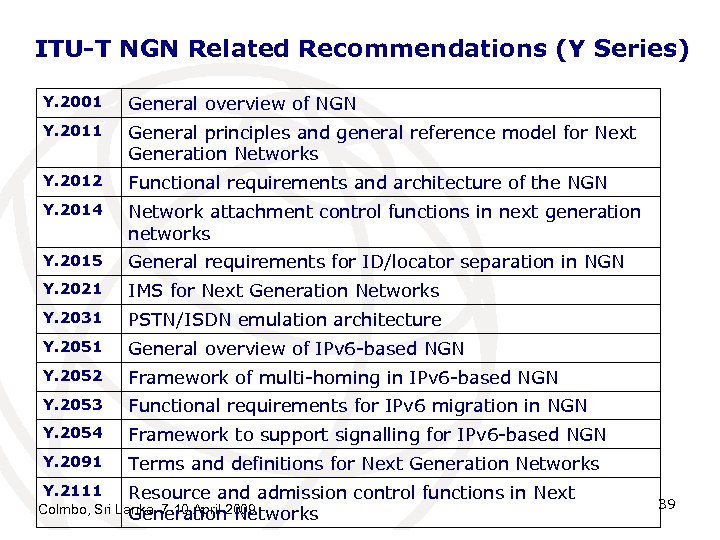
ITU-T NGN Related Recommendations (Y Series) Y. 2001 General overview of NGN Y. 2011 General principles and general reference model for Next Generation Networks Y. 2012 Functional requirements and architecture of the NGN Y. 2014 Network attachment control functions in next generation networks Y. 2015 General requirements for ID/locator separation in NGN Y. 2021 IMS for Next Generation Networks Y. 2031 PSTN/ISDN emulation architecture Y. 2051 General overview of IPv 6 -based NGN Y. 2052 Framework of multi-homing in IPv 6 -based NGN Y. 2053 Functional requirements for IPv 6 migration in NGN Y. 2054 Framework to support signalling for IPv 6 -based NGN Y. 2091 Terms and definitions for Next Generation Networks Resource and admission control functions in Next Colmbo, Sri Lanka, 7 -10 April 2009 Generation Networks Y. 2111 39
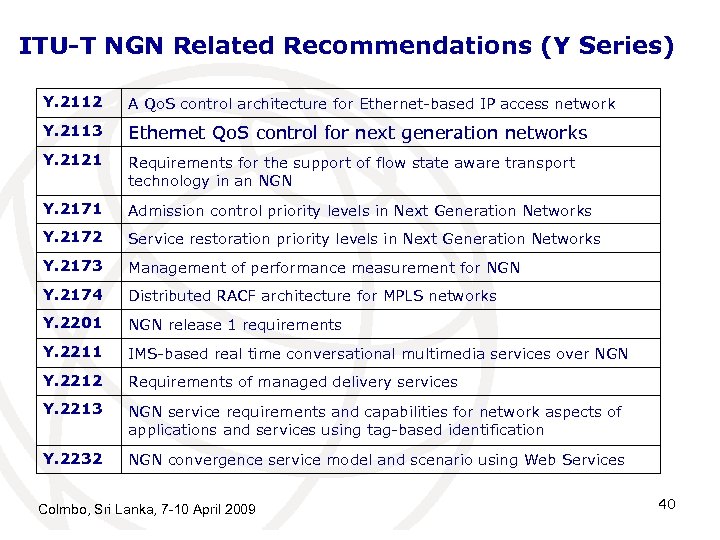
ITU-T NGN Related Recommendations (Y Series) Y. 2112 A Qo. S control architecture for Ethernet-based IP access network Y. 2113 Ethernet Qo. S control for next generation networks Y. 2121 Requirements for the support of flow state aware transport technology in an NGN Y. 2171 Admission control priority levels in Next Generation Networks Y. 2172 Service restoration priority levels in Next Generation Networks Y. 2173 Management of performance measurement for NGN Y. 2174 Distributed RACF architecture for MPLS networks Y. 2201 NGN release 1 requirements Y. 2211 IMS-based real time conversational multimedia services over NGN Y. 2212 Requirements of managed delivery services Y. 2213 NGN service requirements and capabilities for network aspects of applications and services using tag-based identification Y. 2232 NGN convergence service model and scenario using Web Services Colmbo, Sri Lanka, 7 -10 April 2009 40
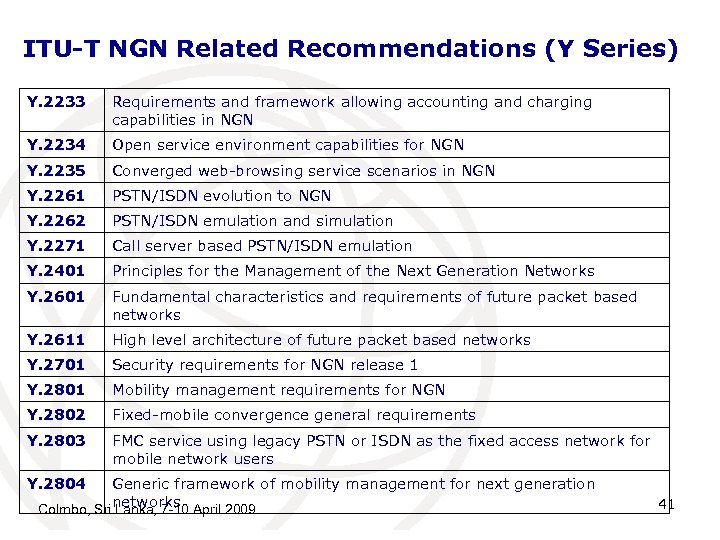
ITU-T NGN Related Recommendations (Y Series) Y. 2233 Requirements and framework allowing accounting and charging capabilities in NGN Y. 2234 Open service environment capabilities for NGN Y. 2235 Converged web-browsing service scenarios in NGN Y. 2261 PSTN/ISDN evolution to NGN Y. 2262 PSTN/ISDN emulation and simulation Y. 2271 Call server based PSTN/ISDN emulation Y. 2401 Principles for the Management of the Next Generation Networks Y. 2601 Fundamental characteristics and requirements of future packet based networks Y. 2611 High level architecture of future packet based networks Y. 2701 Security requirements for NGN release 1 Y. 2801 Mobility management requirements for NGN Y. 2802 Fixed-mobile convergence general requirements Y. 2803 FMC service using legacy PSTN or ISDN as the fixed access network for mobile network users Y. 2804 Generic framework of mobility management for next generation networks Colmbo, Sri Lanka, 7 -10 April 2009 41
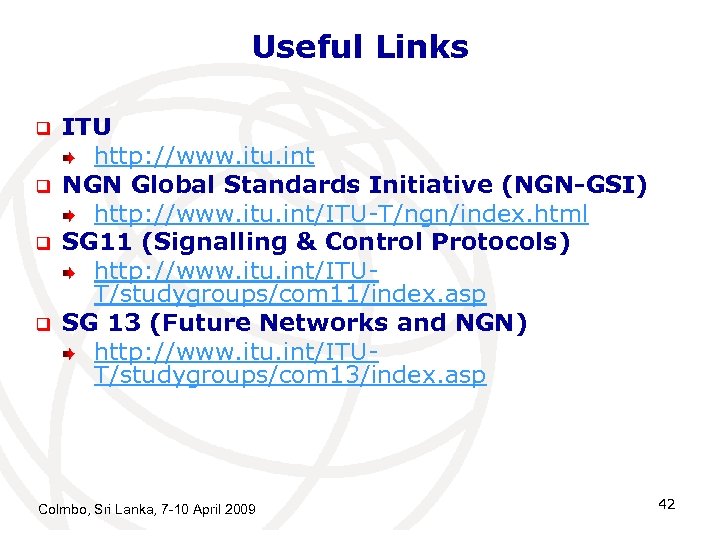
Useful Links q q ITU http: //www. itu. int NGN Global Standards Initiative (NGN-GSI) http: //www. itu. int/ITU-T/ngn/index. html SG 11 (Signalling & Control Protocols) http: //www. itu. int/ITUT/studygroups/com 11/index. asp SG 13 (Future Networks and NGN) http: //www. itu. int/ITUT/studygroups/com 13/index. asp Colmbo, Sri Lanka, 7 -10 April 2009 42
Скачать презентацию FORUM ON NEXT GENERATION STANDARDIZATION Colombo Sri Lanka
cafe6bfd8ceb2fc2329c9bda0a5301e5.ppt