


 Скачать презентацию Fort Monroe on Old Point Comfort is a
bbed4b5c0cde29b2ff97ac8ac6e09469.ppt
- Количество слайдов: 28
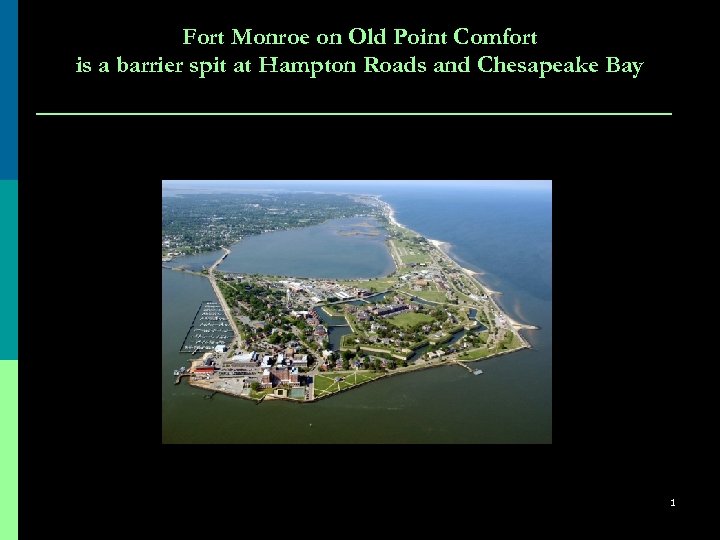 Fort Monroe on Old Point Comfort is a barrier spit at Hampton Roads and Chesapeake Bay 1
 Fort Monroe FADA Planning and Budget Overview House Appropriations Committee January 23, 2008 L. Preston Bryant, Jr. Chair, Fort Monroe Federal Area Development Authority 2
 Fort Monroe’s Special History p p p p 1608: fortification at Point Comfort 1609: Fort Algernourne - protect Jamestown 1819 -1834: Fort Monroe built in response to War of 1812 (2 nd Lt. Robert E. Lee, engineer) Free slaves 1861: Gen. Butler’s “contraband” Post-Civil War: Artillery Corps Since WWII: mission to train soldiers Since 1973: headquarters for Training and Doctrine Command (TRADOC) 3
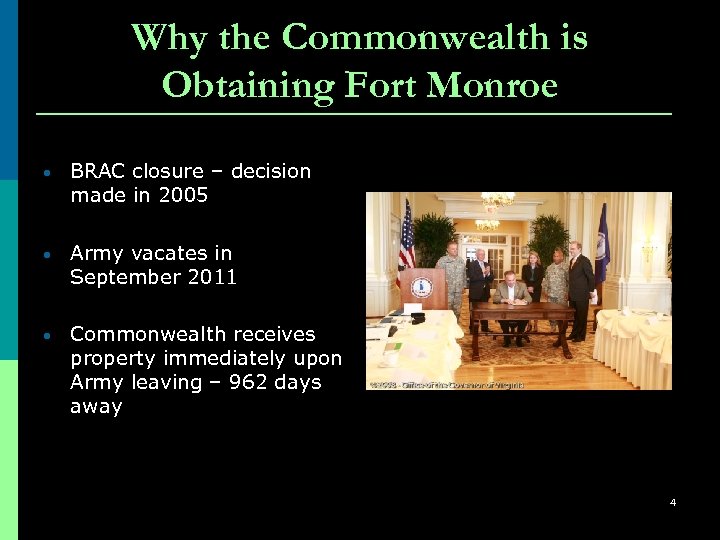 Why the Commonwealth is Obtaining Fort Monroe BRAC closure – decision made in 2005 Army vacates in September 2011 Commonwealth receives property immediately upon Army leaving – 962 days away 4
 Fort Monroe Federal Area Development Authority p Established by the General Assembly in 2007 (§ 15. 2 -6304. 1) p Will hold and manage the property p Professional staff of 4 (Bill Armbruster, Executive Director) p 18 -member board n 5 Gubernatorial appointees (cabinet members) n 4 General Assembly members (Dels. Hamilton and Gear; Sens. Locke and J. Miller) n 9 Citizen appointees (7 appointed by and from City of Hampton; 2 appointed by the Governor with expertise in historic preservation and heritage tourism) 5
 Historic Preservation Advisory Group p Created by the FMFADA board 9 members (4 appointed by Governor; State Historic Preservation Office rep; National Trust for Historic Preservation rep; 3 FMFADA appointees) Mission: Advisory to the FMFADA board n n n Develop Design Guidelines for the treatment and maintenance standards for historic resources. Design guidelines for new construction Business Plan and Management Plan for publicly accessible buildings. 6
 Fort Monroe Property Characteristics p 570 total acres (108 acres submerged; 85 acres of wetlands) p Almost entire property listed as a National Historic Landmark, since 1966 p 130 acres of open space; 13 acres of beach (3 miles of Bay shoreline) p Nearly 200 buildings – vast majority to be reused p 332 -slip marina 7
 Fort Monroe Infrastructure p Significant road network – Mc. Nair Drive (main entry road) sees ~ 3, 000 vehicle trips per day p Other infrastructure – water and wastewater; stormwater; landfills; electrical and gas system p Chamberlin Hotel – now privately owned, high-end senior independent living facility 8
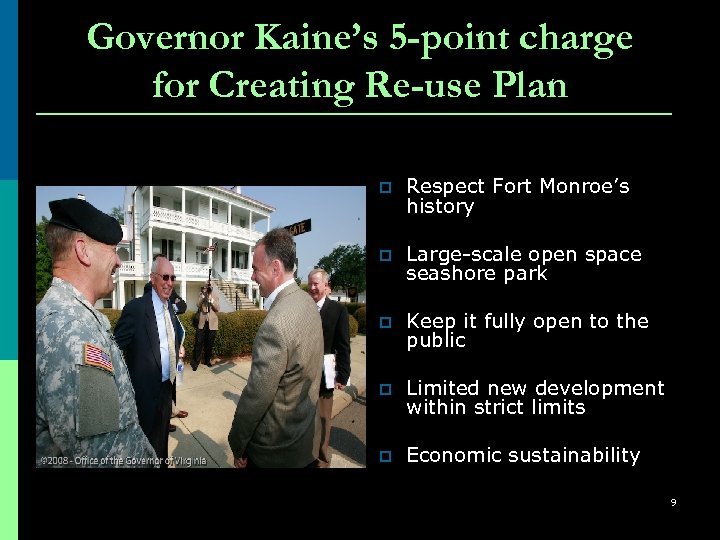 Governor Kaine’s 5 -point charge for Creating Re-use Plan p Respect Fort Monroe’s history p Large-scale open space seashore park p Keep it fully open to the public p Limited new development within strict limits p Economic sustainability 9
 Re-Use Planning – Process p Hampton and Hampton FADA led early efforts (2005 -2006) – lots of citizen involvement; community design charrettes (~ 600 participated) p State and new FMFADA given planning responsibility in 2007 p Since 2007, have been guided by the Governor’s 5 -point charge p Must follow National Historic Preservation Act Section 106 process (federal law) p Determining appropriate level of adaptive re-use, open space preservation, and new development 30+ consulting parties involved (allowed by federal law) 10
 Re-Use Planning Programmatic Agreement p Programmatic Agreement – the guide to how property is re-used p Army-led process n PA Signatories: Army, State Historic Preservation officer (Virginia), Commonwealth, Advisory Council on Historic Preservation, FMFADA, National Park Service 11
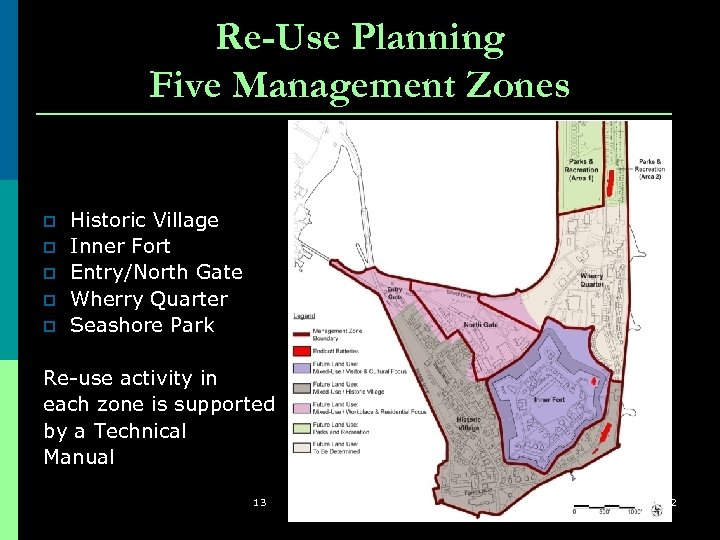 Re-Use Planning Five Management Zones p p p Historic Village Inner Fort Entry/North Gate Wherry Quarter Seashore Park Re-use activity in each zone is supported by a Technical Manual 13 12
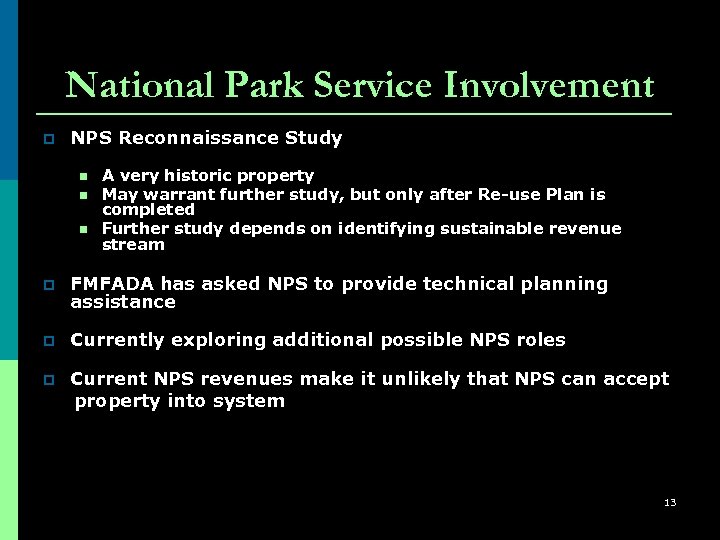 National Park Service Involvement p NPS Reconnaissance Study n n n A very historic property May warrant further study, but only after Re-use Plan is completed Further study depends on identifying sustainable revenue stream p FMFADA has asked NPS to provide technical planning assistance p Currently exploring additional possible NPS roles p Current NPS revenues make it unlikely that NPS can accept property into system 13
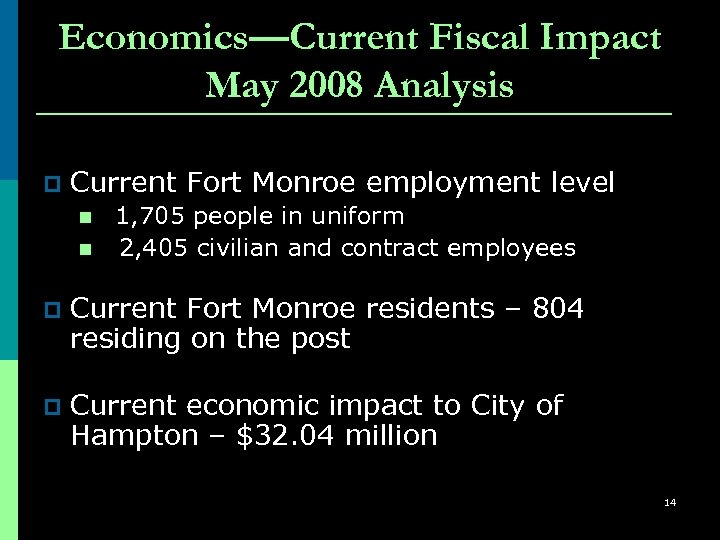 Economics—Current Fiscal Impact May 2008 Analysis p Current Fort Monroe employment level n n 1, 705 people in uniform 2, 405 civilian and contract employees p Current Fort Monroe residents – 804 residing on the post p Current economic impact to City of Hampton – $32. 04 million 14
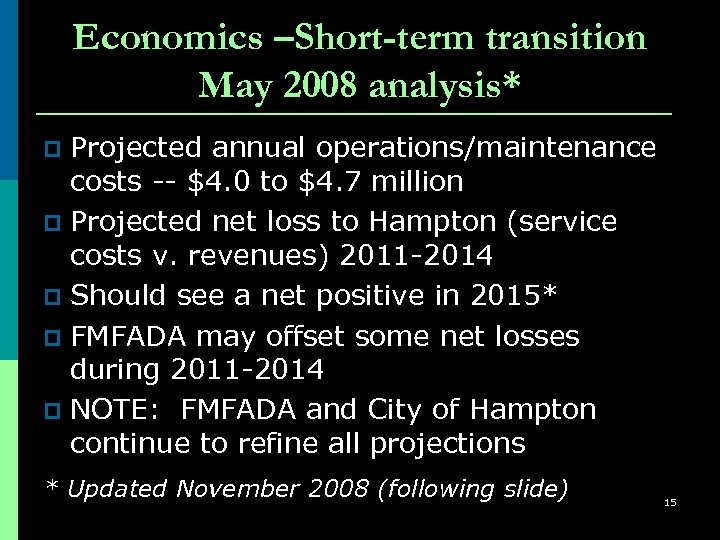 Economics –Short-term transition May 2008 analysis* Projected annual operations/maintenance costs -- $4. 0 to $4. 7 million p Projected net loss to Hampton (service costs v. revenues) 2011 -2014 p Should see a net positive in 2015* p FMFADA may offset some net losses during 2011 -2014 p NOTE: FMFADA and City of Hampton continue to refine all projections p * Updated November 2008 (following slide) 15
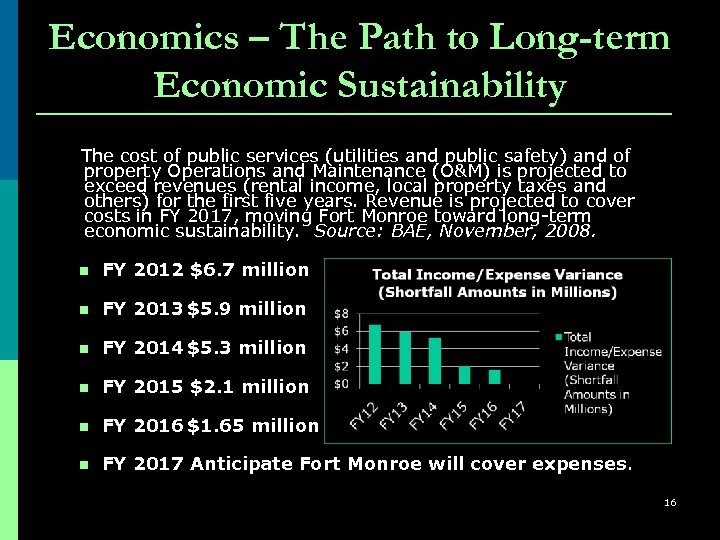 Economics – The Path to Long-term Economic Sustainability The cost of public services (utilities and public safety) and of property Operations and Maintenance (O&M) is projected to exceed revenues (rental income, local property taxes and others) for the first five years. Revenue is projected to cover costs in FY 2017, moving Fort Monroe toward long-term economic sustainability. Source: BAE, November, 2008. n FY 2012 $6. 7 million n FY 2013 $5. 9 million n FY 2014 $5. 3 million n FY 2015 $2. 1 million n FY 2016 $1. 65 million n FY 2017 Anticipate Fort Monroe will cover expenses. 16
 Economics – 20 -year Financial Model (2011 -2031) p FMFADA consultants – Bay Area Economics (have BRAC expertise) n n n n Development program Operating budget analysis Fiscal impact analysis Interim property leasing program (leasing some buildings “as is”) Pre-paid residential leasehold program (potential revenues from ground leases) Capital budget Cash flow estimate 17
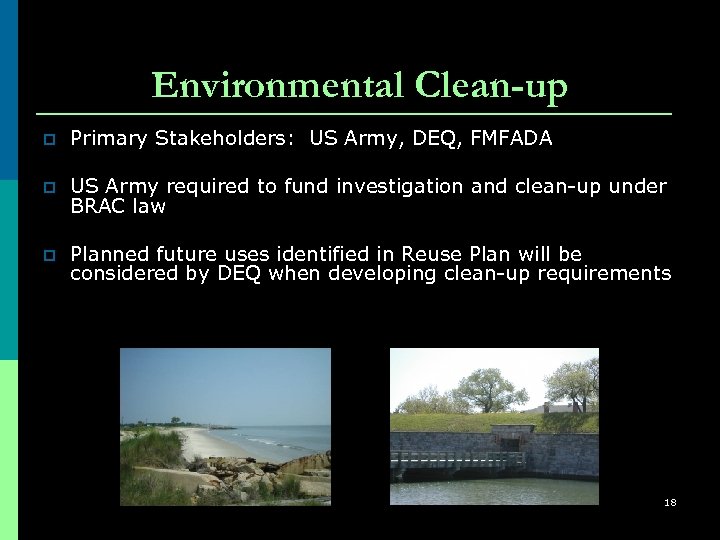 Environmental Clean-up p Primary Stakeholders: US Army, DEQ, FMFADA p US Army required to fund investigation and clean-up under BRAC law p Planned future uses identified in Reuse Plan will be considered by DEQ when developing clean-up requirements 18
 Environmental Clean-up A state responsibility, not FMFADA’s p DEQ negotiating with Army p Focusing on unexploded ordnance and conventional pollutants p Army is responsible for all environmental clean-up costs p Estimated clean-up costs – still to be determined p 19
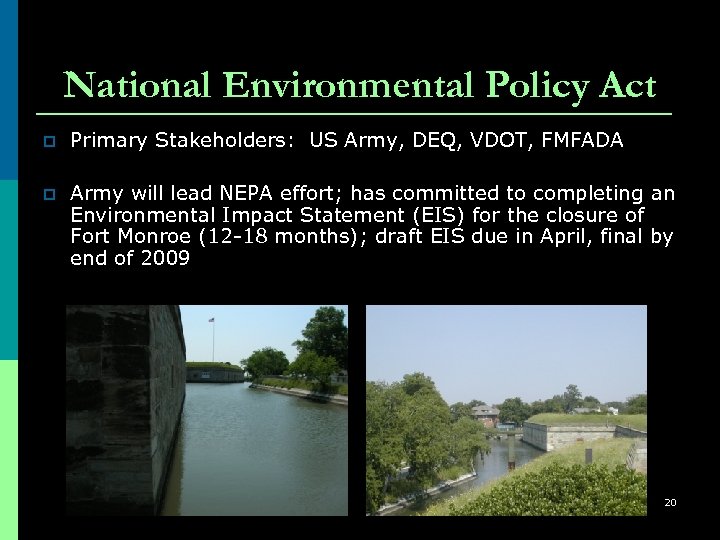 National Environmental Policy Act p Primary Stakeholders: US Army, DEQ, VDOT, FMFADA p Army will lead NEPA effort; has committed to completing an Environmental Impact Statement (EIS) for the closure of Fort Monroe (12 -18 months); draft EIS due in April, final by end of 2009 20
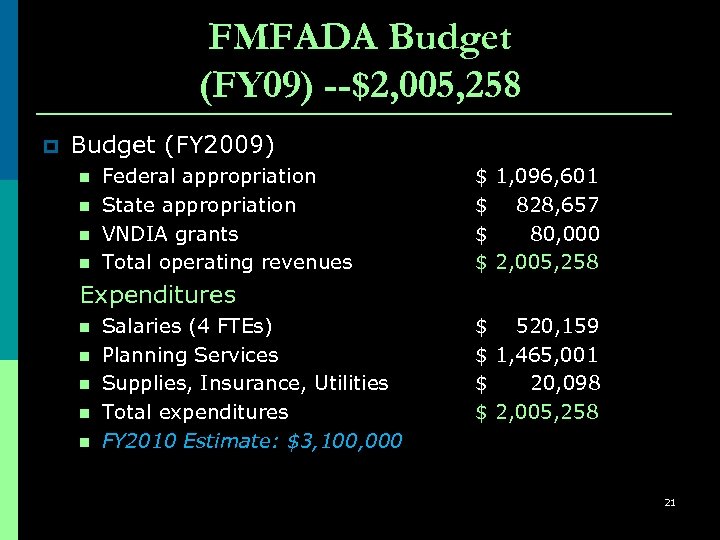 FMFADA Budget (FY 09) --$2, 005, 258 p Budget (FY 2009) n n Federal appropriation State appropriation VNDIA grants Total operating revenues $ 1, 096, 601 $ 828, 657 $ 80, 000 $ 2, 005, 258 Expenditures n n n Salaries (4 FTEs) Planning Services Supplies, Insurance, Utilities Total expenditures FY 2010 Estimate: $3, 100, 000 $ 520, 159 $ 1, 465, 001 $ 20, 098 $ 2, 005, 258 21
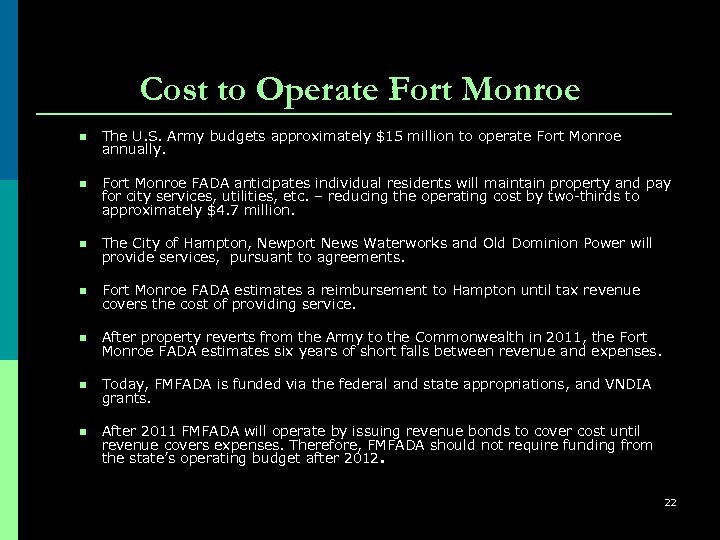 Cost to Operate Fort Monroe n The U. S. Army budgets approximately $15 million to operate Fort Monroe annually. n Fort Monroe FADA anticipates individual residents will maintain property and pay for city services, utilities, etc. – reducing the operating cost by two-thirds to approximately $4. 7 million. n The City of Hampton, Newport News Waterworks and Old Dominion Power will provide services, pursuant to agreements. n Fort Monroe FADA estimates a reimbursement to Hampton until tax revenue covers the cost of providing service. n After property reverts from the Army to the Commonwealth in 2011, the Fort Monroe FADA estimates six years of short falls between revenue and expenses. n Today, FMFADA is funded via the federal and state appropriations, and VNDIA grants. n After 2011 FMFADA will operate by issuing revenue bonds to cover cost until revenue covers expenses. Therefore, FMFADA should not require funding from the state’s operating budget after 2012. 22
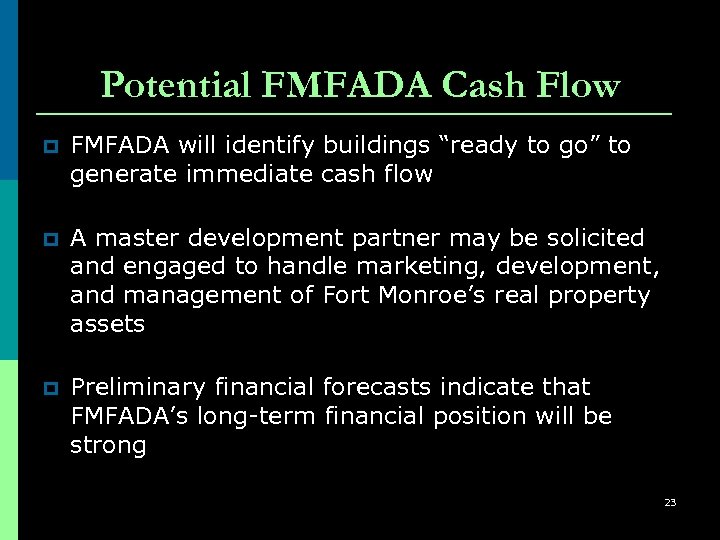 Potential FMFADA Cash Flow p FMFADA will identify buildings “ready to go” to generate immediate cash flow p A master development partner may be solicited and engaged to handle marketing, development, and management of Fort Monroe’s real property assets p Preliminary financial forecasts indicate that FMFADA’s long-term financial position will be strong 23
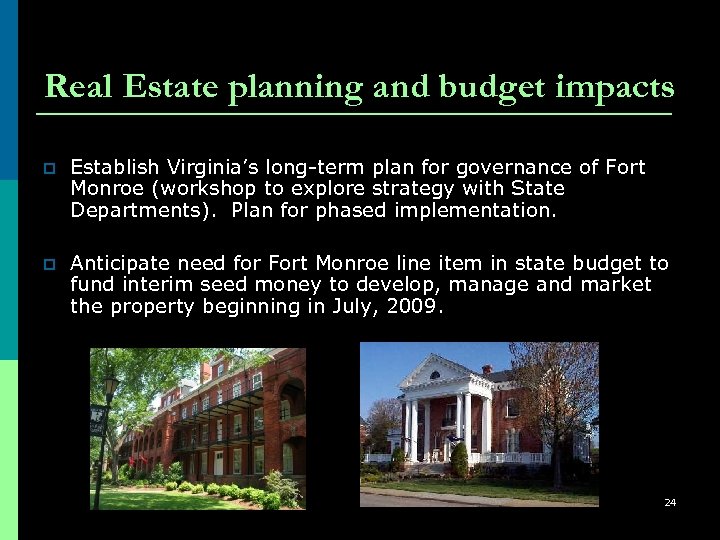 Real Estate planning and budget impacts p Establish Virginia’s long-term plan for governance of Fort Monroe (workshop to explore strategy with State Departments). Plan for phased implementation. p Anticipate need for Fort Monroe line item in state budget to fund interim seed money to develop, manage and market the property beginning in July, 2009. 24
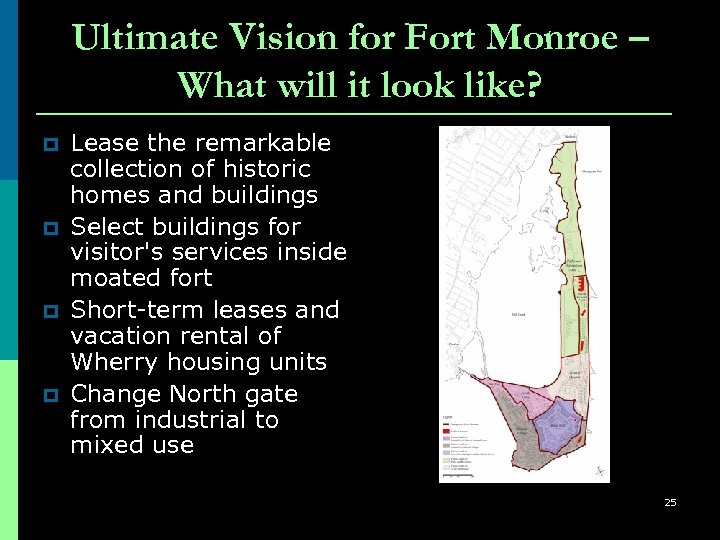 Ultimate Vision for Fort Monroe – What will it look like? p p Lease the remarkable collection of historic homes and buildings Select buildings for visitor's services inside moated fort Short-term leases and vacation rental of Wherry housing units Change North gate from industrial to mixed use 25
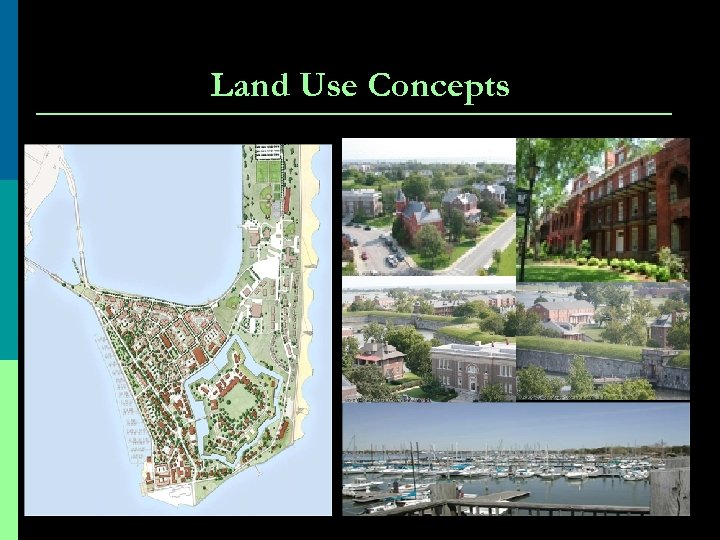 Land Use Concepts 26
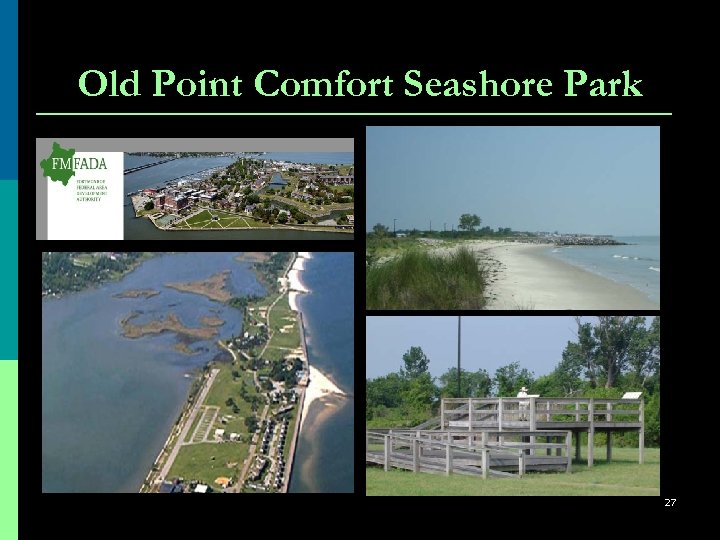 Old Point Comfort Seashore Park 27
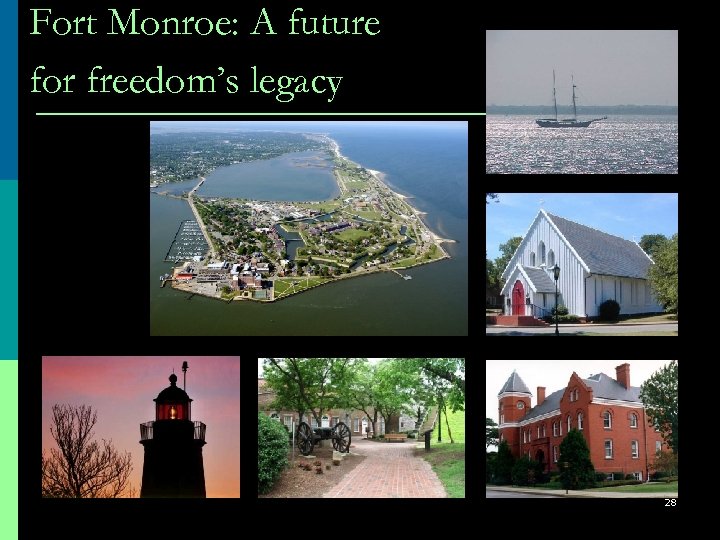 Fort Monroe: A future for freedom’s legacy 28