


 Скачать презентацию Fort Monroe Authority Interpretive Master Plan Report Presentation
35a168243331dc0149aec5712f9669e6.ppt
- Количество слайдов: 43
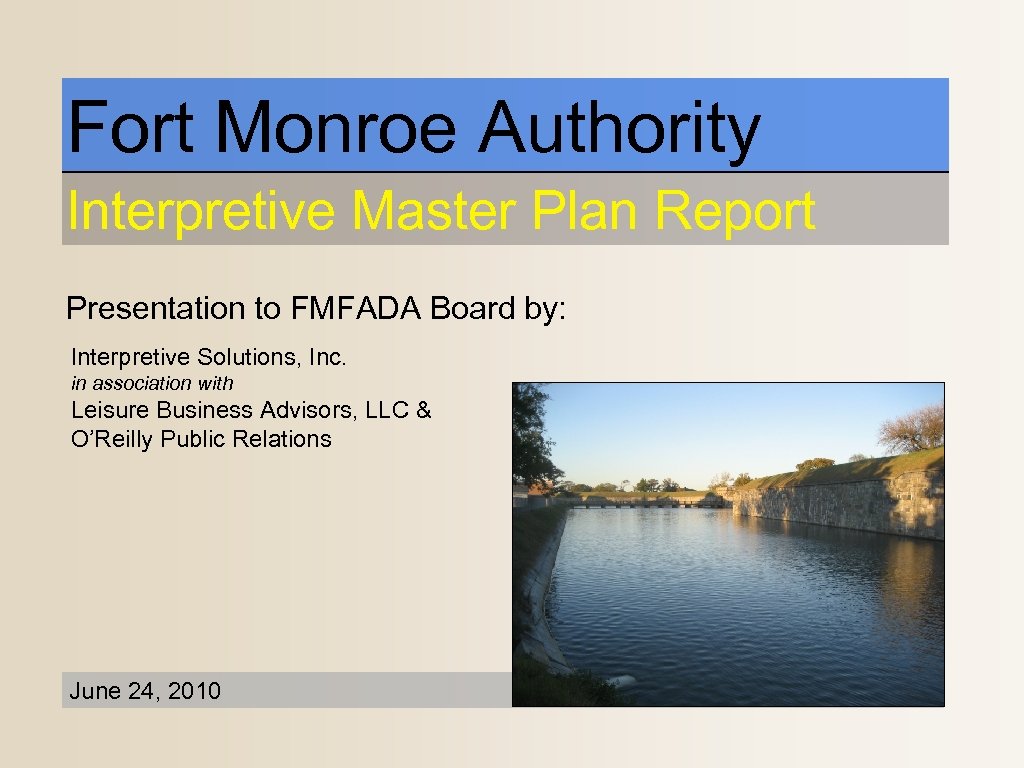 Fort Monroe Authority Interpretive Master Plan Report Presentation to FMFADA Board by: Interpretive Solutions, Inc. in association with Leisure Business Advisors, LLC & O’Reilly Public Relations June 24, 2010
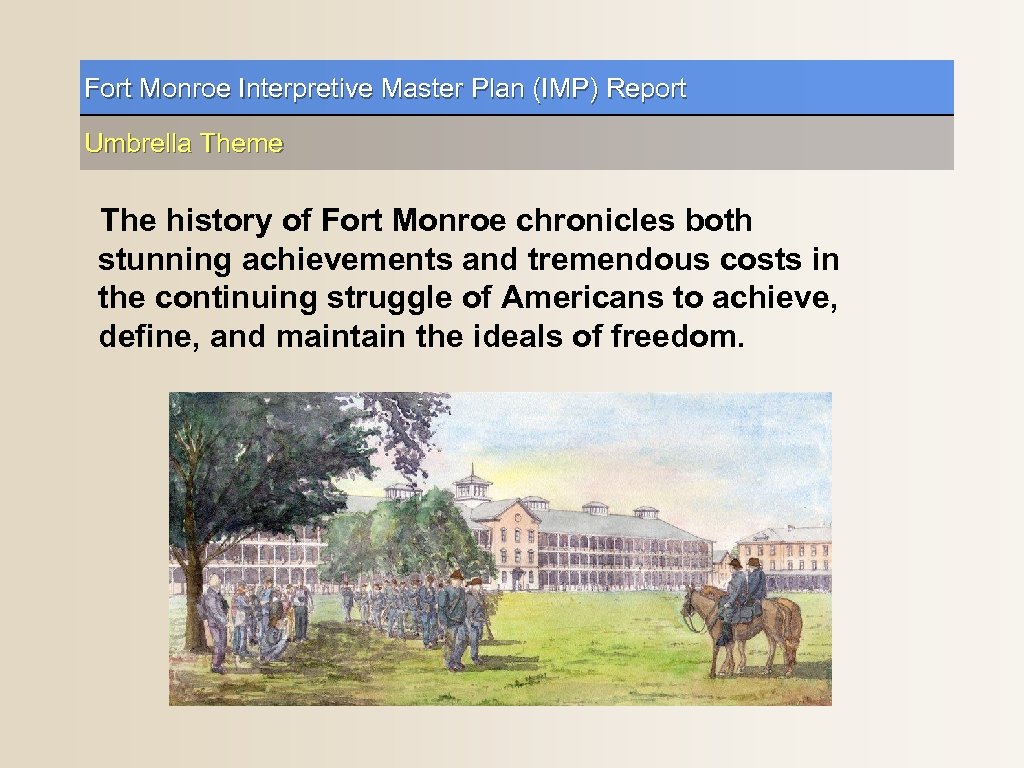 Fort Monroe Interpretive Master Plan (IMP) Report Umbrella Theme The history of Fort Monroe chronicles both stunning achievements and tremendous costs in the continuing struggle of Americans to achieve, define, and maintain the ideals of freedom.
 Fort Monroe’s Six Primary Interpretive Themes as recommended by the IMP Steering Committee Theme 1: The Natural Environment Theme 2: The Virginia Indians Theme 3: The African American Experience Theme 4: The Civil War Theme 5: Defense of the Nation Theme 6: Old Point Comfort Resorts
 Fort Monroe’s Six Primary Interpretive Themes Theme 1: The Natural Environment The physical and historical geography of Fort Monroe. Old Point Comfort demonstrates how the natural environment shapes human history, and how human endeavors profoundly affect natural landscapes.
 Fort Monroe’s Six Primary Interpretive Themes Theme 2: The Virginia Indians The English colonization of Virginia interrupted and irremediably changed thousands of years of the use and occupation of this land by American Indians, an early harbinger of a continuing pattern of loss and reuse of American landforms.
 Fort Monroe’s Six Primary Interpretive Themes Theme 3: The African American Experience The African American experience at Old Point Comfort, from the earliest Colonial times to the present day, reflects a long, continuing struggle for freedom and equal rights.
 Fort Monroe’s Six Primary Interpretive Themes Theme 4: The Civil War Events that occurred at Fort Monroe during the Civil War era shaped American society, culture and the American experience.
 Fort Monroe’s Six Primary Interpretive Themes Theme 5: Defense of the Nation The history of Fort Monroe reflects the evolving response of the nation to an ever-changing array of threats.
 Fort Monroe’s Six Primary Interpretive Themes Theme 6: Old Point Comfort Resorts Recreation and leisure activities have been part of the Fort Monroe experience almost as long as the fort has existed. The Chamberlin reminds us of the energy and excitement that characterizes the ever-evolving resort community of Old Point Comfort, with its hotels having been among the most famous in the nation.
 Fort Monroe’s Six Primary Interpretive Themes/Stories are Braided - Each theme is closely related to the others, but each with its own narrative force. - Together they create a continuum of history at Fort Monroe from geological times to the present – a spectrum of American history, all in one location.
 Fort Monroe’s Target Audiences Four main categories: 1. DAY VISITORS - Heritage seekers - Recreation seekers 2. LONGER-STAY VACATIONERS - “Twenty-somethings” - Gen X families - Baby boomers - Multi-generational families
 Fort Monroe’s Target Audiences Four main categories: 3. LEARNERS - School groups - Teacher learners - Distance learners - Adult (life-long) learners 4. RESIDENTS AND OFFICE WORKERS
 How do we know what people want? Who was surveyed? • Town Hall meetings • Meetings with stakeholders • Survey Monkey • Formal SIR survey • National internet panel • Recreational travelers • 66% of respondents were Virginians • The rest were from Pennsylvania, North Carolina, Maryland D. C.
 Survey Results • Two-thirds of respondents prefer beach vacations. • Affordability, atmosphere and relaxation/tranquility were the highest rated vacation attributes. • 37% had heard of Fort Monroe; 19% had visited. • Preferred name: “Fort Monroe at Old Point Comfort. ” • 67% want museums=Civil War, Indian, Fort Monroe themes. • Nearly 50% interested in a “living history” experience. • 50%-plus willing to pay extra for the experience.
 Educational programs at Fort Monroe 1. School programs: inquiry-based learning 2. Teacher institute model: training the trainer 3. Distance learning
 Potential Interpretive and Educational Partnerships Museums 1. The Casemate 2. Hampton History Museum 3. Museum of the Confederacy 4. Virginia Living Museum 5. Virginia Museum of Natural History 6. Virginia War Museum
 Potential Interpretive and Educational Partnerships (cont. ) Other organizations 1. Contraband Historical Society 2. Chesapeake Bay Foundation 3. Hampton University 4. National Park Service 5. Virginia Department of Game and Inland Fisheries 6. Virginia Modeling, Analysis & Simulation Center (VMASC) 7. Virginia Sesquicentennial Commemoration of the American Civil War, City of Hampton
 Potential Interpretive and Educational Partnerships (cont. ) Other interested parties 1. Coast Defense Study Group 2. Governor’s School for Science and Technology (Hampton) 3. Seven area school divisions 4. NASA 5. The “Historic Triangle” (Colonial Williamsburg, Jamestown Settlement, Historic Jamestowne, Yorktown Victory Center, Yorktown Battlefield) 6. Virginia Council on Indians 7. Virginia Dept. of Conservation and Recreation 8. Virginia Tourism Corporation
 Potential Interpretive and Educational Partnerships (cont. ) Interpretive Networks 1. Captain John Smith Chesapeake National Historic Trail 2. Chesapeake Bay Gateways Network 3. Chesapeake Treasured Landscape Initiative 4. Star-Spangled Banner National Historic Trail 5. Virginia Birding and Wildlife Trail 6. Virginia Civil War Trails 7. Virginia Indian Heritage Trail 8. Washington-Rochambeau Revolutionary War Historic Trail
 Analysis of buildings as interpretive venues National Museum Criteria • • • Security Climate controls, including control of natural light High ceilings, 15 -18” feet high for display of large items such as flags, banners, and other items Large, flexible interior spaces for specific uses Wide doorways and delivery entrance ADA compliance Flood potential Parking conditions/transportation Restrooms
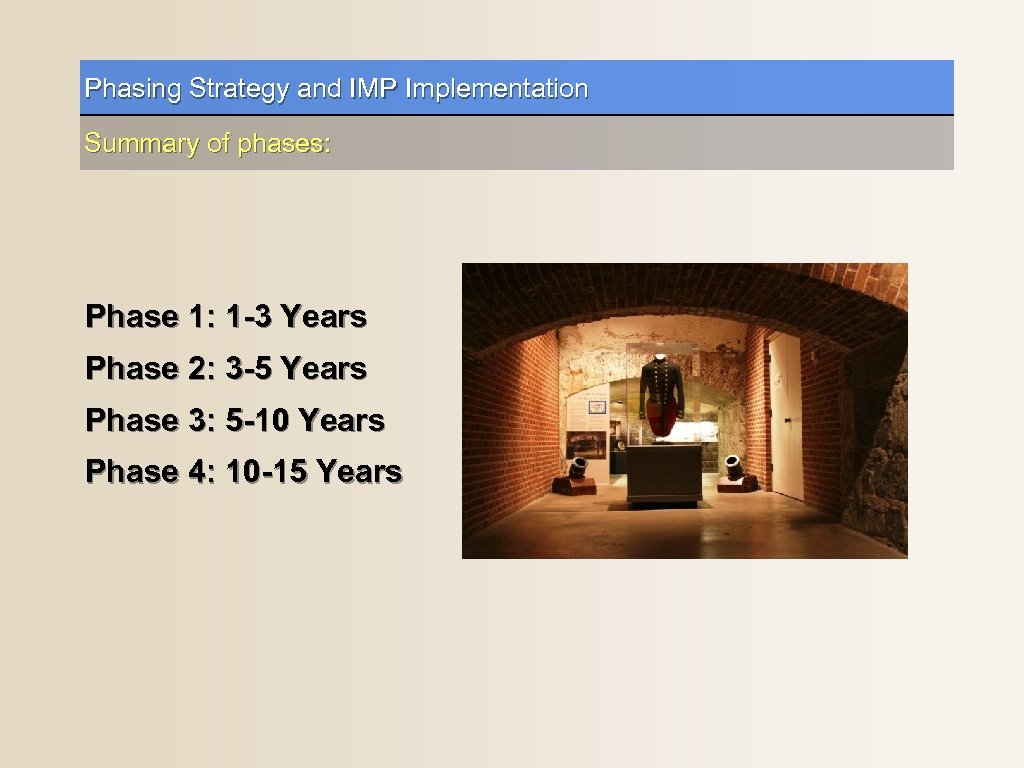 Phasing Strategy and IMP Implementation Summary of phases: Phase 1: 1 -3 Years Phase 2: 3 -5 Years Phase 3: 5 -10 Years Phase 4: 10 -15 Years
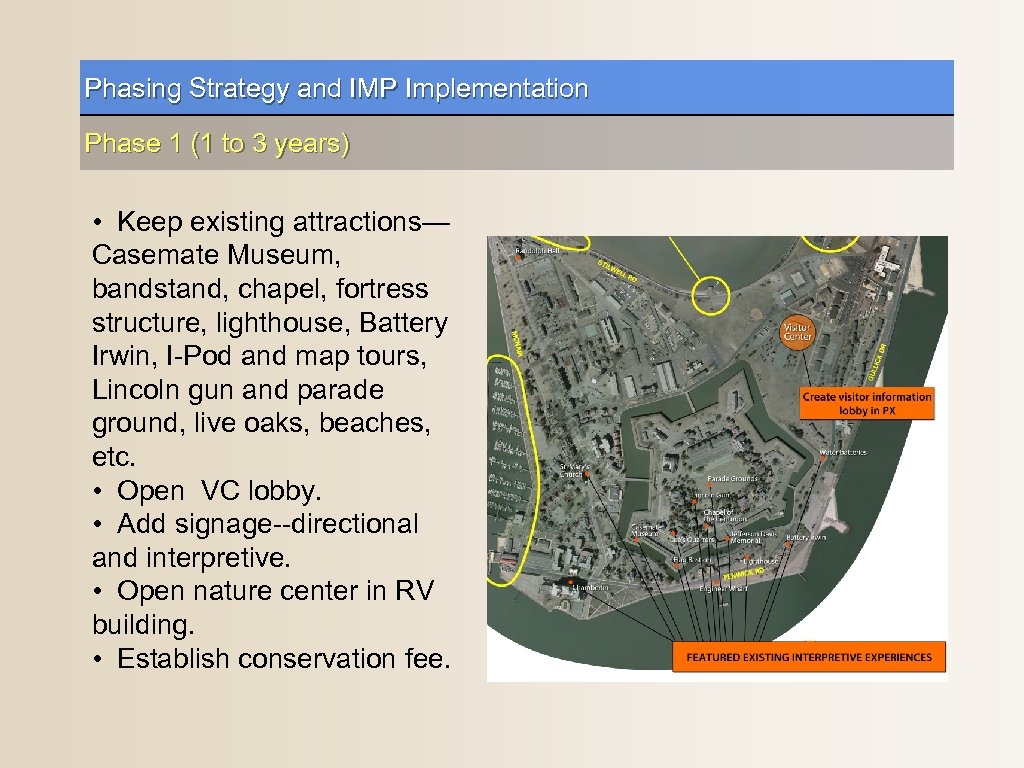 Phasing Strategy and IMP Implementation Phase 1 (1 to 3 years) • Keep existing attractions— Casemate Museum, bandstand, chapel, fortress structure, lighthouse, Battery Irwin, I-Pod and map tours, Lincoln gun and parade ground, live oaks, beaches, etc. • Open VC lobby. • Add signage--directional and interpretive. • Open nature center in RV building. • Establish conservation fee.
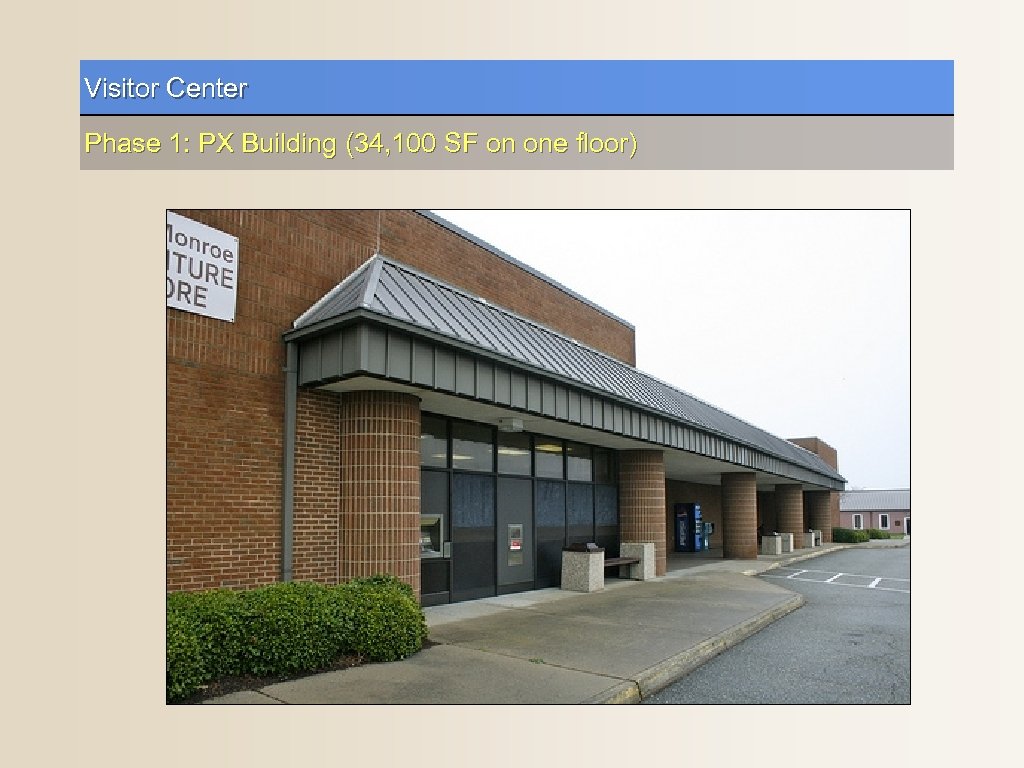 Visitor Center Phase 1: PX Building (34, 100 SF on one floor)
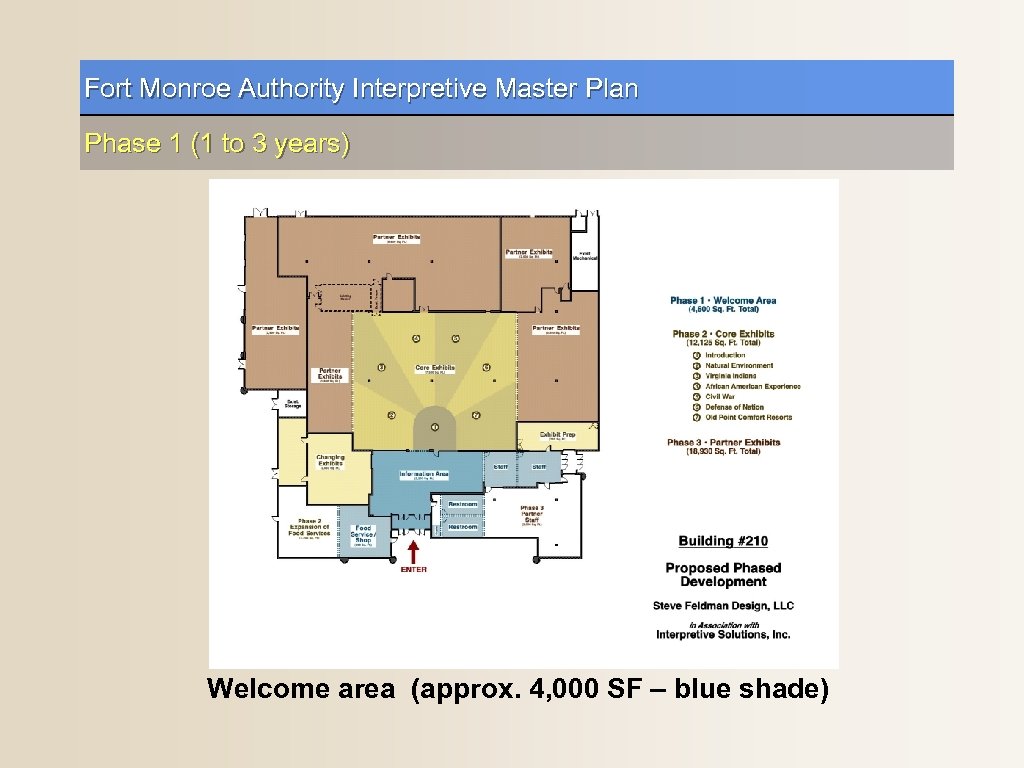 Fort Monroe Authority Interpretive Master Plan Phase 1 (1 to 3 years) Welcome area (approx. 4, 000 SF – blue shade)
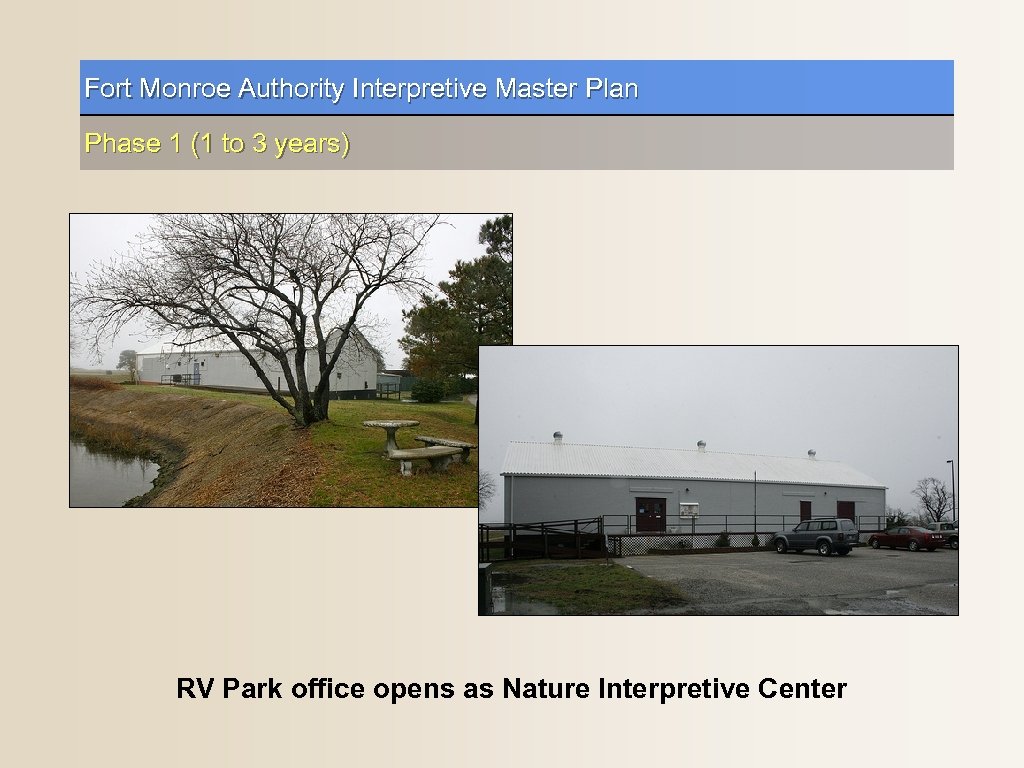 Fort Monroe Authority Interpretive Master Plan Phase 1 (1 to 3 years) RV Park office opens as Nature Interpretive Center
 Fort Monroe Authority Interpretive Master Plan Phase 1: Visitor Parking, Transportation, Circulation & Retail Services 1. Go green: limit auto traffic. Hub parking at VC. 2. VC rents carts, bikes, Segways; shuttle service. 3. Dedicated ADA parking inside moat and near East and North Gate. 4. Beach parking for recreation. 5. Open VC museum shop with partners.
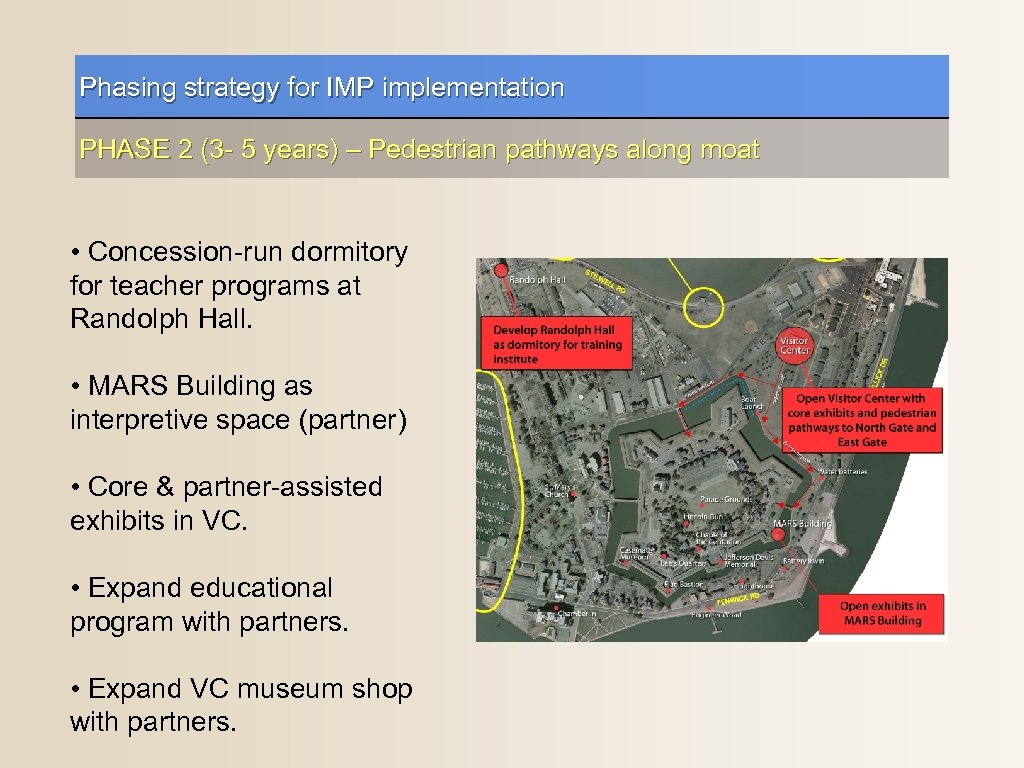 Phasing strategy for IMP implementation PHASE 2 (3 - 5 years) – Pedestrian pathways along moat • Concession-run dormitory for teacher programs at Randolph Hall. • MARS Building as interpretive space (partner) • Core & partner-assisted exhibits in VC. • Expand educational program with partners. • Expand VC museum shop with partners.
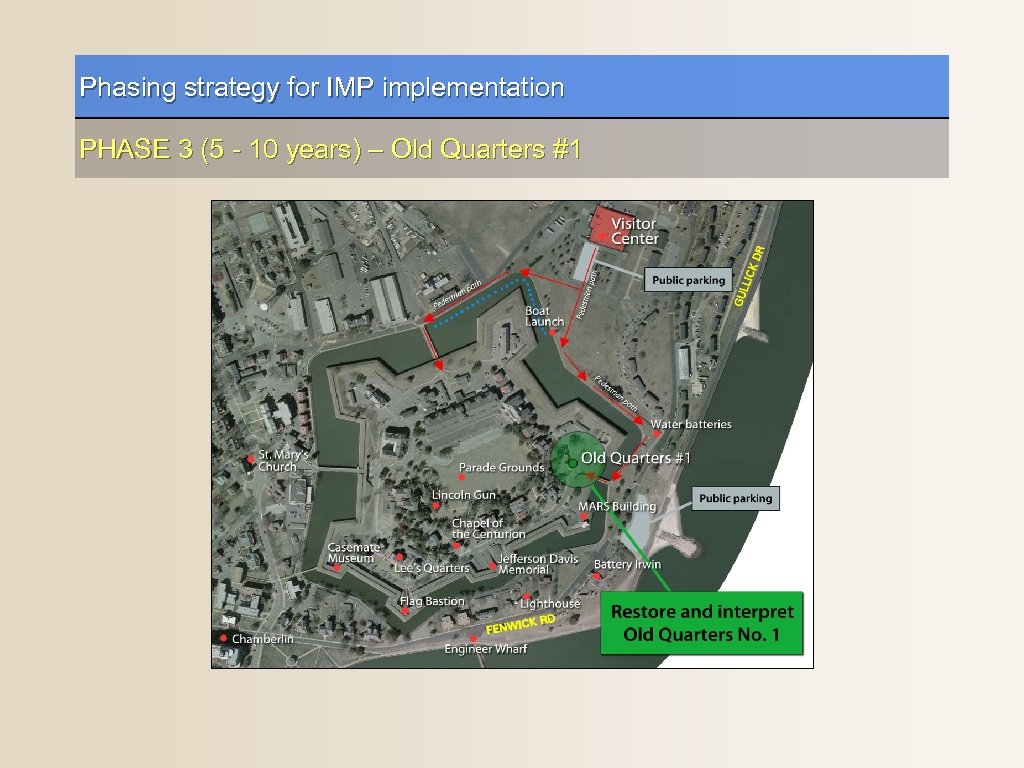 Phasing strategy for IMP implementation PHASE 3 (5 - 10 years) – Old Quarters #1
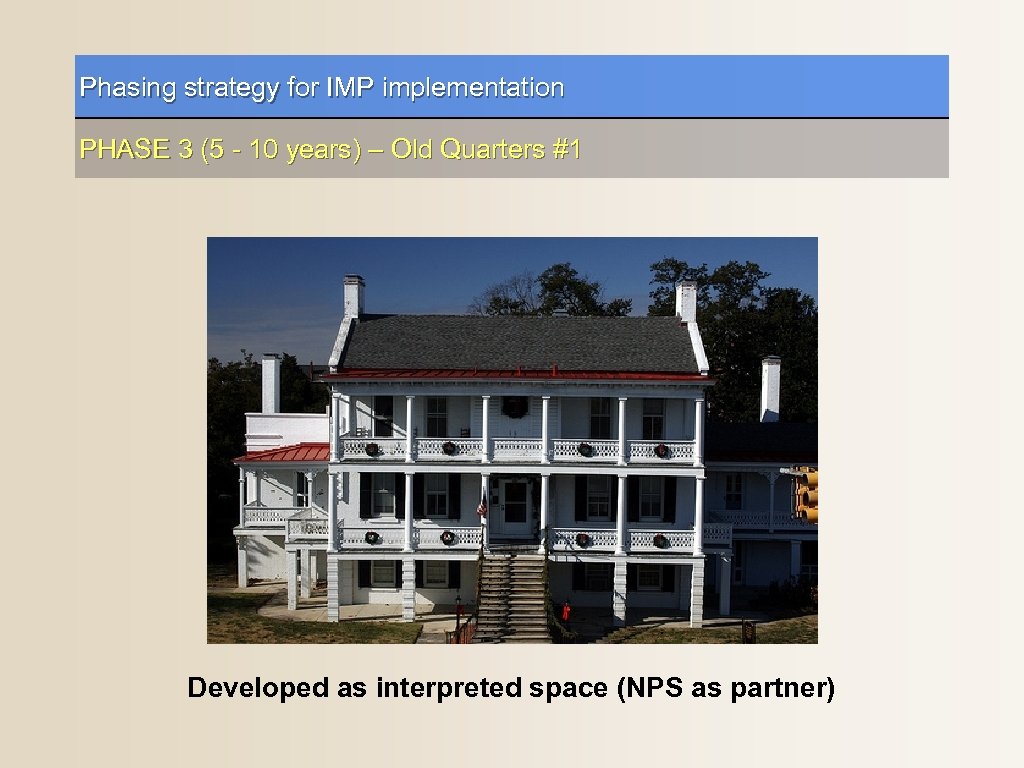 Phasing strategy for IMP implementation PHASE 3 (5 - 10 years) – Old Quarters #1 Developed as interpreted space (NPS as partner)
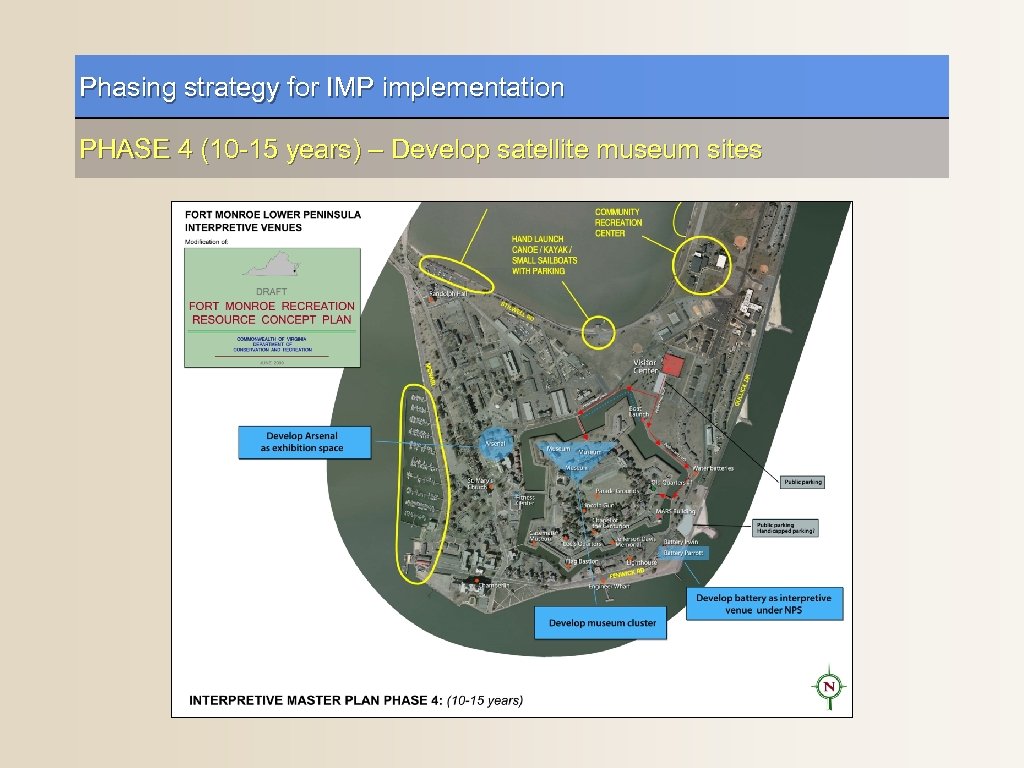 Phasing strategy for IMP implementation PHASE 4 (10 -15 years) – Develop satellite museum sites
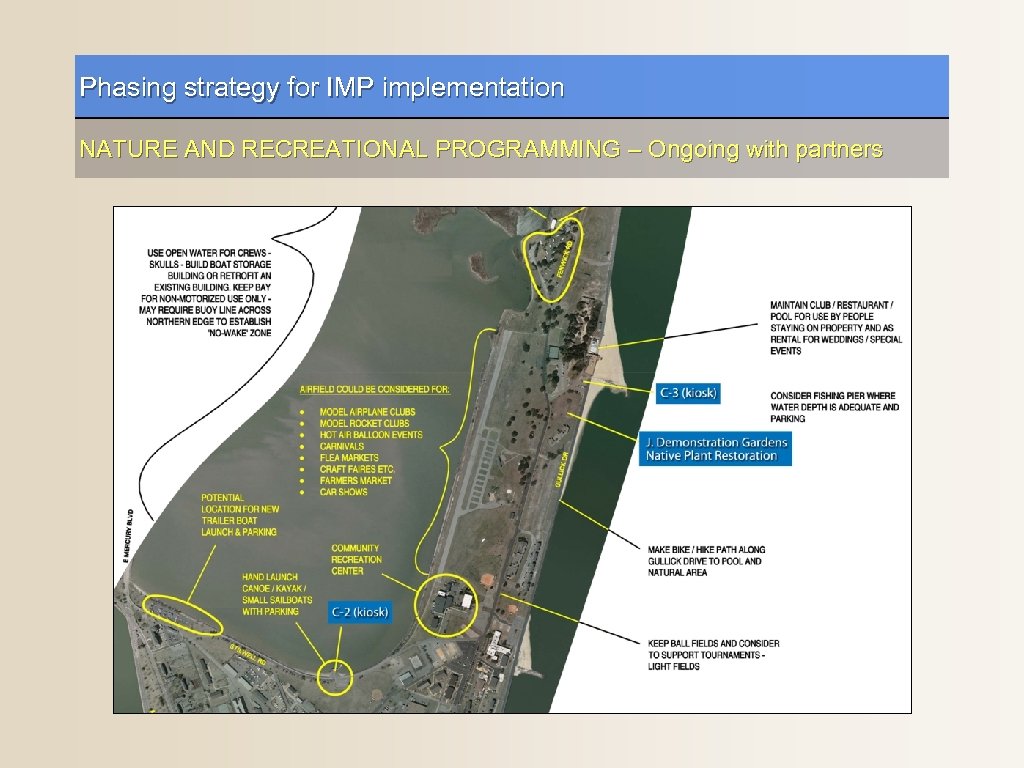 Phasing strategy for IMP implementation NATURE AND RECREATIONAL PROGRAMMING – Ongoing with partners
 Cultural Business Plan Recommendations Approach • Plan based on FMA mainly serving as a landlord for a diverse range of future uses. • Most operations would be operated by partners, tenants or concessionaires. • FMA provides tourism infrastructure and core public programming, supported by a conservation fee paid by visitors.
 Cultural Business Plan Recommendations (continued) Partnerships • National Park Service (NPS) is main partner, with part of Fort Monroe eventually established as an NPS unit. Congressional legislation to be introduced. • FMA builds an extensive partnership network with museums, recreation providers, and educational organizations through a Request for Proposals (RFP) process.
 Cultural Business Plan Recommendations (continued) Relationship • FMA provides overall administration and marketing efforts. • FMA strives to maintain a cash-flow neutral approach after expenses. It would not aim to profit from its interpretive partners for their involvement at Fort Monroe, but would also not subsidize them.
 Cultural Business Plan Recommendations (continued) Visitor Center • Visitors start Fort Monroe experience at the visitor center. • PX building as VC space is more than adequate. • Old Point Comfort Foundation as fund-raising arm and producer of core VC permanent exhibit gallery.
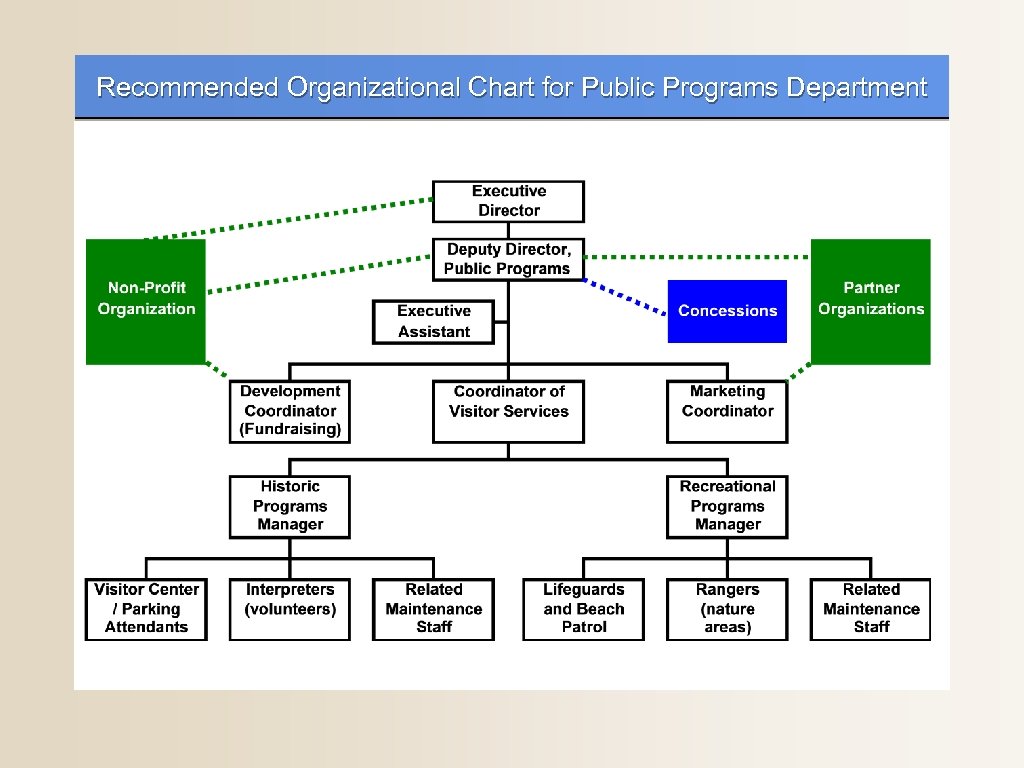 Recommended Organizational Chart for Public Programs Department
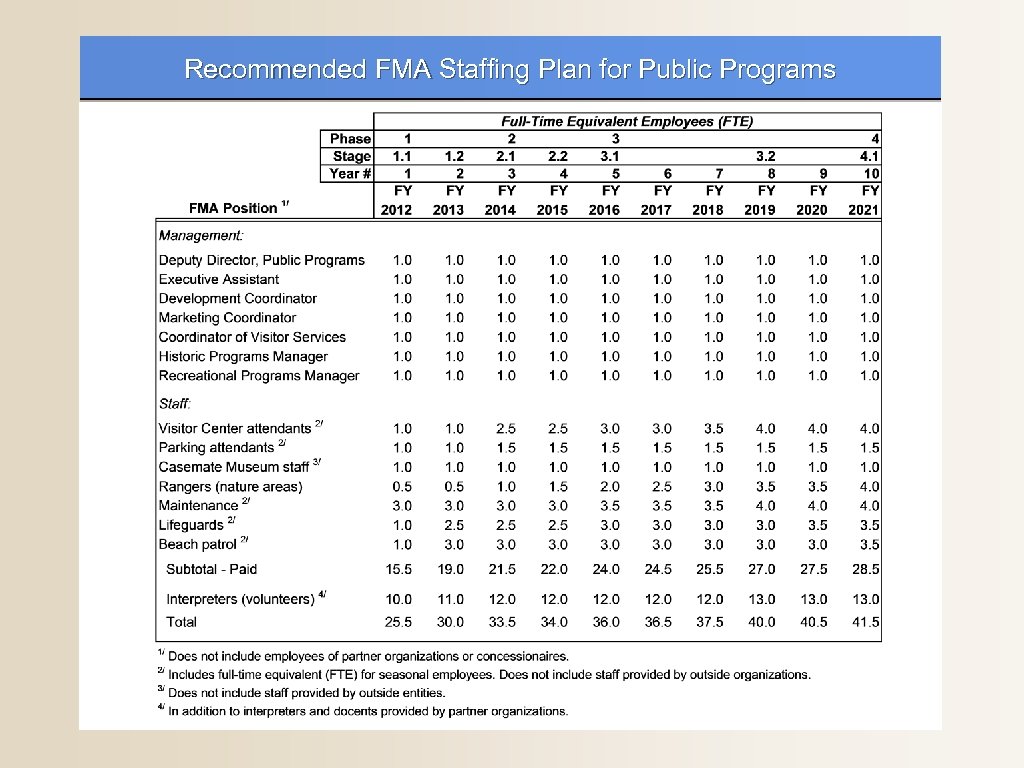 Recommended FMA Staffing Plan for Public Programs
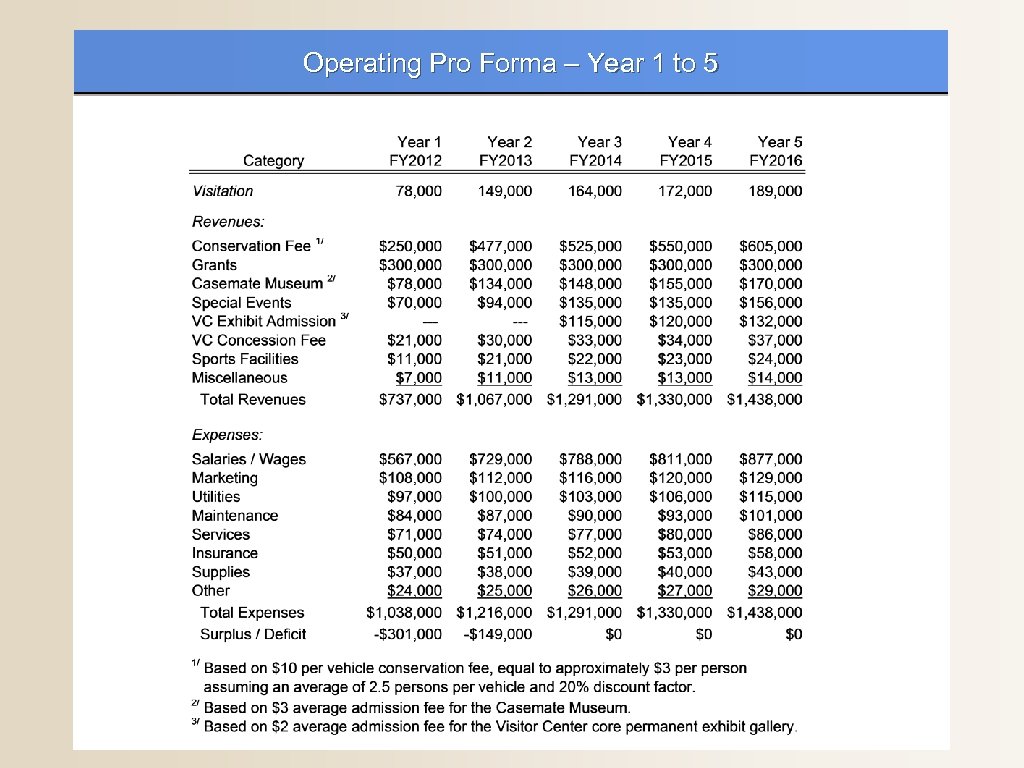 Operating Pro Forma – Year 1 to 5
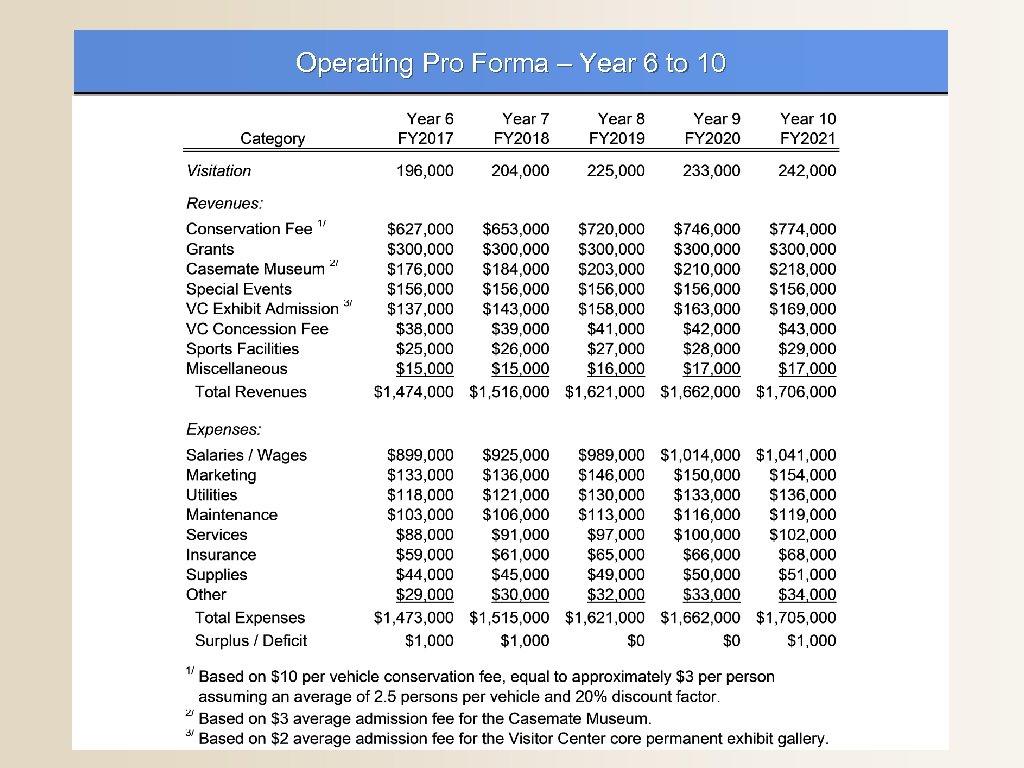 Operating Pro Forma – Year 6 to 10
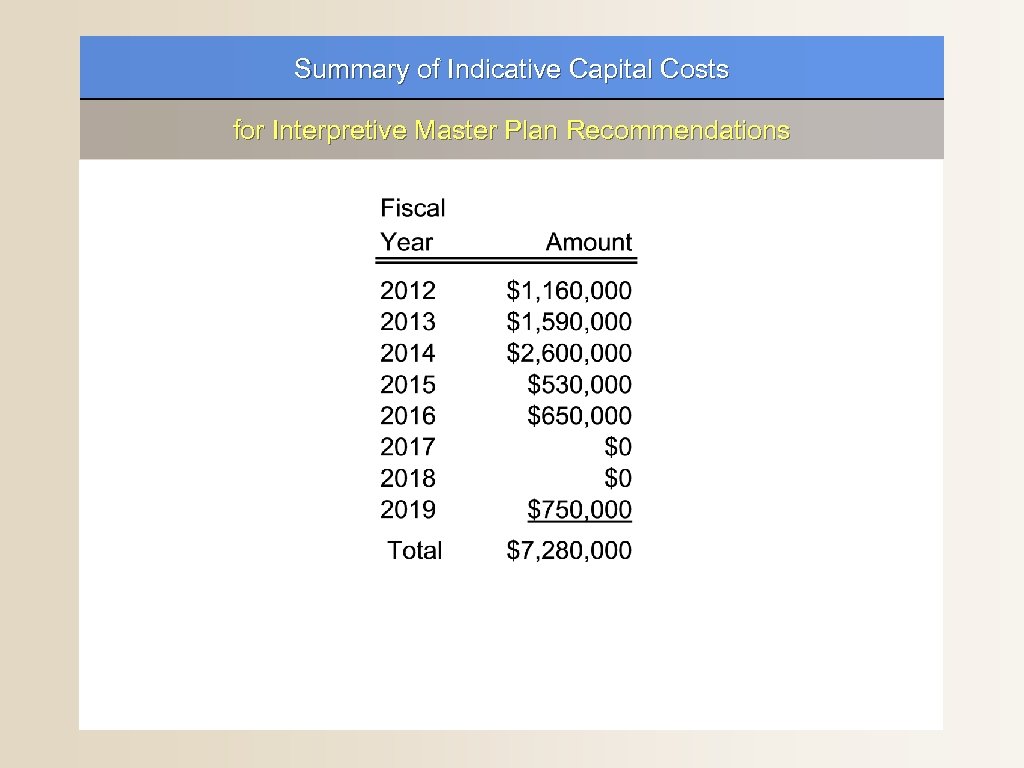 Summary of Indicative Capital Costs for Interpretive Master Plan Recommendations
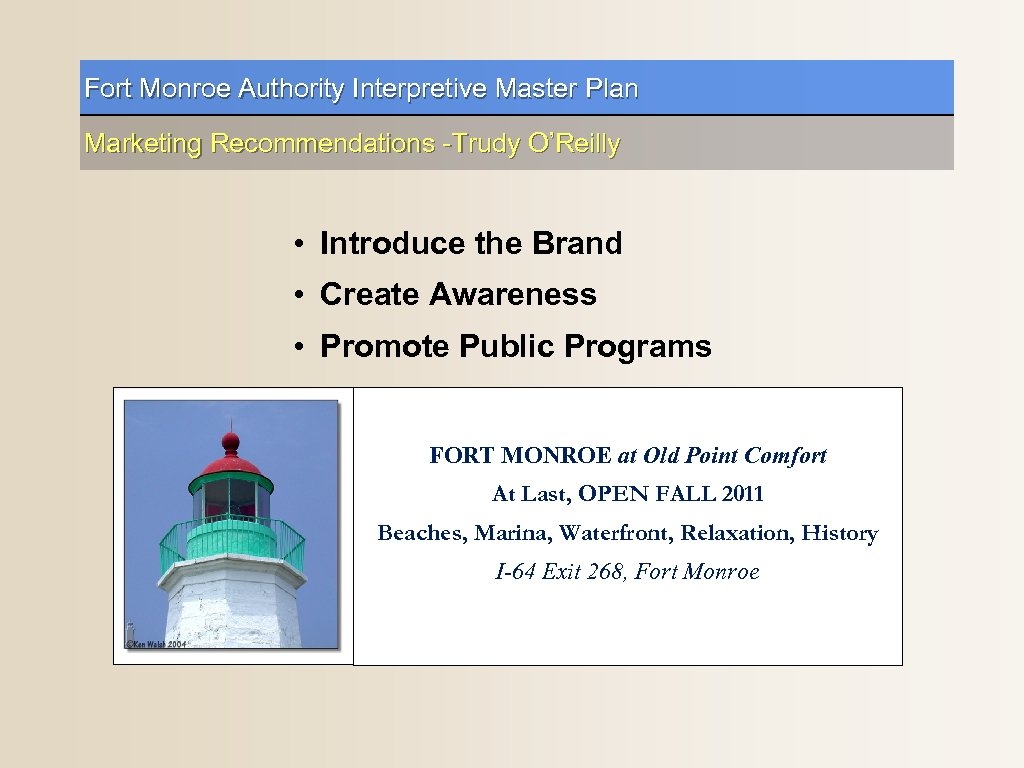 Fort Monroe Authority Interpretive Master Plan Marketing Recommendations -Trudy O’Reilly • Introduce the Brand • Create Awareness • Promote Public Programs FORT MONROE at Old Point Comfort At Last, OPEN FALL 2011 Beaches, Marina, Waterfront, Relaxation, History I-64 Exit 268, Fort Monroe
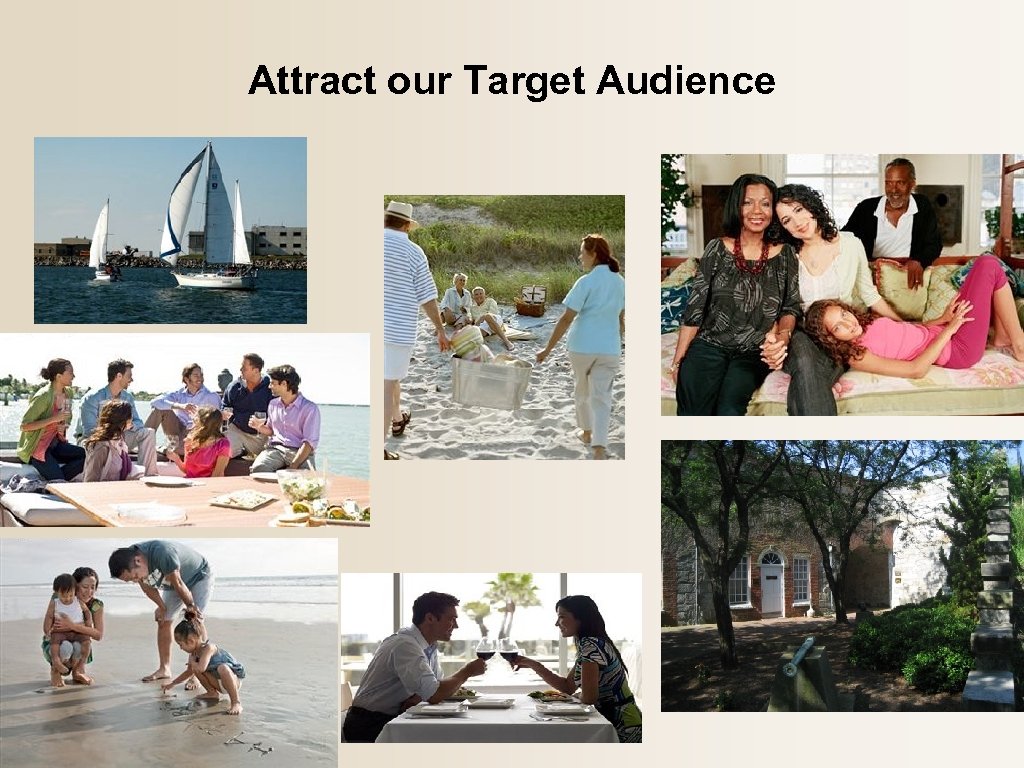 Attract our Target Audience
 Questions?