 Скачать презентацию Forschungskolloquium 2008 Kommunikations-Netzwerk-Topologie und Marktverhalten 15 Februar 2008
646ea1316c427859d3da6aa3a19eae6c.ppt
- Количество слайдов: 33



Forschungskolloquium 2008 Kommunikations-Netzwerk-Topologie und Marktverhalten 15. Februar 2008 von Oliver Hein, Goethe University, Frankfurt, Financial Agent-based Computational Economics (FINACE)
Contents 1. 2. 3. 4. Frankfurt Artificial Stock Market Components Agent Types Auction Method Networks Network Topologies Network Centralization Measures Simulation Parameters Simulation Results: • Centralization against Volatility and Distortion • Agent Type Performance Outlook Oliver Hein, Goethe University, Frankfurt, Financial Agent-based Computational Economics (FINACE)
Frankfurt Artificial Stock Market The Frankfurt Artificial Stock Market (FASM) 1. 6 is available for download at: www. finace. org But there is no documentation yet! Only articles exist that describe the system. Oliver Hein, Goethe University, Frankfurt, Financial Agent-based Computational Economics (FINACE)
Frankfurt Artificial Stock Market (FASM) ver. 1. 6 Oliver Hein, Goethe University, Frankfurt, Financial Agent-based Computational Economics (FINACE)
Handelsablauf Oliver Hein, Goethe University, Frankfurt, Financial Agent-based Computational Economics (FINACE)
Kommunikationsnetzwerke Börse Meistausführungsprinzip Zufallsnetzwerk Scale-Free-Netzwerk Blau=kaufen, Rot=verkaufen Oliver Hein, Goethe University, Frankfurt, Financial Agent-based Computational Economics (FINACE)
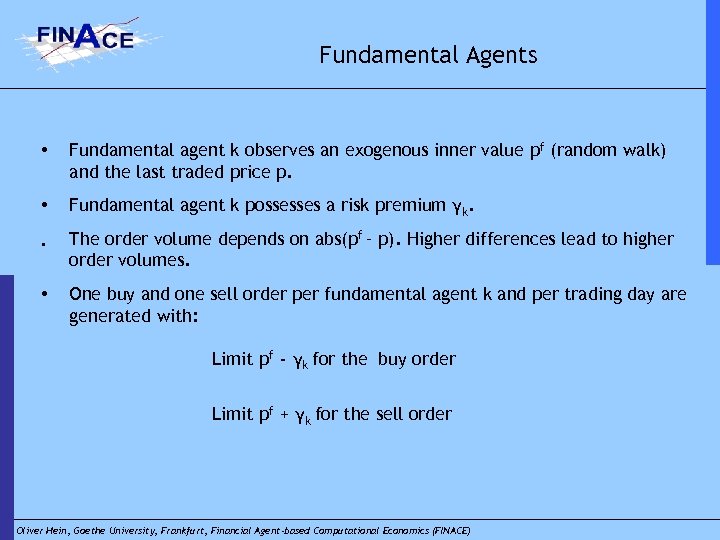
Fundamental Agents • Fundamental agent k observes an exogenous inner value pf (random walk) and the last traded price p. • Fundamental agent k possesses a risk premium γk. • The order volume depends on abs(pf – p). Higher differences lead to higher order volumes. • One buy and one sell order per fundamental agent k and per trading day are generated with: Limit pf - γk for the buy order Limit pf + γk for the sell order Oliver Hein, Goethe University, Frankfurt, Financial Agent-based Computational Economics (FINACE)
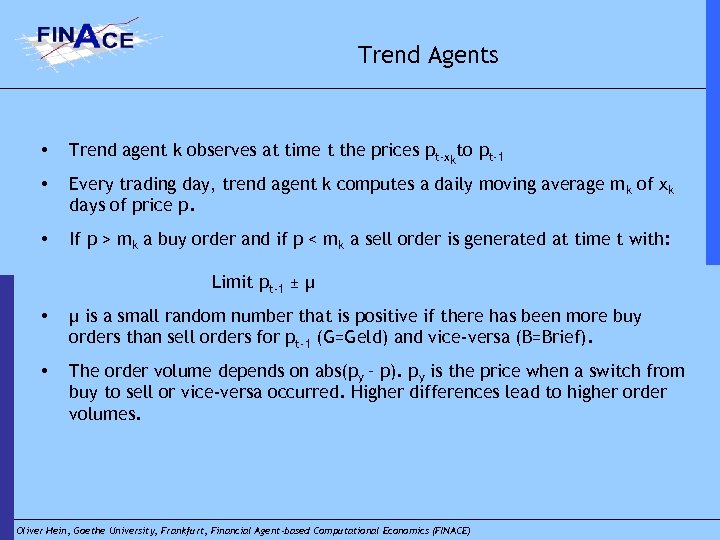
Trend Agents • Trend agent k observes at time t the prices pt-xkto pt-1 • Every trading day, trend agent k computes a daily moving average mk of xk days of price p. • If p > mk a buy order and if p < mk a sell order is generated at time t with: Limit pt-1 ± μ • μ is a small random number that is positive if there has been more buy orders than sell orders for pt-1 (G=Geld) and vice-versa (B=Brief). • The order volume depends on abs(py – p). py is the price when a switch from buy to sell or vice-versa occurred. Higher differences lead to higher order volumes. Oliver Hein, Goethe University, Frankfurt, Financial Agent-based Computational Economics (FINACE)
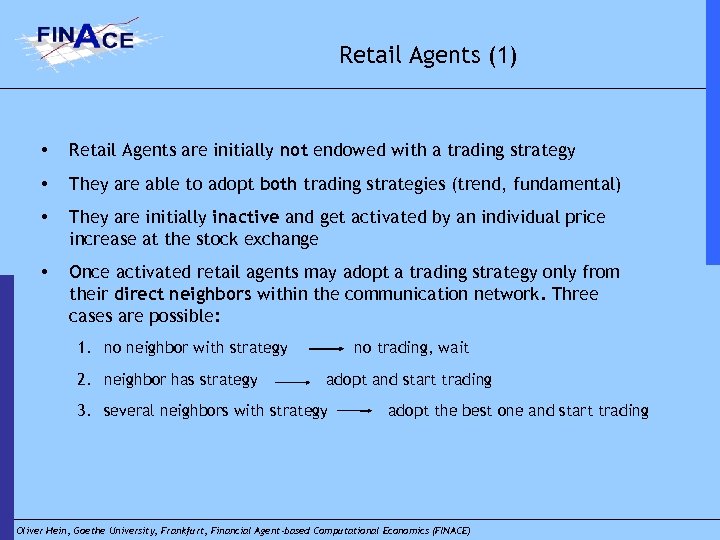
Retail Agents (1) • Retail Agents are initially not endowed with a trading strategy • They are able to adopt both trading strategies (trend, fundamental) • They are initially inactive and get activated by an individual price increase at the stock exchange • Once activated retail agents may adopt a trading strategy only from their direct neighbors within the communication network. Three cases are possible: 1. no neighbor with strategy 2. neighbor has strategy no trading, wait adopt and start trading 3. several neighbors with strategy adopt the best one and start trading Oliver Hein, Goethe University, Frankfurt, Financial Agent-based Computational Economics (FINACE)
Retail Agents (2) Retail agents stop trading and go into hibernation if an individual price decrease at the stock exchange occurred (e. g. 10%) • • They sell all their shares over a defined period (e. g. 10 days) and remain inactive for an individual number of days (e. g. 90 days) • When the hibernation period is over, they may get activated again depending on their individual threshold Oliver Hein, Goethe University, Frankfurt, Financial Agent-based Computational Economics (FINACE)
Distribution of Agent Types Green=Retail Agents, Yellow=Fundamental Agents, Red=Trend Agents Oliver Hein, Goethe University, Frankfurt, Financial Agent-based Computational Economics (FINACE)
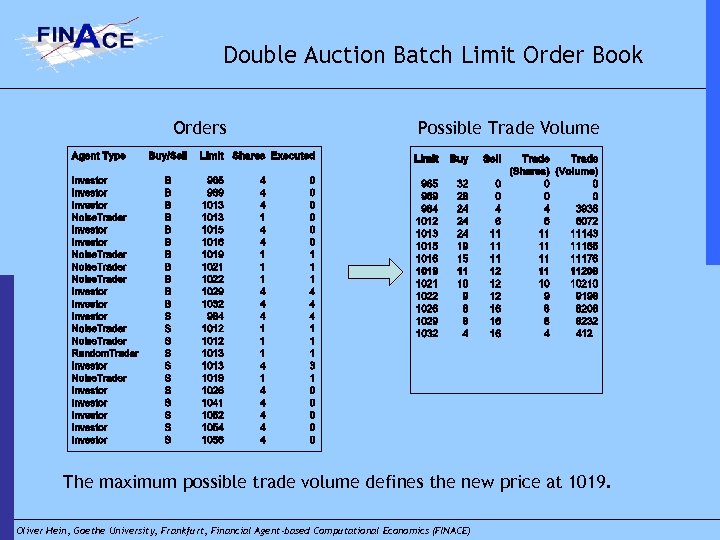
Double Auction Batch Limit Order Book Orders Possible Trade Volume The maximum possible trade volume defines the new price at 1019. Oliver Hein, Goethe University, Frankfurt, Financial Agent-based Computational Economics (FINACE)
NETWORKS Oliver Hein, Goethe University, Frankfurt, Financial Agent-based Computational Economics (FINACE)
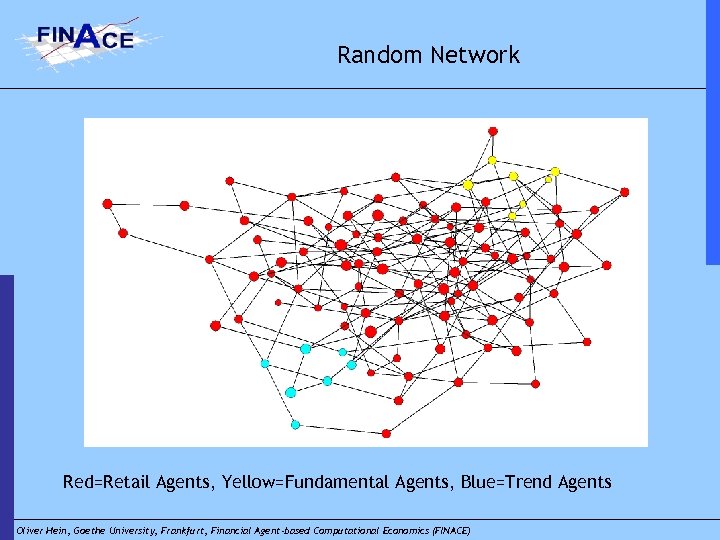
Random Network Red=Retail Agents, Yellow=Fundamental Agents, Blue=Trend Agents Oliver Hein, Goethe University, Frankfurt, Financial Agent-based Computational Economics (FINACE)
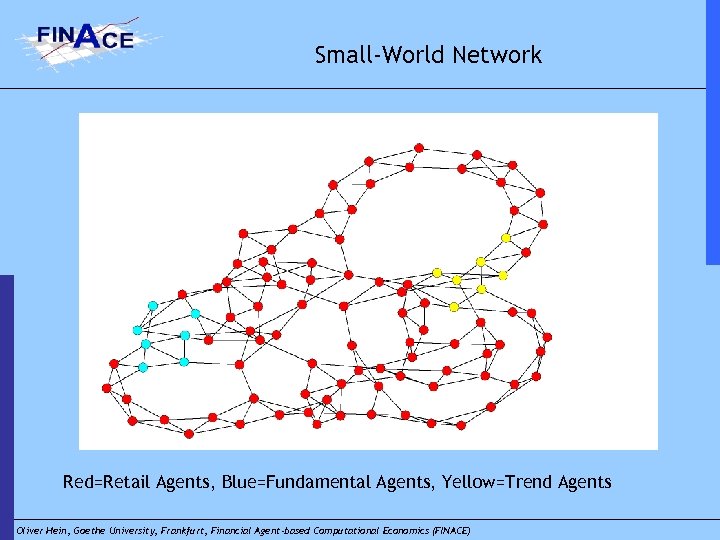
Small-World Network Red=Retail Agents, Blue=Fundamental Agents, Yellow=Trend Agents Oliver Hein, Goethe University, Frankfurt, Financial Agent-based Computational Economics (FINACE)
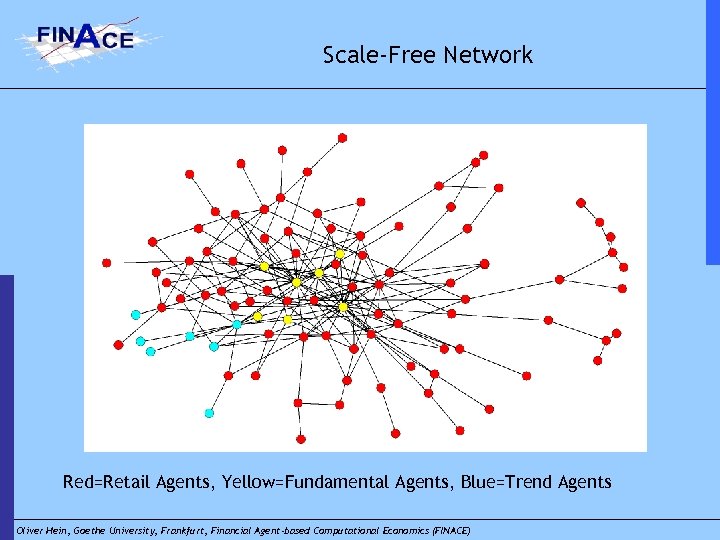
Scale-Free Network Red=Retail Agents, Yellow=Fundamental Agents, Blue=Trend Agents Oliver Hein, Goethe University, Frankfurt, Financial Agent-based Computational Economics (FINACE)
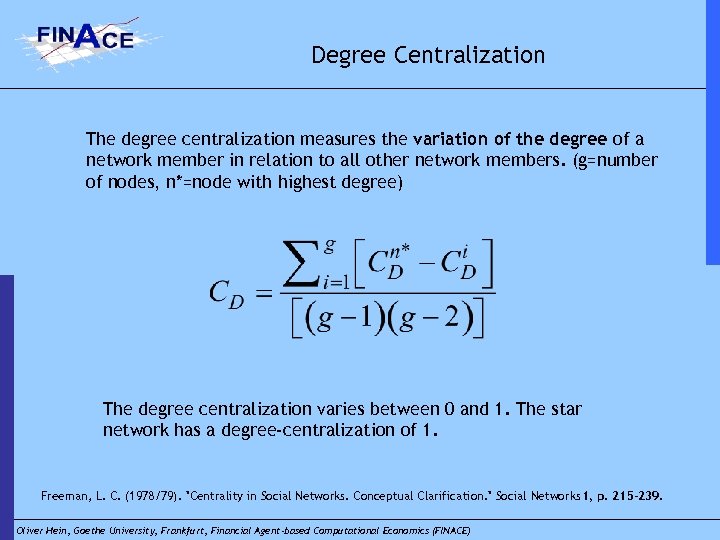
Degree Centralization The degree centralization measures the variation of the degree of a network member in relation to all other network members. (g=number of nodes, n*=node with highest degree) The degree centralization varies between 0 and 1. The star network has a degree-centralization of 1. Freeman, L. C. (1978/79). "Centrality in Social Networks. Conceptual Clarification. " Social Networks 1, p. 215 -239. Oliver Hein, Goethe University, Frankfurt, Financial Agent-based Computational Economics (FINACE)
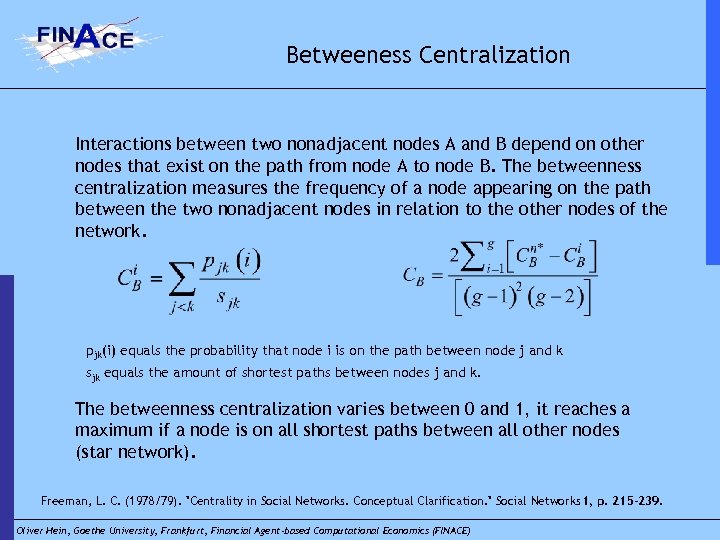
Betweeness Centralization Interactions between two nonadjacent nodes A and B depend on other nodes that exist on the path from node A to node B. The betweenness centralization measures the frequency of a node appearing on the path between the two nonadjacent nodes in relation to the other nodes of the network. pjk(i) equals the probability that node i is on the path between node j and k sjk equals the amount of shortest paths between nodes j and k. The betweenness centralization varies between 0 and 1, it reaches a maximum if a node is on all shortest paths between all other nodes (star network). Freeman, L. C. (1978/79). "Centrality in Social Networks. Conceptual Clarification. " Social Networks 1, p. 215 -239. Oliver Hein, Goethe University, Frankfurt, Financial Agent-based Computational Economics (FINACE)
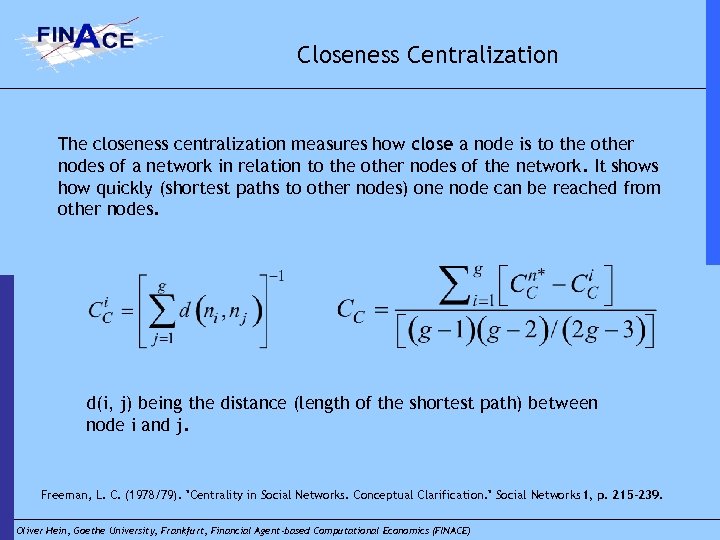
Closeness Centralization The closeness centralization measures how close a node is to the other nodes of a network in relation to the other nodes of the network. It shows how quickly (shortest paths to other nodes) one node can be reached from other nodes. d(i, j) being the distance (length of the shortest path) between node i and j. Freeman, L. C. (1978/79). "Centrality in Social Networks. Conceptual Clarification. " Social Networks 1, p. 215 -239. Oliver Hein, Goethe University, Frankfurt, Financial Agent-based Computational Economics (FINACE)
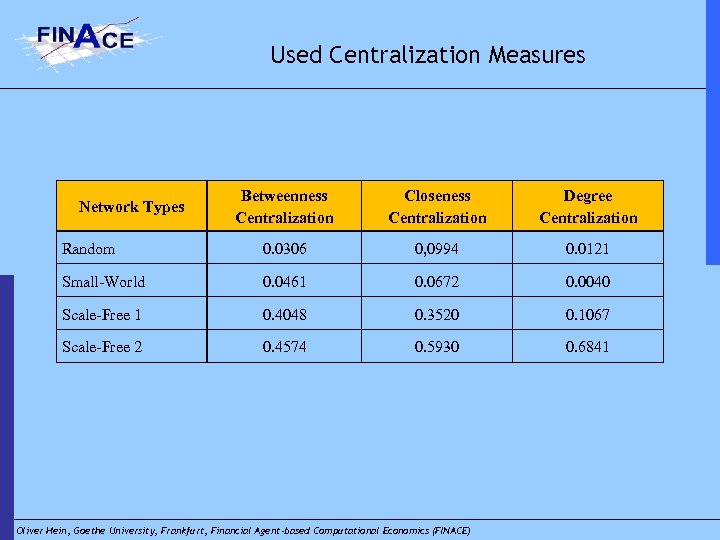
Used Centralization Measures Betweenness Centralization Closeness Centralization Degree Centralization Random 0. 0306 0, 0994 0. 0121 Small-World 0. 0461 0. 0672 0. 0040 Scale-Free 1 0. 4048 0. 3520 0. 1067 Scale-Free 2 0. 4574 0. 5930 0. 6841 Network Types Oliver Hein, Goethe University, Frankfurt, Financial Agent-based Computational Economics (FINACE)
SIMULATIONS AND RESULTS Oliver Hein, Goethe University, Frankfurt, Financial Agent-based Computational Economics (FINACE)
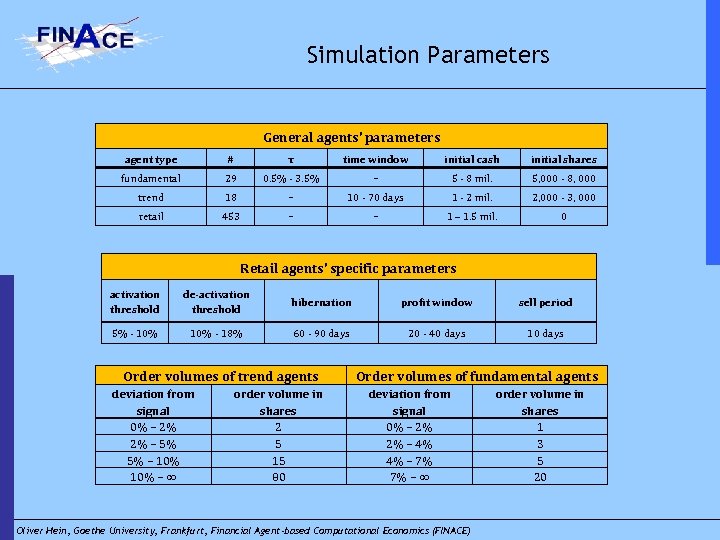
Simulation Parameters General agents’ parameters agent type # τ time window initial cash initial shares fundamental 29 0. 5% - 3. 5% − 5 - 8 mil. 5, 000 - 8, 000 trend 18 − 10 - 70 days 1 - 2 mil. 2, 000 - 3, 000 retail 453 − − 1 – 1. 5 mil. 0 Retail agents’ specific parameters activation threshold de-activation threshold hibernation profit window sell period 5% - 10% - 18% 60 - 90 days 20 - 40 days 10 days Order volumes of trend agents deviation from signal 0% − 2% 2% − 5% 5% − 10% − ∞ order volume in shares 2 5 15 80 Order volumes of fundamental agents deviation from signal 0% − 2% 2% − 4% 4% − 7% 7% − ∞ Oliver Hein, Goethe University, Frankfurt, Financial Agent-based Computational Economics (FINACE) order volume in shares 1 3 5 20
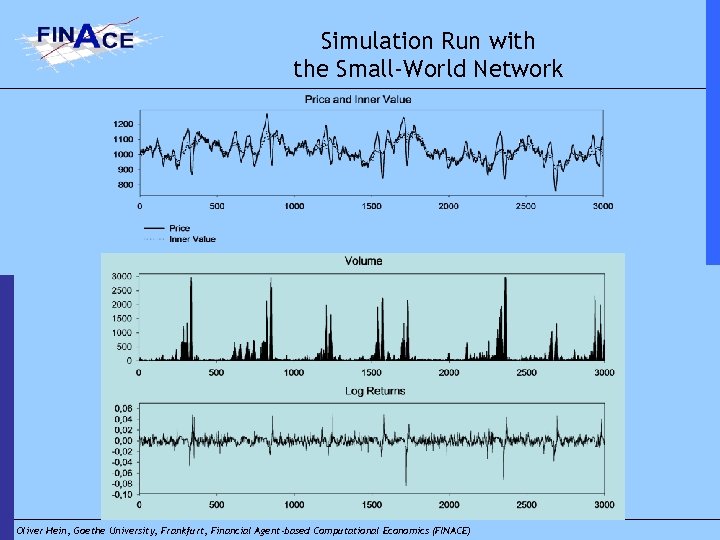
Simulation Run with the Small-World Network Oliver Hein, Goethe University, Frankfurt, Financial Agent-based Computational Economics (FINACE)
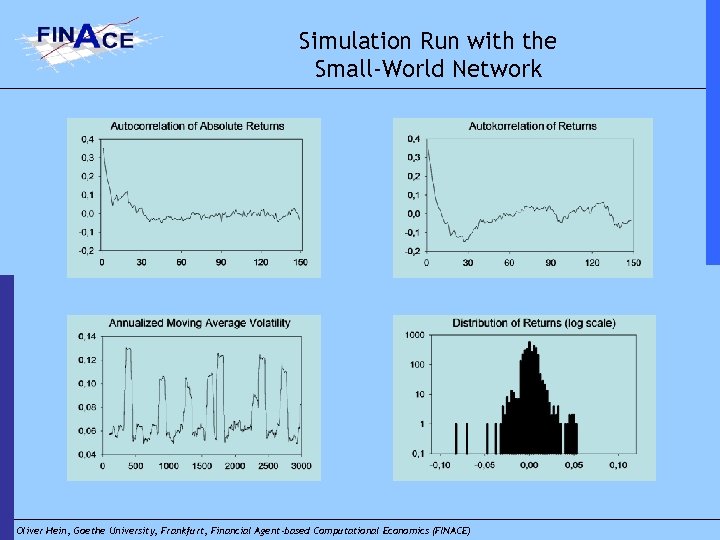
Simulation Run with the Small-World Network Oliver Hein, Goethe University, Frankfurt, Financial Agent-based Computational Economics (FINACE)
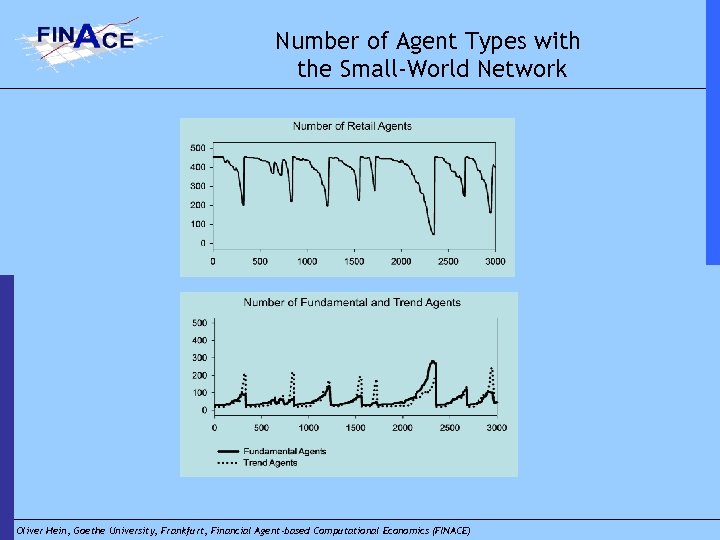
Number of Agent Types with the Small-World Network Oliver Hein, Goethe University, Frankfurt, Financial Agent-based Computational Economics (FINACE)
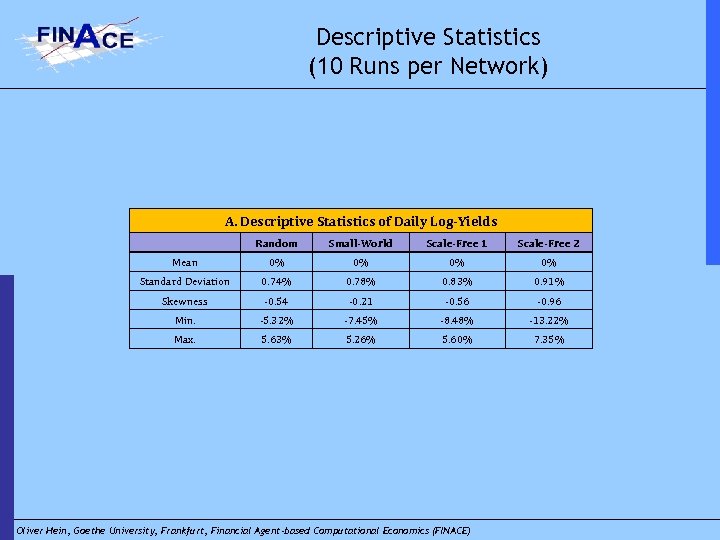
Descriptive Statistics (10 Runs per Network) A. Descriptive Statistics of Daily Log-Yields Random Small-World Scale-Free 1 Scale-Free 2 Mean 0% 0% Standard Deviation 0. 74% 0. 78% 0. 83% 0. 91% Skewness -0. 54 -0. 21 -0. 56 -0. 96 Min. -5. 32% -7. 45% -8. 48% -13. 22% Max. 5. 63% 5. 26% 5. 60% 7. 35% Oliver Hein, Goethe University, Frankfurt, Financial Agent-based Computational Economics (FINACE)
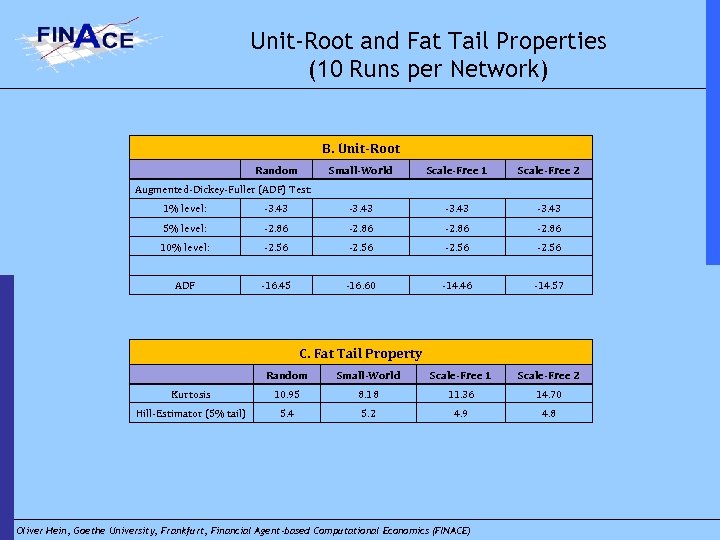
Unit-Root and Fat Tail Properties (10 Runs per Network) B. Unit-Root Random Small-World Scale-Free 1 Scale-Free 2 Augmented-Dickey-Fuller (ADF) Test: 1% level: -3. 43 5% level: -2. 86 10% level: -2. 56 ADF -16. 45 -16. 60 -14. 46 -14. 57 C. Fat Tail Property Random Small-World Scale-Free 1 Scale-Free 2 Kurtosis 10. 95 8. 18 11. 36 14. 70 Hill-Estimator (5% tail) 5. 4 5. 2 4. 9 4. 8 Oliver Hein, Goethe University, Frankfurt, Financial Agent-based Computational Economics (FINACE)
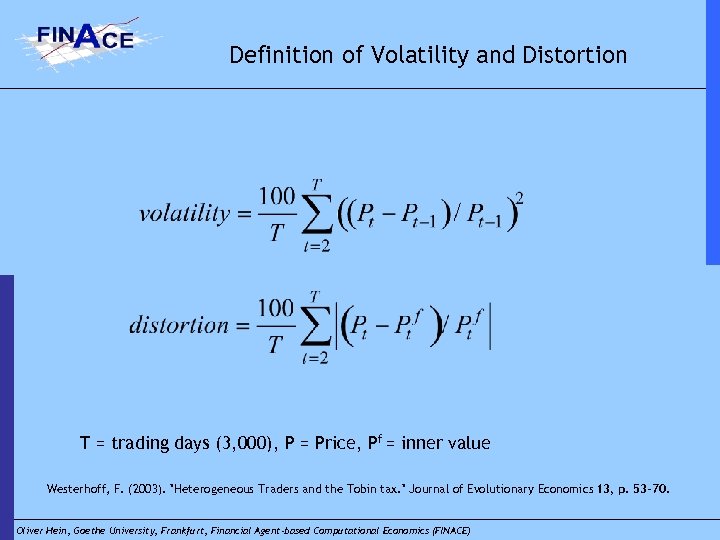
Definition of Volatility and Distortion T = trading days (3, 000), P = Price, Pf = inner value Westerhoff, F. (2003). "Heterogeneous Traders and the Tobin tax. " Journal of Evolutionary Economics 13, p. 53 -70. Oliver Hein, Goethe University, Frankfurt, Financial Agent-based Computational Economics (FINACE)
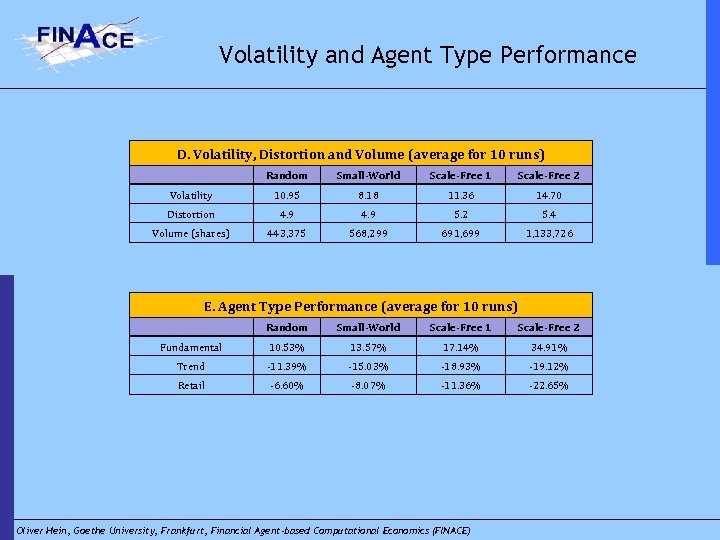
Volatility and Agent Type Performance D. Volatility, Distortion and Volume (average for 10 runs) Random Small-World Scale-Free 1 Scale-Free 2 Volatility 10. 95 8. 18 11. 36 14. 70 Distortion 4. 9 5. 2 5. 4 Volume (shares) 443, 375 568, 299 691, 699 1, 133, 726 E. Agent Type Performance (average for 10 runs) Random Small-World Scale-Free 1 Scale-Free 2 Fundamental 10. 53% 13. 57% 17. 14% 34. 91% Trend -11. 39% -15. 03% -18. 93% -19. 12% Retail -6. 60% -8. 07% -11. 36% -22. 65% Oliver Hein, Goethe University, Frankfurt, Financial Agent-based Computational Economics (FINACE)
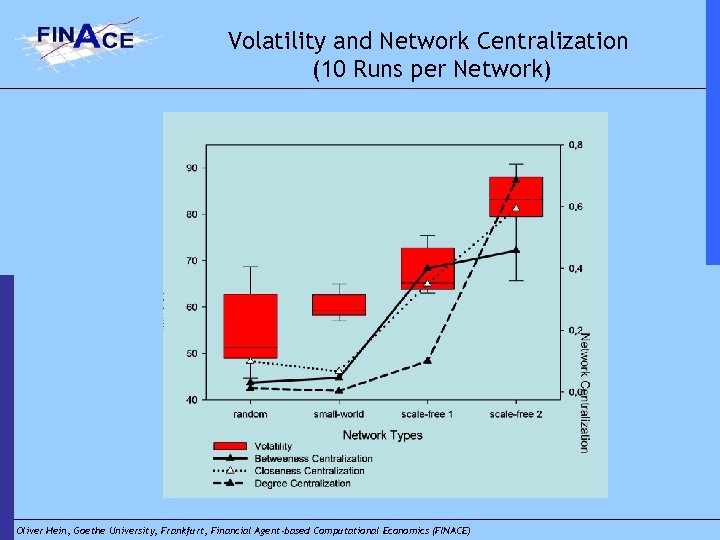
Volatility and Network Centralization (10 Runs per Network) Oliver Hein, Goethe University, Frankfurt, Financial Agent-based Computational Economics (FINACE)
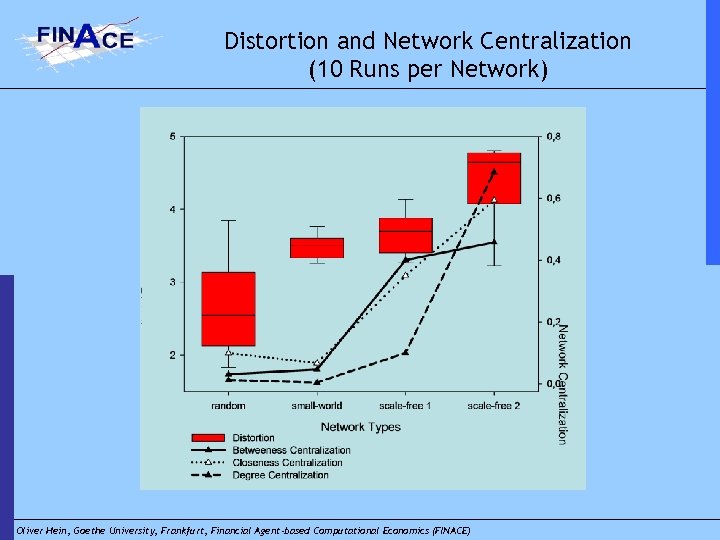
Distortion and Network Centralization (10 Runs per Network) Oliver Hein, Goethe University, Frankfurt, Financial Agent-based Computational Economics (FINACE)
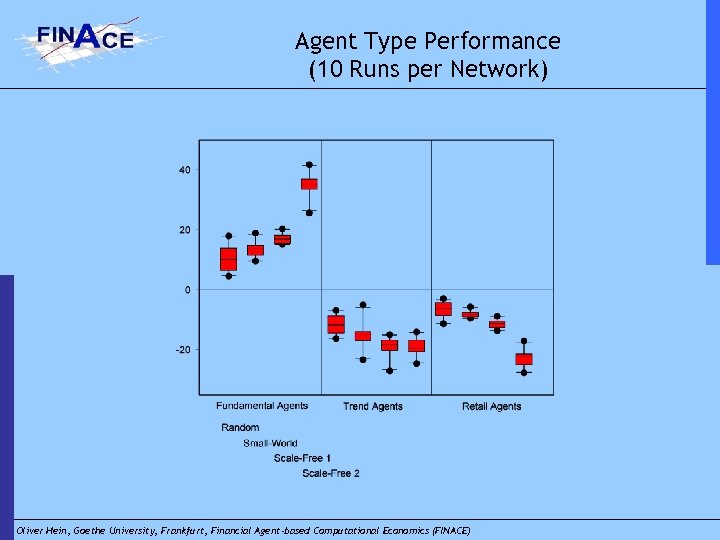
Agent Type Performance (10 Runs per Network) Oliver Hein, Goethe University, Frankfurt, Financial Agent-based Computational Economics (FINACE)
Outlook • A cooperation with the Sparkasse Gifhorn-Wolfsburg is in preparation, to find more empirical evidence about the behavior of retail investors. • The model parameters are analyzed for their sensitivity and if some may be endogenous. • An analytical solution of the simulation model is still needed. • Dynamic communication networks might be an interesting extension. Oliver Hein, Goethe University, Frankfurt, Financial Agent-based Computational Economics (FINACE)
Скачать презентацию Forschungskolloquium 2008 Kommunikations-Netzwerk-Topologie und Marktverhalten 15 Februar 2008
646ea1316c427859d3da6aa3a19eae6c.ppt