


 Скачать презентацию Formative Assessment An Essential Ingredient in a Recipe
e81ff637b24cf9e8a16a49e6adc8a46f.ppt
- Количество слайдов: 40
 Formative Assessment: An Essential Ingredient in a Recipe for a Comprehensive Balanced Assessment System Future Ready Schools
 Session Objectives: At the conclusion of this session: • Participants will demonstrate an increased awareness of the definition and attributes of effective formative assessment. • Participants will be able to demonstrate and increased awareness of how to deconstruct content standards to clarify learning targets and maximize student success. Future Ready Schools
 CAT HERDERS Future Ready Schools
 VARIATIONS ON A THEME… ALL KIDS CAN LEARN! (Du. Four & Dufour Copyright Soulution Tree) 1. . Based on ability 2. …If they take advantage of the opportunity 3. …And we will accept responsibility for ensuring their growth 4. …And we will establish high standards of learning that we expect all students to achieve Future Ready Schools
 If the purpose of school is truly to ensure high levels of learning for all students, schools will: (Du. Four & Dufour Copyright Soulution Tree) v. Clarify what each student is expected to learn v. Monitor each student’s learning on a timely basis v. Create systems to ensure students receive additional time and support if they are not learning Future Ready Schools
 4 POINTS FOR GROWTH: Du. Four’s Critical Corollary Questions IF WE BELIEVE ALL KIDS CAN LEARN… • What is it we expect them to learn? • How will we know when they have learned it? • How will we respond when they don’t learn? • How will we respond when they already know it? Future Ready Schools
 Du. Four’s Critical Corollary Questions The answers to Du. Four’s critical corollary questions depend on who the student has as a teacher. Thus, to ensure ALL students have access to the best solution to these questions, there must be a systematic, non-invitational school response. Future Ready Schools
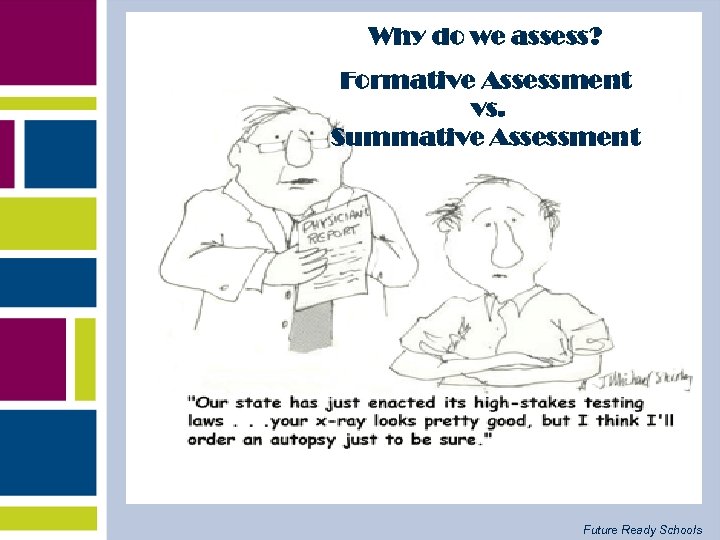 Why do we assess? Formative Assessment vs. Summative Assessment Future Ready Schools
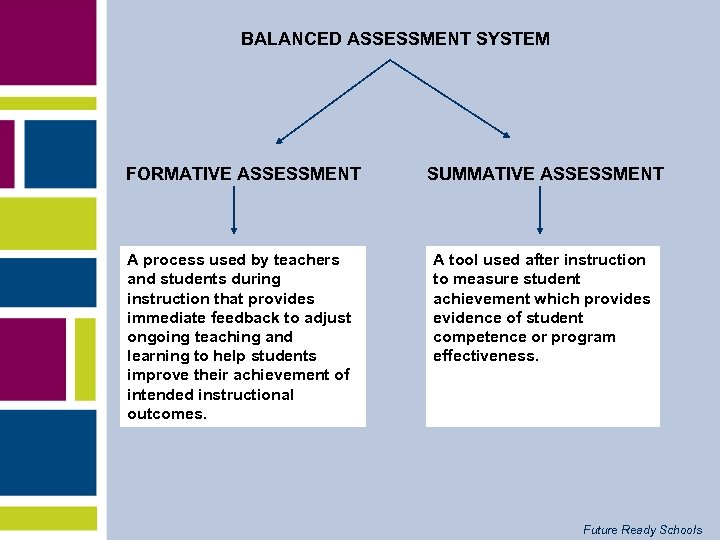 BALANCED ASSESSMENT SYSTEM FORMATIVE ASSESSMENT SUMMATIVE ASSESSMENT A process used by teachers and students during instruction that provides immediate feedback to adjust ongoing teaching and learning to help students improve their achievement of intended instructional outcomes. A tool used after instruction to measure student achievement which provides evidence of student competence or program effectiveness. Future Ready Schools
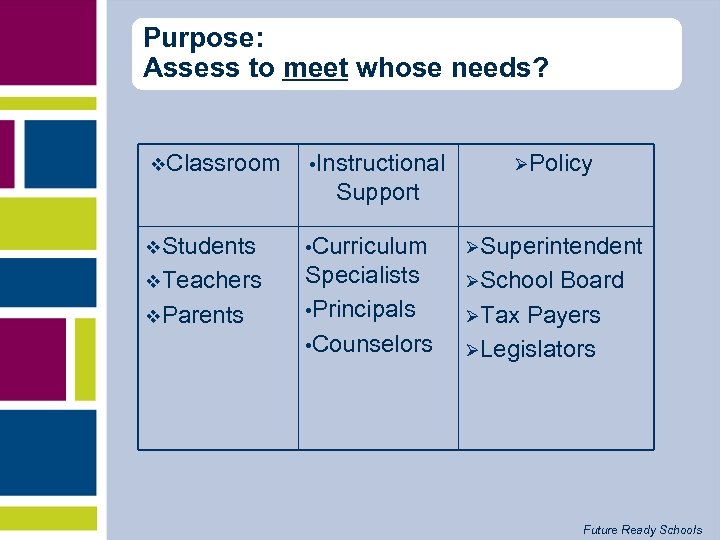 Purpose: Assess to meet whose needs? v. Classroom • Instructional ØPolicy Support v. Students • Curriculum ØSuperintendent v. Teachers Specialists • Principals • Counselors ØSchool v. Parents Board ØTax Payers ØLegislators Future Ready Schools
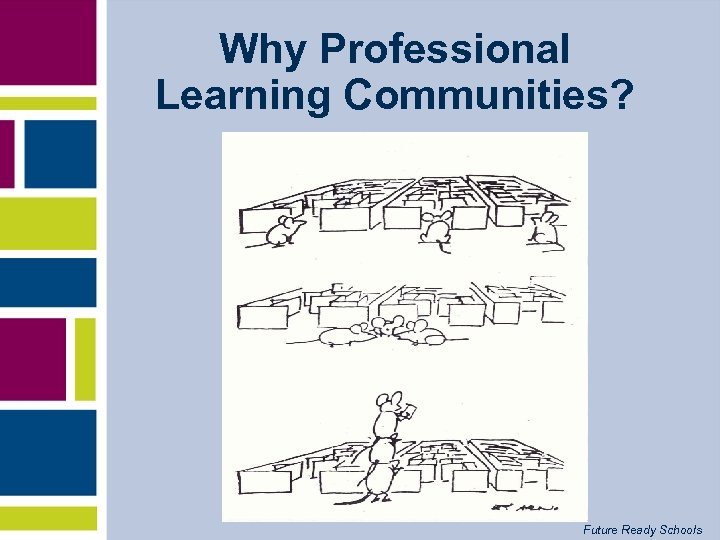 Why Professional Learning Communities? Future Ready Schools
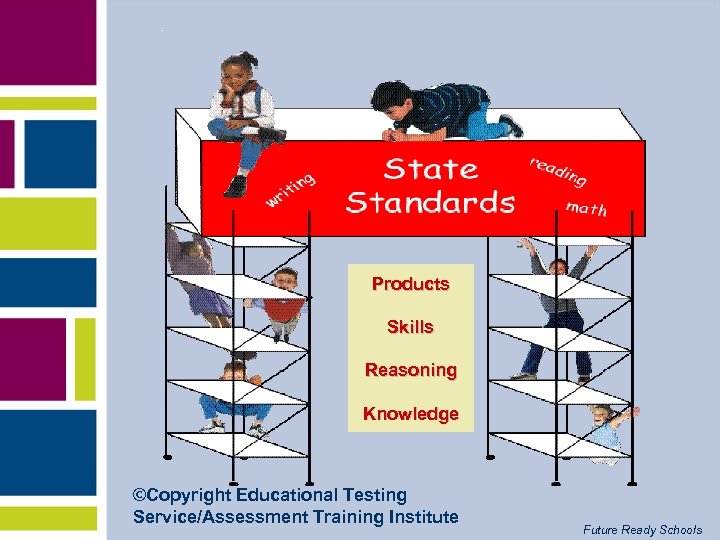
 Creating Consensus Ask the following: • What do you want to teach to kids? (NC Standard Course of Study) • What is most important? (What do I like to teach? Deconstruct the Standards) • What skills do they need to know (vertical alignment)? (Vertical Team Planning) Future Ready Schools
 Future Ready Schools
 Products Skills Reasoning Knowledge ©Copyright Educational Testing Service/Assessment Training Institute Future Ready Schools
 A Comprehensive Balanced Assessment System Aligned to State Standards Statewide Assessments (Summative) Interim/Benchmark Assessments (Summative) Classroom Assessment (Formative and Summative) Future Ready Schools
 • How do we close the gap and have a balanced assessment system? Future Ready Schools
 Focus on the Importance of Classroom Assessment • it guides students’ judgment of “what is important to learn, affects their motivation and self perceptions of competence, structures their approaches to and timing of personal study…consolidates learning and affects the development of enduring learning strategies and skills. It appears to be the most potent forces influencing education” Crooks (1988) Future Ready Schools
 What should classroom assessment involve? Future Ready Schools
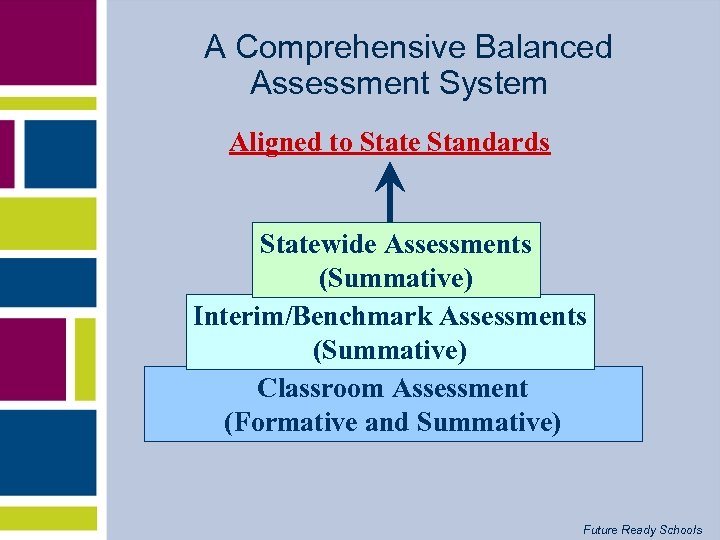
 Both Formative and Summative Assessment Formative Summative A process used by teachers and students during instruction that provides feedback to adjust ongoing teaching and learning to help students improve their achievement of intended instructional outcomes A measure of achievement to provide evidence of student competence or program effectiveness Future Ready Schools
 Possible Assessment Methods Formative Assessment - Questioning - Classroom Discussions - Learning Tasks - Feedback - Conferences - Interviews - Student Selfassessment Summative Assessment • Selected Response Multiple-Choice -True/False -Matching -Fill in - • Extended Written Response • Performance Assessment Future Ready Schools
 Formative Assessment FOR Student Learning • Where does the student need to go? • Where is the student now? • How do I help the student close the gap? Future Ready Schools
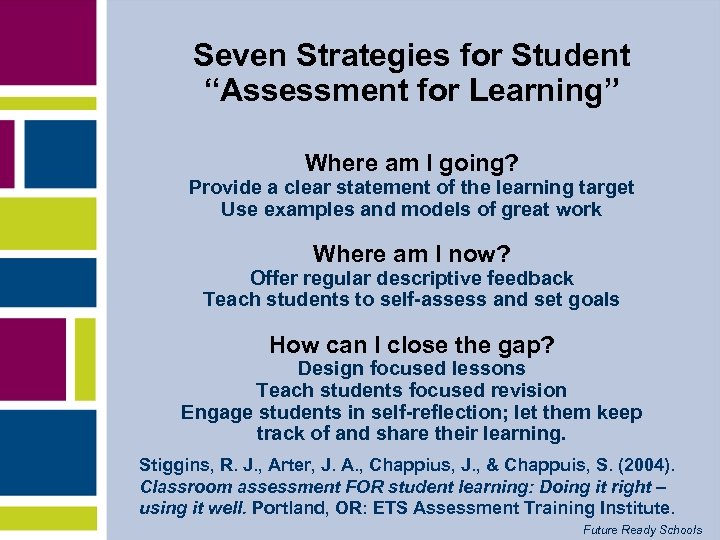 Seven Strategies for Student “Assessment for Learning” Where am I going? Provide a clear statement of the learning target Use examples and models of great work Where am I now? Offer regular descriptive feedback Teach students to self-assess and set goals How can I close the gap? Design focused lessons Teach students focused revision Engage students in self-reflection; let them keep track of and share their learning. Stiggins, R. J. , Arter, J. A. , Chappius, J. , & Chappuis, S. (2004). Classroom assessment FOR student learning: Doing it right – using it well. Portland, OR: ETS Assessment Training Institute. Future Ready Schools
 Where does the student need to go? • Students must be involved in this process. They must understand what is expected of them. Future Ready Schools
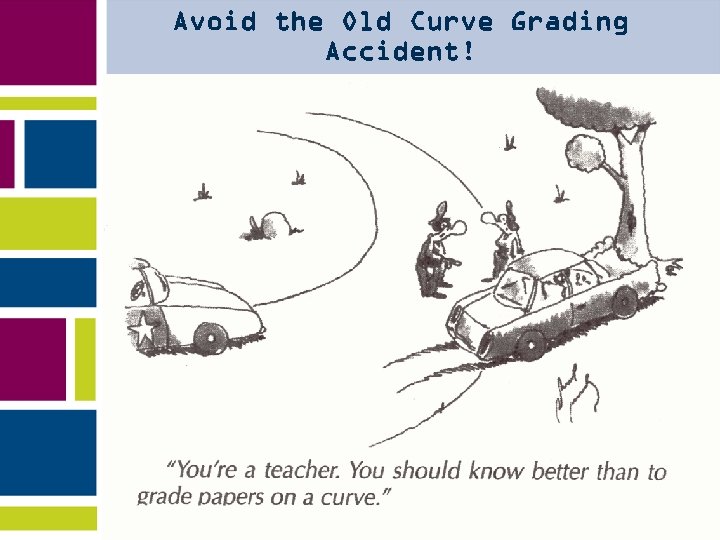 Avoid the Old Curve Grading Accident! Future Ready Schools
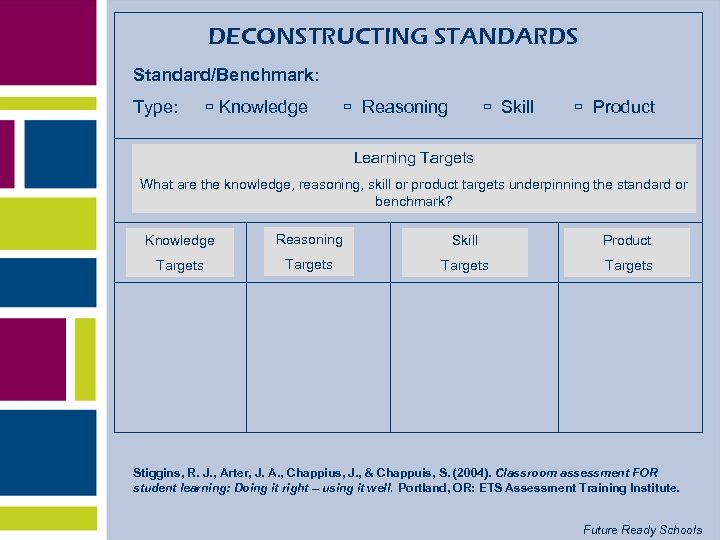 DECONSTRUCTING STANDARDS Standard/Benchmark: Type: Knowledge Reasoning Skill Product Learning Targets What are the knowledge, reasoning, skill or product targets underpinning the standard or benchmark? Knowledge Reasoning Skill Product Targets Stiggins, R. J. , Arter, J. A. , Chappius, J. , & Chappuis, S. (2004). Classroom assessment FOR student learning: Doing it right – using it well. Portland, OR: ETS Assessment Training Institute. Future Ready Schools
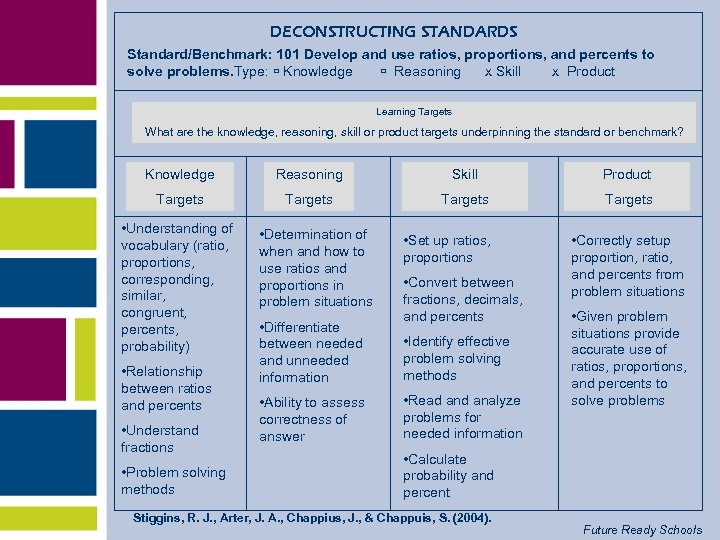 DECONSTRUCTING STANDARDS Standard/Benchmark: 101 Develop and use ratios, proportions, and percents to solve problems. Type: Knowledge Reasoning x Skill x Product Learning Targets What are the knowledge, reasoning, skill or product targets underpinning the standard or benchmark? Knowledge Reasoning Skill Product Targets • Understanding of vocabulary (ratio, proportions, corresponding, similar, congruent, percents, probability) • Relationship between ratios and percents • Understand fractions • Problem solving methods • Determination of when and how to use ratios and proportions in problem situations • Differentiate between needed and unneeded information • Ability to assess correctness of answer • Set up ratios, proportions • Convert between fractions, decimals, and percents • Identify effective problem solving methods • Read analyze problems for needed information • Correctly setup proportion, ratio, and percents from problem situations • Given problem situations provide accurate use of ratios, proportions, and percents to solve problems • Calculate probability and percent Stiggins, R. J. , Arter, J. A. , Chappius, J. , & Chappuis, S. (2004). Future Ready Schools
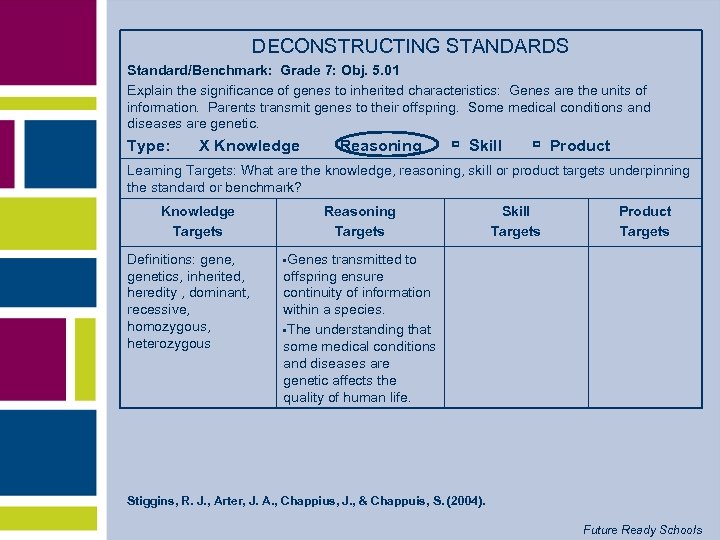 DECONSTRUCTING STANDARDS Standard/Benchmark: Grade 7: Obj. 5. 01 Explain the significance of genes to inherited characteristics: Genes are the units of information. Parents transmit genes to their offspring. Some medical conditions and diseases are genetic. Type: X Knowledge Reasoning Skill Product Learning Targets: What are the knowledge, reasoning, skill or product targets underpinning the standard or benchmark? Knowledge Targets Definitions: gene, genetics, inherited, heredity , dominant, recessive, homozygous, heterozygous Reasoning Targets Skill Targets Product Targets • Genes transmitted to offspring ensure continuity of information within a species. • The understanding that some medical conditions and diseases are genetic affects the quality of human life. Stiggins, R. J. , Arter, J. A. , Chappius, J. , & Chappuis, S. (2004). Future Ready Schools
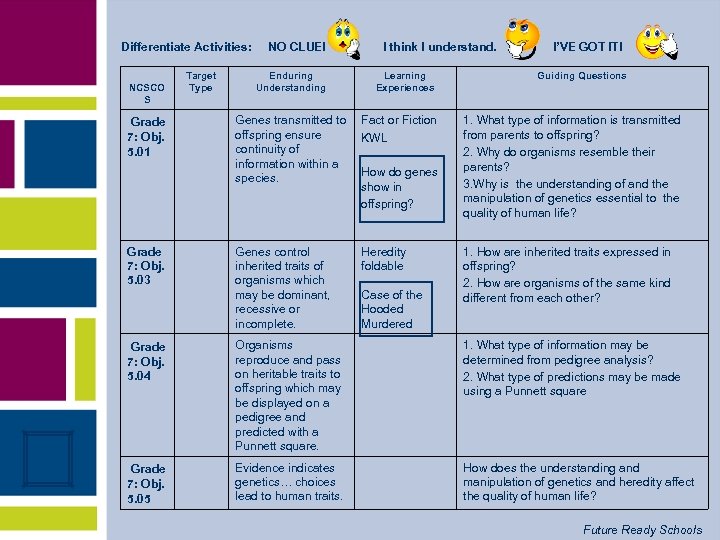 Differentiate Activities: NCSCO S Grade 7: Obj. 5. 01 Grade 7: Obj. 5. 03 Target Type NO CLUE! Enduring Understanding I think I understand. Learning Experiences Genes transmitted to offspring ensure continuity of information within a species. Fact or Fiction KWL Genes control inherited traits of organisms which may be dominant, recessive or incomplete. Heredity foldable How do genes show in offspring? Case of the Hooded Murdered I’VE GOT IT! Guiding Questions 1. What type of information is transmitted from parents to offspring? 2. Why do organisms resemble their parents? 3. Why is the understanding of and the manipulation of genetics essential to the quality of human life? 1. How are inherited traits expressed in offspring? 2. How are organisms of the same kind different from each other? Grade 7: Obj. 5. 04 Organisms reproduce and pass on heritable traits to offspring which may be displayed on a pedigree and predicted with a Punnett square. 1. What type of information may be determined from pedigree analysis? 2. What type of predictions may be made using a Punnett square Grade 7: Obj. 5. 05 Evidence indicates genetics… choices lead to human traits. How does the understanding and manipulation of genetics and heredity affect the quality of human life? Future Ready Schools
 • The student must be provided with descriptive rather than evaluative feedback • Descriptive feedback must be ongoing and must include information about how the student can improve Future Ready Schools
 Example of Descriptive Feedback • “You performed the calculations correctly. However, you are getting confused about when to apply the perimeter formula and when to apply the area formula. Review the definitions of area and perimeter and try to think of ways they are different. ” Future Ready Schools
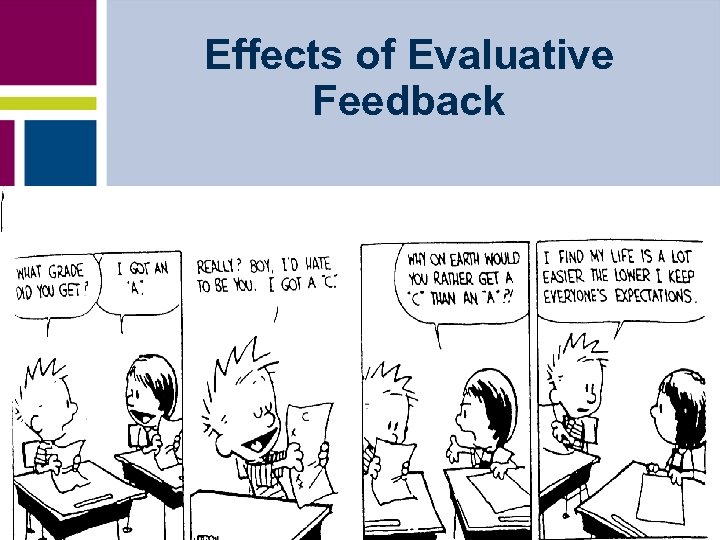 Effects of Evaluative Feedback Future Ready Schools
 Students must be involved in self-assessment and peer assessment • Students must be engaged in a dialogue with teachers and peers about the content • Future Ready Schools
 Next steps… • • • Increased commitment to a high-quality formative assessment as a process Increase the use of descriptive feedback, reduce evaluative feedback Increase student involvement in the assessment process Future Ready Schools
 Challenges • • • Getting buy-in This is not a quick fix so why do it? Do we believe that all teachers can effectively teach/assess students? Process vs. Product Focus on Learning vs. Focus on measurement Changing priorities and using time wisely vs. Add-on for teachers…. Future Ready Schools
 Future Ready Schools
 NOT AGAIN! Future Ready Schools
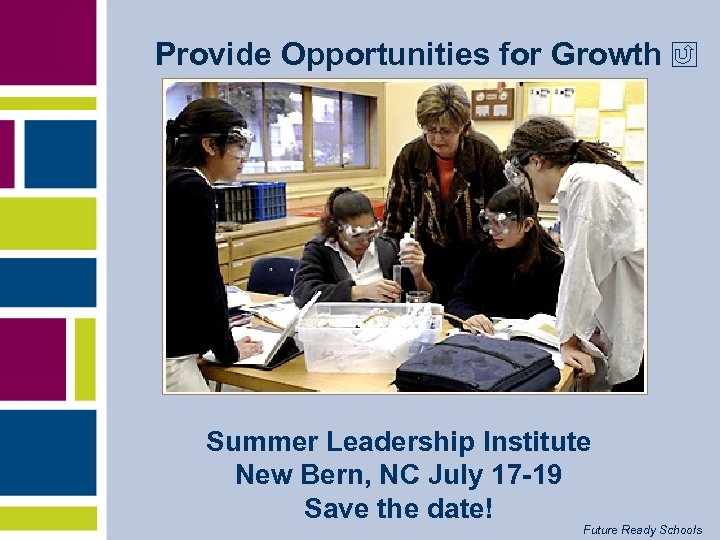 Provide Opportunities for Growth Summer Leadership Institute New Bern, NC July 17 -19 Save the date! Future Ready Schools
 Future Ready Schools
 Contact Information Sarah Mc. Manus Section Chief, Testing Policy and Operations North Carolina Department of Public Instruction/Accountability Services Division smcmanus@dpi. state. nc. us Future Ready Schools
 4 POINTS FOR GROWTH: Du. Four’s Critical Corollary Questions IF WE BELIEVE ALL KIDS CAN LEARN… • What is it we expect them to learn? • How will we know when they have learned it? • How will we respond when they don’t learn? • How will we respond when they already know it? Future Ready Schools