


 Скачать презентацию FORMATION AND DEVELOPMENT OF PHILOSOPHICAL THOUGHT IN UKRAINE
Ukrainian Philosophy.ppt
- Количество слайдов: 25
 FORMATION AND DEVELOPMENT OF PHILOSOPHICAL THOUGHT IN UKRAINE
 Plan 1) Ukrainian Philosophical Culture and Its Specificity. 2) Philosophical Thought in Period of Kyiv Rus. 3) Ukrainian Philosophy of XV–XVIII Centuries. 4) Ukrainian Philosophy in XIX - XX Centuries.
 1. Emotionality, sentimentality and Aestheticism; 2. Individualism, psychological mobility and cordocentrism; 3. Existential esteeming of individual’s freedom; 4. Religiousness; 5. Antheism – intimate and loving attitude to Nature and Native Land
 Peculiarities of Ukrainian philosophy It represents itself as an internal phenomenon of Ukrainian culture; n It never claimed for abstract- rational philosophical systems; n It always aspired to ethical injunction and life teaching; n It esteemed religion and highest spiritual values; n
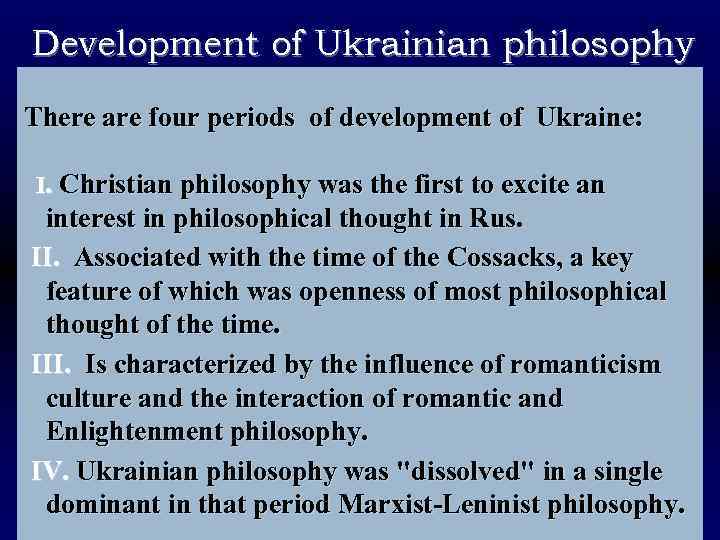 Development of Ukrainian philosophy There are four periods of development of Ukraine: I. Christian philosophy was the first to excite an interest in philosophical thought in Rus. II. Associated with the time of the Cossacks, a key feature of which was openness of most philosophical thought of the time. III. Is characterized by the influence of romanticism culture and the interaction of romantic and Enlightenment philosophy. IV. Ukrainian philosophy was "dissolved" in a single dominant in that period Marxist-Leninist philosophy.
 The Period of Kiev Rus : Basic Philosophical problems § § § man and God, coincidence of body and soul, moral and ethical code of man, man’s role in society, the purpose of Kyiv Rus in the world history
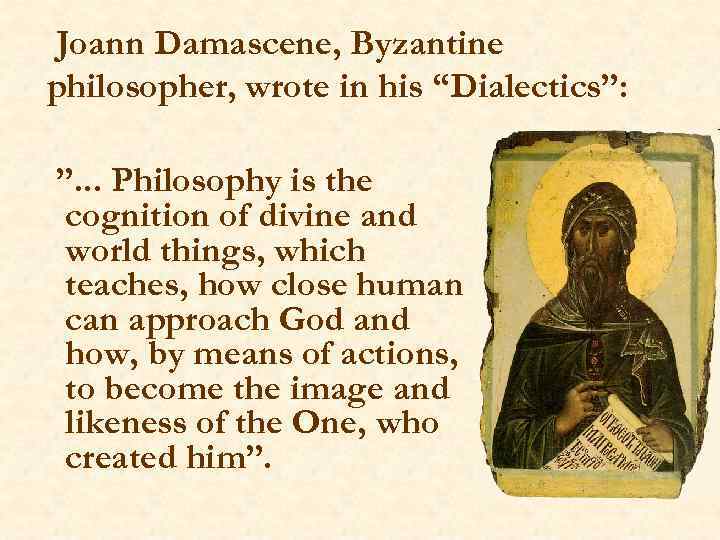 Joann Damascene, Byzantine philosopher, wrote in his “Dialectics”: ”. . . Philosophy is the cognition of divine and world things, which teaches, how close human can approach God and how, by means of actions, to become the image and likeness of the One, who created him”.
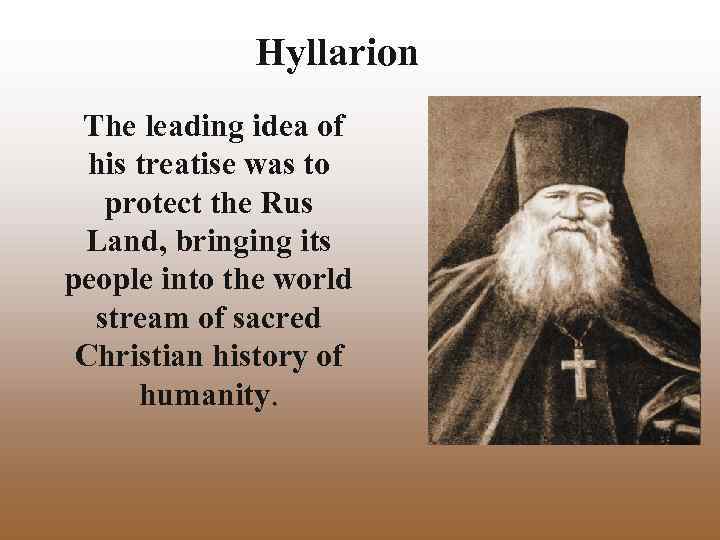 Hyllarion The leading idea of his treatise was to protect the Rus Land, bringing its people into the world stream of sacred Christian history of humanity.
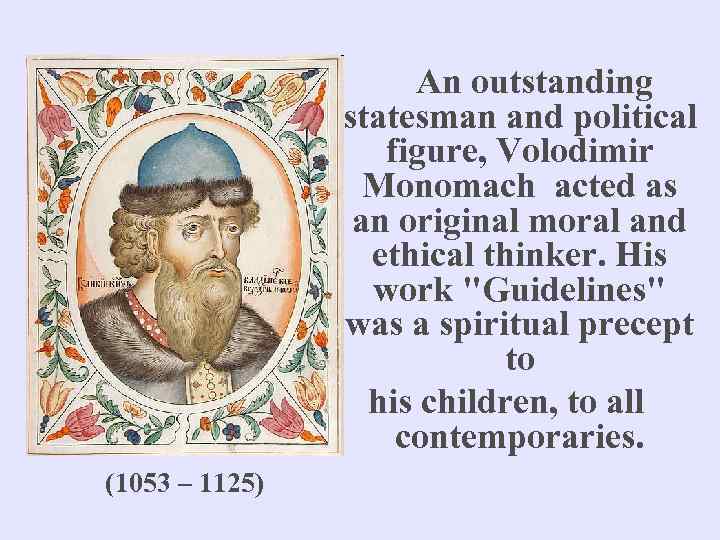 An outstanding statesman and political figure, Volodimir Monomach acted as an original moral and ethical thinker. His work "Guidelines" was a spiritual precept to his children, to all contemporaries. (1053 – 1125)
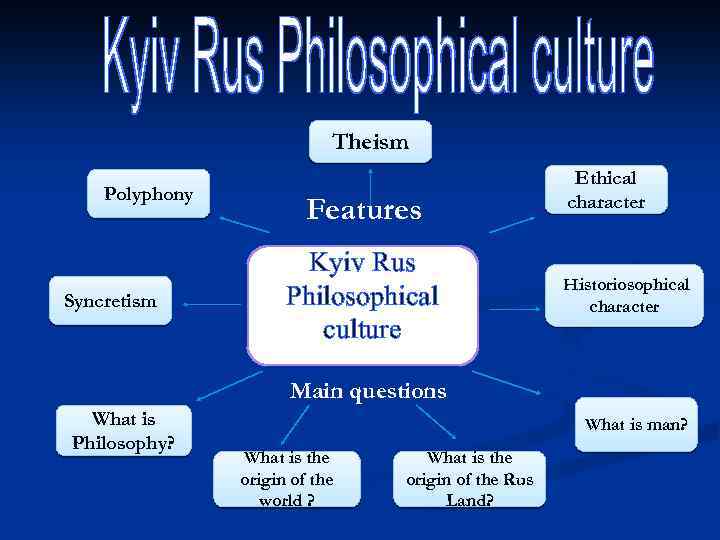 Theism Polyphony Syncretism Features Kyiv Rus Philosophical culture Ethical character Historiosophical character Main questions What is Philosophy? What is man? What is the origin of the world ? What is the origin of the Rus Land?
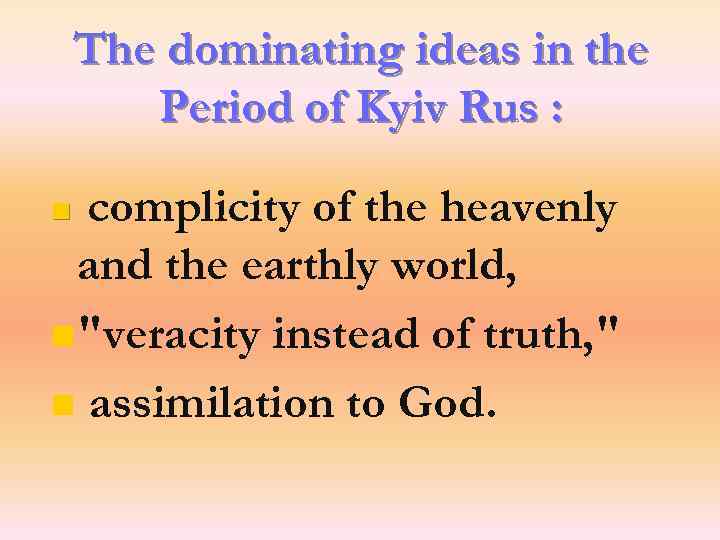 The dominating ideas in the Period of Kyiv Rus : complicity of the heavenly and the earthly world, n "veracity instead of truth, " n assimilation to God. n
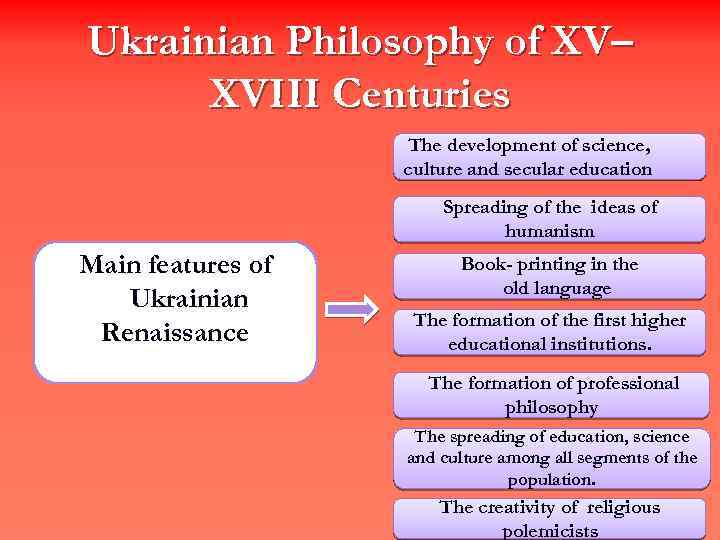 Ukrainian Philosophy of XV– XVIII Centuries The development of science, culture and secular education Spreading of the ideas of humanism Main features of Ukrainian Renaissance Book- printing in the old language The formation of the first higher educational institutions. The formation of professional philosophy The spreading of education, science and culture among all segments of the population. The creativity of religious polemicists
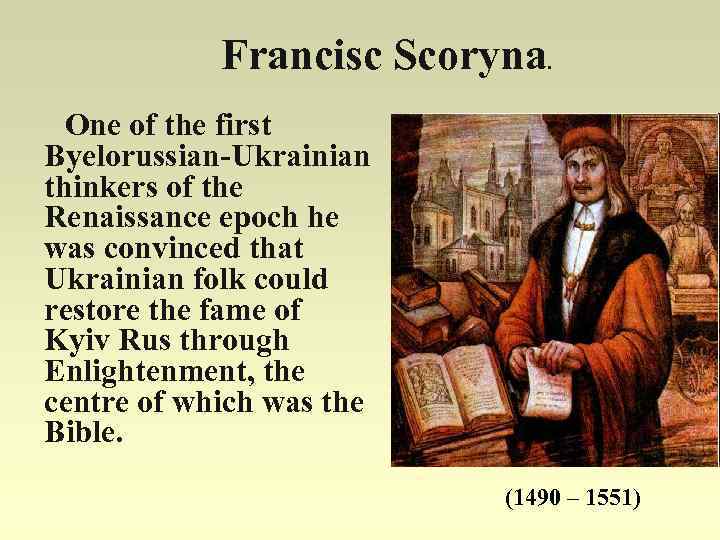 Francisc Scoryna. One of the first Byelorussian-Ukrainian thinkers of the Renaissance epoch he was convinced that Ukrainian folk could restore the fame of Kyiv Rus through Enlightenment, the centre of which was the Bible. (1490 – 1551)
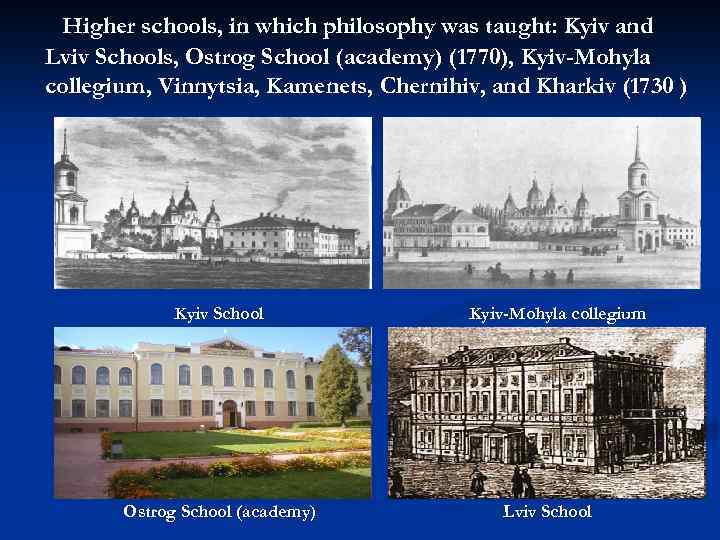 Higher schools, in which philosophy was taught: Kyiv and Lviv Schools, Ostrog School (academy) (1770), Kyiv-Mohyla collegium, Vinnytsia, Kamenets, Chernihiv, and Kharkiv (1730 ) Kyiv School Ostrog School (academy) Kyiv-Mohyla collegium Lviv School
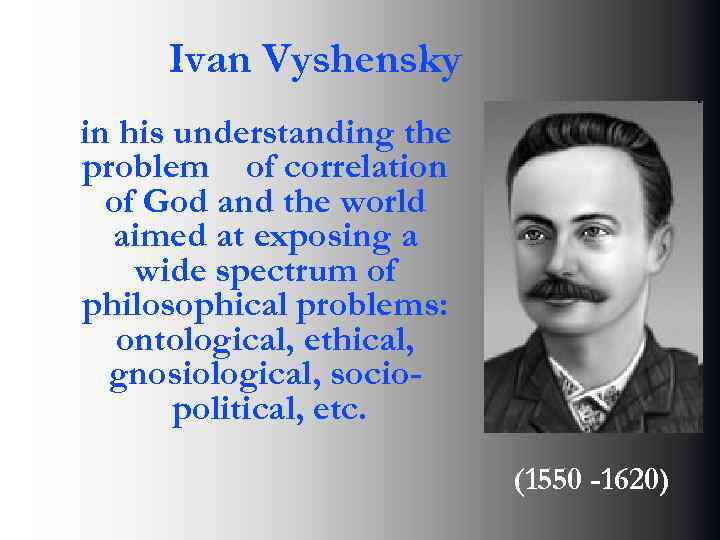 Ivan Vyshensky in his understanding the problem of correlation of God and the world aimed at exposing a wide spectrum of philosophical problems: ontological, ethical, gnosiological, sociopolitical, etc. (1550 -1620)
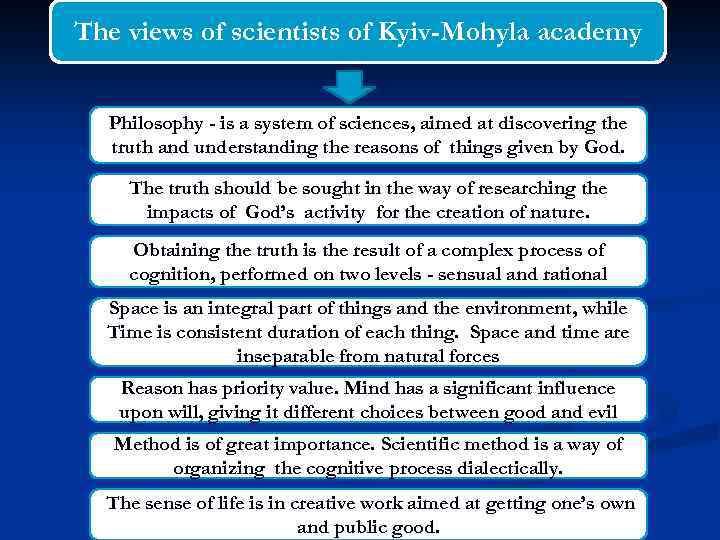 The views of scientists of Kyiv-Mohyla academy Philosophy - is a system of sciences, aimed at discovering the truth and understanding the reasons of things given by God. The truth should be sought in the way of researching the impacts of God’s activity for the creation of nature. Obtaining the truth is the result of a complex process of cognition, performed on two levels - sensual and rational Space is an integral part of things and the environment, while Time is consistent duration of each thing. Space and time are inseparable from natural forces Reason has priority value. Mind has a significant influence upon will, giving it different choices between good and evil Method is of great importance. Scientific method is a way of organizing the cognitive process dialectically. The sense of life is in creative work aimed at getting one’s own and public good.
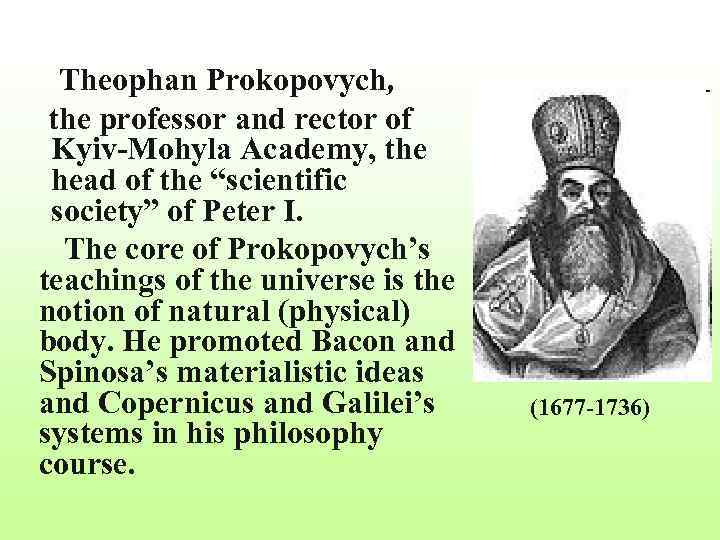 Theophan Prokopovych, the professor and rector of Kyiv-Mohyla Academy, the head of the “scientific society” of Peter I. The core of Prokopovych’s teachings of the universe is the notion of natural (physical) body. He promoted Bacon and Spinosa’s materialistic ideas and Copernicus and Galilei’s systems in his philosophy course. (1677 -1736)
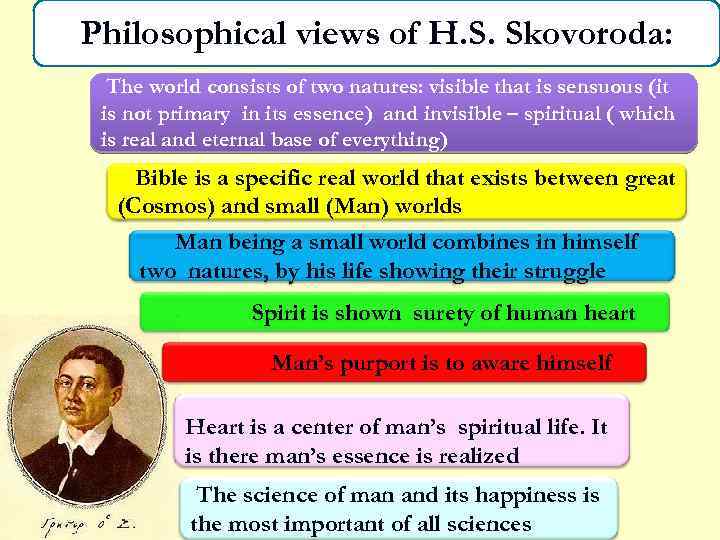 Philosophical views of H. S. Skovoroda: The world consists of two natures: visible that is sensuous (it is not primary in its essence) and invisible – spiritual ( which is real and eternal base of everything) Bible is a specific real world that exists between great (Cosmos) and small (Man) worlds Man being a small world combines in himself two natures, by his life showing their struggle Spirit is shown surety of human heart Man’s purport is to aware himself Heart is a center of man’s spiritual life. It is there man’s essence is realized The science of man and its happiness is the most important of all sciences
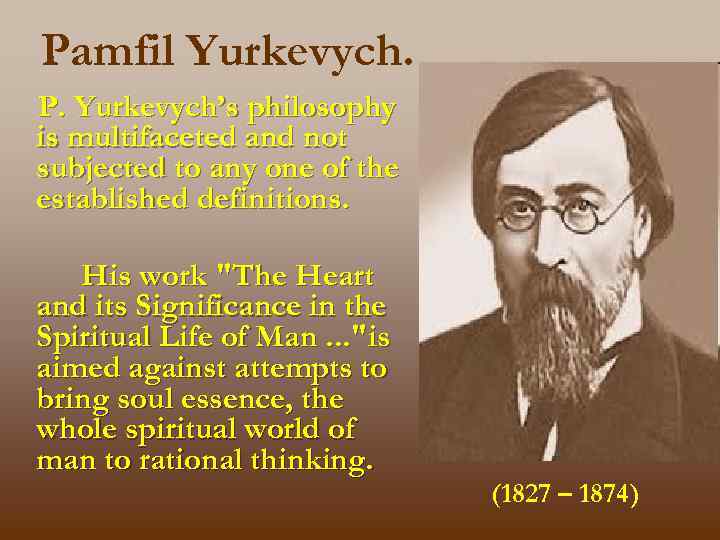 Pamfil Yurkevych. P. Yurkevych’s philosophy is multifaceted and not subjected to any one of the established definitions. His work "The Heart and its Significance in the Spiritual Life of Man. . . "is aimed against attempts to bring soul essence, the whole spiritual world of man to rational thinking. (1827 – 1874)
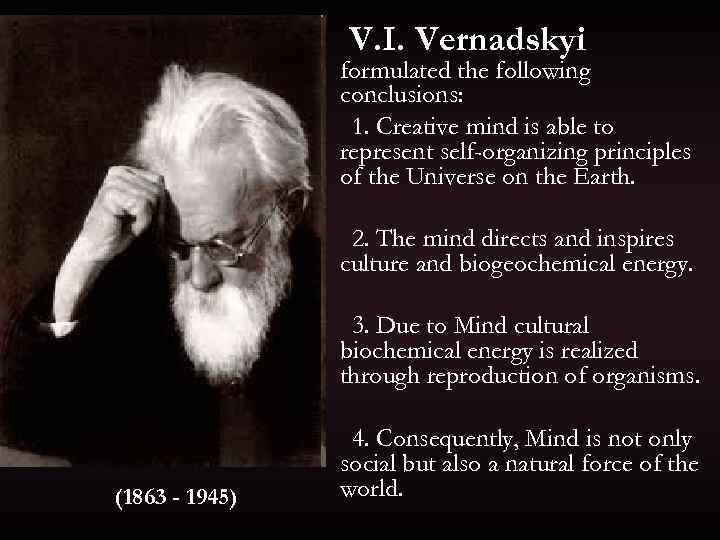 V. I. Vernadskyi formulated the following conclusions: 1. Creative mind is able to represent self-organizing principles of the Universe on the Earth. 2. The mind directs and inspires culture and biogeochemical energy. 3. Due to Mind cultural biochemical energy is realized through reproduction of organisms. (1863 - 1945) 4. Consequently, Mind is not only social but also a natural force of the world.
 Philosophical Thought in Ukraine in XX-XXI Centuries Cultural Renaissance of the twenties ended tragically and entered in the history as the "shot Renaissance. ”
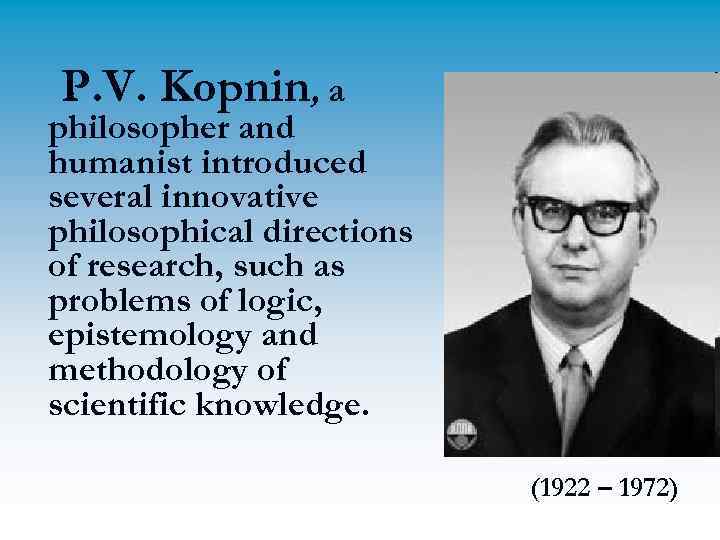 P. V. Kopnin, a philosopher and humanist introduced several innovative philosophical directions of research, such as problems of logic, epistemology and methodology of scientific knowledge. (1922 – 1972)
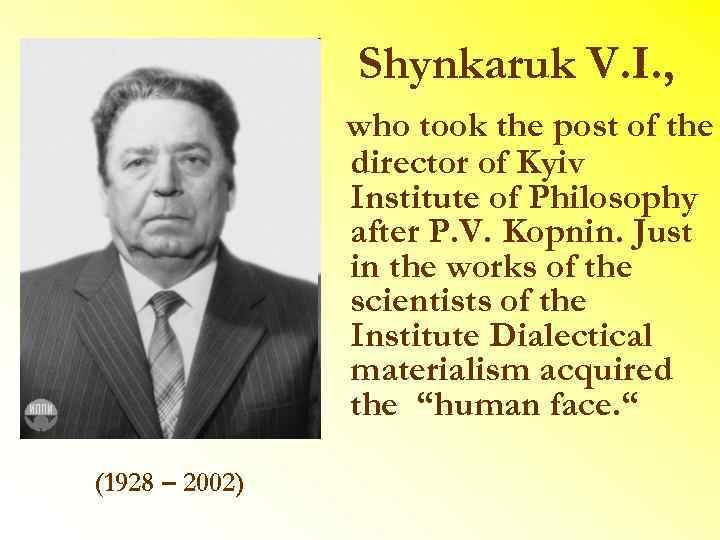 Shynkaruk V. I. , who took the post of the director of Kyiv Institute of Philosophy after P. V. Kopnin. Just in the works of the scientists of the Institute Dialectical materialism acquired the “human face. “ (1928 – 2002)
 Ukrainian philosophy may be referred to neo-classical trend in West European philosophical flow with its regarding man as uniqueness. v In Ukrainian philosophy personalism is combined with the idea of individualism. v Ukrainian philosophy is famous for its “heart principle”, meaning human self -penetration into his authenticity. v
 Questions for express-control: 1. An intimate and loving attitude to Nature and Native Land is called…? 2. Who was the first to have translated the Bible into the native language? 3. Who was the first rector of Kyiv-Mohyla Academy? 4. What philosopher is considered to be “Ukrainian Socrates”? 5. What principle characterizes Ukrainian philosophy as a national and original one?