 Скачать презентацию Formal methods Learning Objectives list characteristics of
d1ff49327fbfc937110b6f3545372727.ppt
- Количество слайдов: 87



Formal methods
Learning Objectives list characteristics of formal methods and delineate their use in qualitative research describe the technique of a free list and pile sort describe some other formal methods participate in a free list and pile sort exercise with the whole class perform pile sort tabulations
Tony's Comments on Exercise 3 (Informant Interview)

Next Tuesday Participant Observation DUE
CLASS Free list exercise: Name all the different foods you buy in a grocery store if students ask what do you mean by "foods" they hear "something you consider a food" if students ask what do you mean by "in a grocery store" they hear "the place ones goes to buy foods that is not a restaurant"
LEGAL PROCES: • • silence, “what else”, “uh huh”, “ are there other foods? ”
SUPPLEMENTARY QUESTION: Name the grocery store in which you would buy this item

Class pile sort exercise “Sort these into as many piles as you wish, in whatever way you think is right, there is no right way or wrong way to do this”
Reason sorted in same pile • “Why are these together in this pile? ”
FORMAL (SYSTEMATIC) DATA COLLECTION METHODS
Purpose: • systematic exploration of cultural domains (another way of eliciting what do people mean by the words they use? ) • Cognitive anthropology • Ethnolinguistics
Characteristics of formal methods: preceded by unstructured data collection methods to determine coherent cultural domains respondents are usually randomly selected respondents are asked the same question (in same way, with same rules for probing) FUN
Validity(measures what it is supposed to measure) high if domains are properly identified respondents familiar with domains (sample of respondents must be coherent) questions are comprehensible & coherent can be used by non-expert field worker permits comparison of data from different cultures/geographic areas
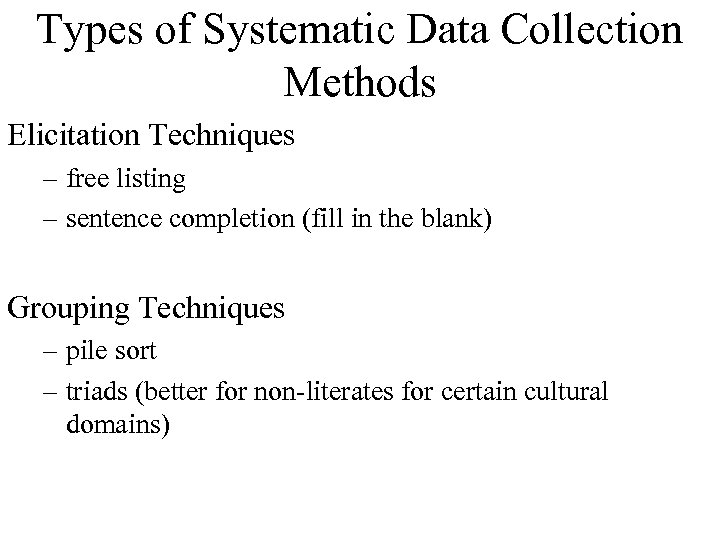
Types of Systematic Data Collection Methods Elicitation Techniques – free listing – sentence completion (fill in the blank) Grouping Techniques – pile sort – triads (better for non-literates for certain cultural domains)
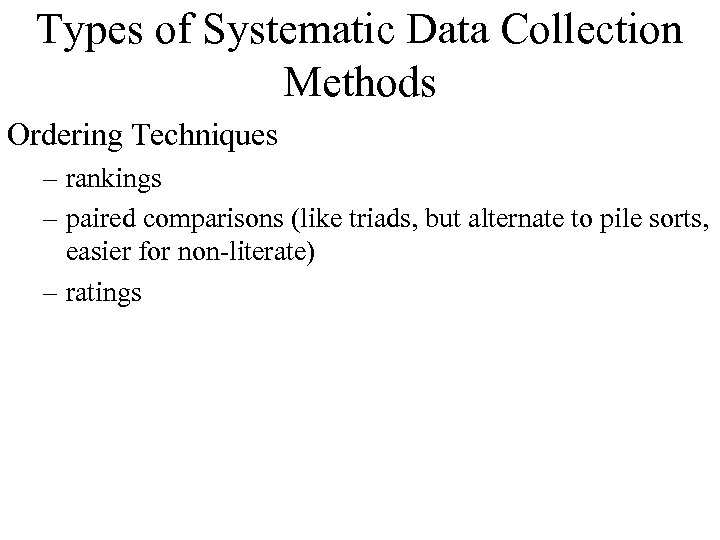
Types of Systematic Data Collection Methods Ordering Techniques – rankings – paired comparisons (like triads, but alternate to pile sorts, easier for non-literate) – ratings

Computer Analysis
More information: Weller & Romney, Systematic Data Collection, 1988, pages 9 -26 in reading packet Bernard pg 715 has listing of software, and other resources
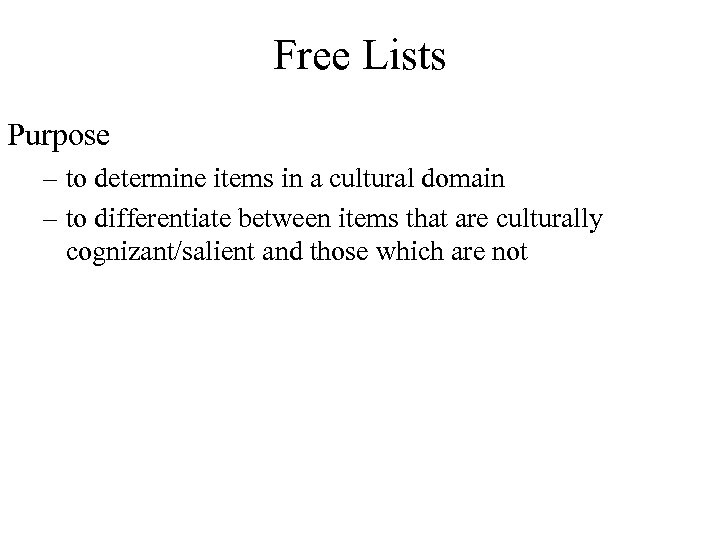
Free Lists Purpose – to determine items in a cultural domain – to differentiate between items that are culturally cognizant/salient and those which are not
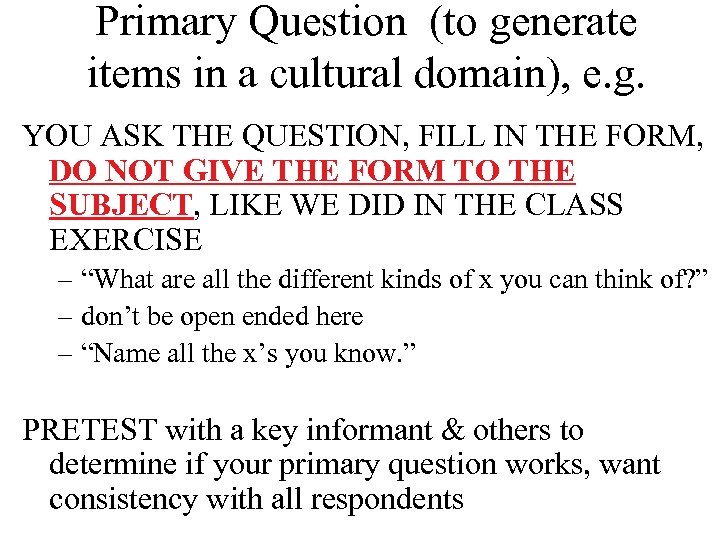
Primary Question (to generate items in a cultural domain), e. g. YOU ASK THE QUESTION, FILL IN THE FORM, DO NOT GIVE THE FORM TO THE SUBJECT, LIKE WE DID IN THE CLASS EXERCISE – “What are all the different kinds of x you can think of? ” – don’t be open ended here – “Name all the x’s you know. ” PRETEST with a key informant & others to determine if your primary question works, want consistency with all respondents
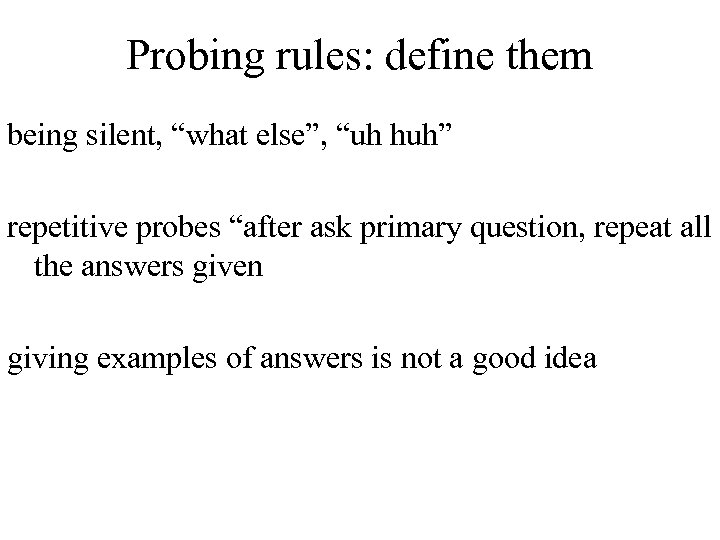
Probing rules: define them being silent, “what else”, “uh huh” repetitive probes “after ask primary question, repeat all the answers given giving examples of answers is not a good idea
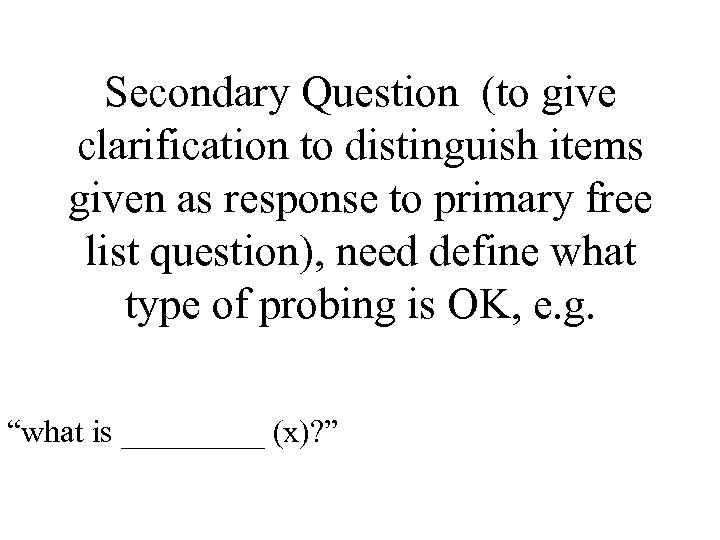
Secondary Question (to give clarification to distinguish items given as response to primary free list question), need define what type of probing is OK, e. g. “what is _____ (x)? ”
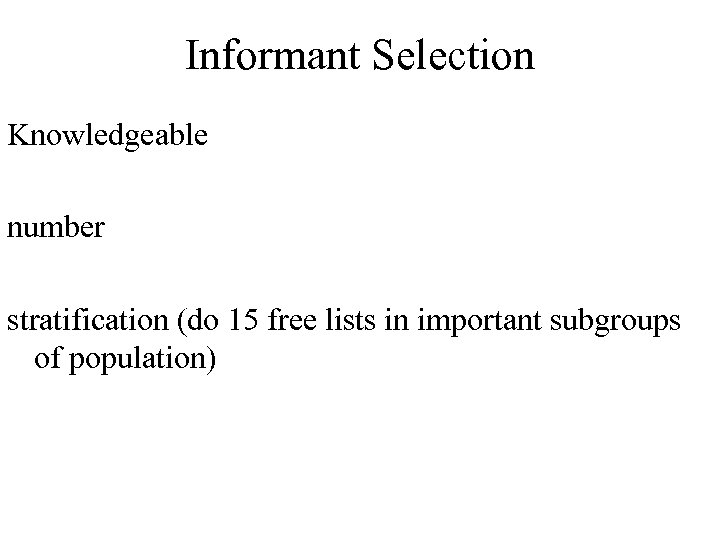
Informant Selection Knowledgeable number stratification (do 15 free lists in important subgroups of population)
Generic Free List Forms for data collection

Working with free list data use their terms, e. g. don’t use illegal drugs if they don’t Frequency chart

Frequency of items select cut off somewhere in middle of steep slops use order that respondents give items could try in a group, except that people will be influenced by the group dynamic
Strengths of Free Lists good first step in defining a new cultural domain, if you can get a good elicitation question frequency that a term is mentioned in a group supports inclusion in a cultural domain prevents researchers from using inappropriate terms can try in a group (nominal, or focus)
Weaknesses may be hard to find the appropriate generic term to start the listing process lists may be too long or too brief no accepted ways to check statistical reliability of the procedure
Examples women’s illness terms, free list , then pile sort to depict illnesses that women perceive to be close to one another fruits/vegetables (Weller & Romney) Frequency Tabulation infant foods, to determine foods people (parents) would list together & why hazardous activities while traveling healthy foods types of pain
Pile Sorts Purpose – to get insider’s perspective of how terms relate to one another – look at similarities, categories, taxonomies – sometimes called a Q-sort (though usu. refers to a rating scale)
Steps in “single/free” pile sort (as many piles as respondent wishes) choose items to be sorted (usu. from free list) assess literacy of potential respondents prepare pile sort cards (pictures (example for diarrhea) vs words vs material objects), unique identifier number on back, shuffle cards
Initial explanations, “this is not a test, we are interested in what you think” can do a demonstration sort, but not using cards they are to sort, but say, domestic animals, but this can be LEADING,
Make data collection sheet (form in exercise) for each person, putting numbers sorted & reasons why “Why are these together in a pile? ” “In what way are these alike? ” (slightly more leading)


14 6 7 2 3 5 8
Aggregate Proximity Matrix

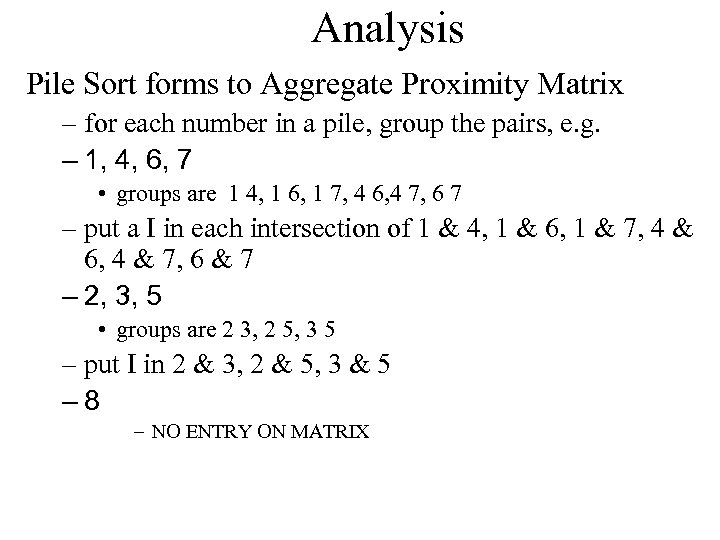
Analysis Pile Sort forms to Aggregate Proximity Matrix – for each number in a pile, group the pairs, e. g. – 1, 4, 6, 7 • groups are 1 4, 1 6, 1 7, 4 6, 4 7, 6 7 – put a I in each intersection of 1 & 4, 1 & 6, 1 & 7, 4 & 6, 4 & 7, 6 & 7 – 2, 3, 5 • groups are 2 3, 2 5, 3 5 – put I in 2 & 3, 2 & 5, 3 & 5 – 8 – NO ENTRY ON MATRIX

Pile Sort forms to Aggregate Proximity Matrix – for each number in a pile, group the pairs, e. g. – 1, 4, 6, 7 • groups are 1 4, 1 6, 1 7, 4 6, 4 7, 6 7 – put a I in each intersection of 1 & 4, 1 & 6, 1 & 7, 4 & 6, 4 & 7, 6 & 7 – 2, 3, 5 • groups are 2 3, 2 5, 3 5 – put I in 2 & 3, 2 & 5, 3 & 5 – 8 – NO ENTRY ON MATRIX I I I I I

I I I I I
Common problems with single free pile sorts lumpers vs splitters (if structure number of piles, get around lumpers/splitters) items go into multiple piles marginal literacy, use both words & pictures on pile sort cards
Many other kinds of pile sorts: multiple (items belong in more than one category) successive (for building taxonomies, ask to make 2 groups, & ask why the cards in one group were grouped that way, & ask to split that pile into 2 groups etc. ), can get a taxonomy or tree
Similarity or proximity matrix (form in exercise), gives sense of grouping, example from Places to Smoke Outside School Building risky activities while traveling


Computer Analysis, can give you multi-dimensional scaling to see how close various terms on a pile sort are Hierarchical Clustering




Triangulation discuss results with informant to see if they agree
Strengths of Pile Sorts can accommodate large number of items (cf with triads, paired comparisons to be discussed below) easy to administer, informants usually enjoy it high reliability
successive sorts useful if there is an underlying taxonomic structure (like an outline, with headings, subheadings, etc. ) foods into different categories kinship terms in Nepal do not fit an underlying taxonomic structure as they cut across nuclear families, everybody is k; Nz; (youngest brother)
Weaknesses with non-literates, unless items are pictures, it is difficult to administer successive sorts hard to do orally with non-literates successive sorts may force a taxonomic structure onto a domain where it isn’t appropriate hard to compare informants on the basis of their sorts, the difference between lumpers and splitters overwhelms all other differences among pile sorts

Recent published studies using these methods “Cognition of caregiving tasks: multidimensional scaling of the caregiver task domain. ” Early initiation of sex and non-association with risk behaviors among adolescent African-Americans “Sexual subcultures and degree of risk for acquiring HIV in adolescents in a marginal neighborhood. ” “From asparagus to zucchini: mapping cognitive space for vegetable names. ” “Contraceptive methods: do Hispanic adolescents and their family planning care providers think about contraceptive methods the same way? ” “Culture and the self: implications for the perception of depression by Australian and Vietnamese nursing students. ” “Nurses' perceptions of the dimensions of nursing care episodes. ” “Ethnographic assessment of pain coping perceptions. ” Care seeking in Sri Lanka: one possible explanation for low childhood mortality
Stanton, B. F. , et al. “Urban adolescent highrisk sexual behavior: corroboration of focus group discussions through pile-sorting. The AIDS Youth Research Team. ” Aids Educ Prev 5. 2 (1993): 162 -74.
Started with focus groups with youths aged 10 to 11, or 13 to 14 years, from transcripts, developed relevant phrases for pile sorts
did two pile sorts: 1 open sort, three different kinds phrases or words describing behaviors, feelings, and events – of sexual behavior (open sex sort) – of risk and social activities (open activity sort) – of relationships (open relationship sort)

PMT (Protection Motivation Theory) sort (forced choice mechanism) place cards in piles based on 3 -point scale for PMT constructs – Extrinsic/Instrinsic Rewards: • things that make me feel good • things I have no feeling about • things that do not make me feel good – Vulerability • things that might happen to me • things I am not sure about • things that probably won't happen to me
Analysis: similarity matrices, hierarchical clustering
Results Extrinsic rewards – either sexual abstinence or activity is acceptable for girls, whereas virginity is not acceptable for boys – perceived age of initiation of sex is younger for boys than for girls and may have a different meaning – being pregnant as a girl, and being a young mother was not considered a reward
Results Intrinsic rewards – sex proves a boy is a man; sexual excitement results in/justifies unplanned sex – intimacy is important: sex is a part of intimacy
Results Severity: STDs not perceived as serious for boys, but are moderately so for girls, AIDS, while rarely mentioned, is perceived as serious -variability exists in perceived relationship between pregnancy and parenthood and of the anticipated impact on their lives -having a baby and becoming pregnant formed a strong cluster for girls, but not for the boys Vulnerability: youths vulnerable to pregnancy youths are vulnerable to STDs but not to AIDS
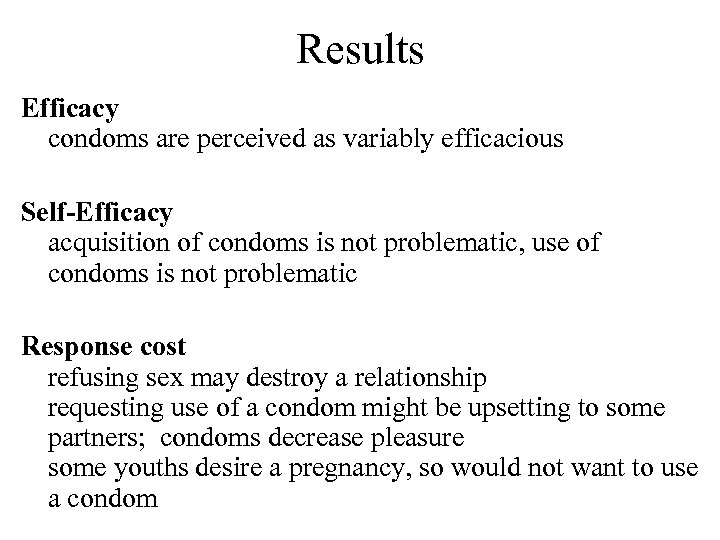
Results Efficacy condoms are perceived as variably efficacious Self-Efficacy acquisition of condoms is not problematic, use of condoms is not problematic Response cost refusing sex may destroy a relationship requesting use of a condom might be upsetting to some partners; condoms decrease pleasure some youths desire a pregnancy, so would not want to use a condom
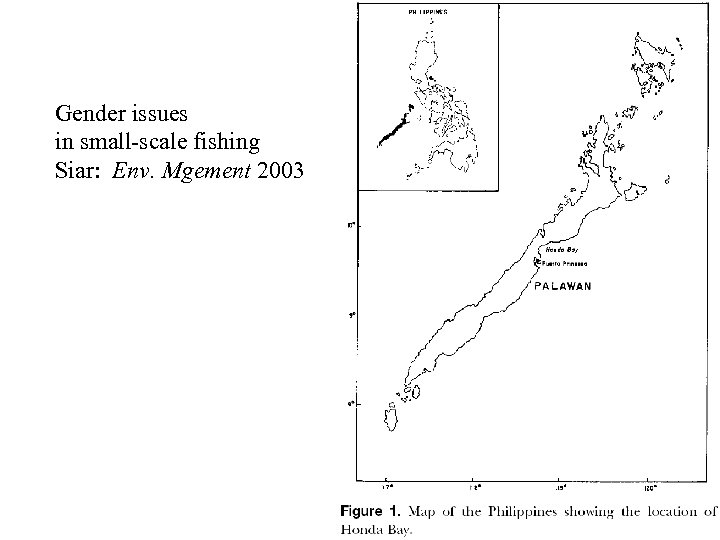
Gender issues in small-scale fishing Siar: Env. Mgement 2003
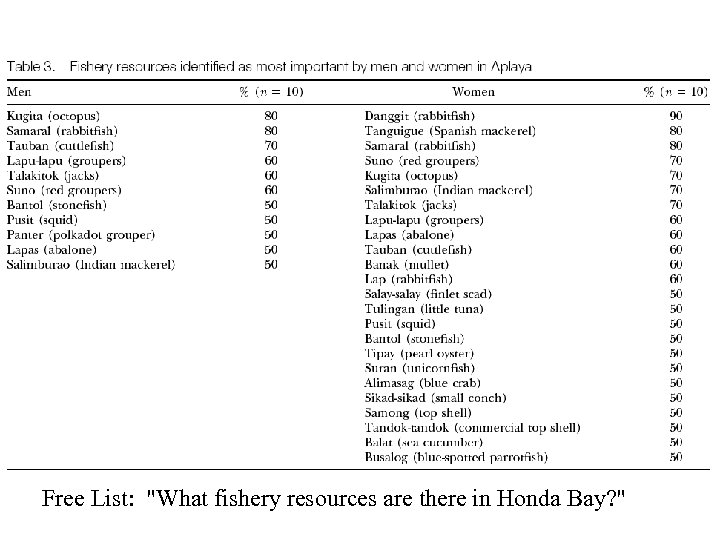
Free List: "What fishery resources are there in Honda Bay? "
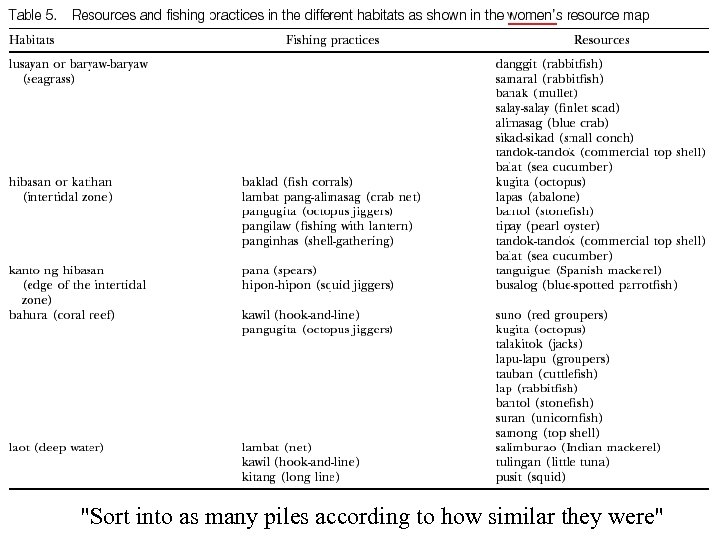
"Sort into as many piles according to how similar they were"
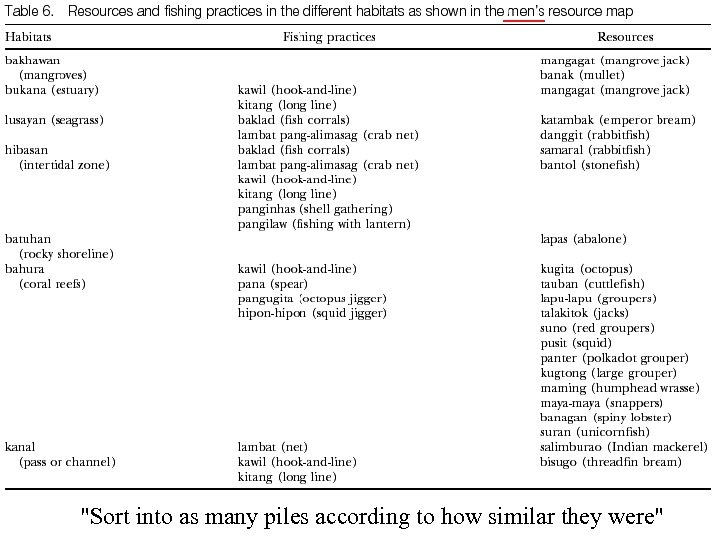
"Sort into as many piles according to how similar they were"
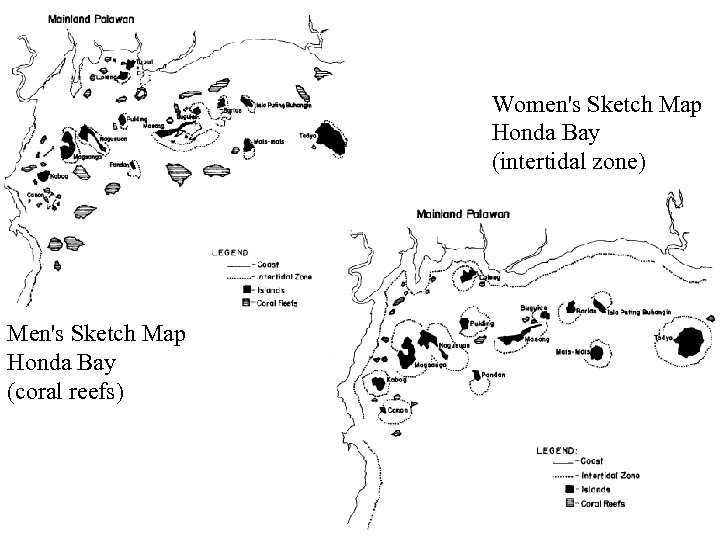
Women's Sketch Map Honda Bay (intertidal zone) Men's Sketch Map Honda Bay (coral reefs)
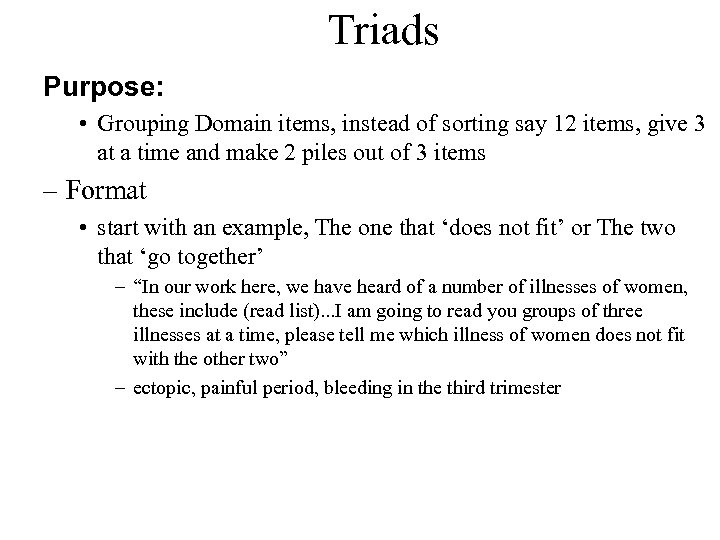
Triads Purpose: • Grouping Domain items, instead of sorting say 12 items, give 3 at a time and make 2 piles out of 3 items – Format • start with an example, The one that ‘does not fit’ or The two that ‘go together’ – “In our work here, we have heard of a number of illnesses of women, these include (read list). . . I am going to read you groups of three illnesses at a time, please tell me which illness of women does not fit with the other two” – ectopic, painful period, bleeding in the third trimester
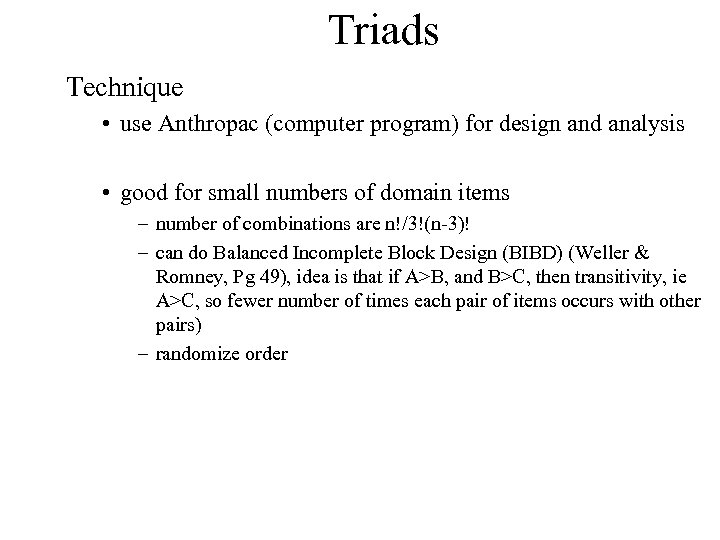
Triads Technique • use Anthropac (computer program) for design and analysis • good for small numbers of domain items – number of combinations are n!/3!(n-3)! – can do Balanced Incomplete Block Design (BIBD) (Weller & Romney, Pg 49), idea is that if A>B, and B>C, then transitivity, ie A>C, so fewer number of times each pair of items occurs with other pairs) – randomize order
Triads can read off, can be written or oral (easier with non-literates, than Pile Sorts, there is less to remember at a time), a series of “simple” decisions, less confusing, but more difficult to analyse and people come up with different models for each line, which are often in conflict plenty of redundancy
Strengths of Triads can do orally or with pen and paper can get stable results from non-literates Weaknesses – not practical for large number (> 10, say with complete design, or > 25 for balanced incomplete block design) of items in a domain
Ranking (including Paired Comparisons) Purpose – ordering domain items on a dimension e. g. for junk foods, sweetness, greasiness (get dimensions from results of pile sorts) Format – cards, or forms – dimension to be determined by investigator or informants, e. g. most to least, – each item is a separate level
Paired Comparisons “which illness is the more severe or serious? ” – “painful period, ectopic pregnancy” “where would you go to be treated if you had a women’s illness? ” – University Hospital Emergency Department or Health. Care for Women
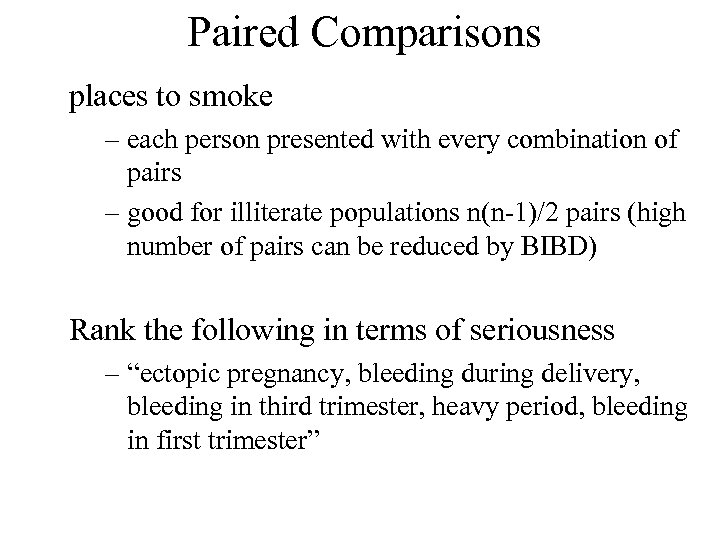
Paired Comparisons places to smoke – each person presented with every combination of pairs – good for illiterate populations n(n-1)/2 pairs (high number of pairs can be reduced by BIBD) Rank the following in terms of seriousness – “ectopic pregnancy, bleeding during delivery, bleeding in third trimester, heavy period, bleeding in first trimester”
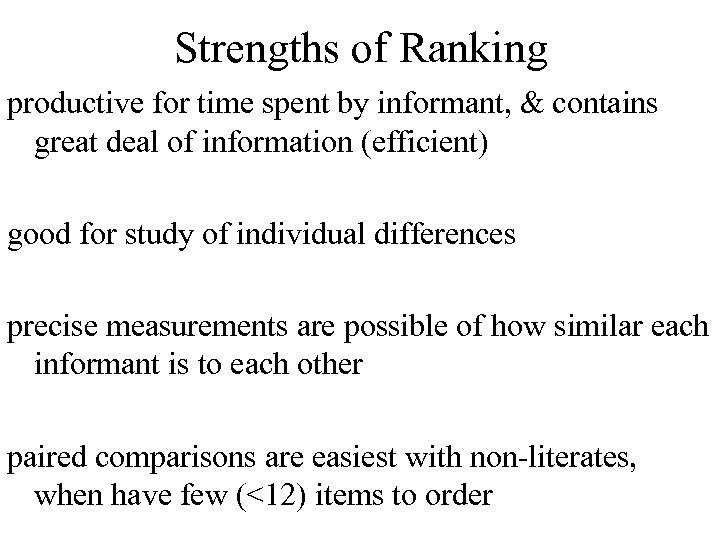
Strengths of Ranking productive for time spent by informant, & contains great deal of information (efficient) good for study of individual differences precise measurements are possible of how similar each informant is to each other paired comparisons are easiest with non-literates, when have few (<12) items to order
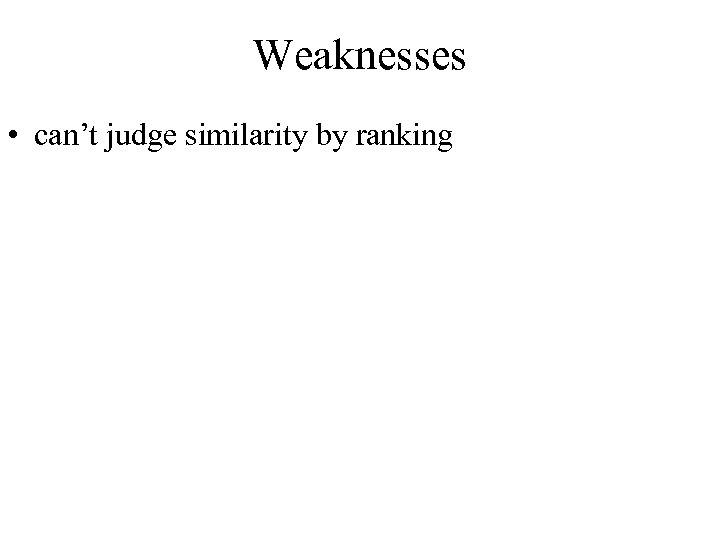
Weaknesses • can’t judge similarity by ranking
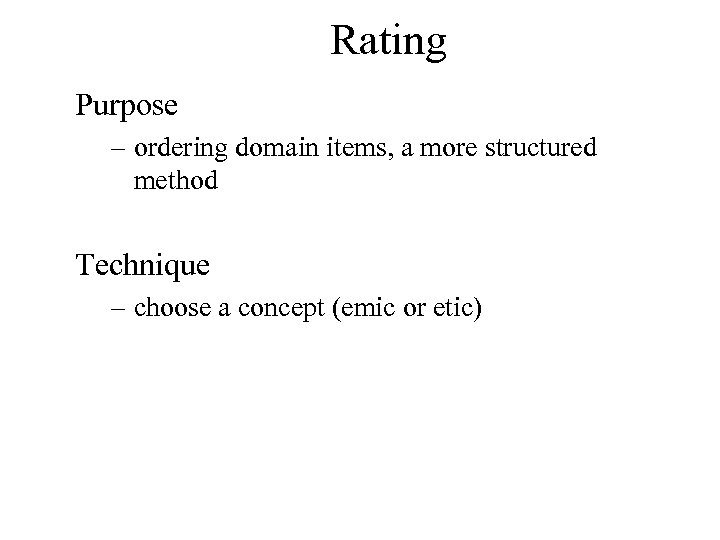
Rating Purpose – ordering domain items, a more structured method Technique – choose a concept (emic or etic)
Rating Technique – Anchors or Steps (each step has adjective or modifying verb describing that step or can use numbers, anchors are the scale steps and end points) – strongly disagree, slightly agree, strongly agree, etc. • number of steps should be small, especially if done orally with nonliterate informants • have odd number of steps, if want a middle, neutral category
Strengths of rating familiar to educated North Americans can be administered to large numbers of respondents
Weaknesses don’t lend themselves to oral interviewing, much response bias if you try requires literate subjects anchor points not comparable within or between subjects preferences for first, middle, last position on scale • questionable meaningfulness
Cultural consensus can analyze true-false data, proximity matrices, and paired comparisons with CONSENSUS program of Athropac, to see how it fits the Romney, Weller & Batchelder (1986) model
SUMMARY Formal methods can be used to better understand similarities among words and concepts used by people in a culture Free lists and pile sorts tend to be fun The more structure that is applied, the more quantitative the analysis Unclear how to use results Not used much in public health to date
Скачать презентацию Formal methods Learning Objectives list characteristics of
d1ff49327fbfc937110b6f3545372727.ppt