


 Скачать презентацию Formal Methods in SE Qaisar Javaid Assistant Professor
3ec62c6711f34426adc4b86d432ae466.ppt
- Количество слайдов: 33
 Formal Methods in SE Qaisar Javaid Assistant Professor Lecture 09
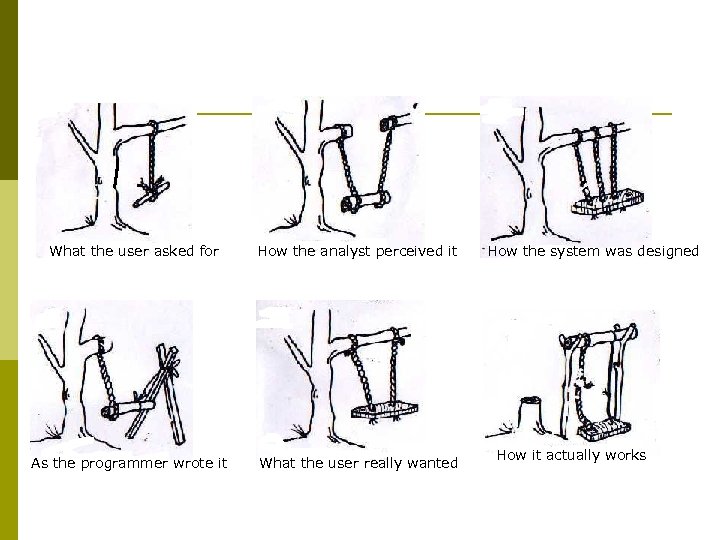 What the user asked for As the programmer wrote it How the analyst perceived it What the user really wanted How the system was designed How it actually works
 Contents p What are Formal Methods? n Definition n Myths n History n Types of formal methods n Use of mathematics p Do we really need Formal Methods? n Design errors n Effects of design errors n The promise of formal methods p The Formal Methods Debate n General concerns n Weaknesses in formal methods n Success of formal methods
 What Are Formal Methods p Formal methods refers to a variety of mathematical modeling techniques that are applicable to computer system design. p They include activities such as system specification, specification analysis and proof, transformational development, and program verification.
 Definition “ Formal methods are mathematical approaches to software and system development which support the rigorous specification, design and verification of computer systems. ” [Fme 04] “[they]… exploit the power of mathematical notation and mathematical proofs. “ [Gla 04]
 Seven Myths of Formal Methods 1. 2. 3. 4. 5. 6. 7. Formal methods can guarantee that software is perfect. Work by proving that programs are correct. Only highly critical systems benefit from their use. They involve complex math. They increase the cost of development. They are incomprehensible to clients. Nobody uses them for real projects.
 History p Formal specifications have been in use since the early days of computing. n n 1960's: Floyd, Hoare and Naur recommended using axiomatic n p 1940's: 1970's: Turing annotated the properties of program states to simplify the logical analysis of sequential programs. techniques to prove programs meet their specifications. Dijkstra used formal calculus to aid to develop of nondeterministic programs. The interest in the use of formal methods in software engineering has continued to grow.
 Definition "Formal is often confused with precise". A formal specification consists of three components: i. Syntax - grammatical rules to determine if sentences are well formed ii. Semantics - rules for interpreting the sentences in a precise, meaningful way within the domain iii. Proof Theory - rules for inferring useful information from the specification
 What are Formal Methods? § Notation with precise syntax and semantics § Doesn’t necessarily involve mathematics § Although mathematics is a formal notation § There are levels of formulization. § Techniques, methods, procedures, tools can support levels
 Types of Formal Methods A variety of formal methods exist: n Abstract State Machines - The Abstract State Machine (ASM) thesis implies that any algorithm can be modeled by an appropriate ASM. http: //www. eecs. umich. edu/gasm/ n B-Method - B is a formal method for the development of program code from a specification in the Abstract Machine Notation. http: //www. afm. sbu. ac. uk/b/ n Z – A specification language used for describing computer-based systems; based set theory and first order predicate logic http: //vl. zuser. org/ n “Unified Modeling Language (UML) provides system architects…with one consistent language for specifying, visualizing, constructing, and documenting the artifacts of software systems. . ” p p Visual notation for OO modeling Extensible Independent of programming languages Formal basis for understanding the modeling language
 Other Types of Formal Methods Others types include: n n n n n Comm. Unity Estelle Esterel Lotos Overture Modeling Language Petri Nets RAISE SDL TRIO, Unity, and VDM Any programming language
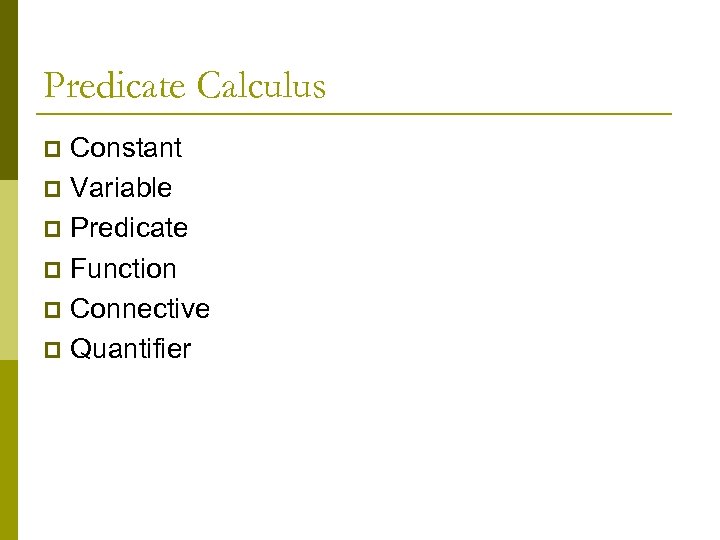
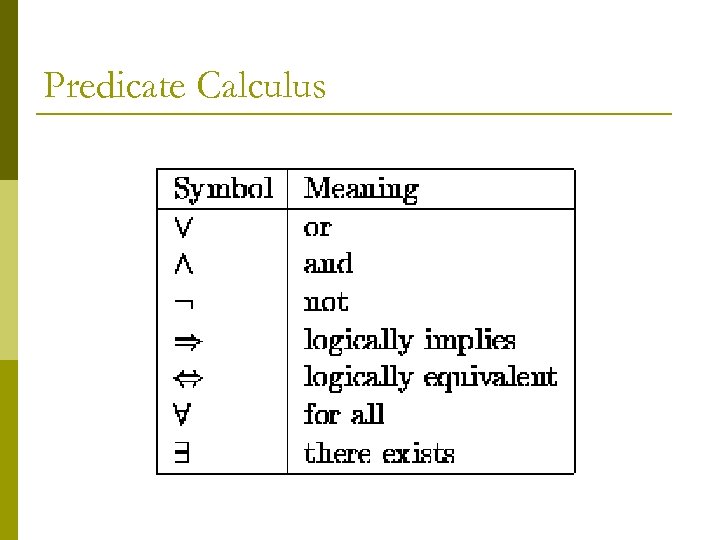
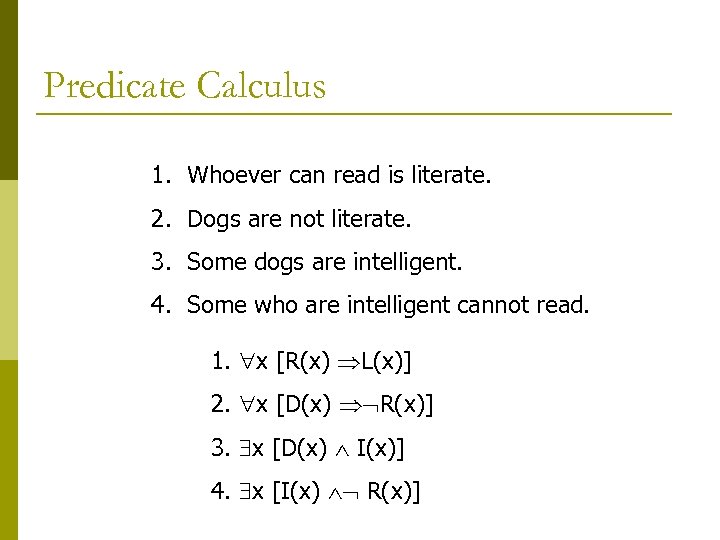
 Predicate Calculus p The first order predicate calculus is a formal language for expressing propositions. p A properly-formed predicate calculus expression is called a well-formed formula or WFF (pronounced wiff).
 Predicate Calculus Constant p Variable p Predicate p Function p Connective p Quantifier p
 Predicate Calculus
 Predicate Calculus 1. Whoever can read is literate. 2. Dogs are not literate. 3. Some dogs are intelligent. 4. Some who are intelligent cannot read. 1. x [R(x) L(x)] 2. x [D(x) R(x)] 3. x [D(x) I(x)] 4. x [I(x) R(x)]
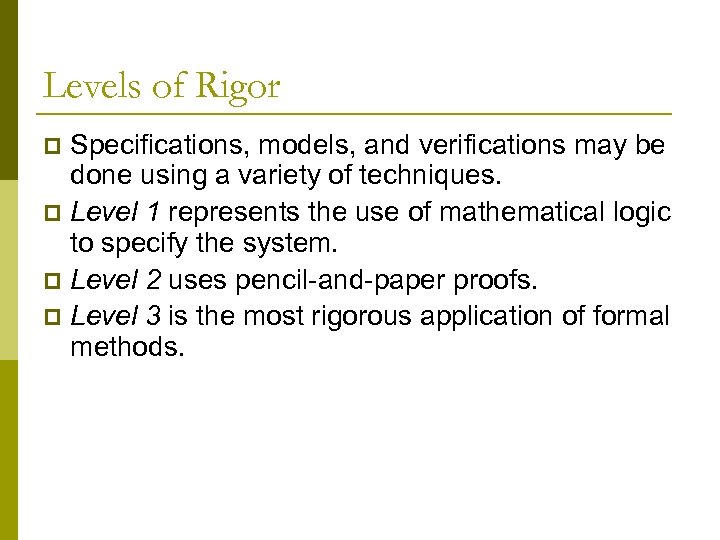 Levels of Rigor Specifications, models, and verifications may be done using a variety of techniques. p Level 1 represents the use of mathematical logic to specify the system. p Level 2 uses pencil-and-paper proofs. p Level 3 is the most rigorous application of formal methods. p
 Do we really need Formal Methods? Design errors "Digital systems can fail in catastrophic ways leading to death or tremendous financial loss. “ Potential causes of failure include: n n physical failure human error environmental factors design errors - Design errors are the major culprit. [Nas 03]
 Effects of Design Errors p Between June 1985 and January 1987, a computer-controlled radiation therapy machine, called the Therac-25 , massively overdosed six people, killing two. p On April 30, 1999 Titan I cost taxpayers 1. 23 billion dollars, all due to a software malfunction (incorrectly entered roll rate filter constant)
 Effects of Design Errors p Denver Airport’s computerized baggage handling system delayed opening by 16 months. Airport cost was $3. 2 billion over budget. p NASA’s Checkout Launch and Control System (CLCS) cancelled 9/2002 after spending over $300 million.
 The promise of Formal Methods Formal methods are needed to: n n n Improve SW Quality Reduce cost of verifying system Improve quality and rigor of entire development process Reduce specification errors and provide a rational basis for choosing test data Explore the properties of a design architecture
 The Formal Methods Debate: General Concerns p Evidence n n n p Impracticality n n p No Quantitative evidence Used with other techniques formal methods has led to highly reliable code; fewer errors and easy to test. "Formal methods do not claim to remove the possibility of unwise design decisions. “ [San 98] "Automatically generating proofs of program correctness are regarded as unrealizable for realistic systems. " Methods of automatically generating test cases that expose problems are available. Communication n n Improved documentation and better understanding of designs Difficult for untrained SW Eng/Consumer to understand specs.
 Weaknesses in Formal Methods p Weaknesses: n n n Low-level ontologies Limited Scope Isolation Cost Poor tool feedback
 Success of Formal Methods There are many examples of successful and cost -effective systems implemented using formal methods. n n Mainly in domain of transportation systems Also in domains such as: information systems p telecommunication systems p power plant control p security p
 Investigating Influence of Formal Methods: Case Study p Project: Praxis air-traffic control information system for UK Civil Aviation Authority n n Used FMs before, not to this extent Developed functional requirements using 3 techniques: p E-R analysis p Real time extension of Yourdon. Constantine structured analysis p Formal Methods for specification and Design
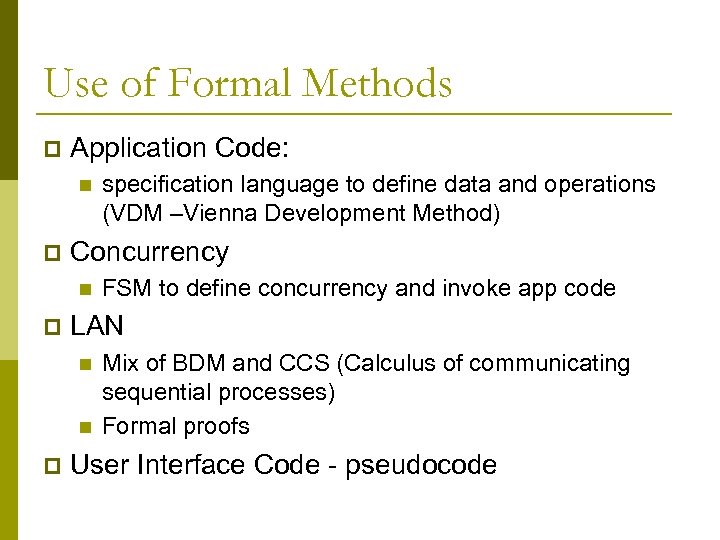 Use of Formal Methods p Application Code: n p Concurrency n p FSM to define concurrency and invoke app code LAN n n p specification language to define data and operations (VDM –Vienna Development Method) Mix of BDM and CCS (Calculus of communicating sequential processes) Formal proofs User Interface Code - pseudocode
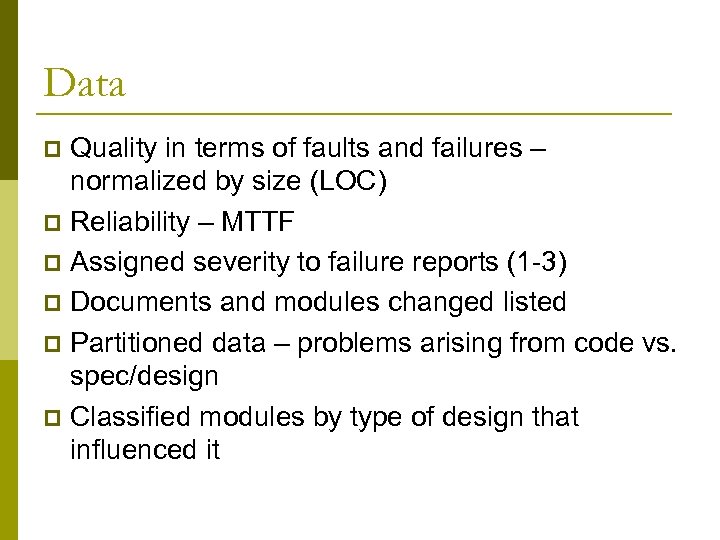 Data Quality in terms of faults and failures – normalized by size (LOC) p Reliability – MTTF p Assigned severity to failure reports (1 -3) p Documents and modules changed listed p Partitioned data – problems arising from code vs. spec/design p Classified modules by type of design that influenced it p
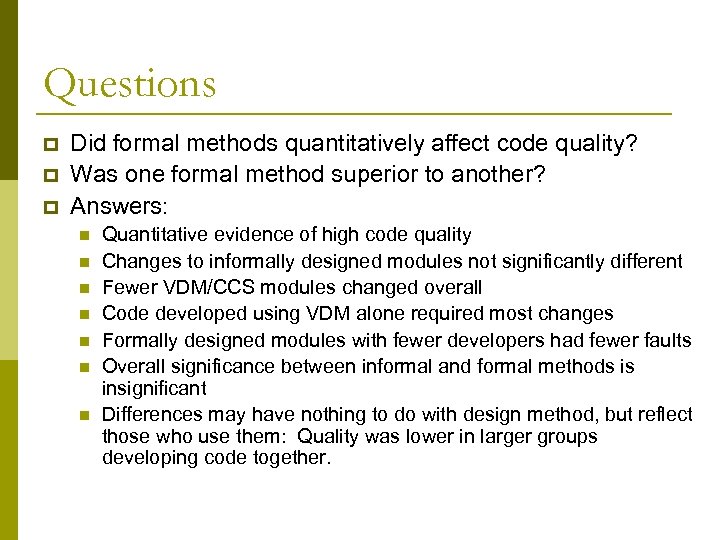 Questions p p p Did formal methods quantitatively affect code quality? Was one formal method superior to another? Answers: n n n n Quantitative evidence of high code quality Changes to informally designed modules not significantly different Fewer VDM/CCS modules changed overall Code developed using VDM alone required most changes Formally designed modules with fewer developers had fewer faults Overall significance between informal and formal methods is insignificant Differences may have nothing to do with design method, but reflect those who use them: Quality was lower in larger groups developing code together.
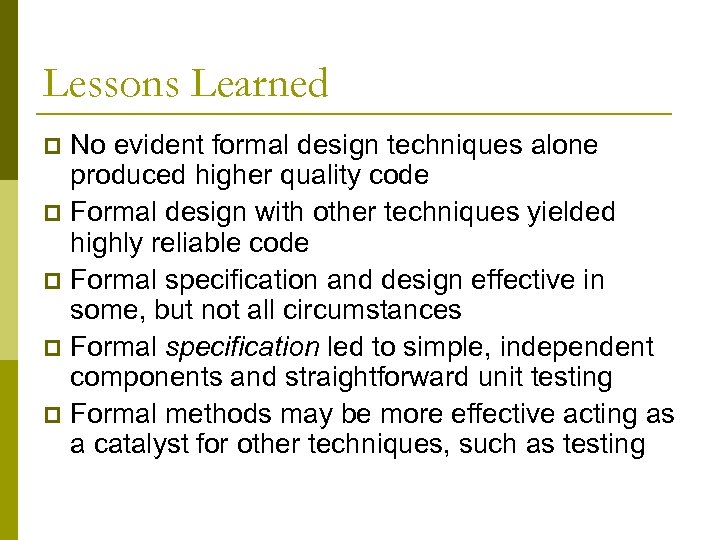 Lessons Learned No evident formal design techniques alone produced higher quality code p Formal design with other techniques yielded highly reliable code p Formal specification and design effective in some, but not all circumstances p Formal specification led to simple, independent components and straightforward unit testing p Formal methods may be more effective acting as a catalyst for other techniques, such as testing p
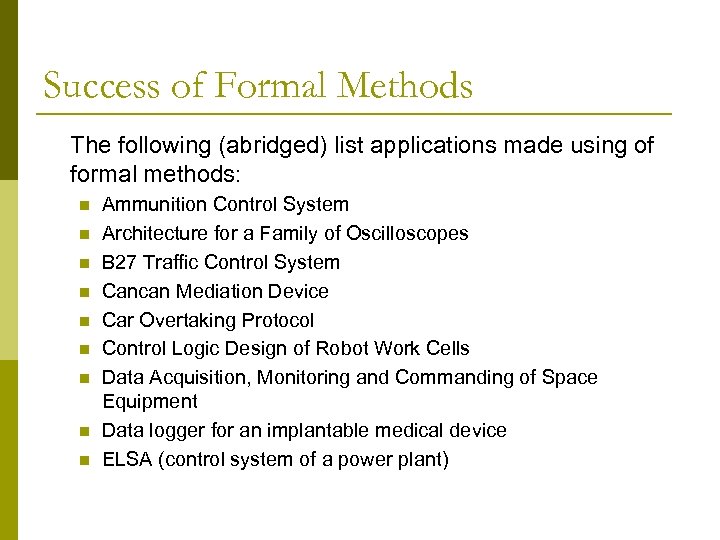 Success of Formal Methods The following (abridged) list applications made using of formal methods: n n n n n Ammunition Control System Architecture for a Family of Oscilloscopes B 27 Traffic Control System Cancan Mediation Device Car Overtaking Protocol Control Logic Design of Robot Work Cells Data Acquisition, Monitoring and Commanding of Space Equipment Data logger for an implantable medical device ELSA (control system of a power plant)
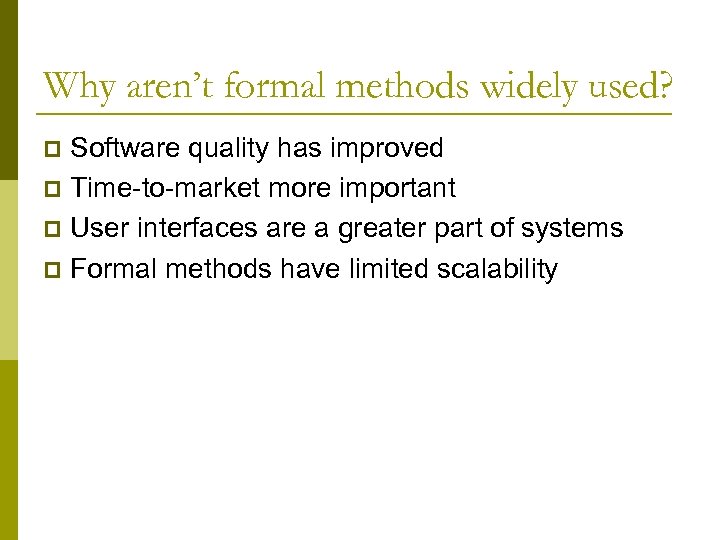 Why aren’t formal methods widely used? Software quality has improved p Time-to-market more important p User interfaces are a greater part of systems p Formal methods have limited scalability p
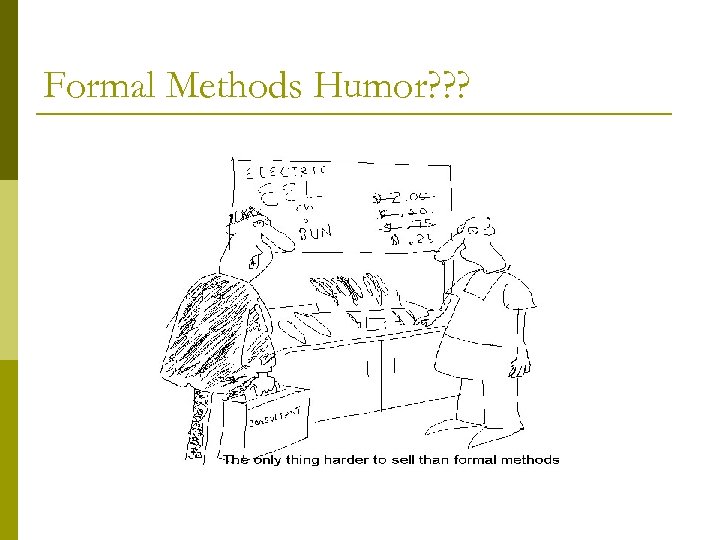 Formal Methods Humor? ? ?
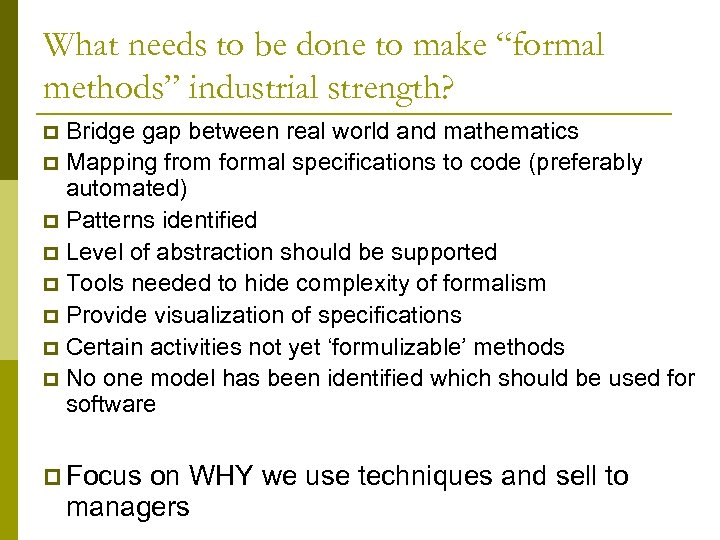 What needs to be done to make “formal methods” industrial strength? Bridge gap between real world and mathematics p Mapping from formal specifications to code (preferably automated) p Patterns identified p Level of abstraction should be supported p Tools needed to hide complexity of formalism p Provide visualization of specifications p Certain activities not yet ‘formulizable’ methods p No one model has been identified which should be used for software p p Focus on WHY we use techniques and sell to managers
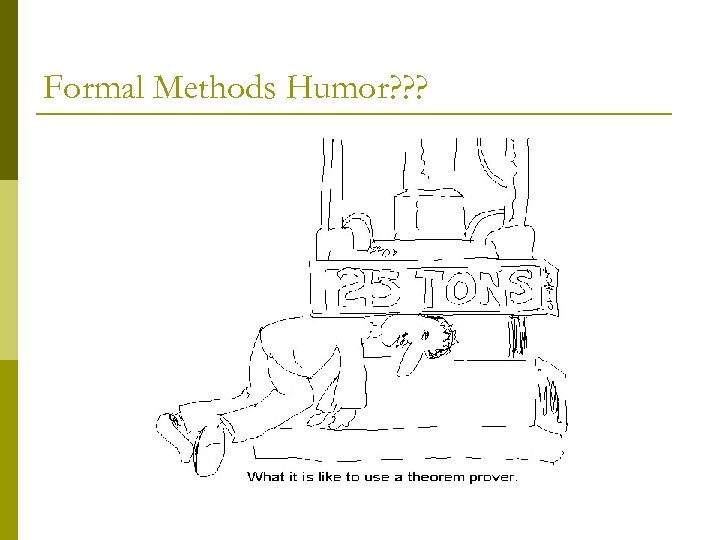 Formal Methods Humor? ? ?