 Скачать презентацию Form 5 Parents Evening 2016 Presentation by C
494d26b5526b3437c96563b7c51ad7b0.ppt
- Количество слайдов: 28



Form 5 Parents’ Evening 2016 Presentation by C. Downey (Guidance Counsellor)
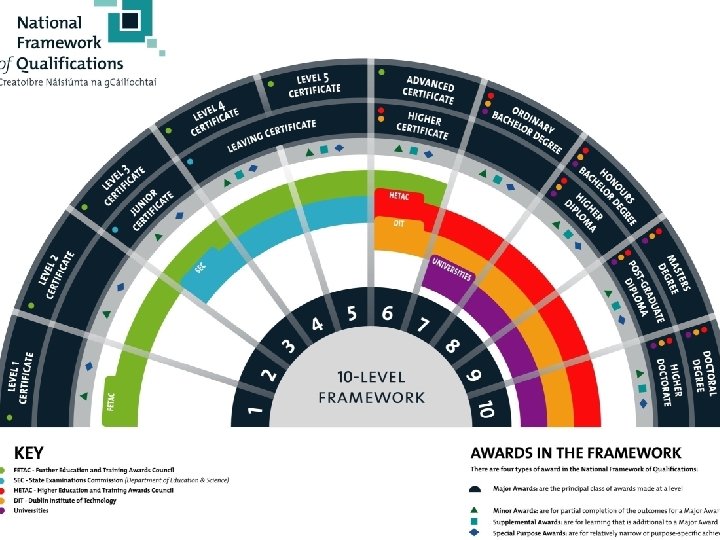
Format of Presentation • My Role as Guidance Counsellor • National Framework of Qualifications - Where is your teenager at present? • CAO application system, New Common Points Scale, Access to College Schemes, PLC Courses. • UCAS(UK) application system. • Study abroad options (EU UNIVERSITIES) and cost involved. • Senior Journal (contains important information on study skills, project and practical deadline dates, CAO, UCAS, PLC courses, Guards, Army etc. , revision websites and open days).
My Role as Guidance Counsellor § Help students assess their skills, interests and aptitudes so as to make an informed subject & career choice (Career Interest Inventory, DATS, JC results, work experience). Individual Form 5 meetings scheduled for February & March. § Familiarise students with the many different courses on offer in Universities (here and abroad), ITs, the PLC colleges and the many career choices available in institutions such as the Guards, Defence Forces, Teagasc, Apprenticeships, Aviation etc. § Inform students about how the CAO and the UCAS systems work. § Teach students how to use the QUALIFAX website effectively so as to become familiar with minimum and specific entry requirements, course content and career progression opportunities of courses that interest them.
My Role as Guidance Counsellor § Keep students informed about open days (UL- Tuesday 27 th September), Higher Options, etc. ) during school assembly and through the use of the guidance notice board and school website. § Provide students with information about the various GRANTS/SCHOLARSHIPS/HEAR & DARE alternative access routes into college. § Provide students with helpful study skill techniques and time management skills. § Support students through personal counselling when needed. § Meet with students to discuss dropping/changing a subject or subject level. Note: Students must study 8 subjects until Christmas of Form V.
Two Applications on One Form § There are two course choice lists and applicants may make up to ten course choices on each list. § 10 choices may be made on the Level 8 list § 10 choices may be made on the Level 7/6 list
Level 8 (Honours Degree) § Offered over 3 -4 yrs in Universities and 4 years in ITs. § Points and entry requirements are generally higher than Level 6/7 courses. § Must complete the full term of years before being awarded. Level 6/7 (Certificate/Ordinary Degree) § Level 6/7 Offered in ITs over a period of 2 -3 years. § Points and entry requirements are generally lower than Level 8 courses. § Some ITs offer a progression onto a Level 8 Higher Degree. § A certain grade needs to be achieved to make this progression.
CAO Application system §Processes entry into undergraduate courses in HEIs. §Opens online in November of Form 6. §All undergraduate courses are listed online on the CAO website and in the CAO handbook which is given to students in Form 6 during a CAO Form group presentation. §Pupils’ own responsibility to apply online by the deadline (Feb 1 st).
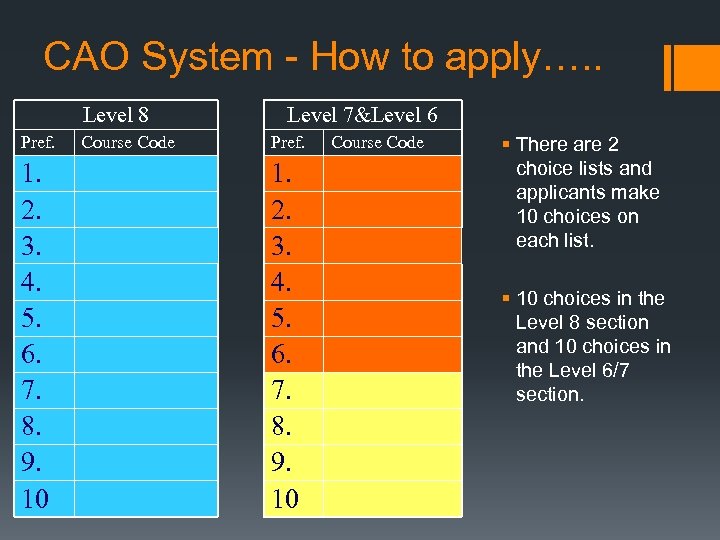
CAO System - How to apply…. . Level 8 Pref. 1. 2. 3. 4. 5. 6. 7. 8. 9. 10 Course Code Level 7&Level 6 Pref. 1. 2. 3. 4. 5. 6. 7. 8. 9. 10 Course Code § There are 2 choice lists and applicants make 10 choices on each list. § 10 choices in the Level 8 section and 10 choices in the Level 6/7 section.
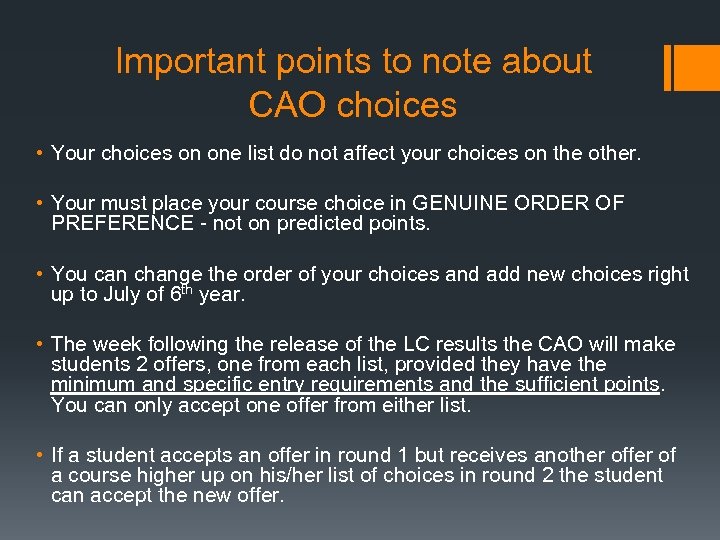
Important points to note about CAO choices • Your choices on one list do not affect your choices on the other. • Your must place your course choice in GENUINE ORDER OF PREFERENCE - not on predicted points. • You can change the order of your choices and add new choices right up to July of 6 th year. • The week following the release of the LC results the CAO will make students 2 offers, one from each list, provided they have the minimum and specific entry requirements and the sufficient points. You can only accept one offer from either list. • If a student accepts an offer in round 1 but receives another offer of a course higher up on his/her list of choices in round 2 the student can accept the new offer.
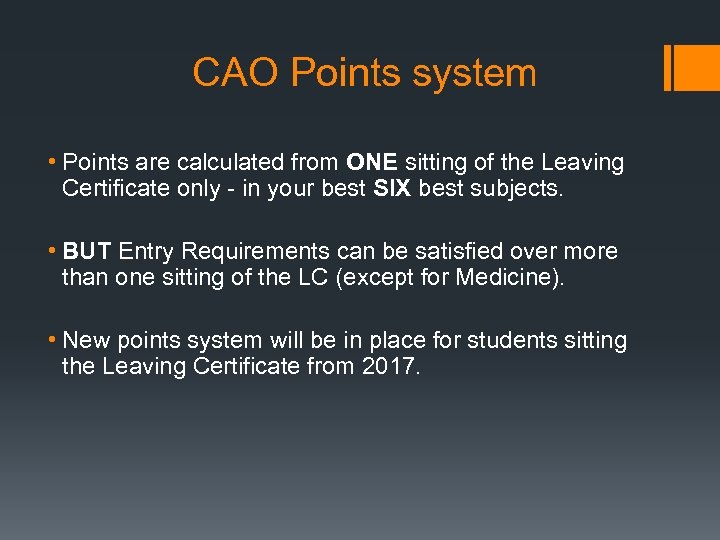
CAO Points system • Points are calculated from ONE sitting of the Leaving Certificate only - in your best SIX best subjects. • BUT Entry Requirements can be satisfied over more than one sitting of the LC (except for Medicine). • New points system will be in place for students sitting the Leaving Certificate from 2017.
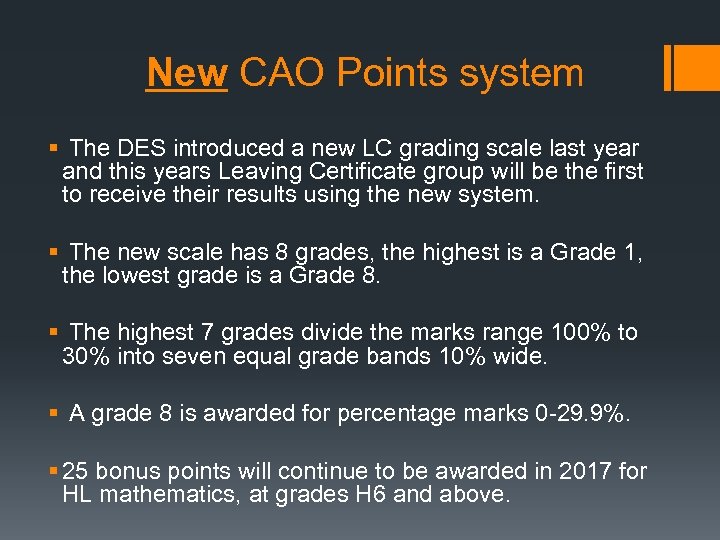
New CAO Points system § The DES introduced a new LC grading scale last year and this years Leaving Certificate group will be the first to receive their results using the new system. § The new scale has 8 grades, the highest is a Grade 1, the lowest grade is a Grade 8. § The highest 7 grades divide the marks range 100% to 30% into seven equal grade bands 10% wide. § A grade 8 is awarded for percentage marks 0 -29. 9%. § 25 bonus points will continue to be awarded in 2017 for HL mathematics, at grades H 6 and above.
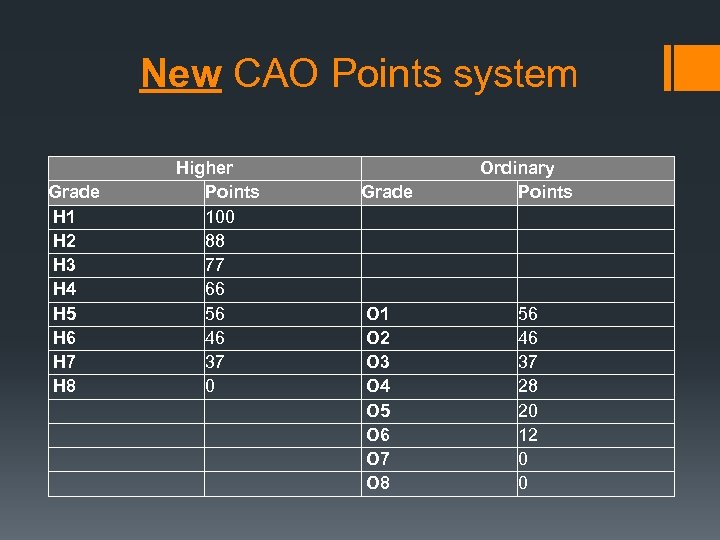
New CAO Points system Grade H 1 H 2 H 3 H 4 H 5 H 6 H 7 H 8 Higher Points 100 88 77 66 56 46 37 0 Grade O 1 O 2 O 3 O 4 O 5 O 6 O 7 O 8 Ordinary Points 56 46 37 28 20 12 0 0
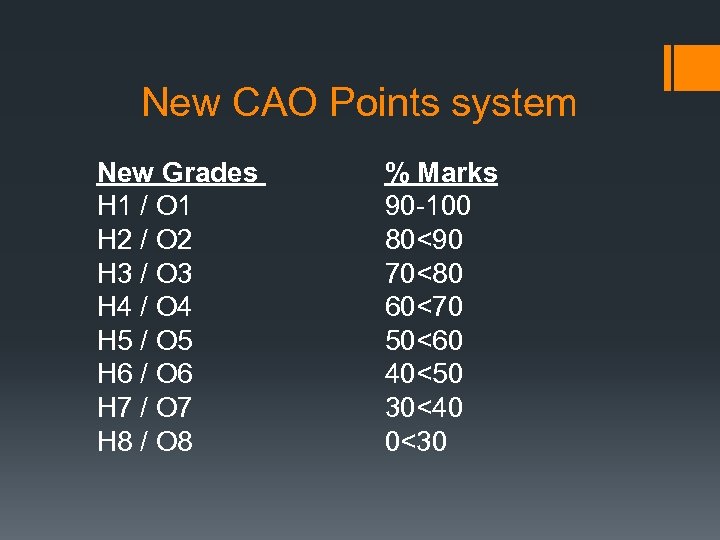
New CAO Points system New Grades H 1 / O 1 H 2 / O 2 H 3 / O 3 H 4 / O 4 H 5 / O 5 H 6 / O 6 H 7 / O 7 H 8 / O 8 % Marks 90 -100 80<90 70<80 60<70 50<60 40<50 30<40 0<30
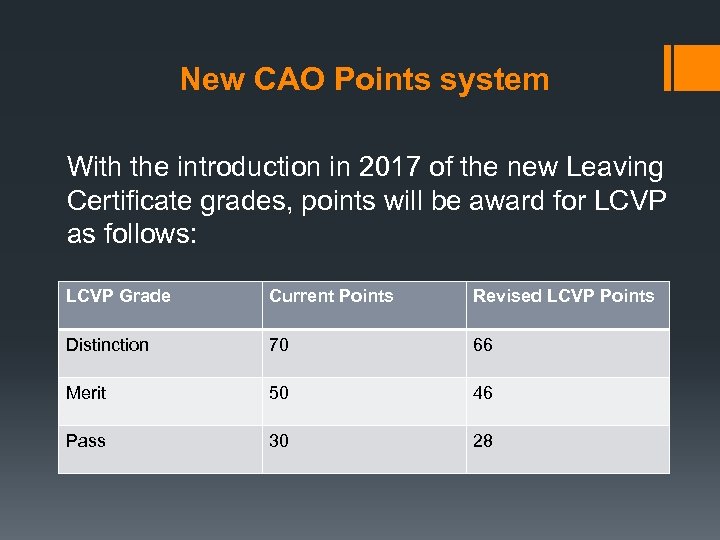
New CAO Points system With the introduction in 2017 of the new Leaving Certificate grades, points will be award for LCVP as follows: LCVP Grade Current Points Revised LCVP Points Distinction 70 66 Merit 50 46 Pass 30 28
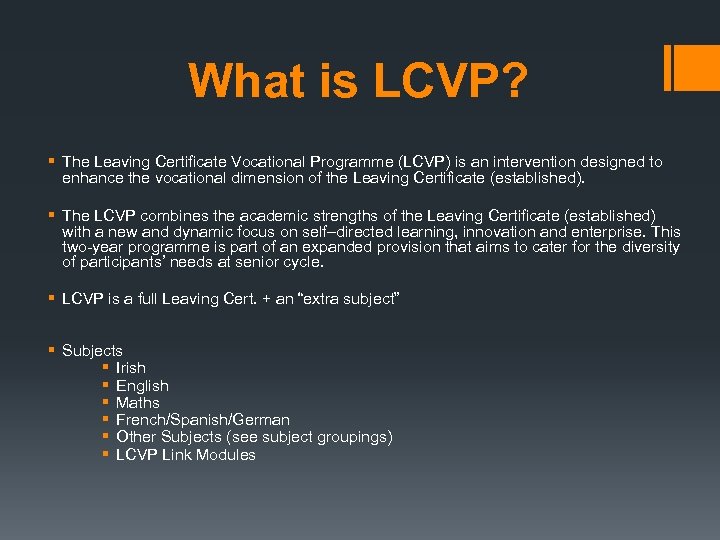
What is LCVP? § The Leaving Certificate Vocational Programme (LCVP) is an intervention designed to enhance the vocational dimension of the Leaving Certificate (established). § The LCVP combines the academic strengths of the Leaving Certificate (established) with a new and dynamic focus on self–directed learning, innovation and enterprise. This two-year programme is part of an expanded provision that aims to cater for the diversity of participants’ needs at senior cycle. § LCVP is a full Leaving Cert. + an “extra subject” § Subjects § Irish § English § Maths § French/Spanish/German § Other Subjects (see subject groupings) § LCVP Link Modules
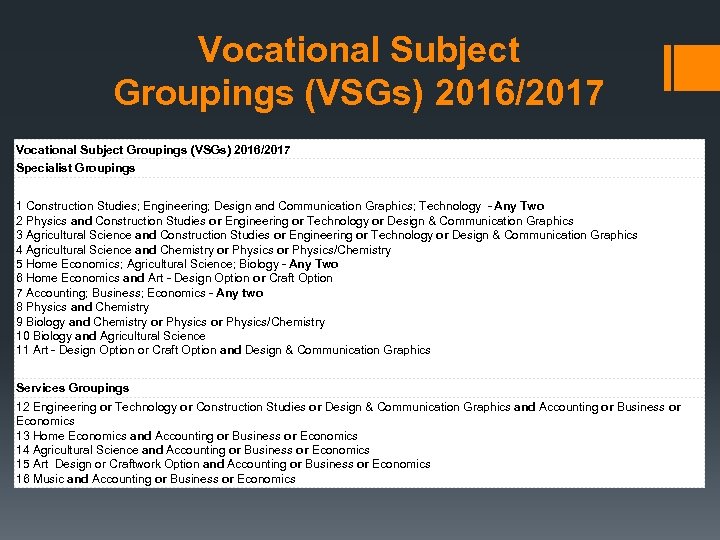
Vocational Subject Groupings (VSGs) 2016/2017 Specialist Groupings 1 Construction Studies; Engineering; Design and Communication Graphics; Technology - Any Two 2 Physics and Construction Studies or Engineering or Technology or Design & Communication Graphics 3 Agricultural Science and Construction Studies or Engineering or Technology or Design & Communication Graphics 4 Agricultural Science and Chemistry or Physics/Chemistry 5 Home Economics; Agricultural Science; Biology - Any Two 6 Home Economics and Art - Design Option or Craft Option 7 Accounting; Business; Economics - Any two 8 Physics and Chemistry 9 Biology and Chemistry or Physics/Chemistry 10 Biology and Agricultural Science 11 Art - Design Option or Craft Option and Design & Communication Graphics Services Groupings 12 Engineering or Technology or Construction Studies or Design & Communication Graphics and Accounting or Business or Economics 13 Home Economics and Accounting or Business or Economics 14 Agricultural Science and Accounting or Business or Economics 15 Art Design or Craftwork Option and Accounting or Business or Economics 16 Music and Accounting or Business or Economics

Link Modules Assessment § Assessed by written portfolio and written examination § Portfolio submission in April of 6 th year § Written exam takes place in May of 6 th year
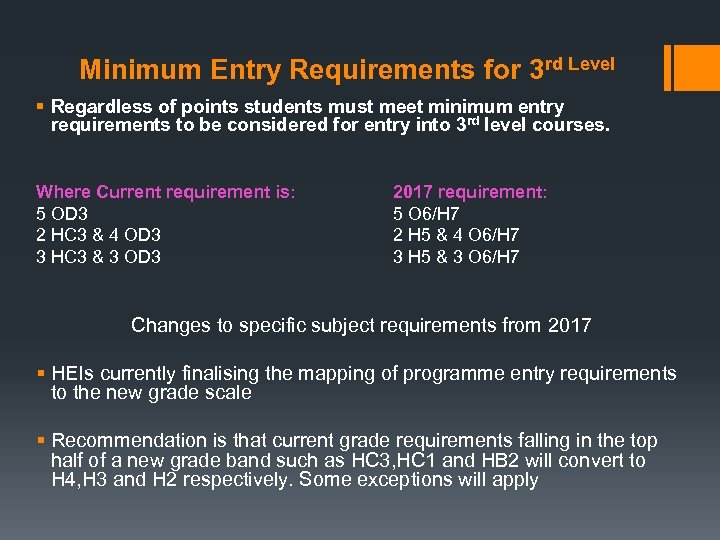
Minimum Entry Requirements for 3 rd Level § Regardless of points students must meet minimum entry requirements to be considered for entry into 3 rd level courses. Where Current requirement is: 5 OD 3 2 HC 3 & 4 OD 3 3 HC 3 & 3 OD 3 2017 requirement: 5 O 6/H 7 2 H 5 & 4 O 6/H 7 3 H 5 & 3 O 6/H 7 Changes to specific subject requirements from 2017 § HEIs currently finalising the mapping of programme entry requirements to the new grade scale § Recommendation is that current grade requirements falling in the top half of a new grade band such as HC 3, HC 1 and HB 2 will convert to H 4, H 3 and H 2 respectively. Some exceptions will apply
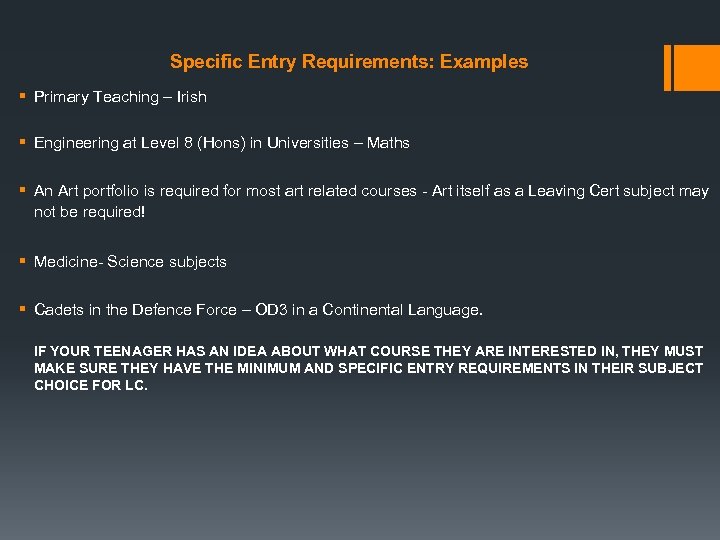
Specific Entry Requirements: Examples § Primary Teaching – Irish § Engineering at Level 8 (Hons) in Universities – Maths § An Art portfolio is required for most art related courses - Art itself as a Leaving Cert subject may not be required! § Medicine- Science subjects § Cadets in the Defence Force – OD 3 in a Continental Language. IF YOUR TEENAGER HAS AN IDEA ABOUT WHAT COURSE THEY ARE INTERESTED IN, THEY MUST MAKE SURE THEY HAVE THE MINIMUM AND SPECIFIC ENTRY REQUIREMENTS IN THEIR SUBJECT CHOICE FOR LC.
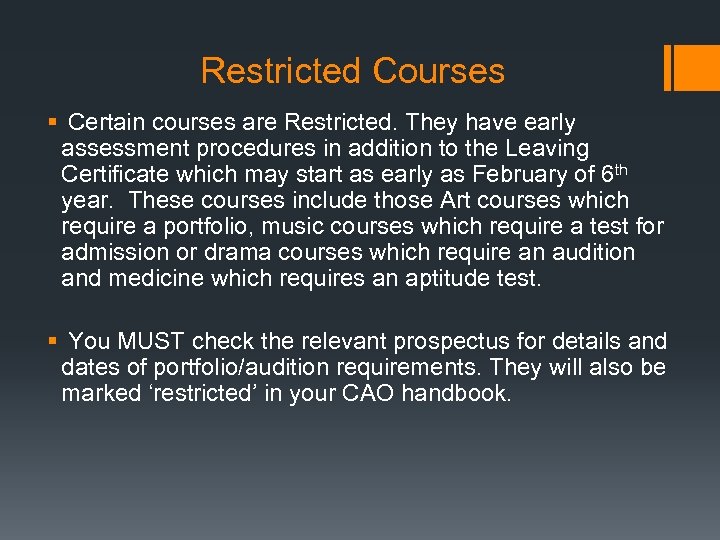
Restricted Courses § Certain courses are Restricted. They have early assessment procedures in addition to the Leaving Certificate which may start as early as February of 6 th year. These courses include those Art courses which require a portfolio, music courses which require a test for admission or drama courses which require an audition and medicine which requires an aptitude test. § You MUST check the relevant prospectus for details and dates of portfolio/audition requirements. They will also be marked ‘restricted’ in your CAO handbook.
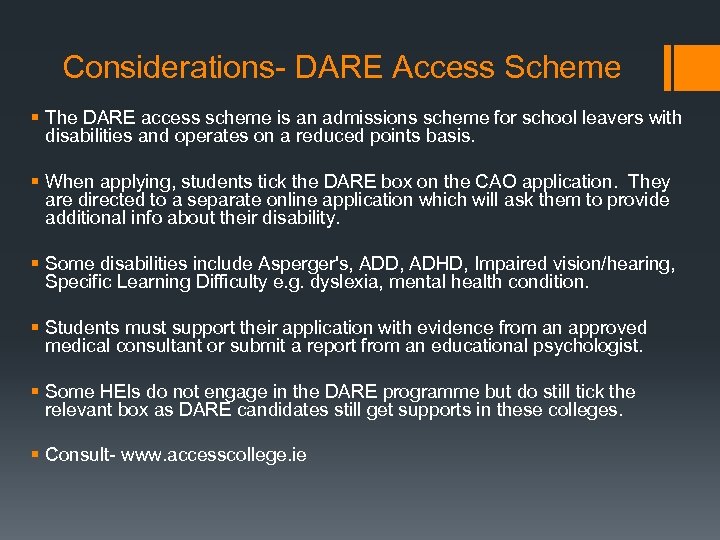
Considerations- DARE Access Scheme § The DARE access scheme is an admissions scheme for school leavers with disabilities and operates on a reduced points basis. § When applying, students tick the DARE box on the CAO application. They are directed to a separate online application which will ask them to provide additional info about their disability. § Some disabilities include Asperger's, ADD, ADHD, Impaired vision/hearing, Specific Learning Difficulty e. g. dyslexia, mental health condition. § Students must support their application with evidence from an approved medical consultant or submit a report from an educational psychologist. § Some HEIs do not engage in the DARE programme but do still tick the relevant box as DARE candidates still get supports in these colleges. § Consult- www. accesscollege. ie
NON-CAO: PLC § A Post Leaving Certificate course is a college route-way that is also available to students of the Established Leaving Certificate. § CAO points are not needed to apply to a PLC course. A student applies directly to the PLC college. The course length is usually one or two years. PLC colleges are available all over the country usually in VECs. They offer a mixture of practical work, academic work and work experience (see www. qualifax. ie). § A wide range of disciplines are covered including business, electronics engineering, computing, catering, sport and leisure, theatre and stage, performance art, art craft and design, equestrian studies, multi-media studies, journalism, tourism, marketing, childcare and community care, hairdressing and beauty care, applied science, horticulture etc. § There are hundreds of courses to choose from but be sure to choose a course that is accepted for entry into the Level 6/7 or 8 courses the student wishes to progress onto. § Students receive a FETAC Award, from which they can progress to Level 6, 7 and 8 courses and in effect go on to do a postgraduate, masters or doctorate!
UCAS § Irish students often decide to apply to the UK as entry requirements for many courses are less than in the Republic. Popular courses include Medicine, Dentistry, OT, PE Teaching, Physiotherapy, Primary Teaching, Veterinary Medicine. § The English government charges tuition fees (except for courses covered by the NHS). Universities can charge up to £ 9000 a year. Scotland is still free for Irish students (for now!). Wales and Northern Ireland are subsidised by their governments and cost between £ 3350 -£ 3500 per year. § Total yearly living expenses in the UK are between £ 7000 and £ 9000 depending on location. § Students who wish to apply for Medicine & Dentistry in the UK often have to take the UKCAT (£ 60). Students applying to medicine in Oxford, Cambridge, Imperial College London or Veterinary Medicine in Royal Veterinary College must sit the BMAT (£ 57). Entry early in 6 th year. I recommend completing the UKCAT in the summer before LC.
Applying to UCAS § Students apply online by either October or January of 6 th Form depending on their chosen course. Unlike CAO, students only have 5 choices. They must submit a personal statement, predicted grades and a reference from the Headmistress along with their application. § Students will receive an offer/several offers on the condition that they achieve the LC exam results specified. § Students can hold up to two offers, one being a firm acceptance and the other an insurance acceptance. The insurance acceptance will usually be an offer requiring lower grades in case students don’t meet the conditions of their first choice.

Study abroad option (www. enicas. ie) There are now many degree courses being taught through English in universities across the EU. These include courses in Architecture, Business, Media, Health Sciences, Engineering, Science, Hospitality & Tourism, IT, International Law and Performing Arts. Realistic Entry requirements § Entry requirements for undergraduate degrees, at most of the universities across the EU, are currently lower than those being set by Irish and UK universities. This is not a reflection of quality. It is a simply an indicator that, in Ireland, our third-level education system is under pressure, as more and more students chase a small number of places in our universities. § Places are available abroad on courses for which there is high demand in Ireland. There are places available on many of these degrees abroad. They include subjects such as medicine, dentistry, veterinary science, psychology and pharmacy. Budapest, for example, is a popular location for Irish students who want to study medicine. § Fees for such medical courses are expensive and can cost between € 6500 and € 8500 a year before living costs. § Entry requirements are considerably lower than Ireland. Most emphasis is placed on passing a scientific entrance exam which is a similar standard to L. C Higher Level Biology and Chemistry (some Physics also).
Study abroad option NOT ALL COURSES IN THE EU ARE AS EXPENSIVE! Value: The cost of attending many universities can work out as equivalent, or sometimes cheaper, than registering for an equivalent programme at home. § In Central Europe, living costs are about half of that in Ireland. In some of the more established EU states, tuition fees are equivalent to, or lower, than in Ireland. For example, there are no fees for Irish students studying in Denmark and, in Holland, fees are just above € 1600 pa. § Application to EU Universities can be complicated but www. eunicas. ie will help you every step of the way, free of charge. They are funded by EU Universities to recruit Irish students. There are details off all courses offered through English across the EU on the website.
Please take a look at the senior journal where career information is explained in more detail. Please keep an eye on LC Projects and Coursework deadlines in journal also. Some Useful websites: www. cao. ie www. qualifax. ie www. ucas. co. uk www. fetac. ie www. studentfinance. ie www. accesscollege. ie www. careersportal. ie
Thank you! Please make an appointment if you would like to know more. Email: cdowney@villiers-school. com
Скачать презентацию Form 5 Parents Evening 2016 Presentation by C
494d26b5526b3437c96563b7c51ad7b0.ppt