


 Скачать презентацию FORENSIC SCIENCE INTRODUCTION UNITS FIRST SEMESTER Introduction
0b685ed9c1141a792c27fcfa47b84638.ppt
- Количество слайдов: 20
 FORENSIC SCIENCE INTRODUCTION
 UNITS FIRST SEMESTER *Introduction *Physical Evidence *DNA *Documentation *Biology SECOND SEMESTER *Introduction *Prints *Toxicology *Trace Evidence *Serology 2
 Forensic Science Application of science to those criminal and civil laws that are enforced by police agencies in a criminal justice system. The business of providing timely, accurate, and thorough information to all levels of decisions makers in our criminal justice system. 3
 Complex Reasoning In Forensic Science Deductive and Inductive Reasoning Classifying Comparing and contrasting Problem Solving Analyzing Perspectives Constructing Support Error Analysis 4
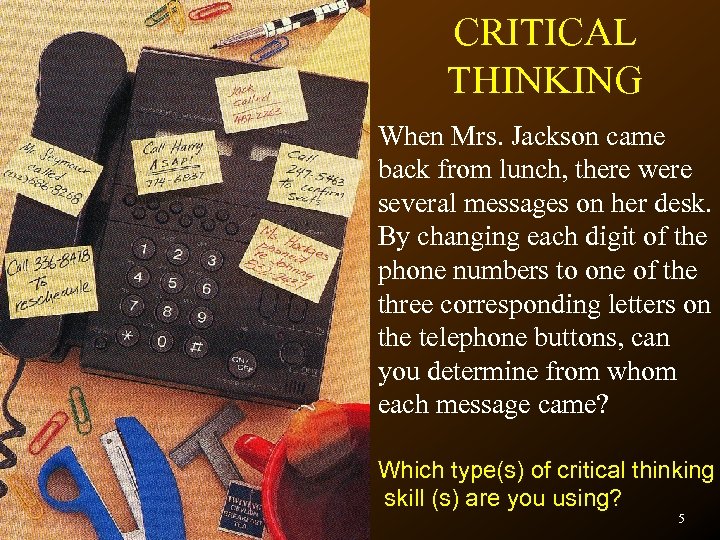 CRITICAL THINKING When Mrs. Jackson came back from lunch, there were several messages on her desk. By changing each digit of the phone numbers to one of the three corresponding letters on the telephone buttons, can you determine from whom each message came? Which type(s) of critical thinking skill (s) are you using? 5
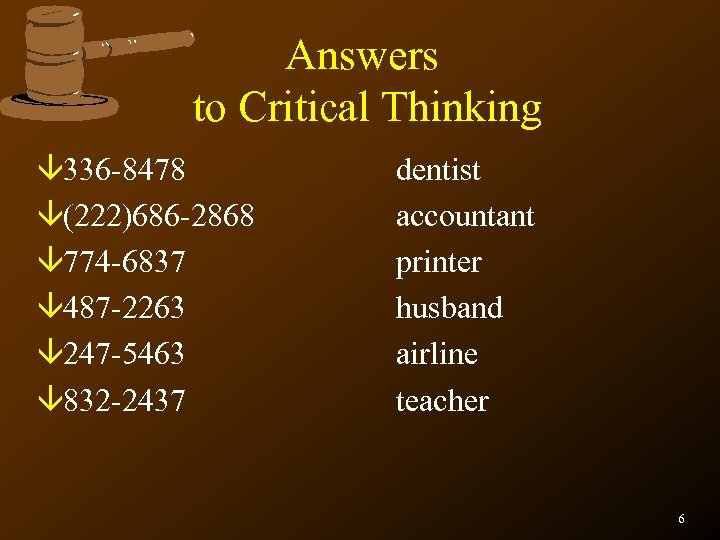 Answers to Critical Thinking â 336 -8478 â(222)686 -2868 â 774 -6837 â 487 -2263 â 247 -5463 â 832 -2437 dentist accountant printer husband airline teacher 6
 CORPUS DELICTI You must prove: “Body of the Crime” â that a crime occurred â that the person charged with the crime was responsible for the crime Top Reasons for Committing a Crime â Money â Revenge â Sex â Emotion--love, hate, anger Source of Evidence â Body â Primary and/or Secondary Crime Scene â Suspect(s) 7
 FACETS OF GUILT âMeans--the ability of have committed the crime âMotive--the reason for committing the crime. (This doesn’t have to be proven or presented in a court of law, but its what everyone wants to know. ) âOpportunity--time or availability to have committed the crime. 8
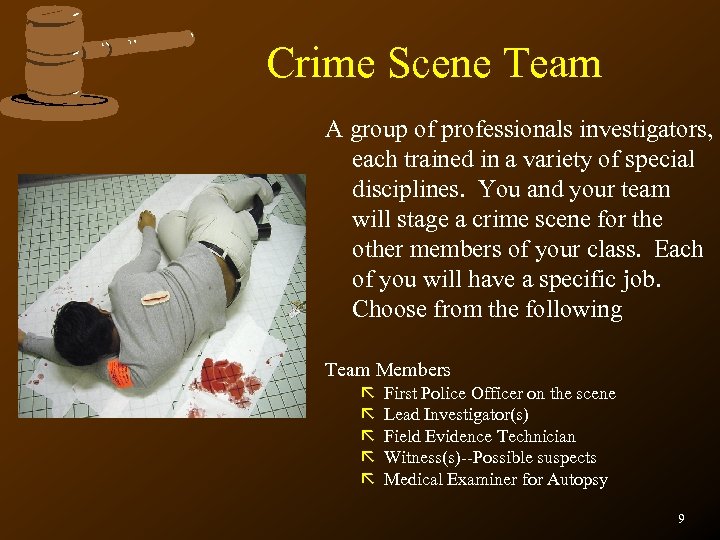 Crime Scene Team A group of professionals investigators, each trained in a variety of special disciplines. You and your team will stage a crime scene for the other members of your class. Each of you will have a specific job. Choose from the following Team Members ã ã ã First Police Officer on the scene Lead Investigator(s) Field Evidence Technician Witness(s)--Possible suspects Medical Examiner for Autopsy 9
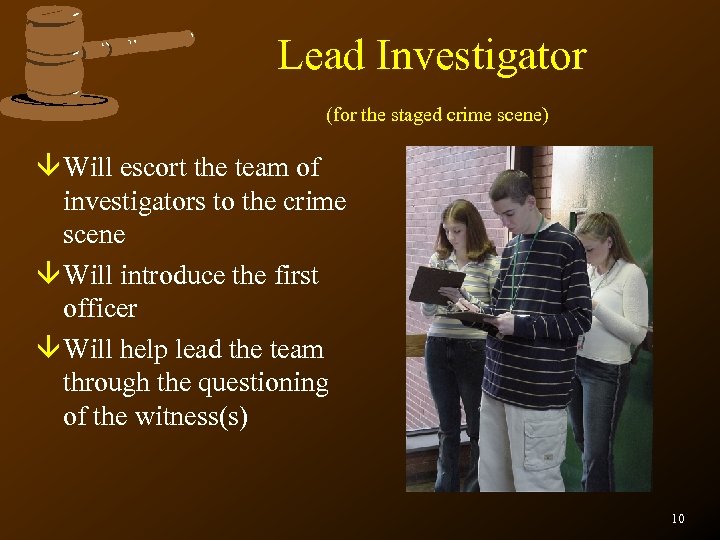 Lead Investigator (for the staged crime scene) â Will escort the team of investigators to the crime scene â Will introduce the first officer â Will help lead the team through the questioning of the witness(s) 10
 First Officer (for the staged crime scene) âDiscuss what you saw when you arrived. â Have a set time: âfor call to police âfor arrival of police âwitness(es) last seeing the victim â Give a body temperature (algor mortis). â State the body rigor. â Discuss livor mortis and/or blanching. 11
 Witnesses (for the staged crime scene) ãWill explain their part of the scene ãGive enough information to lead the team to a conclusion about what happened at this crime scene 12
 EYEWITNESS Crazy Criminal Suspect Falters Over Account of Robberies Robbery suspect Frank Margary can’t seem to keep his mouth shut. In some subtle statements, he has confessed to a series of robberies. When questioned about a November robbery at Lakeside Dili and Mini Market, he told detectives: “There’s no way the clerk could identify me, I had my hat down over my eyes. ” 13
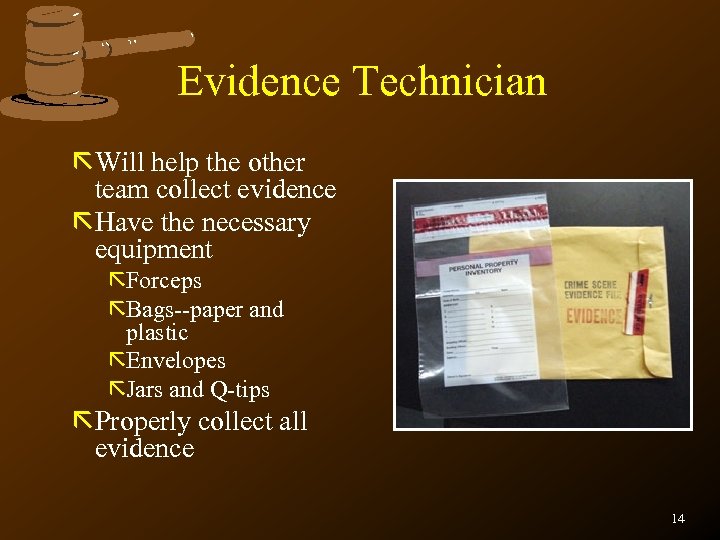 Evidence Technician ãWill help the other team collect evidence ãHave the necessary equipment ãForceps ãBags--paper and plastic ãEnvelopes ãJars and Q-tips ãProperly collect all evidence 14
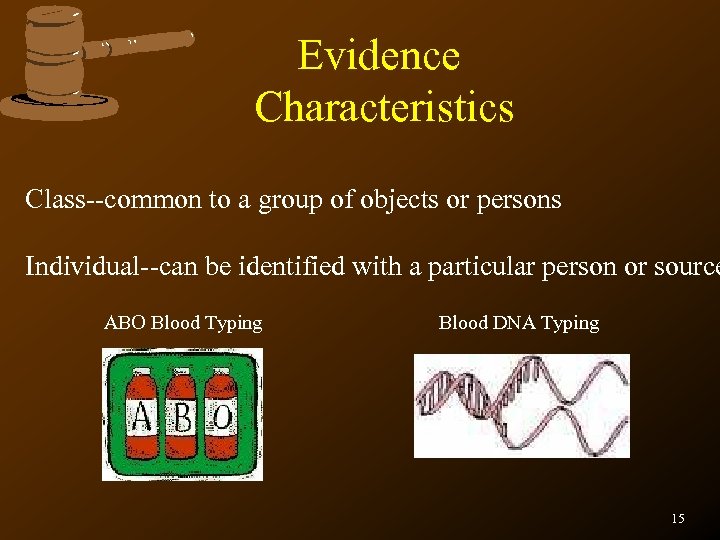 Evidence Characteristics Class--common to a group of objects or persons Individual--can be identified with a particular person or source ABO Blood Typing Blood DNA Typing 15
 Physical Evidence Be sure to include various types of evidence, in particular ones that we will be studying and working with this semester. You will have to draw the crime scene to scale. Please do not include more than 10 pieces of evidence. 16
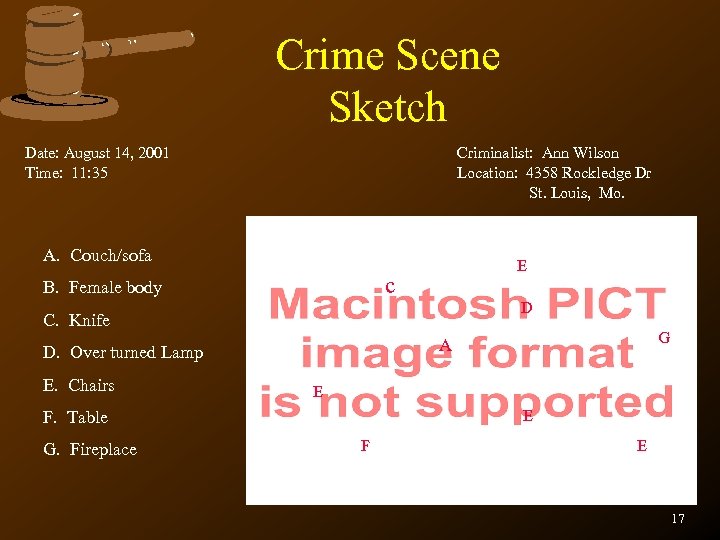 Crime Scene Sketch Date: August 14, 2001 Time: 11: 35 Criminalist: Ann Wilson Location: 4358 Rockledge Dr St. Louis, Mo. A. Couch/sofa E c B. Female body D C. Knife D. Over turned Lamp E. Chairs E F. Table G. Fireplace G A F E E E 17
 Medical Examiner’s Responsibilities ã Identify the deceased ã Establish the time and date of death ã Determine a medical cause of death--the injury or disease that resulted in the person dying ã Determine the mechanism of death--the physiological reason that the person died ã Classify the manner of death ã ã ã Natural Accidental Suicide Homicide Undetermined ã Notify the next of kin 18
 Remember: “HOW PLUS WHY EQUALS WHO” --John Douglas, former FBI profiler Keep this in mind as you set up your crime scene and work up your lab. 19
 History-Repeating Itself? *1840 *1860 *1880 *1900 *1920 *1940 *1960 *1980 *2000 William Henry Harrison--died in office Abraham Lincoln--assassinated James A. Garfield--assassinated William Mc. Kinley--assassinated Warren G. Harding--died in office Franklin D. Roosevelt--died in office John F. Kennedy--assassinated Ronald Reagan--survived assassination attempt George Bush--KIND OF SCARY? 20