


 Скачать презентацию Forensic and Investigative Accounting Chapter 3 Fraudulent Financial
73354d63e7390626bff0e93e2e45fb37.ppt
- Количество слайдов: 36
 Forensic and Investigative Accounting Chapter 3 Fraudulent Financial Reporting © 2011 CCH. All Rights Reserved. 4025 W. Peterson Ave. Chicago, IL 60646 -6085 1 800 248 3248 Chapter 3 www. CCHGroup. com Forensic and Investigative Accounting
 An International Problem Fraud is an international phenomenon touching all countries. Transparency International (TI) is a global network including more than 90 locally established national chapters and chapters-in-formation, whose goal is to fight corruption in the national arena. TI produces a Transparency International Corruption Perception Index (CPI), which ranks more than 150 countries by their perceived levels of corruption, as determined by expert assessments and opinion surveys. Chapter 3 Forensic and Investigative Accounting 2
 Michael Comer’s Types of Fraud Corruptions (e. g. , kickbacks). 2. Conflicts of interest (e. g. , drug/alcohol abuse, part-time work). 3. Theft of assets. 4. False reporting or falsifying performance (e. g. , false accounts, manipulating financial results). 5. Technological abuse (e. g. , computer related fraud, unauthorized Internet browsing). Comer’s Rule: Fraud can happen to anyone at anytime. 1. Source: M. J. Comer, Investigating Corporate Fraud, Burlington, Vt. : Gower Publishing Co. , 2003, pp. 4 -5. Chapter 3 Forensic and Investigative Accounting 3
 The Cost of Fraud Ø Ø Organizations lose 5 percent of annual revenue to fraud and abuse. Fraud and abuse costs organizations more than $2. 9* trillion annually. * $994 billion in 2008 in U. S. $652 billion in 2006. $660 billion in 2004. Source: 2010 Wells Report Chapter 3 Forensic and Investigative Accounting 4
 Advantage of Compliance Spending General Counsel Roundtable says that each $1 of compliance spending saves organizations, on the average, $5. 21 in heightened avoidance of legal liabilities, harm to the organization’s reputation, and lost productivity. Source: Jonny Frank, “Fraud Risk Assessments, ” Internal Auditor, April 2004, p. 47. Chapter 3 Forensic and Investigative Accounting 5
![Some Research on Fraud Primary motivation to commit fraud [Dechow et al. ] 1.](https://present5.com/presentation/73354d63e7390626bff0e93e2e45fb37/image-6.jpg "Some Research on Fraud Primary motivation to commit fraud [Dechow et al. ] 1.") Some Research on Fraud Primary motivation to commit fraud [Dechow et al. ] 1. Desire to obtain low-cost loans. 2. Weaker governance system. 3. Experience higher cost of capital after fraud discovered. 4. Summers and Sweeney [1998]: 5. 6. In the presence of fraud, insiders reduce their holdings of company stock through high levels of selling activity. Also, growth, inventory, and ROA differ significantly. Chapter 3 Forensic and Investigative Accounting 6
Some Research on Fraud Primary motivation to commit fraud [Dechow et al. ] 1. Desire to obtain low-cost loans. 2. Weaker governance system. 3. Experience higher cost of capital after fraud discovered. 4. Summers and Sweeney [1998]: 5. 6. In the presence of fraud, insiders reduce their holdings of company stock through high levels of selling activity. Also, growth, inventory, and ROA differ significantly. Chapter 3 Forensic and Investigative Accounting 6
 The Methods - Frequency Ø Ø Ø Asset misappropriation accounted for more than four out of five offenses or 90% in 2010 (88. 7% in 2008) (91. 5% in 2006) (92. 7% in 2004). $135, 000 Bribery and corruption constituted about 30% (27. 4% in 2008) (30. 8% in 2006) (30. 1% in 2004) of offenses. $250, 000 ($375, 000) ($538, 000) Fraudulent statements were the smallest category of offense 5% (10. 3% in 2008) (10. 6% in 2006) (7. 9% in 2004) (most costly). $4 million per scheme. Source: 2010 Global Fraud Study, ACFE. Chapter 3 Forensic and Investigative Accounting 7
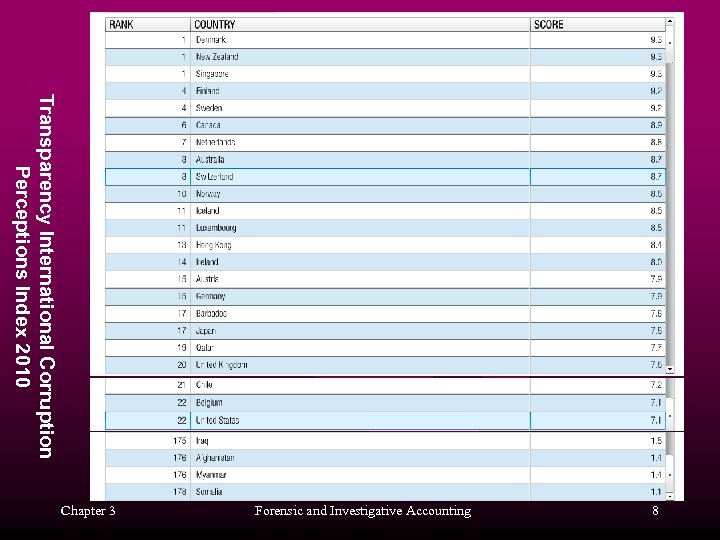 Transparency International Corruption Perceptions Index 2010 8 Forensic and Investigative Accounting Chapter 3
 One Small Clue A former Scotland Yard scientist tried to create the world’s biggest fraud by authenticating $2. 5 trillion worth of fake U. S. Treasury bonds. When two men tried to pass off $25 million worth of the bonds in Toronto in 2001, a Mountie noticed the bonds bore the word “dollar” rather “dollars. ” Police later raided a London bank vault and discovered that the bonds had been printed with an ink jet printer that had not been invented when the bonds were allegedly produced. Zip codes were used even though they were not introduced until 1963. Sue Clough, “Bungling Scientist Is Jailed for Plotting World's Biggest Fraud, ” News. telegraph. co. uk, January 11, 2003. Chapter 3 Forensic and Investigative Accounting 9
 Catch Me If You Can Numbers Don’t Lie. Criminals are another story. Money talks. But more often it whispers. When shady characters are up to no good, they often leave a trail of questionable financial transactions. Chapter 3 Forensic and Investigative Accounting 10
 Three M’s of Financial Reporting Fraud Manipulation, falsification, or alteration of accounting records or supporting documents from which financial statements are prepared. n Misrepresentation in or intentional omission from the financial statements of events, transactions, or other significant information. n Intentional misapplication of accounting principles relating to amounts, classification, manner of presentation, or disclosure. n Source: D. S. Hilzenrath, “Forensic Auditors Find What Some Companies Try to Hide, ” The Washington Post, November 23, 2002, p. 19. Chapter 3 Forensic and Investigative Accounting 11
 Fraud Schemes Based on SEC Releases 1. 2. 3. 4. 5. Fictitious and/or overstated revenues and assets. Fictitious reductions of expenses and liabilities. Premature revenue recognition. Misclassified revenues and assets. Overvalued assets or undervalued expenses and liabilities. (continued on next slide) Chapter 3 Forensic and Investigative Accounting 12
 Fraud Schemes Based on SEC Releases Omitted liabilities. 7. Omitted or improper disclosures. 8. Equity fraud. 9. Related-party transactions. 10. Alter ego. 11. Minimizing income or inflating expenses to reduce tax liabilities. 6. Chapter 3 Forensic and Investigative Accounting 13
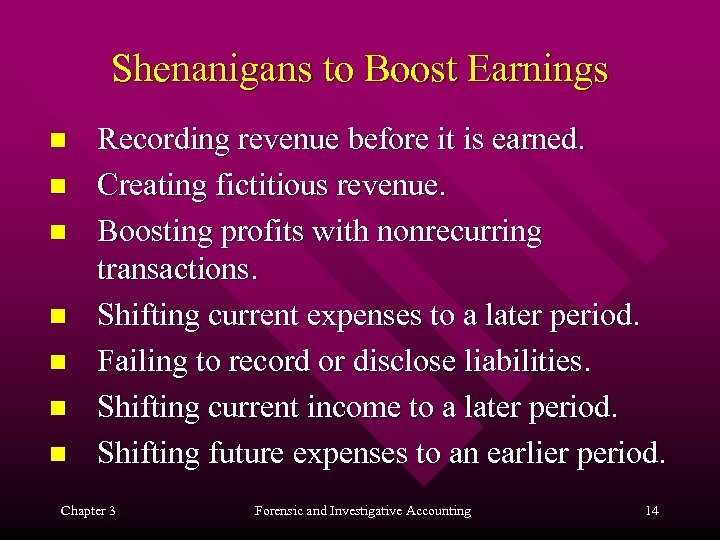 Shenanigans to Boost Earnings n n n n Recording revenue before it is earned. Creating fictitious revenue. Boosting profits with nonrecurring transactions. Shifting current expenses to a later period. Failing to record or disclose liabilities. Shifting current income to a later period. Shifting future expenses to an earlier period. Chapter 3 Forensic and Investigative Accounting 14
 Rationalization Sherron Watkins provides an excellent comment about rationalization with respect to Enron’s Jeff Skilling and Andy Fastow. At what point did they turn crooked? “But there is not a defining point where they became corrupt. It was one small step after another, with more and more rationalizations. There was a slow erosion of values over time. ” Source: Pamela Colloff, “The Whistle-Blower, ” Texas Monthly, April 2003, p. 141. Chapter 3 Forensic and Investigative Accounting 15
 Reframing Behavioral psychologists call this rationalization “reframing, ” where someone who is about to cheat will adjust the definition of cheating to exclude his or her actions. Dan Ariely says “people who would never take $5 from petty cash have no problem paying for a drink for a stranger and putting it on a company tab. ” Source: S. L. Mintz, “The Gauge of Innocence, ” CFO, April 2009, p. 56. Chapter 3 Forensic and Investigative Accounting 16
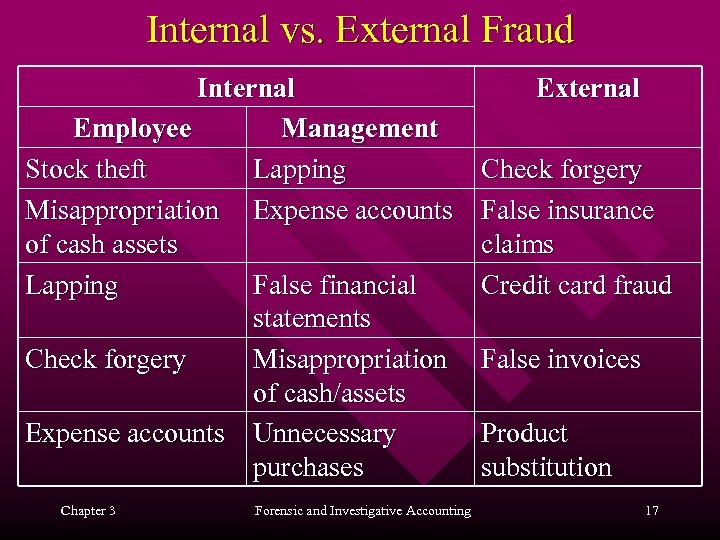 Internal vs. External Fraud Internal Employee Management Stock theft Lapping Misappropriation Expense accounts of cash assets Lapping False financial statements Check forgery Misappropriation of cash/assets Expense accounts Unnecessary purchases Chapter 3 Forensic and Investigative Accounting External Check forgery False insurance claims Credit card fraud False invoices Product substitution 17
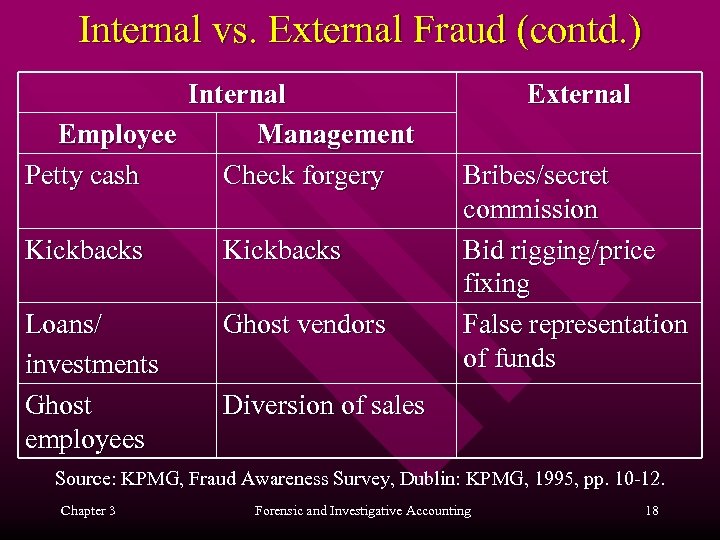 Internal vs. External Fraud (contd. ) Internal Employee Management Petty cash Check forgery Kickbacks Loans/ investments Ghost employees Ghost vendors External Bribes/secret commission Bid rigging/price fixing False representation of funds Diversion of sales Source: KPMG, Fraud Awareness Survey, Dublin: KPMG, 1995, pp. 10 -12. Chapter 3 Forensic and Investigative Accounting 18
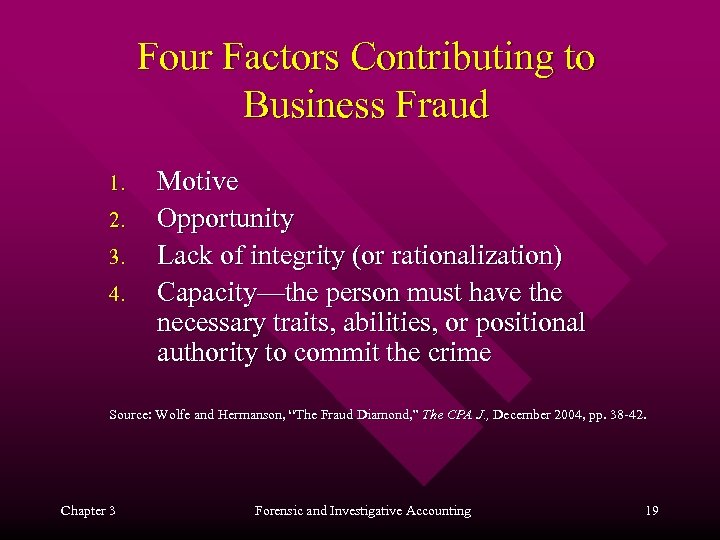 Four Factors Contributing to Business Fraud 1. 2. 3. 4. Motive Opportunity Lack of integrity (or rationalization) Capacity—the person must have the necessary traits, abilities, or positional authority to commit the crime Source: Wolfe and Hermanson, “The Fraud Diamond, ” The CPA J. , December 2004, pp. 38 -42. Chapter 3 Forensic and Investigative Accounting 19
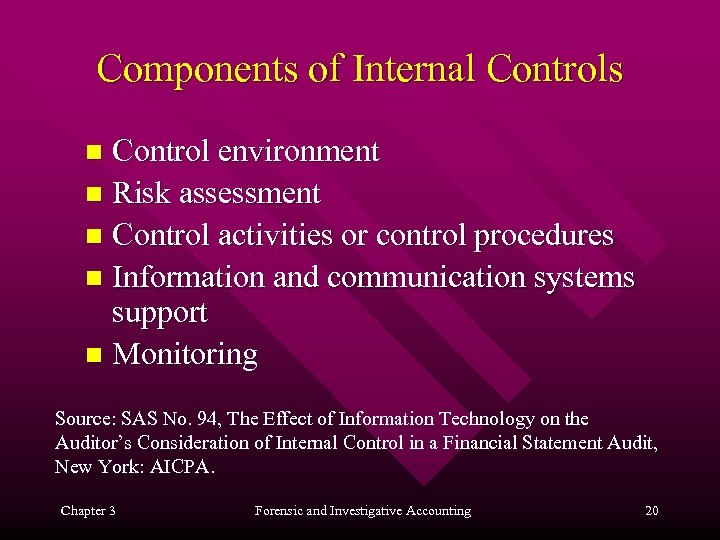 Components of Internal Controls Control environment n Risk assessment n Control activities or control procedures n Information and communication systems support n Monitoring n Source: SAS No. 94, The Effect of Information Technology on the Auditor’s Consideration of Internal Control in a Financial Statement Audit, New York: AICPA. Chapter 3 Forensic and Investigative Accounting 20
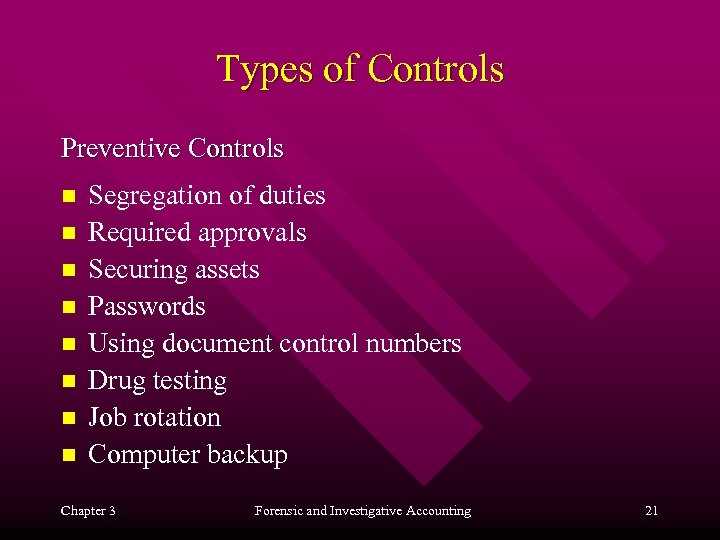 Types of Controls Preventive Controls n n n n Segregation of duties Required approvals Securing assets Passwords Using document control numbers Drug testing Job rotation Computer backup Chapter 3 Forensic and Investigative Accounting 21
 Types of Controls Detective Controls Reconciliations n Reviews n Event notifications n Surprise cash count n Counting inventory n Chapter 3 Forensic and Investigative Accounting 22
 Types of Controls Corrective Controls Training n Process redesign n Additional technology n Quality circle teams n Budget variance reports n Chapter 3 Forensic and Investigative Accounting 23
 Earnings Management Earnings management may be defined as the “purposeful intervention in the external financial reporting process, with the intent of obtaining some private gain. ” – Katherine Schipper, “Commentary on Earnings Management, ” Accounting Horizon, December 1989, p. 92. Chapter 3 Forensic and Investigative Accounting 24
 Difficult to Measure Integrity Richard Davis says there is no psychometric way to measure integrity, so forget about personality tests to pick the fraudsters. They are easily faked. He is more hopeful about new methods involving microexpressions, or those brief facial expressions that may reveal a person’s predisposition to fraud. Source: S. L. Mintz, “The Gauge of Innocence, ” CFO, April 2009, p. 57. Chapter 3 Forensic and Investigative Accounting 25
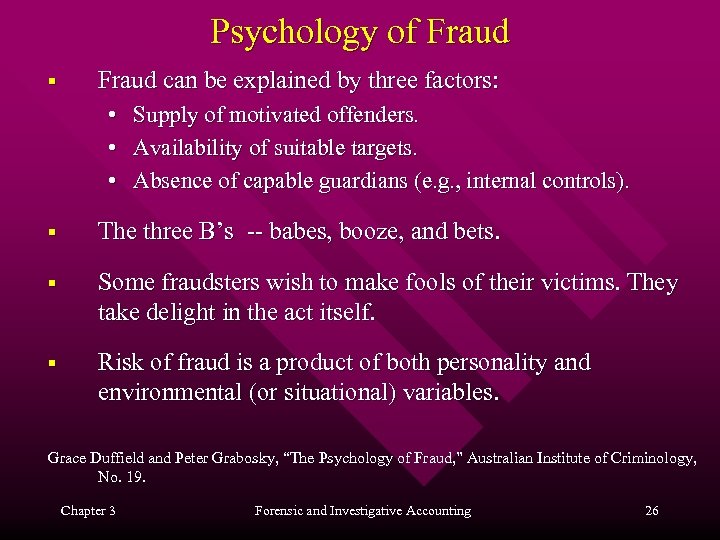 Psychology of Fraud § Fraud can be explained by three factors: • • • Supply of motivated offenders. Availability of suitable targets. Absence of capable guardians (e. g. , internal controls). § The three B’s -- babes, booze, and bets. § Some fraudsters wish to make fools of their victims. They take delight in the act itself. § Risk of fraud is a product of both personality and environmental (or situational) variables. Grace Duffield and Peter Grabosky, “The Psychology of Fraud, ” Australian Institute of Criminology, No. 19. Chapter 3 Forensic and Investigative Accounting 26
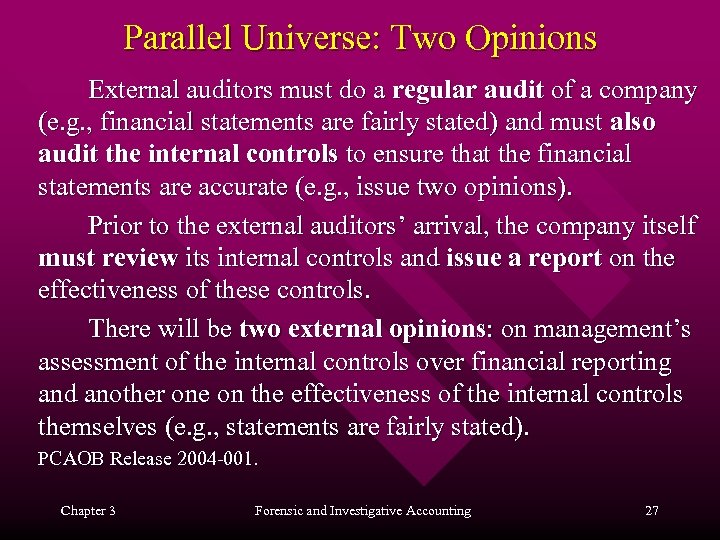 Parallel Universe: Two Opinions External auditors must do a regular audit of a company (e. g. , financial statements are fairly stated) and must also audit the internal controls to ensure that the financial statements are accurate (e. g. , issue two opinions). Prior to the external auditors’ arrival, the company itself must review its internal controls and issue a report on the effectiveness of these controls. There will be two external opinions: on management’s assessment of the internal controls over financial reporting and another one on the effectiveness of the internal controls themselves (e. g. , statements are fairly stated). PCAOB Release 2004 -001. Chapter 3 Forensic and Investigative Accounting 27
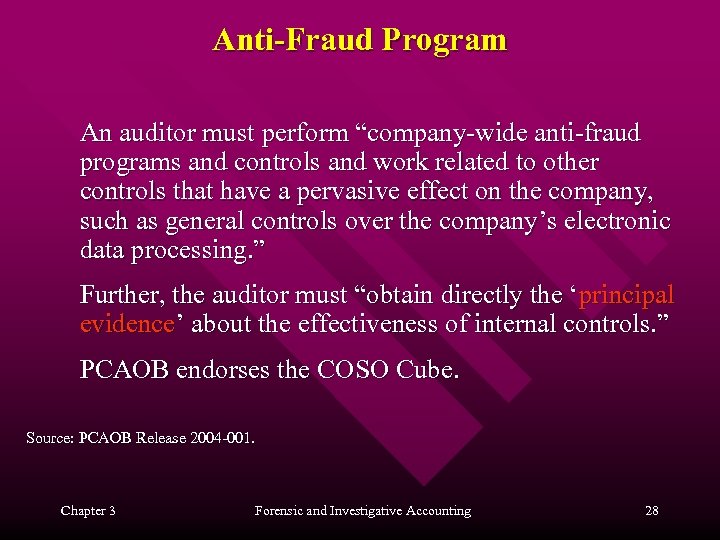 Anti-Fraud Program An auditor must perform “company-wide anti-fraud programs and controls and work related to other controls that have a pervasive effect on the company, such as general controls over the company’s electronic data processing. ” Further, the auditor must “obtain directly the ‘principal evidence’ about the effectiveness of internal controls. ” PCAOB endorses the COSO Cube. Source: PCAOB Release 2004 -001. Chapter 3 Forensic and Investigative Accounting 28
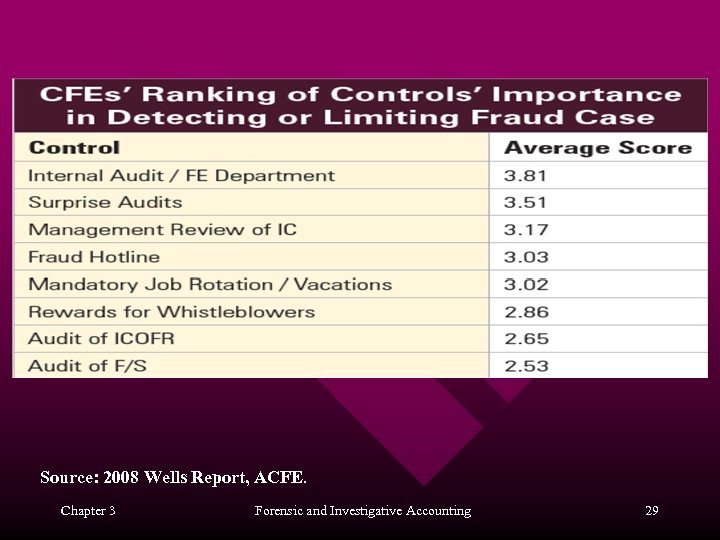 Source: 2008 Wells Report, ACFE. Chapter 3 Forensic and Investigative Accounting 29
 Fraud’s Fatal Failings Ø Ø Ø 85% of fraud victims never get their money or property back. Most investigations flounder, leaving the victims to defend for themselves against counter-attacks by hostile parties. 30% of companies that fail do so because of fraud. Source: Michael J. Comer, Investigating Corporate Fraud, Burlington, VT: Gower Publishing, 2003, p. 9. Chapter 3 Forensic and Investigative Accounting 30
 COSO Study Findings n n Financial fraud affects companies of all sizes, with the median company having assets and revenues just under $100 million. The median fraud was $12. 1 million. More than 30 of the fraud cases each involved misstatements/misappropriations of $500 million or more. The SEC names the CEO and/or CFO for involvement in 89 percent of the fraud cases. Within two years of the completion of the SEC investigation, about 20 percent of the CEOs/CFOs had been indicted. Over 60 percent of those indicted were convicted. Motivations include meeting expectations, concealing deteriorating financial conditions, and preparing for debt/equity offerings. Chapter 3 Forensic and Investigative Accounting 31
 COSO Study Findings n n n Revenue frauds accounted for over 60 percent of the cases. Overstated assets, 51%. Understatement of expenses/ liabilities (31%). Misappropriation of assets, 14%. Many of the commonly observed board of director and audit committee characteristics such as size, meeting frequency, composition, and experience do not differ meaningfully between fraud and no-fraud companies. Recent corporate governance regulatory efforts appear to have reduced variation in observable board-related governance characteristics. Twenty-six percent of the firms engaged in fraud changed auditors during the period examined compared to a 12 percent rate for no-fraud firms. Chapter 3 Forensic and Investigative Accounting 32
 COSO Study Findings n n Initial news in the press of an alleged fraud resulted in an average 16. 7 percent abnormal stock price decline for the fraud company in the two days surrounding the announcement. News of an SEC or Department of Justice investigation resulted in an average 7. 3 percent abnormal stock price decline. Companies engaged in fraud often experienced bankruptcy, delisting from a stock exchange, or material asset sales at rates much higher than those experienced by no-fraud firms. 50% of the stock traded on NASDAQ over a variety of industries. Chapter 3 Forensic and Investigative Accounting 33
 COSO Study Findings n n 20% of the fraud companies were in the computer hardware/software industry and 20% were in financial service providers. 11% were in health care and health products. 45% of the Section 404 opinions indicated effective controls and 45% indicated ineffective controls. Source: COSO News Release, Alamonte Springs, May 20, 2010, www. coso. org/documents. Chapter 3 Forensic and Investigative Accounting 34
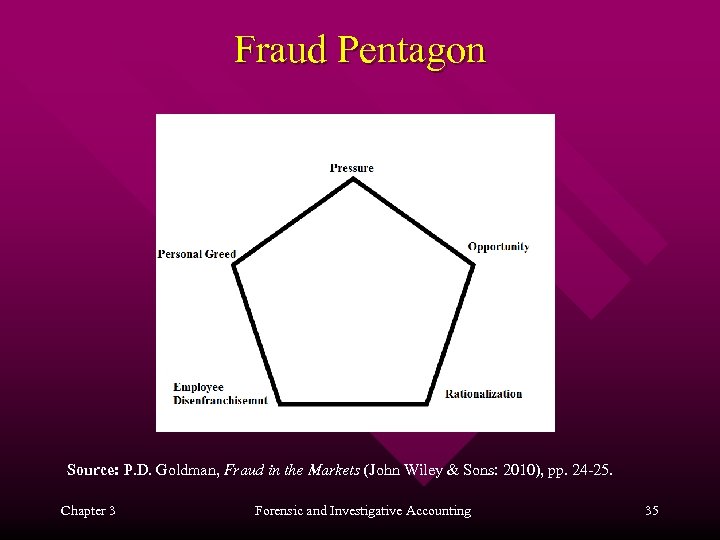 Fraud Pentagon Source: P. D. Goldman, Fraud in the Markets (John Wiley & Sons: 2010), pp. 24 -25. Chapter 3 Forensic and Investigative Accounting 35
 A Thin Line There certainly is a thin line between legal earnings management and abusive earnings management. Where does a company cross the line between criminal behavior and merely conduct that is beneficial to the organization? Chapter 3 Forensic and Investigative Accounting 36