


 Скачать презентацию FOREIGN TOURISM CLUSTERS AN OVERVIEW AND THE EXAMPLES
Petrovic M. D._Foreign Tourism Clusters.ppt
- Количество слайдов: 15
 FOREIGN TOURISM CLUSTERS AN OVERVIEW AND THE EXAMPLES Marko D. Petrovic, Ph. D. South Ural State University, Chelyabinsk, October 19, 2017
 Introduction Over the last few decades, tourism has been one of the activities with the highest potential for the regional development and global expansion Since the 1980 s, the fast internationalization process and the opening of national economies have boosted tourism to becoming one of the most growing global sector (second only to the financial sectors) [Silveira, 2002] But for the successful tourism, it is necessary to have not only attractive resources, capacities and high-quality products, but also an adequate training, well-designed marketing and efficient organization The concept of cluster is situated in specific characteristics of tourism activities. The tourism product interacts with local base (physical space and social actors), leading to joint actions of inter-related enterprises with great power to create conglomerates
 The definitions of the “cluster in tourism” and its characteristics q Cluster in tourism can be define as a cluster which ambition is to reinforce, in terms of sustainable development, the destination identity – what makes it different from other destinations – and which stakeholders are all responsible for it q The characteristics define the cluster potential of tourism activities: 1. the complementarities and interdependence among the parts of a tourism conglomerate occur through the interaction and organization of the local actors 2. the necessary integration of people, culture, economy and nature results in actions and interventions, which come true in a systemic way 3. the power of attraction depends on the differing potential of the tourism product and the supporting services
 Some of the good examples of “tourism clustering” are…
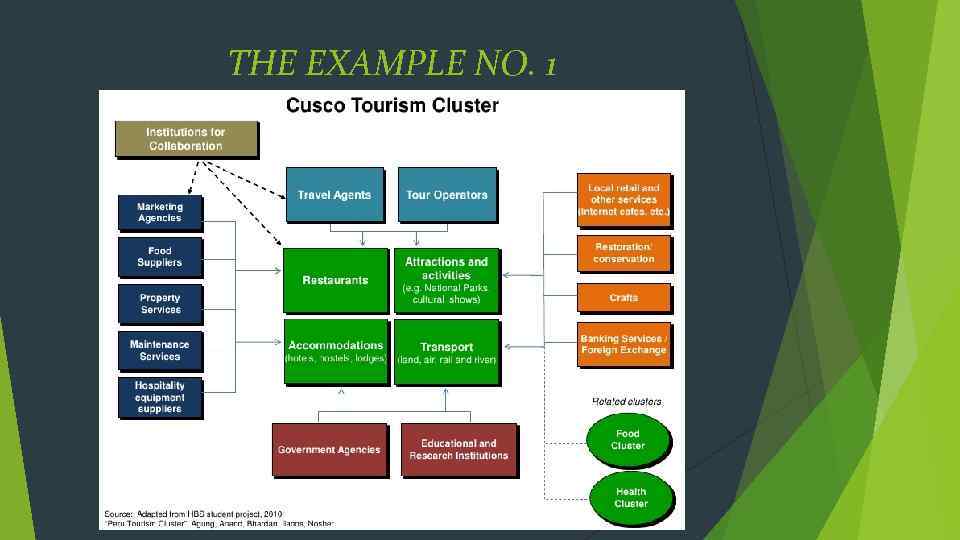 THE EXAMPLE NO. 1
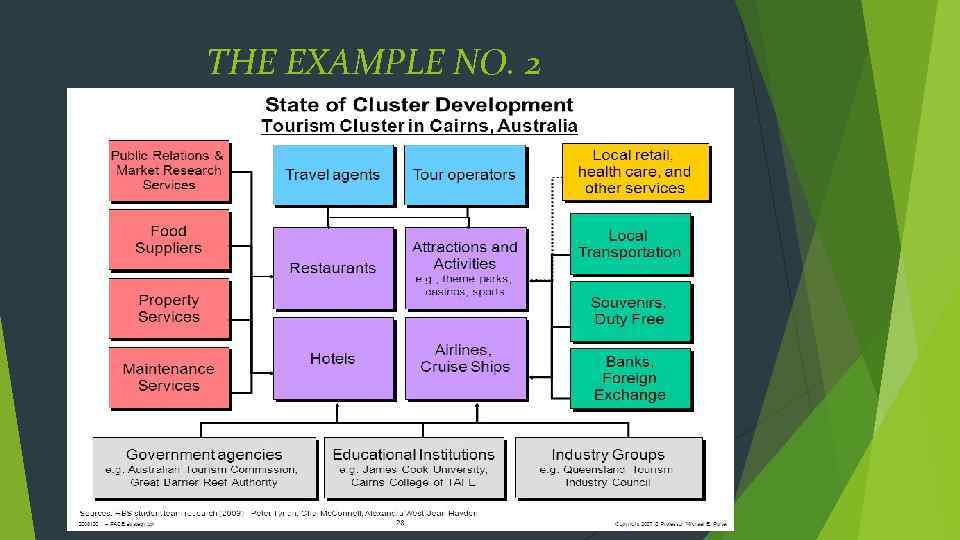 THE EXAMPLE NO. 2
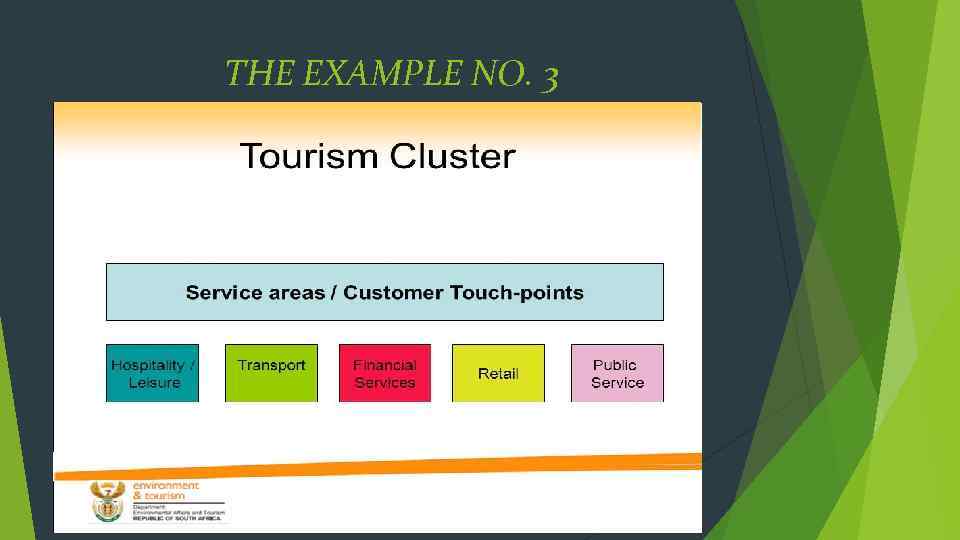 THE EXAMPLE NO. 3
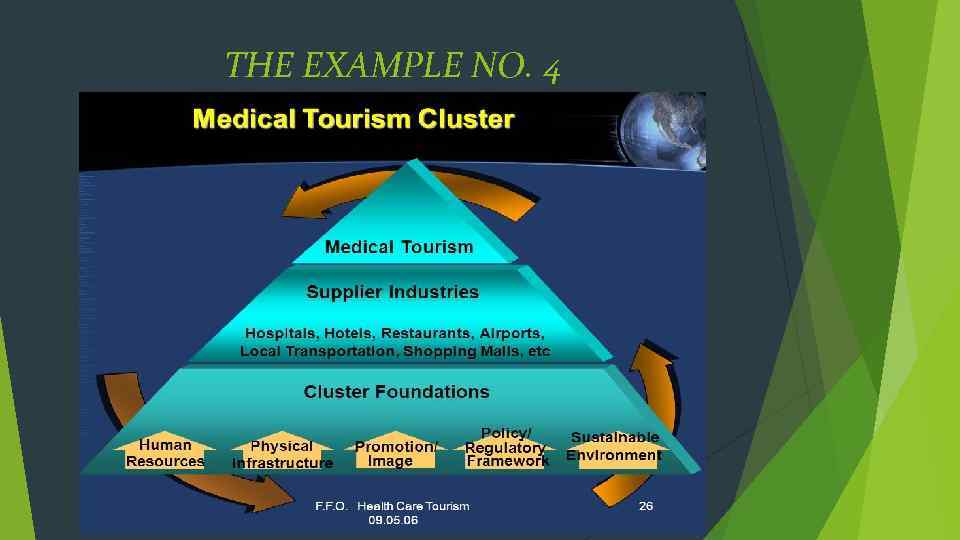 THE EXAMPLE NO. 4
 The tourism cluster can be understood in two ways: Horizontal – by the creation of strategic alliances, where agreements can be of two kinds: 1. the agreements between enterprises that have the same principal activity, i. e. among enterprises that deal with entertainment, transport, catering… 2. the agreements between enterprises working with the same group of customer satisfaction, but offering different product components to the customers [Rodrigues, 2001, p. 307] Vertical – by the creation of strategic nets, where there is the establishment of a unilateral supplier/customer relation among the partners • This can be organized in such a way that the object activities of the agreement are fulfilled by one of the parts, which gives its output to the other in exchange for a payment
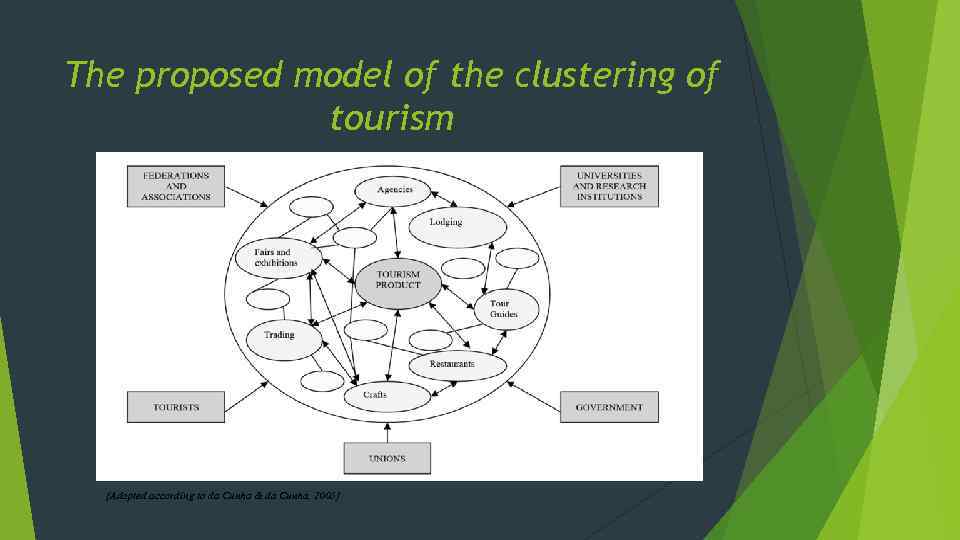 The proposed model of the clustering of tourism [Adapted according to da Cunha & da Cunha, 2005]
 Systemic cluster competitiveness in tourism comprises four levels of the relationships: 1. Metalevel – involving socio-cultural factors that define the articulating ability of social actors to formulate strategies and policies demanded by local society 2. Macrolevel – macroeconomic strategies and stability determined by policies: fiscal, monetary, foreign exchange, commercial and competition policies 3. Mesolevel – supporting structures that facilitate interaction and cooperation among many companies (marketing, exports, fairs, etc. ), labor training and training institutions and infrastructure 4. Microlevel – the capability of a company to be competitive by offering goods and services that optimize cost efficiency relationships, quality and variety [Adapted according to Altenburg et al. , 1998]
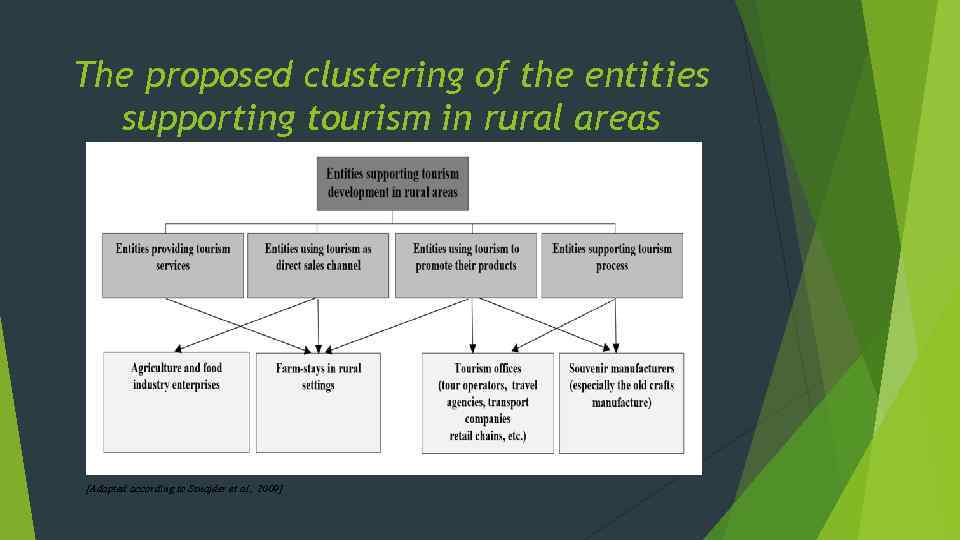 The proposed clustering of the entities supporting tourism in rural areas [Adapted according to Sznajder et al. , 2009]
 Cooperation in tourism on the national and international level – the examples of successful rural development in the EU and Serbia Cooperation on national level Cooperation on international level
 Conclusion The spatial expansion of tourism and the growing diversification of this activity in the world at the same time creates opportunities for countries, regions and communities to seek to bring about their development, but also can brings damaging effects One of the challenges for government agents in charge of elaborating and implementing development policies for tourism activities is to build a model of sustained development with competitiveness, sustainability and social justice The focus of the cluster analyses is adapted to the characteristics of tourism activity as it is based on the analyses of agglomerations, functional complementary, cooperative relationships and competition among the all involved actors Otherwise, the traditional cluster analyses are not clear when the objective is to evaluate local impacts concerning sustainability, competitiveness and social justice
 THANK YOU FOR YOUR ATTENTION! All questions or suggestions regarding this presentation you may send at: m. petrovic@gi. sanu. ac. rs South Ural State University, Chelyabinsk, October 19, 2017