


 Скачать презентацию Foreign Exchange Risk u Transaction u Operating Exposure
3866eb5c444e7886d10bbbd37f9f43ae.ppt
- Количество слайдов: 87
 Foreign Exchange Risk u Transaction u Operating Exposure - Chapter 10 Exposure - Chapter 12 u Translation Exposure - Chapter 11 1
 OUTLINE FOR CHAPTER 10 u Understand Transaction Risk v. Definition of Transaction Risk v. How to hedge a receivable v. How to hedge a payable v. Picking the best alternative v. Should a firm hedge 2
 Chapter 10 - Transaction Risk u Measures changes in the value of outstanding financial obligations incurred prior to a change in exchange rates but not due to be settled until after an exchange rate change 3
 Transaction Exposure Arises From: u Buying or selling goods and services on credit whose prices are stated in a foreign currency u Borrowing or lending in a foreign currency u Being a party to an underperformed foreign exchange forward contract u Acquiring other assets or incurring other liabilities denominated in a foreign currency 4
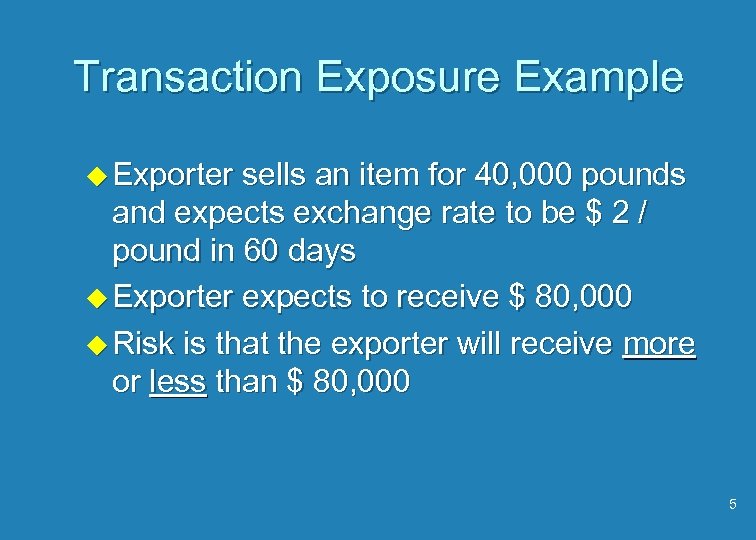 Transaction Exposure Example u Exporter sells an item for 40, 000 pounds and expects exchange rate to be $ 2 / pound in 60 days u Exporter expects to receive $ 80, 000 u Risk is that the exporter will receive more or less than $ 80, 000 5
 Transaction Exposure u Note if exporter invoices in home currency the exporter avoids transaction risk u In this case risk is transferred to the importer 6
 Hedging u Taking a position (either acquiring a cash flow, an asset, or a contract) that will rise (fall) in value and offset a fall (rise) in the value of the existing position. u Hedging reduces the possible losses of the firm at the expense of reducing possible gains. It reduces the variance of cash flows. 7
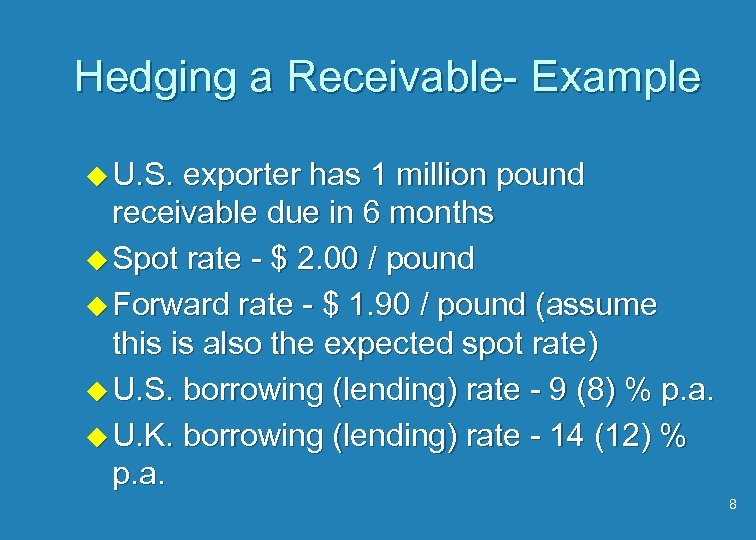 Hedging a Receivable- Example u U. S. exporter has 1 million pound receivable due in 6 months u Spot rate - $ 2. 00 / pound u Forward rate - $ 1. 90 / pound (assume this is also the expected spot rate) u U. S. borrowing (lending) rate - 9 (8) % p. a. u U. K. borrowing (lending) rate - 14 (12) % p. a. 8
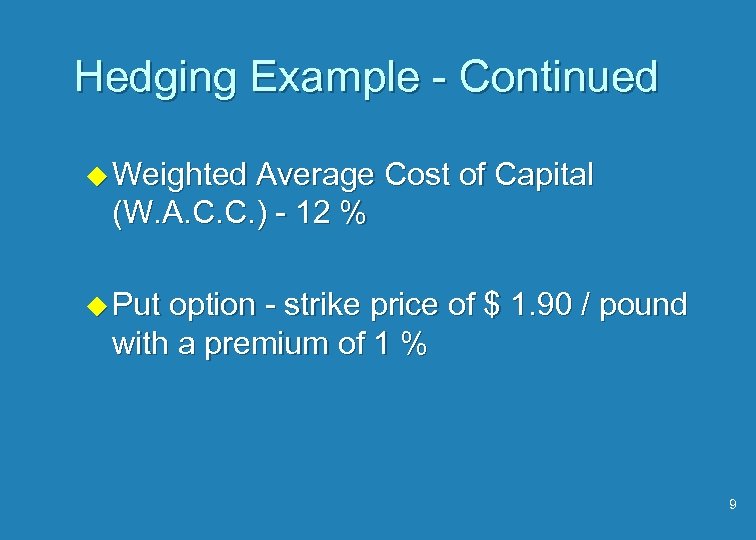 Hedging Example - Continued u Weighted Average Cost of Capital (W. A. C. C. ) - 12 % u Put option - strike price of $ 1. 90 / pound with a premium of 1 % 9
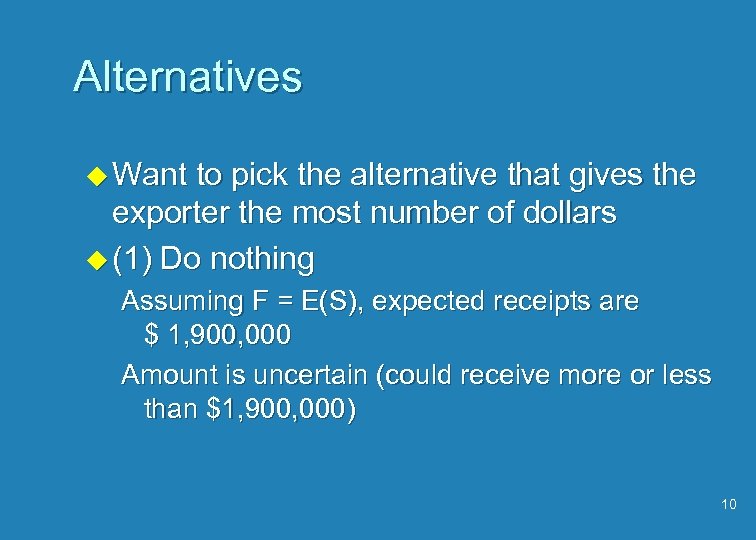 Alternatives u Want to pick the alternative that gives the exporter the most number of dollars u (1) Do nothing Assuming F = E(S), expected receipts are $ 1, 900, 000 Amount is uncertain (could receive more or less than $1, 900, 000) 10
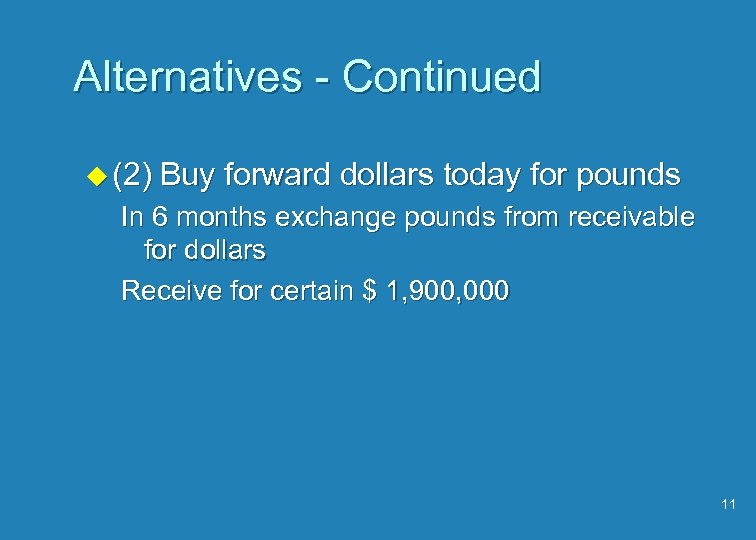 Alternatives - Continued u (2) Buy forward dollars today for pounds In 6 months exchange pounds from receivable for dollars Receive for certain $ 1, 900, 000 11
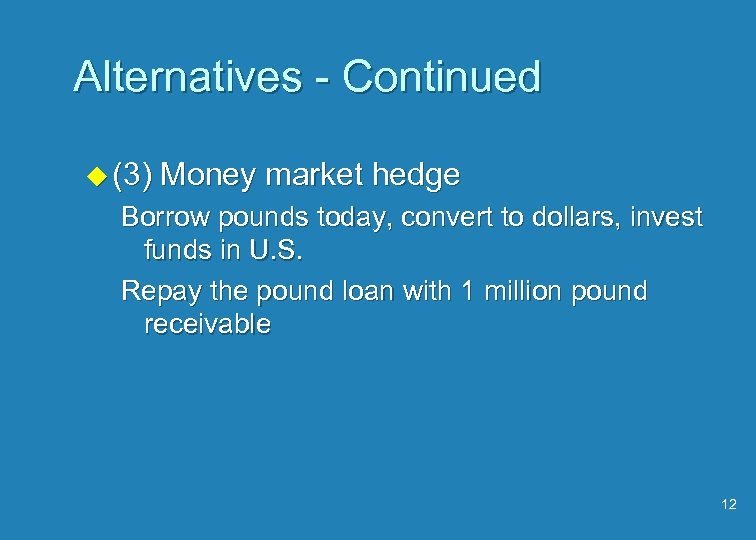 Alternatives - Continued u (3) Money market hedge Borrow pounds today, convert to dollars, invest funds in U. S. Repay the pound loan with 1 million pound receivable 12
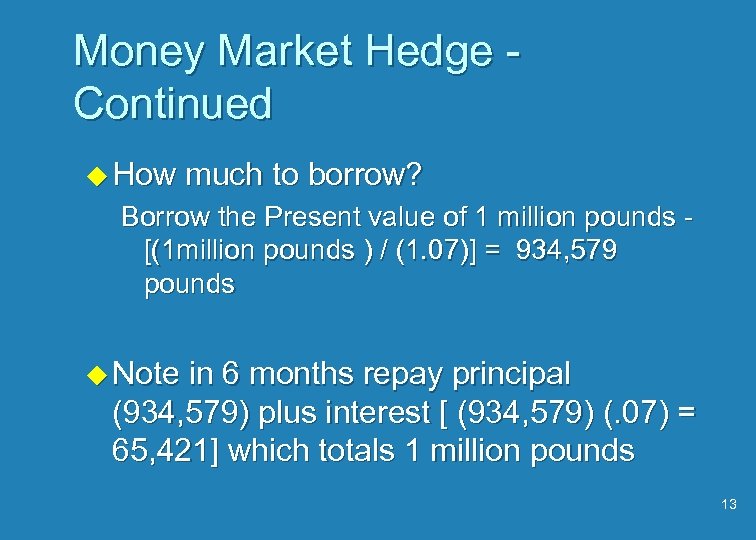 Money Market Hedge Continued u How much to borrow? Borrow the Present value of 1 million pounds [(1 million pounds ) / (1. 07)] = 934, 579 pounds u Note in 6 months repay principal (934, 579) plus interest [ (934, 579) (. 07) = 65, 421] which totals 1 million pounds 13
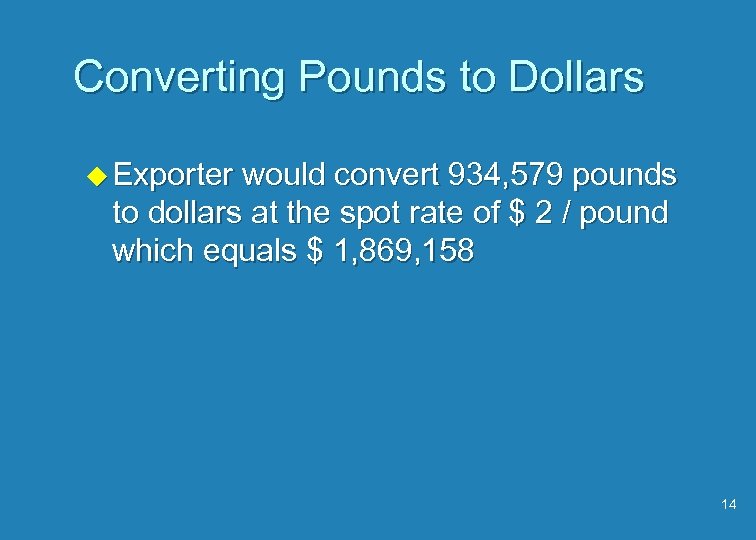 Converting Pounds to Dollars u Exporter would convert 934, 579 pounds to dollars at the spot rate of $ 2 / pound which equals $ 1, 869, 158 14
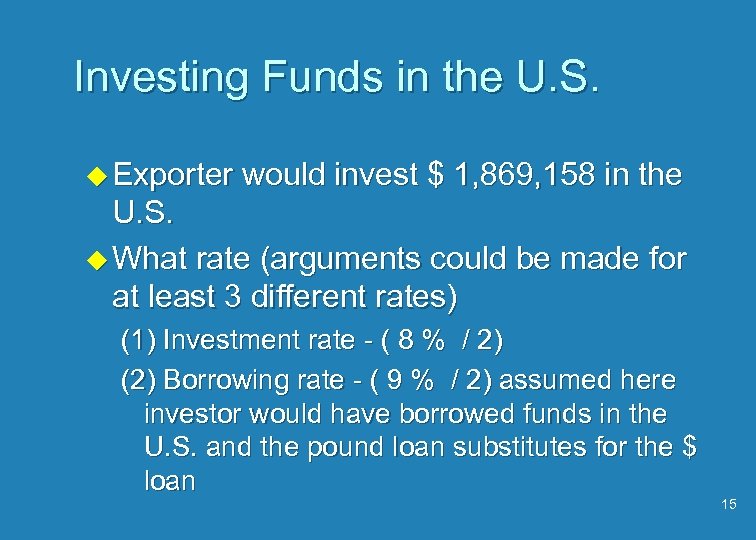 Investing Funds in the U. S. u Exporter would invest $ 1, 869, 158 in the U. S. u What rate (arguments could be made for at least 3 different rates) (1) Investment rate - ( 8 % / 2) (2) Borrowing rate - ( 9 % / 2) assumed here investor would have borrowed funds in the U. S. and the pound loan substitutes for the $ loan 15
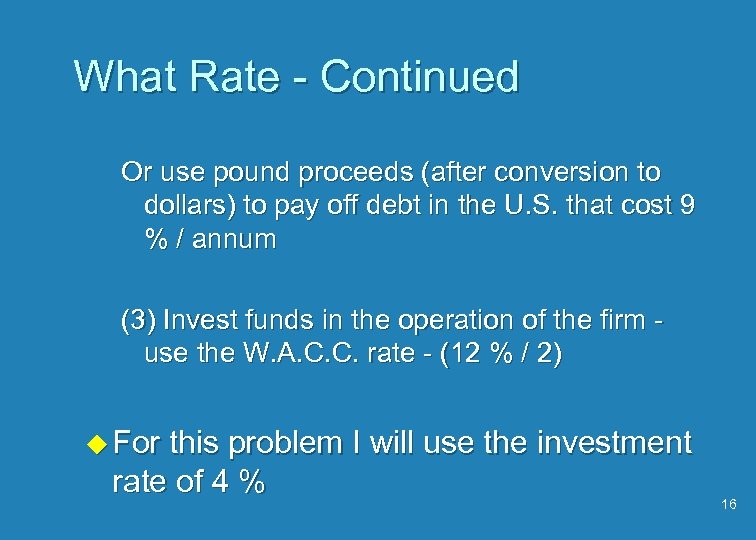 What Rate - Continued Or use pound proceeds (after conversion to dollars) to pay off debt in the U. S. that cost 9 % / annum (3) Invest funds in the operation of the firm use the W. A. C. C. rate - (12 % / 2) u For this problem I will use the investment rate of 4 % 16
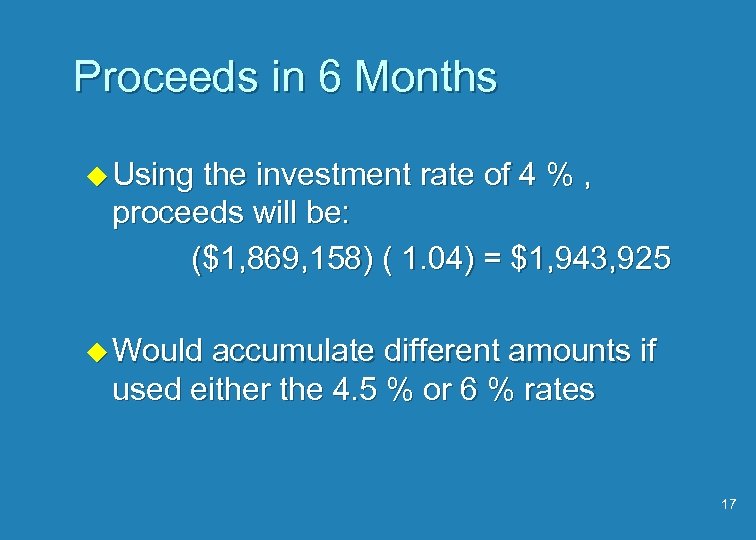 Proceeds in 6 Months u Using the investment rate of 4 % , proceeds will be: ($1, 869, 158) ( 1. 04) = $1, 943, 925 u Would accumulate different amounts if used either the 4. 5 % or 6 % rates 17
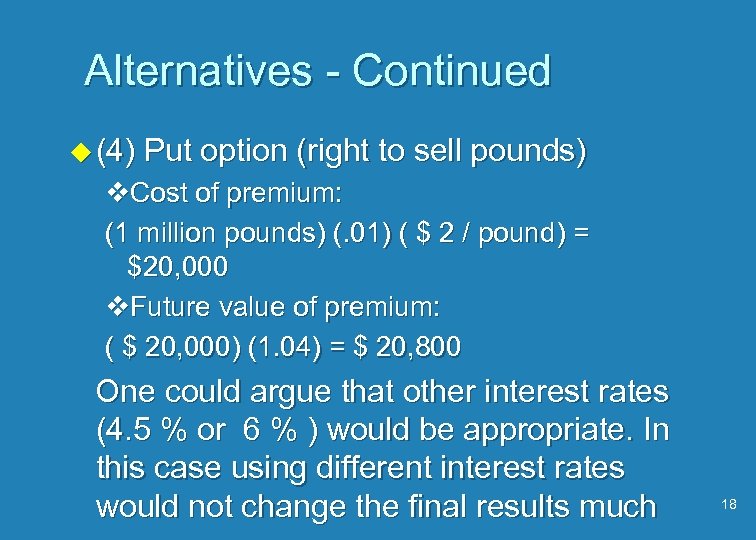 Alternatives - Continued u (4) Put option (right to sell pounds) v. Cost of premium: (1 million pounds) (. 01) ( $ 2 / pound) = $20, 000 v. Future value of premium: ( $ 20, 000) (1. 04) = $ 20, 800 One could argue that other interest rates (4. 5 % or 6 % ) would be appropriate. In this case using different interest rates would not change the final results much 18
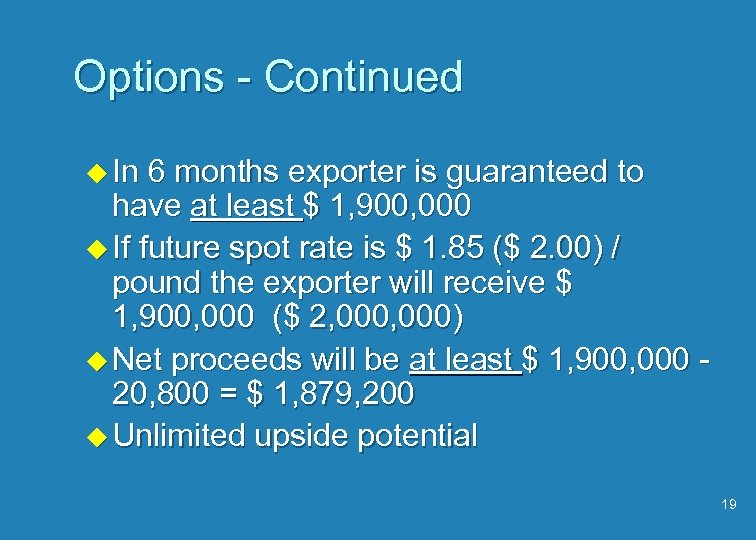 Options - Continued u In 6 months exporter is guaranteed to have at least $ 1, 900, 000 u If future spot rate is $ 1. 85 ($ 2. 00) / pound the exporter will receive $ 1, 900, 000 ($ 2, 000) u Net proceeds will be at least $ 1, 900, 000 20, 800 = $ 1, 879, 200 u Unlimited upside potential 19
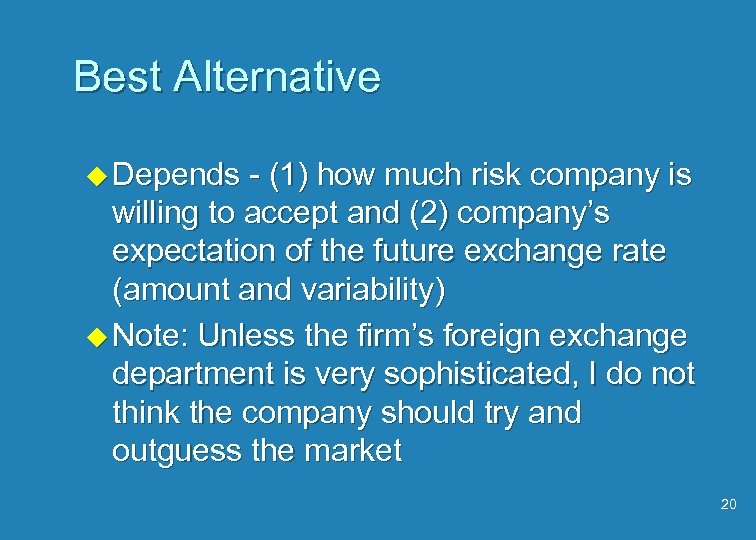 Best Alternative u Depends - (1) how much risk company is willing to accept and (2) company’s expectation of the future exchange rate (amount and variability) u Note: Unless the firm’s foreign exchange department is very sophisticated, I do not think the company should try and outguess the market 20
 Best Alternative - Continued u In this problem can say money market hedge is better than forward hedge no matter which of the three interest rate assumptions is made u Choosing between the money market hedge and the put option is more difficult. How much risk is the company willing to accept for potentially more gain. 21
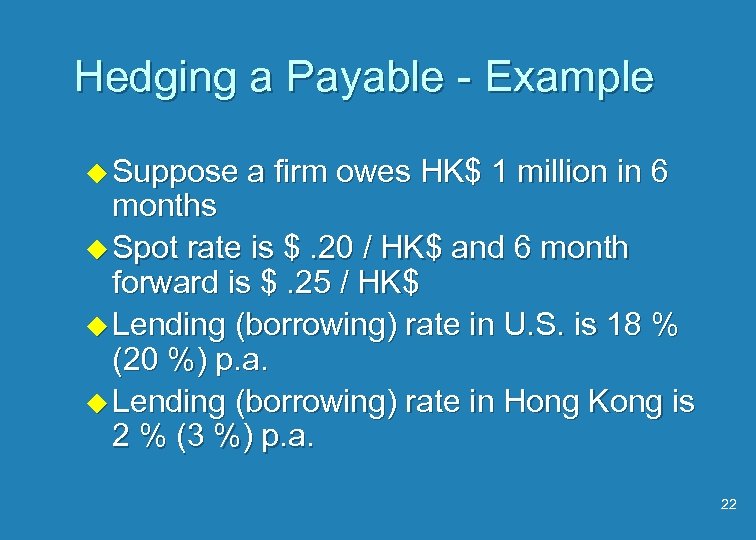 Hedging a Payable - Example u Suppose a firm owes HK$ 1 million in 6 months u Spot rate is $. 20 / HK$ and 6 month forward is $. 25 / HK$ u Lending (borrowing) rate in U. S. is 18 % (20 %) p. a. u Lending (borrowing) rate in Hong Kong is 2 % (3 %) p. a. 22
 Example - Continued u Call option with a strike price of $. 22 / HK$ with a premium of 1 % 23
 Alternatives u Pick the least costly alternative u (1) Do nothing - if the F = E(S), then the firm is expected to pay $ 250, 000 - This amount is uncertain 24
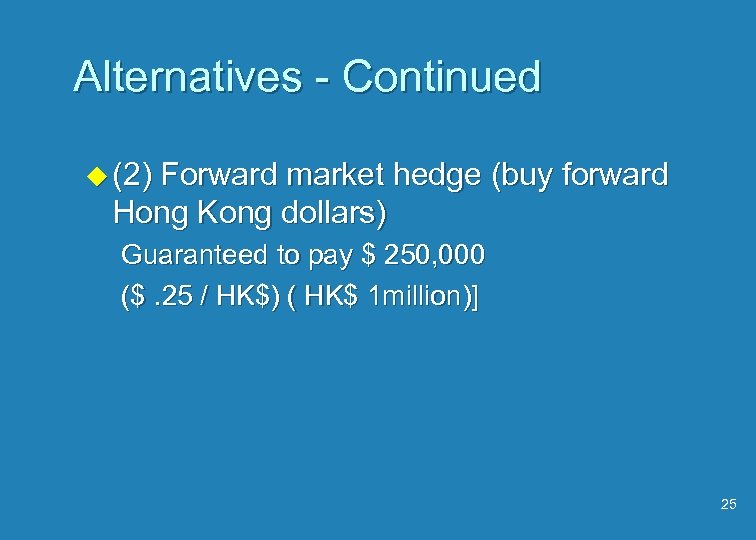 Alternatives - Continued u (2) Forward market hedge (buy forward Hong Kong dollars) Guaranteed to pay $ 250, 000 ($. 25 / HK$) ( HK$ 1 million)] 25
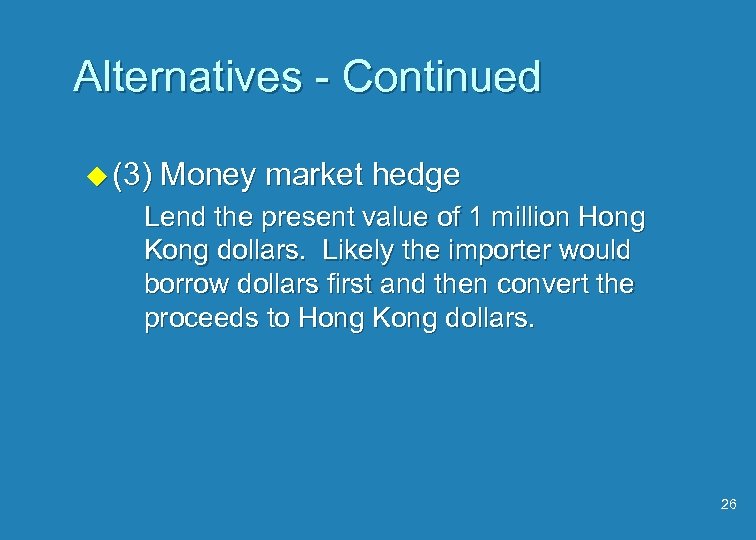 Alternatives - Continued u (3) Money market hedge Lend the present value of 1 million Hong Kong dollars. Likely the importer would borrow dollars first and then convert the proceeds to Hong Kong dollars. 26
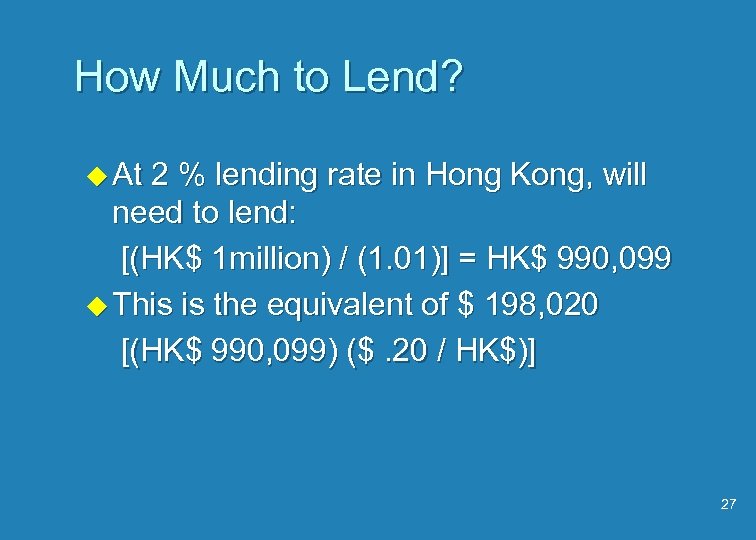 How Much to Lend? u At 2 % lending rate in Hong Kong, will need to lend: [(HK$ 1 million) / (1. 01)] = HK$ 990, 099 u This is the equivalent of $ 198, 020 [(HK$ 990, 099) ($. 20 / HK$)] 27
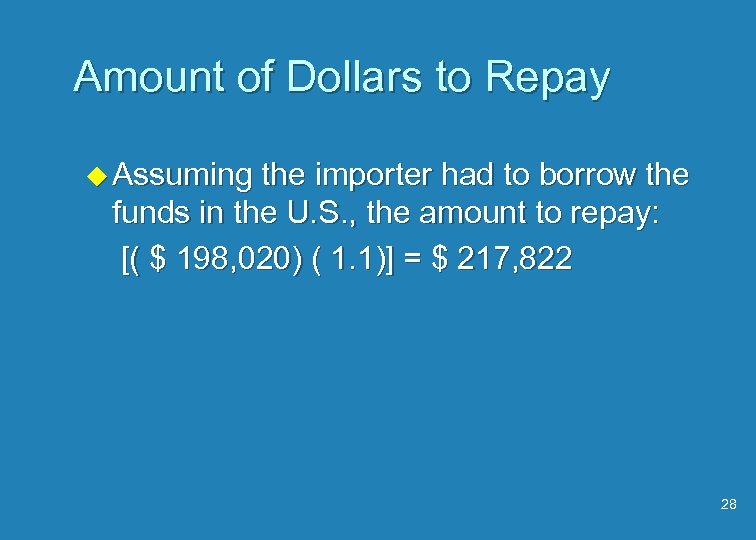 Amount of Dollars to Repay u Assuming the importer had to borrow the funds in the U. S. , the amount to repay: [( $ 198, 020) ( 1. 1)] = $ 217, 822 28
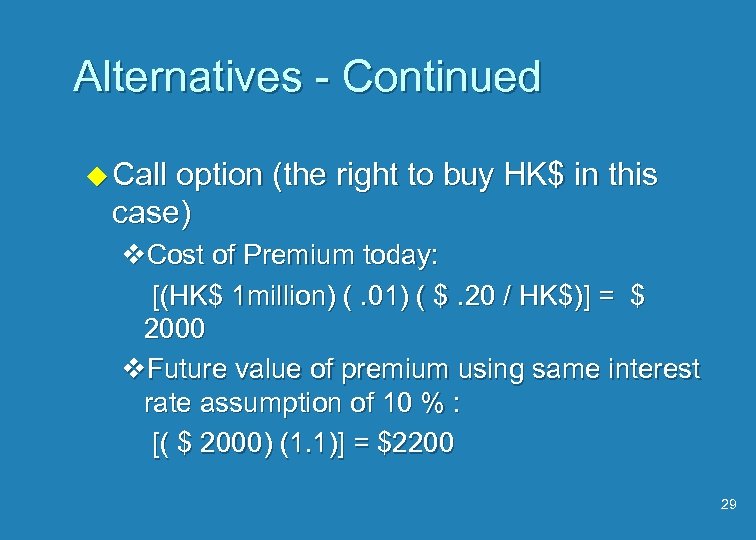 Alternatives - Continued u Call option (the right to buy HK$ in this case) v. Cost of Premium today: [(HK$ 1 million) (. 01) ( $. 20 / HK$)] = $ 2000 v. Future value of premium using same interest rate assumption of 10 % : [( $ 2000) (1. 1)] = $2200 29
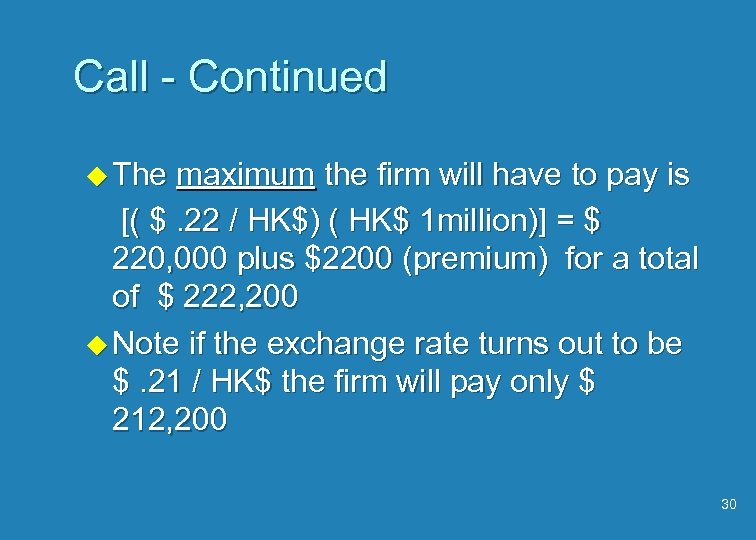 Call - Continued u The maximum the firm will have to pay is [( $. 22 / HK$) ( HK$ 1 million)] = $ 220, 000 plus $2200 (premium) for a total of $ 222, 200 u Note if the exchange rate turns out to be $. 21 / HK$ the firm will pay only $ 212, 200 30
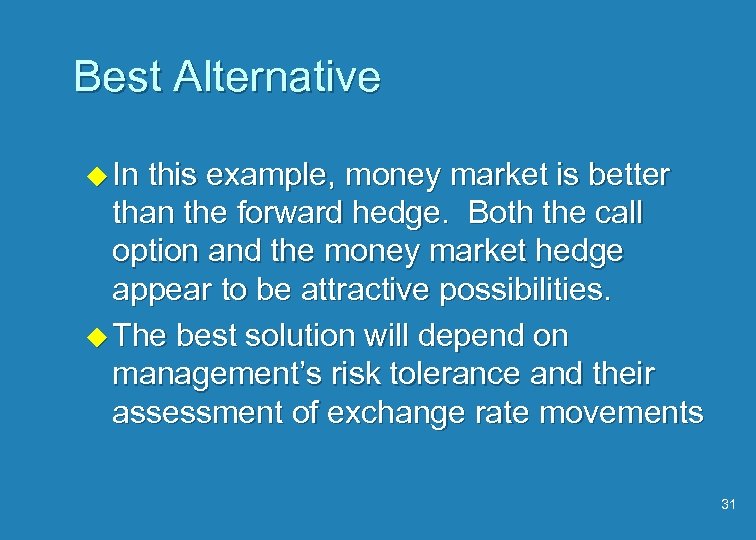 Best Alternative u In this example, money market is better than the forward hedge. Both the call option and the money market hedge appear to be attractive possibilities. u The best solution will depend on management’s risk tolerance and their assessment of exchange rate movements 31
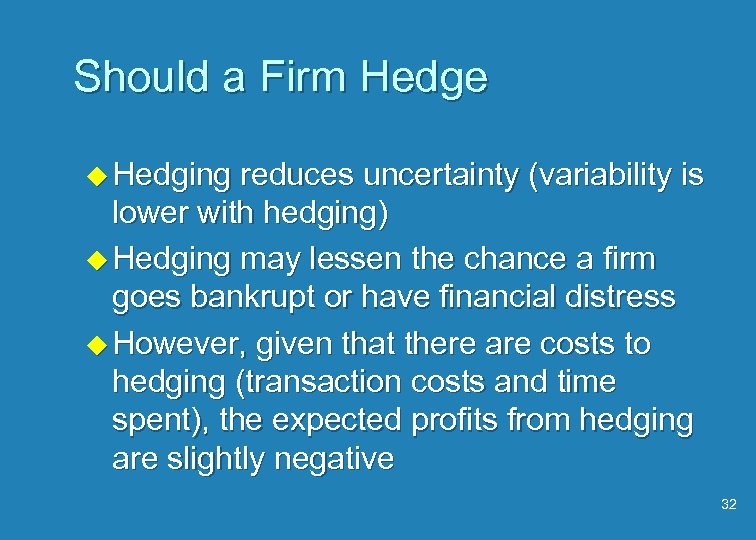 Should a Firm Hedge u Hedging reduces uncertainty (variability is lower with hedging) u Hedging may lessen the chance a firm goes bankrupt or have financial distress u However, given that there are costs to hedging (transaction costs and time spent), the expected profits from hedging are slightly negative 32
 To Hedge - Continued u Stockholders can diversify some currency risks by investing in many companies u But, managers of firms know currency risks of their firms better than their stockholders. Selective hedging may be beneficial to stockholders. 33
 To Hedge - Continued u By reducing uncertainty, managers may be able to plan better and perhaps can undertake some more profitable investment projects u Conclusion: there are pros and cons to hedging 34
 Who Should Hedge u Occasional exporter (importer) with a big foreign sale (purchase) does not want to take the risk of a big loss u A multinational with many relatively small foreign transactions probably does not need to hedge since losses will probably even out with gains 35
 Appendix to Chapter 10 Complex Option Hedges 36
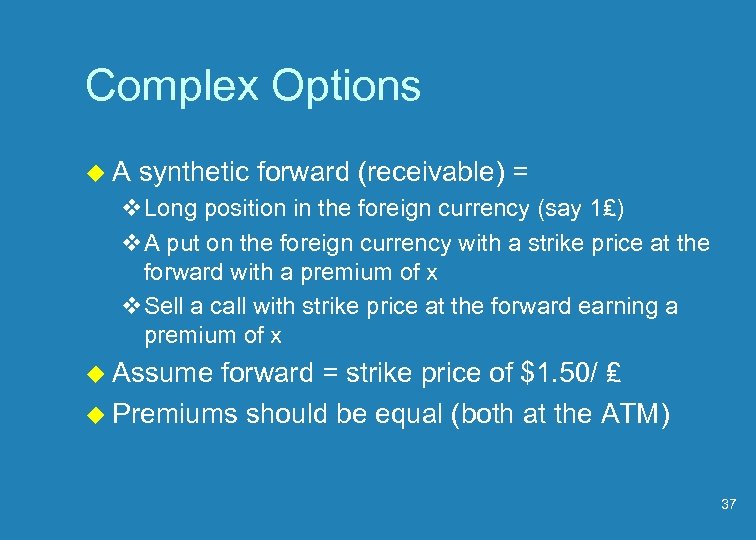 Complex Options u. A synthetic forward (receivable) = v. Long position in the foreign currency (say 1₤) v. A put on the foreign currency with a strike price at the forward with a premium of x v. Sell a call with strike price at the forward earning a premium of x u Assume forward = strike price of $1. 50/ ₤ u Premiums should be equal (both at the ATM) 37
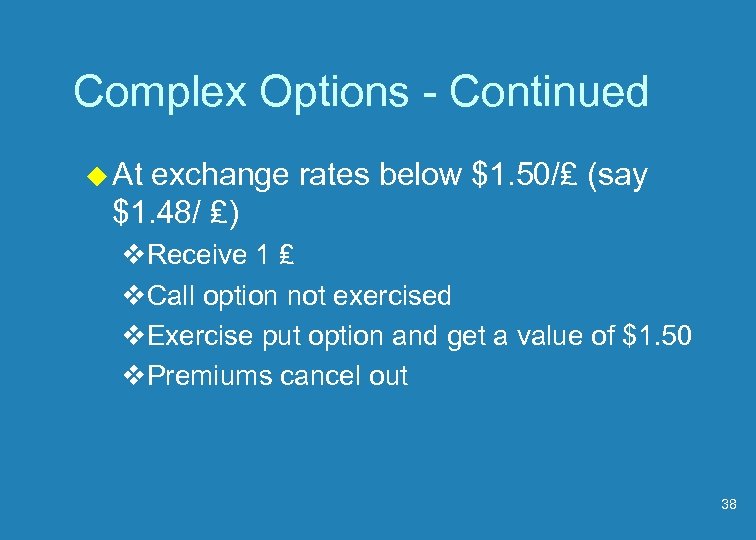 Complex Options - Continued u At exchange rates below $1. 50/₤ (say $1. 48/ ₤) v. Receive 1 ₤ v. Call option not exercised v. Exercise put option and get a value of $1. 50 v. Premiums cancel out 38
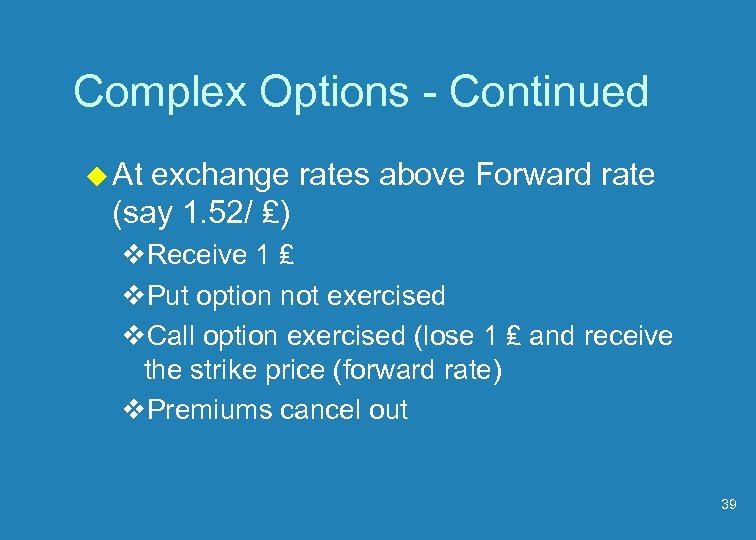 Complex Options - Continued u At exchange rates above Forward rate (say 1. 52/ ₤) v. Receive 1 ₤ v. Put option not exercised v. Call option exercised (lose 1 ₤ and receive the strike price (forward rate) v. Premiums cancel out 39
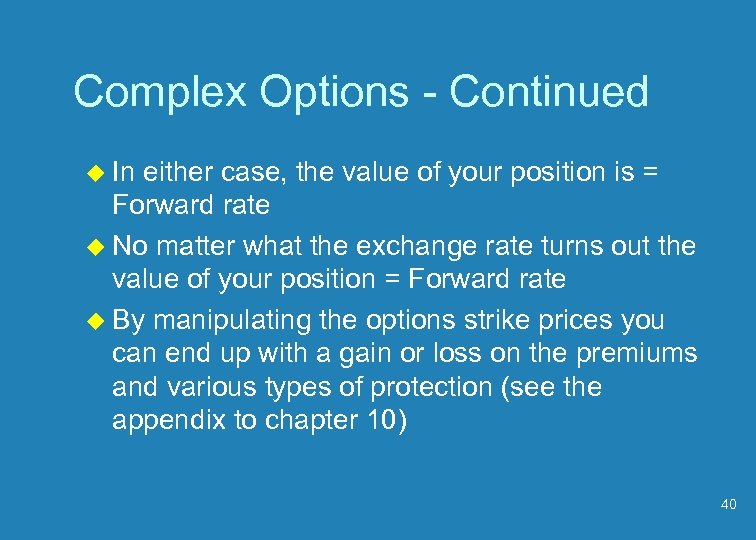 Complex Options - Continued u In either case, the value of your position is = Forward rate u No matter what the exchange rate turns out the value of your position = Forward rate u By manipulating the options strike prices you can end up with a gain or loss on the premiums and various types of protection (see the appendix to chapter 10) 40
 Complex Options - Continued u Note the protection afforded by (1) Range Forward or Collar with a net premium of “zero” and (2) Participating Forward 41
 A Synthetic for a Payable u Pay 1 ₤ in the future u Buy a call option at a strike price of the forward rate (pay premium) u Sell a put with a strike price of the forward rate (receive premium) 42
 Homework - Chapter 10 u #2 in book u Given the following facts: u Spot rate - $2/£ u 3 month Forward rate - $1. 98/£ u 3 month U. K. (U. S. ) interest rate - 4% (3%) per year. u 3 month put contract with a strike price of $1. 99/£ with a 4% premium 43
 Homework - Continued u 3 month call option with a strike price of $1. 99/£ with a 3. 5% premium u A) How would company ABC hedge a £ 200 million receivable? Which alternative would you pick? u B) How would company ABC hedge a £ 400 million payable? Which alternative would you pick? 44
 OUTLINE FOR CHAPTER 12 u Understand Operating Exposure v. Definition v. What firms are the most vulnerable to this risk? v. Calculating Cash Flows under different exchange rates v. The impact of inflation on Operating risk v. Management of Operating Exposure through diversification 45
 OUTLINE - CONTINUED v. Managing Operating and Transaction Exposure by changing operating procedures v. Managing Operating and Transaction Exposure by changing financial policies 46
 Operating Exposure - Chapter 12 u Measures the change in the present value of a firm resulting from changes in future operating cash flows caused by an unexpected change in the exchange rate u Sometimes called economic exposure, competitive exposure, or strategic exposure 47
 Operating Exposure - An Example u How will a devaluation of the local currency affect the value of a firm in Mexico? u Will the firm be worth more or less after the exchange rate change? 48
 Example - Continued u Answer - it depends on the characteristics of the firm u For the moment lets count our money in pesos (for an American owned firm counting in dollars would probably be more appropriate) 49
 Example - Continued u Value of the firm is based on the present value of the firms expected cash flows u What should happen to revenues and costs 50
 Time Horizons u The shorter the time horizon the more contracts are fixed (volumes, prices, currencies etc. ) Relatively little flexibility to change u Longer horizons allow firms to make adjustments – change prices, currencies, volumes, where to source, where to produce etc. 51
 Revenue Changes u Export revenues should increase (if the firm keeps the same foreign price abroad this will translate into more pesos / sale or if they drop the foreign price - volume should increase) u The more the firm’s competitors are non. Mexican, the better off the firm in general 52
 Revenues - Continued u Domestic sales may stay relatively constant u Foreign (non-Mexican) companies may want to raise prices in Mexico so the Mexican firm may be able to steal some market share u Aggregate demand may increase in Mexico as a result of the devaluation. If that is true sales of the firm’s products may increase 53
 Revenues - Continued u On the negative side, there may be an increase in inflation which would negate some of the benefits of the devaluation 54
 Cost Changes u Import costs will tend to rise u Domestic costs may rise a little due to inflation and / or a general increase in demand for raw materials and labor 55
 Example - Continued u The Mexican firm that exports a lot and sources domestically may be helped by the devaluation u On the other hand, the Mexican firm that sells locally and sources outside Mexico will likely be hurt from the devaluation 56
 Operating Exposure u. A first generalization is that firms that source and sell in different markets are more subject to operating exposure than those that sell and source in the same market (an example of this is an exporter who sources externally) 57
 Generalization - Continued u This generalization is subject to an important caveat - a lot depends on the firm’s competitors u Suppose there is an American firm that sells and sources entirely in the U. S. and its competitors are Japanese - this firm could have a lot of exchange risk if the Yen / dollar exchange rate changes 58
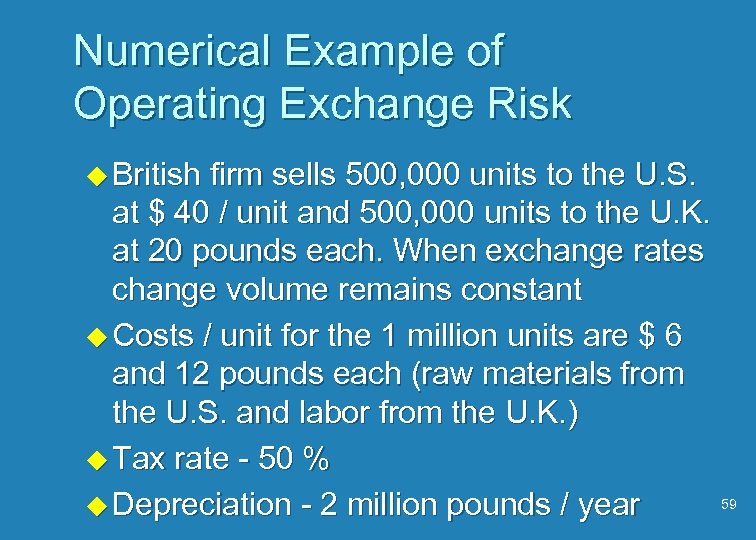 Numerical Example of Operating Exchange Risk u British firm sells 500, 000 units to the U. S. at $ 40 / unit and 500, 000 units to the U. K. at 20 pounds each. When exchange rates change volume remains constant u Costs / unit for the 1 million units are $ 6 and 12 pounds each (raw materials from the U. S. and labor from the U. K. ) u Tax rate - 50 % 59 u Depreciation - 2 million pounds / year
 Example - Continued u Assume the expected exchange rate is $ 2 / pound and 2 other (unexpected) exchange rate possibilities are $ 1. 50 / pound and $ 2. 50 / pound u This example assumes the firm sells in constant foreign prices and its costs remain constant in foreign prices u What are the cash flows for the 3 exchange rates? 60
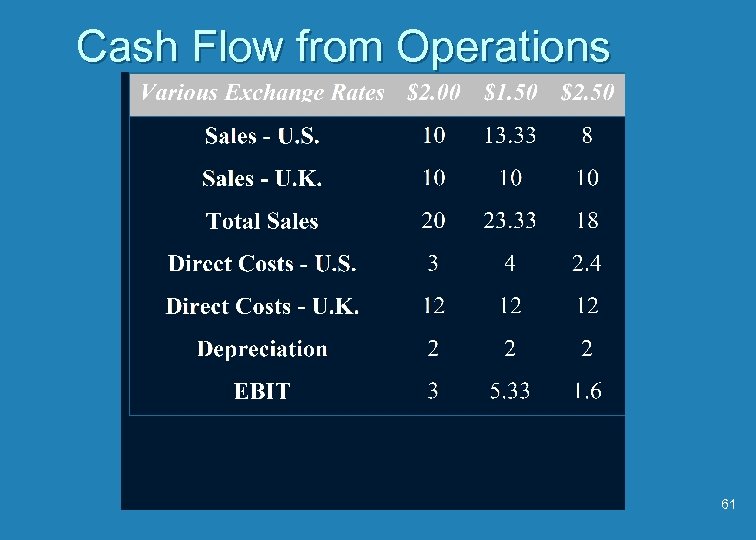 Cash Flow from Operations 61
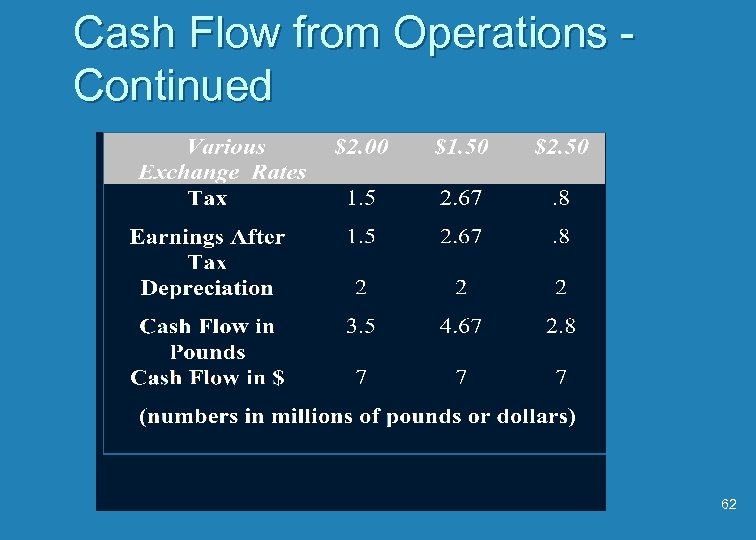 Cash Flow from Operations Continued 62
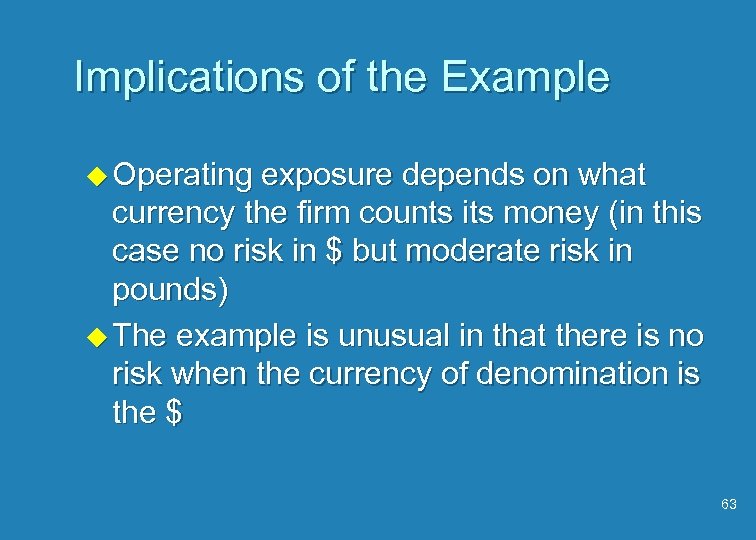 Implications of the Example u Operating exposure depends on what currency the firm counts its money (in this case no risk in $ but moderate risk in pounds) u The example is unusual in that there is no risk when the currency of denomination is the $ 63
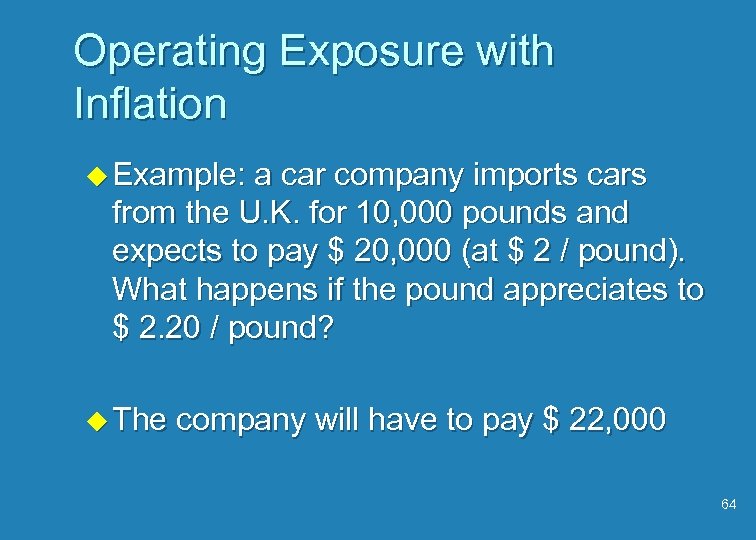 Operating Exposure with Inflation u Example: a car company imports cars from the U. K. for 10, 000 pounds and expects to pay $ 20, 000 (at $ 2 / pound). What happens if the pound appreciates to $ 2. 20 / pound? u The company will have to pay $ 22, 000 64
 Operating Exposure with Inflation - Continued u Suppose inflation causes the price of cars to rise by 10 % , then the company is not any “worse” off u Point of the example is that one must consider inflationary effects along with exchange rate effects in calculating operating exposure 65
 Example of Operating Exposure with Inflation u Assume the base case is a U. S. exporter who sells 1 million units at 5 pounds each that costs $ 6 / unit, tax rate = 50 % , depreciation is $ 2 million per year, and spot rate is $ 2. 00 / pound 66
 Example of Operating Exposure with Inflation - Continued u What happens: (1) if dollar depreciates to $ 2. 50 / pound and selling price in pounds, cost in dollars, volume all stay the same and (2) same as case 1 above but cost of goods sold increases due to inflation from $ 6 to $ 7 / unit? 67
 Management of Operating Exposure through Diversification u Key idea: Management must recognize a disequilibrium and be able to react quickly and effectively u A diversified firm can react quickly because it has many options to pursue u Diversification - Operations and Financing 68
 Diversifying Operations u Want to diversify sales, production facilities and sourcing to take advantage of exchange rate changes u If the home currency falls in value the firm would want to stress exports u If it becomes cheaper to produce in Italy, would want to shift marginal (example overtime) production there, if feasible 69
 Diversifying Operations Continued u If it becomes cheaper to buy raw materials in China due to exchange rate changes, then would want to source there u Note a purely domestic firm is not in a position to switch sales, production facilities and perhaps sourcing 70
 Diversifying Financing u The firm would want to be in a position to take advantage of deviations from the International Fisher Effect or Interest Rate Parity u Only companies with the ability to borrow in more than one market or currency can do this 71
 Managing Operating and Transaction Exposure u Examples: v. Leads and lags v. Risk Sharing v. Reinvoicing centers v. Matching currency cash flows v. Back to Back or Parallel loans v. Currency swaps 72
 Leading and Lagging u To lead (lag) is to pay early (late) u Suppose a firm has a receivable in a soft currency, it would like to be paid early before its currency depreciated. Unfortunately the other firm would not want to do this. 73
 Leading and Lagging Continued u Leading and lagging between independent firms usually results in one winner and one loser and hence it is hard for independent firms to agree on a mutually satisfying strategy u Between affiliates of the same company can agree to lead and lag for the betterment of the entire firm 74
 Risk Sharing u Works for firms that have a continual relationship u Might set up an arrangement as follows: v. Use actual exchange rate if exchange rate turns out to be between $ 1. 80 / pound and $ 2. 00 / pound v. For exchange rates below $ 1. 80 / pound (above $ 2. 00 / pound) use average of actual and $ 1. 80 / pound (actual and $ 2. 00 / pound) 75
 Risk Sharing - Continued u Suppose as in the previous slide a firm had a £ 100 million receivable and the exchange rate turned out to be $1. 60/£ u Instead of receiving a $160 million (with an exchange rate of $1. 60/£) the firm would receive $170 million (with an exchange rate of $1. 70/£ per the risk sharing agreement) u Of course this same firm would lose with the risk sharing agreement for exchange rates above $2. 00/£. 76
 Currency Clauses - Continued u Purpose of this arrangement is to avoid having one company take a big loss on a transaction 77
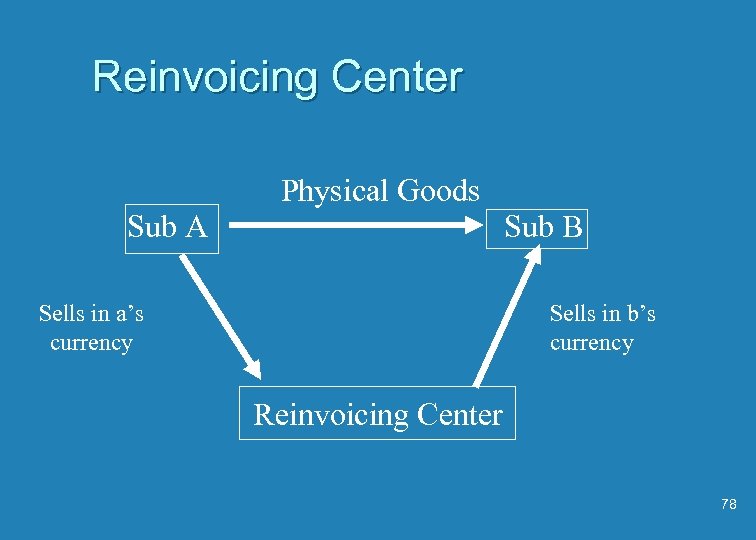 Reinvoicing Center Physical Goods Sub A Sub B Sells in a’s currency Sells in b’s currency Reinvoicing Center 78
 Reinvoicing Center - Continued u No transaction risk for sub a or sub b u One advantage to a reinvoicing center is that personnel can become experts in hedging and can manage transaction risk in a big scale u Since dealing in bigger amounts of money make get better quotes from banks 79
 Reinvoicing Center - Continued u However there is a cost in setting up this unit (set up and a continual cost 80
 Matching Currency Cash Flows u If a firm receives a lot of cash flows from a country it could reduce its exposure by borrowing in that country (repay the debt and principal in that currency) or buying raw materials from that country and paying in that currency u Works best if cash inflows are reasonably constant and predictable 81
 Matching Currency - Continued u Could also use the foreign currency to pay expenses to a third party (currency switching) u Works best if cash inflows are reasonably constant and predictable 82
 Back-to-Back Loans or Parallel Loan or Credit Swap u Two firms both in two countries borrow from each other and agree to return the currencies at a later time u No transaction exposure is created u Example: Suppose a German firm wants to send money to a German sub in Japan and a Japanese firm wants to send money to a Japanese sub in Germany 83
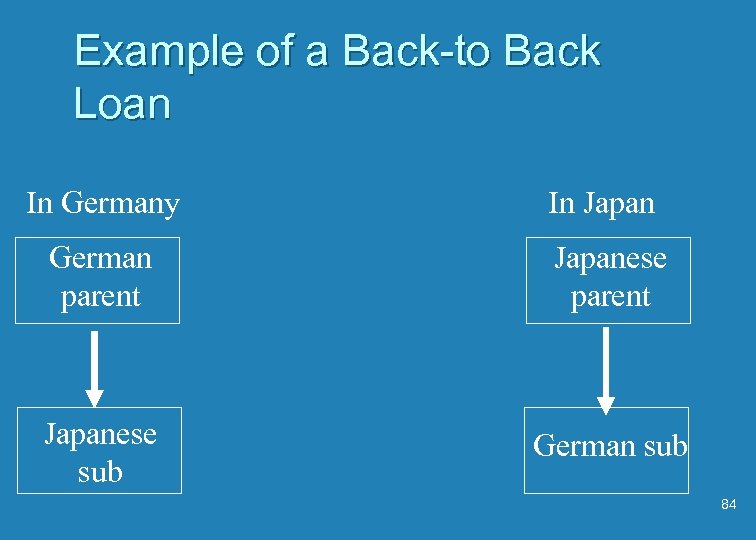 Example of a Back-to Back Loan In Germany In Japan German parent Japanese sub German sub 84
 Example - Continued u In this example the German parent loans Euros to the Japanese sub and the Japanese parent loans Yen to the German sub u Each sub must repay in the same currency as it received - no transaction risk on either loan u Of course it is difficult to find a partner who has the exact opposite desires as your firm 85
 Currency Swap u Suppose there is a Japanese firm that borrows in Japan but would prefer to borrow in dollars but since it is not known in the U. S. it would expensive to borrow there u The Japanese firm could contact a swap dealer who could arrange to have the Japanese firm service the debt in dollars 86
 Currency Swap - Continued u Meanwhile the swap dealer would try and find a U. S. firm that had the opposite wish - to service debt in Yen. The U. S. firm would borrow dollars but swap its payments so that it was paying in Yen u This arrangement is attractive if both firms have regular inflows in each other’s currency 87