


 Скачать презентацию Foreign Exchange Market Intervention Amie Colgan Mary Deely
d9485226aa629a0a0ce5b55c753d952a.ppt
- Количество слайдов: 19
 Foreign Exchange Market Intervention Amie Colgan, Mary Deely, Fergus Colleran, Anna Nikolskaya
 Exchange Rate Intervention • Buy or sell foreign currency/assets to affect the exchange rate • Purchases push down the home currency value of the exchange rate • Sales push it up
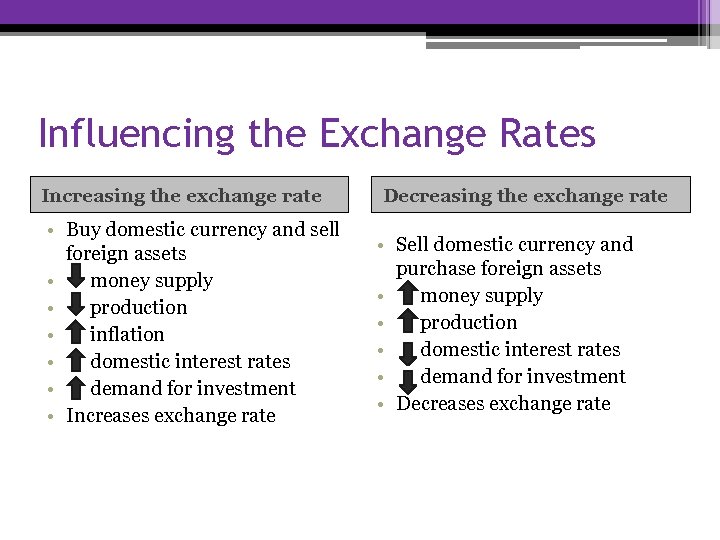 Influencing the Exchange Rates Increasing the exchange rate • Buy domestic currency and sell foreign assets • money supply • production • inflation • domestic interest rates • demand for investment • Increases exchange rate Decreasing the exchange rate • Sell domestic currency and purchase foreign assets • money supply • production • domestic interest rates • demand for investment • Decreases exchange rate
 Why Intervene? • Stabilise Fluctuations • International trade and investment decisions • Dependent on exchange rates • Reverse the growth in the country’s trade deficit • • Rise when exchange rates rise High currency – cheaper foreign goods and services Increasing imports and reducing exports Rising trade deficit – Intervention needed
 Types of Intervention • Sterilized Intervention – has little or no effect on the exchange rate • Unsterilized Intervention – has a higher impact on exchange rates
 How does Sterilized Intervention differ from Unsterilized Intervention?
 Unsterilized Intervention • Central Banks purchase/sell domestic currency to sell/purchase foreign assets which expands/contracts the monetary base. • These actions may decrease/increase the money supply which in turn affects prices, inflation and in turn interest rates. • Passive approach of intervention by Central Banks. • Allows foreign exchange markets to function without manipulation of the supply of domestic currency. • Has a higher effect on interest rates and liquidity.
 Unsterilized Intervention • Unsterilized Intervention is used when a Central Bank wants to change it’s monetary conditions • It has an overall greater effect on money supply interest rates and foreign exchange rates. • It takes time to come into effect, not useful if Central Bank wants an immediate change in exchange rates. • Has long term effects on the exchange rates. • Not used as often because it conflicts with monetary policy.
 Sterilized Intervention • Buying or selling domestic currency in order to sell or purchase foreign assets to slightly affect exchange rates. • This can expand or contract the monetary base. • Sterilising means offsetting this expansion/contraction by selling or purchasing government bonds in the domestic bond market to bring back the monetary base to it’s target level. • When Central Banks want to leave money supply and interest rates unaffected. • Maintains price stability
 Sterilized Intervention • Intervention in exchange rates without affecting its domestic liquidity. • Process limits the amount of domestic currency available for exchange. • Altering its debt composition without affecting its monetary base. • Sterilised Intervention has little effect on long-term exchange rates. • Almost immediate effect on demand supply of foreign exchange. • Affects expectations about future exchange rates, particularly if open market operations are hidden. • It’s effect on exchange rates is not as obvious an Unsterilized intervention.
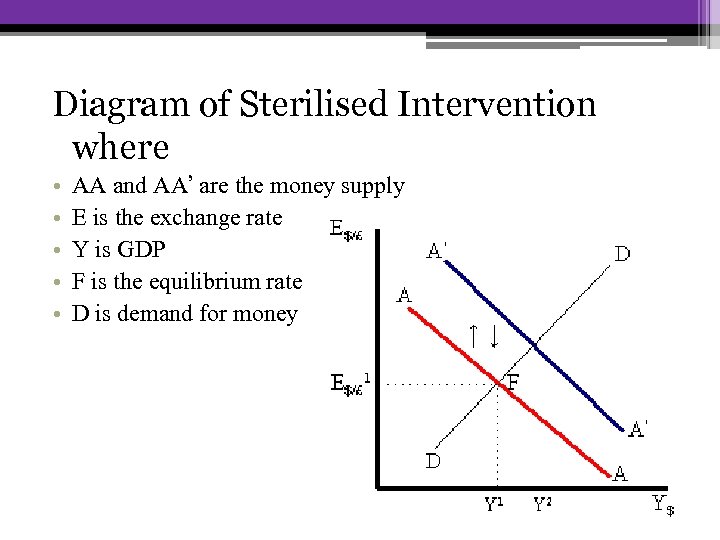 Diagram of Sterilised Intervention where • • • AA and AA’ are the money supply E is the exchange rate Y is GDP F is the equilibrium rate D is demand for money
 Effects of Central Bank Action on Exchange Rates • May be intentional or not • Motivation: (1) Resist short run trends in exchange rates (2) Correct medium-term “misalignments” of exchange rates away from fundamental values • Decline in the frequency of intervention
 Federal Reserve • Quantitative Easing • Wed 18/3/09 –Fed announced it is to buy $300 billion in long term treasuries & $750 billion in mortgage-backed securities Create more liquidity –print money • Euro rose 3. 2% to $1. 342 after the statement
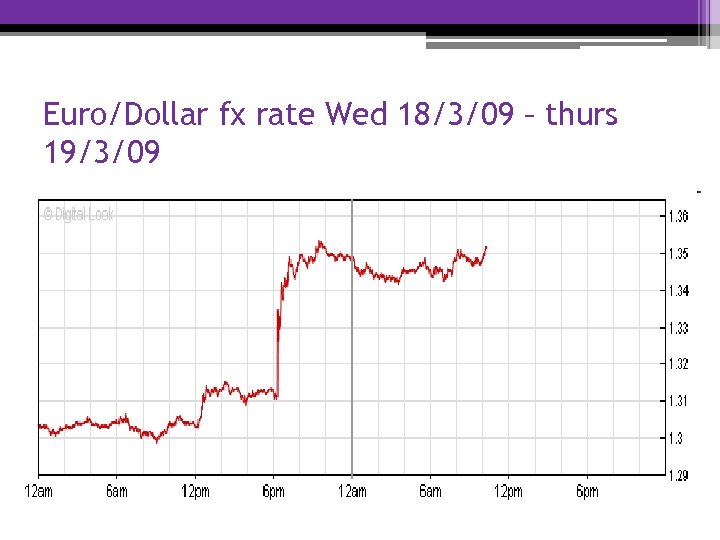 Euro/Dollar fx rate Wed 18/3/09 – thurs 19/3/09
 Statement of G 7 Finance Ministers and Central Bank Governors: • “Excess volatility and disorderly movements in exchange rates have adverse implications for economic and financial stability. ” • 14 th February
 Swiss National Bank (SNB) • 12 th March • Aim: ‘push down’ Swiss franc • SNB cut its 3 -month LIBOR target rate by 25 basis points (to historic low of 0. 25%) • Sold francs for euros and dollars • SNB said it’s planning to increase liquidity by ▫ Engaging in repo operations ▫ Buying Swiss franc bonds issued by private sector borrowers ▫ Purchasing foreign currency on the FX market
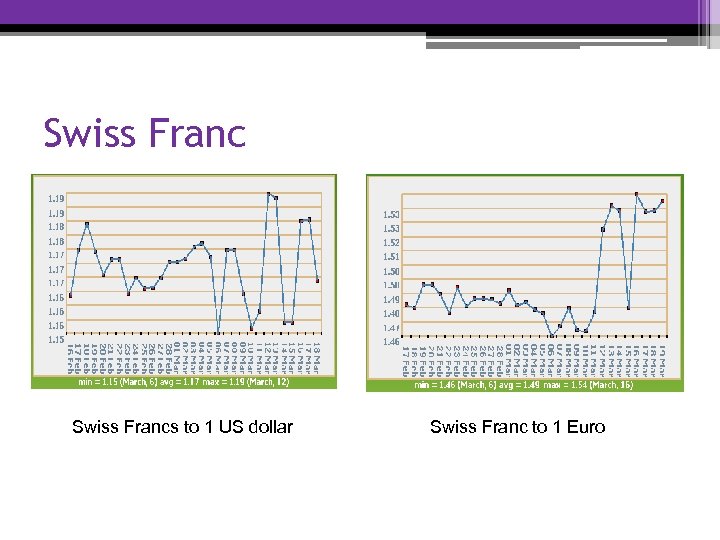 Swiss Francs to 1 US dollar Swiss Franc to 1 Euro
 Bank of England • 5 th March • Quantitative easing: up to £ 150 billion ▫ up to £ 75 billion mostly in medium and long-term gilts over next 3 months ▫ £ 50 billion private-sector assets • Cut repo interest rate by 50 basis points to 0. 5% • £ has depreciated against both € and $
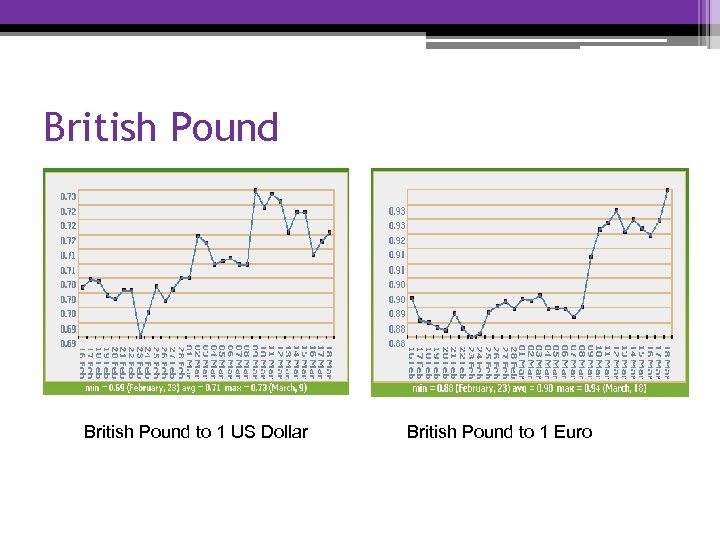 British Pound to 1 US Dollar British Pound to 1 Euro