


 Скачать презентацию Forecasting Successful operations of the company Effective
19 Forecasting.ppt
- Количество слайдов: 24
 Forecasting
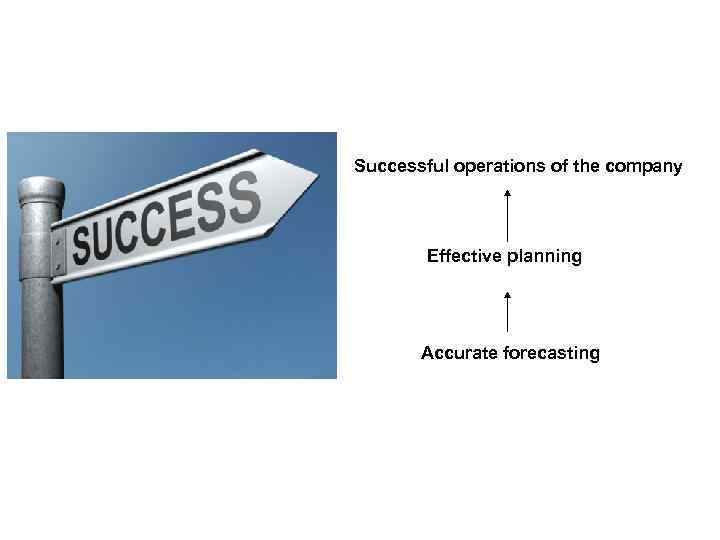 Successful operations of the company Effective planning Accurate forecasting
 Forecasting techniques: Mechanical extrapolation Simulation Linear interpolation Exponential smoothing Barometric methods Leading indicators Compound indexes Diffuse indexes Collection of opinions and reviews of goals
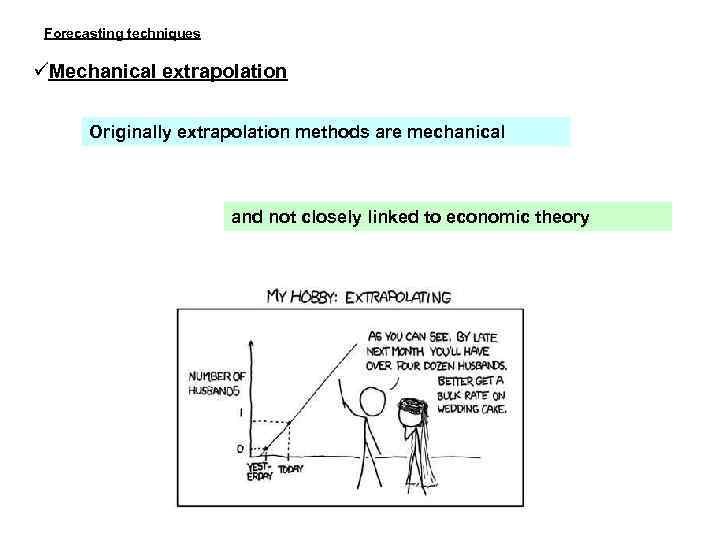 Forecasting techniques Mechanical extrapolation Originally extrapolation methods are mechanical and not closely linked to economic theory
 However, they are widely used by professional economists who make forecasting Because of they are easy to apply and satisfy reasonably the requirements of the management
 Forecasting techniques: Mechanical extrapolation The simplest models: All future values of the studied variable in some way are a function of its present or recent status ] Y – the experimental value of the analyzed variable ^ ^ – the predicted value of the analyzed variable Y t – index to distinguish periods
 Forecasting techniques: Mechanical extrapolation The simplest models: Unchanging model The predicted value of the variable for the next period will be equal to its value in the present period ^ Y t+1 = Y t Proportionaly - changing model The value of a variable changes from current to next period will be proportional to the value of a variable changes from the previous period to the current period ^ Y t+1 = Y t+ k ∆ Y t Evaluation of k based on retrospective information. K = 1 is a uniformly changing the model
 Forecasting techniques: Mechanical extrapolation The simplest models: The vast majority of all economic, political and social decisions are made based on considered the simplest models For most short-term predictions the simplest models are the most easy ways of forecasting, since they are easy to use and requires minimal information for calculating
 TASK: Forcasting based on extrapolation It is known that in 2008 your company's servers were exposed to 245 DDo. S attacks, in 2009 – 315, in 2010 - 298 in 2011 – 306, in 2012379, in 2013 – 376. As a specialist in information security, using the method of extrapolation on the current average annual growth rate in the number of attacks, make a forcast about the number of DDo. S attacks on the servers of your company in 2014.
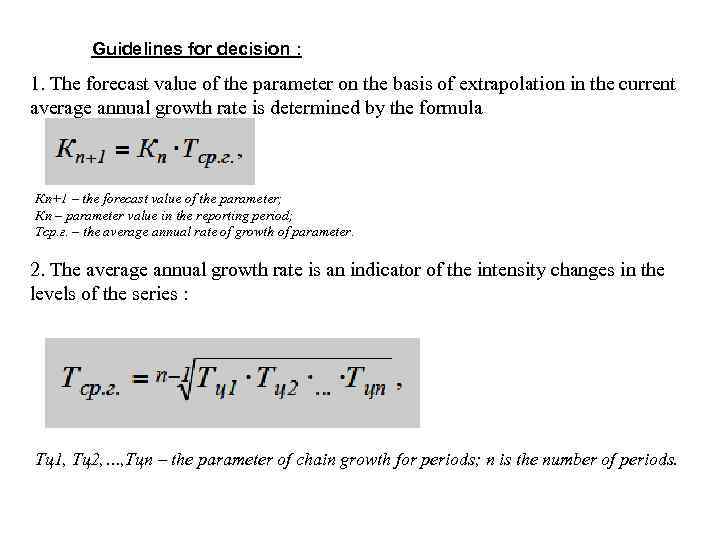 Guidelines for decision : 1. The forecast value of the parameter on the basis of extrapolation in the current average annual growth rate is determined by the formula Кn+1 – the forecast value of the parameter; Кn – parameter value in the reporting period; Тср. г. – the average annual rate of growth of parameter. 2. The average annual growth rate is an indicator of the intensity changes in the levels of the series : Тц1, Тц2, …, Тцn – the parameter of chain growth for periods; n is the number of periods.
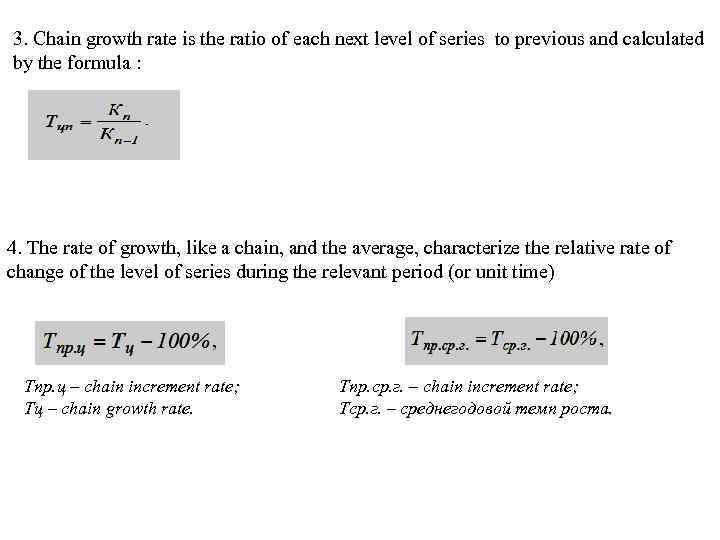 3. Chain growth rate is the ratio of each next level of series to previous and calculated by the formula : 4. The rate of growth, like a chain, and the average, characterize the relative rate of change of the level of series during the relevant period (or unit time) Тпр. ц – chain increment rate; Тц – chain growth rate. Тпр. ср. г. – chain increment rate; Тср. г. – среднегодовой темп роста.
 Forecasting techniques: Mechanical extrapolation Time series analysis: Time series consist of values corresponding to certain points or periods Ordered in time indicators: sales, production volume, prices….
 Forecasting techniques: Mechanical extrapolation Time series analysis: Why fluctuation is typical for the time series? Usually there are four sources of variation in economic time series, : 1) Trend (T) 2) Seasonal changes (S) 3) Cyclic changes (C) 4) Irregular forces (I)
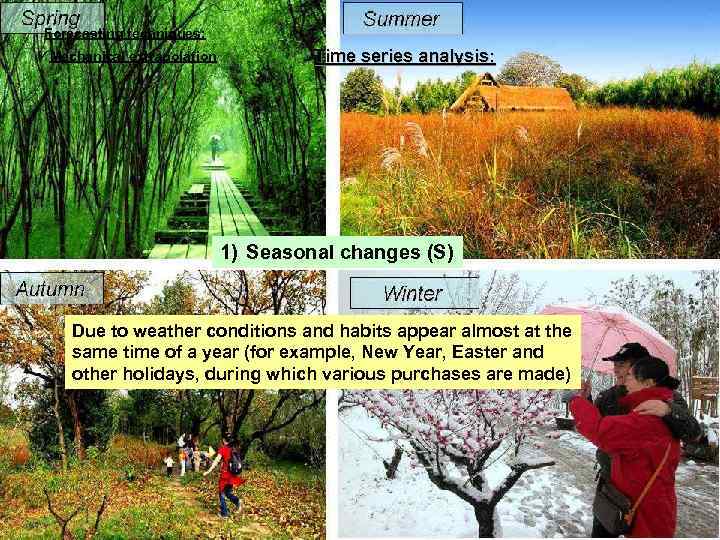 Forecasting techniques: Mechanical extrapolation Time series analysis: 1) Trend (Т) Is a long-term increase or decrease of series 1) Seasonal changes (S) Due to weather conditions and habits appear almost at the same time of a year (for example, New Year, Easter and other holidays, during which various purchases are made)
 Forecasting techniques: Mechanical extrapolation Time series analysis: 3) Cyclic changes (С) Cover periods of several years, reflect the level of economic boom or recession 4) Irregular forces (I) Strikes, war. Inconsistent in their effect on individual series, but, nevertheless, be taken into account
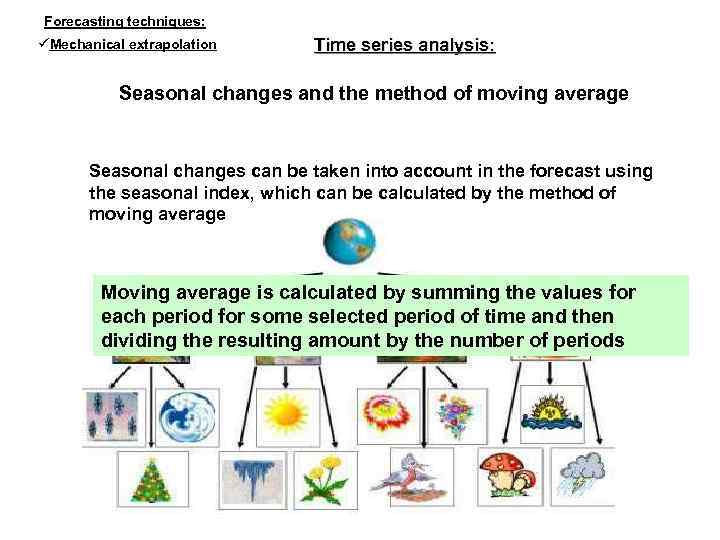 Forecasting techniques: Mechanical extrapolation Time series analysis: Seasonal changes and the method of moving average Seasonal changes can be taken into account in the forecast using the seasonal index, which can be calculated by the method of moving average Moving average is calculated by summing the values for each period for some selected period of time and then dividing the resulting amount by the number of periods
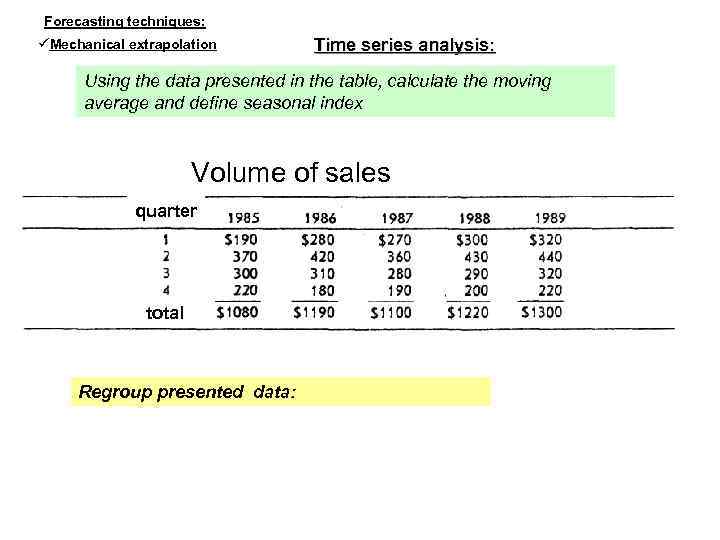 Forecasting techniques: Mechanical extrapolation Time series analysis: Using the data presented in the table, calculate the moving average and define seasonal index Volume of sales quarter total Regroup presented data:
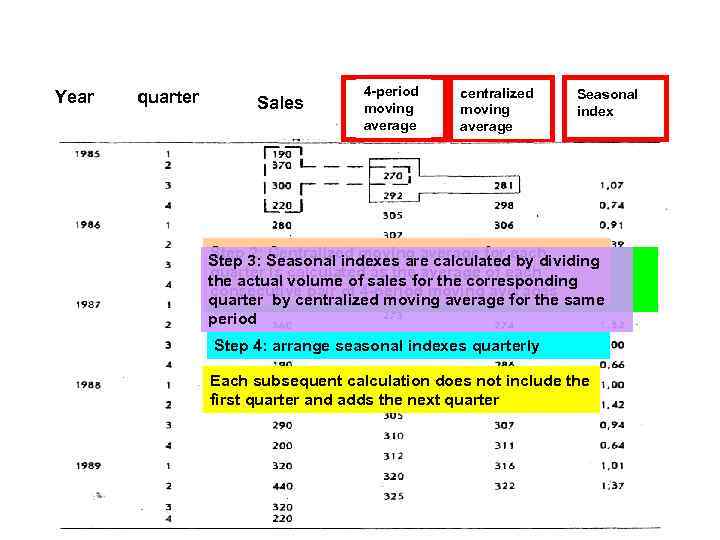 Year quarter Sales 4 -period moving average centralized moving average Seasonal index Step 2: Centralized moving average for each Step 3: Seasonal indexes are the four periods is Step 1: Moving average over calculated by dividing quarter is calculated as the average of each the actual volumeaof sales for the 4 calculated using consistent set corresponding consecutive pair of 4 -period moving averages quarter by centralized moving average for the same quarters period Step 4: arrange seasonal indexes quarterly Each subsequent calculation does not include the first quarter and adds the next quarter
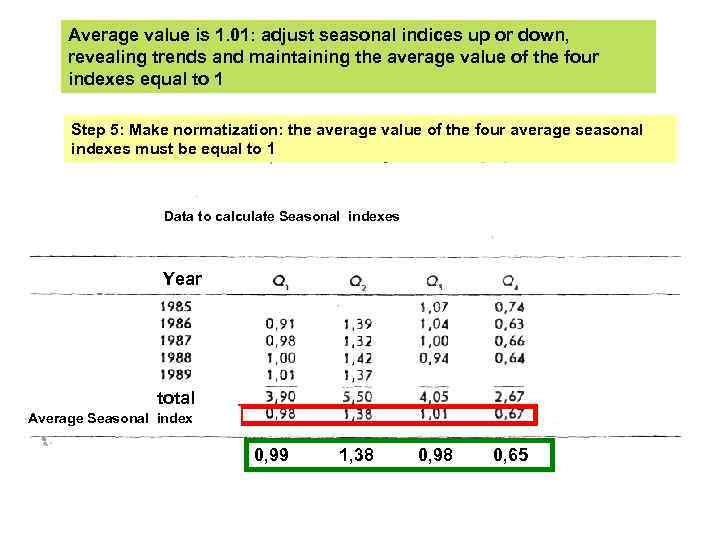 Average value is 1. 01: adjust seasonal indices up or down, revealing trends and maintaining the average value of the four indexes equal to 1 Step 5: Make normatization: the average value of the four average seasonal indexes must be equal to 1 Data to calculate Seasonal indexes Year total Average Seasonal index 0, 99 1, 38 0, 98 0, 65
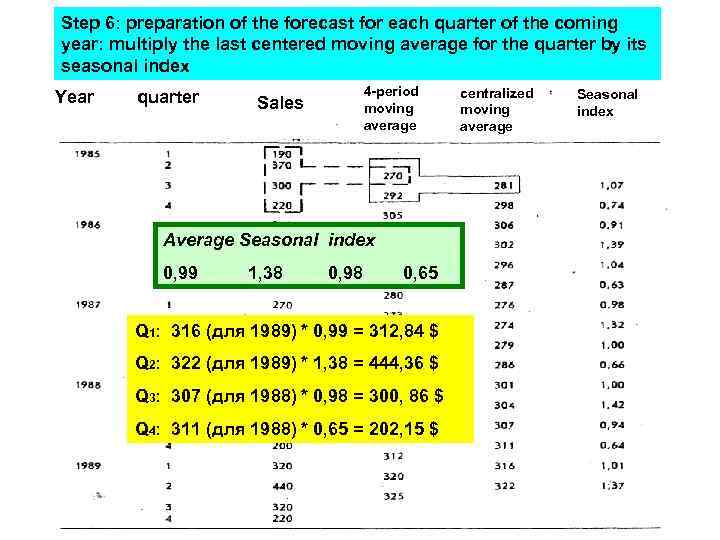 Step 6: preparation of the forecast for each quarter of the coming year: multiply the last centered moving average for the quarter by its seasonal index Year quarter 4 -period moving average Sales Average Seasonal index 0, 99 1, 38 0, 98 0, 65 Q 1: 316 (для 1989) * 0, 99 = 312, 84 $ Q 2: 322 (для 1989) * 1, 38 = 444, 36 $ Q 3: 307 (для 1988) * 0, 98 = 300, 86 $ Q 4: 311 (для 1988) * 0, 65 = 202, 15 $ centralized moving average Seasonal index
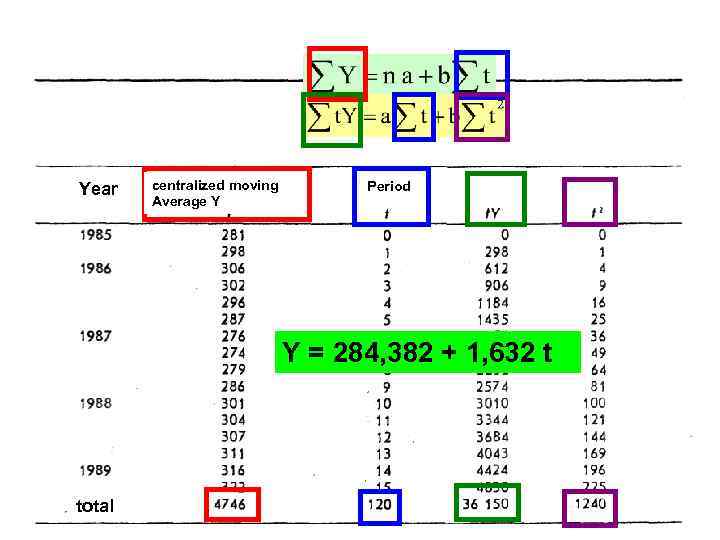
 Forecasting techniques: Mechanical extrapolation Time series analysis: Designing of trend As a forecasting method assumes that started change in the variable will continue in the future The most widely used method of trend detection is regression analysis, namely the method of least squares The method consists of the selection of a regression line according to the observations so that the squares of their deviations from the regression line were minimal
![] Y – the observed value of the analyzed variable ^ Y – the](https://present5.com/presentation/222386723_451539130/image-22.jpg "] Y – the observed value of the analyzed variable ^ Y – the") ] Y – the observed value of the analyzed variable ^ Y – the predicted value of the analyzed variable ^ Regression line is presented by: Y = a + bt, where a and b parameters of evaluation, t – number of period To find the values of the parameters a and b, it is necessary to solve the system of equations
] Y – the observed value of the analyzed variable ^ Y – the predicted value of the analyzed variable ^ Regression line is presented by: Y = a + bt, where a and b parameters of evaluation, t – number of period To find the values of the parameters a and b, it is necessary to solve the system of equations
 Trend estimates are more reliable if they are based on data released from seasonal effects Seasonal effects are smoothed by a moving average
 Year centralized moving Average Y Period Y = 284, 382 + 1, 632 t total