


 Скачать презентацию FORECASTING SEGMENTATION TARGETING AND POSITIONING a market is
CHP 7 Forecasting.ppt
- Количество слайдов: 10
 FORECASTING, SEGMENTATION, TARGETING AND POSITIONING a market is the set of all actual and potential buyers of a product or service. A market is the set of buyers, and an industry is the set of sellers. DEMAND There are three different aspects of current market demand: 1)total market demand, 2)area market demand, 3)actual sales and market shares
 Demand 1) Total market demand Q=n. Xq. Xp Where Q = total market demand n = number of buyers in the market q = quantity purchased by an average buyer per year p = price of an average unit. Thus, if there are 100 million buyers of compact discs each year, the average buyer buys six discs a year, and the average price is $14, then the total market demand for discs is $8. 4 billion (= 100, 000 X 6 X $14).
 Demand 2) Area market demand A) The market-buildup method: A forecasting method that calls for identifying all the potential buyers in each market and estimating their potential purchase. B) Market-factor index method: A forecasting method that identifies market factors that correlates with market potential and combines them into a weighted index 3) Actual sales and market shares - A company must identify its competitors and estimate their sales. Evaluate its performance against the industry E. g. buy information from agencies that deal with collecting info about all types of sales.
 FORECASTING Forecasting is the art of estimating future demand by anticipating what buyers are likely to do under a given set of future conditions. The environmental forecast: forecast of gross domestic product (inflation, unemployment, interest rates, consumer spending and saving, business investment, government expenditures, net exports, and other environ mental events important to the company ) Common Sales Forecasting Techniques: 1) Expert Opinion [What people say] 2) Test Marketing [What people do] 3) Time Series Analysis [What people have done]
 Target Marketing 1. Market Segmentation: Dividing a market into distinct groups of buyers with different needs, charac teristics, or behavior who might require separate products or marketing mixes. 2. Market Targeting: The process of evaluating each market segment's attractiveness and selecting one or more segments to enter. 3. Market Positioning: Arranging for a product to occupy a clear, distinctive, and desirable place relative to competing products in the minds of target consumers.
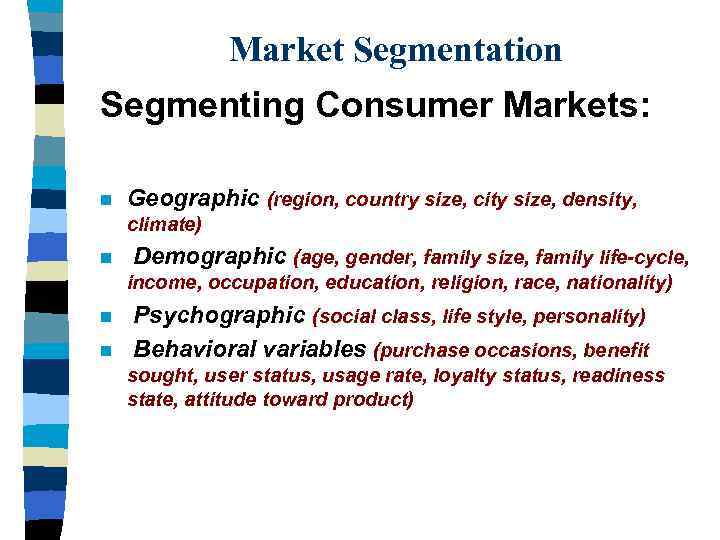 Market Segmentation Segmenting Consumer Markets: n Geographic (region, country size, city size, density, climate) n Demographic (age, gender, family size, family life-cycle, income, occupation, education, religion, race, nationality) n n Psychographic (social class, life style, personality) Behavioral variables (purchase occasions, benefit sought, user status, usage rate, loyalty status, readiness state, attitude toward product)
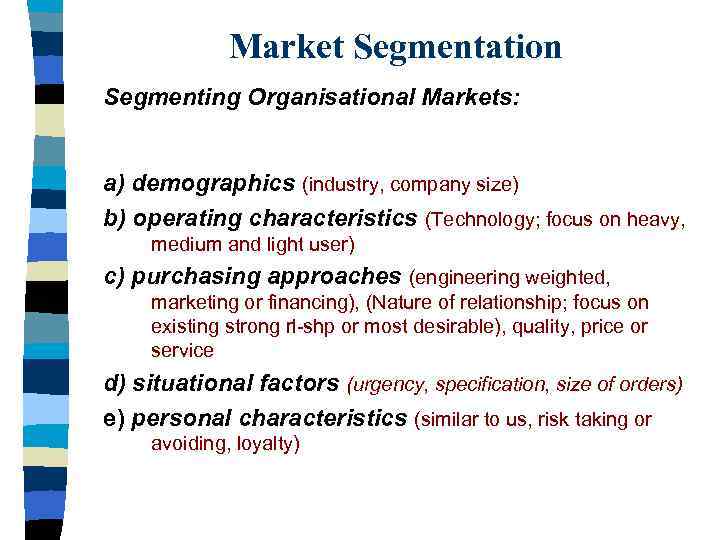 Market Segmentation Segmenting Organisational Markets: a) demographics (industry, company size) b) operating characteristics (Technology; focus on heavy, medium and light user) c) purchasing approaches (engineering weighted, marketing or financing), (Nature of relationship; focus on existing strong rl shp or most desirable), quality, price or service d) situational factors (urgency, specification, size of orders) e) personal characteristics (similar to us, risk taking or avoiding, loyalty)
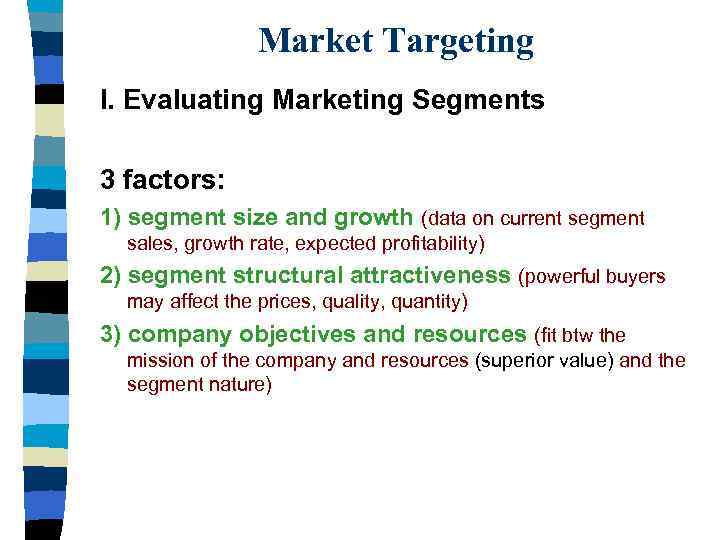 Market Targeting I. Evaluating Marketing Segments 3 factors: 1) segment size and growth (data on current segment sales, growth rate, expected profitability) 2) segment structural attractiveness (powerful buyers may affect the prices, quality, quantity) 3) company objectives and resources (fit btw the mission of the company and resources (superior value) and the segment nature)
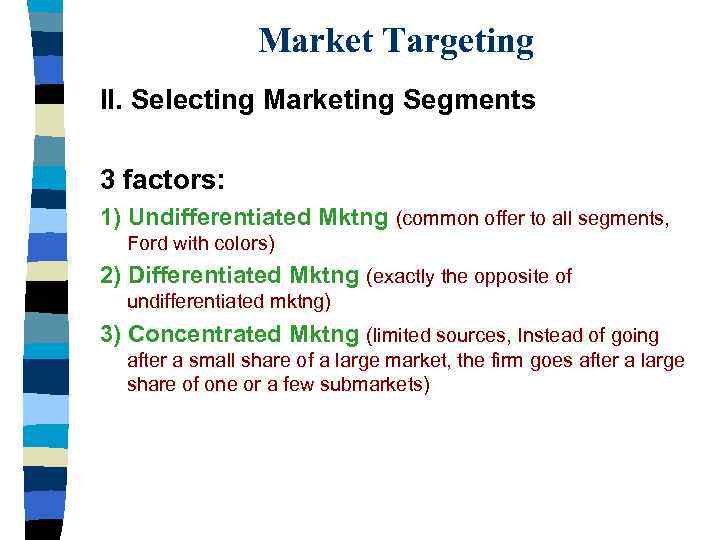 Market Targeting II. Selecting Marketing Segments 3 factors: 1) Undifferentiated Mktng (common offer to all segments, Ford with colors) 2) Differentiated Mktng (exactly the opposite of undifferentiated mktng) 3) Concentrated Mktng (limited sources, Instead of going after a small share of a large market, the firm goes after a large share of one or a few submarkets)
 Market Positioning Strategies: 1) Product Attributes e. g. Honda low price; BMW high performance 2) Benefits 3) Usage occasions 4) Users 5) Against/Away the competitor 6) Product classes e. g. margarine vs. cooking oils or dove vs. crème Marketers use combinations of all these strategies