


 Скачать презентацию Forecasting Fed Funds Rate Group 4 Neelima Akkannapragada
947f61ab31f0499bf4d2706815d3993a.ppt
- Количество слайдов: 19
 Forecasting Fed Funds Rate Group 4 Neelima Akkannapragada Chayaporn Lertrattanapaiboon Anthony Mak Joseph Singh Corinna Traumueller Hyo Joon You
 Background l l l Fed funds rate (FFR) as an instrument of control. FFR as sign of economic strength/weakness. FFR is at 1. 25%, the lowest since 1961. Greenspan intimates at possibility of deflation (last week). Japanese Deflation and the Great Depression.
 Objectives l What will happen to the FFR given indicators such as GDP, CPI, stock market price levels, etc? – Create a distributed lag model with FFR as the dependent variable. – Provide one period ahead forecast of FFR. l And what does this forecast mean to us? – Provide economic context for the forecast.
 The Idea Supposing that the Fed made its decision solely on previous FFR would be naive. l Fed’s decision on future FFR depends on existing information. l We focus on these existing information to explain FFR. l – GDP – CPI – SP 500
 Data Standardization l l l l All data from Fred II. Different time range and frequencies But same time range and frequencies necessary for DL model Lower bound set by data with the latest start (SP 5000 Jan 1970) Upper bound set by data with the earliest end (GDP Jan 2003) Frequency set by data with lowest frequency (GDP quarterly). Result is a shorter and less frequent data set (120 obs). Still enough data.
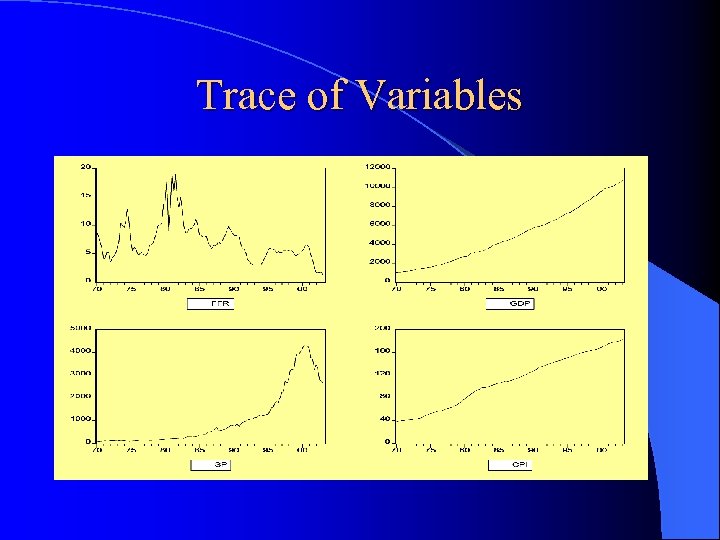 Trace of Variables
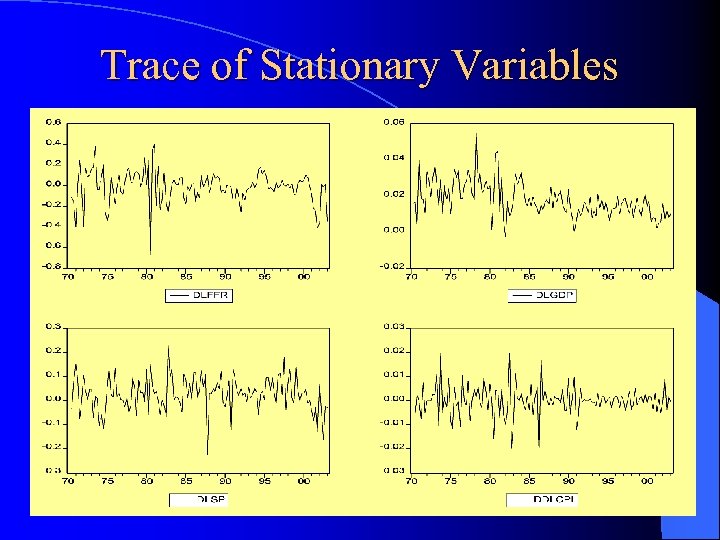 Trace of Stationary Variables
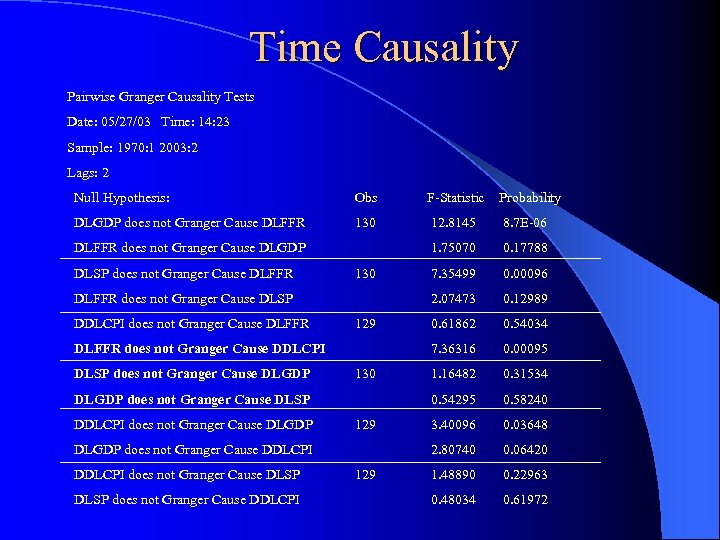 Time Causality Pairwise Granger Causality Tests Date: 05/27/03 Time: 14: 23 Sample: 1970: 1 2003: 2 Lags: 2 Null Hypothesis: Obs F-Statistic Probability DLGDP does not Granger Cause DLFFR 130 12. 8145 8. 7 E-06 1. 75070 0. 17788 7. 35499 0. 00096 2. 07473 0. 12989 0. 61862 0. 54034 7. 36316 0. 00095 1. 16482 0. 31534 0. 54295 0. 58240 3. 40096 0. 03648 2. 80740 0. 06420 1. 48890 0. 22963 0. 48034 0. 61972 DLFFR does not Granger Cause DLGDP DLSP does not Granger Cause DLFFR 130 DLFFR does not Granger Cause DLSP DDLCPI does not Granger Cause DLFFR 129 DLFFR does not Granger Cause DDLCPI DLSP does not Granger Cause DLGDP 130 DLGDP does not Granger Cause DLSP DDLCPI does not Granger Cause DLGDP 129 DLGDP does not Granger Cause DDLCPI does not Granger Cause DLSP does not Granger Cause DDLCPI 129
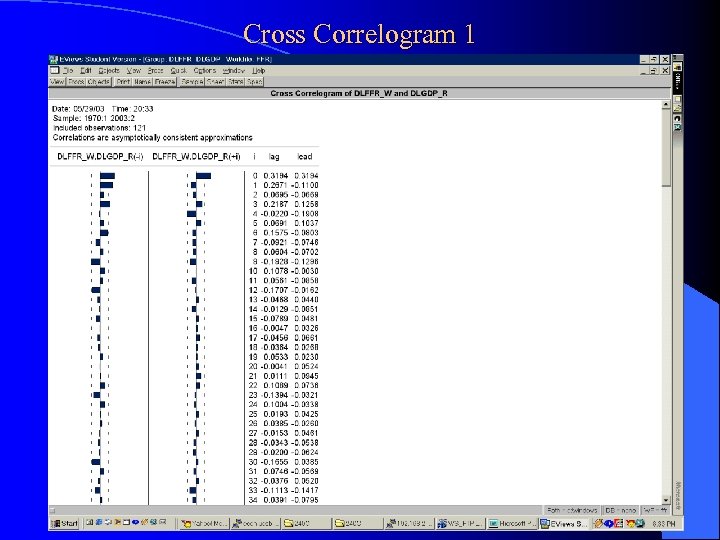 Cross Correlogram 1
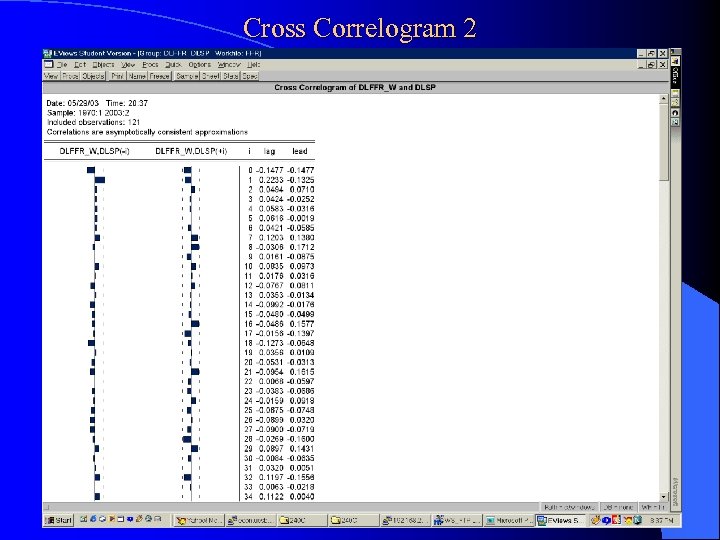 Cross Correlogram 2
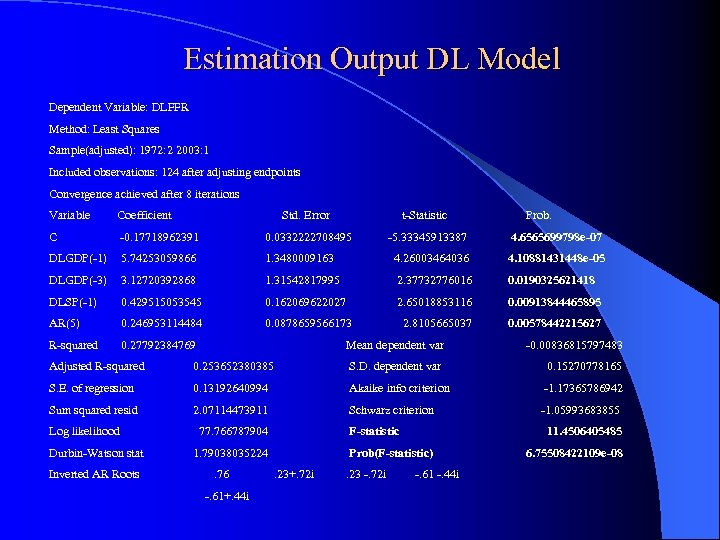 Estimation Output DL Model Dependent Variable: DLFFR Method: Least Squares Sample(adjusted): 1972: 2 2003: 1 Included observations: 124 after adjusting endpoints Convergence achieved after 8 iterations Variable Coefficient Std. Error t-Statistic C Prob. -0. 17718962391 0. 0332222708495 -5. 33345913387 4. 6565699798 e-07 DLGDP(-1) 5. 74253059866 1. 3480009163 4. 26003464036 4. 10881431448 e-05 DLGDP(-3) 3. 12720392868 1. 31542817995 2. 37732776016 0. 0190325621418 DLSP(-1) 0. 429515053545 0. 162069622027 2. 65018853116 0. 00913844465895 AR(5) 0. 246953114484 0. 0878659566173 2. 8105665037 0. 00578442215627 R-squared 0. 27792384769 Mean dependent var -0. 00836815797483 Adjusted R-squared 0. 253652380385 S. D. dependent var 0. 15270778165 S. E. of regression 0. 13192640994 Akaike info criterion -1. 17365786942 Sum squared resid 2. 07114473911 Schwarz criterion -1. 05993683855 Log likelihood Durbin-Watson stat Inverted AR Roots 77. 766787904 F-statistic 1. 79038035224. 76 -. 61+. 44 i 11. 4506405485 Prob(F-statistic). 23+. 72 i . 23 -. 72 i -. 61 -. 44 i 6. 75508422109 e-08
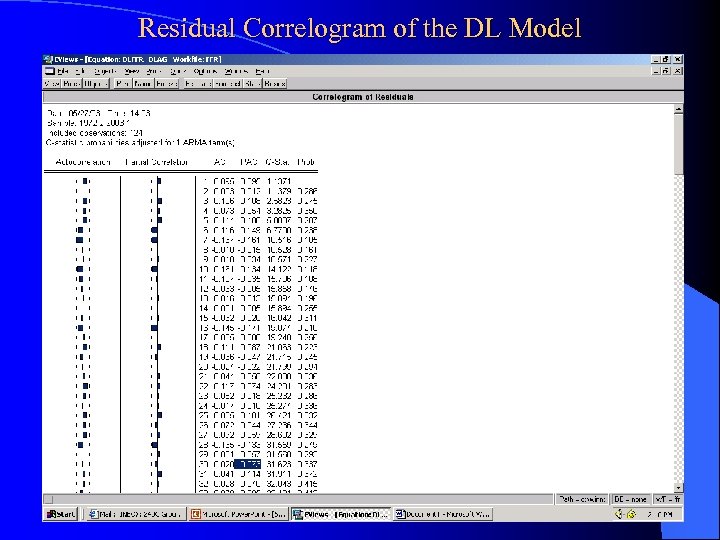 Residual Correlogram of the DL Model
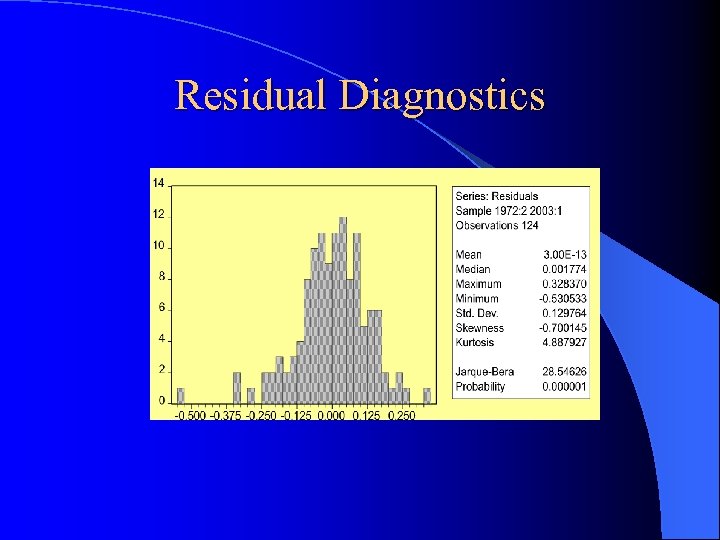 Residual Diagnostics
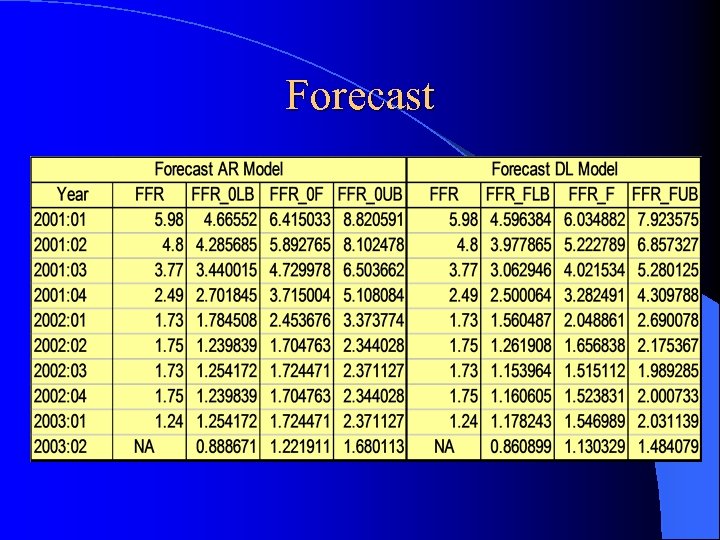 Forecast
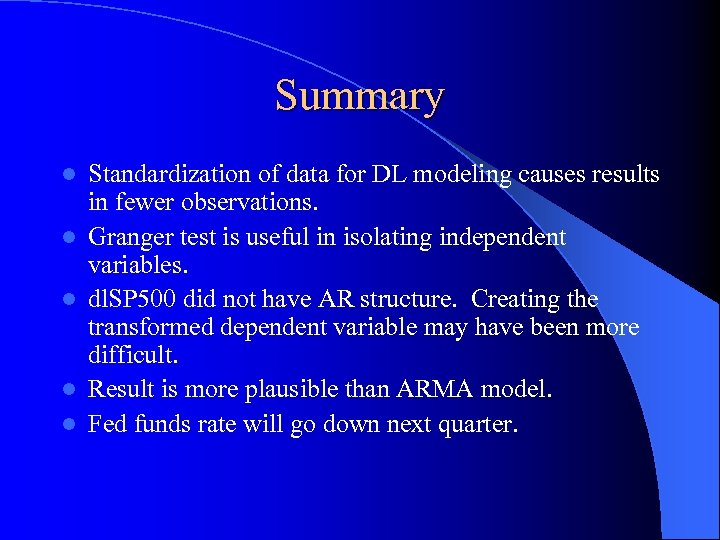 Summary l l l Standardization of data for DL modeling causes results in fewer observations. Granger test is useful in isolating independent variables. dl. SP 500 did not have AR structure. Creating the transformed dependent variable may have been more difficult. Result is more plausible than ARMA model. Fed funds rate will go down next quarter.
 What Now? l Assuming that fed funds will continue to go down, one can… – buy treasury bonds now and sell them later at a higher price when interest rate drops – simply try harder to find a job in the sluggish economy – start a business now in anticipation of next boom
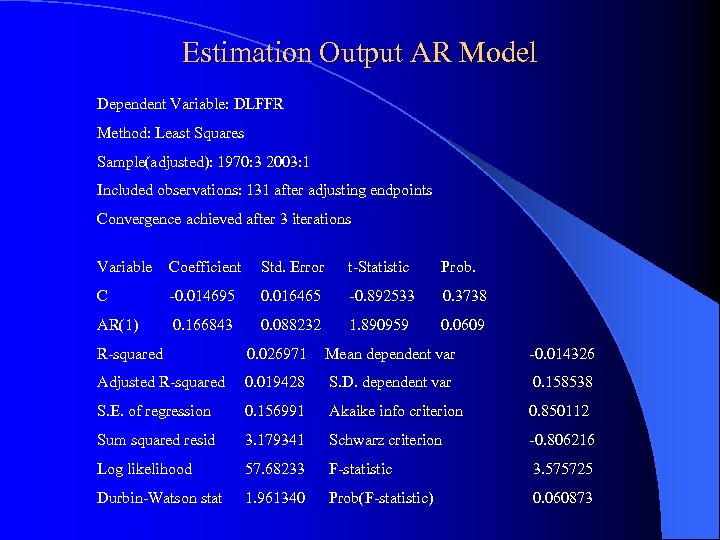 Estimation Output AR Model Dependent Variable: DLFFR Method: Least Squares Sample(adjusted): 1970: 3 2003: 1 Included observations: 131 after adjusting endpoints Convergence achieved after 3 iterations Variable Coefficient Std. Error t-Statistic Prob. C -0. 014695 0. 016465 -0. 892533 0. 3738 AR(1) 0. 166843 0. 088232 1. 890959 0. 0609 R-squared 0. 026971 Mean dependent var -0. 014326 Adjusted R-squared 0. 019428 S. D. dependent var 0. 158538 S. E. of regression 0. 156991 Akaike info criterion 0. 850112 Sum squared resid 3. 179341 Schwarz criterion -0. 806216 Log likelihood 57. 68233 F-statistic 3. 575725 Durbin-Watson stat 1. 961340 Prob(F-statistic) 0. 060873
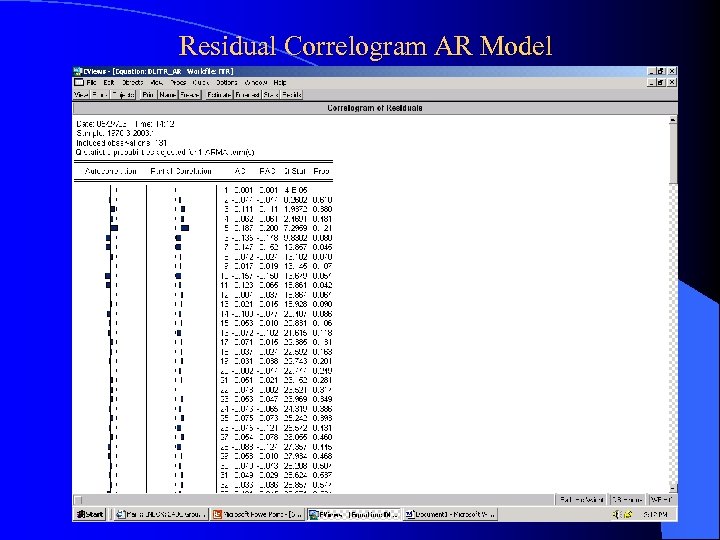 Residual Correlogram AR Model
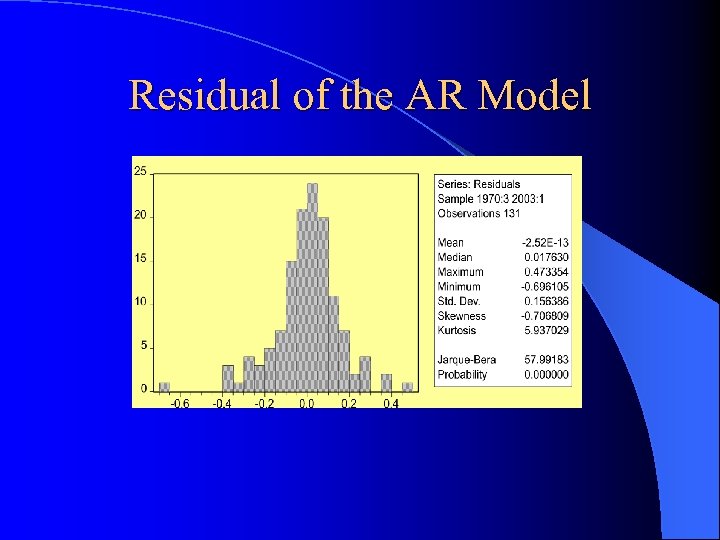 Residual of the AR Model