


 Скачать презентацию Foraging an Industrial Society UNIT 6 1869 -1900
b2e841cb0bdea4b493421088c84a3d83.ppt
- Количество слайдов: 85
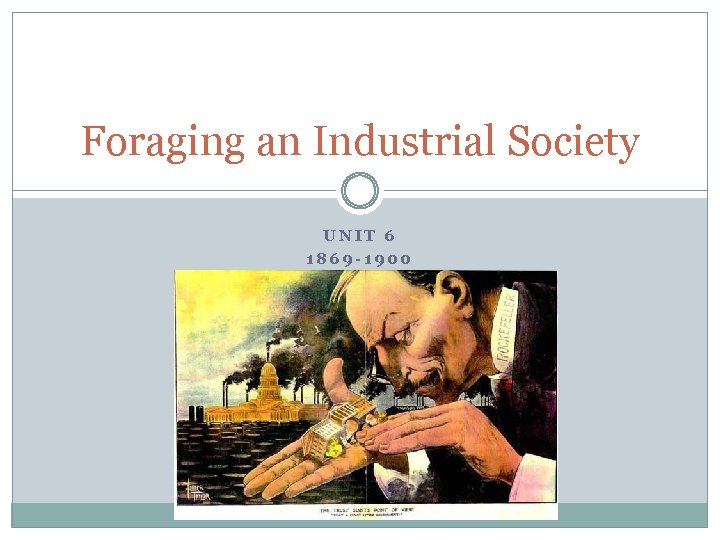 Foraging an Industrial Society UNIT 6 1869 -1900
 Forging an Industrial Society America went from a rural society beginning of the Civil War to urbanizing, industrial one by the end of the century Economic and technological change allowed a whole new civilization to emerge The last part of the 1800’s saw the rise of industry and industrial giants American movement to urban areas brought into question the spirit of individualism, but also expansion and closure onto the Western frontier Reformers ushered in an age of more active governmental affairs on the social and business fronts
 Forging an Industrial Society Economic change brought political and social turmoil and allowed for the expansion of labor unions Disputes over monetary policies divided industrialists and farmers and gave rise to the Populist party The South remained untouched by this prosperity and African Americans became victims of institutionalized racism As the century ended Americans were again gripped by expansionism and people questioned American’s role on the world stage
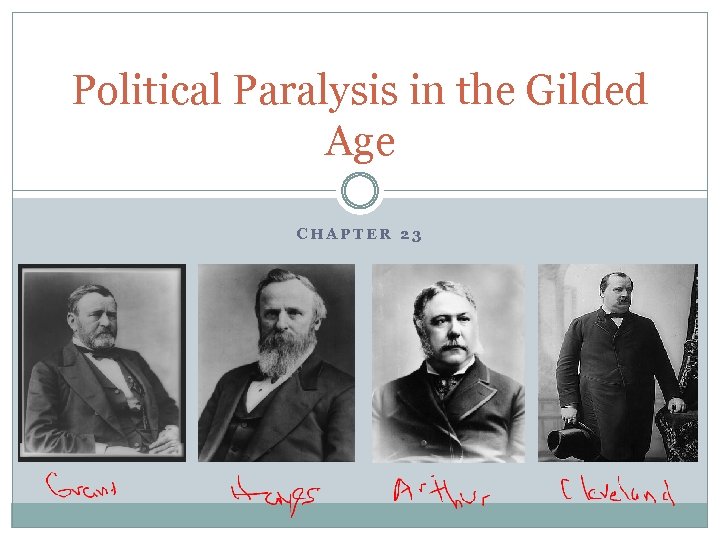 Political Paralysis in the Gilded Age CHAPTER 23
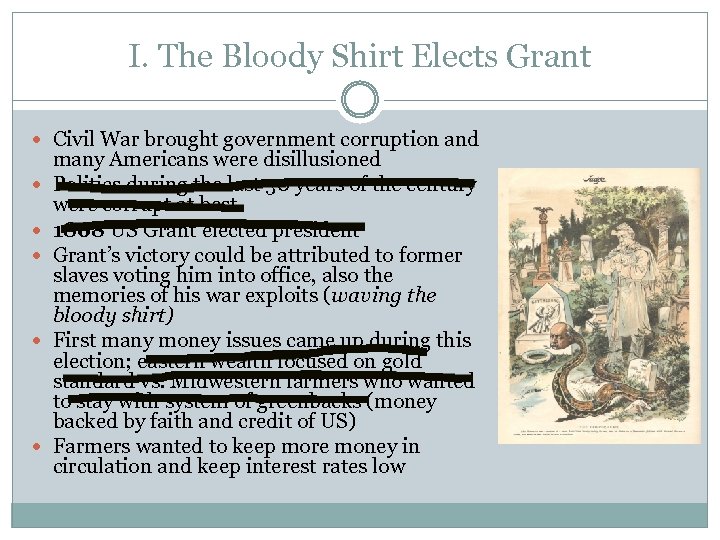 I. The Bloody Shirt Elects Grant Civil War brought government corruption and many Americans were disillusioned Politics during the last 30 years of the century were corrupt at best 1868 US Grant elected president Grant’s victory could be attributed to former slaves voting him into office, also the memories of his war exploits (waving the bloody shirt) First many money issues came up during this election; eastern wealth focused on gold standard vs. Midwestern farmers who wanted to stay with system of greenbacks (money backed by faith and credit of US) Farmers wanted to keep more money in circulation and keep interest rates low
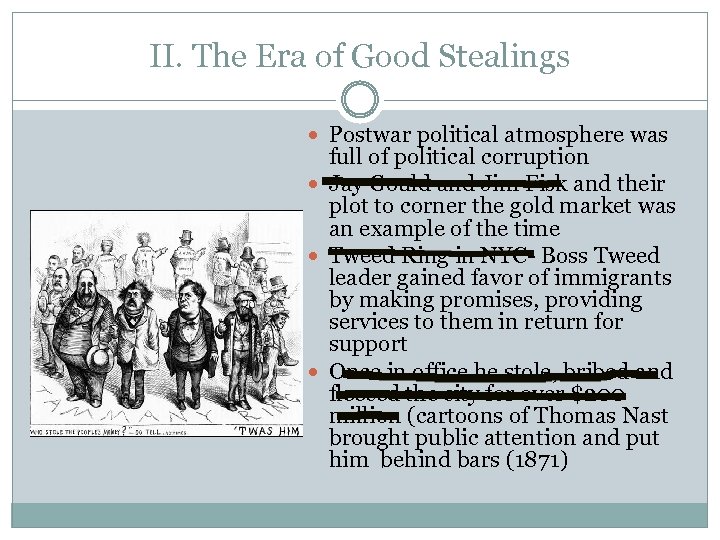 II. The Era of Good Stealings Postwar political atmosphere was full of political corruption Jay Gould and Jim Fisk and their plot to corner the gold market was an example of the time Tweed Ring in NYC- Boss Tweed leader gained favor of immigrants by making promises, providing services to them in return for support Once in office he stole, bribed and fleeced the city for over $200 million (cartoons of Thomas Nast brought public attention and put him behind bars (1871)
 III. A Carnival of Corruption Misdeeds of federal government Grant’s cabinet was full of crooks 1872 Credit Mobilier Scandal Union Pacific RR formed Credit Mobilier Construction to build railroads and hired themselves at inflated prices Gave stock to key Congressmen to cover up investigation, even paid off VP 1874 -1875 Whiskey Ring robbed treasury of millions in excise tax revenue 1876 Sec. of War had to resign after pocketing bribes from suppliers to Indian reservations
 IV. The Liberal Republican Revolt of 1872 Reformers tired of corruption formed Liberal Republican Party in 1872 Nominated editor of New York Tribune, Horace Greely Democrats endorse Greely and his views on national unity Election 1872 between Grant and Greely a choice of the lesser of two evils and Grant won
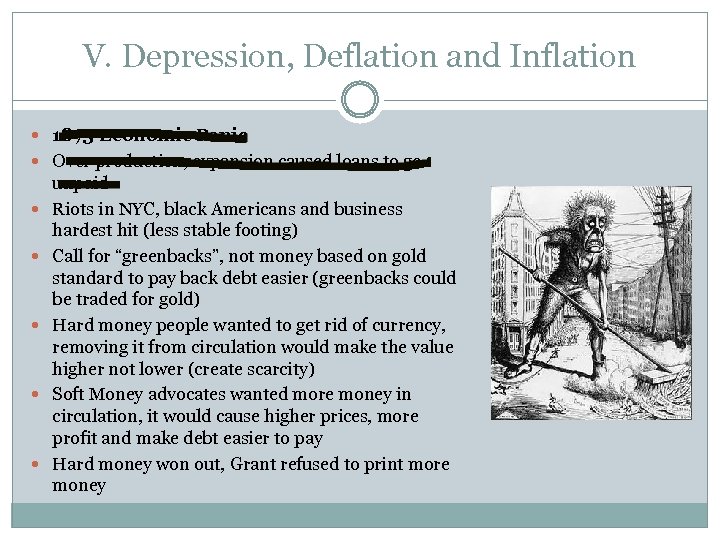 V. Depression, Deflation and Inflation 1873 Economic Panic Over production, expansion caused loans to go unpaid Riots in NYC, black Americans and business hardest hit (less stable footing) Call for “greenbacks”, not money based on gold standard to pay back debt easier (greenbacks could be traded for gold) Hard money people wanted to get rid of currency, removing it from circulation would make the value higher not lower (create scarcity) Soft Money advocates wanted more money in circulation, it would cause higher prices, more profit and make debt easier to pay Hard money won out, Grant refused to print more money
 V. Depression, Deflation and Inflation Debtors looked to silver as a substitute for greenbacks and gold Silver undervalued by US government (16: 1), higher prices on open market so miners did not sell to US government 1873 Congress formally drops making silver coins New discoveries in the same year, production up and mining interests and debtors called end of production “Crime of ’ 73” Demand for more silver scheme to promote inflation Grant has government buy more gold and reduce greenbacks, policy of contraction worsened panic 1874 - Result of money policy led to Democrats regaining control of Congress 1878 limited production of silver coinage (Bland-Alison Act)
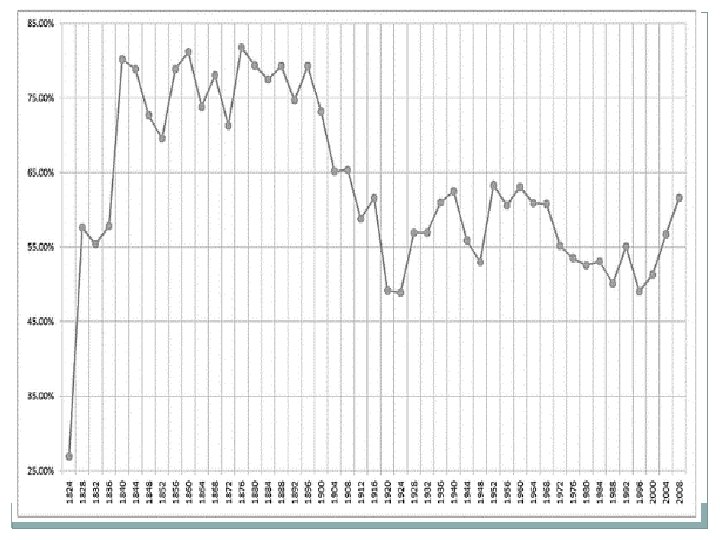
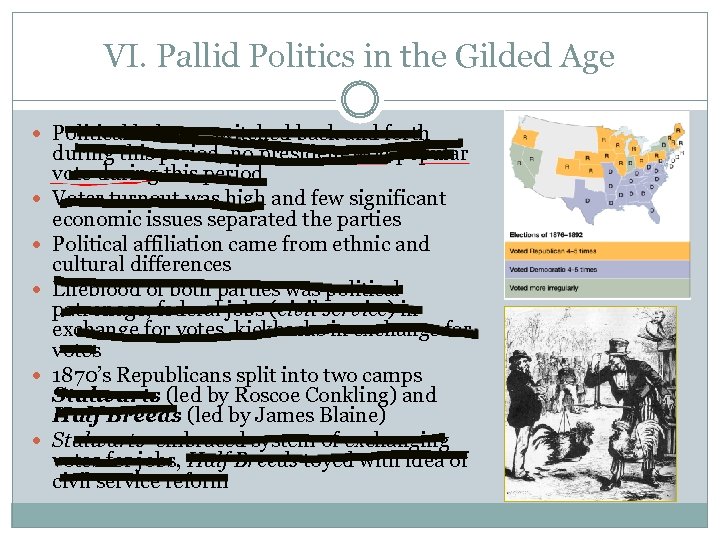 VI. Pallid Politics in the Gilded Age Political balance switched back and forth during this period, no president won popular vote during this period Voter turnout was high and few significant economic issues separated the parties Political affiliation came from ethnic and cultural differences Lifeblood of both parties was political patronage, federal jobs (civil service) in exchange for votes, kickbacks in exchange for votes 1870’s Republicans split into two camps Stalwarts (led by Roscoe Conkling) and Half Breeds (led by James Blaine) Stalwarts embraced system of exchanging votes for jobs, Half Breeds toyed with idea of civil service reform
 Republicans vs. Democrats Northern Protestant Southern whites African Americans Immigrants Supported nativitist causes Catholics Supported prohibition Jews Pro-business Freethinkers Farmers
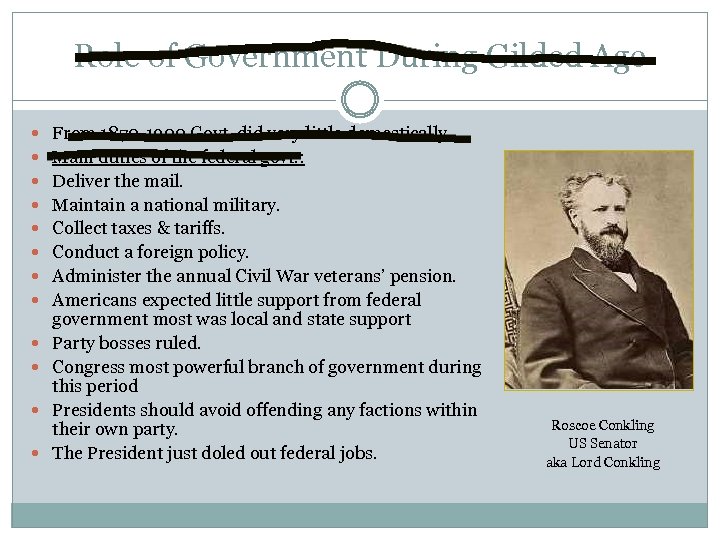 Role of Government During Gilded Age From 1870 -1900 Govt. did very little domestically. Main duties of the federal govt. : Deliver the mail. Maintain a national military. Collect taxes & tariffs. Conduct a foreign policy. Administer the annual Civil War veterans’ pension. Americans expected little support from federal government most was local and state support Party bosses ruled. Congress most powerful branch of government during this period Presidents should avoid offending any factions within their own party. The President just doled out federal jobs. Roscoe Conkling US Senator aka Lord Conkling
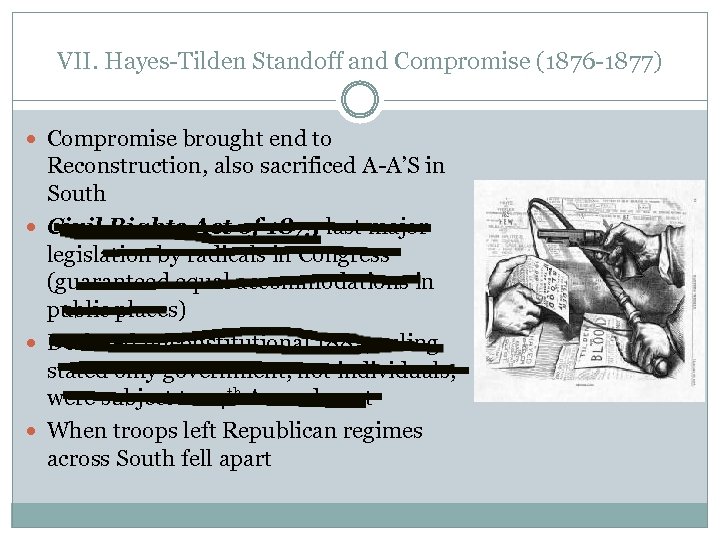 VII. Hayes-Tilden Standoff and Compromise (1876 -1877) Compromise brought end to Reconstruction, also sacrificed A-A’S in South Civil Rights Act of 1875 last major legislation by radicals in Congress (guaranteed equal accommodations in public places) Declared unconstitutional 1883, ruling stated only government, not individuals, were subject to 14 th Amendment When troops left Republican regimes across South fell apart
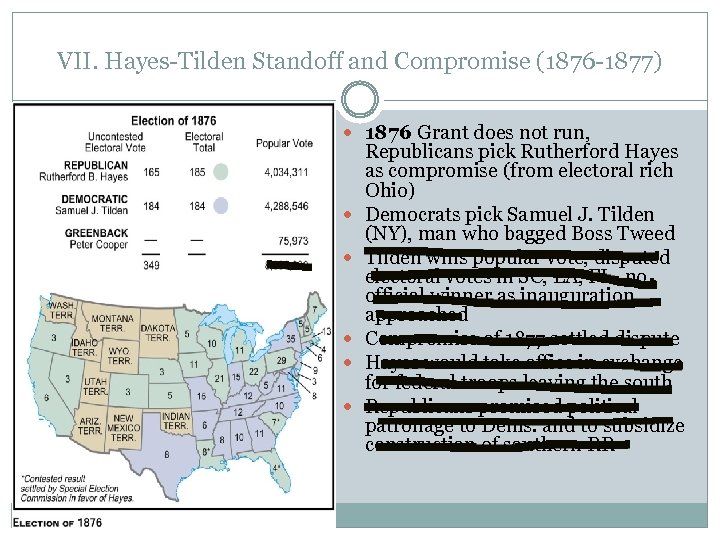 VII. Hayes-Tilden Standoff and Compromise (1876 -1877) 1876 Grant does not run, Republicans pick Rutherford Hayes as compromise (from electoral rich Ohio) Democrats pick Samuel J. Tilden (NY), man who bagged Boss Tweed Tilden wins popular vote, disputed electoral votes in SC, LA, FL- no official winner as inauguration approached Compromise of 1877 settled dispute Hayes would take office in exchange for federal troops leaving the south Republicans promised political patronage to Dems. and to subsidize construction of southern RR
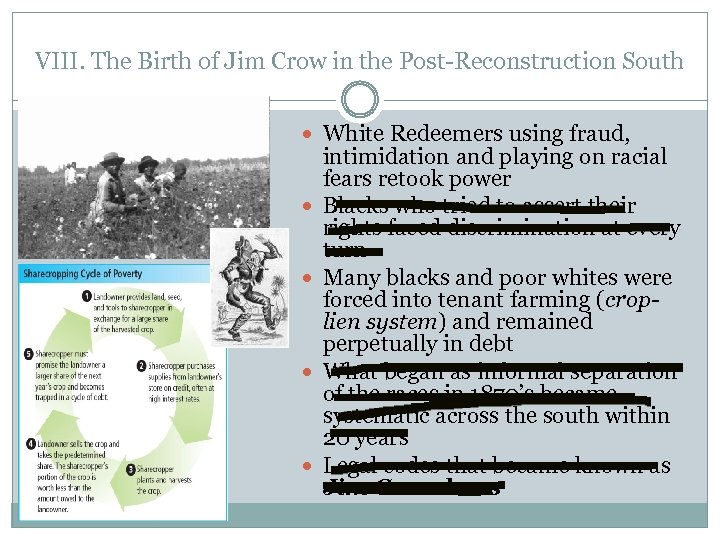 VIII. The Birth of Jim Crow in the Post-Reconstruction South White Redeemers using fraud, intimidation and playing on racial fears retook power Blacks who tried to assert their rights faced discrimination at every turn Many blacks and poor whites were forced into tenant farming (croplien system) and remained perpetually in debt What began as informal separation of the races in 1870’s became systematic across the south within 20 years Legal codes that became known as Jim Crow laws
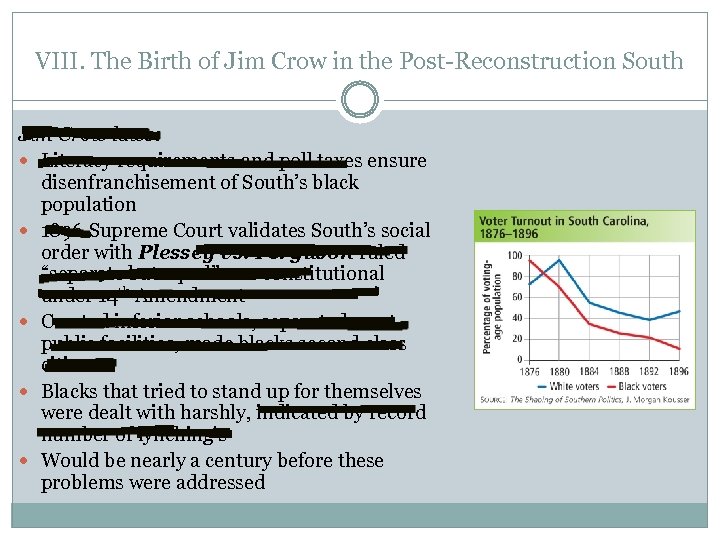 VIII. The Birth of Jim Crow in the Post-Reconstruction South Jim Crow laws: Literacy requirements and poll taxes ensure disenfranchisement of South’s black population 1896 Supreme Court validates South’s social order with Plessey vs. Ferguson ruled “separate but equal” was constitutional under 14 th Amendment Created inferior schools, separated most public facilities, made blacks second class citizens Blacks that tried to stand up for themselves were dealt with harshly, indicated by record number of lynching's Would be nearly a century before these problems were addressed
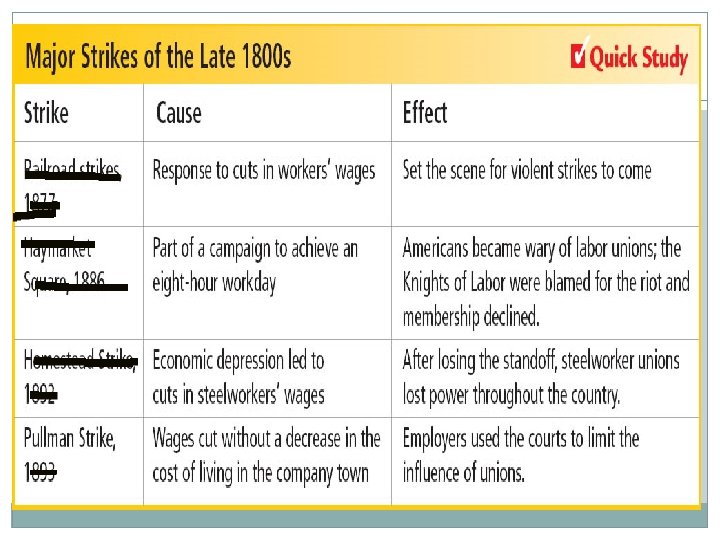
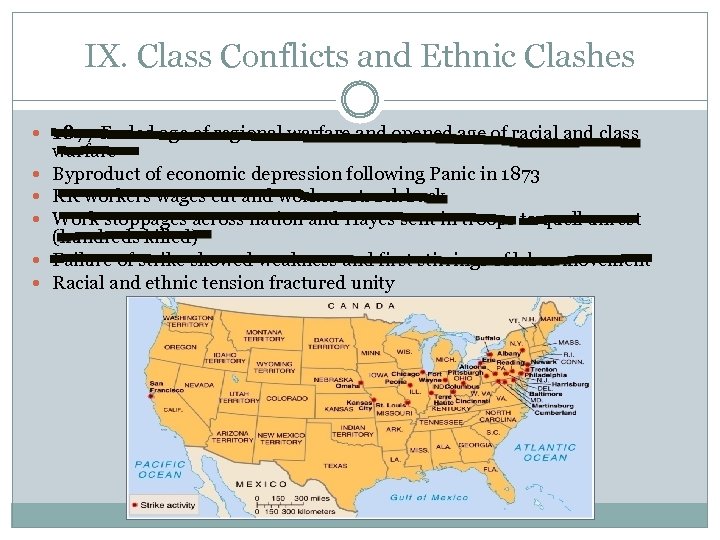 IX. Class Conflicts and Ethnic Clashes 1877 Ended age of regional warfare and opened age of racial and class warfare Byproduct of economic depression following Panic in 1873 RR workers wages cut and workers struck back Work stoppages across nation and Hayes sent in troops to quell unrest (hundreds killed) Failure of strike showed weakness and first stirrings of labor movement Racial and ethnic tension fractured unity
 IX. Class Conflicts and Ethnic Clashes Tension high in California between Chinese and Irish Many Chinese came to work in goldfields and RR’s Irish (Kearneyites) resented competition of cheap Chinese labor , terrorized Chinese 1882 Congress cuts off further immigration from China until 1943 1896 and 1898 victory for Chinese in Yik Wo vs. Hopkins, US vs. Wong Kim protected them in employment and citizenship (guaranteed by 14 th Amendment) Wong Kim case protected other immigrant groups as well
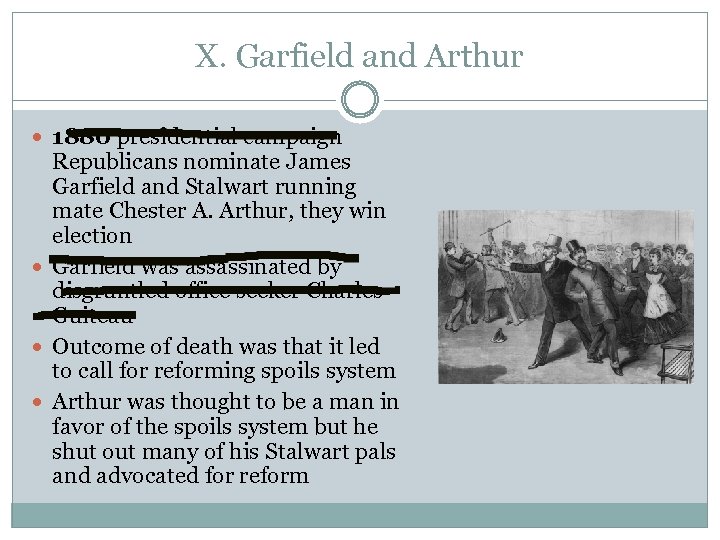 X. Garfield and Arthur 1880 presidential campaign Republicans nominate James Garfield and Stalwart running mate Chester A. Arthur, they win election Garfield was assassinated by disgruntled office seeker Charles Guiteau Outcome of death was that it led to call for reforming spoils system Arthur was thought to be a man in favor of the spoils system but he shut out many of his Stalwart pals and advocated for reform
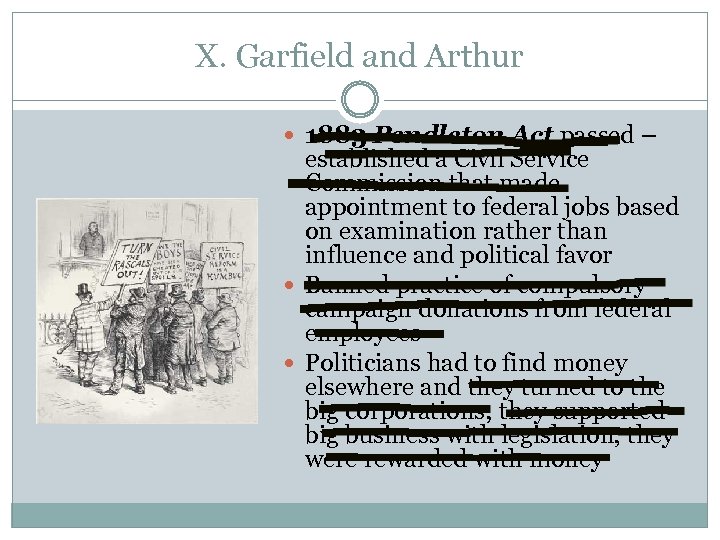 X. Garfield and Arthur 1883 Pendleton Act passed – established a Civil Service Commission that made appointment to federal jobs based on examination rather than influence and political favor Banned practice of compulsory campaign donations from federal employees Politicians had to find money elsewhere and they turned to the big corporations; they supported big business with legislation, they were rewarded with money
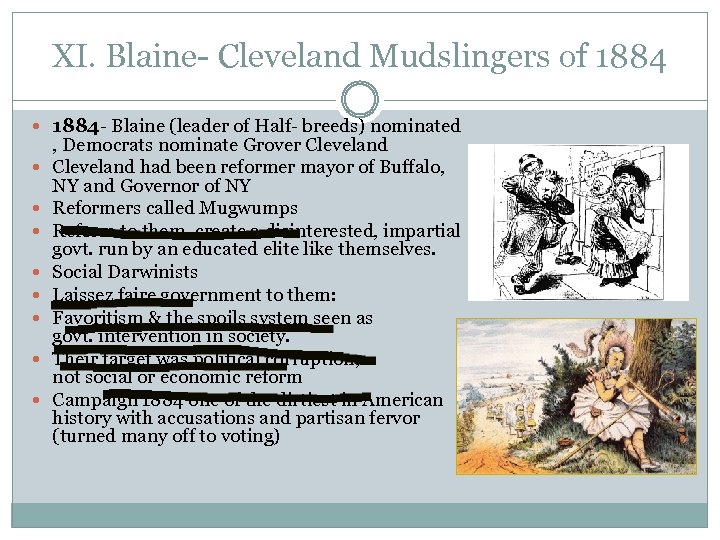 XI. Blaine- Cleveland Mudslingers of 1884 - Blaine (leader of Half- breeds) nominated , Democrats nominate Grover Cleveland had been reformer mayor of Buffalo, NY and Governor of NY Reformers called Mugwumps Reform to them, create a disinterested, impartial govt. run by an educated elite like themselves. Social Darwinists Laissez faire government to them: Favoritism & the spoils system seen as govt. intervention in society. Their target was political corruption, not social or economic reform Campaign 1884 one of the dirtiest in American history with accusations and partisan fervor (turned many off to voting)
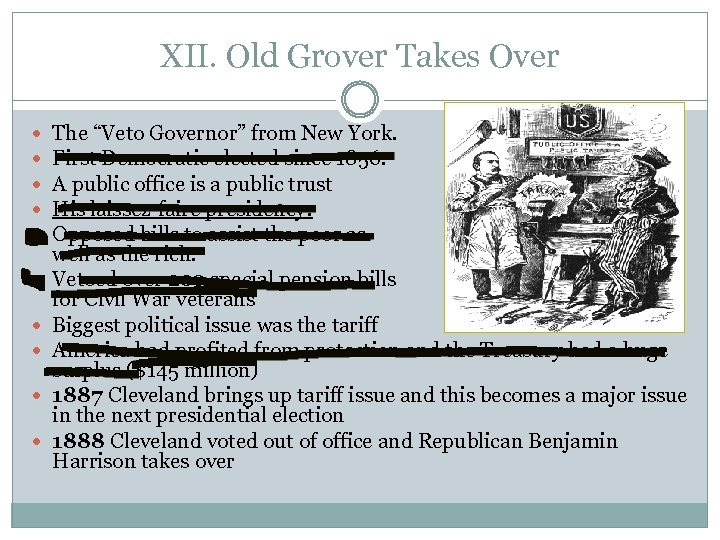 XII. Old Grover Takes Over The “Veto Governor” from New York. First Democratic elected since 1856. A public office is a public trust His laissez-faire presidency: Opposed bills to assist the poor as well as the rich. Vetoed over 200 special pension bills for Civil War veterans Biggest political issue was the tariff America had profited from protection and the Treasury had a huge surplus ($145 million) 1887 Cleveland brings up tariff issue and this becomes a major issue in the next presidential election 1888 Cleveland voted out of office and Republican Benjamin Harrison takes over
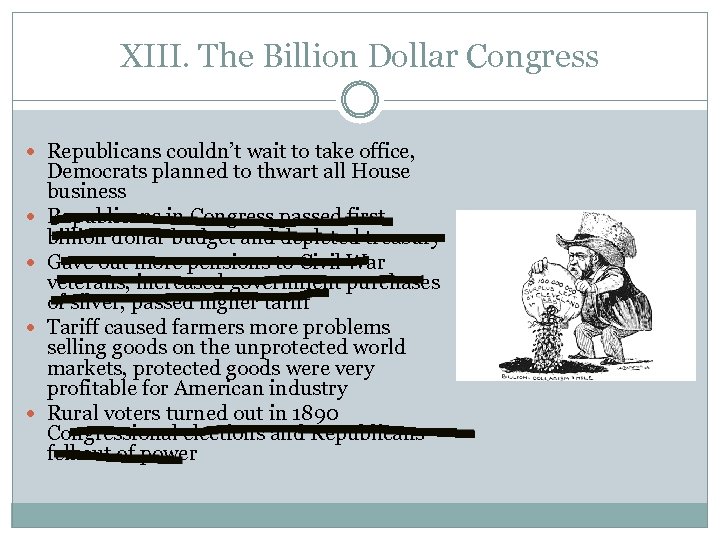 XIII. The Billion Dollar Congress Republicans couldn’t wait to take office, Democrats planned to thwart all House business Republicans in Congress passed first billion dollar budget and depleted treasury Gave out more pensions to Civil War veterans, increased government purchases of silver, passed higher tariff Tariff caused farmers more problems selling goods on the unprotected world markets, protected goods were very profitable for American industry Rural voters turned out in 1890 Congressional elections and Republicans fell out of power
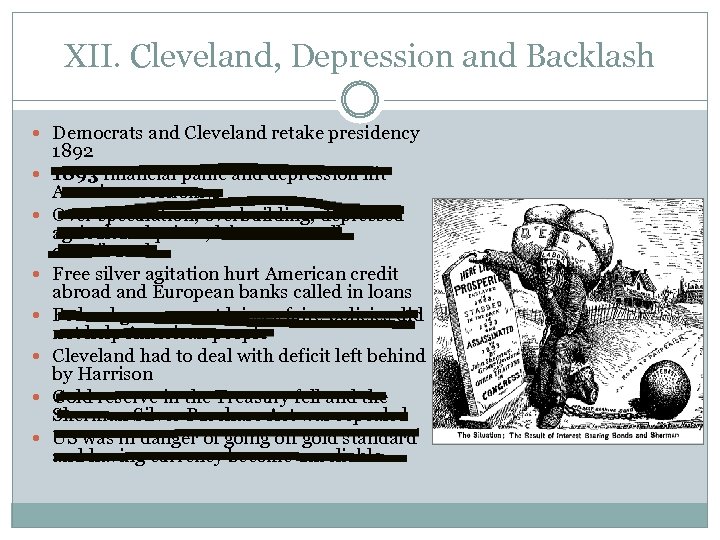 XII. Cleveland, Depression and Backlash Democrats and Cleveland retake presidency 1892 1893 financial panic and depression hit American economy Over speculation, overbuilding, depressed agricultural prices, labor unrest all contributed Free silver agitation hurt American credit abroad and European banks called in loans Federal government laissez faire policies did not help American people Cleveland had to deal with deficit left behind by Harrison Gold reserve in the Treasury fell and the Sherman Silver Purchase Act was repealed US was in danger of going off gold standard and having currency become unreliable
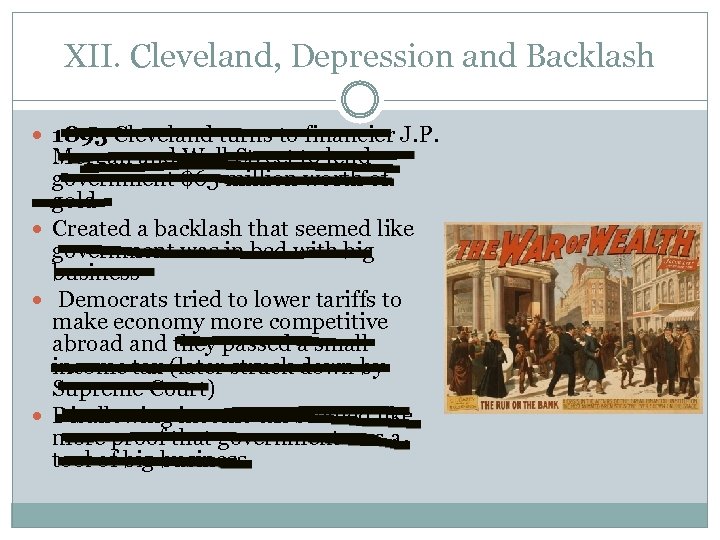 XII. Cleveland, Depression and Backlash 1895 Cleveland turns to financier J. P. Morgan and Wall Street to lend government $65 million worth of gold Created a backlash that seemed like government was in bed with big business Democrats tried to lower tariffs to make economy more competitive abroad and they passed a small income tax (later struck down by Supreme Court) Disallowing income tax seemed like more proof that government was a tool of big business
 XIV. The Drumbeat of Discontent 1892 Populist Party first appeared It was a coalition of frustrated farmers in the south and west that denounced government injustice They met in Omaha to announce their support for the following 1. System of “sub-treasuries. ” 2. Abolition of the National Bank. 3. Direct election of Senators. 4. Govt. ownership of RRs, telephone & telegraph companies. 5. Government-operated postal savings banks. 6. Restriction of undesirable immigration. 7. 8 -hour work day for government employees. 8. Abolition of the Pinkerton detective agency. 9. Australian secret ballot. 10. Re-monitization of silver. 11. A single term for President & Vice President
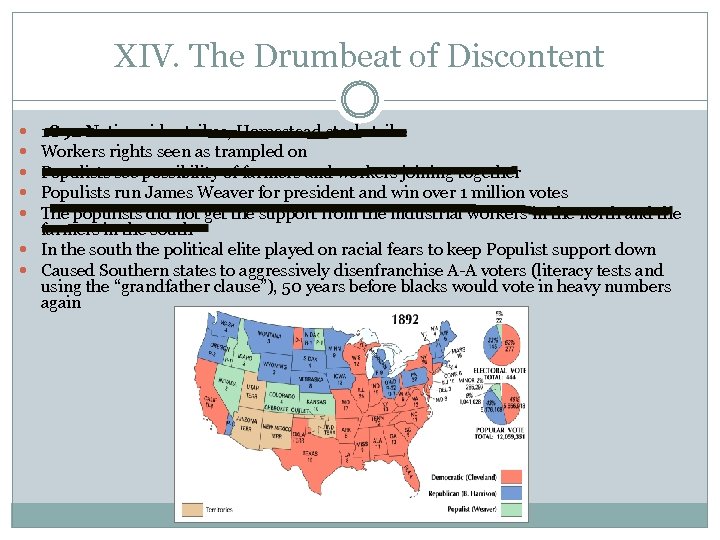 XIV. The Drumbeat of Discontent 1892 Nationwide strikes, Homestead steel strike Workers rights seen as trampled on Populists see possibility of farmers and workers joining together Populists run James Weaver for president and win over 1 million votes The populists did not get the support from the industrial workers in the north and the farmers in the south In the south the political elite played on racial fears to keep Populist support down Caused Southern states to aggressively disenfranchise A-A voters (literacy tests and using the “grandfather clause”), 50 years before blacks would vote in heavy numbers again
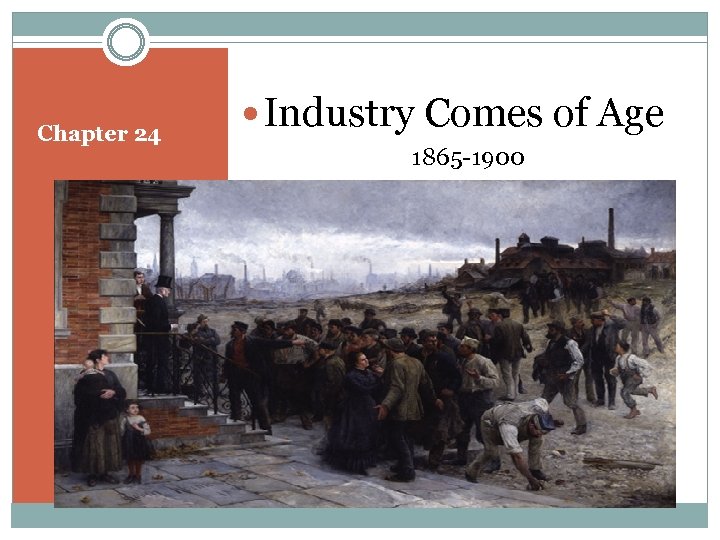 Chapter 24 Industry Comes of Age 1865 -1900
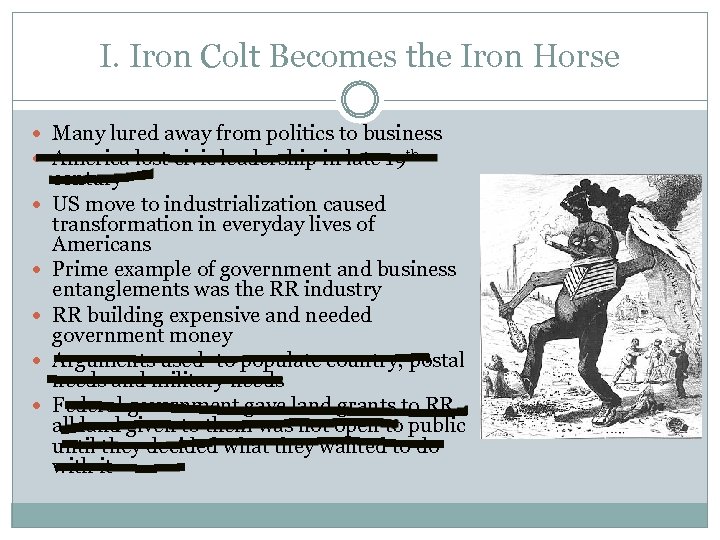 I. Iron Colt Becomes the Iron Horse Many lured away from politics to business America lost civic leadership in late 19 th century US move to industrialization caused transformation in everyday lives of Americans Prime example of government and business entanglements was the RR industry RR building expensive and needed government money Arguments used- to populate country, postal needs and military needs Federal government gave land grants to RR, all land given to them was not open to public until they decided what they wanted to do with it
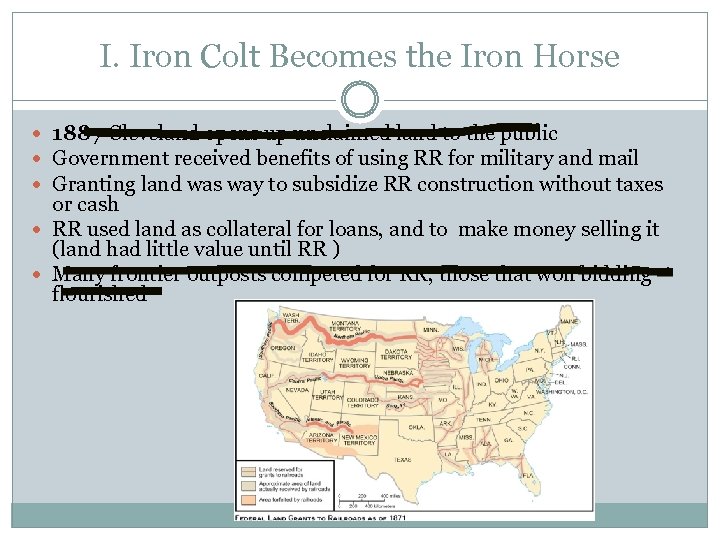 I. Iron Colt Becomes the Iron Horse 1887 Cleveland opens up unclaimed land to the public Government received benefits of using RR for military and mail Granting land was way to subsidize RR construction without taxes or cash RR used land as collateral for loans, and to make money selling it (land had little value until RR ) Many frontier outposts competed for RR, those that won bidding flourished
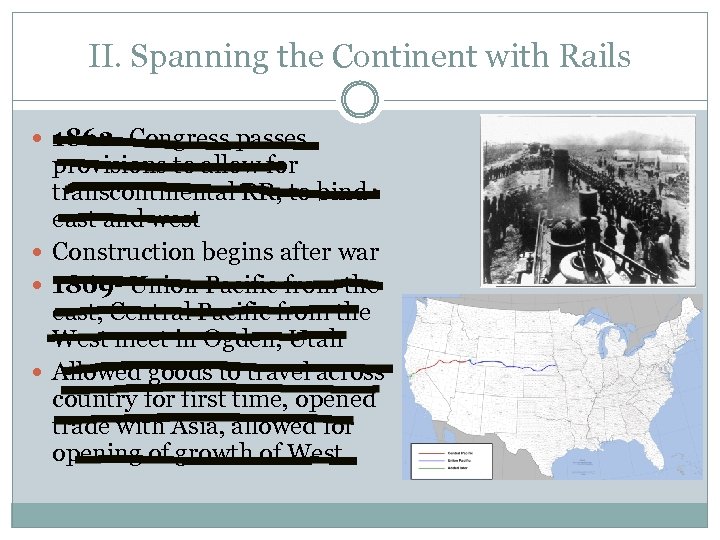 II. Spanning the Continent with Rails 1862 - Congress passes provisions to allow for transcontinental RR, to bind east and west Construction begins after war 1869 - Union Pacific from the east, Central Pacific from the West meet in Ogden, Utah Allowed goods to travel across country for first time, opened trade with Asia, allowed for opening of growth of West
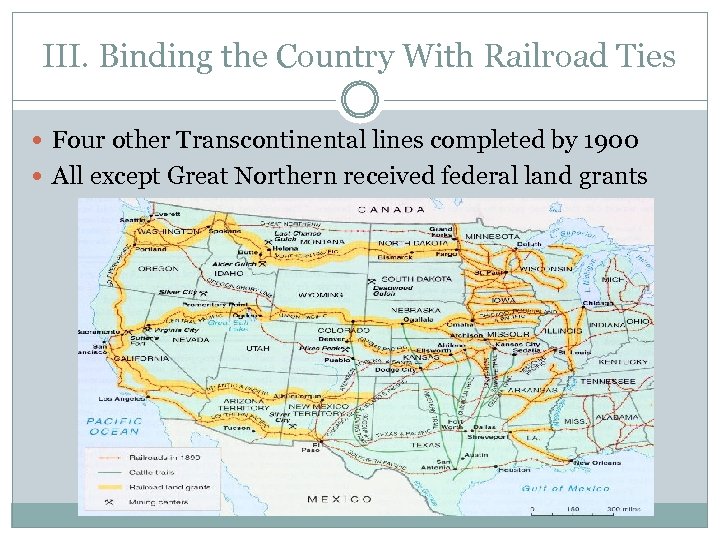 III. Binding the Country With Railroad Ties Four other Transcontinental lines completed by 1900 All except Great Northern received federal land grants
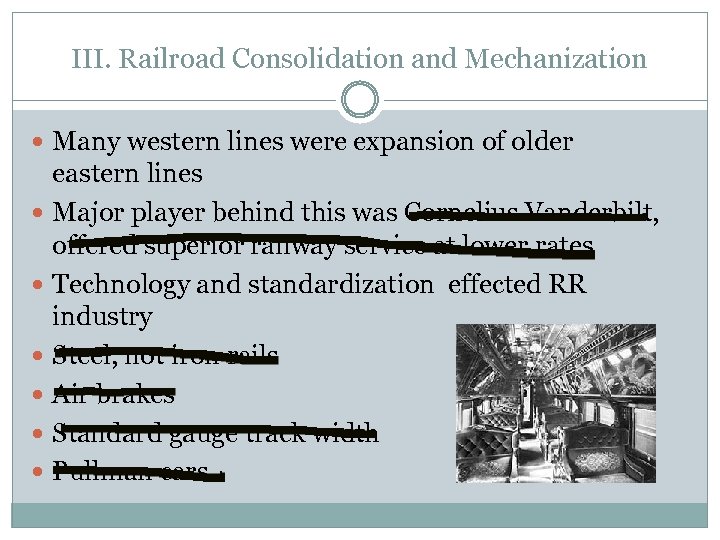 III. Railroad Consolidation and Mechanization Many western lines were expansion of older eastern lines Major player behind this was Cornelius Vanderbilt, offered superior railway service at lower rates Technology and standardization effected RR industry Steel, not iron rails Air brakes Standard gauge track width Pullman cars
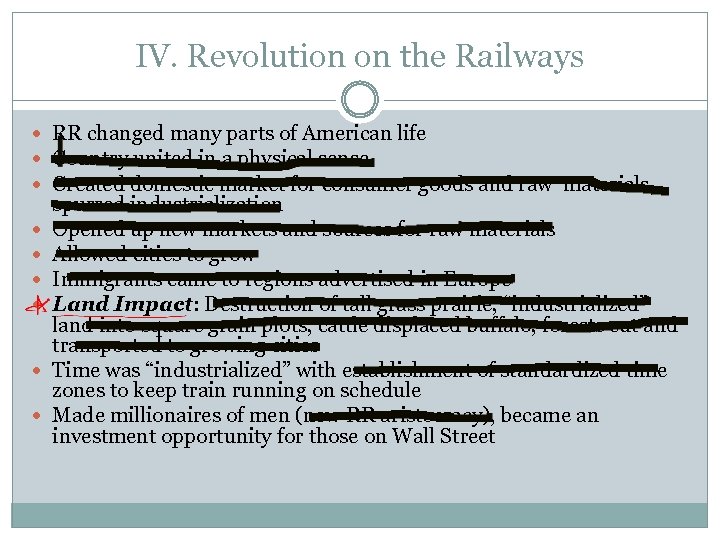 IV. Revolution on the Railways RR changed many parts of American life Country united in a physical sense Created domestic market for consumer goods and raw materials, spurred industrialization Opened up new markets and sources for raw materials Allowed cities to grow Immigrants came to regions advertised in Europe Land Impact: Destruction of tall grass prairie, “industrialized” land into square grain plots, cattle displaced buffalo, forests cut and transported to growing cities Time was “industrialized” with establishment of standardized time zones to keep train running on schedule Made millionaires of men (new RR aristocracy), became an investment opportunity for those on Wall Street
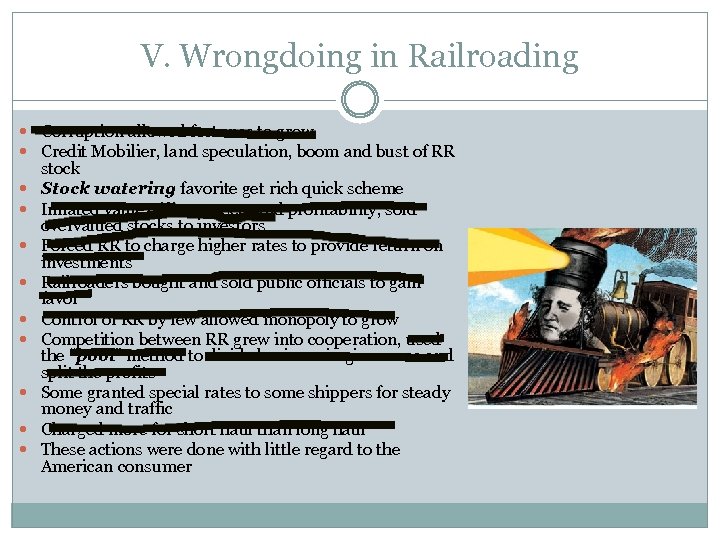 V. Wrongdoing in Railroading Corruption allowed fortunes to grow Credit Mobilier, land speculation, boom and bust of RR stock Stock watering favorite get rich quick scheme Inflated value of lines assets and profitability, sold overvalued stocks to investors Forced RR to charge higher rates to provide return on investments Railroaders bought and sold public officials to gain favor Control of RR by few allowed monopoly to grow Competition between RR grew into cooperation, used the “pool” method to divide business in given area and split the profits Some granted special rates to some shippers for steady money and traffic Charged more for short haul than long haul These actions were done with little regard to the American consumer
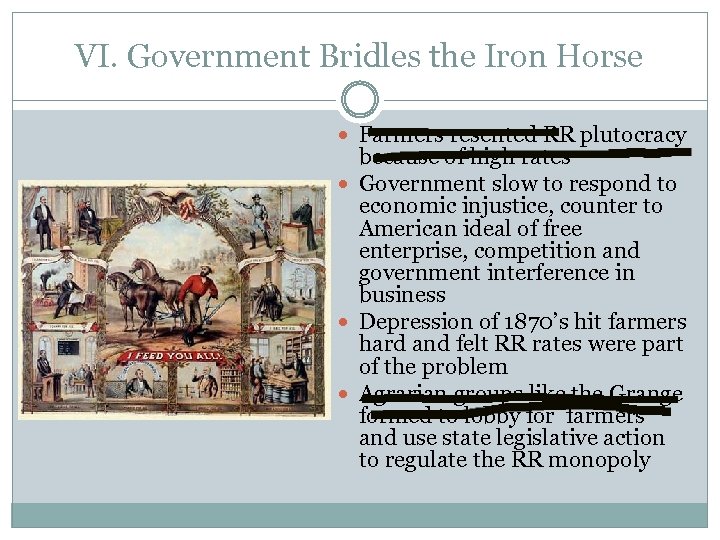 VI. Government Bridles the Iron Horse Farmers resented RR plutocracy because of high rates Government slow to respond to economic injustice, counter to American ideal of free enterprise, competition and government interference in business Depression of 1870’s hit farmers hard and felt RR rates were part of the problem Agrarian groups like the Grange formed to lobby for farmers and use state legislative action to regulate the RR monopoly
 VI. Government Bridles the Iron Horse States had some successes in the Midwest (Grange Laws) but Supreme Court put an end to all of it 1886 Wabash vs. Illinois decided that states had no authority to regulate interstate commerce, only the federal government 1887 Congress passes the Interstate Commerce Act Prohibited rebates and pools RR had to publish rates openly Forbid discrimination against shippers, rates for short and long haul Set up Interstate Commerce Commission (ICC) to enforce, regulate new legislation Act provided a way for business interests to resolve their differences in the open, country could avoid rate wars and action by state legislatures ICC stabilized business in America First large scale attempt to regulate business in the interest of society at large, demonstrated that government would protect public interest
 VII. Miracles of Mechanization After the war America steadily grew to be the world leader in Industrial production Why? Natural resources- coal, timber, many navigable rivers, in 1859 oil was discovered - new source of inexpensive energy Workforce growth- Immigrants pushed from their homeland pulled by the opportunity that America offered. Mechanization of agriculture pushed many farmers to the new, growing cities to find work. Provided new industry a huge workforce Capitalism- liquid capital became more available after the war, system of free enterprise allowed entrepreneurs to fuel industrial growth, established factories, created jobs, attracted foreign investment Government Policies- encouraged growth of business. Provided railroads millions of acres of land to link the country. Passed protective tariffs, encouraged laissez- faire policies Strong legal system and private property rights encouraged investment and growth Technological Innovation- capitalism encouraged innovation and efficiency, brought women into the workplace, established a communication network, changed the daily lives of Americans
 VIII. The Trust Titan Emerges New ways of doing business emerged that concentrated capital and allowed for more efficient control of industry Corporation people share ownership through stock ownership, created huge pool of capital to invest in the business, run different factories Corporations worked to maximize profits, tried to pay workers as little as possible, pay low prices for raw materials. Monopolies were formed to gain complete control of a product or service charge low fares to put others out of business, Others tried to eliminate competition by forming cartels to keep prices artificially high More efficient ways of doing business and organizing their companies Two new methods: Horizontal Integration- consolidating many firms into one business (Standard Oil and refineries) Vertical Integration- gaining control of the many different businesses that make up all parts of a products development (Carnegie Steel)
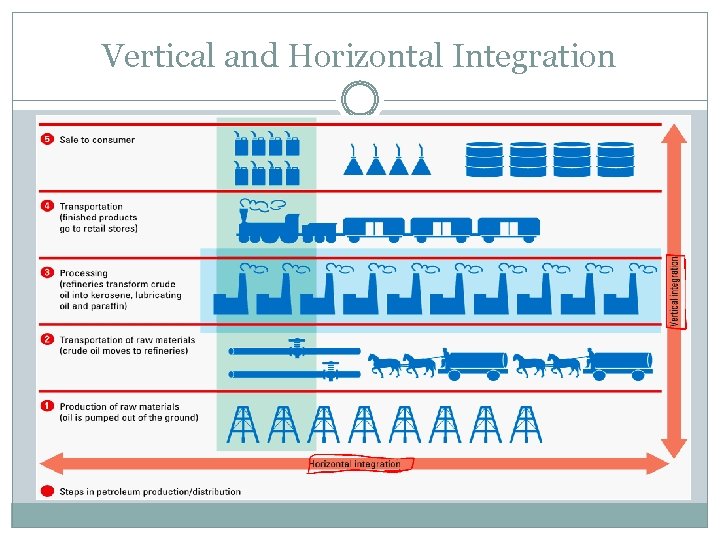 Vertical and Horizontal Integration
 Capitan’s of Industry Andrew Carnegie, John D. Rockefeller, J. P. Morgan, Richard Sears and Alvah Roebuck were men skilled in organizing and promoting big business. A. Rockefeller, Carnegie were known for their innovations in organization B. J. P. Morgan developed investment banking C. Sears and Roebuck were the pioneers of mail order retailing
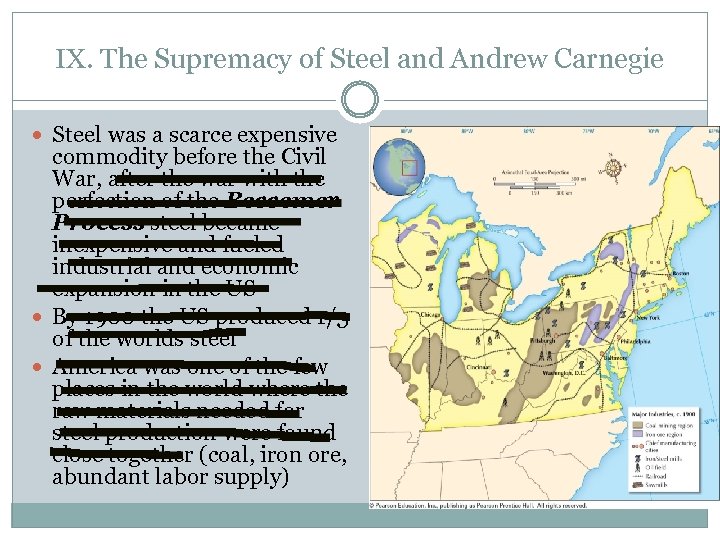 IX. The Supremacy of Steel and Andrew Carnegie Steel was a scarce expensive commodity before the Civil War, after the war with the perfection of the Bessemer Process steel became inexpensive and fueled industrial and economic expansion in the US By 1900 the US produced 1/3 of the worlds steel America was one of the few places in the world where the raw materials needed for steel production were found close together (coal, iron ore, abundant labor supply)
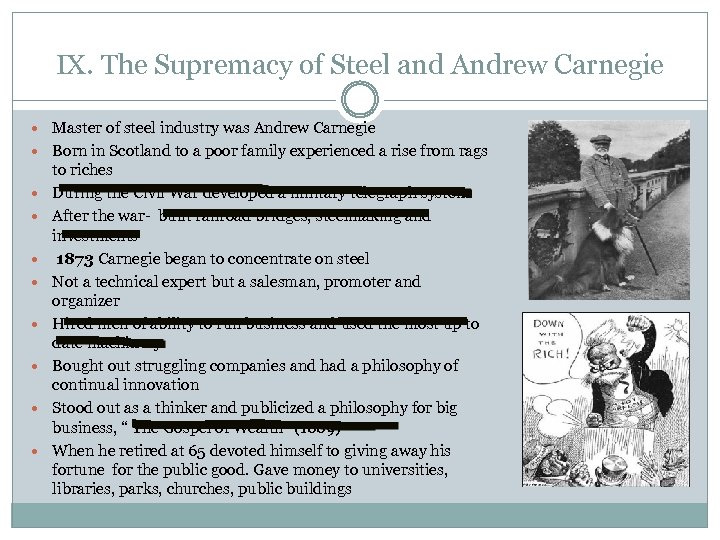 IX. The Supremacy of Steel and Andrew Carnegie Master of steel industry was Andrew Carnegie Born in Scotland to a poor family experienced a rise from rags to riches During the Civil War developed a military telegraph system After the war- built railroad bridges, steelmaking and investments 1873 Carnegie began to concentrate on steel Not a technical expert but a salesman, promoter and organizer Hired men of ability to run business and used the most up to date machinery Bought out struggling companies and had a philosophy of continual innovation Stood out as a thinker and publicized a philosophy for big business, “ The Gospel of Wealth” (1889) When he retired at 65 devoted himself to giving away his fortune for the public good. Gave money to universities, libraries, parks, churches, public buildings
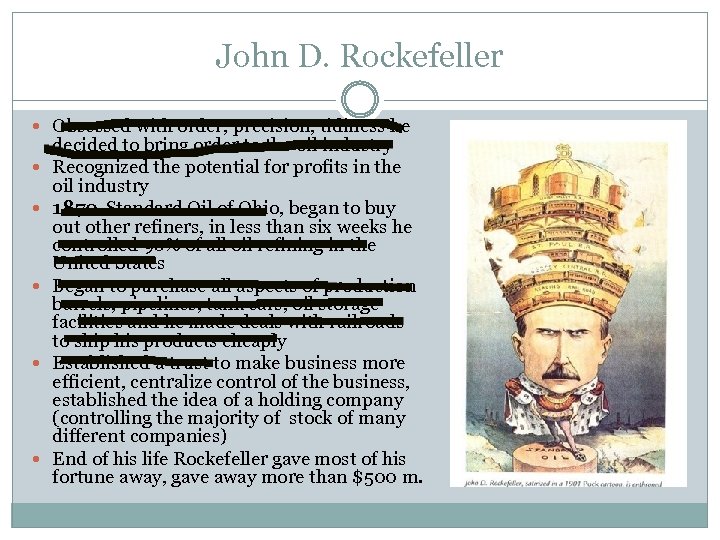 John D. Rockefeller Obsessed with order, precision, tidiness he decided to bring order to the oil industry Recognized the potential for profits in the oil industry 1870 -Standard Oil of Ohio, began to buy out other refiners, in less than six weeks he controlled 90% of all oil refining in the United States Began to purchase all aspects of production barrels, pipelines, tank cars, oil storage facilities and he made deals with railroads to ship his products cheaply Established a trust to make business more efficient, centralize control of the business, established the idea of a holding company (controlling the majority of stock of many different companies) End of his life Rockefeller gave most of his fortune away, gave away more than $500 m.
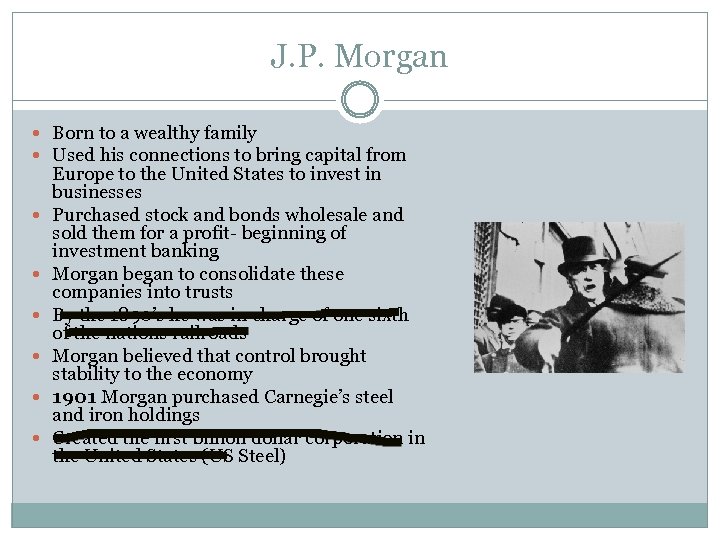 J. P. Morgan Born to a wealthy family Used his connections to bring capital from Europe to the United States to invest in businesses Purchased stock and bonds wholesale and sold them for a profit- beginning of investment banking Morgan began to consolidate these companies into trusts By the 1890’s he was in charge of one sixth of the nations railroads Morgan believed that control brought stability to the economy 1901 Morgan purchased Carnegie’s steel and iron holdings Created the first billion dollar corporation in the United States (US Steel)
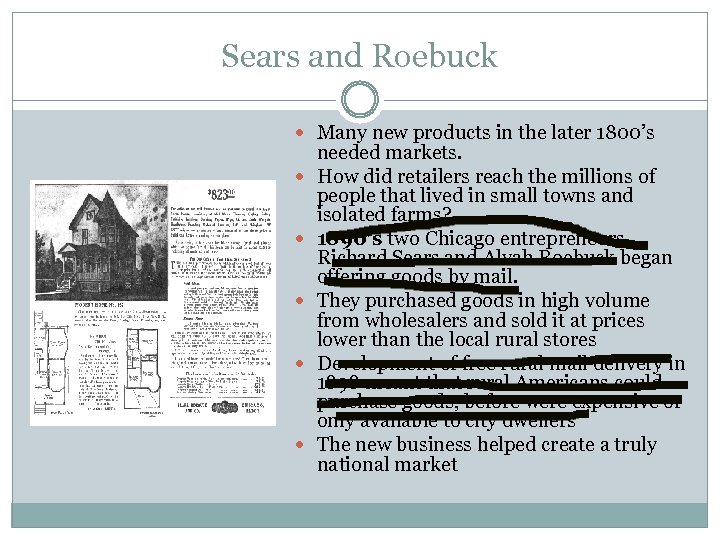 Sears and Roebuck Many new products in the later 1800’s needed markets. How did retailers reach the millions of people that lived in small towns and isolated farms? 1890’s two Chicago entrepreneurs Richard Sears and Alvah Roebuck began offering goods by mail. They purchased goods in high volume from wholesalers and sold it at prices lower than the local rural stores Development of free rural mail delivery in 1898 meant that rural Americans could purchase goods, before were expensive or only available to city dwellers The new business helped create a truly national market
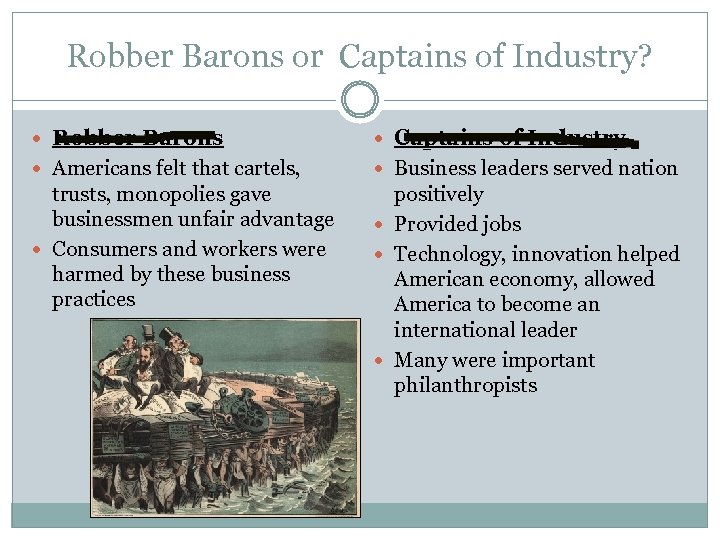 Robber Barons or Captains of Industry? Robber Barons Captains of Industry Americans felt that cartels, Business leaders served nation trusts, monopolies gave businessmen unfair advantage Consumers and workers were harmed by these business practices positively Provided jobs Technology, innovation helped American economy, allowed America to become an international leader Many were important philanthropists
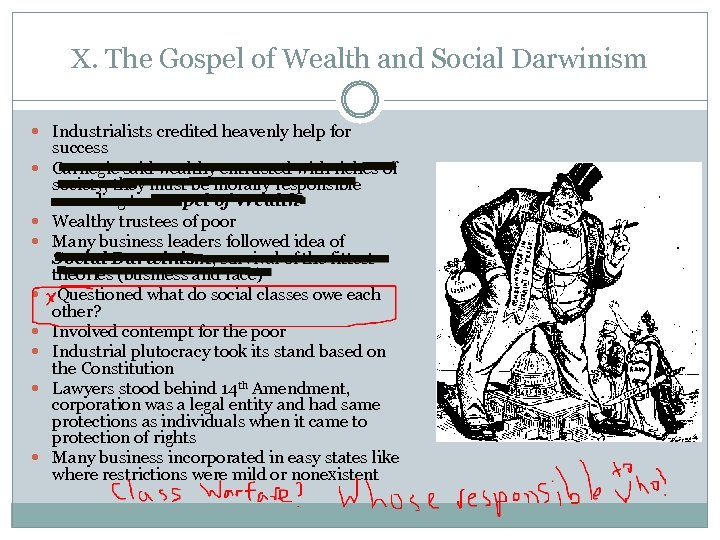 X. The Gospel of Wealth and Social Darwinism Industrialists credited heavenly help for success Carnegie said wealthy entrusted with riches of society, they must be morally responsible according to Gospel of Wealthy trustees of poor Many business leaders followed idea of Social Darwinism, survival of the fittest theories (business and race) Questioned what do social classes owe each other? Involved contempt for the poor Industrial plutocracy took its stand based on the Constitution Lawyers stood behind 14 th Amendment, corporation was a legal entity and had same protections as individuals when it came to protection of rights Many business incorporated in easy states like where restrictions were mild or nonexistent
 XI. Government Tackles the Trust Evil Masses begin to mobilize against the monopolies State legislation did not work 1890 - Congress passes the Sherman Anti-Trust Act Forbid monopolies that restrained trade (bigness was the sin) Law was ineffective and hard to enforce, actually used against labor unions to curb their activities Early step to government control of the business sector
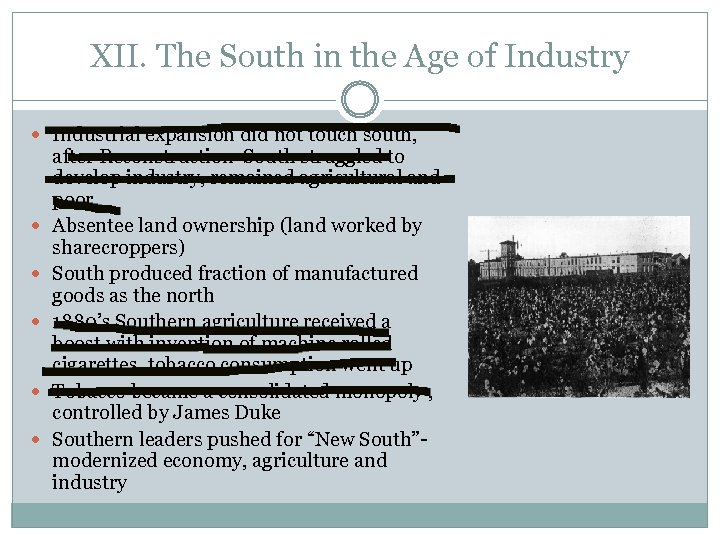 XII. The South in the Age of Industry Industrial expansion did not touch south, after Reconstruction South struggled to develop industry, remained agricultural and poor Absentee land ownership (land worked by sharecroppers) South produced fraction of manufactured goods as the north 1880’s Southern agriculture received a boost with invention of machine rolled cigarettes, tobacco consumption went up Tobacco became a consolidated monopoly , controlled by James Duke Southern leaders pushed for “New South”modernized economy, agriculture and industry
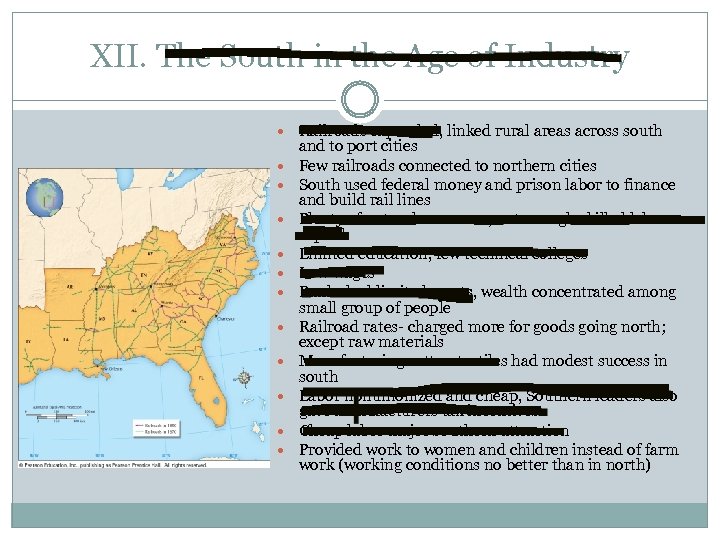 XII. The South in the Age of Industry Railroads expanded, linked rural areas across south and to port cities Few railroads connected to northern cities South used federal money and prison labor to finance and build rail lines Plenty of natural resources, not enough skilled labor or capital Limited education, few technical colleges Low wages Banks had limited assets, wealth concentrated among small group of people Railroad rates- charged more for goods going north; except raw materials Manufacturing cotton textiles had modest success in south Labor nonunionized and cheap, Southern leaders also gave manufacturers tax incentives Cheap labor major southern attraction Provided work to women and children instead of farm work (working conditions no better than in north)
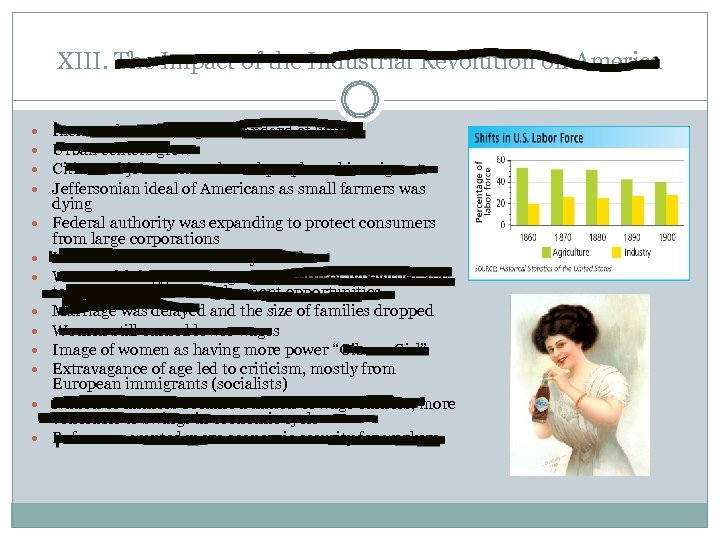 XIII. The Impact of the Industrial Revolution on America Increased wealth, higher standard of living Urban centers grew Cities and jobs attracted rural people and immigrants Jeffersonian ideal of Americans as small farmers was dying Federal authority was expanding to protect consumers from large corporations Lives were chained to factory whistle Women felt biggest changes, invention of typewriter and telephone provided employment opportunities Marriage was delayed and the size of families dropped Women still earned lower wages Image of women as having more power “Gibson Girl” Extravagance of age led to criticism, mostly from European immigrants (socialists) Nation of farmers became a nation of wage earners, more venerable to swings in economic cycle Reformers wanted more economic security for workers
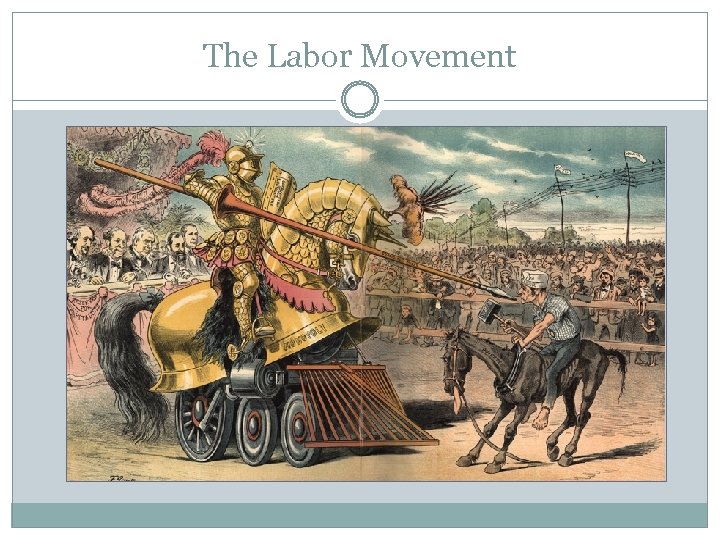 The Labor Movement
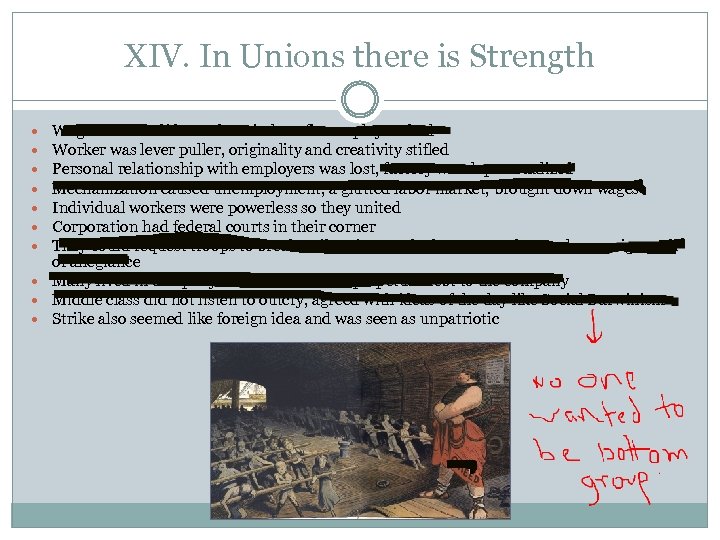 XIV. In Unions there is Strength Wage workers did not share in benefits employers had Worker was lever puller, originality and creativity stifled Personal relationship with employers was lost, factory was depersonalized Mechanization caused unemployment, a glutted labor market, brought down wages Individual workers were powerless so they united Corporation had federal courts in their corner They could request troops to break strikes, impose lockouts or make employees sign oath of allegiance Many lived in company towns and were in perpetual debt to the company Middle class did not listen to outcry, agreed with ideas of the day like Social Darwinism Strike also seemed like foreign idea and was seen as unpatriotic
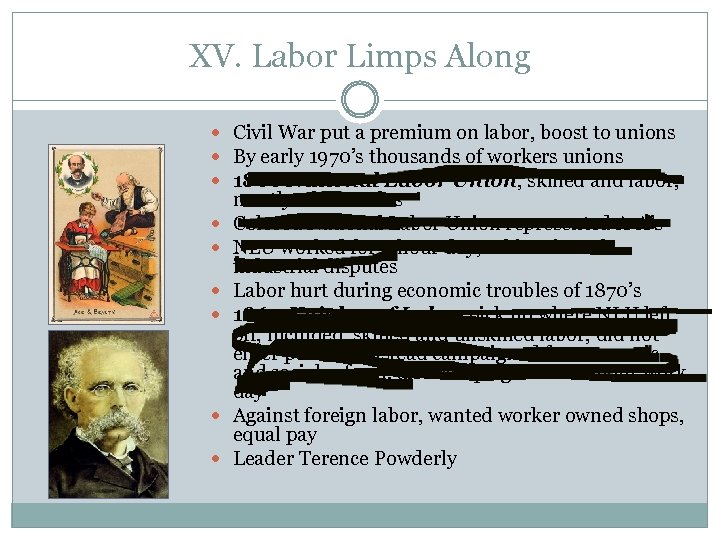 XV. Labor Limps Along Civil War put a premium on labor, boost to unions By early 1970’s thousands of workers unions 1866 National Labor Union, skilled and labor, mostly white males Colored National Labor Union represented A-A’s NLU worked for 8 hour day, arbitration of industrial disputes Labor hurt during economic troubles of 1870’s 1869 Knights of Labor pick up where NLU left off, included skilled and unskilled labor, did not enter politics , instead campaigned for economic and social reform, also campaigned for 8 hour work day Against foreign labor, wanted worker owned shops, equal pay Leader Terence Powderly
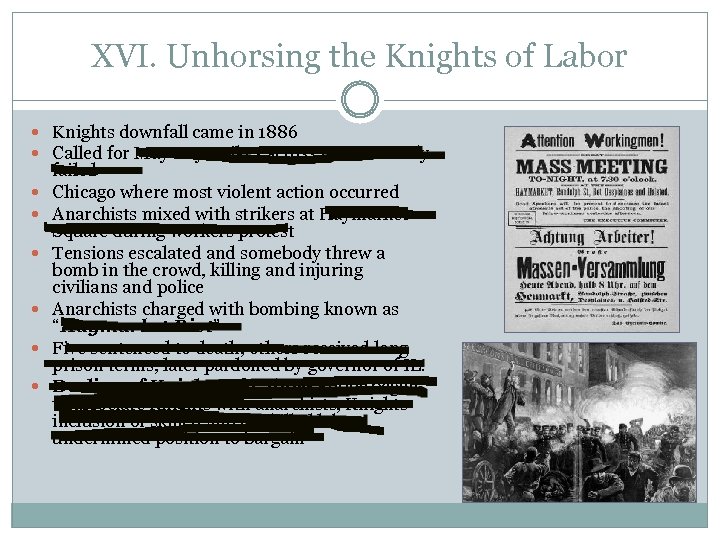 XVI. Unhorsing the Knights of Labor Knights downfall came in 1886 Called for May Day strikes across nation mostly failed Chicago where most violent action occurred Anarchists mixed with strikers at Haymarket Square during workers protest Tensions escalated and somebody threw a bomb in the crowd, killing and injuring civilians and police Anarchists charged with bombing known as “Haymarket Riot” Five sentenced to death, others received long prison terms, later pardoned by governor of IL. Decline of Knights of Labor- Public began to associate Knights with anarchists, Knights inclusion of skilled and unskilled labor undermined position to bargain
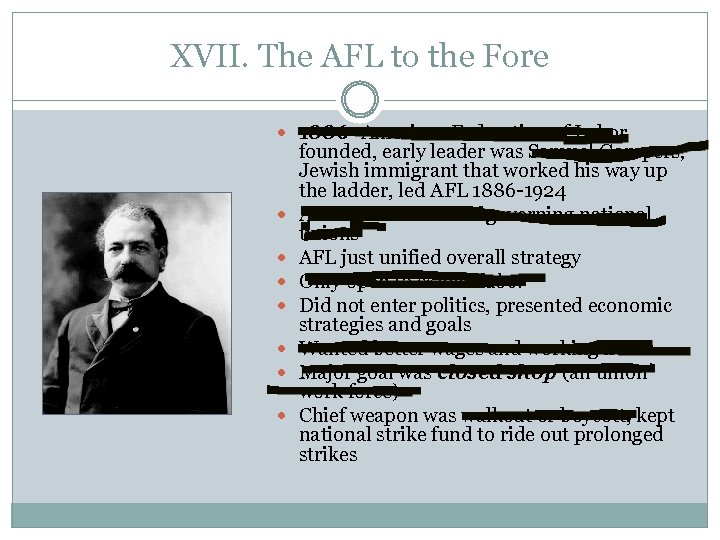 XVII. The AFL to the Fore 1886 - American Federation of Labor founded, early leader was Samuel Gompers; Jewish immigrant that worked his way up the ladder, led AFL 1886 -1924 AFL consisted of self governing national unions AFL just unified overall strategy Only open to skilled labor Did not enter politics, presented economic strategies and goals Wanted better wages and working hours Major goal was closed shop (all union work force) Chief weapon was walkout or boycott, kept national strike fund to ride out prolonged strikes
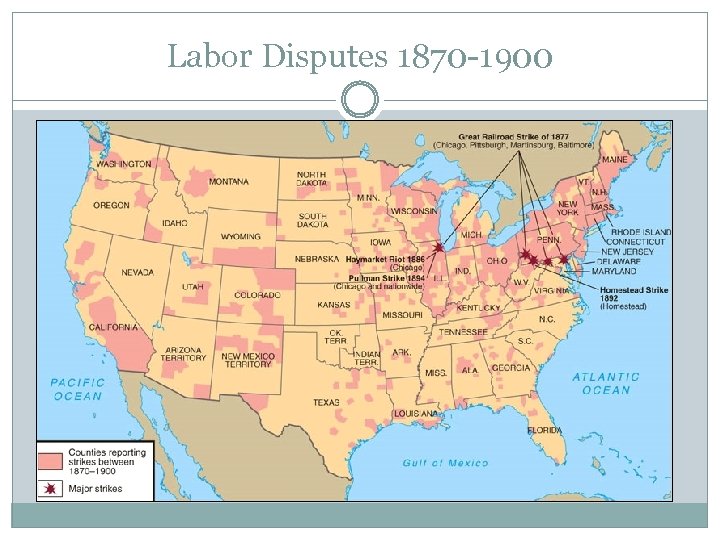 Labor Disputes 1870 -1900
 XVII. The AFL to the Fore Labor disorders were not solved by labor unions, continued through the end of the century Won about half of their strikes but management still held upper hand By 1900 public attitude toward labor changed, they thought workers had right to organize Management wanted to avoid economic warfare and began to bargain with labor, although equality was a long way off
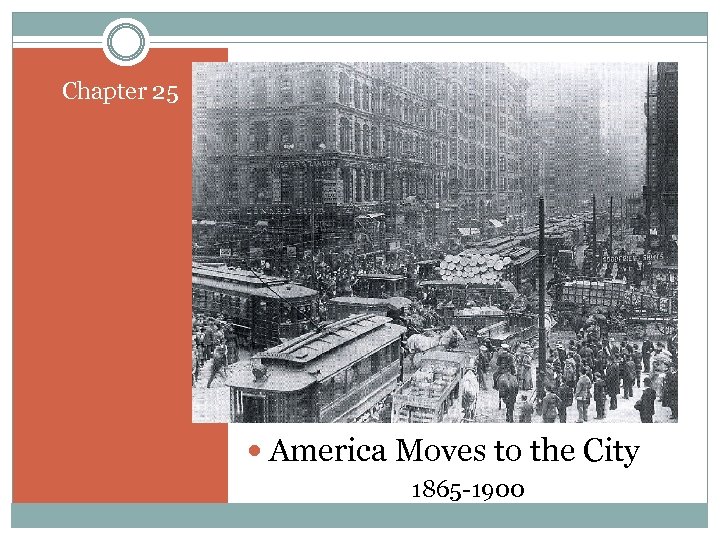 Chapter 25 America Moves to the City 1865 -1900
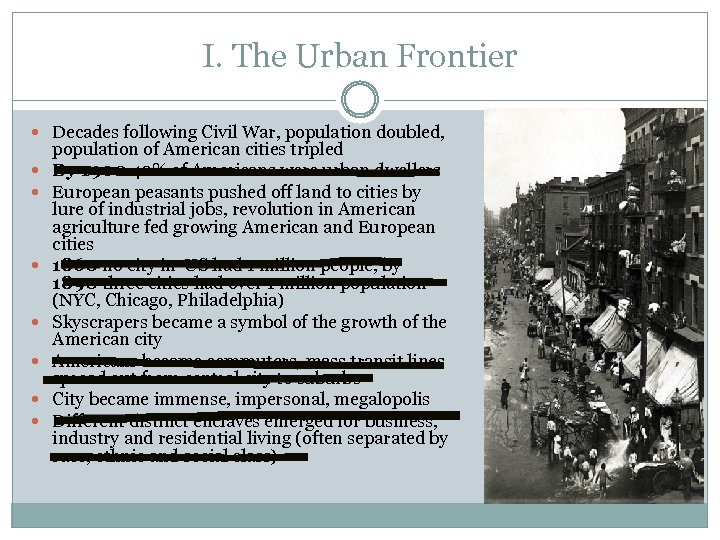 I. The Urban Frontier Decades following Civil War, population doubled, population of American cities tripled By 1900 40% of Americans were urban dwellers European peasants pushed off land to cities by lure of industrial jobs, revolution in American agriculture fed growing American and European cities 1860 no city in US had 1 million people, by 1890 three cities had over 1 million population (NYC, Chicago, Philadelphia) Skyscrapers became a symbol of the growth of the American city Americans became commuters, mass transit lines spread out from central city to suburbs City became immense, impersonal, megalopolis Different distinct enclaves emerged for business, industry and residential living (often separated by race, ethnic and social class)
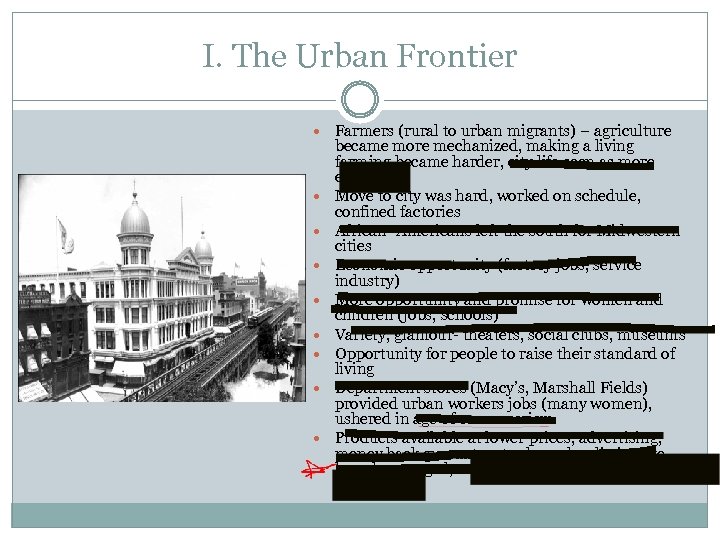 I. The Urban Frontier Farmers (rural to urban migrants) – agriculture became more mechanized, making a living farming became harder, city life seen as more exciting Move to city was hard, worked on schedule, confined factories African- Americans left the south for Midwestern cities Economic opportunity (factory jobs, service industry) More opportunity and promise for women and children (jobs, schools) Variety, glamour- theaters, social clubs, museums Opportunity for people to raise their standard of living Department stores (Macy’s, Marshall Fields) provided urban workers jobs (many women), ushered in age of consumerism Products available at lower prices, advertising, money back guarantee, trademarks, distinctive brands emerged, contributed to mass culture of Americans
 I. The Urban Frontier Growth caused cities to respond to new problems (water, sewers, schools, safety) New technology developed to meet challenges Skyscrapers- more efficient use of space, gave cities recognizable skylines Technology- steel frames, elevator, central heat, telephone, electricity Architecture- emerged as a specialized career, new buildings used artistic design to magnify height City Planning designed to make cities more beautiful, functional, control growth Zoning laws- certain areas for certain functions Public libraries, public buildings, parks and recreational spaces Fredrick Law Olmsted designed Central Park nations first urban public park (1860’s)
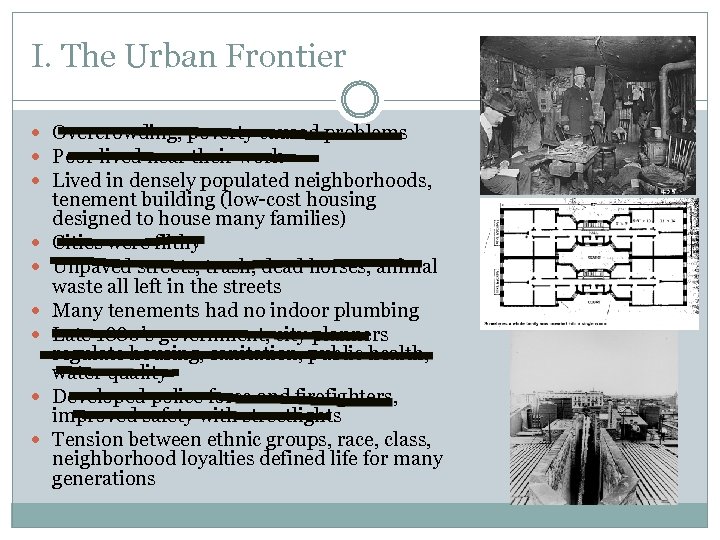 I. The Urban Frontier Overcrowding, poverty caused problems Poor lived near their work Lived in densely populated neighborhoods, tenement building (low-cost housing designed to house many families) Cities were filthy Unpaved streets, trash, dead horses, animal waste all left in the streets Many tenements had no indoor plumbing Late 1880’s government, city planners regulate housing, sanitation, public health, water quality Developed police force and firefighters, improved safety with streetlights Tension between ethnic groups, race, class, neighborhood loyalties defined life for many generations
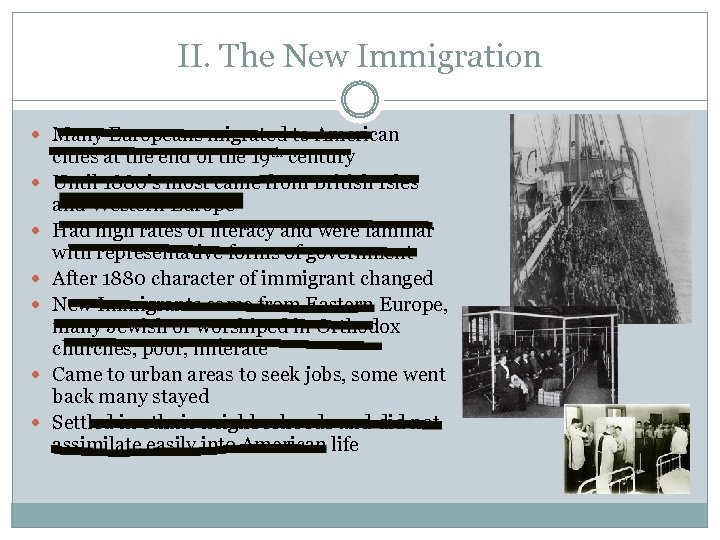 II. The New Immigration Many Europeans migrated to American cities at the end of the 19 th century Until 1880’s most came from British Isles and Western Europe Had high rates of literacy and were familiar with representative forms of government After 1880 character of immigrant changed New Immigrants came from Eastern Europe, many Jewish or worshiped in Orthodox churches, poor, illiterate Came to urban areas to seek jobs, some went back many stayed Settled in ethnic neighborhoods and did not assimilate easily into American life
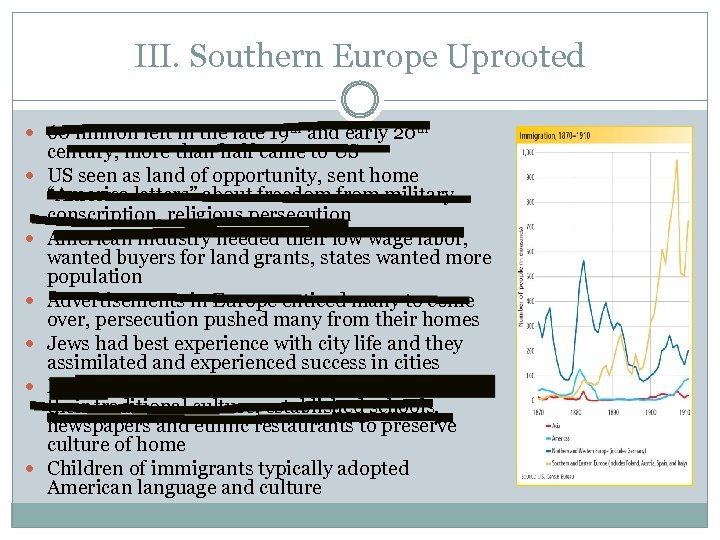 III. Southern Europe Uprooted 60 million left in the late 19 th and early 20 th century, more than half came to US US seen as land of opportunity, sent home “America letters” about freedom from military conscription, religious persecution American industry needed their low wage labor, wanted buyers for land grants, states wanted more population Advertisements in Europe enticed many to come over, persecution pushed many from their homes Jews had best experience with city life and they assimilated and experienced success in cities Many immigrants that stayed struggled to preserve their traditional culture, established schools, newspapers and ethnic restaurants to preserve culture of home Children of immigrants typically adopted American language and culture
 IV. Reaction to New Immigrants Government did little to weed out new immigrants or help them adjust to American life City government was the most proactive force for their assimilation and they did very little Political machines and party bosses took care of many immigrants; they provided jobs, housing, food and public services in return for votes Immigrants awakened social consciences of American reformers, many used ideas of Christian charity to help immigrants (Christian Socialists), paved the way for Progressive movement of early 20 th century
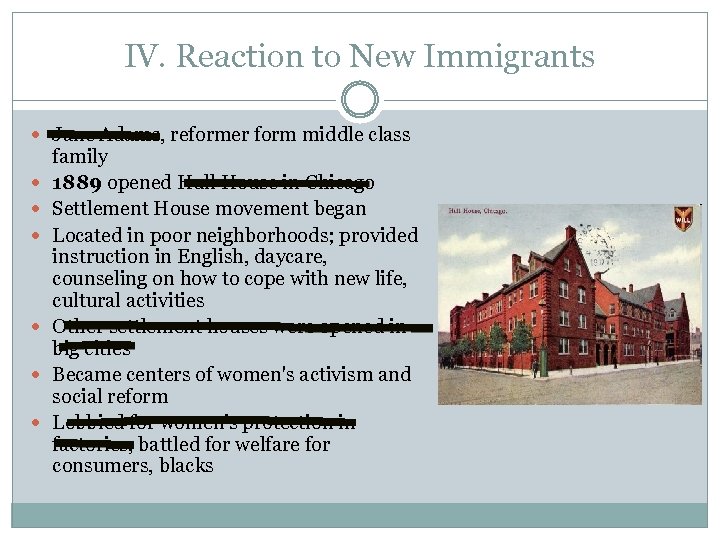 IV. Reaction to New Immigrants Jane Adams, reformer form middle class family 1889 opened Hull House in Chicago Settlement House movement began Located in poor neighborhoods; provided instruction in English, daycare, counseling on how to cope with new life, cultural activities Other settlement houses were opened in big cities Became centers of women's activism and social reform Lobbied for women’s protection in factories, battled for welfare for consumers, blacks
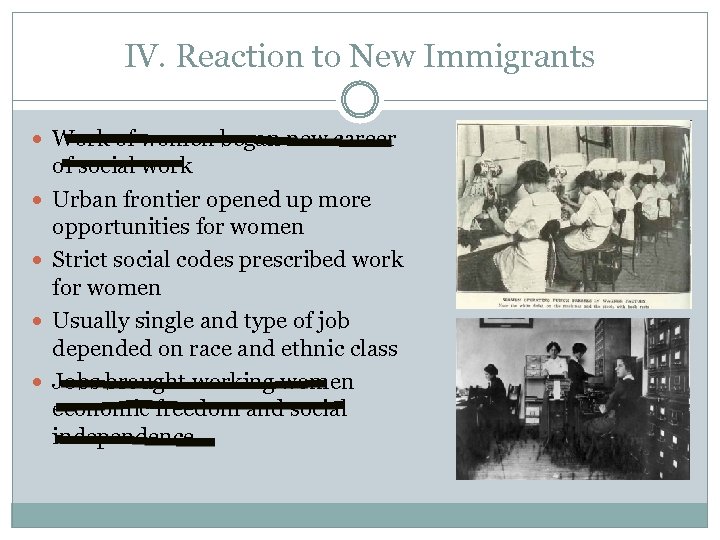 IV. Reaction to New Immigrants Work of women began new career of social work Urban frontier opened up more opportunities for women Strict social codes prescribed work for women Usually single and type of job depended on race and ethnic class Jobs brought working women economic freedom and social independence
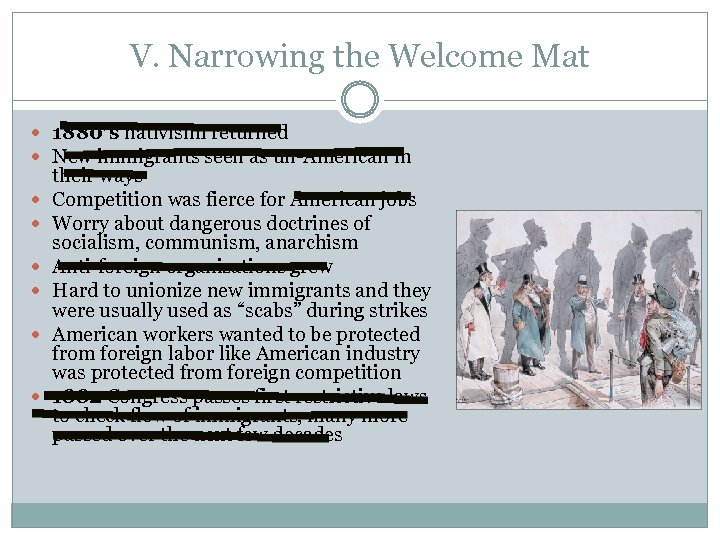 V. Narrowing the Welcome Mat 1880’s nativisim returned New immigrants seen as un-American in their ways Competition was fierce for American jobs Worry about dangerous doctrines of socialism, communism, anarchism Anti-foreign organizations grew Hard to unionize new immigrants and they were usually used as “scabs” during strikes American workers wanted to be protected from foreign labor like American industry was protected from foreign competition 1882 Congress passes first restrictive laws to check flow of immigrants, many more passed over the next few decades
 VI. Churches Confront the Urban Challenges Protestant churches suffered under changing urban conditions Traditional doctrines seemed irrelevant, and were slow to raise voice against changing social and economic values Concern with mounting emphasis on materialism New Gospel of Wealth said God allowed righteous to prosper 1875 -1925 new liberal ideas and rise of liberal Protestants Adaptation to modern culture called for social reforms “Social Gospel” movement Message of forgiveness, community fellowship, focus on earthly salvation and personal growth Roman Catholics strong in labor movement Salvation Army established, appealed to down and out Christian Scientist movement founded by Mary Baker Eddy found converts in urban areas YMCA’s provided spiritual, physical education
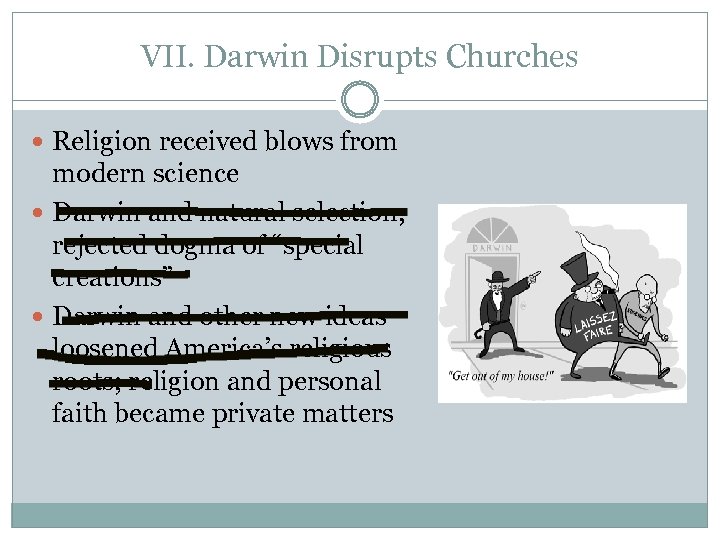 VII. Darwin Disrupts Churches Religion received blows from modern science Darwin and natural selection, rejected dogma of “special creations” Darwin and other new ideas loosened America’s religious roots; religion and personal faith became private matters
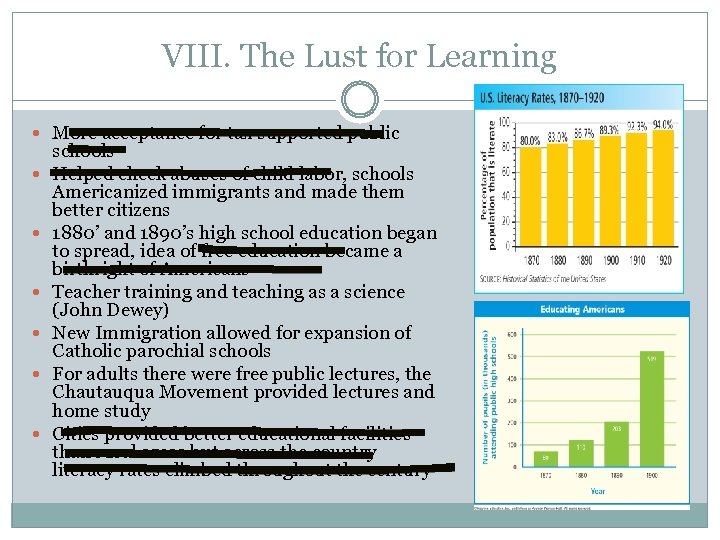 VIII. The Lust for Learning More acceptance for tax supported public schools Helped check abuses of child labor, schools Americanized immigrants and made them better citizens 1880’ and 1890’s high school education began to spread, idea of free education became a birthright of Americans Teacher training and teaching as a science (John Dewey) New Immigration allowed for expansion of Catholic parochial schools For adults there were free public lectures, the Chautauqua Movement provided lectures and home study Cities provided better educational facilities than rural areas but across the country literacy rates climbed throughout the century
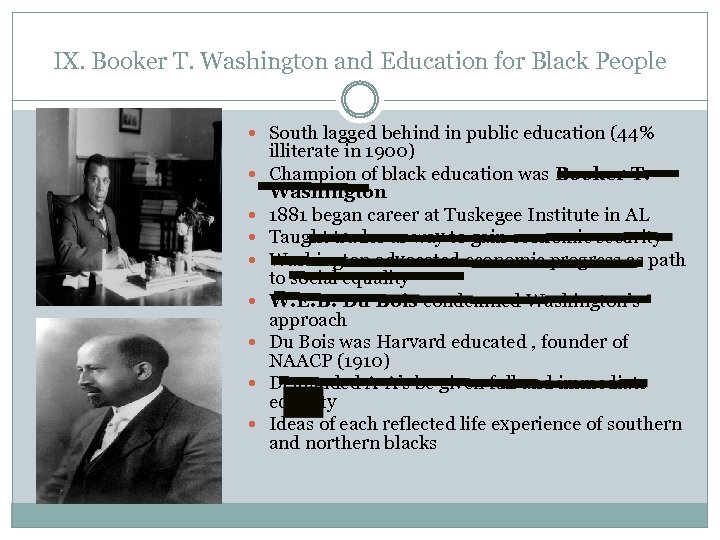 IX. Booker T. Washington and Education for Black People South lagged behind in public education (44% illiterate in 1900) Champion of black education was Booker T. Washington 1881 began career at Tuskegee Institute in AL Taught trades as way to gain economic security Washington advocated economic progress as path to social equality W. E. B. Du Bois condemned Washington’s approach Du Bois was Harvard educated , founder of NAACP (1910) Demanded A-A’s be given full and immediate equality Ideas of each reflected life experience of southern and northern blacks
 X. Hallowed Halls of Ivy Colleges and universities grew during period College education became noteworthy for success in the modern world Women’s colleges, black institutes of education were founded Growth of higher education can be traced to Morrill Act of 1862 that granted public land to to states to support education Hatch Act 1887 extended Morrill Act and provided funds to establish agricultural experiment stations for “land grant” colleges New industrial millionaires gave money to colleges (Vanderbilt, Stanford, Duke, University of Chicago) Increase in technical, professional and graduate schools Increase in elective system of education was due to increasing specialization of workforce Medical schools were established that promoted public health
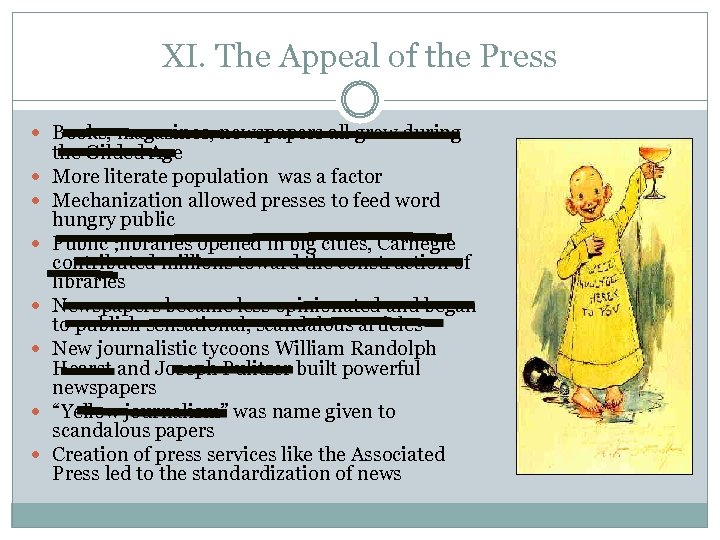 XI. The Appeal of the Press Books, magazines, newspapers all grew during the Gilded Age More literate population was a factor Mechanization allowed presses to feed word hungry public Public ; libraries opened in big cities, Carnegie contributed millions toward the construction of libraries Newspapers became less opinionated and began to publish sensational, scandalous articles New journalistic tycoons William Randolph Hearst and Joseph Pulitzer built powerful newspapers “Yellow journalism” was name given to scandalous papers Creation of press services like the Associated Press led to the standardization of news
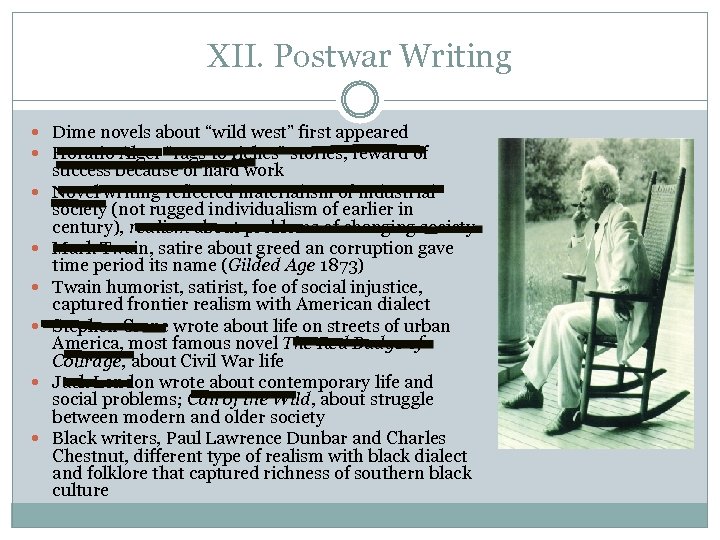 XII. Postwar Writing Dime novels about “wild west” first appeared Horatio Alger “rags to riches” stories, reward of success because of hard work Novel writing reflected materialism of industrial society (not rugged individualism of earlier in century), realism about problems of changing society Mark Twain, satire about greed an corruption gave time period its name (Gilded Age 1873) Twain humorist, satirist, foe of social injustice, captured frontier realism with American dialect Stephen Crane wrote about life on streets of urban America, most famous novel The Red Badge of Courage, about Civil War life Jack London wrote about contemporary life and social problems; Call of the Wild, about struggle between modern and older society Black writers, Paul Lawrence Dunbar and Charles Chestnut, different type of realism with black dialect and folklore that captured richness of southern black culture
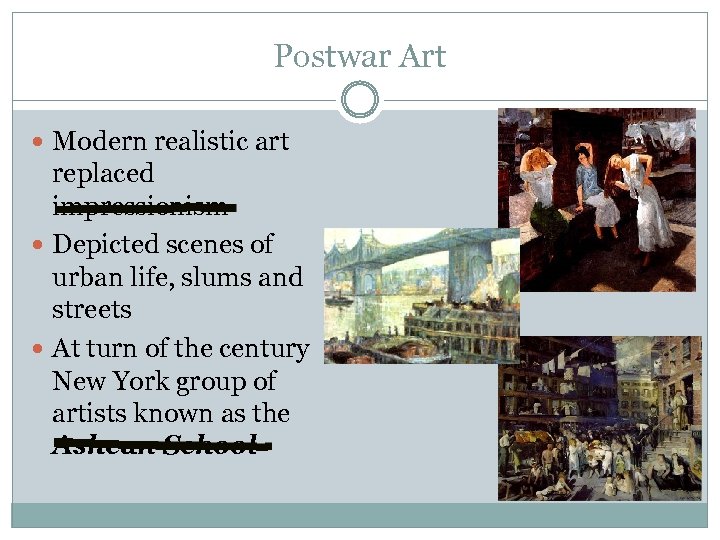 Postwar Art Modern realistic art replaced impressionism Depicted scenes of urban life, slums and streets At turn of the century New York group of artists known as the Ashcan School
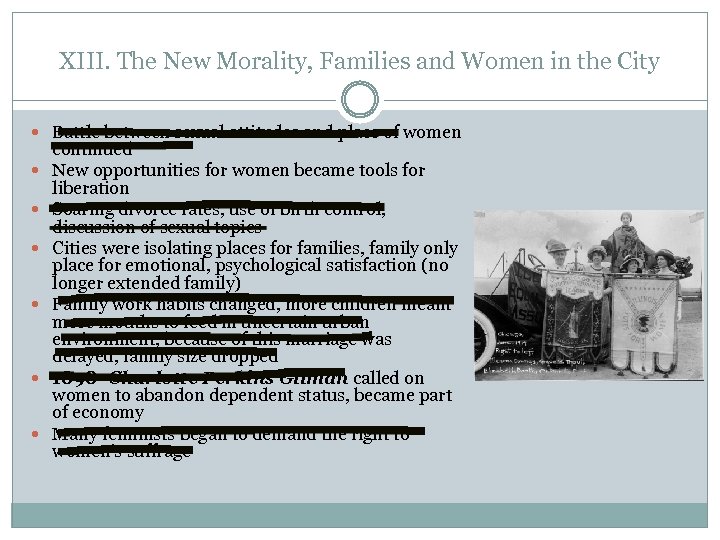 XIII. The New Morality, Families and Women in the City Battle between sexual attitudes and place of women continued New opportunities for women became tools for liberation Soaring divorce rates, use of birth control, discussion of sexual topics Cities were isolating places for families, family only place for emotional, psychological satisfaction (no longer extended family) Family work habits changed, more children meant more mouths to feed in uncertain urban environment, because of this marriage was delayed, family size dropped 1898 - Charlotte Perkins Gilman called on women to abandon dependent status, became part of economy Many feminists began to demand the right to women's suffrage
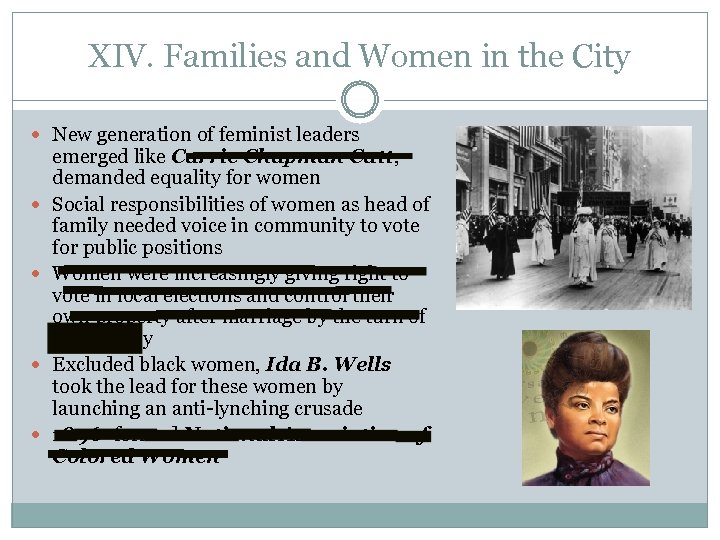 XIV. Families and Women in the City New generation of feminist leaders emerged like Carrie Chapman Catt, demanded equality for women Social responsibilities of women as head of family needed voice in community to vote for public positions Women were increasingly giving right to vote in local elections and control their own property after marriage by the turn of the century Excluded black women, Ida B. Wells took the lead for these women by launching an anti-lynching crusade 1896 - formed National Association of Colored Women
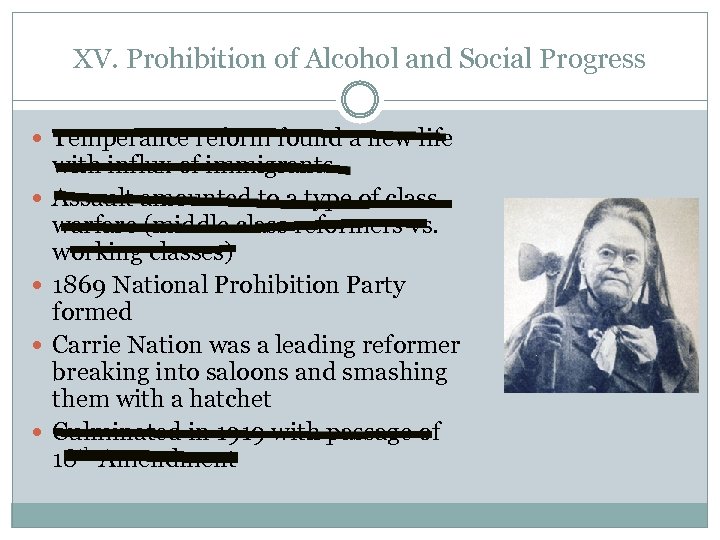 XV. Prohibition of Alcohol and Social Progress Temperance reform found a new life with influx of immigrants Assault amounted to a type of class warfare (middle class reformers vs. working classes) 1869 National Prohibition Party formed Carrie Nation was a leading reformer breaking into saloons and smashing them with a hatchet Culminated in 1919 with passage of 18 th Amendment
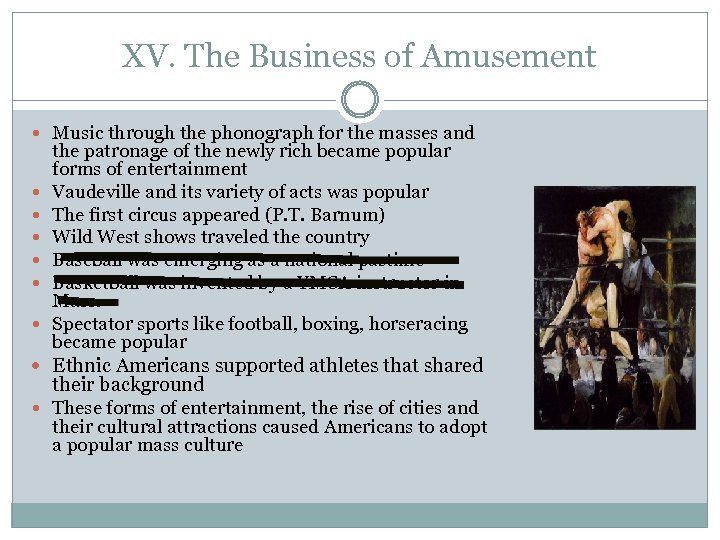 XV. The Business of Amusement Music through the phonograph for the masses and the patronage of the newly rich became popular forms of entertainment Vaudeville and its variety of acts was popular The first circus appeared (P. T. Barnum) Wild West shows traveled the country Baseball was emerging as a national pastime Basketball was invented by a YMCA instructor in Mass. Spectator sports like football, boxing, horseracing became popular Ethnic Americans supported athletes that shared their background These forms of entertainment, the rise of cities and their cultural attractions caused Americans to adopt a popular mass culture