


 Скачать презентацию for Korean Language Classrooms Russell Hugo Department of
fdf2abfb6a7bbf15fc3cbb79c9667b62.ppt
- Количество слайдов: 28
 for Korean Language Classrooms Russell Hugo Department of Linguistics Language Learning Center University of Washington June 2010
 What is Moodle? n Modular Object-Oriented Dynamic Learning Environment n CMS (Content Management System) n Open Source (Free) / PHP n Users: 35+million / Sites: 45, 000+1
 Why use Moodle? n Open source n Large community of users n Robust and flexible roles n Save instructor’s time
 Why use Moodle? (Teaching) n Security n Automated & streamlined grading (Stats analysis, gradebook) n One-stop course website (with interaction) n Ease of archiving and recycling
 What can Moodle do? Questions: n Question bank: – Shared across courses – Randomized questions n n Auto grading Adaptive Analytics Feedback: – Detail per answer / different times
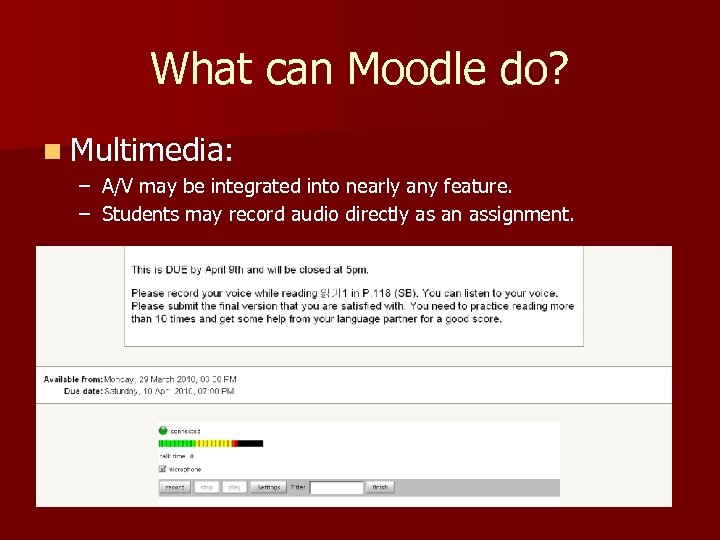 What can Moodle do? n Multimedia: – A/V may be integrated into nearly any feature. – Students may record audio directly as an assignment.
 What can Moodle do? n Dropbox: – Assignments or general n Interaction: – Wikis, forum, chat n Other: – Post nearly any file format (PDF, DOC, etc) – Available customization and notification
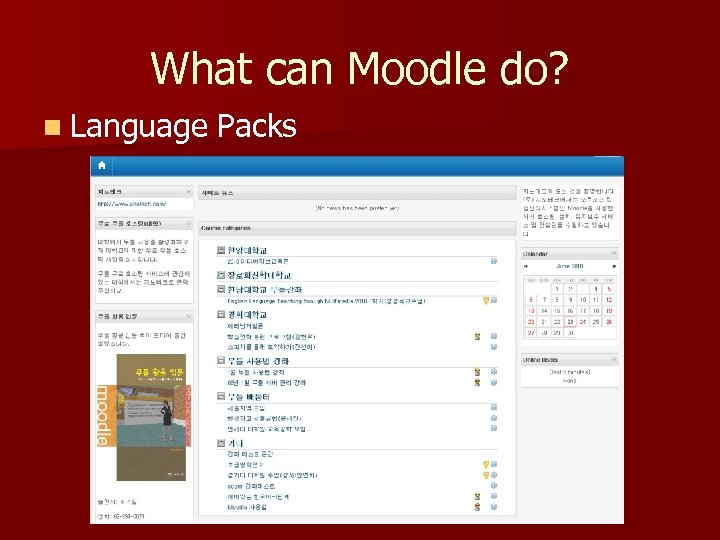 What can Moodle do? n Language Packs
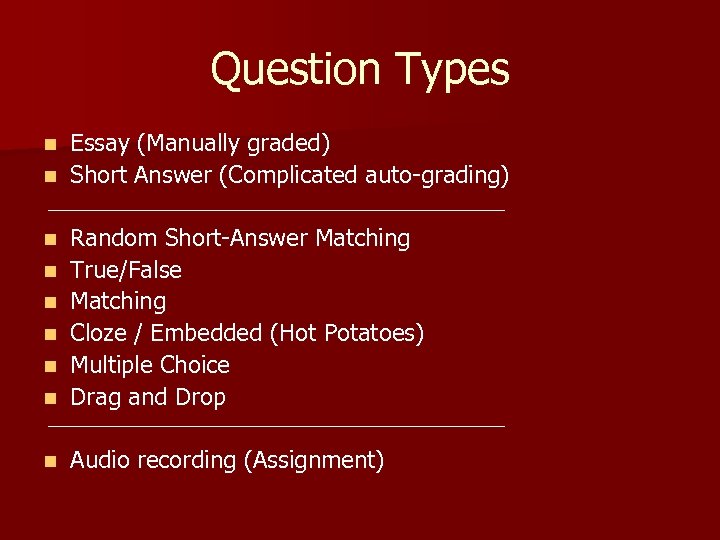 Question Types Essay (Manually graded) n Short Answer (Complicated auto-grading) n n Random Short-Answer Matching True/False Matching Cloze / Embedded (Hot Potatoes) Multiple Choice Drag and Drop n Audio recording (Assignment) n n n
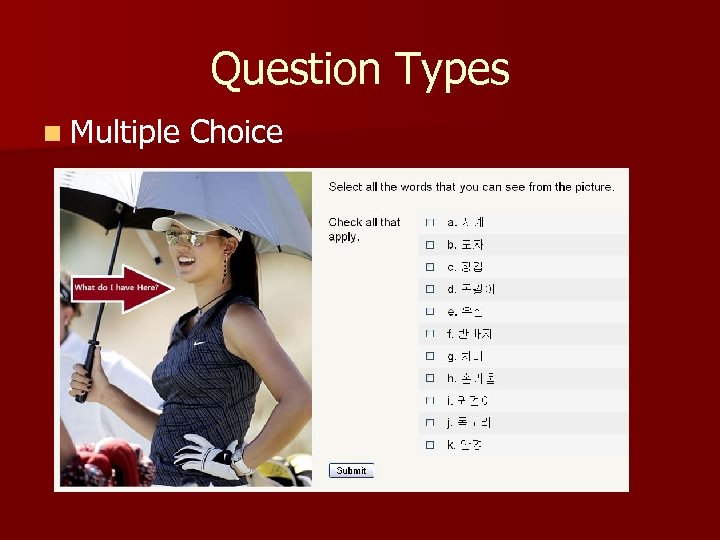 Question Types n Multiple Choice
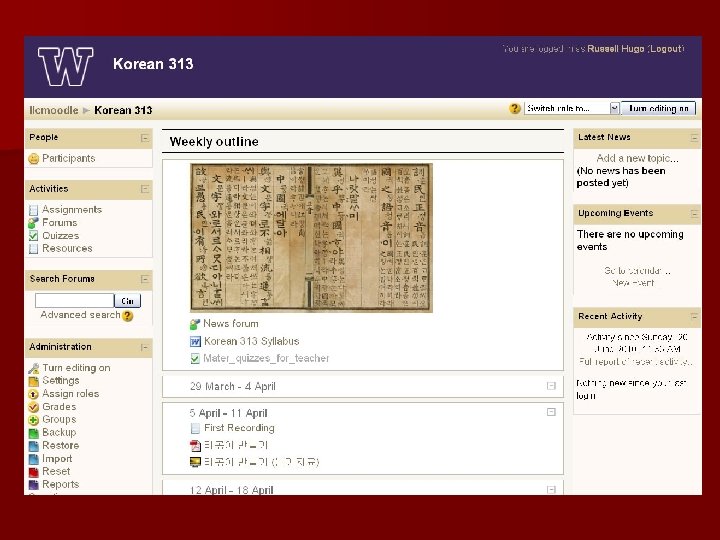
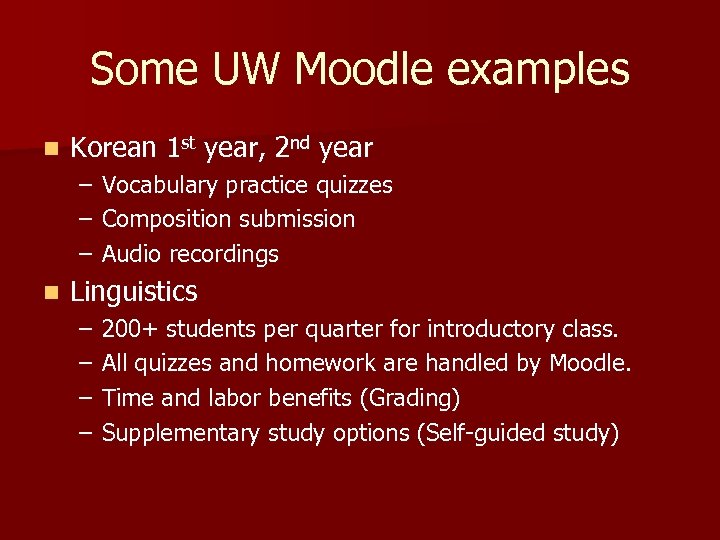 Some UW Moodle examples n Korean 1 st year, 2 nd year – – – n Vocabulary practice quizzes Composition submission Audio recordings Linguistics – – 200+ students per quarter for introductory class. All quizzes and homework are handled by Moodle. Time and labor benefits (Grading) Supplementary study options (Self-guided study)
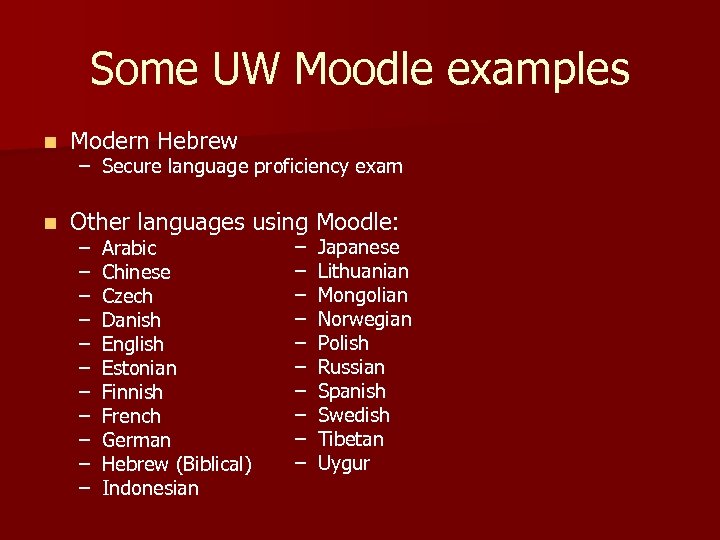 Some UW Moodle examples n Modern Hebrew n Other languages using Moodle: – Secure language proficiency exam – – – Arabic Chinese Czech Danish English Estonian Finnish French German Hebrew (Biblical) Indonesian – – – – – Japanese Lithuanian Mongolian Norwegian Polish Russian Spanish Swedish Tibetan Uygur
 Incremental vs. complete launch n Supplementary materials (e. g. , syllabi) n Naming conventions n Customization and archiving n Incremental steps are safer
 Incremental launch examples n Linguistics: – Fall: Quizzes – Winter: Quizzes & HW – Spring: Quizzes, HW, and some tests. n Korean: – Fall: Recording assignment and supplementary materials – Winter: + Quizzes
 General course management n Outline/Weekly n Roles n Enrollment Key (Student responsibility) n Archiving and course reset
 Roles & TAs n Enrollment keys for groups n TAs as non-editing teachers
 Question Bank design n Depth vs breadth § Arbitrary, but careful planning is recommended. – Depth of 3 (Korean) – Depth of 4 (Linguistics) n Organization – Lesson (Korean) – Type (Linguistics)
 Cheating prevention n Randomization – Actual questions § Question order § Choice order n Time limits and availability n Logs – Detailed record of exact student activity. – Did they really experience a problem?
 Prevention of hardware and software issues n Required quiz for the first week. – Test audio – Test fonts n Optional: – End of the quarter survey
 Other modules suited for language teaching n Covcell: – Whiteboard – Audio/Video Conferencing – Presence block (Chat) n Hot Potatoes
 Moodle 2. 0 Is the future of Moodle worth waiting for? ETA: July 20 th n Conditional activities 2 n – “Completion tracking” § § § § # number of new posts or replies in a forum made # scored in a quiz Has created # pages in a wiki or has made # edits A user has viewed a resource # number of times A user has participated in an activity (i. e. has made a choice) A completion Criteria can be date based if required It can also be set that a student themselves can mark when they deem the activity completed
 Moodle 2. 0 Is the future of Moodle worth waiting for? n Community n New Hubs blocks – Comments may be added to any page. – Student personal online file repository n Blogs
 Moodle 2. 0 Is the future of Moodle worth waiting for? n Fixes/Improvements – Quiz and questions – – – – § Tagging, searching, flagging § Layout, navigation Backup and restore Layout flexibility Multiple enrolment Better file management New HTML editor Email/messaging integration New workshops module New Wiki module
 Limitations and Downsides n Interface – Student user – Instructor learning curve § (interface makes it seem more difficult). n Server required – Linux recommended § Arguably wider support and larger community n Administrator My. SQL) knowledge required (PHP, – A skilled admin is recommended. – Bugs
 Limitations and Downsides n Amount of options – Some obscure terminology n HTML interface – Allegedly fixed in 2. 0.
 Thank you n References: – 1 http: //moodle. org/stats/ – 2 http: //www. moodleman. net/archives/290 – http: //moodle. org/ n Links: – http: //moodle. org/course/view. php? id=21 § Korean Moodle Forum – http: //moodle. org/course/view. php? id=31 § Moodle for Language Learning – http: //lms 2. cms. hu-berlin. de/covcell/login/index. php § COVCELL testing course
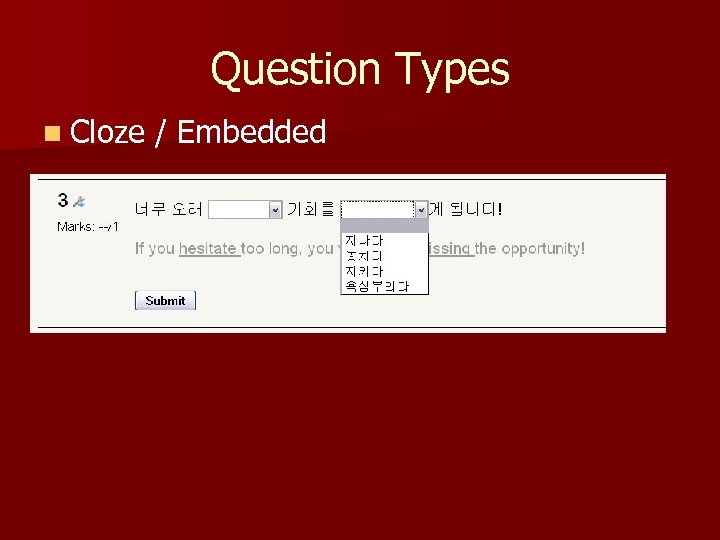 Question Types n Cloze / Embedded