 Скачать презентацию FOODBORNE BOTULISM NYC Dept of Health and Mental
a7e70f564d241bb3c0e9b30c9c66cbd3.ppt
- Количество слайдов: 24



FOODBORNE BOTULISM NYC Dept. of Health and Mental Hygiene Office of Emergency Preparedness and Response
OBJECTIVES Review DOHMH roles and responsibilities during a foodborne botulism incident Discuss ways to address potential planning gaps and incident-related challenges
BOTULISM: CLINICAL FEATURES
GENERAL Botulism is a paralytic illness caused by a neurotoxin that is produced by an anaerobic bacterium, Clostridium botulinum Toxin absorbed in the digestive tract binds irreversibly to structures in voluntary/involuntary motor nerves, inhibiting secretion of a neurotransmitter and transmission of nerve impulses – This leads to weakness or paralysis of affected motor nerves, including those governing respiration Botulinum toxin is heat-sensitive and is inactivated in food when the temperature is kept above boiling for 10 minutes Sensory nerves are unaffected. Human botulism is caused by toxin types A, B, E and F. Waterborne botulism has never been documented – Successful contamination of large water supplies is unlikely because of dilutional effects Aerosol release of botulinum toxin not considered very likely
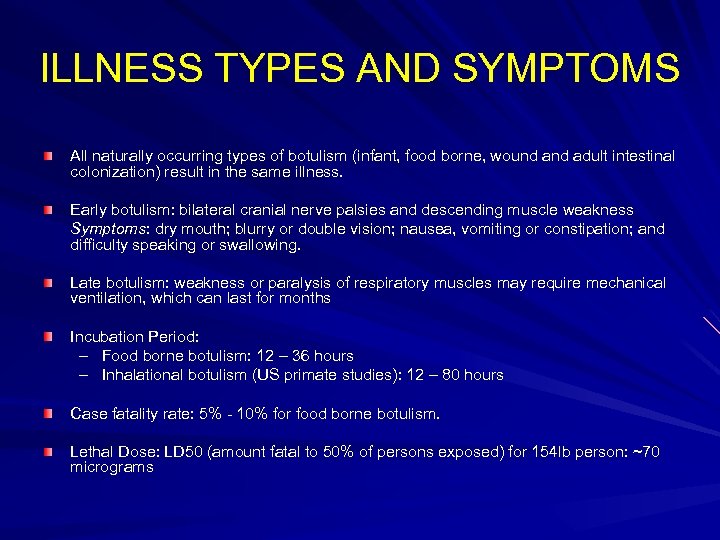
ILLNESS TYPES AND SYMPTOMS All naturally occurring types of botulism (infant, food borne, wound adult intestinal colonization) result in the same illness. Early botulism: bilateral cranial nerve palsies and descending muscle weakness Symptoms: dry mouth; blurry or double vision; nausea, vomiting or constipation; and difficulty speaking or swallowing. Late botulism: weakness or paralysis of respiratory muscles may require mechanical ventilation, which can last for months Incubation Period: – Food borne botulism: 12 – 36 hours – Inhalational botulism (US primate studies): 12 – 80 hours Case fatality rate: 5% - 10% for food borne botulism. Lethal Dose: LD 50 (amount fatal to 50% of persons exposed) for 154 lb person: ~70 micrograms
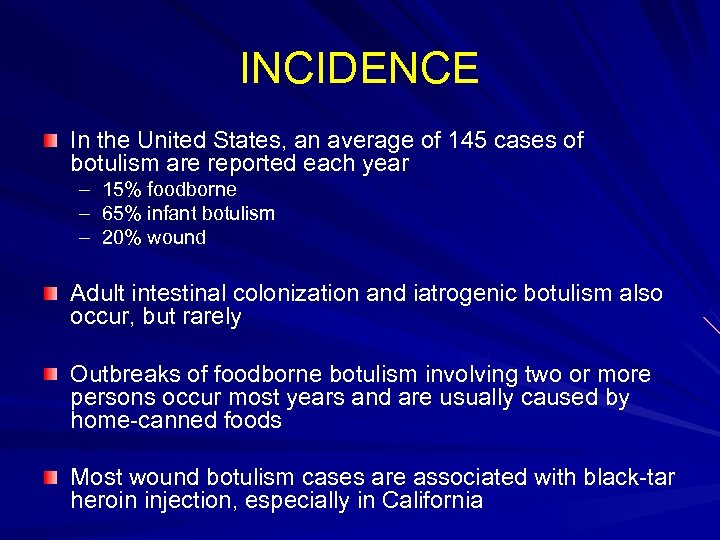
INCIDENCE In the United States, an average of 145 cases of botulism are reported each year – 15% foodborne – 65% infant botulism – 20% wound Adult intestinal colonization and iatrogenic botulism also occur, but rarely Outbreaks of foodborne botulism involving two or more persons occur most years and are usually caused by home-canned foods Most wound botulism cases are associated with black-tar heroin injection, especially in California
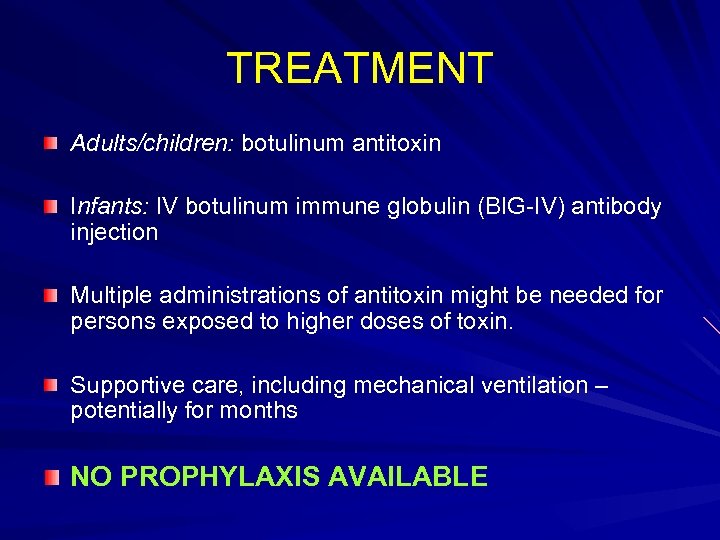
TREATMENT Adults/children: botulinum antitoxin Infants: IV botulinum immune globulin (BIG-IV) antibody injection Multiple administrations of antitoxin might be needed for persons exposed to higher doses of toxin. Supportive care, including mechanical ventilation – potentially for months NO PROPHYLAXIS AVAILABLE
BOTULISM: PUBLIC HEALTH FEATURES
TRANSMISSION, ISOLATION & QUARANTINE No person-to-person transmission. Isolation not required and quarantine would not be used.
ENVIRONMENTAL STABILITY Heating food/beverage to boiling for 10 minutes inactivates toxin. Depending on concentration, pasteurization might inactivate most, but not all, toxin Toxin would be stable on countertops/other environmental surfaces that came in contact with contaminated food item (e. g. , spilled milk) Proper disposal of contaminated food item and decontamination of locations/surfaces where contaminated food item was found
FOOD SAFETY, DECONTAMINATION & REMEDIATION Once identified, the implicated food item would be collected, disposed and recalled by the manufacturer. Personal decontamination and bagging/disposal of clothing would not be necessary. Goals and standards for environmental decontamination will be determined by environmental hazard and risk assessments in collaboration with other agencies.
RE-OCCUPANCY Limited evacuation, remediation and re-occupancy may be indicated.
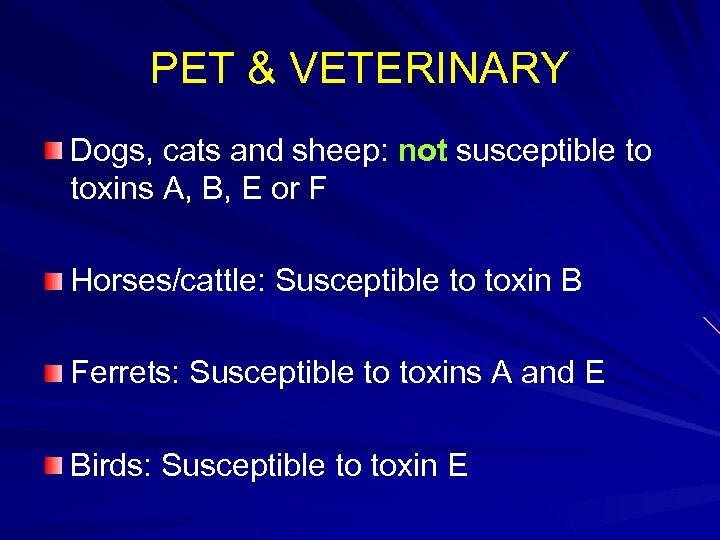
PET & VETERINARY Dogs, cats and sheep: not susceptible to toxins A, B, E or F Horses/cattle: Susceptible to toxin B Ferrets: Susceptible to toxins A and E Birds: Susceptible to toxin E
MENTAL HEALTH IMPACT Widespread anxiety and distress Fear driven behaviors (e. g. , flight) Resistance to public health measures

POTENTIAL CITYWIDE EFFECTS
GENERAL CONSIDERATIONS Multiple attacks possible Cross-contamination of persons, property, animals and food might occur Impacts will depend on the nature of the attack(s) and targeted industry and/or populations Emergency responders who collect food from residences will assume that the environment they are entering is contaminated and will require specific training and equipment Highly unlikely that MTA would suspend all or parts of service on rail and bus lines
HEATHCARE CONSIDERATIONS NYC has ~20, 000 hospital beds; typically operating at ~80% capacity. Surge in capacities will be needed within 2 days of a large release Botulism outbreaks have the potential to generate high demand for ICU care (e. g. , skilled nursing and ventilators), other staffed beds and mental health services – DOHMH and other ESF 8 partners may need to determine resource allocation strategies and implementation. Initial symptoms may be vague (e. g. , blurred vision). May need nurse’s hotline to triage calls from 311.
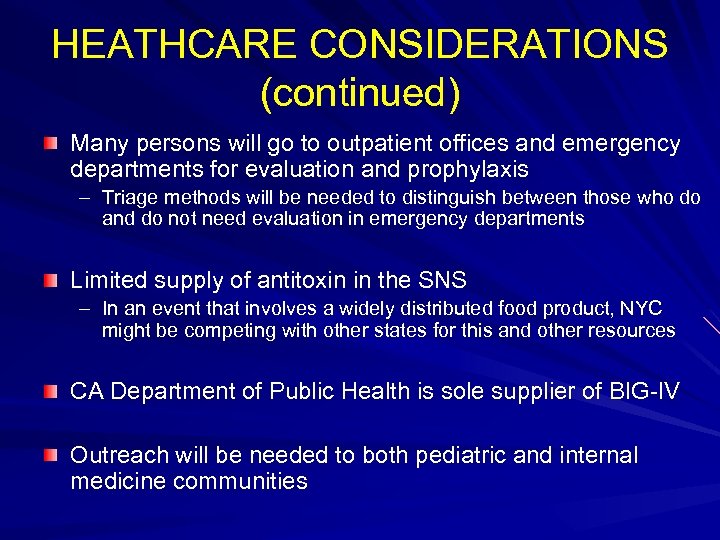
HEATHCARE CONSIDERATIONS (continued) Many persons will go to outpatient offices and emergency departments for evaluation and prophylaxis – Triage methods will be needed to distinguish between those who do and do not need evaluation in emergency departments Limited supply of antitoxin in the SNS – In an event that involves a widely distributed food product, NYC might be competing with other states for this and other resources CA Department of Public Health is sole supplier of BIG-IV Outreach will be needed to both pediatric and internal medicine communities
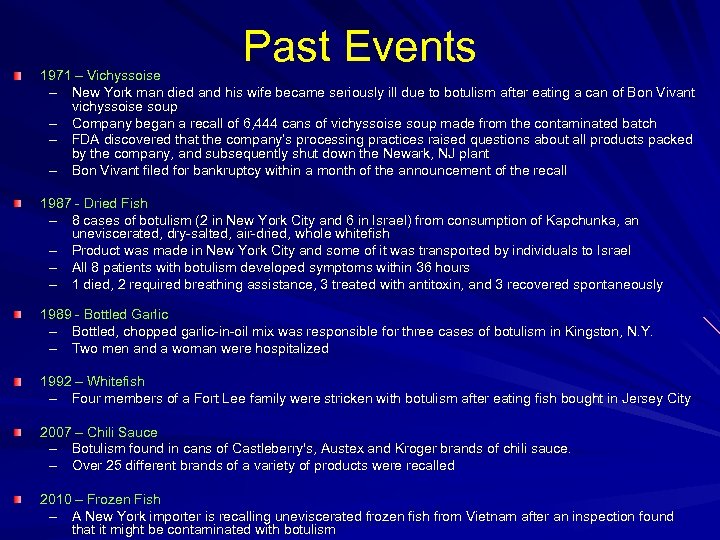
Past Events 1971 – Vichyssoise – New York man died and his wife became seriously ill due to botulism after eating a can of Bon Vivant vichyssoise soup – Company began a recall of 6, 444 cans of vichyssoise soup made from the contaminated batch – FDA discovered that the company’s processing practices raised questions about all products packed by the company, and subsequently shut down the Newark, NJ plant – Bon Vivant filed for bankruptcy within a month of the announcement of the recall 1987 - Dried Fish – 8 cases of botulism (2 in New York City and 6 in Israel) from consumption of Kapchunka, an uneviscerated, dry-salted, air-dried, whole whitefish – Product was made in New York City and some of it was transported by individuals to Israel – All 8 patients with botulism developed symptoms within 36 hours – 1 died, 2 required breathing assistance, 3 treated with antitoxin, and 3 recovered spontaneously 1989 - Bottled Garlic – Bottled, chopped garlic-in-oil mix was responsible for three cases of botulism in Kingston, N. Y. – Two men and a woman were hospitalized 1992 – Whitefish – Four members of a Fort Lee family were stricken with botulism after eating fish bought in Jersey City 2007 – Chili Sauce – Botulism found in cans of Castleberry's, Austex and Kroger brands of chili sauce. – Over 25 different brands of a variety of products were recalled 2010 – Frozen Fish – A New York importer is recalling uneviscerated frozen fish from Vietnam after an inspection found that it might be contaminated with botulism
CITYWIDE RESPONSE
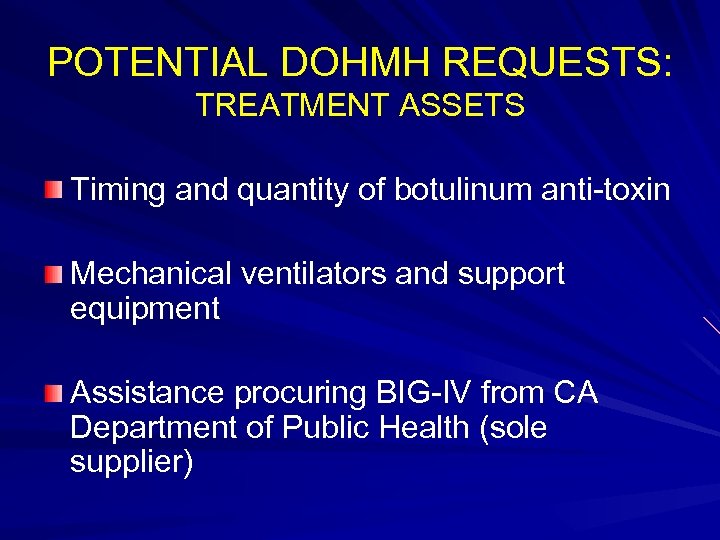
POTENTIAL DOHMH REQUESTS: TREATMENT ASSETS Timing and quantity of botulinum anti-toxin Mechanical ventilators and support equipment Assistance procuring BIG-IV from CA Department of Public Health (sole supplier)
POTENTIAL DOHMH REQUESTS: Environmental Response Guidance & Standards Federal assistance in collecting and analyzing environmental samples in coordination with local environmental sampling efforts: – USDA/FSIS: meat, poultry and eggs – FDA: all other food items Coordination of data sharing requirements Federal (CDC NIOSH and EPA) and NYSDOH participation in multiagency advisory group for environmental recovery, remediation and re-occupancy issues Decontamination, remediation and re-occupancy standards and guidelines for locations where contaminated food item was manufactured, stored, prepared and consumed
POTENTIAL DOHMH REQUESTS: Public Health Surge Capabilities Laboratory sampling and analytical capacity, including staff, reagents and other laboratory supplies (e. g. , bioassay, if needed)
POTENTIAL DOHMH REQUESTS: Federal Health/Medical Assets Request from below or order per specific mission needs through ESF-8 via OEM to NY State National Medical Response Team (medical care; biological incident specialty; mass casualty decon; 50 -person, 48 hours; currently one team available for deployment) Federal Medical Station (acute, non-trauma care; 250 beds scalable in 50 bed increments, 48 hours, order with or without staff; 60 caches around country. ) HHS Rapid Deployment Force (can staff medical station; clinical; mental health, public health; 105 members, 12 hours; only one available on eastern seaboard) Pediatric intensivist strike teams (two persons/team; available through Public Health Service Tier III or NDMS. ) Applied Public Health Teams (PHS officers w/ equipment to surge all key local health department functions. ) NDMS Disaster Medical Assistance Teams (Can be configured as needed; approximately six - 35 member teams within a 12 hour deployment zone.
Скачать презентацию FOODBORNE BOTULISM NYC Dept of Health and Mental
a7e70f564d241bb3c0e9b30c9c66cbd3.ppt