


 Скачать презентацию FOOD FOR THOUGHT Prosecution of International Crimes 18
97cd1d14176403c3945c6f9a90cd9a87.ppt
- Количество слайдов: 24
 FOOD FOR THOUGHT: “Prosecution of International Crimes” 18 January 2016
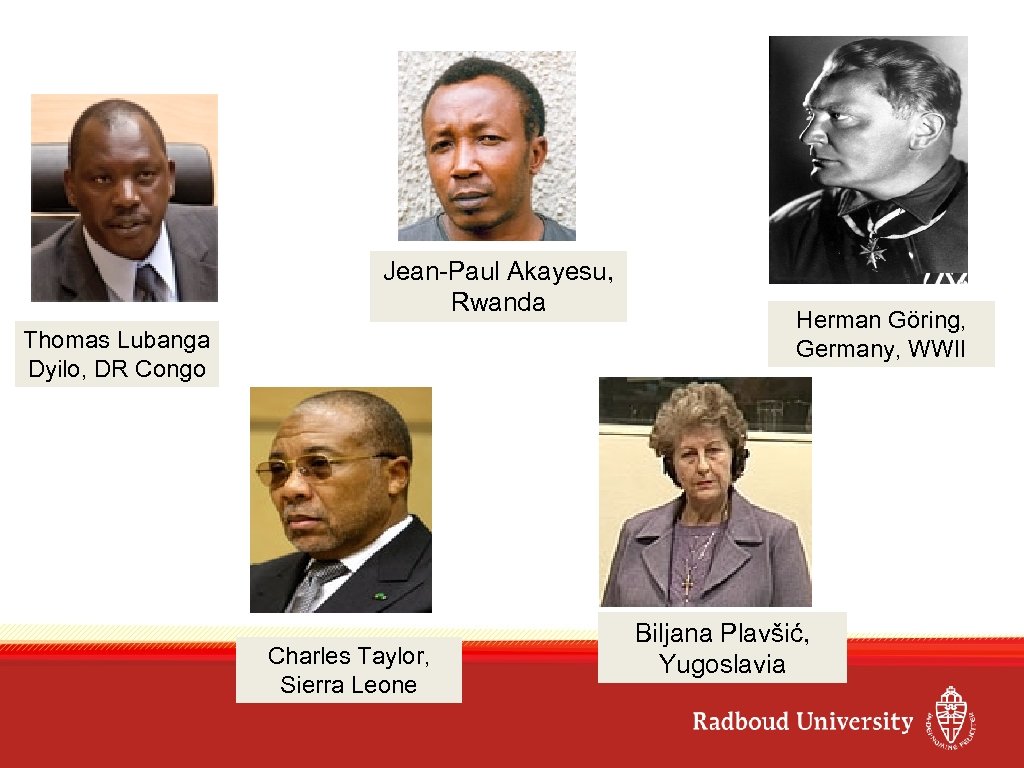 Jean-Paul Akayesu, Rwanda Thomas Lubanga Dyilo, DR Congo Charles Taylor, Sierra Leone Herman Göring, Germany, WWII Biljana Plavšić, Yugoslavia
 I. What are international crimes: definition and elements • Basic principle: international crimes ought to be punished! No impunity for international crimes! All those who commit international crimes have to be punished • Punishment of individuals for international crimes has the following goals: - to deter commission of further crimes – international criminal law is law and will be implemented against lawbreakers - to provide for restoration of peace and reconciliation of communities • to acknowledge that crimes have been committed and to seek truth to bring justice to the victims A definition: “International crimes are crimes which are as such established by international law and which invoke individual criminal responsibility”
 • How can we make a difference between crimes on the national level and international crimes? In July 2014 in an American city a man had a quarrel with his wife and brutally killed her In 1988 in a military operation led by Saddam Hussein's Ba’athist regime against the ethnic Kurds of northern Iraq at least 100, 000 Kurds were killed through the use of chemical weapons and aerial attacks
 Crime under national law • Crime under international law The distinction between crimes under national and under international law is based on the elements of the crime
 • Core international crimes are: a. war crimes b. crimes against humanity c. genocide d. a crime of aggression
 a. War crimes Ongoing conflicts: Brown Red Orange Yellow - Major wars, 10, 000+ deaths in current or past year Wars, 1, 000– 9, 999 deaths in current or past year Minor conflicts, 100– 999 deaths in current or past year Skirmishes and clashes, fewer than 100 deaths in current or past year
 Conflicts with at least 10, 000 casualties in 2015 Afghanistan: since 1978 – 1, 240, 000 -2, 000 (in 2015 – 36, 345) Iraq + Iraq Civil War (since 2003): 242, 000 -1, 000 (in 2015 – 21, 429) Syrian Civil War: since 250, 000 -340, 000 (in 2015 – 55, 219)
 • Which elements indicate that a war crime has been committed? - war crimes take place only during an international or internal armed conflict - they can be committed by military and civilians - victims are civilians, civilian property and military not actively participating in fighting and which belong to the opposing party - the act of an individual should be linked to the armed conflict - more than 50 different crimes can be war crimes: - atrocities against the civilian population, looting and destruction of civilian property, use of poisons weapons, mutilation, cruel treatment and torture; taking of hostages; intentionally directing attacks against buildings dedicated to religion, education, art, science or charitable purposes, historical monuments or hospitals; pillaging; rape, sexual slavery, forced pregnancy or any other form of sexual violence; conscripting or enlisting children under the age of 15 years into armed forces or groups or using them to participate actively in hostilities
 b. Crimes against humanity – “ particularly odious offences, serious attack on human dignity or grave humiliation or a degradation of huma beings”: - a widespread or systematic attack directed against any civilian population – nationals and non-nationals - can take place during an armed conflict and in peacetime - can be committed by military and civilians - murder; extermination; enslavement; deportation or forcible transfer of population; imprisonment; torture; rape, sexual slavery, enforced prostitution, forced pregnancy, enforced sterilization, or any other form of sexual violence of comparable gravity; persecution against an identifiable group on political, racial, national, ethnic, cultural, religious or gender grounds; enforced disappearance of persons; the crime of apartheid; other inhumane acts of a similar character intentionally causing great suffering or serious bodily or mental injury
 Augusto Pinochet, Chile, military dictatorship from 1973 -1990
 c. Genocide: Extermination of a national, ethnical, racial or religious group - - the victim is the member of a group Adolf Eichmann, trial 1961 -1962 can be committed by: killing members of the group; causing serious bodily or mental harm to members of the group; deliberately inflicting on the group conditions of life calculated to bring about its physical destruction in whole or in part; imposing measures intended to prevent births within the group; forcibly transferring children of the group to another group incitement to commit genocide is also punishable - responsibility of States?
 d. A crime of aggression – “leadership crime”: - 2010 – the year of the definition! - can be committed by a person who has political and military power in a State - an act of using armed force by a State against the sovereignty, territorial integrity or political independence of another State - invasion, military occupation, and annexation by the use of force, blockade of the ports or coasts, if it is considered being, by its character, gravity and scale, a manifest violation of the Charter of the United Nations
 II. Prosecutions: the past and existing courts Nuremberg Tribunal, 1945 Trial of Peter van Hagenbach, 1474 “crimes against the laws of God and Men” Tokyo Tribunal, 1946
 … international ad hoc Tribunals (established for prosecution of certain crimes) International Criminal Tribunal for the former Yugoslavia (ICTY), 1993 – in the process of closing International Criminal Tribunal for Rwanda (ICTR), 1994 -December 2015
 … “Internationalized” or hybrid ad hoc courts and tribunals Kosovo Relocated Specialist Judicial Institution (national / just relocated) The Extraordinary Chambers in Cambodia The Special Court for Sierra Leone (2002 -2013) The Special Panels of the Dili District Court (East Timor) (2000 -2006) The Special Tribunal for Lebanon The War Crimes Chamber in Bosnia and Herzegovina
 … International Criminal Court (ICC), since 2002 (permanent court) International Criminal Court (ICC), 1998
 • International Criminal Court - universal, 123 States are parties to the Rome Statute (main document of the Court) - States Parties: 34 African States, 19 Asia-Pacific States, 18 Eastern European, 27 Latin American and Caribbean States, 25 Western European and other States - States not Parties: USA, China, Russia, Egypt, Israel, Libya, Lebanon, Indonesia, Iran, Iraq, Syria, Morocco ….
 III. Who can be prosecuted by the International Criminal Court? • Individuals! Which individuals? i. Persons which committed crimes in the territory of the State party to the Rome Statute – all persons including foreigners which commit international crimes on the territory of a State Party can be prosecuted ii. Nationals of the State which is Party to the Rome Statute commit crimes elsewhere in the world iii. Nationals of the State which is referred to the Court by the United Nations Security Council • Persons younger than 18 cannot be prosecuted by the International Criminal Court. What happens to them?
 • What about Heads of State or Government? Can they also be prosecuted? Do they enjoy immunities? Different rules of international law. The International Criminal Court: Heads of State or Government do not enjoy immunities and can be prosecuted Omar al Bashir, President of the Republic of Sudan since 1993; indicted for war crimes, crimes against humanity and genocide; two warrants of arrest (2009 and 2010)
 • Can organizations and organizational groups be prosecuted by the International Criminal Court? • Can States be prosecuted by the International Criminal Court? For States – different (State and not criminal) responsibility & different court (ICJ). E. g. genocide in Bosnia and Herzegovina • Which sentences the persons convicted by the International Criminal Court can get? Where they can serve their sentence?
 • Which situations and cases are currently under the consideration of the International Criminal Court? In 2014 -2015 ICC conducted preliminary examination activities in 10 situations: - Afghanistan the Central African Republic Colombia Georgia Guinea Honduras Iraq Nigeria Ukraine and State of Palestine Court is currently seized of 21 cases and eight situations: - Central African Republic I and II - Co te d’Ivoire - the Democratic Republic of the Congo - Kenya - Libya - Mali - Darfur (the Sudan) - Uganda
 • Apart from the International Criminal Court, national courts can also prosecute international crimes These are: - States on whose territory an international crime was committed - States whose nationals are perpetrators of crimes - States whose nationals are victims of crimes - All States in the world if the crime is so serious to give the right to States to prosecute it. “No place should be a save heaven for those who have committed certain crimes”, such as genocide, crimes against, humanity, war crimes, torture, forced disappearance …
 IV. There also other ways to respond to international crimes: amnesties and truth commissions • Amnesties • Truth and reconciliation commissions (TRC)