 Скачать презентацию Food and Forestry Global change and global challenges
cfe0db3cac15cd79e0e0029bd08ecb10.ppt
- Количество слайдов: 26



Food and Forestry: Global change and global challenges GCTE Keynote Address LINKS BETWEEN SCIENCE AND POLICY MAKING by Jeffrey B. Tschirley and David Norse
Requirements for policy relevant science: Definition of the chain (filiere) of linkages Matrix analysis to target key policy areas and opportunities Early and direct links (collaborative partnerships) with policy research, analysis and formulation specialists
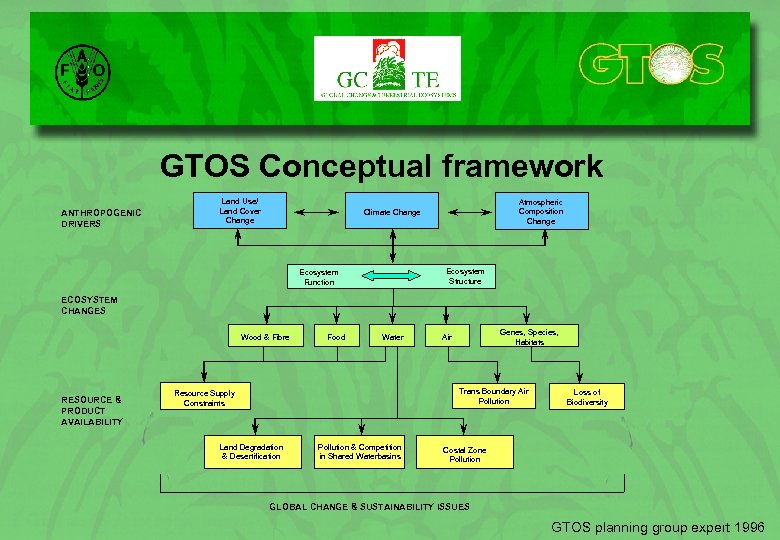
GTOS Conceptual framework ANTHROPOGENIC DRIVERS Land Use/ Land Cover Change Atmospheric Composition Change Climate Change Ecosystem Structure Ecosystem Function ECOSYSTEM CHANGES Wood & Fibre RESOURCE & PRODUCT AVAILABILITY Food Water Genes, Species, Habitats Air Trans Boundary Air Pollution Resource Supply Constraints Land Degradation & Desertification Pollution & Competition in Shared Waterbasins Loss of Biodiversity Costal Zone Pollution GLOBAL CHANGE & SUSTAINABILITY ISSUES GTOS planning group expert 1996
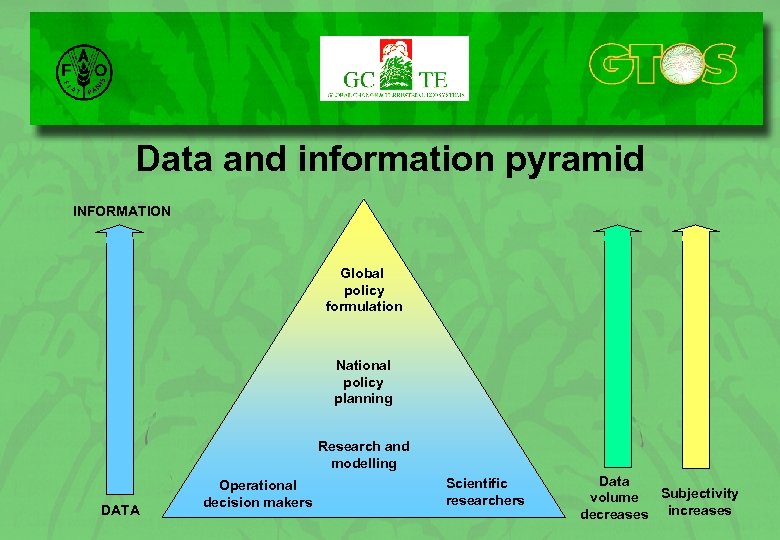
Data and information pyramid INFORMATION Global policy formulation National policy planning Research and modelling DATA Operational decision makers Scientific researchers Data Subjectivity volume decreases increases
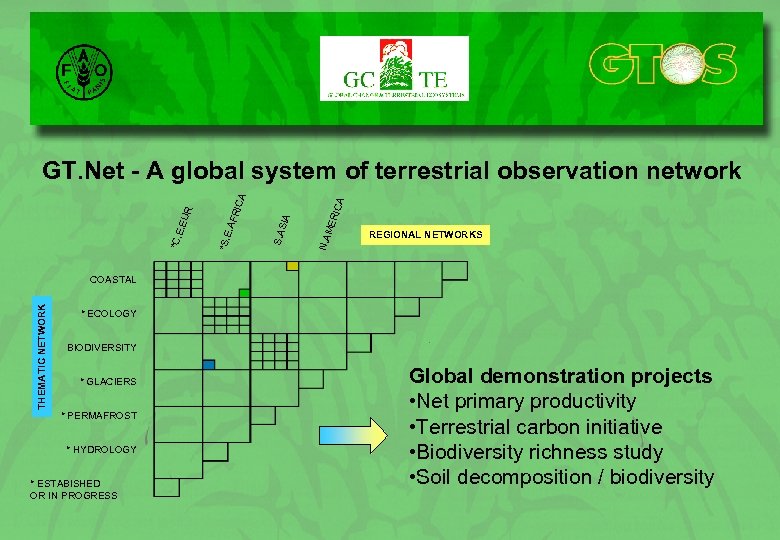
A RIC N. A ME IA S. A S RIC. AF *S. E *C. E. EU R A GT. Net - A global system of terrestrial observation network REGIONAL NETWORKS THEMATIC NETWORK COASTAL * ECOLOGY BIODIVERSITY * GLACIERS * PERMAFROST * HYDROLOGY * ESTABISHED OR IN PROGRESS Global demonstration projects • Net primary productivity • Terrestrial carbon initiative • Biodiversity richness study • Soil decomposition / biodiversity
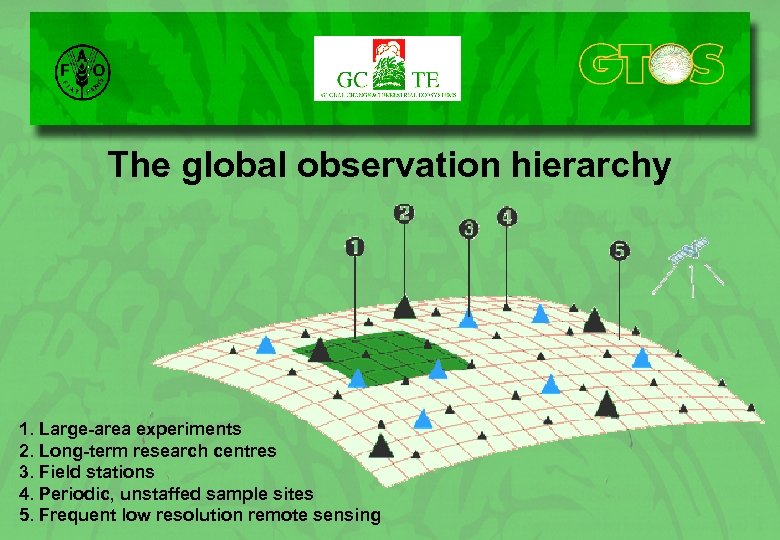
The global observation hierarchy 1. Large-area experiments 2. Long-term research centres 3. Field stations 4. Periodic, unstaffed sample sites 5. Frequent low resolution remote sensing
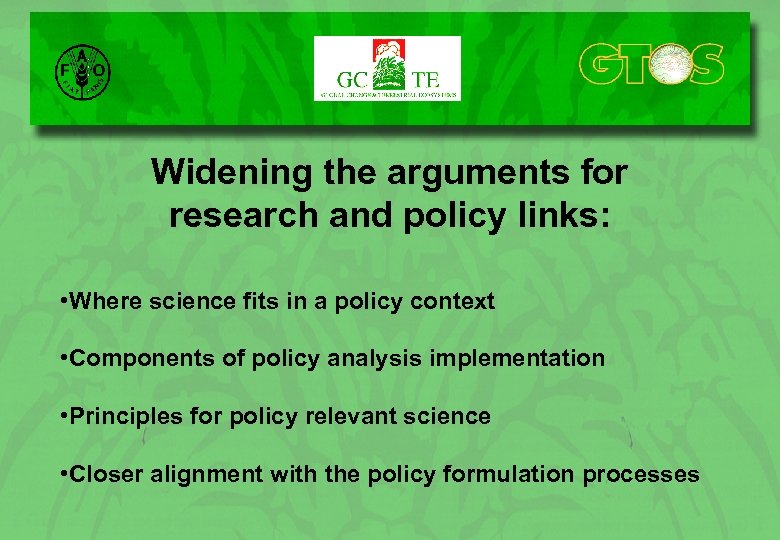
Widening the arguments for research and policy links: • Where science fits in a policy context • Components of policy analysis implementation • Principles for policy relevant science • Closer alignment with the policy formulation processes
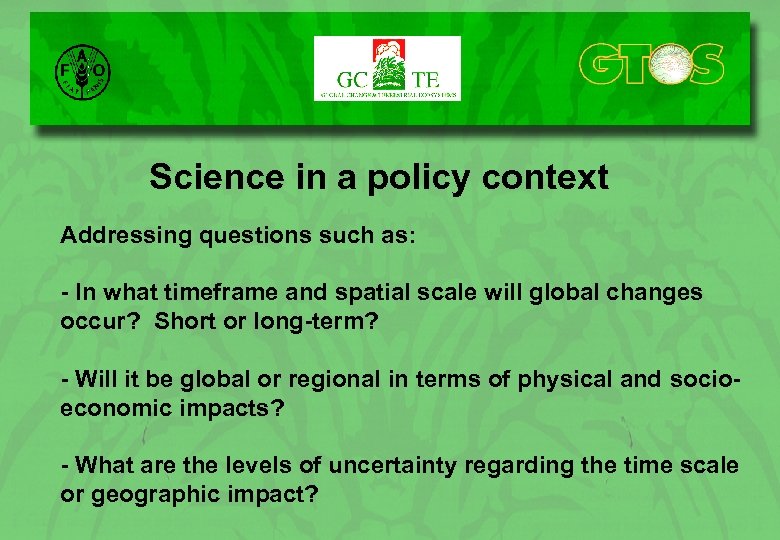
Science in a policy context Addressing questions such as: - In what timeframe and spatial scale will global changes occur? Short or long-term? - Will it be global or regional in terms of physical and socioeconomic impacts? - What are the levels of uncertainty regarding the time scale or geographic impact?
Factors inhibiting the use of science in policy formulation: • Those primarily responsible for causing global change may not suffer most from its impacts • Misconceptions about the nature of natural resource management (NRM) problems. • Tendency to accept public information about environmental risks at face value.
Components of policy analysis and implementation: §problem identification; §strategy formulation; §selection of policy options; §policy implementation; §setting of regulatory standards; §monitoring and evaluation.
Problem identification: problems that are global in scale problems that are global in scope (and in the future may be global in scale)
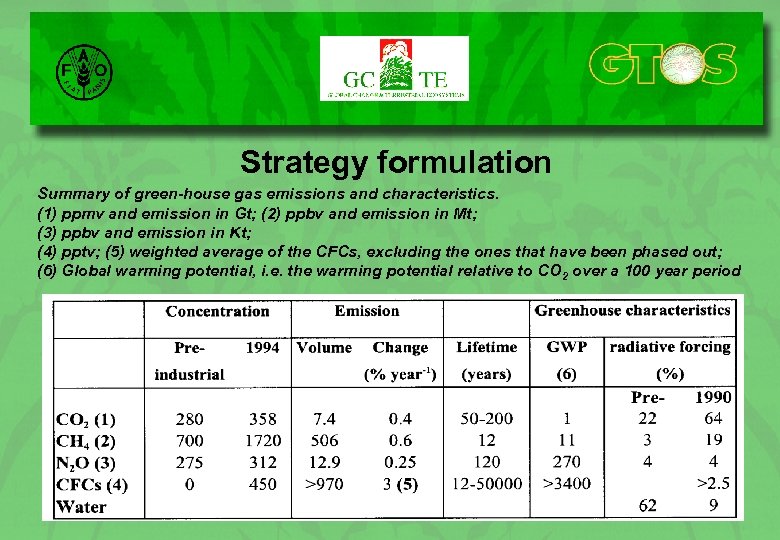
Strategy formulation Summary of green-house gas emissions and characteristics. (1) ppmv and emission in Gt; (2) ppbv and emission in Mt; (3) ppbv and emission in Kt; (4) pptv; (5) weighted average of the CFCs, excluding the ones that have been phased out; (6) Global warming potential, i. e. the warming potential relative to CO 2 over a 100 year period
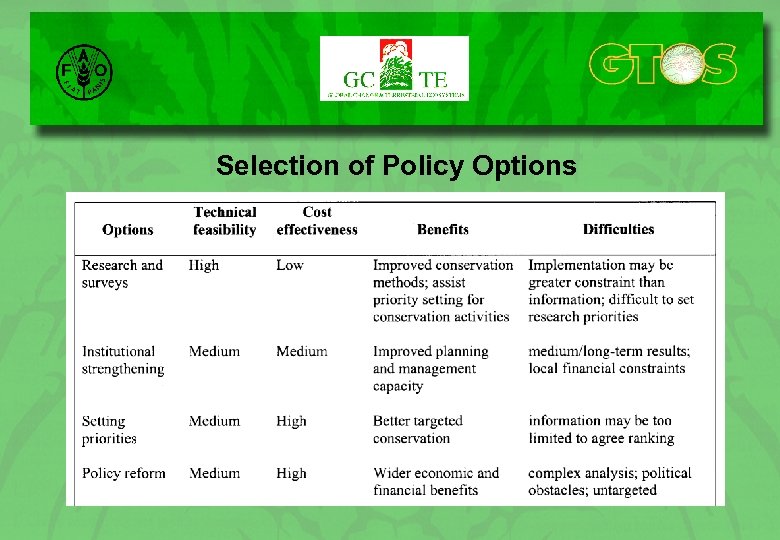
Selection of Policy Options
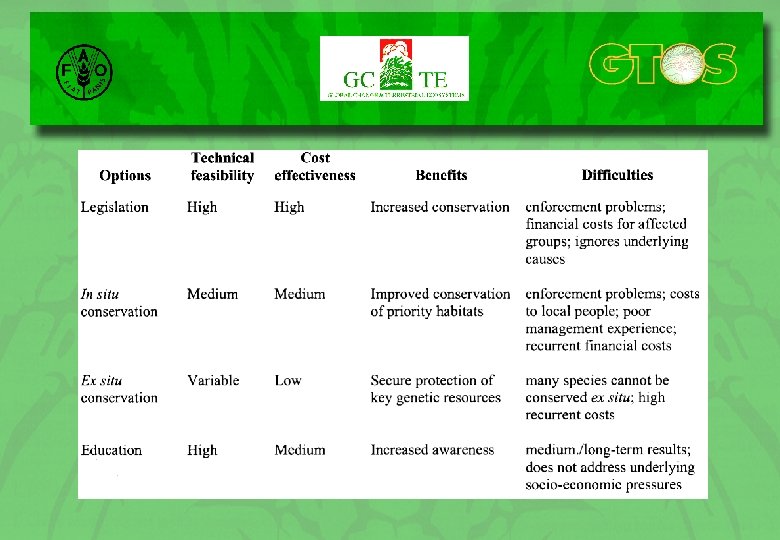
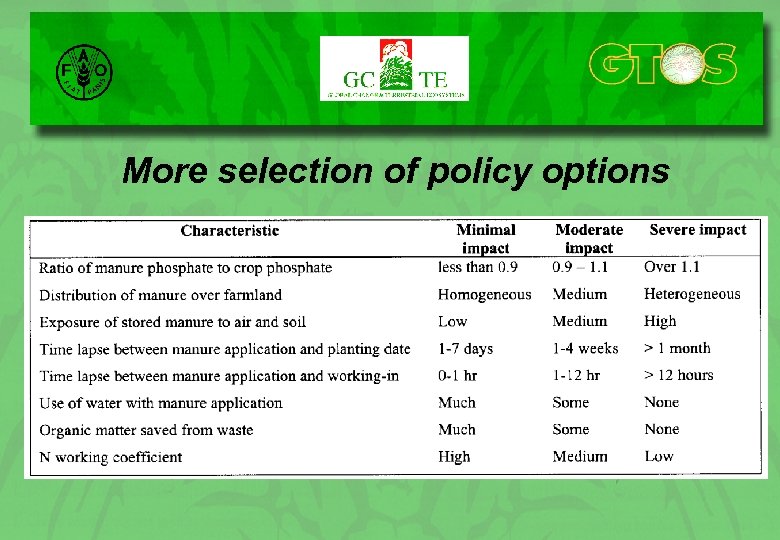
More selection of policy options
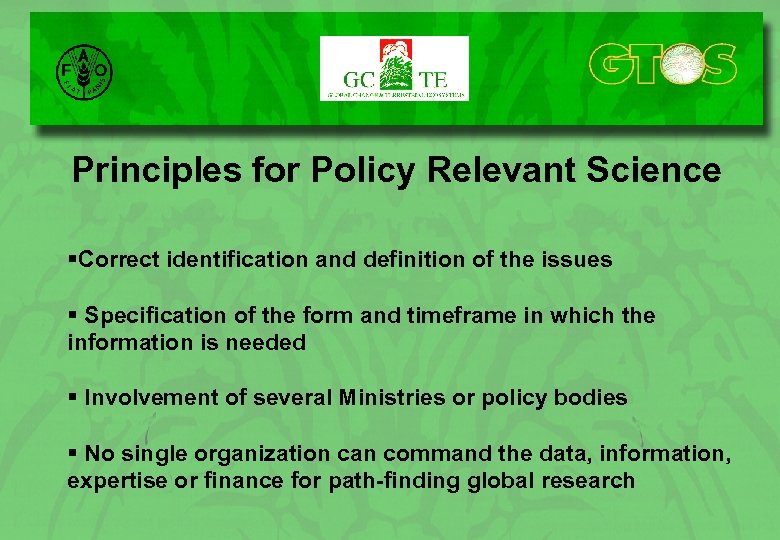
Principles for Policy Relevant Science §Correct identification and definition of the issues § Specification of the form and timeframe in which the information is needed § Involvement of several Ministries or policy bodies § No single organization can command the data, information, expertise or finance for path-finding global research
§ Strategic geographical participation of scientists and institutions §Full disciplinary and analytical integration; §Transparency of data, method, and presentation; documentation of meta data; §An open peer review process and clarification of issues on which there is not yet broad consensus; §Sensitivity analysis of the scientific uncertainties and their spatial and temporal impacts; §Clear synthesis and presentation of the scientific issues and response options.
More elements for success: • break traditional molds • build new collaborative, cross-disciplinary partnerships
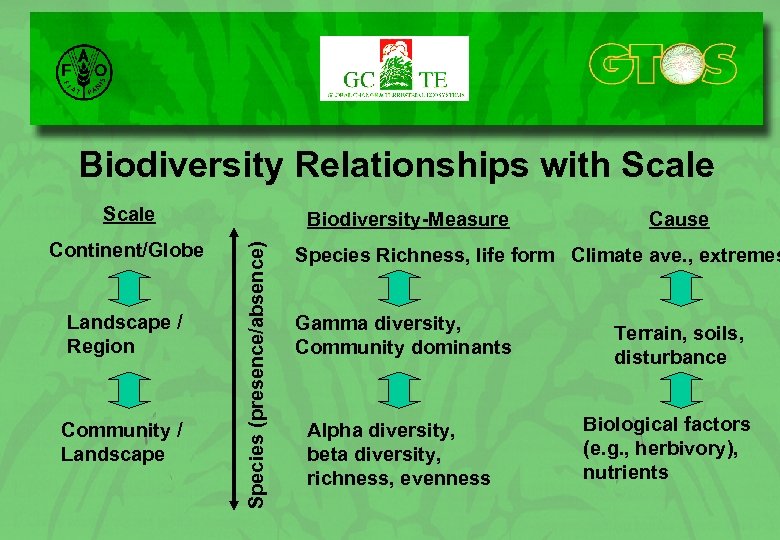
Biodiversity Relationships with Scale Landscape / Region Community / Landscape Species (presence/absence) Continent/Globe Biodiversity-Measure Cause Species Richness, life form Climate ave. , extremes Gamma diversity, Community dominants Alpha diversity, beta diversity, richness, evenness Terrain, soils, disturbance Biological factors (e. g. , herbivory), nutrients
Species Abundance “The various aspects of abundance (there a plethora of terms and indices) are often correlated with one another, but they are not interchangeable, making it difficult to compare information gathered in different ways or to select appropriate conservation priorities. A method for translating abundance information between different measures is badly needed. ” (Kunin 1998)
Scaling NPP, ecosystem metabolism and biodiversity relationships From plots to: communities to: landscapes to: lifeforms to: regions/continents Relating biodiversity measures to these hierarchial levels and the different controls that occur at each scale.
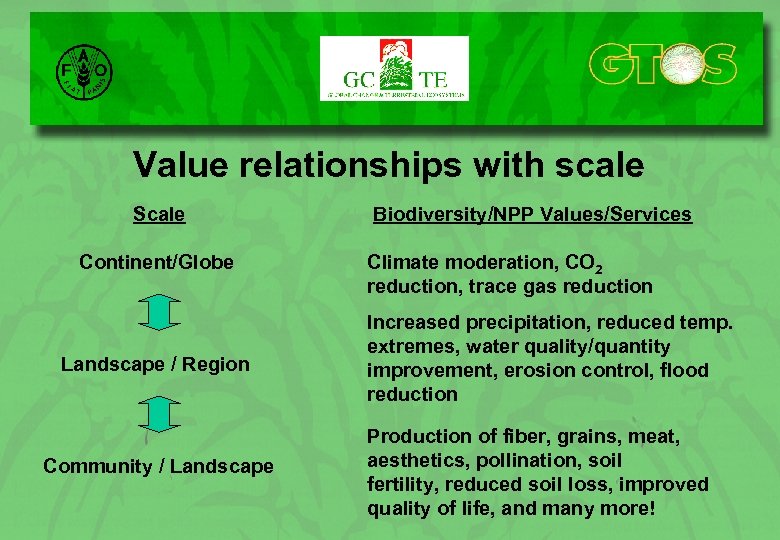
Value relationships with scale Scale Continent/Globe Landscape / Region Community / Landscape Biodiversity/NPP Values/Services Climate moderation, CO 2 reduction, trace gas reduction Increased precipitation, reduced temp. extremes, water quality/quantity improvement, erosion control, flood reduction Production of fiber, grains, meat, aesthetics, pollination, soil fertility, reduced soil loss, improved quality of life, and many more!
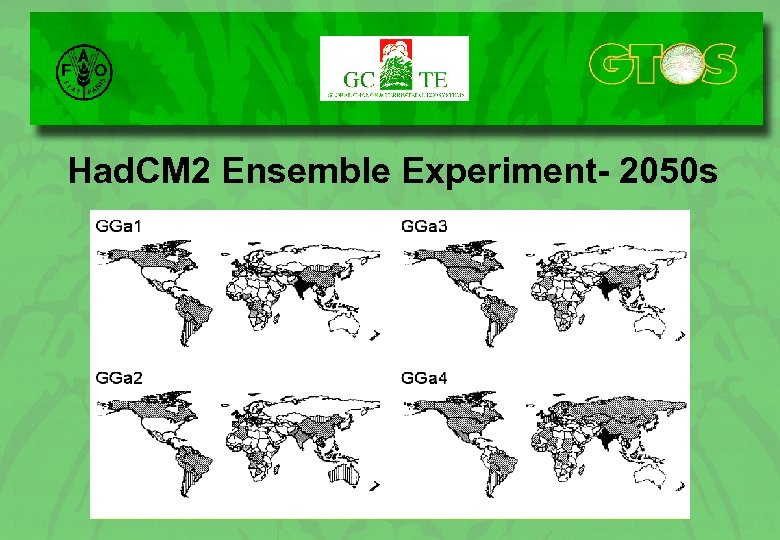
Had. CM 2 Ensemble Experiment- 2050 s
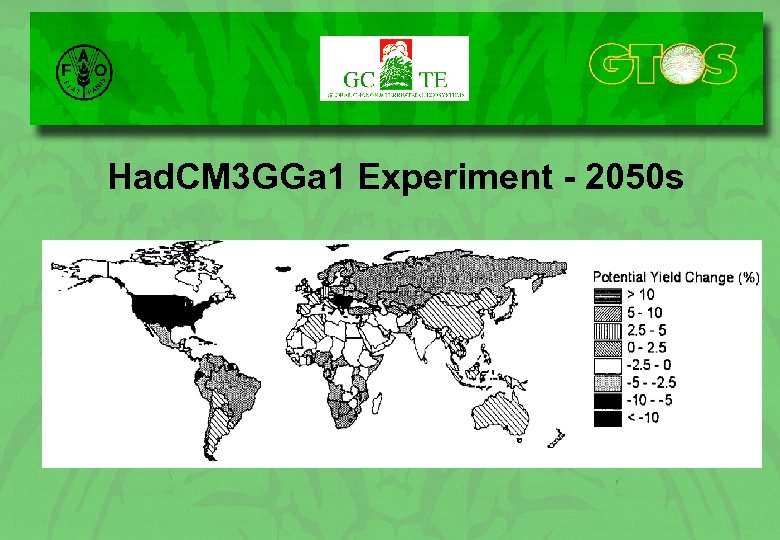
Had. CM 3 GGa 1 Experiment - 2050 s
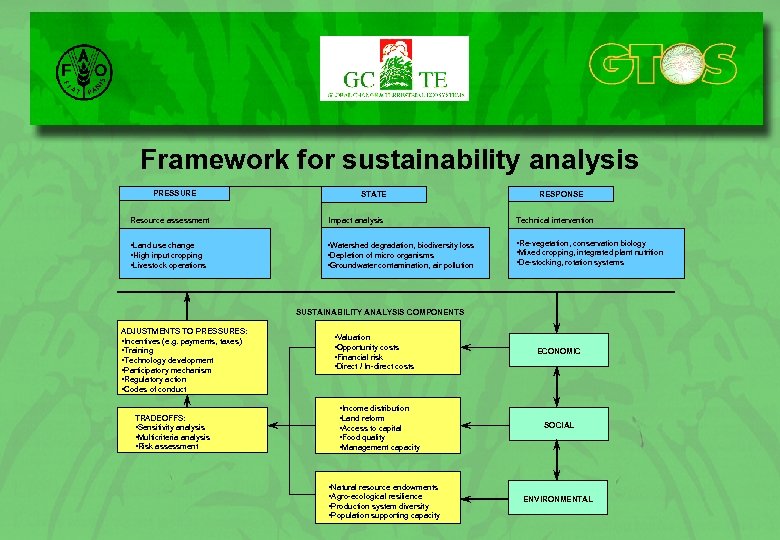
Framework for sustainability analysis PRESSURE STATE RESPONSE Resource assessment Impact analysis Technical intervention • Land use change • High input cropping • Livestock operations • Watershed degradation, biodiversity loss • Depletion of micro organisms • Groundwater contamination, air pollution • Re-vegetation, conservation biology • Mixed cropping, integrated plant nutrition • De-stocking, rotation systems SUSTAINABILITY ANALYSIS COMPONENTS ADJUSTMENTS TO PRESSURES: • Incentives (e. g. payments, taxes) • Training • Technology development • Participatory mechanism • Regulatory action • Codes of conduct TRADEOFFS: • Sensitivity analysis • Multicriteria analysis • Risk assessment • Valuation • Opportunity costs • Financial risk • Direct / In-direct costs • Income distribution • Land reform • Access to capital • Food quality • Management capacity • Natural resource endowments • Agro-ecological resilience • Production system diversity • Population supporting capacity ECONOMIC SOCIAL ENVIRONMENTAL
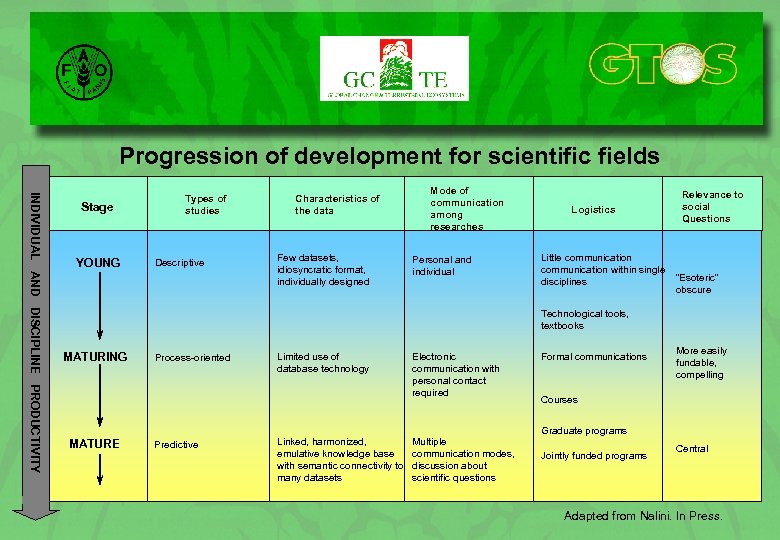
Progression of development for scientific fields INDIVIDUAL AND DISCIPLINE PRODUCTIVITY Stage YOUNG Types of studies Descriptive Characteristics of the data Few datasets, idiosyncratic format, individually designed Mode of communication among researches Personal and individual Logistics Little communication within single disciplines Relevance to social Questions “Esoteric” obscure Technological tools, textbooks MATURING Process-oriented Limited use of database technology Electronic communication with personal contact required Formal communications More easily fundable, compelling Courses Graduate programs MATURE Predictive Linked, harmonized, emulative knowledge base with semantic connectivity to many datasets Multiple communication modes, discussion about scientific questions Jointly funded programs Central Adapted from Nalini. In Press.
Скачать презентацию Food and Forestry Global change and global challenges
cfe0db3cac15cd79e0e0029bd08ecb10.ppt