


 Скачать презентацию Food Additives- The Canadian Situation Presented to Guelph
5ccde17ac3141dec6ecabb990b984ec3.ppt
- Количество слайдов: 64
 Food Additives- The Canadian Situation Presented to: Guelph Food Safety Seminar May 11 th, 2005 Guelph, Ontario Presented by: Doug Morrison Canadian Food Inspection Agency (416) 973 - 4226 Email: “morrisondc@Inspection. gc. ca”
 Food Safety Issues are sure keeping everyone busy! Thanks for the invite!
 Challenge (Today): l How much information to provide and explain to you within 45 minutes?
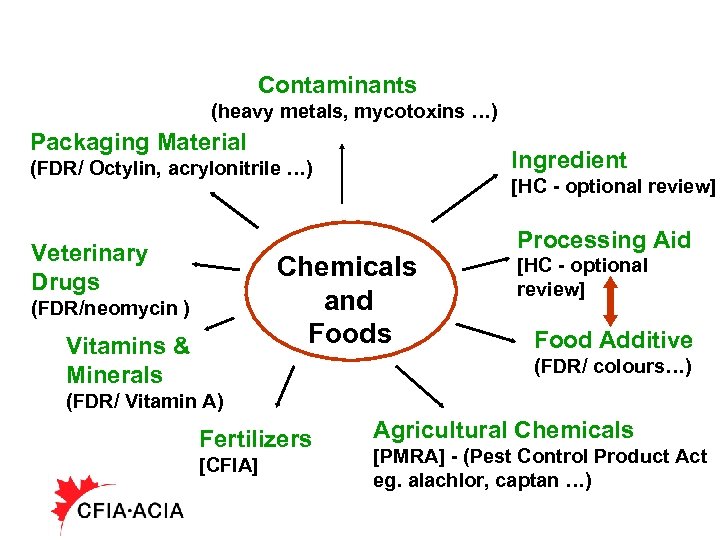 Contaminants (heavy metals, mycotoxins …) Packaging Material Ingredient (FDR/ Octylin, acrylonitrile …) Veterinary Drugs [HC - optional review] Chemicals and Foods (FDR/neomycin ) Vitamins & Minerals Processing Aid [HC - optional review] Food Additive (FDR/ colours…) (FDR/ Vitamin A) Fertilizers [CFIA] Agricultural Chemicals [PMRA] - (Pest Control Product Act eg. alachlor, captan …)
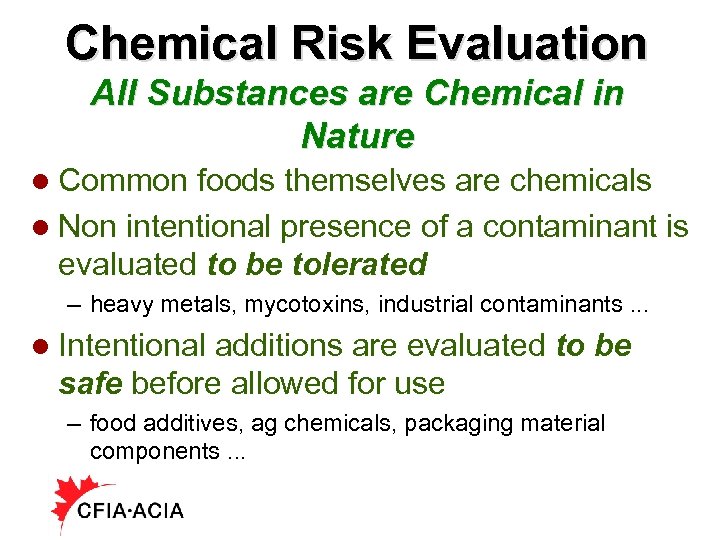 Chemical Risk Evaluation All Substances are Chemical in Nature l Common foods themselves are chemicals l Non intentional presence of a contaminant is evaluated to be tolerated – heavy metals, mycotoxins, industrial contaminants. . . l Intentional additions are evaluated to be safe before allowed for use – food additives, ag chemicals, packaging material components. . .
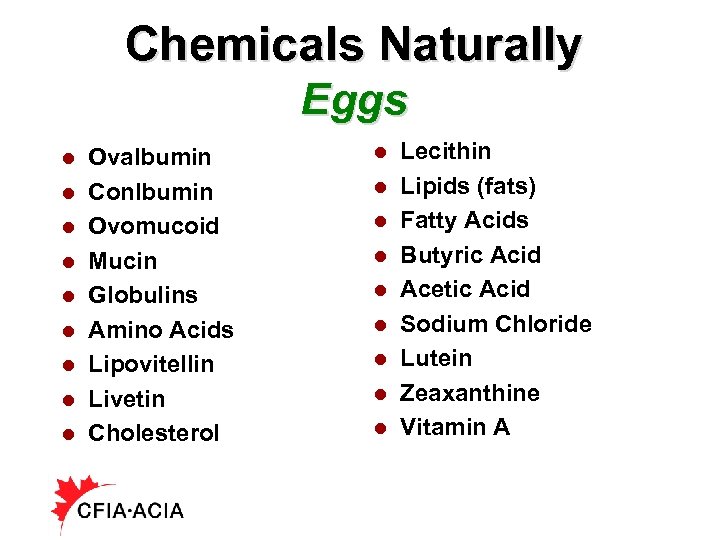 Chemicals Naturally Eggs l l l l l Ovalbumin Conlbumin Ovomucoid Mucin Globulins Amino Acids Lipovitellin Livetin Cholesterol l l l l Lecithin Lipids (fats) Fatty Acids Butyric Acid Acetic Acid Sodium Chloride Lutein Zeaxanthine Vitamin A
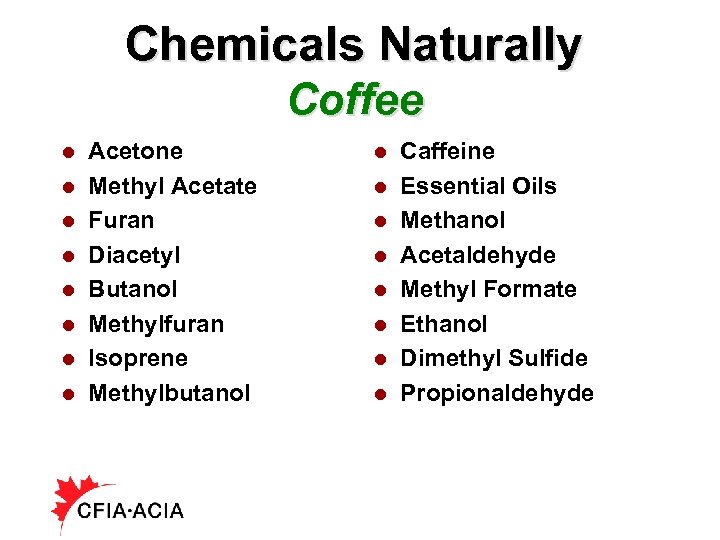 Chemicals Naturally Coffee l l l l Acetone Methyl Acetate Furan Diacetyl Butanol Methylfuran Isoprene Methylbutanol l l l l Caffeine Essential Oils Methanol Acetaldehyde Methyl Formate Ethanol Dimethyl Sulfide Propionaldehyde
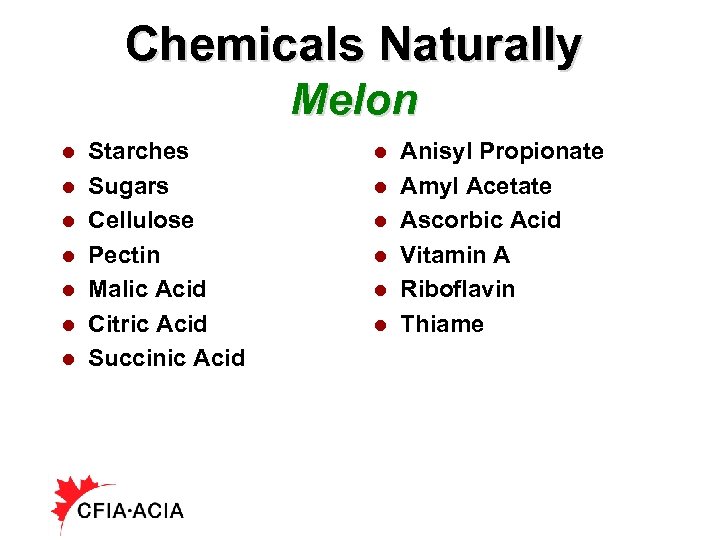 Chemicals Naturally Melon l l l l Starches Sugars Cellulose Pectin Malic Acid Citric Acid Succinic Acid l l l Anisyl Propionate Amyl Acetate Ascorbic Acid Vitamin A Riboflavin Thiame
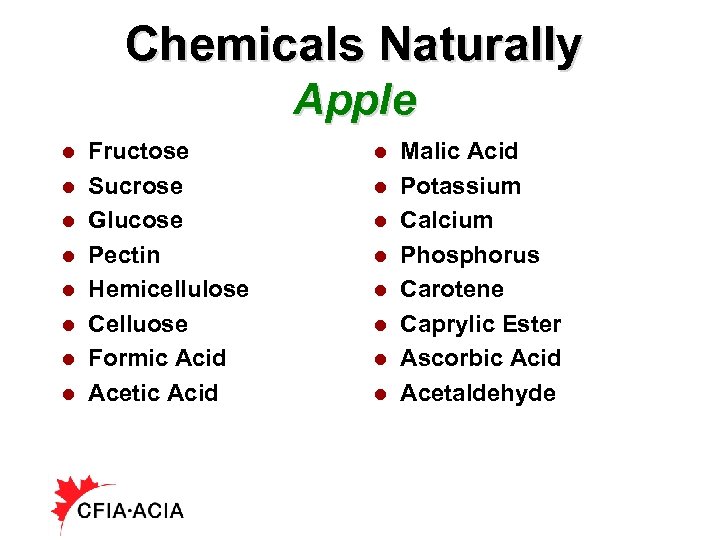 Chemicals Naturally Apple l l l l Fructose Sucrose Glucose Pectin Hemicellulose Celluose Formic Acid Acetic Acid l l l l Malic Acid Potassium Calcium Phosphorus Carotene Caprylic Ester Ascorbic Acid Acetaldehyde
 Important Terms
 Food: l Any article manufactured, sold or represented for use as food or drink for human beings, chewing gum, and any ingredient that may be mixed with food for any purpose whatever
 Food Additives Part B /Foods/ Division 1 l Any substance the use of which results, or may reasonably be expected to result, in it or its by-products becoming a part of or affecting the characteristics of a food, but … (do not include)
 Food Additives do not include: l Nutritive food ingredients such as salt, sugar, starch, glucose, casein. . . l vitamins, minerals, amino acids l spices, seasonings, flavouring preparations l agricultural chemicals l veterinary drugs l food packaging materials Why? Covered separately by the FDR
 Processing Aid (An Administrative Definition) l Understood to be a substance added during food processing and determined necessary to actually manufacture/ process an end food product, with no residue detectable in the end food l No technological effect in the final food l Review/acceptance by Health Canada is not necessary, but recommended
 Vegetable Washes l Not regulated under the Food and Drugs Act and Regulations l Considered to be a processing aid situation and not a food additive situation l General FDA safety requirements expected l HC does offer letter of opinion when asked
 Fruit & Vegetable Coatings l Not regulated under the Food and Drugs Act and Regulations (except mineral oil, paraffin & petroleum) l General FDA safety requirements expected l HC does offer letter of opinion when asked
 Appreciate The Regulations Now ! FDA FDR
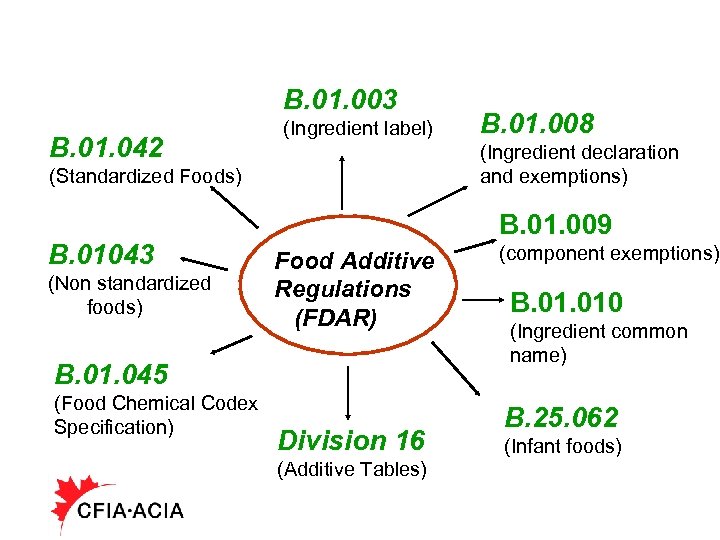 B. 01. 003 B. 01. 042 (Ingredient label) (Ingredient declaration and exemptions) (Standardized Foods) B. 01043 (Non standardized foods) B. 01. 009 Food Additive Regulations (FDAR) B. 01. 045 (Food Chemical Codex Specification) B. 01. 008 Division 16 (Additive Tables) (component exemptions) B. 010 (Ingredient common name) B. 25. 062 (Infant foods)
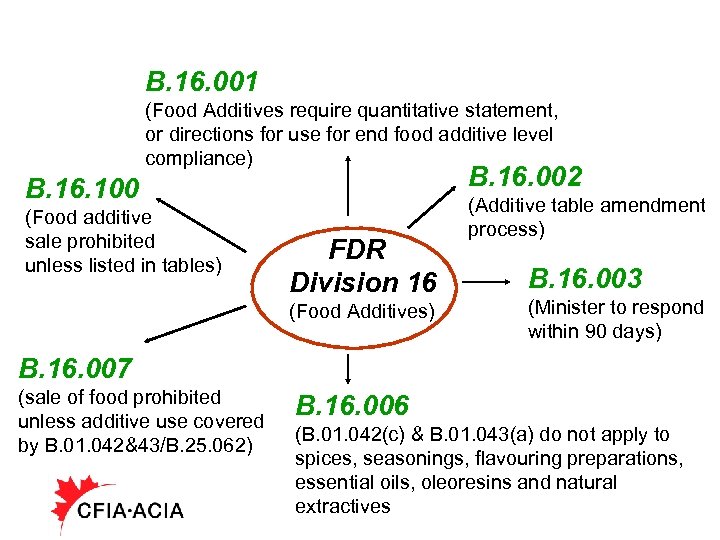 B. 16. 001 (Food Additives require quantitative statement, or directions for use for end food additive level compliance) B. 16. 002 B. 16. 100 (Food additive sale prohibited unless listed in tables) FDR Division 16 (Food Additives) (Additive table amendment process) B. 16. 003 (Minister to respond within 90 days) B. 16. 007 (sale of food prohibited unless additive use covered by B. 01. 042&43/B. 25. 062) B. 16. 006 (B. 01. 042(c) & B. 01. 043(a) do not apply to spices, seasonings, flavouring preparations, essential oils, oleoresins and natural extractives
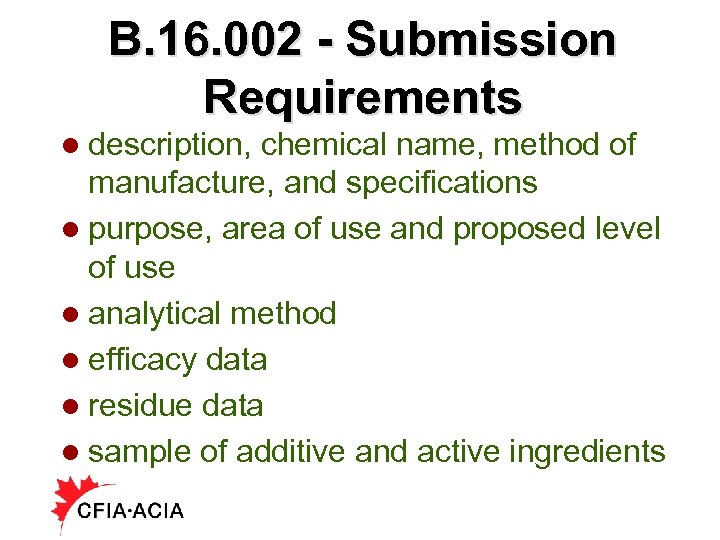 B. 16. 002 - Submission Requirements l description, chemical name, method of manufacture, and specifications l purpose, area of use and proposed level of use l analytical method l efficacy data l residue data l sample of additive and active ingredients
 Other Considerations: l Must not lead to deception l Must result in an advantage to consumers by improving, or maintaining the nutritive value, quantity, quality or acceptability of the food
 Good Manufacturing Practice (Section B. 01. 044) l Where a limit is prescribed for a food additive in a Table to section B. 16. 100 is stated to be GMP the amount of the additive added… shall not exceed the amount required to accomplish the purpose for which the additive is permitted to be added to that food
 The Additive Challenge Finding a Recognizable Name l What about the following and do they each have permitted use? – Sodium Phosphate Monobasic* – Sodium Biphosphate – Sodium Dihydgrogen Phosphate – Monosodium Orthophosphate – Primary Sodium Phosphate – Acid Sodium Phosphate
 References to Consider In Finding a Recognizable Name l Google Search (simply type in the name and see what comes up) l Food Chemical Codex l Merck Index, eleventh edition l Handbook of Food Additives l CFIA policies - Intranet and Internet l “Your” Program Specialist
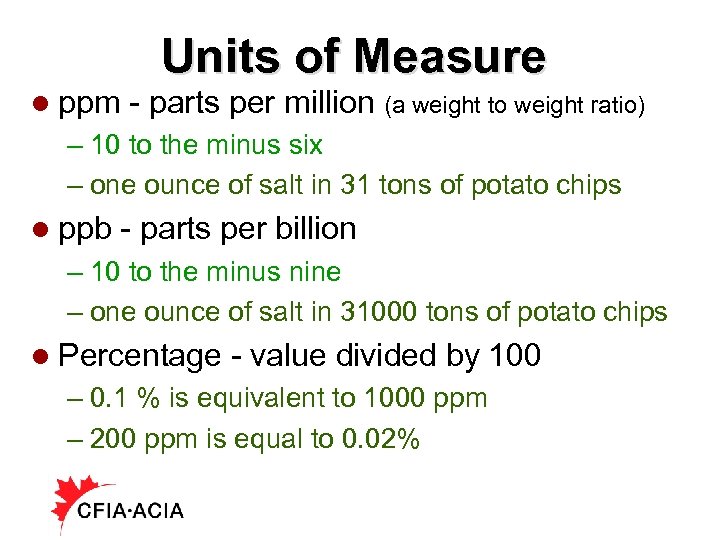 l ppm Units of Measure - parts per million (a weight to weight ratio) – 10 to the minus six – one ounce of salt in 31 tons of potato chips l ppb - parts per billion – 10 to the minus nine – one ounce of salt in 31000 tons of potato chips l Percentage - value divided by 100 – 0. 1 % is equivalent to 1000 ppm – 200 ppm is equal to 0. 02%
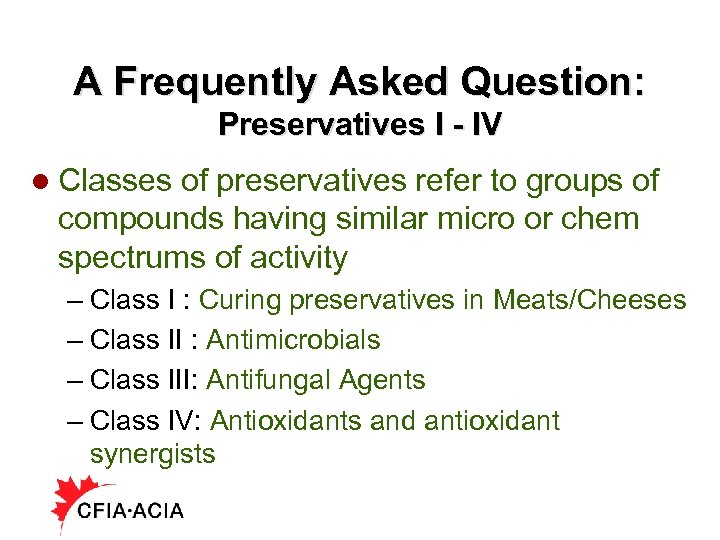 A Frequently Asked Question: Preservatives I - IV l Classes of preservatives refer to groups of compounds having similar micro or chem spectrums of activity – Class I : Curing preservatives in Meats/Cheeses – Class II : Antimicrobials – Class III: Antifungal Agents – Class IV: Antioxidants and antioxidant synergists
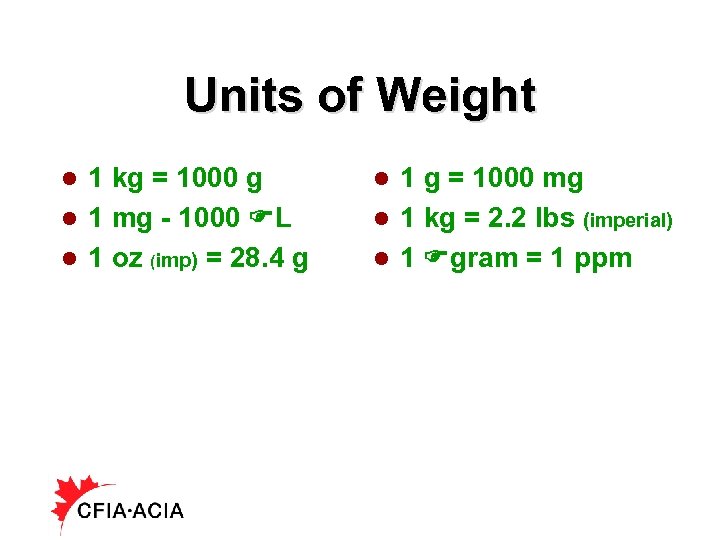 Units of Weight 1 kg = 1000 g l 1 mg - 1000 FL l 1 oz (imp) = 28. 4 g l 1 g = 1000 mg l 1 kg = 2. 2 lbs (imperial) l 1 Fgram = 1 ppm l
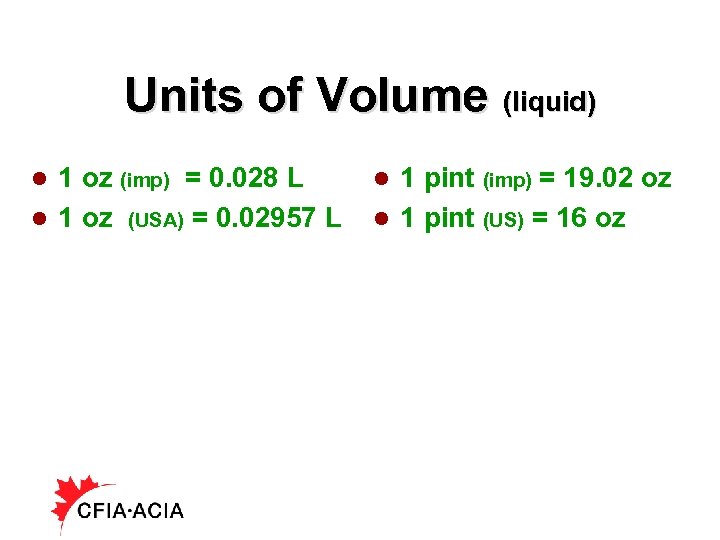 Units of Volume (liquid) 1 oz (imp) = 0. 028 L l 1 oz (USA) = 0. 02957 L l 1 pint (imp) = 19. 02 oz l 1 pint (US) = 16 oz l
 Temporary Marketing Authorization Letter (B. 01. 054) l Letter issued by HC to authorize the sale of a currently non compliant product l To assist in generating information in support of a regulation amendment l Period of time and designated area of sale is stated l Safety data for the additive is completed and accepted by HC
 Interim Marketing Authorization (B. 01. 056) l Provided by HC to a firm in situations where the firm has requested an amendment to either the Division 16 Food Additive Tables I - XV, or the Tables II, or III of Division 15 l The IMA has to be published in Canada Gazette I (public notice of HC’s intent to amend the regulations) l Information provided by a firm is adequate and amendment to the Regulations is expected
 Summary - For Compliant Additive Use l The Additive must be listed in the Tables to Section B. 16. 100 l Added to the foods listed l Used for the purpose stated (fifteen tables) l Within the limits prescribed by the listing l Meet, or exceed Food Chemical Codex Specs
 EEC - Numbering System (Tab 6) l EEC - European Economic Community – a system which has been successfully used in Europe to label food additive use – the system is not accepted in Canada or the USA
 INS Numbering System l INS - International Numbering System for Food Additives – a Codex sponsored numbering system – set out in three columns providing • Identification Number • The name of the additive • The Technological Function of the Additive For Tartrazine: (colour 102)/colour(tartrazine) l For Sodium Carboxymethyl Cellulose l • (thickener 466) / thickener (sodium carboxymethyl cellulose)
 How am I doing?
 Assessing Food Additive Safety
 Important Terms
 No Observed Effect Level (NOEL) l Estimated to be the no observed effect level in animals, divided by a 100 (sometimes a 1000) safety factor
 Acceptable Daily Intake (ADI) l Estimated to be the no observed effect level in animals, divided by a 100 l Sometimes a 1000 safety factor depending on the nature of toxic effects noted and quality of available toxicity data l The dietary intake of an additive which can be safely ingested over a lifetime without appreciable risk from the known information
 For Example: l It is determined that a 1 kg rat could consume without effect 300, 000 mg daily, the no effect level expressed per unit of body weight would be 3000 mg/kg/day – the ADI (using a 100 safety factor) would be 30 mg/kg/day
 Estimating the P. D. I. (Probable Daily Intake) l Obtained by adding up likely sources and exposures elsewhere in the diet – necessary to determine if the proposed additive amendment will continue to result in consumer exposure within the ADI established for the additive
 The RDI (Reasonable Daily Intake) l Where to find these values: – on the product label (serving size) – Part D, Schedule K of FDR (pg. 537) – in absence of the above, USA/FDA …. ?
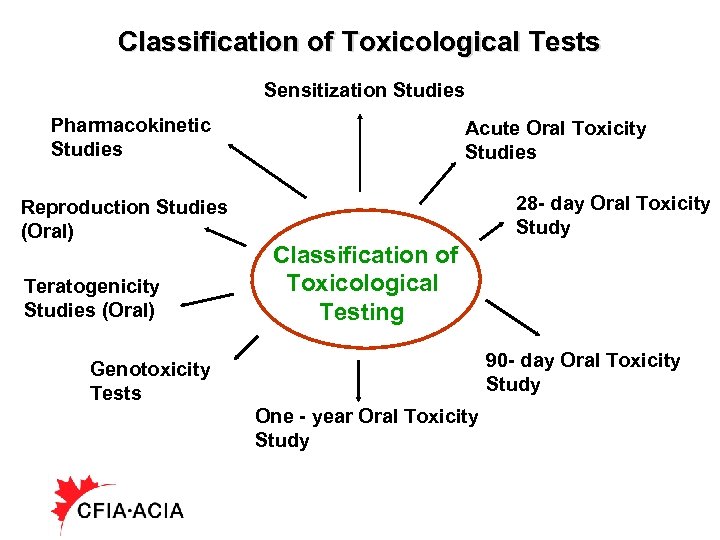 Classification of Toxicological Tests Sensitization Studies Pharmacokinetic Studies Reproduction Studies (Oral) Teratogenicity Studies (Oral) Acute Oral Toxicity Studies 28 - day Oral Toxicity Study Classification of Toxicological Testing 90 - day Oral Toxicity Study Genotoxicity Tests One - year Oral Toxicity Study
 Another Term for Evaluating Chemical Toxicity (eg. pesticides) l LD 50 test – this is a test for the dose of the additive which is level (deadly) to 50% of the animals when given only once – several animal species are tested – the lower the LD 50, the higher the toxicity
 Assessing Food Additive Control
 Taking the Barometer Reading for Food Additive Control Potential For Food Additive Problems
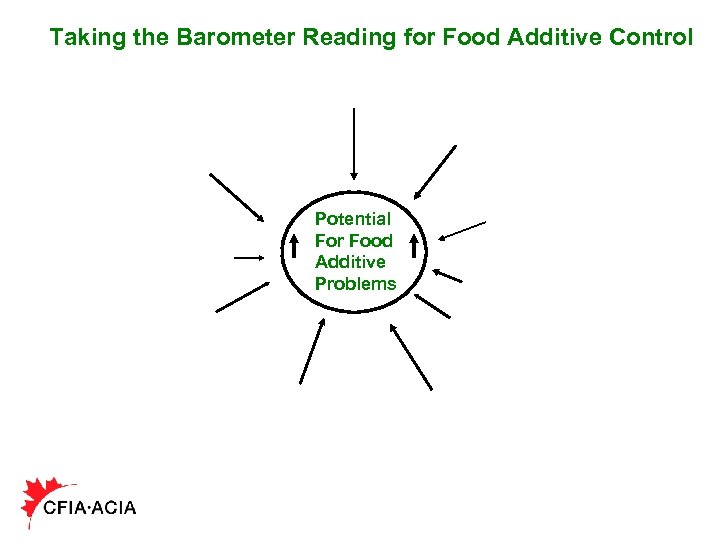
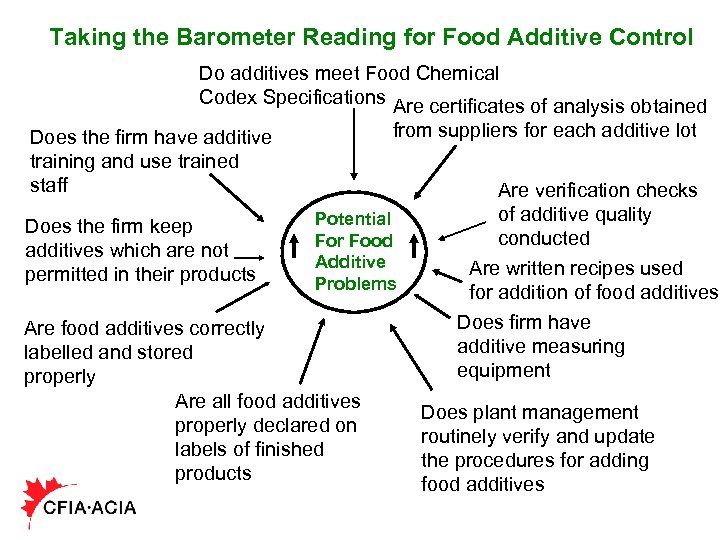 Taking the Barometer Reading for Food Additive Control Do additives meet Food Chemical Codex Specifications Are certificates of analysis obtained from suppliers for each additive lot Does the firm have additive training and use trained staff Does the firm keep additives which are not permitted in their products Potential For Food Additive Problems Are food additives correctly labelled and stored properly Are all food additives properly declared on labels of finished products Are verification checks of additive quality conducted Are written recipes used for addition of food additives Does firm have additive measuring equipment Does plant management routinely verify and update the procedures for adding food additives
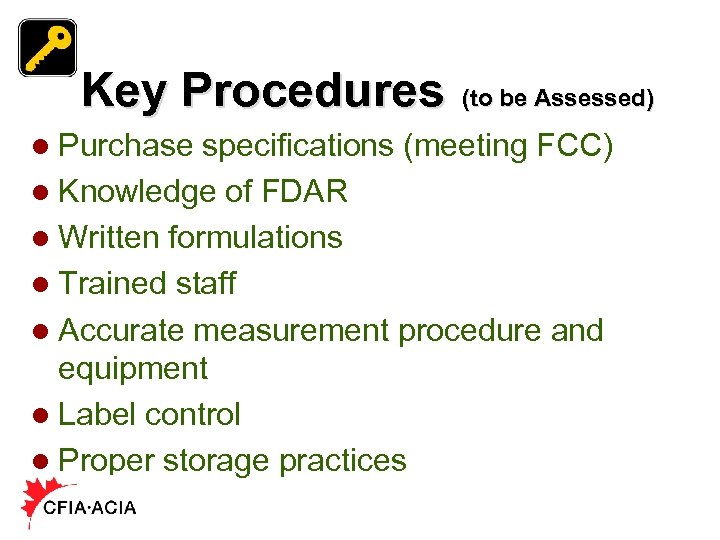 Key Procedures l Purchase (to be Assessed) specifications (meeting FCC) l Knowledge of FDAR l Written formulations l Trained staff l Accurate measurement procedure and equipment l Label control l Proper storage practices
 What about colours?
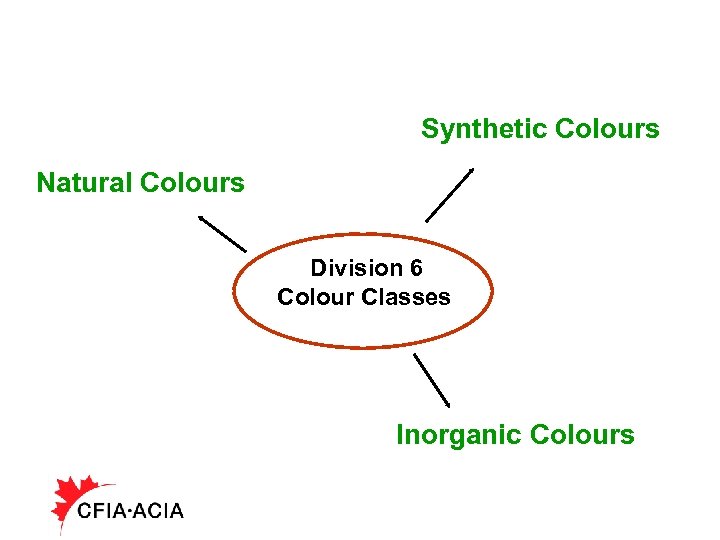 Synthetic Colours Natural Colours Division 6 Colour Classes Inorganic Colours
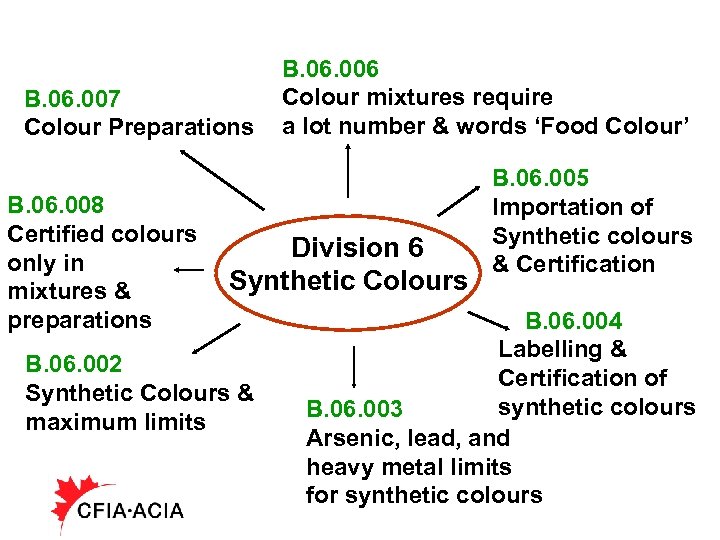 B. 06. 007 Colour Preparations B. 06. 008 Certified colours only in mixtures & preparations B. 06. 006 Colour mixtures require a lot number & words ‘Food Colour’ Division 6 Synthetic Colours B. 06. 002 Synthetic Colours & maximum limits B. 06. 005 Importation of Synthetic colours & Certification B. 06. 004 Labelling & Certification of synthetic colours B. 06. 003 Arsenic, lead, and heavy metal limits for synthetic colours
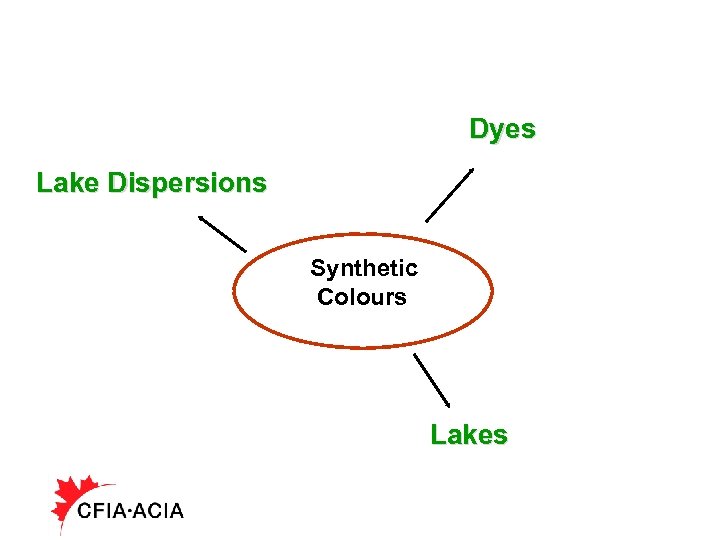 Dyes Lake Dispersions Synthetic Colours Lakes
 Food Colour Dyes l Food colour dyes are synthetic organic compounds l Each batch is to be certified and registered with HC l Eight primary colours are permitted in Canada l Dyes are usually the most economical form of food colouring
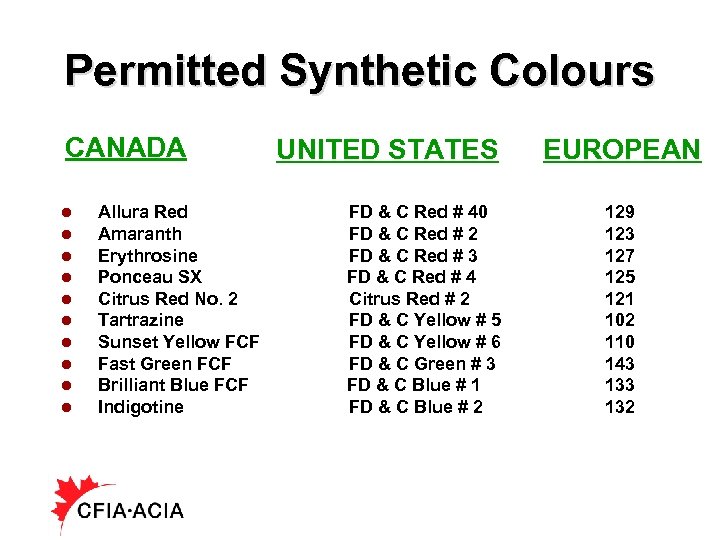 Permitted Synthetic Colours CANADA l l l l l Allura Red Amaranth Erythrosine Ponceau SX Citrus Red No. 2 Tartrazine Sunset Yellow FCF Fast Green FCF Brilliant Blue FCF Indigotine UNITED STATES FD & C Red # 40 FD & C Red # 2 FD & C Red # 3 FD & C Red # 4 Citrus Red # 2 FD & C Yellow # 5 FD & C Yellow # 6 FD & C Green # 3 FD & C Blue # 1 FD & C Blue # 2 EUROPEAN 129 123 127 125 121 102 110 143 132
 Food Colour Lakes l Made by precipitating soluble dyes onto an aluminum hydroxide substrate which is dried and ground to a very fine particle size l Lakes function as pigments and are effective colourants without being dissolved l Effective in colouring low moisture foods l Each batch is to be certified l Generally more stable to heat, light & ph change
 Lake Dispersions l Require high-shear mixing into a liquid for optimum tinting power and uniform colouring l Forms of lake dispersions: – sucrose based (sugar coated candy) – glycerine based (chewing gum & other confections) – oil based (cookie fillings & cream type confections) – propylene glycol (certain low-moisture applications) – water based (film coating of pharmaceutical tablets)
 Possible Synthetic Colour Defects l Precipitation (solubility exceeded, chem rx, low temp, p. H) l Dulling effects (excessive colour, high temp, product type) l Speckling and spotting (bakery & confectionary) l Fading – light, metals, micro-organisms, excessive heat, oxidizing and reducing agents, strong acids & alkalis, retorting with protein material l Poor shelf life - canned carbonated beverages
 Natural / Inorganic Colours (Exempt from Certification) l l l l Tumeric Titanium dioxide Charcoal black Annatto Beta Carotene Caramel Paprika Oleoresin l l l Carimine/Cochineal Red Cabbage Red Beet Red Fruit Juice Grape skin extract Passiflora Note: use limits are GMP levels
 Synthetic Colour Certification Colours are unique as they are the only additive requiring certification by HC l Manufacturers may apply for self certification status by submitting to HC: methodology, analytical data on three samples provided by HC l Colour shipments before entry must be certified and only manufacturers with status may apply l – required to submit 100 g sample of dye, certificate of analysis & analytical data If accepted, HC issues a Certification Number (CN) to the Cdn Importer to be presented to Customs l Certificates issued by FDA are also acceptable l Colour lakes are issued an Identification Number (IN) l
 Product Testing
 Challenges - Too Many l Thousands of permitted food additives listed in the Food and Drug Regulations l Just as many possible food additives not permitted in Canada l The number of different methods required is in the hundreds
 Division 16 - Groups l Although additives are divided by groups in Division 16, testing of each within each group are not all similar – Additives within each group may be mineral, carbohydrate, protein, lipid, hydrocarbons or combinations of them – Each type is tested differently
 Testing Equipment l Different additive types, require different types of instruments, or perhaps can not be instrumentally analyzed at all – HPLC, GC, Atomic Absorption, UV/Vis Spectrometer, Infrared Spectrometer, etc. – Not all labs have the instruments or apparatus needed
 Methodology l Although a wide variety of methods are published, some additives do not have specific methods l Labs require some expertise with the additive, or method before offering testing services
 Thankyou!