


 Скачать презентацию Focus on Literary Elements Survival Tools for Reading
9c45060cf22e1e6c74a0977e05d1a703.ppt
- Количество слайдов: 16
 Focus on Literary Elements Survival Tools for Reading
 What if…. l The three little pigs had been giraffes? l The three bears had gone to the house of Goldilocks? l Sleeping Beauty had not been able to fall asleep? l Cinderella’s stepsisters had been nice? l Hansel and Gretel had found a house made of spinach?
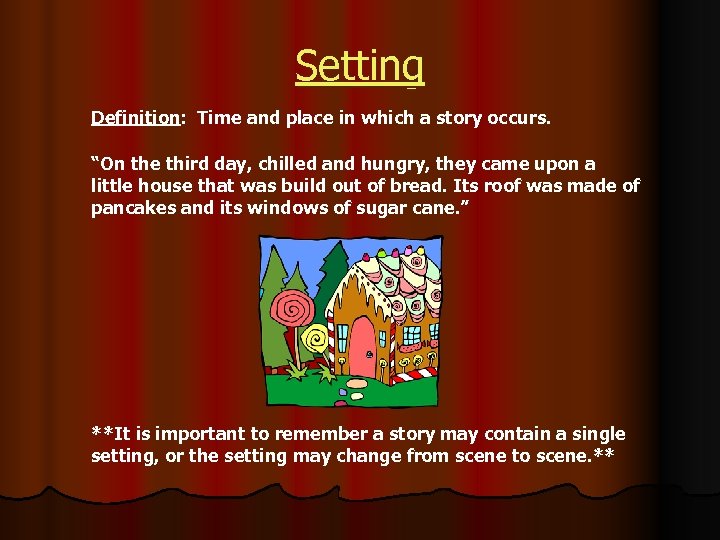 Setting Definition: Time and place in which a story occurs. “On the third day, chilled and hungry, they came upon a little house that was build out of bread. Its roof was made of pancakes and its windows of sugar cane. ” **It is important to remember a story may contain a single setting, or the setting may change from scene to scene. **
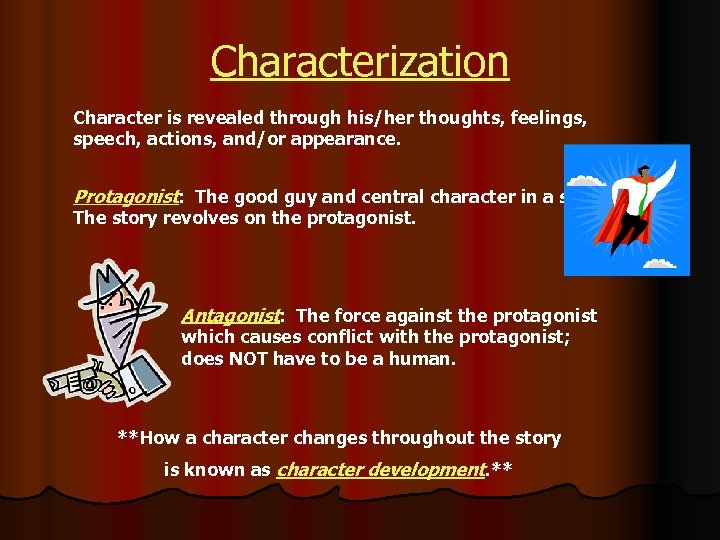 Characterization Character is revealed through his/her thoughts, feelings, speech, actions, and/or appearance. Protagonist: The good guy and central character in a story. The story revolves on the protagonist. Antagonist: The force against the protagonist which causes conflict with the protagonist; does NOT have to be a human. **How a character changes throughout the story is known as character development. **
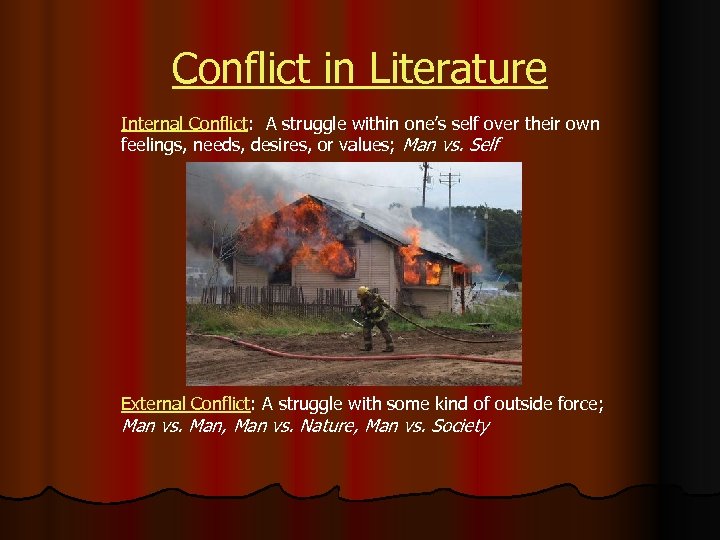 Conflict in Literature Internal Conflict: A struggle within one’s self over their own feelings, needs, desires, or values; Man vs. Self External Conflict: A struggle with some kind of outside force; Man vs. Man, Man vs. Nature, Man vs. Society
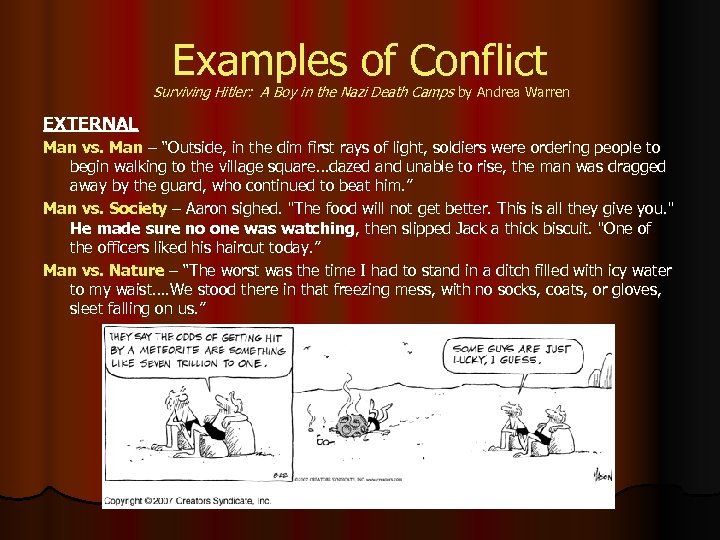 Examples of Conflict Surviving Hitler: A Boy in the Nazi Death Camps by Andrea Warren EXTERNAL Man vs. Man – “Outside, in the dim first rays of light, soldiers were ordering people to begin walking to the village square…dazed and unable to rise, the man was dragged away by the guard, who continued to beat him. ” Man vs. Society – Aaron sighed. "The food will not get better. This is all they give you. " He made sure no one was watching, then slipped Jack a thick biscuit. "One of the officers liked his haircut today. ” Man vs. Nature – “The worst was the time I had to stand in a ditch filled with icy water to my waist…. We stood there in that freezing mess, with no socks, coats, or gloves, sleet falling on us. ”
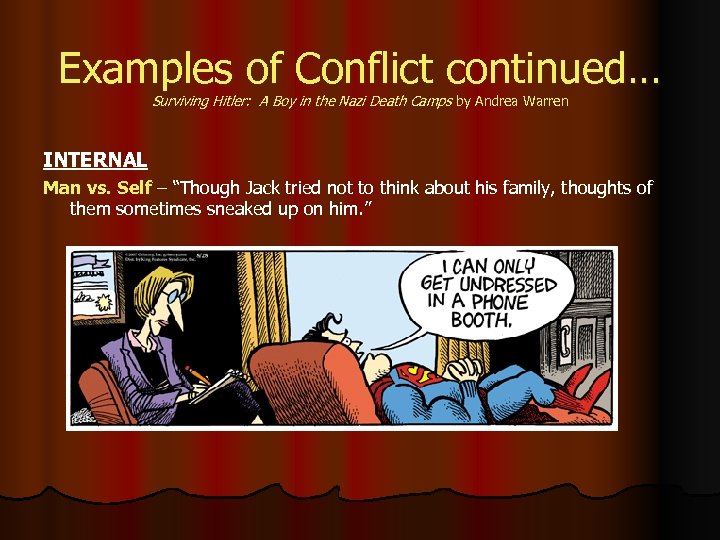 Examples of Conflict continued… Surviving Hitler: A Boy in the Nazi Death Camps by Andrea Warren INTERNAL Man vs. Self – “Though Jack tried not to think about his family, thoughts of them sometimes sneaked up on him. ”
 Mood The mood is the feeling or atmosphere of a piece. Examples: love, peace, doom, fear, pride, chaos It was a cold and cheerless evening. The fog seemed to hover the street, clutching the building, the streetlamps-the entire city-in a damp, icy grip. If one were to stand still, passers-by would emerge briefly from the gloom, only to disappear from view after taking just a few steps. These ghostly apparitions tormented James as he impatiently waited for his valet to return with his carriage. Dad said that we needed some gas, so Matt said, “I have gas!” and blew on his arm to make farty noises. He’s trying to et me to laugh but I won’t. Dad said to Matt, “Keep it down in the rear!” But Matt, of course, said, “The REAR!!? ? ” and started cackling and snorting with laughter even more. “They found the Burke girl this morning down in the creek. ” “No, ” he said, finding his voice. “Leslie wouldn’t drown. She could swim real good. ” “That old rope you kids been swinging on broke. ” His father went quietly and relentlessly on. “They think she musta hit her head on something when she fell. ”
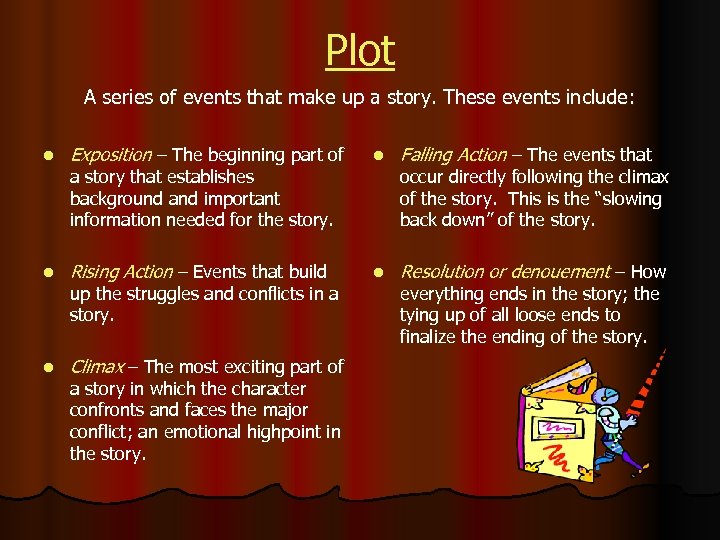 Plot A series of events that make up a story. These events include: l Exposition – The beginning part of l Falling Action – The events that l Rising Action – Events that build l Resolution or denouement – How l Climax – The most exciting part of a story that establishes background and important information needed for the story. up the struggles and conflicts in a story in which the character confronts and faces the major conflict; an emotional highpoint in the story. occur directly following the climax of the story. This is the “slowing back down” of the story. everything ends in the story; the tying up of all loose ends to finalize the ending of the story.
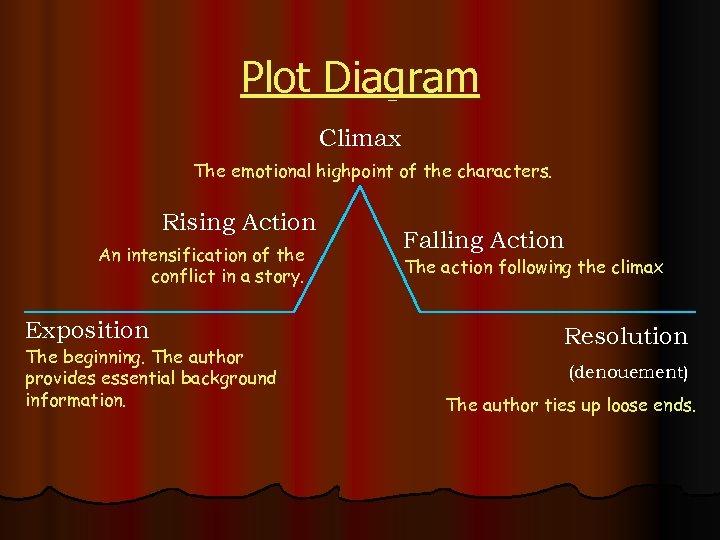 Plot Diagram Climax The emotional highpoint of the characters. Rising Action An intensification of the conflict in a story. Exposition The beginning. The author provides essential background information. Falling Action The action following the climax Resolution (denouement) The author ties up loose ends.
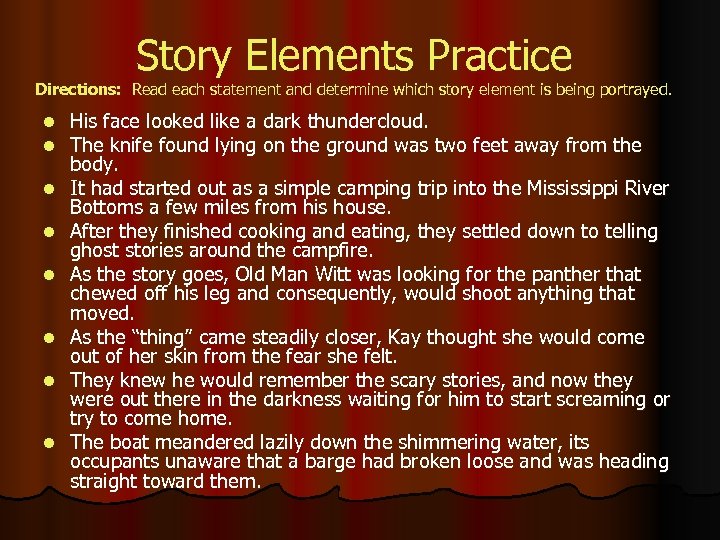 Story Elements Practice Directions: Read each statement and determine which story element is being portrayed. l l l l His face looked like a dark thundercloud. The knife found lying on the ground was two feet away from the body. It had started out as a simple camping trip into the Mississippi River Bottoms a few miles from his house. After they finished cooking and eating, they settled down to telling ghost stories around the campfire. As the story goes, Old Man Witt was looking for the panther that chewed off his leg and consequently, would shoot anything that moved. As the “thing” came steadily closer, Kay thought she would come out of her skin from the fear she felt. They knew he would remember the scary stories, and now they were out there in the darkness waiting for him to start screaming or try to come home. The boat meandered lazily down the shimmering water, its occupants unaware that a barge had broken loose and was heading straight toward them.
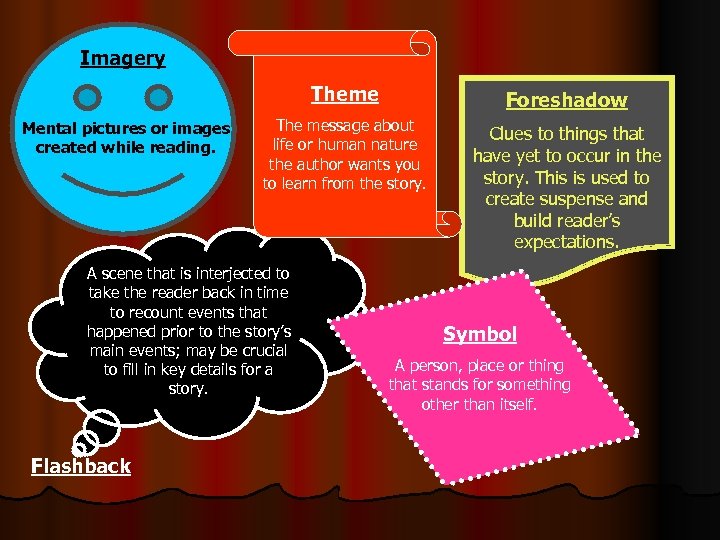 Imagery Theme Mental pictures or images created while reading. Foreshadow The message about life or human nature the author wants you to learn from the story. Clues to things that have yet to occur in the story. This is used to create suspense and build reader’s expectations. A scene that is interjected to take the reader back in time to recount events that happened prior to the story’s main events; may be crucial to fill in key details for a story. Flashback Symbol A person, place or thing that stands for something other than itself.
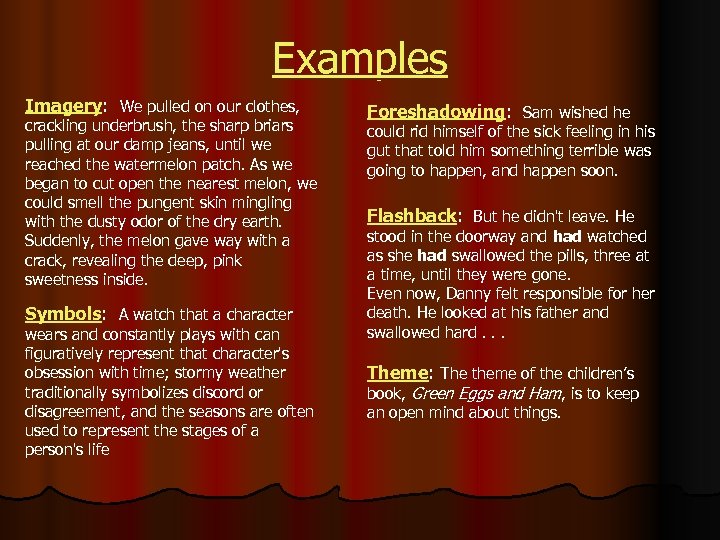 Examples Imagery: We pulled on our clothes, crackling underbrush, the sharp briars pulling at our damp jeans, until we reached the watermelon patch. As we began to cut open the nearest melon, we could smell the pungent skin mingling with the dusty odor of the dry earth. Suddenly, the melon gave way with a crack, revealing the deep, pink sweetness inside. Symbols: A watch that a character wears and constantly plays with can figuratively represent that character's obsession with time; stormy weather traditionally symbolizes discord or disagreement, and the seasons are often used to represent the stages of a person's life Foreshadowing: Sam wished he could rid himself of the sick feeling in his gut that told him something terrible was going to happen, and happen soon. Flashback: But he didn't leave. He stood in the doorway and had watched as she had swallowed the pills, three at a time, until they were gone. Even now, Danny felt responsible for her death. He looked at his father and swallowed hard. . . Theme: The theme of the children’s book, Green Eggs and Ham, is to keep an open mind about things.
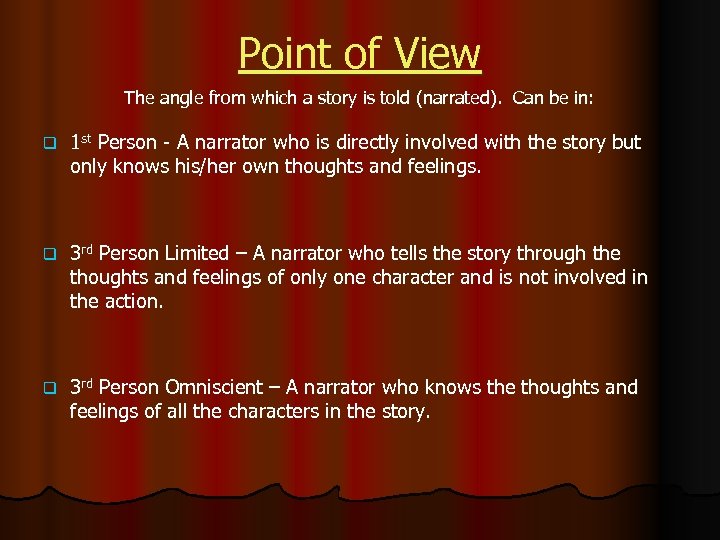 Point of View The angle from which a story is told (narrated). Can be in: q 1 st Person - A narrator who is directly involved with the story but only knows his/her own thoughts and feelings. q 3 rd Person Limited – A narrator who tells the story through the thoughts and feelings of only one character and is not involved in the action. q 3 rd Person Omniscient – A narrator who knows the thoughts and feelings of all the characters in the story.
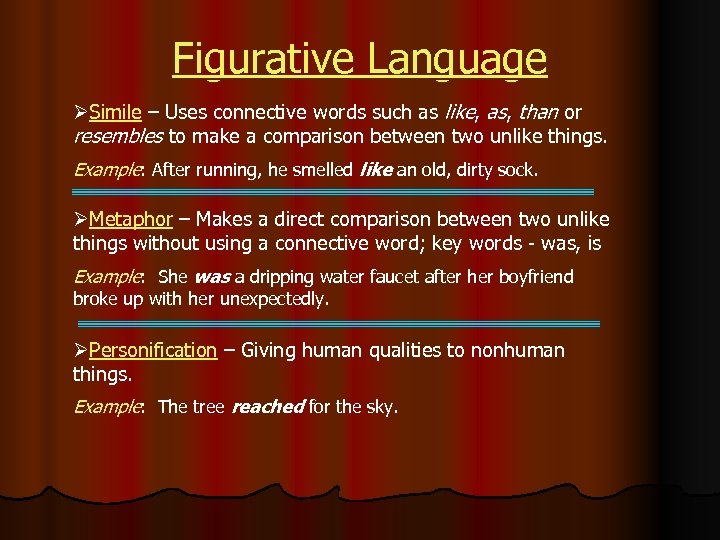 Figurative Language ØSimile – Uses connective words such as like, as, than or resembles to make a comparison between two unlike things. Example: After running, he smelled like an old, dirty sock. ØMetaphor – Makes a direct comparison between two unlike things without using a connective word; key words - was, is Example: She was a dripping water faucet after her boyfriend broke up with her unexpectedly. ØPersonification – Giving human qualities to nonhuman things. Example: The tree reached for the sky.
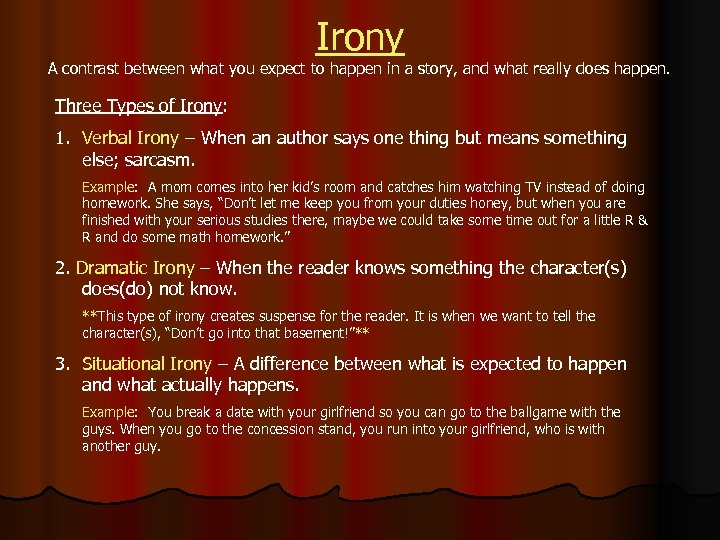 Irony A contrast between what you expect to happen in a story, and what really does happen. Three Types of Irony: 1. Verbal Irony – When an author says one thing but means something else; sarcasm. Example: A mom comes into her kid’s room and catches him watching TV instead of doing homework. She says, “Don’t let me keep you from your duties honey, but when you are finished with your serious studies there, maybe we could take some time out for a little R & R and do some math homework. ” 2. Dramatic Irony – When the reader knows something the character(s) does(do) not know. **This type of irony creates suspense for the reader. It is when we want to tell the character(s), “Don’t go into that basement!”** 3. Situational Irony – A difference between what is expected to happen and what actually happens. Example: You break a date with your girlfriend so you can go to the ballgame with the guys. When you go to the concession stand, you run into your girlfriend, who is with another guy.