


 Скачать презентацию Focus on Hypertension Relates to Chapter 33 Nursing
ebb5b1d0565ee79281a04deb14dd1217.ppt
- Количество слайдов: 65
 Focus on Hypertension (Relates to Chapter 33, “Nursing Management: Hypertension, ” in the textbook) Copyright © 2011, 2007 by Mosby, Inc. , an affiliate of Elsevier Inc.
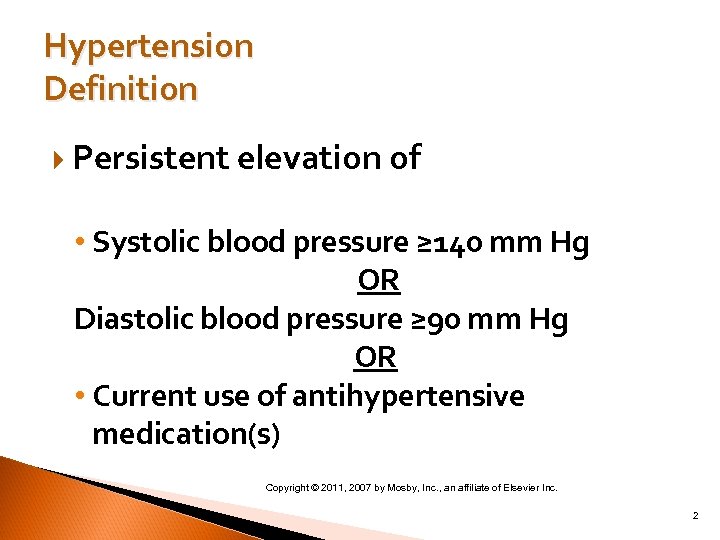 Hypertension Definition Persistent elevation of • Systolic blood pressure ≥ 140 mm Hg OR Diastolic blood pressure ≥ 90 mm Hg OR • Current use of antihypertensive medication(s) Copyright © 2011, 2007 by Mosby, Inc. , an affiliate of Elsevier Inc. 2
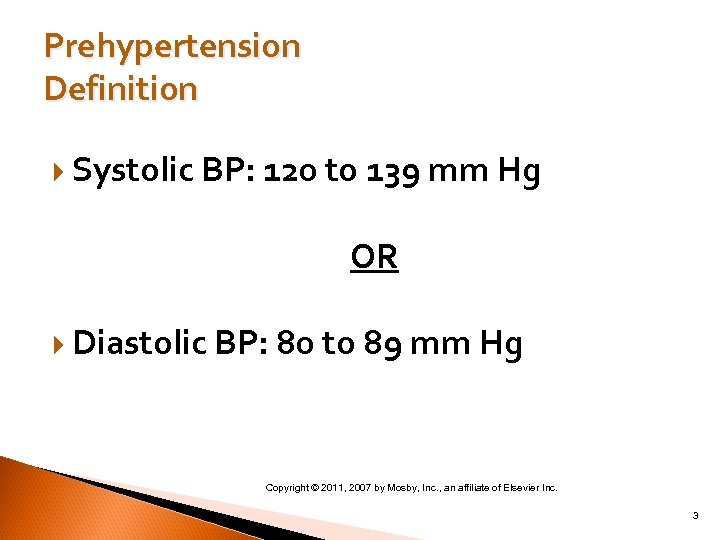 Prehypertension Definition Systolic BP: 120 to 139 mm Hg OR Diastolic BP: 80 to 89 mm Hg Copyright © 2011, 2007 by Mosby, Inc. , an affiliate of Elsevier Inc. 3
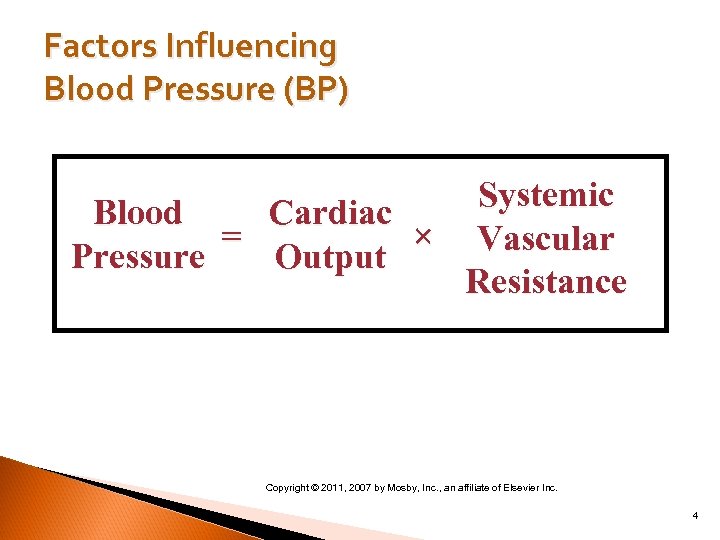 Factors Influencing Blood Pressure (BP) Systemic Blood Cardiac = × Vascular Pressure Output Resistance Copyright © 2011, 2007 by Mosby, Inc. , an affiliate of Elsevier Inc. 4
 Systemic Vascular Resistance SVR : is the force opposing the movement of blood within the blood vessels The radius of the small arteries and arterioles is the primary factor determining vascular resistance Copyright © 2011, 2007 by Mosby, Inc. , an affiliate of Elsevier Inc.
 Blood Pressure Classification Subtypes • Isolated systolic hypertension SBP > 140 mm Hg with DBP < 90 mm Hg • Pseudohypertension Copyright © 2011, 2007 by Mosby, Inc. , an affiliate of Elsevier Inc. 6
 Etiology of Hypertension Primary (essential or idiopathic) hypertension • Elevated BP without an identified cause • 90% to 95% of all cases Copyright © 2011, 2007 by Mosby, Inc. , an affiliate of Elsevier Inc. 7
 Etiology of Hypertension Primary (essential or idiopathic) hypertension • Contributing factors ↑ SNS activity ↑ Sodium-retaining hormones and vasoconstrictors Diabetes mellitus > Ideal body weight ↑ Sodium intake Excessive alcohol intake Copyright © 2011, 2007 by Mosby, Inc. , an affiliate of Elsevier Inc. 8
 Etiology of Hypertension Secondary hypertension • Elevated BP with a specific cause • 5% to 10% of adult cases Copyright © 2011, 2007 by Mosby, Inc. , an affiliate of Elsevier Inc. 9
 Etiology of Hypertension Secondary hypertension • Contributing factors Coarctation of aorta Renal disease Endocrine disorders Neurologic disorders Cirrhosis Sleep apnea Copyright © 2011, 2007 by Mosby, Inc. , an affiliate of Elsevier Inc. 10
 Risk Factors for Primary Hypertension Age Alcohol Cigarette smoking Diabetes mellitus Elevated serum lipids Excess dietary sodium Gender Copyright © 2011, 2007 by Mosby, Inc. , an affiliate of Elsevier Inc. 11
 Risk Factors for Primary Hypertension Family history Obesity Ethnicity Sedentary lifestyle Socioeconomic status Stress Copyright © 2011, 2007 by Mosby, Inc. , an affiliate of Elsevier Inc. 12
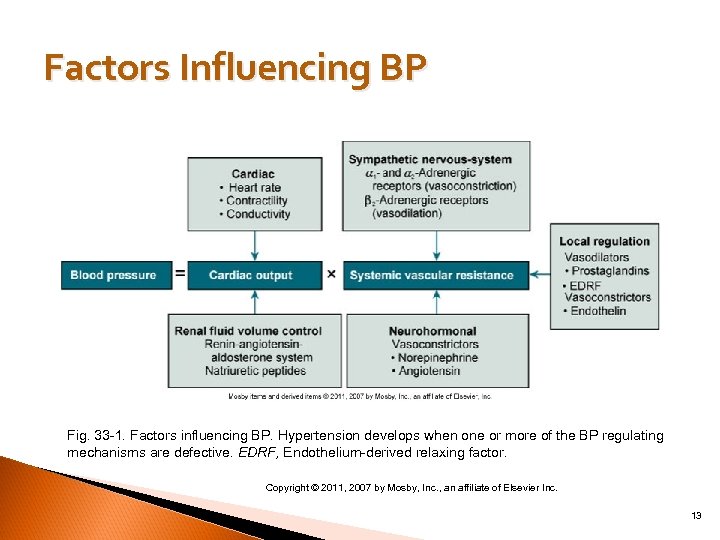 Factors Influencing BP Fig. 33 1. Factors influencing BP. Hypertension develops when one or more of the BP regulating mechanisms are defective. EDRF, Endothelium derived relaxing factor. Copyright © 2011, 2007 by Mosby, Inc. , an affiliate of Elsevier Inc. 13
 Pathophysiology of Primary Hypertension Heredity • Genetic factors have little contribution to BP levels in the general population. Copyright © 2011, 2007 by Mosby, Inc. , an affiliate of Elsevier Inc. 14
 Pathophysiology of Primary Hypertension Water and sodium retention • High sodium intake may activate a number of pressor mechanisms, resulting in water retention. Copyright © 2011, 2007 by Mosby, Inc. , an affiliate of Elsevier Inc. 15
 Pathophysiology of Primary Hypertension Water and sodium retention • Certain demographics are associated with “salt sensitivity. ” ex higher among the African Americans Obesity Increasing age African American ethnicity Copyright © 2011, 2007 by Mosby, Inc. , an affiliate of Elsevier Inc. 16
 Pathophysiology of Primary Hypertension Stress and increased SNS activity • Produce increased vasoconstriction • ↑ HR • ↑ Renin release Copyright © 2011, 2007 by Mosby, Inc. , an affiliate of Elsevier Inc. 17
 Pathophysiology of Primary Hypertension Insulin resistance and hyperinsulinemia • High insulin concentration stimulates SNS activity and impairs nitric oxide–mediated vasodilation Copyright © 2011, 2007 by Mosby, Inc. , an affiliate of Elsevier Inc. 18
 Pathophysiology of Primary Hypertension Altered renin-angiotensin mechanism: High plasma renin activity , Renin is a pote Endothelial cell dysfunction Copyright © 2011, 2007 by Mosby, Inc. , an affiliate of Elsevier Inc. 19
 Hypertension Clinical Manifestations Referred to as the “silent killer” because patients are frequently asymptomatic until target organ disease occurs Copyright © 2011, 2007 by Mosby, Inc. , an affiliate of Elsevier Inc. 20
 Hypertension Clinical Manifestations Symptoms are often secondary to target organ disease and can include • Fatigue, reduced activity tolerance • Dizziness • Palpitations, angina • Dyspnea Copyright © 2011, 2007 by Mosby, Inc. , an affiliate of Elsevier Inc. 21
 Hypertension Complications Target organ diseases occur most frequently in the • Heart • Brain • Peripheral vasculature • Kidney • Eyes Copyright © 2011, 2007 by Mosby, Inc. , an affiliate of Elsevier Inc. 22
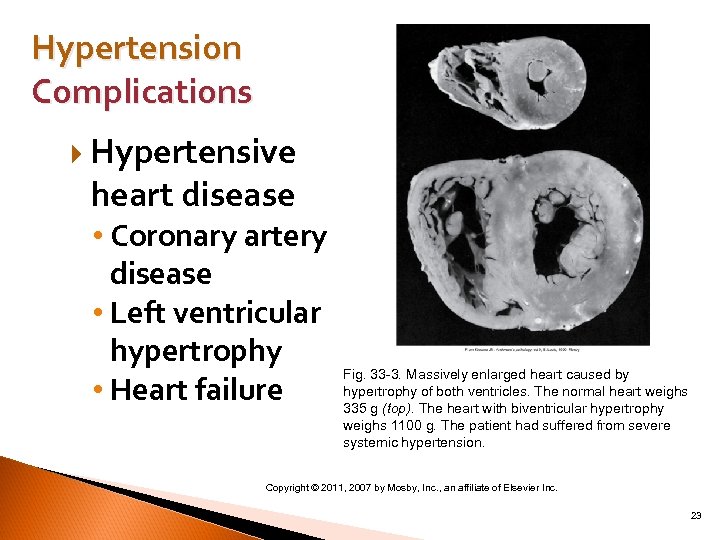 Hypertension Complications Hypertensive heart disease • Coronary artery disease • Left ventricular hypertrophy • Heart failure Fig. 33 3. Massively enlarged heart caused by hypertrophy of both ventricles. The normal heart weighs 335 g (top). The heart with biventricular hypertrophy weighs 1100 g. The patient had suffered from severe systemic hypertension. Fig. 33 -3: Top, normal heart; Bottom, left ventricular hypertrophy Copyright © 2011, 2007 by Mosby, Inc. , an affiliate of Elsevier Inc. 23
 Hypertension Complications Cerebrovascular disease • Stroke Peripheral vascular disease Nephrosclerosis Retinal damage Copyright © 2011, 2007 by Mosby, Inc. , an affiliate of Elsevier Inc. 24
 Hypertension Diagnostic Studies History and physical examination Bilateral BP measurement • Use arm with higher reading for subsequent measurements. • BP is highest in early morning, lowest at night. Copyright © 2011, 2007 by Mosby, Inc. , an affiliate of Elsevier Inc. 25
 Hypertension Office BP Measurement Use auscultatory method with a properly calibrated instrument. Patient should be seated quietly for 5 minutes in a chair, with feet on the floor and arms supported at heart level. Copyright © 2011, 2007 by Mosby, Inc. , an affiliate of Elsevier Inc. 26
 Hypertension Office BP Measurement Use appropriately sized cuff to ensure accurate readings. Obtain at least two measurements. Copyright © 2011, 2007 by Mosby, Inc. , an affiliate of Elsevier Inc. 27
 Hypertension Diagnostic Studies Urinalysis, creatinine clearance Serum electrolytes, glucose BUN and serum creatinine Serum lipid profile ECG Echocardiogram Copyright © 2011, 2007 by Mosby, Inc. , an affiliate of Elsevier Inc. 28
 Hypertension Diagnostic Studies “White coat” phenomenon may precipitate the need for ambulatory blood pressure monitoring (ABPM). • Noninvasive, fully automated system that measures BP at preset intervalsover 24 hour period Copyright © 2011, 2007 by Mosby, Inc. , an affiliate of Elsevier Inc. 29
 Hypertension Collaborative Care Overall goals • Control blood pressure • Reduce CVD risk factors Copyright © 2011, 2007 by Mosby, Inc. , an affiliate of Elsevier Inc. 30
 Hypertension Collaborative Care Strategies for adherence to regimens • Empathy increases patient trust, motivation, and adherence to therapy. • Consider patient’s cultural beliefs and individual attitudes when formulating treatment goals. Copyright © 2011, 2007 by Mosby, Inc. , an affiliate of Elsevier Inc. 31
 Hypertension Collaborative Care Lifestyle modifications • Weight reduction: Weight loss of 10 kg (22 lb) may decrease SBP by approx 5 to 20 mm Hg • DASH eating plan Copyright © 2011, 2007 by Mosby, Inc. , an affiliate of Elsevier Inc. 32
 Hypertension Collaborative Care Lifestyle modifications • Dietary sodium reduction: <2300 mg of sodium/day • Moderation of alcohol consumption: Men: No more than 2 drinks/day Women: No more than 1 drink/day Copyright © 2011, 2007 by Mosby, Inc. , an affiliate of Elsevier Inc. 33
 Hypertension Collaborative Care Lifestyle modifications • Physical activity: Regular physical (aerobic) activity, at least 30 minutes, most days of the week • Avoidance of tobacco products • Psychosocial risk factors Copyright © 2011, 2007 by Mosby, Inc. , an affiliate of Elsevier Inc. 34
 Hypertension Collaborative Care Drug therapy: Primary actions of drugs to treat hypertension • Reduce SVR • Reduce volume of circulating blood Copyright © 2011, 2007 by Mosby, Inc. , an affiliate of Elsevier Inc. 35
 Hypertension Collaborative Care Drug therapy: Classifications of drugs used to treat hypertension • Diuretics • Adrenergic inhibitors • Direct vasodilators • Angiotensin-converting enzyme inhibitors • Angiotensin II receptor blockers • Calcium channel blockers Copyright © 2011, 2007 by Mosby, Inc. , an affiliate of Elsevier Inc. 36
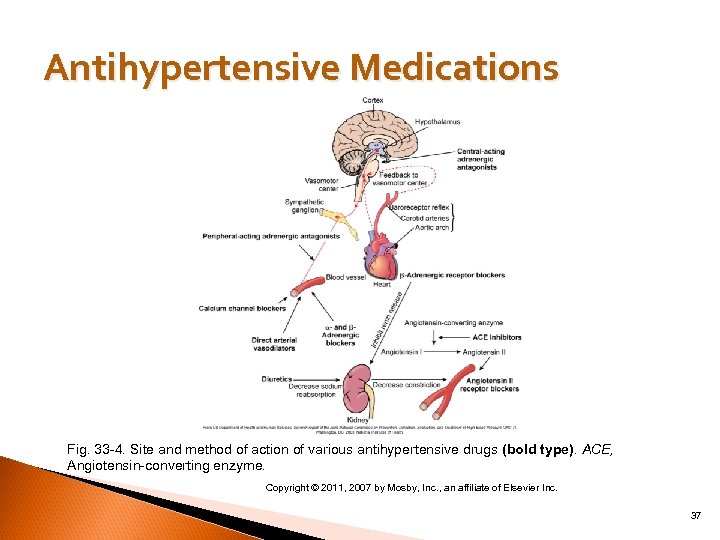 Antihypertensive Medications Fig. 33 4. Site and method of action of various antihypertensive drugs (bold type). ACE, Angiotensin converting enzyme. Copyright © 2011, 2007 by Mosby, Inc. , an affiliate of Elsevier Inc. 37
 Hypertension Collaborative Care Drug therapy and patient teaching • Identify, report, and minimize side effects. Orthostatic hypotension Sexual dysfunction Dry mouth Frequent urination Copyright © 2011, 2007 by Mosby, Inc. , an affiliate of Elsevier Inc. 38
 Drug categories diuretics thiazides : diuril, microzide loop diuretics : lasix, bumex, demadex potassium sparing diuretics : amiloride, triametrene Aldasterone receptor blockers : aldactone Copyright © 2011, 2007 by Mosby, Inc. , an affiliate of Elsevier Inc.
 Drug therapy cont. . Adrenergic inhibitors Centrally acting alpha adrenergic antagonists : clonadine, Tenex, Aldomet Peripherally acting alpha adrenergic antagonists : guanathidine, reserpine Alpha adrenergic blockers : cardura, minipress, hytrin, regitine Copyright © 2011, 2007 by Mosby, Inc. , an affiliate of Elsevier Inc.
 Drug Therapy Cont … Beta adrenergic blockers : atenalol, metoprolol, propranalol, timalol, esmolol, labetalol, * Coreg has alpha 1, beta 1 and beta 2 adrenergic blocking properties producing peripheral vasodilation, and decreased heart rate. Decrease CO, SVR, and BP Copyright © 2011, 2007 by Mosby, Inc. , an affiliate of Elsevier Inc.
 Drug Therapy Cont … Direct vasodilation : corlopam, hydralazine, minoxidil, nitroglycerine, nipride Ganglionic blockers : trimethaphan Copyright © 2011, 2007 by Mosby, Inc. , an affiliate of Elsevier Inc.
 Drug Therapy Cont … Angiotensin inhibitors Angiotensin converting enzyme inhibitor : benazepril, captopril, enalapril, lisinopril, Angiotensin ll receptor blockers : losatan, diovan, micardis, cozaar, Copyright © 2011, 2007 by Mosby, Inc. , an affiliate of Elsevier Inc.
 Drug Therapy Cont. . Renin Inhibitors Aliskiren – directly inhibit renin Calcium channel blockers : Amlodipine, cardizam , nicardipine, nifedipine, verapamil, Copyright © 2011, 2007 by Mosby, Inc. , an affiliate of Elsevier Inc.
 Hypertension Nursing Management Nursing Assessment • Subjective data Past health history Medications Functional health patterns • Objective data Target organ damage Copyright © 2011, 2007 by Mosby, Inc. , an affiliate of Elsevier Inc. 45
 Audience Response Question The nurse determines that the patient has stage 2 hypertension when the patient’s average blood pressure is: 1. 155/88 mm Hg. 2. 172/92 mm Hg. 3. 160/110 mm Hg. 4. 182/106 mm Hg. Copyright © 2011, 2007 by Mosby, Inc. , an affiliate of Elsevier Inc. 46
 Hypertension Nursing Management Nursing Diagnoses • Ineffective health maintenance • Anxiety • Sexual dysfunction • Ineffective self-health management • Disturbed body image • Ineffective tissue perfusion Copyright © 2011, 2007 by Mosby, Inc. , an affiliate of Elsevier Inc. 47
 Hypertension Nursing Management Collaborative problems • Potential complication: Adverse effects from antihypertensive therapy • Potential complication: Hypertensive crisis • Potential complication: Stroke • Potential complication: Myocardial infarction Copyright © 2011, 2007 by Mosby, Inc. , an affiliate of Elsevier Inc. 48
 Hypertension Nursing Management Planning: Patient will: • Achieve and maintain the individually determined goal BP. • Understand, accept, and implement therapeutic plan. • Experience minimal or no unpleasant side effects of therapy. • Be confident of ability to manage and cope with this condition. Copyright © 2011, 2007 by Mosby, Inc. , an affiliate of Elsevier Inc. 49
 Hypertension Nursing Management Nursing Implementation • Health Promotion Individual patient evaluation Blood pressure measurement Screening programs Cardiovascular risk factor modification Copyright © 2011, 2007 by Mosby, Inc. , an affiliate of Elsevier Inc. 50
 Audience Response Question While performing blood pressure screening at a health fair, the nurse counsels which of the following visitors as having the greatest risk for developing hypertension? 1. A 56 -year-old man whose father died at age 62 from a stroke 2. A 30 -year-old female advertising agent who is unmarried and lives alone 3. A 68 -year-old man who uses herbal remedies to treat his enlarged prostate gland 4. A 43 -year-old man who travels extensively with his job and exercises only on weekends Copyright © 2011, 2007 by Mosby, Inc. , an affiliate of Elsevier Inc. 51
 Hypertension Nursing Management Nursing Implementation • Ambulatory and home care • Patient and caregiver teaching includes: Nutritional therapy. Drug therapy. Physical activity. Home BP monitoring (if appropriate). Tobacco cessation (if applicable). Copyright © 2011, 2007 by Mosby, Inc. , an affiliate of Elsevier Inc. 52
 Hypertension Nursing Management Nursing Evaluation • Patient will: Achieve and maintain goal BP Understand, accept, and implement therapeutic plan Experience minimal or no unpleasant side effects of therapy Express confidence in ability to maintain plan Copyright © 2011, 2007 by Mosby, Inc. , an affiliate of Elsevier Inc. 53
 Audience Response Question A patient’s blood pressure has not responded consistently to prescribed medications for hypertension. The first cause of this lack of responsiveness the nurse should explore is: 1. Progressive target organ damage. 2. The possibility of drug interactions. 3. The patient not adhering to therapy. 4. The patient’s possible use of recreational drugs. Copyright © 2011, 2007 by Mosby, Inc. , an affiliate of Elsevier Inc. 54
 Hypertension in Older Persons Isolated systolic hypertension (ISH): Most common form of hypertensionin individuals age >50 Copyright © 2011, 2007 by Mosby, Inc. , an affiliate of Elsevier Inc. 55
 Hypertension in Older Persons Older adults are more likely to have “white coat” hypertension. Often a wide gap between the first Korotkoff sound and subsequent beats is called the auscultatory gap. Failure to inflate the cuff high enough may result in serious underestimation of the SBP. Copyright © 2011, 2007 by Mosby, Inc. , an affiliate of Elsevier Inc. 56
 Hypertension in Older Persons Older adults have varying degrees of impaired baroreceptor reflex mechanisms. Consequently, orthostatic hypotension occurs often, especially in patients with ISH. Copyright © 2011, 2007 by Mosby, Inc. , an affiliate of Elsevier Inc. 57
 Hypertensive Crisis Severe increase in BP (>220/140) Often occurs in patients with a history of HTN who have failed to comply with medications or who have been undermedicated Copyright © 2011, 2007 by Mosby, Inc. , an affiliate of Elsevier Inc. 58
 Hypertensive Crisis Clinical Manifestations Hypertensive emergency = Evidence of acute target organ damage: • Hypertensive encephalopathy, cerebral hemorrhage • Acute renal failure • Myocardial infarction • Heart failure with pulmonary edema Copyright © 2011, 2007 by Mosby, Inc. , an affiliate of Elsevier Inc. 59
 Hypertensive Crisis Nursing and Collaborative Management Hospitalization • IV drug therapy: Titrated to MAP • Monitor cardiac and renal function • Neurologic checks • Determine cause • Education to avoid future crises Copyright © 2011, 2007 by Mosby, Inc. , an affiliate of Elsevier Inc. 60
 Case Study Copyright © 2011, 2007 by Mosby, Inc. , an affiliate of Elsevier Inc. 61
 Case Study 4 o-year-old man attends a community health screening. He is alert, oriented, and coordinated in all movements. Copyright © 2011, 2007 by Mosby, Inc. , an affiliate of Elsevier Inc. 62
 Case Study Clinical findings: • 5 foot, 9 inches; weight: 230 lb • Blood pressure 182/104 • Pulse 90 • Respirations 24 • Temperature 97. 0°F Copyright © 2011, 2007 by Mosby, Inc. , an affiliate of Elsevier Inc. 63
 Case Study Subjective: He states: • “I’m a truck driver and I eat a lot of fast food. ” • “It’s hard to eat healthy on the road. ” • “This is my first checkup in a long time. ” • “I smoke a pack of cigarettes a day; this keeps me calm and helps me stay awake on the road. ” Copyright © 2011, 2007 by Mosby, Inc. , an affiliate of Elsevier Inc. 64
 Discussion Questions 1. What risk factors for hypertension does he have? 2. As part of the health screening, what should you do next? 3. In what areas should you provide teaching? Copyright © 2011, 2007 by Mosby, Inc. , an affiliate of Elsevier Inc. 65