


 Скачать презентацию Focus on Grammar 2 3 rd edition Part
bd37d2dc41e4afef9deb39aadbee1371.ppt
- Количество слайдов: 14
 Focus on Grammar 2 (3 rd edition) Part 3, Chapters 8 10 Simple Present Tense
 Unit 8 Yes and No Statements Unit 9 Yes/No Questions
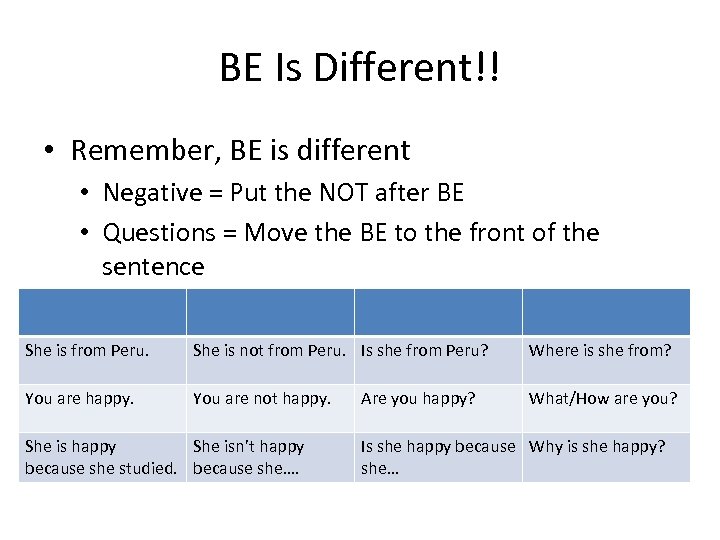 BE Is Different!! • Remember, BE is different • Negative = Put the NOT after BE • Questions = Move the BE to the front of the sentence She is from Peru. She is not from Peru. Is she from Peru? Where is she from? You are happy. You are not happy. What/How are you? She is happy She isn’t happy because she studied. because she…. Are you happy? Is she happy because Why is she happy? she…
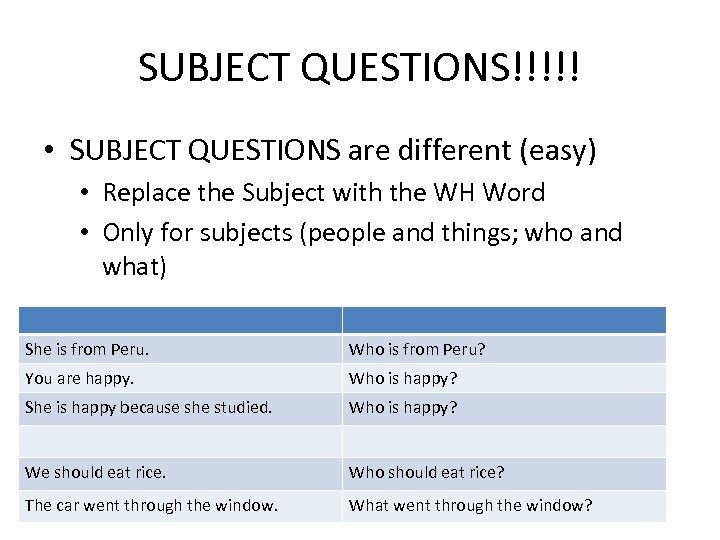 SUBJECT QUESTIONS!!!!! • SUBJECT QUESTIONS are different (easy) • Replace the Subject with the WH Word • Only for subjects (people and things; who and what) She is from Peru. Who is from Peru? You are happy. Who is happy? She is happy because she studied. Who is happy? We should eat rice. Who should eat rice? The car went through the window. What went through the window?
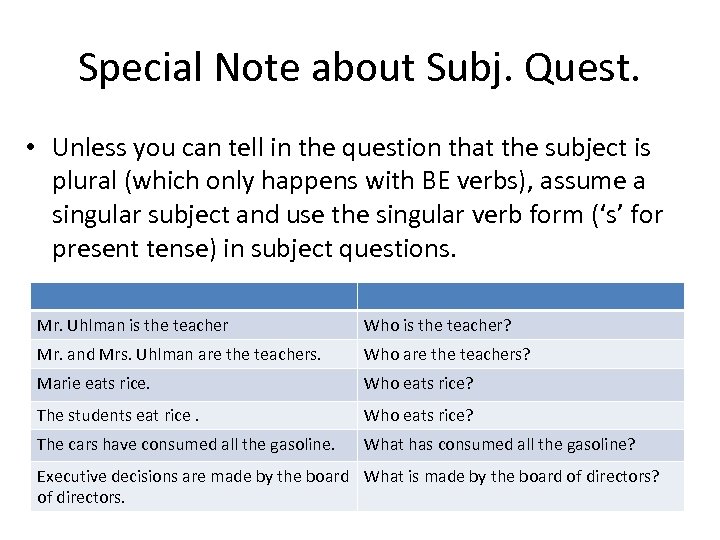 Special Note about Subj. Quest. • Unless you can tell in the question that the subject is plural (which only happens with BE verbs), assume a singular subject and use the singular verb form (‘s’ for present tense) in subject questions. Mr. Uhlman is the teacher Who is the teacher? Mr. and Mrs. Uhlman are the teachers. Who are the teachers? Marie eats rice. Who eats rice? The students eat rice. Who eats rice? The cars have consumed all the gasoline. What has consumed all the gasoline? Executive decisions are made by the board What is made by the board of directors? of directors.
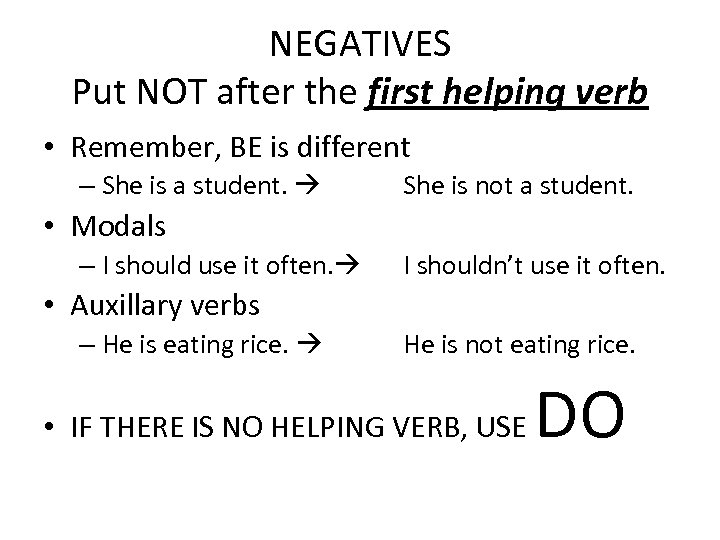 NEGATIVES Put NOT after the first helping verb • Remember, BE is different – She is a student. She is not a student. • Modals – I should use it often. I shouldn’t use it often. • Auxillary verbs – He is eating rice. He is not eating rice. • IF THERE IS NO HELPING VERB, USE DO
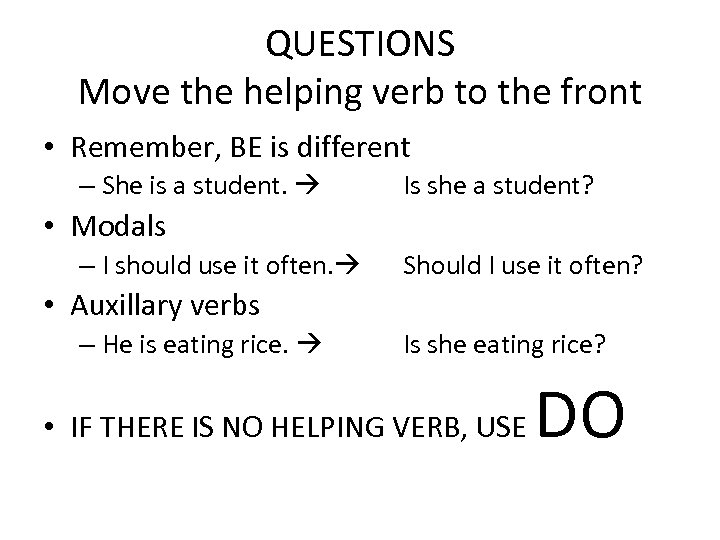 QUESTIONS Move the helping verb to the front • Remember, BE is different – She is a student. Is she a student? • Modals – I should use it often. Should I use it often? • Auxillary verbs – He is eating rice. Is she eating rice? • IF THERE IS NO HELPING VERB, USE DO
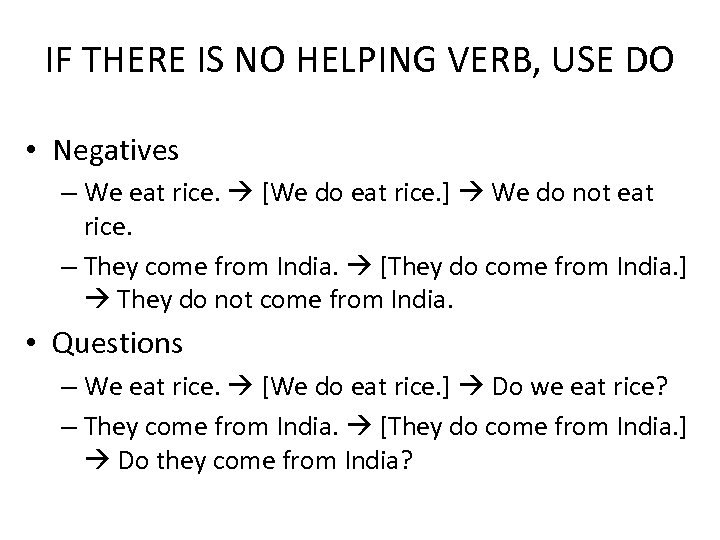 IF THERE IS NO HELPING VERB, USE DO • Negatives – We eat rice. [We do eat rice. ] We do not eat rice. – They come from India. [They do come from India. ] They do not come from India. • Questions – We eat rice. [We do eat rice. ] Do we eat rice? – They come from India. [They do come from India. ] Do they come from India?
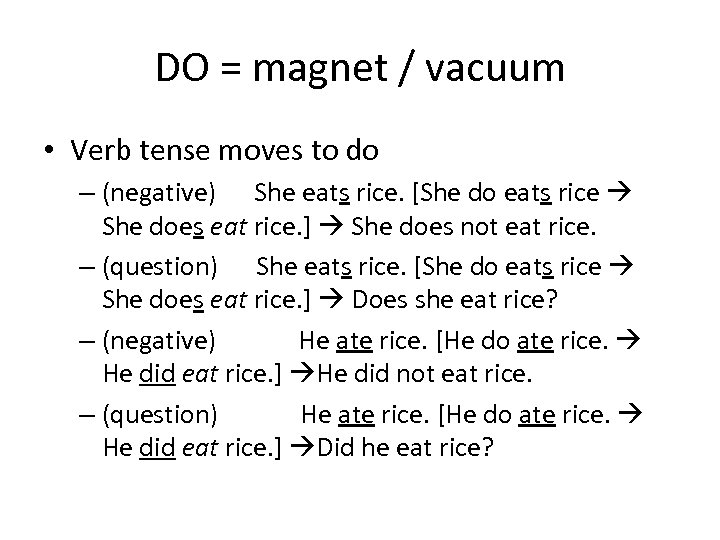 DO = magnet / vacuum • Verb tense moves to do – (negative) She eats rice. [She do eats rice She does eat rice. ] She does not eat rice. – (question) She eats rice. [She do eats rice She does eat rice. ] Does she eat rice? – (negative) He ate rice. [He do ate rice. He did eat rice. ] He did not eat rice. – (question) He ate rice. [He do ate rice. He did eat rice. ] Did he eat rice?
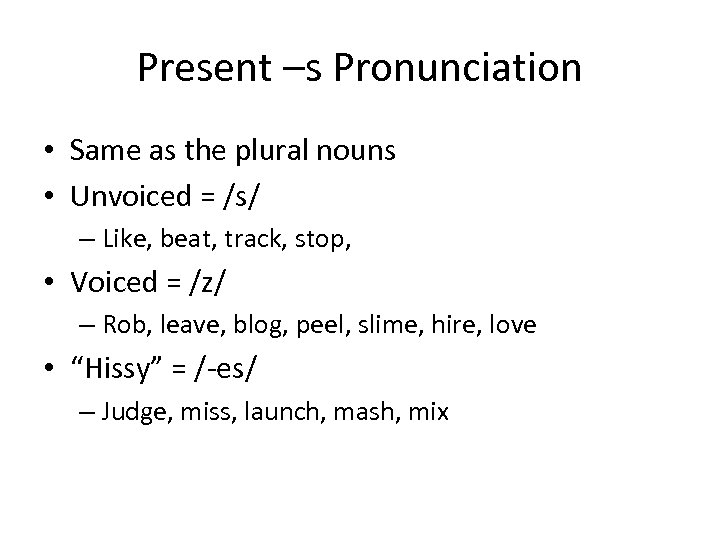 Present –s Pronunciation • Same as the plural nouns • Unvoiced = /s/ – Like, beat, track, stop, • Voiced = /z/ – Rob, leave, blog, peel, slime, hire, love • “Hissy” = /-es/ – Judge, miss, launch, mash, mix
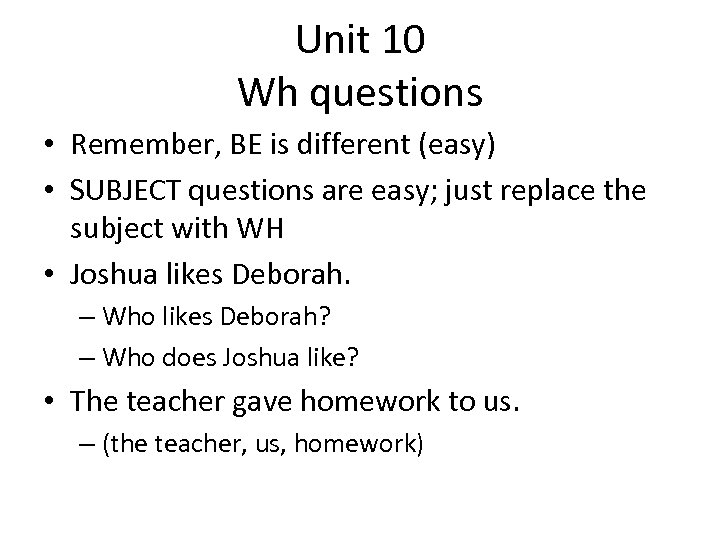 Unit 10 Wh questions • Remember, BE is different (easy) • SUBJECT questions are easy; just replace the subject with WH • Joshua likes Deborah. – Who likes Deborah? – Who does Joshua like? • The teacher gave homework to us. – (the teacher, us, homework)
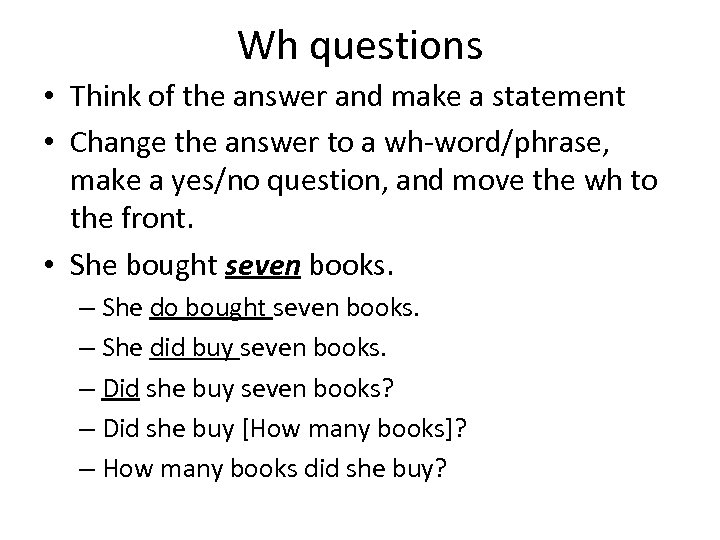 Wh questions • Think of the answer and make a statement • Change the answer to a wh-word/phrase, make a yes/no question, and move the wh to the front. • She bought seven books. – She do bought seven books. – She did buy seven books. – Did she buy seven books? – Did she buy [How many books]? – How many books did she buy?
 • • Who, whom = people What = things When = at 8: 55, in September, on June 15 th Where = in the house, on the street, etc. Why = because How = (explain a process) How much… how many… how often…
 Wh Questions with Prepositions (some verbs are followed by prepositions) • The police are looking for Razia – Are the police looking for Razia? – Are the police looking [for who? / for whom? ] • Who/Whom are the police looking for? (very much ok) • For whom are the police looking for? (formal) • • He gives money to the students. She pays $100 for her cell phone service. They talk about their favorite teachers. He went to the store. (use where, not to what)